4.1.1.2
Microscopy
The work of Antonie van Leeuwenhoek was pivotal in developments in understanding the microscopic world. The compound microcope he invented was used to observe detail in objects that were far too small for the human eye to see. Your task is to view slides under a light microscope at low and high resolution. You will draw a scientific sketch of your object at two different magnifications, add labels (if possible) and include a magnification scale. Learning outcomes
Maths skills required
Formulae
Use a light microscope to observe a range of different objects.
Calculate the size of the real object, the size of the image or the magnification.
magnification =
Record observations from a light microscope using simple diagrams. Use a scale bar to identify the size of images from microscope slides.
Express answers in standard x form (1 × 10 ).
size of image actual size of object
Use prefixes centi-, milli-, micro- and nano-.
Apparatus list light microscope
forceps
slides
adhesive tape
cover slips
everyday objects – string, newspaper, paper, hair, plastic, insect wings; and a selection of prepared plant and animal slides Safety notes If using glass slides and cover slips, be careful as these are delicate and can shatter. Common mistakes You might struggle drawing a scientific sketch. Draw the outlines of the structures you see. Don’t add any shading. You might forget your units. Remember: 1 m = 100 cm = 1000 mm = 1 000 000 µm = 1 000 000 000 nm
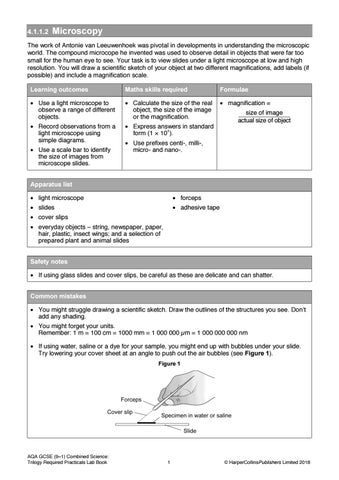
If using water, saline or a dye for your sample, you might end up with bubbles under your slide. Try lowering your cover sheet at an angle to push out the air bubbles (see Figure 1). Figure 1
AQA GCSE (9–1) Combined Science: Trilogy Required Practicals Lab Book
1
© HarperCollinsPublishers Limited 2018