3.5 Conservation of momentum Answer v1b = 3.5
m s–1
v2b = 0
v1a
1
2
1
0.9 kg
2.2 kg
Tip
v2a
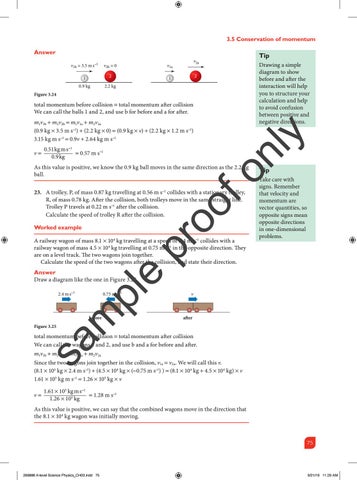
Drawing a simple diagram to show before and after the interaction will help you to structure your calculation and help to avoid confusion between positive and negative directions.
2
Figure 3.24
total momentum before collision = total momentum after collision We can call the balls 1 and 2, and use b for before and a for after.
0.51kg m s −1 = 0.57 m s–1 0.9 kg
nl
v=
y
m1v1b + m2v2b = m1v1a + m2v2a (0.9 kg × 3.5 m s–1) + (2.2 kg × 0) = (0.9 kg × v) + (2.2 kg × 1.2 m s–1) 3.15 kg m s–1 = 0.9v + 2.64 kg m s–1
Tip
fo
As this value is positive, we know the 0.9 kg ball moves in the same direction as the 2.2 kg ball.
oo
23. A trolley, P, of mass 0.87 kg travelling at 0.56 m s–1 collides with a stationary trolley, R, of mass 0.78 kg. After the collision, both trolleys move in the same straight line. Trolley P travels at 0.22 m s–1 after the collision. Calculate the speed of trolley R after the collision. Worked example
pr
A railway wagon of mass 8.1 × 10⁴ kg travelling at a speed of 2.4 m s–1 collides with a railway wagon of mass 4.5 × 10⁴ kg travelling at 0.75 m s–1 in the opposite direction. They are on a level track. The two wagons join together. Calculate the speed of the two wagons after the collision, and state their direction.
Take care with signs. Remember that velocity and momentum are vector quantities, so opposite signs mean opposite directions in one-dimensional problems.
0.75 m s–1
m
2.4 m s–1
pl
e
Answer Draw a diagram like the one in Figure 3.25.
before
Figure 3.25
v
after
sa
total momentum before collision = total momentum after collision We can call the wagons 1 and 2, and use b and a for before and after. m1v1b + m2v2b = m1v1a + m2v2a Since the two wagons join together in the collision, v1a = v2a. We will call this v. (8.1 × 104 kg × 2.4 m s–1) + (4.5 × 10⁴ kg × (−0.75 m s–1) ) = (8.1 × 10⁴ kg + 4.5 × 10⁴ kg) × v 1.61 × 10⁵ kg m s–1 = 1.26 × 10⁵ kg × v
v=
1.61 × 10⁵ kg m s −1 = 1.28 m s–1 1.26 × 10⁵ kg
As this value is positive, we can say that the combined wagons move in the direction that the 8.1 × 10⁴ kg wagon was initially moving.
75
266888 A-level Science Physics_CH03.indd 75
9/21/19 11:29 AM