Chemistry
Sub-atomic particles
Key words
Learning objectives: • use the definitions of atomic number and mass number • calculate the number of protons, neutrons and electrons in atoms • calculate the number of sub-atomic particles in isotopes and ions.
atomic mass isotope neutrons protons
Smoke detectors, archaeological dating and bone imaging all use isotopes. Some elements have more than one type of atom. These different types of atom have different numbers of neutrons and are called isotopes.
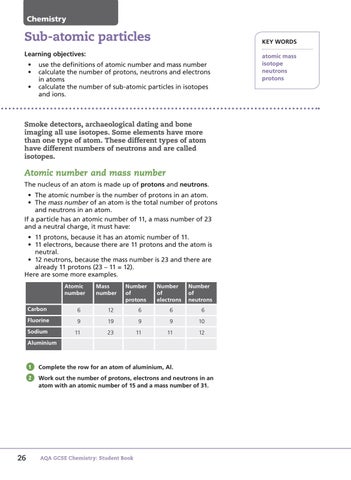
Atomic number and mass number The nucleus of an atom is made up of protons and neutrons. • The atomic number is the number of protons in an atom. • The mass number of an atom is the total number of protons and neutrons in an atom. If a particle has an atomic number of 11, a mass number of 23 and a neutral charge, it must have: • 11 protons, because it has an atomic number of 11. • 11 electrons, because there are 11 protons and the atom is neutral. • 12 neutrons, because the mass number is 23 and there are already 11 protons (23 – 11 = 12). Here are some more examples. Atomic number
Mass number
Number of protons
Number of electrons
Number of neutrons
Carbon
6
12
6
6
6
Fluorine
9
19
9
9
10
Sodium
11
23
11
11
12
Aluminium
26
1
Complete the row for an atom of aluminium, Al.
2
Work out the number of protons, electrons and neutrons in an atom with an atomic number of 15 and a mass number of 31.
AQA GCSE Chemistry: Student Book
16788_P012_055.indd 26
2/11/17 11:57 AM