Chemistry
End of chapter questions Getting started 1
Heavy fuel oil exits near the bottom of the fractionating column during fractional distillation of crude oil. Which temperature range is this? a 80–120 °C b 110–190 °C c 130–230 °C d 240–340 °C
1 Mark
2
Define the term hydrocarbon.
1 Mark
3
Identify the products for complete and incomplete combustion of an alkane.
2 Marks
4
Identify the alkene. a C 3H 8 b C 3H 6 c C 3H 8O d C 3H 6O2
5 6 7
16
Describe the structure of one strand of DNA.
2 Marks
17
Write a balanced equation for the incomplete combustion of heptane, C7H16.
2 Marks
18
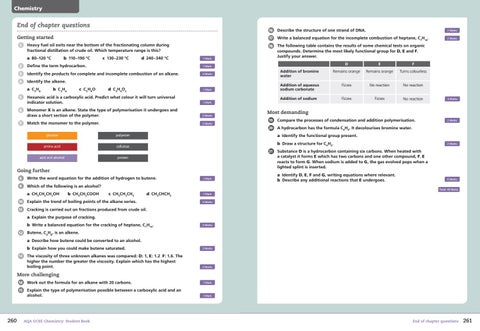
The following table contains the results of some chemical tests on organic compounds. Determine the most likely functional group for D, E and F. Justify your answer.
1 Mark
Hexanoic acid is a carboxylic acid. Predict what colour it will turn universal indicator solution.
1 Mark
Monomer X is an alkene. State the type of polymerisation it undergoes and draw a short section of the polymer.
2 Marks
Match the monomer to the polymer.
2 Marks
D
E
F
Addition of bromine water
Remains orange
Remains orange
Turns colourless
Addition of aqueous sodium carbonate
Fizzes
No reaction
No reaction
Addition of sodium
Fizzes
Fizzes
No reaction
Most demanding 19
Compare the processes of condensation and addition polymerisation.
20
A hydrocarbon has the formula C 4H6. It decolourises bromine water.
glucose
polyester
a Identify the functional group present.
amino acid
cellulose
b Draw a structure for C 4H6. 21
acid and alcohol
protein
Going further 8
Write the word equation for the addition of hydrogen to butene.
9
Which of the following is an alcohol? a CH3CH2CH2OH b CH3CH2COOH
1 Mark
4 Marks
2 Marks
2 Marks
Substance D is a hydrocarbon containing six carbons. When heated with a catalyst it forms E which has two carbons and one other compound, F. E reacts to form G. When sodium is added to G, the gas evolved pops when a lighted splint is inserted. a Identify D, E, F and G, writing equations where relevant. b Describe any additional reactions that E undergoes.
6 Marks
Total: 40 Marks
c CH3CH2CH3 d CH3CHCH2
10
Explain the trend of boiling points of the alkane series.
11
Cracking is carried out on fractions produced from crude oil.
1 Mark 2 Marks
a Explain the purpose of cracking. b Write a balanced equation for the cracking of heptane, C7H16 . 12
2 Marks
Butene, C 4H8, is an alkene. a Describe how butene could be converted to an alcohol.
13
b Explain how you could make butene saturated.
2 Marks
The viscosity of three unknown alkanes was compared: D: 1, E: 1.2 F: 1.6. The higher the number the greater the viscosity. Explain which has the highest boiling point.
2 Marks
More challenging
260
14
Work out the formula for an alkane with 20 carbons.
1 Mark
15
Explain the type of polymerisation possible between a carboxylic acid and an alcohol.
1 Mark
AQA GCSE Chemistry: Student Book
End of chapter questions
261