89532_P001_124.indd 8189532 Physics Sec 6 71 8 title.indd 1
8/18/16 1:10 PM 25/05/2016 09:16
Contents 3.6
Further mechanics and thermal physics 3.6.1 Periodic motion 3.6.2 Thermal physics
4 4 30
3.7
Fields and their consequences 3.7.1 Fields 3.7.2 Gravitational fields 3.7.3 Electric fields 3.7.4 Capacitance 3.7.5 Magnetic fields
48 48 48 61 68 79
3.8
Nuclear physics 3.8.1 Radioactivity
96 96
Examination preparation Practical and mathematical skills Using logarithms and logarithmic graphs Data and formulae Practice exam-style questions Answers
Glossary 150
Index
89532_P001_124.indd 3
125 127 130 132 145
158
19/08/16 3:02 PM
AQA Physics A-level Year 2
3.6 3.6.1
Further mechanics and thermal physics Periodic motion
3.6.1.1 Circular motion Angular measure You have previously studied the motion of objects which move in a straight line. You have used the equations of linear motion to describe such movement in terms of the time taken, t, the displacement, s, the acceleration, a, and the initial and final velocities, u and v. When an object moves in a circular path, the displacement may not be important, since after each full circle the displacement is zero. It is often more useful to consider the total angle, u, that has been turned through. The SI unit used to measure angles is the radian. The radian is defined using a circle. The angle in radians, u, at the centre of a circle is the ratio of the arc length, s, to the radius of the arc, r:
( in radians)
arcc length ar radi dius of arc dius ar
s r
Definition One radian is the angle subtended at the centre of a circle by an arc that is equal in length to the radius. Fig 1 When the arc length is equal to the radius, the angle u is equal to one radian.
r
s
θ
s θ= r
r
If we consider a full circle, the arc length is the circumference, s = 2pr, so: 2 r ( radians) 2 r In other words, there are 2p radians in a full circle. As there are 360° in a full circle, we can use this to convert radians to degrees (see Table 1). Table 1 Conversions between radians and degrees 4
89532_P001_124.indd 4
Radians
Degrees
2p
360°
1
360/2p = 57.3°
2p/360 = 0.017
1°
8/18/16 1:10 PM
Section 6
Example Calculate the angle in radians that the Earth spins through in one hour.
Answer The Earth turns through a full circle, 2p radians, in approximately 24 hours. So in one hour: 2 24 0.262 rad
Angle
Rotational frequency and angular speed The rate at which an object turns is often given in terms of the number of full circles that it completes in a given time. This is the rotational frequency, f, and it is typically quoted in revolutions per minute (rpm). For example, the spin speed of a washing machine may be 1000 rpm, whilst a DVD spins at between 500 and 1500 rpm. However, the SI unit of rotational frequency is the hertz, Hz, which is the number of revolutions per second. The angular speed, , is the angle turned through in one second, measured in radians per second, rad s21. Since there are 2p radians in one revolution, the angular speed is 2p the angular frequency, i.e. 5 2pf
Linear speed Even though an object is moving in a circle, we can still define its ‘linear’ speed as the distance covered per unit time. The speed, v, of an object moving in circular motion depends on the radius of the circle, r, as well as on the angular speed, . For example, think of two children on a roundabout (Fig 2). They both have the same angular speed, but the child further from the centre of the roundabout (the axis of rotation) travels further in the same time, and so has a greater linear speed.
B
Essential Notes All points on a rotating object have the same angular speed, but points at different distances from the axis of rotation have different linear speeds. Fig 2 Children A and B have the same angular speed, but their linear speeds are different.
A
5
89532_P001_124.indd 5
8/18/16 1:10 PM
AQA Physics A-level Year 2
The angular speed, , is linked to the linear speed, v, by the equation: v5r where r = radius (distance from rotational axis). This can be derived from the definition of the radian;
s r
Suppose that this is the angle turned through in a certain time, t, the angular speed, is:
=
s s but v, t rt t
ω
so
v r v5r
or
Example Find the rotational frequency and the angular velocity of the Earth due to its daily rotation about its axis. Find the linear speed of a point on the equator, given that the radius of the Earth is 6.4 106 m.
Answer Rotational frequency is the number of revolutions per second: f =
1 1.16 16 1 10 0 5 H Hzz 24 60 60
The angular speed is given by
ω 2 f 2 1.16 10 5 7.27 10 5 rads 1 The speed of a point on the equator is v r ω 6.4 106 m 7.2 27 7 1 10 0 5 rrad ad s 1 465 m s 1
Centripetal acceleration
Essential Notes Remember the difference between vector and scalar quantities. Velocity is a vector quantity; it has a direction as well as a magnitude. Speed is a scalar quantity; it is defined by a magnitude only.
Acceleration is defined as the rate of change of velocity; this could be a change in the magnitude (the speed) or a change in the direction of the velocity. Since an object moving in a circular path is continuously changing the direction of its motion, it must be continuously accelerating, even if its speed is constant. The acceleration of an object in circular motion is always directed towards the centre of the circle. It is known as centripetal acceleration. The magnitude of this centripetal acceleration depends on how quickly the direction is changing. In a short time, t, the object moves through an angle u and the velocity changes from v1 to v2 (see Fig 4). The difference in velocity, v, can be found by subtracting v1 from v2. From the triangle in Fig 4, v 5 v u.
6
89532_P001_124.indd 6
8/18/16 1:10 PM
Section 6
Fig 3 When a car goes round a roundabout or a corner, it is accelerating, even if it maintains a constant speed.
velocity
acceleration
Notes Objects that are travelling on a circular path may also change their speed: this results in an angular acceleration. However, work at A-level is limited to uniform circular motion, that is motion at constant speed.
The acceleration of an object moving on a circular path depends upon its speed, v, and the radius of curvature of the path. Acceleration is the rate of change of velocity. The change of velocity, Δv, in time Δt, for an object moving in a circle is vΔu, see Fig 4. So acceleration equals a rω 2
v2 r
Notes The derivation of the expression for centripetal acceleration is given here for information. It will not be required in an exam.
Fig 4 Deriving an expression for centripetal acceleration
v2
–v1 r
∆θ
v2
v1
∆θ r
For small angles θ radians ≈ sin θ , so ∆θ ≈ ∆v/v NB. The magnitude of v1 = v2 = v
Definition The centripetal acceleration of an object moving in a circle is given by a = rw 2 = v 2/r. 7
89532_P001_124.indd 7
8/18/16 1:10 PM
AQA Physics A-level Year 2
Essential Notes Note that the force is centripetal (towards the centre), NOT ‘centrifugal’(away from the centre). People talk about centrifugal force ‘throwing’ them off their feet as a bus takes a sharp corner, or being responsible for spin-drying clothes. Using centrifugal force to explain these phenomena is a good way to make your teacher apoplectic. The person on the bus, or the water drops in a drier, are simply obeying Newton’s First Law; i.e. continuing to move in a straight line, until acted on by a force.
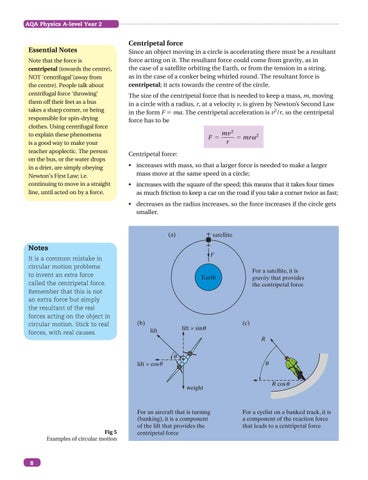
Centripetal force Since an object moving in a circle is accelerating there must be a resultant force acting on it. The resultant force could come from gravity, as in the case of a satellite orbiting the Earth, or from the tension in a string, as in the case of a conker being whirled round. The resultant force is centripetal; it acts towards the centre of the circle. The size of the centripetal force that is needed to keep a mass, m, moving in a circle with a radius, r, at a velocity v, is given by Newton’s Second Law in the form F 5 ma. The centripetal acceleration is v2/r, so the centripetal force has to be F
mv 2 mr ω 2 r
Centripetal force: • increases with mass, so that a larger force is needed to make a larger mass move at the same speed in a circle; • increases with the square of the speed; this means that it takes four times as much friction to keep a car on the road if you take a corner twice as fast; • decreases as the radius increases, so the force increases if the circle gets smaller. (a)
satellite
Notes It is a common mistake in circular motion problems to invent an extra force called the centripetal force. Remember that this is not an extra force but simply the resultant of the real forces acting on the object in circular motion. Stick to real forces, with real causes.
F
(b)
lift × sinθ
lift
(c) R
lift × cos θ
θ
θ
weight
Fig 5 Examples of circular motion
For a satellite, it is gravity that provides the centripetal force
Earth
For an aircraft that is turning (banking), it is a component of the lift that provides the centripetal force
R cos θ
For a cyclist on a banked track, it is a component of the reaction force that leads to a centripetal force
8
89532_P001_124.indd 8
8/18/16 1:10 PM
Section 6
When an object moves on a circular path, the force (and therefore the acceleration) are always at right angles to the velocity. In fact the force is always at right angles to the velocity. Because there is no motion in the direction of the force, there is no work done by the force. A satellite that is well above the Earth’s atmosphere, like the Moon, can keep orbiting without any energy transfer taking place. Fig 6 Force and velocity for circular motion
velocity force
The force and velocity are always at right angles to each other.
Example A conical pendulum is a mass on a string that is whirled round in a horizontal circle.
l
r
mass, m Fig 7
ω
ω
(a) Copy Fig 7 and mark in the forces that are acting on the mass. (b) Identify the force or forces that are causing circular motion. (c) If a 2 kg mass suspended on a 1 m long string is whirled around in a circle of radius 0.25 m, how fast will it be travelling? (d) If the string broke, which direction would the mass move in at first?
9
89532_P001_124.indd 9
8/18/16 1:10 PM
AQA Physics A-level Year 2
Answer (a) The forces that act on the mass are its weight, W 5 mg, and the tension, T, in the string. θ
T cos θ
T
T sin θ
mg
Fig 8
(b) Horizontally there is a resultant force of T sin u that acts towards the centre of the circle. This is the force that causes circular motion. (c) The resultant force is T sin u 5 mv 2/r. We can find the tension by considering the vertical forces. Since the mass is moving in a horizontal circle, the vertical forces must balance: T cos u 5 mg. We can find the angle from si sin
r 0.25 0.25, so si sin n 1 0.25 14.5 l 1
Taking g 5 9.81 N kg21, T
2 kg 9.81N kg 1 = 20.3 N coss 14.5°
This gives v2
rT si sin n 0.2 25 5 m 20 20.3 N sin 14.5° 0.635 m 2 s 2 m 2 kg
The velocity is v 0.797 m s 1 (d) The mass would fly off at a tangent to the circle.
Example Jon bought nylon sewing thread, with an advertised breaking stress of 70 MPa. He wanted to test this but only had one mass: 1 kg. He tied the mass to the thread and whirled it around in a horizontal circle, gradually increasing the speed of rotation until the thread broke. (a) Explain how Jon’s method could lead to an estimate of breaking stress. (b) Estimate how fast the mass was moving when the thread broke. (c) Apart from timing the rotations, can you suggest a way for Jon to get an estimate of the velocity of the mass, when the thread breaks? 10
89532_P001_124.indd 10
8/18/16 1:10 PM
Section 6
Answer (a) The tension in the thread provides the centripetal force = mr2. The tension will increase (proportional to 2) as the mass orbits faster. The force required to break the thread is: = 70 106 cross-sectional area. We need to estimate the radius of the thread, say 0.5 mm. The breaking force = πr 2 70 106 = 55 N. This would occur at = √ (F / mR ), where R is the radius of the circle, say 1 m. (b) This gives = √ (55 / 1 1)= 7.4 rads−1 = 1.2 rev per second or 70 rpm. The mass would be travelling at a linear speed of v = r = 1 7.4 m s−1 = 7.4 m s−1. (c) Jon could estimate the speed of the mass at the instant the thread broke, by treating it as a projectile and measuring the range. s = ut (horizontally) and find t from the vertical distance fallen, s = ½ at 2.
3.6.1.2 Simple harmonic motion (SHM) A car bouncing on its suspension, a child on a playground swing and the vibrations of a water molecule are all examples of oscillations. An oscillation is a repetitive, to-and-fro motion about a fixed position. This sort of motion is caused by a resultant force that is always directed to the same point. This resultant force, which changes direction as the object oscillates, is referred to as a restoring force.
(b)
(a)
Fig 9 The restoring force on a mass suspended from a spring
(c)
T T T
m
F
mg m
m
F
mg T > mg resultant force, F, is upwards
mg
T = mg no resultant force
T < mg resultant force, F, downwards
Simple harmonic motion, or SHM, is a special case of oscillatory motion. If the magnitude of the restoring force on a body is proportional to its distance from the equilibrium position, we say that it moves with simple 11
89532_P001_124.indd 11
8/18/16 1:10 PM
AQA Physics A-level Year 2
harmonic motion. Assuming that the mass of the object doesn’t change, the acceleration will follow the same pattern.
Essential Notes
Definition
The negative sign arises because the acceleration and the displacement are always in opposite directions, so that a positive displacement causes a negative acceleration, and vice versa.
The acceleration, a, of an object moving with simple harmonic motion, is always proportional to its displacement, x, from a fixed point. The acceleration is always directed towards that fixed point. a~2x
acceleration, a/m s–2 Fig 10 Acceleration against displacement for an object moving with SHM
a∝–x –x/m
displacement, x/m
–a/m s−2
Fig 11 Acceleration (a) and displacement (x) for a pendulum
Essential Notes It can be difficult to realise that the pendulum has its greatest acceleration when it isn’t moving at all. Conversely, the pendulum has no acceleration when it is moving fastest.
–a
a x=0 a=0
–x
x
12
89532_P001_124.indd 12
8/18/16 1:10 PM
Section 6
A swinging pendulum is an example of a body moving with SHM. The restoring force, and the acceleration, is greatest when the pendulum is furthest from equilibrium, when the displacement is equal to its maximum value or amplitude, A. The acceleration drops to zero when the displacement of the pendulum is zero.
Definitions Displacement is the distance from a fixed point in a certain direction. It is a vector quantity. Amplitude is the magnitude of the maximum displacement. It is a scalar quantity.
Period, frequency and acceleration Oscillations are often referred to as periodic motion. The vibrations of a guitar string or the motion of a piston in a car engine are examples of periodic motion. In each case a pattern of motion is repeated over and over again. The time taken to complete one full cycle of motion is called the period, T.
displacement/m
Fig 12 Periodic motion
time/s
period, T
The number of oscillations that an object completes in one second is called the frequency of the oscillation. Frequency is measured in hertz, Hz. Frequency is related to period by the expression: freque freq equency nc
1 period ri riod
f
1 T
High-frequency oscillations involve high accelerations, since the body has to speed up and slow down many times per second. For simple harmonic oscillations the acceleration is linked to the frequency and the displacement by the equation a ( 2 f )2 x 13
89532_P001_124.indd 13
8/18/16 1:11 PM
AQA Physics A-level Year 2
Notes
Example
Remember from circular motion that the angular speed is given by î ś = 2Ď€f.
The piston in a car engine moves with a motion that is approximately simple harmonic. One cycle of motion takes 0.017 s and the piston moves through a total distance of 100 mm. Calculate the maximum acceleration of the piston.
Answer The piston’s frequency is: f
1 58.8 Hz 0.017 s
The period of the motion is 0.017 s. The piston moves through a maximum displacement of 100 mm. This will be equal to 50 mm (half the total movement of the piston), so a 2 x ( 2 f f )2 x ( 2 58.8)2 0.05 6800 ms 2 (to o 2 s.f.) in a direction opposite to that of the displacement.
Displacement and time Bodies that move with simple harmonic motion have a displacement that varies sinusoidally with time. Fig 13 Displacement against time for a simple harmonic oscillator
x
displacement/m
A
0
time/s A
–A
Essential Notes To convert degrees to radians you need to remember that there are 2p radians in a circle. So 2p radians 5 360°. From this you can work out that 1 radian 5 360/2p 5 57.3°. See Table 1, page 1.
–x
The equation that describes the graph in Fig 13 is x Acos( A t ) = A cos( os ( 2 ft ft ) where x is the displacement, A is the amplitude, f is the frequency and t is the time. The term 2pft has units of radians (see page 1).
14
89532_P001_124.indd 14
8/18/16 1:11 PM
Section 6
Example (a) Plot a displacement–time graph to show three cycles of an oscillation that has an amplitude of 6 mm and a frequency of 5000 Hz. (b) Calculate the displacement after 0.24 ms.
Answer (a) You need to use the equation x Acos( A t ) = A cos( os ( 2 ft ft ) x 0.006 cos (10 000 t ) Now you need to choose suitable values of t to calculate values of x for plotting. Values of t 5 1, 2, 3, etc. are too large and represent points which are thousands of oscillations apart. The frequency of the oscillation is 5000 Hz, so the oscillation has a period of 1/f 5 1/5000 5 0.0002 s or 0.2 ms. The oscillation will have a maximum displacement at 0, 0.2, 0.4, 0.6 ms etc. The oscillation will have a minimum (negative) displacement at 0.1, 0.3, 0.5 ms etc. The oscillation will have zero displacement in between these points, at 0.05, 0.15, 0.25, 0.35 ms, etc.
x/mm
+6
0.1
0.2
0.3
0.4
0.5
0.6
t/ms
–6
Fig 14
Notes
(b) x 5 0.006 cos (10 000 pt)
Remember to set your calculator to radians when you calculate this formula.
x 5 0.006 cos (10 000 p 0.24 1023) x 5 1.9 1023 m 5 1.9 mm
Velocity and time The velocity of a particle that is moving with SHM can be found from the gradient of the displacement vs time graph.
Essential Notes Remember (from AS/A-Level Year 1, Section 4) that velocity 5 x/t.
15
89532_P001_124.indd 15
8/18/16 1:11 PM
AQA Physics A-level Year 2
gradient = 0 gradient is maximum (negative)
gradient = 0
time/s
gradient is maximum (positive) gradient = 0
velocity/m s–1
displacement/m
Fig 15 Displacement and velocity vs time for a simple harmonic oscillator
time/s
The velocity of a simple harmonic oscillator reaches a maximum when the displacement is zero. The velocity is zero when the displacement is at a maximum. Think of a pendulum where the velocity is zero for an instant at each end of the pendulum’s swing, and the velocity of the pendulum bob is at its greatest when it swings through the equilibrium position.
Fig 16 Velocity and displacement for a pendulum bob
x=–A v=0
x=0 maximum v = ±2πfA
x=+A v=0
16
89532_P001_124.indd 16
8/18/16 1:11 PM
Section 6
This pattern of changing velocity can be linked to the displacement by the equation
v Âą 2 ff
A2 x 2
so that the maximum velocity, vmax occurs at x = 0: vmax 5  î ś A = 2pfA
Example A mass suspended from a spring oscillates with a period of 1.5 s. The amplitude of the oscillations is 5 cm. Find (a) the maximum velocity (b) the minimum velocity (c) the velocity when the displacement is half the amplitude (d) the displacement when the velocity is half of its maximum value.
Answer The period of the oscillation is 1.5 s, so the frequency is 1 f 0.67 67 H Hzz 1.5 (a) The maximum velocity occurs when there is no displacement, x 5 0:
v 2 f
A 2 x 2 2 f A 2 0.67 0.05 0.21 m s 1
(b) The minimum velocity is when x 5 A, and then v 5 0 m s21. (c) The velocity at x 5 0.025 m is v 2 0.67 0.052 0.0252 0 0.1 18 ms 1 (d) When the velocity is
1 2
v 2 4 2 f 2( A 2 x 2 )
so
of its maximum value, v 5 0.105 m s21. x 2 A2
v2 4 2 f 2
Essential Notes Velocity is not proportional to displacement. So, for example, 1 the velocity at x = A does not 2 1 equal vmax. 2
This give gi s x 0.043 m from fr equili equi uilibriu librium.
Essential Notes Acceleration Acceleration is the rate of change of velocity, so an oscillating object will have its greatest acceleration when the velocity is changing most quickly, at the ends of the oscillation. maximum acceleration 5 î ś2 A
Remember that the instantaneous velocity is the gradient of a displacement– time graph, î „x/î „t, and that the instantaneous acceleration is the gradient of a velocity-time graph, î „v/î „t.
17
89532_P001_124.indd 17
8/18/16 1:11 PM
Fig 17 Displacement, velocity and acceleration vs time graph for a simple harmonic oscillator
displacement/m
AQA Physics A-level Year 2
t/s
velocity/m s–1
gradient = 0 maximum gradient (positive)
t/s maximum gradient (negative)
acceleration/m s–2
gradient = 0
t/s
The magnitude of the acceleration reaches its maximum value at the same time as the displacement, though they are in opposite directions.
Example A loudspeaker is vibrating at 250 Hz with an amplitude of 1 mm. If the vibrations change to a frequency of 500 Hz and an amplitude of 2 mm; (a) What would happen to the maximum velocity? (b) What would happen to the maximum acceleration?
Answer (a) vmax = 2πfA. Since A and f are both doubled vmax → 4 its original value. (b) amax = (2πf )2A. Since A is doubled and f 2 goes to 4 its original value, the maximum acceleration increases by a factor of 8.
18
89532_P001_124.indd 18
8/18/16 1:11 PM
Section 6
3.6.1.3 Simple harmonic systems Mass on a spring A mass bouncing on a spring is another example of simple harmonic motion. To show that this is SHM we need to consider the forces acting on the mass. (b) Mass in equilibrium
(a) Unloaded spring
(c) Mass pulled down a distance, x, and released
Fig 18 The forces acting on a mass on a spring
spring constant length, l
k
extension, e
T = ke T = k(e+x) x mg
mg
When the mass is in equilibrium, the sum of the forces must be zero. So, taking downward as the positive direction: W −T = 0
or
mg − ke = 0
When the mass is pulled down by a further displacement, x, the sum of the forces is equal to the mass acceleration (from Newton’s Second Law): mg k (e x ) = ma , but mg 5 ke, so:
2 kx 5 ma
or
k a x m
Essential Notes The negative sign shows that the net force is upwards, whereas the displacement x is measured from the equilibrium position in the downwards direction.
For any given mass and spring, m and k are constants, so the acceleration is proportional to the displacement and directed in the opposite direction. The motion is therefore simple harmonic.
19
89532_P001_124.indd 19
8/18/16 1:11 PM
AQA Physics A-level Year 2
If we compare the equation for acceleration with the general SHM equation, we can find an expression for the period of the oscillations. Mass–spring system
k a x m
General SHM equation
a ( 2 f )2 x k ( 2 f )2 m
This gives
f
So
1 2
k m
As T 5 1/f, T 2
m k
The period of a mass–spring system depends on the mass and the spring constant.
Example A family car has a mass of 1000 kg when it is not loaded. This mass is supported equally by four springs. When the car is fully loaded its mass goes up to 1250 kg and the springs compress by a further 2 cm. When the car goes over a bump in the road, it bounces on its springs. Find the period of these oscillations.
Answer The formula for the period of a mass–spring system is T 2
m . k
We know the mass of the system but we need to calculate the spring constant, k. The extra weight of 250 kg 9.81 N kg21 5 2450 N, will depress the four springs by 0.02 m. If each spring carries 14 of the weight, we can use Hooke’s Law, F 5 ke, to find the spring constant of one spring: Fig 19 Simple pendulum
k
F 613 3.0 6 × 10 4 Nm 1 e 0.0 02
Then we can find the period of oscillation of a spring. The effective mass oscillating on each spring is 1250/4 5 313 kg. T 2 suspension has negligible mass bob
m 313 2 0.6 64 s k 3.0 06 6 ×1 10 4
The simple pendulum A ‘simple’ pendulum has all its mass concentrated at the free end. This mass is called the pendulum ‘bob’. The mass of a simple pendulum’s suspension is small compared to the bob’s mass and so we can neglect
20
89532_P001_124.indd 20
8/18/16 1:11 PM
Section 6
it. When this is not true, the pendulum is referred to as a compound pendulum. We can show that an oscillating simple pendulum is an example of simple harmonic motion. To do this we need to prove that the acceleration is proportional to the displacement from equilibrium, and is directed in the opposite direction to the displacement. First we need to consider the forces acting on the pendulum. There are only two forces acting, the weight of the bob, W, and the tension in the string, T. We resolve the weight into two components, acting parallel and perpendicular to the tension (Fig 20). Fig 20 Forces acting on the bob of a simple pendulum
θ
T
mass, m
W cos θ
θ
length, l
W sin θ
W = mg The displacement x is around an arc of a circle.
Essential Notes
–x
negative direction
positive direction
If the angle u is small enough, we can assume that u in radians is approximately equal to sin u. (This is valid up to about 10°, sin 10° 5 0.17364 and u (radians) 5 0.17453, a difference of only about 0.5%.)
sin u is the only force acting perpendicular to the string. It causes an W acceleration towards the equilibrium position. W sin u 5 ma or mg sin u 5 ma
a g sin
21
89532_P001_124.indd 21
8/18/16 1:11 PM
AQA Physics A-level Year 2
Essential Notes
If the angle u is small, we can say that sin u u 52x/l.
The negative sign appears because we have defined displacement to the left as negative, and a negative displacement produces an acceleration to the right.
So g a x l The definition of SHM states that the acceleration must be proportional to the displacement, and is directed in the opposite direction. Since g/l is constant for this pendulum, we can say that acceleration is proportional to displacement and the motion is therefore simple harmonic. This is only true for small angles of swing. We can find an expression for the period of the motion by comparing the acceleration with the general SHM equation. Simple pendulum
g a x l
General SHM equation
a 2 f
We can see that
g 2 f l
So
f
)2 x
(
(
)2
1 2
g l
As T 1/f , T 2
l g
The period of a simple pendulum just depends on its length and on the acceleration due to gravity. The mass of a pendulum does not affect its period.
Example A child on a playground swing oscillates with a motion that is approximately simple harmonic. (a) If the child has a mass of 30 kg and the swing is 2 m long, calculate the period of oscillation. (b) The child’s younger sister, mass 20 kg, now gets onto the swing instead. What difference would you expect to the period of the pendulum?
Answer (a) We use the equation T 2 T 2
l g 2 2.8 s (to 2 s.f.) 9.8 81
22
89532_P001_124.indd 22
8/18/16 1:11 PM
Section 6
(b) The period will be almost unchanged. The period of a pendulum does not depend on its mass. The effective length of the pendulum would be altered if its centre of mass was different, and this would affect the period slightly.
Energy in oscillations Objects that oscillate are continually transferring energy from potential energy to kinetic energy and back again. A pendulum uses its kinetic energy to do work against gravity, storing gravitational potential energy. This energy is then transferred as kinetic energy as the pendulum accelerates back towards the centre of the oscillation. Fig 21 Energy transfer during the oscillation of a pendulum
gravitational potential energy
gravitational potential energy kinetic energy
If the oscillating system does not transfer energy to the surroundings, the total energy remains constant: Total energy 5 kinetic energy 1 potential energy The variation of kinetic and potential energy with displacement is shown in Fig 22. Fig 22 Energy vs displacement for a pendulum oscillation
energy total energy
potential energy Ep kinetic energy Ek –A
0 displacement
A
23
89532_P001_124.indd 23
8/18/16 1:11 PM
AQA Physics A-level Year 2 Fig 23 A horizontal mass–spring system
spring constant k
natural length
mass m
extension x
Horizontal mass–spring system We can investigate energy changes in a simple harmonic oscillator by considering a mass on a horizontal, frictionless surface. The mass is connected to a spring which extends and contracts. We assume that the spring obeys Hooke’s law in compression as well as extension (Fig 23). The mass is pulled to the right, to a maximum value of displacement, A, and then released. The mass oscillates in simple harmonic motion about the equilibrium position, compressing and extending the spring. At each end of the oscillation, when x 5 ±A, the system has potential energy, stored as elastic strain energy in the spring. As the mass passes through the equilibrium position, when the spring is at its natural length, all the energy is kinetic. The kinetic energy of the mass is given by Ek 5
1 2
mv 2
Since this is SHM, v2 5 4p2 f 2(A2 2 x 2), so Ek 5 2mp2f 2(A2 2 x2) 5 2mp2f 2 (A2 – A2cos22pft) 5 2mp2f 2A2 (1 2 cos22pft)
Notes Remember from AS/A-Level Year 1, Section 4 that the energy stored in a spring is 12 FL, where L is the extension, and since Hooke’s Law gives F = kL, the energy stored is equal to 12 kL2.
Since 1 2 cos2u 5 sin2u, the kinetic energy is given by: Ek 5 2mp2 f 2 A2 sin2 2pft The potential energy is stored in the spring as elastic strain energy: Ep 5
1 2
kx2
where k is the spring constant. For SHM, x 5 A cos 2pft, so E p 12 k kA A 2 cos2 2 fftt The potential energy is therefore proportional to cos22pft. The total energy, ETotal, of the mass–spring system is: ETotal = Ek + Ep = 2mp2f 2A2 sin2(2pft) +
1 2
kA2 cos2 (2pft)
Since the period, T, of a mass–spring system is given by: T = 2p√(m/k), the frequency, f, is given by: f = ( 12 p)√(k/m). So 4p2f 2m = k. So we can write the equation for total energy in terms of the mass, the amplitude and the frequency of oscillations: ETotal = Ek + Ep = 2mp2f 2A2 sin2(2pft) +
1 2
4π2 f 2mA2 cos2 (2pft)
= 2mp2f 2A2{sin2 (2pft)+ cos2 (2pft)} = 2mp2f 2A2 24
89532_P001_124.indd 24
8/18/16 1:11 PM
energy/J
Section 6
Fig 24 The variation of kinetic and potential energy with time in simple harmonic oscillations
kinetic energy Ek
potential energy Ep
time/s
Example A mass of 500 g is hung from a spring which extends by 6 cm. The mass is pulled down a further 4 cm and then released. Calculate the maximum kinetic energy of the mass, and hence find its maximum velocity.
Answer The energy stored in a stretched spring is 12 kx 2 , where k is the spring constant. k
force 4.9 91N 81.8 Nm 1 (taking ki g as 9.81N kg 1 ) king ex nsion exte 0.0 05
The elastic potential energy in the spring when it is extended by a further 4 cm (total extension = 10 cm) is: E
1 2
81.8 0.10 2 0.409 J
This is transferred as kinetic energy and gravitational potential energy when the spring is released. The maximum kinetic energy of the mass will occur when it passes through the equilibrium position. When the mass passes back through the equilibrium position, the gravitational potential energy gained is E p mg h 0.5 9.81 0.04 0.196 J The energy still stored in the spring is E
1 2
81.8 0.06 2 0.147 J
Therefore the kinetic energy is the remainder: Ek 5 0.409 J 2 0.196 J 2 0.147 J 5 0.066 J mv 2 , the velocity is Because kinetic energy is E k 12 m v =
2E k 0.5 51 m s 1 m 25
89532_P001_124.indd 25
8/18/16 1:11 PM