AQA Chemistry AS/A-level Year 1
Essential Notes The mass of the charged particle determines its speed and hence its time of flight.
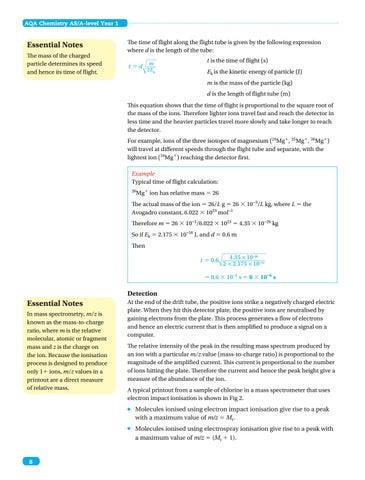
The time of flight along the flight tube is given by the following expression where d is the length of the tube: t d
m 2Ek
t is the time of flight (s) Ek is the kinetic energy of particle (J) m is the mass of the particle (kg) d is the length of flight tube (m)
This equation shows that the time of flight is proportional to the square root of the mass of the ions. Therefore lighter ions travel fast and reach the detector in less time and the heavier particles travel more slowly and take longer to reach the detector. For example, ions of the three isotopes of magnesium (24Mg, 25Mg, 26Mg) will travel at different speeds through the flight tube and separate, with the lightest ion (24Mg) reaching the detector first. Example Typical time of flight calculation: 26
Mg ion has relative mass 26
The actual mass of the ion 26/L g 26 10−3/L kg, where L the Avogadro constant, 6.022 1023 mol−1 Therefore m 26 10−3/6.022 1023 4.35 10−26 kg So if Ek 2.175 10−16 J, and d 0.6 m Then t 0.6
4.35 × 10⁻²⁶ 2 × 2.175 × 10−16
0.6 10−5 s 6 10−6 s
Detection
Essential Notes In mass spectrometry, m/z is known as the mass-to-charge ratio, where m is the relative molecular, atomic or fragment mass and z is the charge on the ion. Because the ionisation process is designed to produce only 1 ions, m/z values in a printout are a direct measure of relative mass.
At the end of the drift tube, the positive ions strike a negatively charged electric plate. When they hit this detector plate, the positive ions are neutralised by gaining electrons from the plate. This process generates a flow of electrons and hence an electric current that is then amplified to produce a signal on a computer. The relative intensity of the peak in the resulting mass spectrum produced by an ion with a particular m/z value (mass-to-charge ratio) is proportional to the magnitude of the amplified current. This current is proportional to the number of ions hitting the plate. Therefore the current and hence the peak height give a measure of the abundance of the ion. A typical printout from a sample of chlorine in a mass spectrometer that uses electron impact ionisation is shown in Fig 2. Molecules ionised using electron impact ionisation give rise to a peak with a maximum value of m/z Mr.
l
Molecules ionised using electrospray ionisation give rise to a peak with a maximum value of m/z (Mr 1).
l
8
80782_P004_065.indd 8
6/1/16 6:08 PM