Core Maths TEACHER BOOK.indd 1
01/08/2016 15:13
Contents
S6: Confidence intervals
81
Chapter 7 Correlation and regression
85
Introduction
4
S7: Correlation
87
Resource Grid
8
S8: The product moment correlation coefficient (pmcc)
89
S9: Regression lines
91
Compulsory content: Paper 1 Chapter 1
Analysis of data
12
D1: Data
15
D2: Collecting and sampling data
18
D3: Representing data numerically D4: Representing data diagrammatically
20 22
Option 2B Critical Path and Risk Analysis Chapter 8 Critical path analysis
95
R1: Compound projects
97
R2: Critical activities
99
R3: Gantt charts
101
Chapter 2 Maths for personal finance
26
F1: Numerical calculations
30
F2: Percentages
32
Chapter 9 Expectation
105
F3: Interest rates
34
R4: Probability
107
F4: Repayments and the cost of credit F5: Graphical representation
36 39
R5: Diagrammatic representations
109
R6: Combined events
111
F6: Taxation
40
R7: Expected value
113
F7: Solution to financial problems
42
Chapter 10 Cost benefit analysis
117
Chapter 3 Estimation
47
R8: Living with uncertainty
119
E1: The modelling cycle
49
R9: Control measures
121
E2: Fermi estimation
52
R10: Risk analysis
123
Option 2C Graphical techniques
Compulsory content: Paper 2 Chapter 4 Critical analysis
55
Chapter 11 Graphical methods
126
G1: Graphs of functions
128
C1: Presenting logical and reasoned arguments in context
57
G2: Intersection points
130
C2: Communicating mathematical approaches and solutions
60
Chapter 12 Rates of change
134
C3: Analysing critically
62
G3: Gradient
136
G4: Average speed
139
G5: Speed and acceleration
141
Chapter 13 Exponential functions
145
Option 2A Statistical techniques Chapter 5 The normal distribution
65
S1: Properties of a normal distribution
67
x
S2: Notation
69
G6: The function a
S3: Calculating probabilities
71
G7: The number e
151
G8: Exponential growth and decay
153
Chapter 14 Answers for practice questions
156
Chapter 6 Probabilities and estimation
75
S4: Population and sample
77
S5: The mean of sample size n
79
AQA Level 3 Mathematical Studies (Core Maths) 3 Teacher Guide – Contents
Š HarperCollinsPublishers Ltd 2016
148
Introduction The Core Maths initiative is a major part of the government’s plan to increase participation and raise standards in mathematics. The aim is to ensure that by 2020, the vast majority of all students in post-16 education continue to study some form of maths. Core Maths is the name of the suite of new Level 3 qualifications that provide an alternative pathway for students who choose not to study A-level Maths. Each Core Maths qualification is half the size of an A-level, and includes 80% Higher-tier content from the reformed 2015 GCSE Maths and 20% from A-level Maths. It is designed to help prepare students to be competent and confident in using maths in their studies, careers and lives, and is particularly useful for students studying A-levels such as Geography, Psychology, Sciences, and other technical and vocational qualifications. It carries UCAS points equivalent to an AS level, counts in the 16–19 Level 3 maths performance measure and as the maths element of the new TechBacc performance measure.
About AQA Level 3 Mathematical Studies This teacher guide accompanies the Collins AQA Level 3 Mathematical Studies Student Book and will help you to deliver the AQA Certificate Level 3 Mathematical Studies specification (Core Maths) for first examination from June 2016. The Collins Student Book is approved by AQA. The qualification is linear, which means that students will sit all the exams at the end of their course. The course is assessed entirely by two written examinations: one assessing compulsory topics and the other assessing a chosen option. Using the specification references, the compulsory content is:
3.1 Analysis of data
3.2 Maths for personal finance
3.3 Estimation
3.4 Critical analysis of given data and models (including spreadsheets and tabular data).
In paper 1, 3.1, 3.2 and 3.3 are assessed. You will notice that 3.4 is not assessed in paper 1; instead, it is assessed in each of the chosen optional papers. The optional content comprises:
3.5 The normal distribution
3.6 Probabilities and estimation
3.7 Correlation and regression
AQA Level 3 Mathematical Studies (Core Maths) 4 Teacher Guide – Introduction
© HarperCollinsPublishers Ltd 2016
3.8 Critical path analysis
3.9 Expectation
3.10 Cost benefit analysis
3.11 Graphical methods
3.12 Rates of change
3.13 Exponential functions.
In optional paper 2A Statistical techniques, 3.4, 3.5, 3.6, 3.7 are assessed. In optional paper 2B Critical path and risk analysis, 3.4, 3.8, 3.9, 3.10 are assessed. In optional paper 2C Graphical techniques, 3.4, 3.11, 3.12, 3.13 are assessed. The options mean that you can choose the area of maths that best matches your teaching expertise. The content, and indeed the qualification, assumes that the student achieved at least a grade C or equivalent at GCSE and this is the starting point for the Collins resources. Some of the topics, such as probability, will have been covered to some degree at GCSE, whereas others, such as critical path analysis, will be entirely new. The content should be accessible to all students taking AQA Level 3 Mathematical Studies and the chapters in the Collins course follow the order of the specification: for example, Chapter X corresponds to 3.X of the AQA specification, which makes it easy for planning and coverage.
About the exams Students will sit two exams in May/June at the end of their two-year course: paper 1 (compulsory) and paper 2 (option 2A, 2B or 2C). Each exam is 1 hour 30 minutes and is worth 60 marks. Candidates will need a scientific calculator or graphics calculator for both exams. A formulae sheet will be provided for each exam. In Paper 2A, students will be expected to develop and demonstrate confidence and competence in the understanding and application of mathematical modelling in the solution of problems related to the use of statistical techniques. Paper 2B expects students to develop and demonstrate confidence and competence in the understanding and application of mathematical modelling in the solution of problems related to decision making and the planning of projects. And Paper 2C focuses on understanding and application of mathematical modelling in the solution of problems related to simple polynomial and exponential functions. Preliminary materials will be available in advance of the exams via eAQA from 1 March each year. A clean copy of the Preliminary material will be provided as an insert in each exam paper. A statistical tables sheet will be provided for use with Paper 2A. Students sitting the Level 3 Certificate qualification will be graded on a five-point scale: A, B, C, D and E.
AQA Level 3 Mathematical Studies (Core Maths) 5 Teacher Guide – Introduction
© HarperCollinsPublishers Ltd 2016
How to use this Teacher Guide The Level 3 Mathematical Studies Teacher Guide helps you to teach skills in mathematical thinking, reasoning and communication, as well as helping students to use mathematical modelling and develop their problem-solving skills. Each chapter begins with an overview spread to set out the scope and sequence, and show how the student book matches to the specification.
It details the assumed knowledge that relates directly to the ‘Assumed Knowledge’ document on the AQA website in the Planning resources section of the Level 3 Mathematical Studies page. This section of the Teacher Guide is followed by an outline of where Level 3 Mathematical Studies supports other A-level subjects, such as Science, Geography, Psychology, Economics, etc. This can be a great motivator for students and may help them to draw the links between their studies. The overview then takes you through each part of the student book – chapter opener, main teaching and learning sections and exercises within them, through to the case study and project work. The descriptions in the overview will help you see what to expect and are a quick way to see the range of real-life contexts covered in the chapter. AQA Level 3 Mathematical Studies (Core Maths) 6 Teacher Guide – Introduction
© HarperCollinsPublishers Ltd 2016
The Teacher Guide follows each section of the student book, which corresponds to the specification, for example D. It outlines the references you need to know, the resources you will need and the prior knowledge. Learning objectives, key terms and definitions, and common misconceptions are set out, as well as support for any content that is beyond GCSE Maths, i.e. A-level. Ideas for thought-provoking starters are included, often using the material in the accompanying student book, to get students hooked into the topic. More support for you around the rich Mathematics in the real world features enables to you take these further and ask probing questions. The notes on the case study and project work give you some ideas on what students may produce and, in some cases, further questions to ask and the answers.
All of the teaching notes are available in Word format on the accompanying CD-ROM so you can edit them to suit your needs. There are over 50 extra ready-made resources, which have been tried and tested in the classroom, to save you time and provide you with a rich bank of additional material to draw on. The next few pages outline the content of these extra resources.
AQA Level 3 Mathematical Studies (Core Maths) 7 Teacher Guide – Introduction
Š HarperCollinsPublishers Ltd 2016
Chapter 1 Analysis of data Overview D1 Data
D3 Representing data numerically
D2 Collecting and sampling data
D4 Representing data diagrammatically
AQA specification coverage This chapter links directly to sections D1–D4 of the AQA specification.
Assumed knowledge This chapter assumes students know the statistical content listed in sections S2, S4, S5 and S6 of the assumed knowledge document (available as a planning resource on the AQA website). Therefore, little, if any, explanations of those terms will be covered, though there will be questions where knowledge of the terms and techniques is included.
Support for other A-level subjects D1 Biology, Psychology, Geography D2 Biology, Geography, Psychology D3 Psychology, Geography, Business Studies, Economics, Biology, Chemistry, Physics D4 Psychology, Geography, Statistics, Biology Chapter opener Students are presented with a three-dimensional graph showing internet activities of people in the UK. They consider questions about the graph, which are designed to help them understand and interpret the data presented and evaluate the way in which it is presented. Students then consider occasions in their own lives when they collect and use data. D1 Data It is explained to students that data can be collected on a variety of things and in a variety of forms, that it is classified to make it easier to process and that different kinds of data should be represented differently, according to type. An example of the kind of diagram a website designer might use to present data collected from design research provides an example of real-life data gathering and presentation. Students are given definitions of qualitative data (non-numerical data that describes a quality), quantitative data (numerical), discrete data (data that is counted) and continuous data (data that is measured). Students are given three purposes for which data could be collected and determine what data types would be fit for purpose. Exercise 1A (dealing with section D1.1 of the specification) requires students to identify and distinguish between types of data. Students are given definitions of primary data (data that comes directly from first-hand experience) and secondary data (data that already exists or has been processed) and then read about how the portable and modular buildings provider, Portakabin, utilises both primary and secondary data in the real world. Students AQA Level 3 Mathematical Studies (Core Maths) 12 Teacher Guide – Chapter 1
Š HarperCollinsPublishers Ltd 2016
then choose one of three situations and, in discussion with their peers, decide what data should be collected and identify whether the data would be primary, secondary or both. Exercise 1B (dealing with section D1.2 of the specification) consolidates students’ ability to recognise primary and secondary data. Students learn about methods of collecting data (direct observation, interviews, surveys, experiments and testing) and how different methods suit different purposes. Students also learn that, in experiments, there are generally two variables: the independent/explanatory variable (that which can be controlled) and the dependent/response variable, which is dependent on the independent variable. Students read about a report from the Office of National Statistics on declining oil and gas extraction in the UK. As the report does not consider the estimated amounts of, as yet, unexploited gas and oil reserves in the UK, this is a real-life example of how data that has already been interpreted may not be fit for purpose. Students choose one of three scenarios and discuss what data to collect, how and why they should collect it and, for any experiments, what the variables would be. Exercise 1C (dealing with section D1.3 of the specification) requires students to consider what data to collect for various purposes, why that data would be useful, how that data should be collected, and what the variables would be in any experiments carried out to collect the data. D2 Collecting and sampling data Students are informed that sampling is used to collect data from some (a sample) of a population, in order to make conclusions about the whole population (a population being a complete set of items that share a common property). Students look at data from a preelection poll, an exit poll and the actual results of the 2015 General Election (examples of sampling in the real world) and read about some of the sampling issues that may have affected the accuracy of the results from the pre-election and exit polls. Students learn about bias (a distortion of data) and things that can result in the collection of distorted data (nonrepresentative samples, untruthful answers, errors in processing or recording results, poor survey design, a lack of response). Students choose one of three scenarios to design a test for and discuss how they would test it and why their chosen method would suit their purpose. Exercise 1D (dealing with section D2.1 of the specification) consists of questions about censuses, samples and populations. Students are given definitions of random sampling (collecting data from part of a population without bias), cluster sampling (collecting data from all of a randomly selected group), stratified sampling (collecting random data from a stratum where the sample is proportional to the stratum’s size) and quota sampling (collecting data from a quota of items from each section to be surveyed). The difference between a census (data from every item of a population) and a sample (data from a part of a population) is then clarified. Students are given real-world examples of each sampling method and look at a table of the advantages and disadvantages of each sampling method. Students choose one of three hypothetical surveys and discuss the sampling method and the sampling frame they would use and explain why. Students read about the need to balance bias (inversely proportional to sample size) against cost (directly proportional to sample size). Exercise 1E (dealing with section D2.2 of the specification) requires students to make decisions on sampling methods, giving reasons for their choice. D3 Representing data numerically This opens with a résumé of the measures studied in GCSE Mathematics. Students are then given a definition of a percentile (a value below which a given percentage of the observations fall) and they look at a chart from the World Health Organization on child growth as an example of percentiles used in the real world. Students discuss the chart and AQA Level 3 Mathematical Studies (Core Maths) 13 Teacher Guide – Chapter 1
© HarperCollinsPublishers Ltd 2016
then complete Exercise 1F (dealing with part of section D3.1 of the specification), which consists of questions on the chart, consolidating their understanding of percentiles, medians and interquartile range. An explanation of standard deviation (a measure of spread that uses all the data) follows, including a step-by-step description of how to calculate it (though it is expected that students will use the appropriate functions on their calculators). Students read about intelligence quotient (IQ) scores, an example of standard deviation used in the real world. Students learn about the use of standard deviation in standardising scores and then discuss whether standardising is a fair way to compare two data sets. Exercise 1G (dealing with the standard deviation part of section D3.1 and section D3.2 of the specification) practises calculating standard deviation and applying it. D4 Representing data diagrammatically This opens with a résumé of the diagrams studied in GCSE Mathematics. The examples included in the résumé include real-world examples of these diagrams. Descriptions of stemand-leaf diagrams, box-and-whisker plots, cumulative frequency graphs and histograms (with examples and some opportunity for discussion) follow. Exercise 1H (dealing with section D4.1 of the specification) requires students to interpret some diagrams and to draw some diagrams. Case study Students read about how a type 1 diabetic collects and analyses data about her blood sugar levels to achieve good control of her condition. Project work Data about the two fleets of battleships at the battle of Trafalgar is provided and there is the choice of three projects, each of which differs in the amount of data, so the student can choose according to their level of achievement. Each project needs both numerical and graphical representation to compare the two data sets and so students can demonstrate their skills and problem solving abilities when dealing with the project selected.
AQA Level 3 Mathematical Studies (Core Maths) 14 Teacher Guide – Chapter 1
© HarperCollinsPublishers Ltd 2016
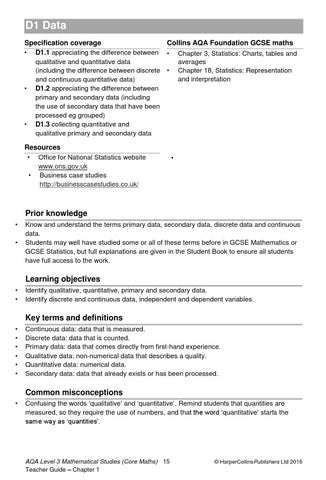
D1 Data Specification coverage Collins AQA Foundation GCSE maths • D1.1 appreciating the difference between • Chapter 3, Statistics: Charts, tables and qualitative and quantitative data averages (including the difference between discrete • Chapter 18, Statistics: Representation and interpretation and continuous quantitative data) • D1.2 appreciating the difference between primary and secondary data (including the use of secondary data that have been processed eg grouped) • D1.3 collecting quantitative and qualitative primary and secondary data Resources • Office for National Statistics website www.ons.gov.uk • Business case studies http://businesscasestudies.co.uk/
•
Prior knowledge • •
Know and understand the terms primary data, secondary data, discrete data and continuous data. Students may well have studied some or all of these terms before in GCSE Mathematics or GCSE Statistics, but full explanations are given in the Student Book to ensure all students have full access to the work.
Learning objectives • •
Identify qualitative, quantitative, primary and secondary data. Identify discrete and continuous data, independent and dependent variables.
Key terms and definitions • • • • • •
Continuous data: data that is measured. Discrete data: data that is counted. Primary data: data that comes directly from first-hand experience. Qualitative data: non-numerical data that describes a quality. Quantitative data: numerical data. Secondary data: data that already exists or has been processed.
Common misconceptions •
Confusing the words ‘qualitative’ and ‘quantitative’. Remind students that quantities are measured, so they require the use of numbers, and that the word ‘quantitative’ starts the same way as ‘quantities’.
AQA Level 3 Mathematical Studies (Core Maths) 15 Teacher Guide – Chapter 1
© HarperCollinsPublishers Ltd 2016
•
Starter
•
You might wish to start this section by asking where students have used data before, perhaps as a basis for making an important decision. For example, ask students how they would justify an increase in their pocket money to their parents. Ask: o Would you collect quantitative data or qualitative data? (They should collect quantitative.) o Would that data be continuous or discrete? (If it is data about money, it is discrete.) o Would you use primary or secondary data? (Expect students to suggest either but follow that by asking them to explain their answer.) There are many sources of data available on the internet that could be used to start this section. The Office for National Statistics (ONS) website, www.ons.gov.uk, is an excellent place to find data on current concerns such as recycling, education and the economy.
•
Mathematics in the real world: Website designers •
•
The diagram shows how website designers categorise various types of data when dealing with websites. Why not display your college/school website and encourage students to consider how it fits in to this diagram? The following are questions you could ask your students. For each one, they should consider what type of data would be collected: quantitative, qualitative, continuous or discrete. o Who do you think uses the website? o How would you test the usability of the website? o Which pages are looked at most often? o What kind of surveys might you do to find out how to improve the website? When asking questions like these, be prepared to discuss the answers with the students but do not spend too much time on it as this chapter contains a lot of material.
Mathematics in the real world: Portakabin •
• •
There is an excellent case study at http://businesscasestudies.co.uk (search ‘Portakabin’), which describes how Portakabin collects and uses data. Page 3 of the study deals with primary and secondary data. You might want to ask your students to read this case study for homework. Ask students: What do you think about the quality of the working environment? Does noise disturb you when you are working? The Business Case Studies website is an excellent resource from which you could take many more informative case studies to share with your students, should you wish to. There may be opportunities here to discuss share cases with business studies and/or economics courses.
Mathematics in the real world: Extraction of oil and gas • •
•
This diagram shows the decline in domestic oil and gas extraction. Here are some questions you could ask your students: o Who do you think provided the data? o How do you think it was collected? o How do you think this diagram might change in the future? Why? o Will fracking play a part in the future of gas and oil extraction in the UK? Fracking is a topic that might be more relevant to some areas than others. Make use of local issues to engage students in mathematics whenever possible. AQA Level 3 Mathematical Studies (Core Maths) 16 Teacher Guide – Chapter 1
© HarperCollinsPublishers Ltd 2016
Discussions
•
The questions given in the Student Book are there to instigate the discussion. It is not intended that these take more than a few minutes as, in some cases, students might not be very vociferous and in other cases they might have a lot to say. Students can sometimes sort out differences between types of data by discussing the matter in small groups and yet be unwilling to offer anything in a whole-class discussion.
AQA Level 3 Mathematical Studies (Core Maths) 17 Teacher Guide – Chapter 1
© HarperCollinsPublishers Ltd 2016
D2 Collecting and sampling data Specification coverage • D2.1 inferring properties of populations or distributions from a sample, whilst knowing the limitations of sampling • D2.2 appreciating the strengths and limitations of random, cluster, stratified and quota sampling methods and applying this understanding when designing sampling strategies (appreciating that improving accuracy by removing bias and increasing sample size may cost/save both time and money)
Collins AQA Foundation GCSE maths • Chapter 3, Statistics: Charts, tables and averages • Chapter 18, Statistics: Representation and interpretation
Resources • Internet access to the poll error in 1936 Landon/Roosevelt (see below)
Prior knowledge •
Perhaps students need to be reminded that √n means the square root of n. Otherwise no prior knowledge is needed here: students may well have studied some or all of these terms before in GCSE Mathematics or GCSE Statistics, but full explanations are given in the Student Book to ensure all students have full access to the work.
Learning objectives • •
Deduce properties of populations from a sample, whilst realising the limitations. Appreciate the advantages and disadvantages of various sampling methods.
Key terms and definitions • • • •
•
Bias: a distortion of results. Census: used when every member of the population provides data. Cluster sample: used to collect data from all members of a randomly selected cluster (or group).Population: a complete set of items that share a common property. Quota sample: used to collect data chosen by the sampler from a stratum (or layer) where the number of items selected is proportional to the size of the stratum in the population.Random sample: used to collect data from part of a population without bias. Sample: part of a population. Sampling: used to collect data from part of a population.Stratified sample: used to collect random data from a stratum (or layer) where the number of items selected is proportional to the size of the stratum in the population.
Common misconceptions •
Confusing the words ‘qualitative’ and ‘quantitative’. Remind students that quantities are measured, so they require the use of numbers, and that the word ‘quantitative’ starts the same way as ‘quantities’.
AQA Level 3 Mathematical Studies (Core Maths) 18 Teacher Guide – Chapter 1
© HarperCollinsPublishers Ltd 2016
•
Starter
•
Ask students if they have ever been stopped in the street to answer some questions, whether they stopped and participated when they were asked. Ask whether they think collecting data it is an easy task. If they have ever filled in any questionnaires, ask whether they always told the truth. Ask: Do you think data collection always gets valid data? There is a wonderful case study demonstrating how damaging sampling bias can be to the accuracy of a survey. The Literary Digest polled a sample size of around 2.4 million people (one of the largest and most expensive polls ever conducted) in order to predict the outcome of the 1936 United States presidential election. The study looks at why the prediction was so wildly inaccurate. Every student should read this as it contains brilliant examples of many of the terms in this section of the book.
•
Mathematics in the real world: The 2015 General Election •
This table shows the difference in the pre-election poll, the exit poll and the actual results of the 2015 General Election. Ask students why they think there are differences and whether there is much point in having such polls. Ask: Do you think these polls could influence the final results?
Mathematics in the real world: Immunisation coverage surveys in Kenya •
•
This is a good example of when cluster sampling is appropriate: widely dispersed populations. As with random sampling, if a person or item is chosen twice then they are ignored the second time and a substitute is picked instead. This can be the next item on a list, or the next random number. Here are some questions you could ask students: o Can you think of any other ways a substitute can be chosen without bias? o Can you think of any other cases where random sampling is used? o Can you think of any other cases where cluster sampling is used?
Discussions •
The same advice applies to this section as applies to the first section.
AQA Level 3 Mathematical Studies (Core Maths) 19 Teacher Guide – Chapter 1
© HarperCollinsPublishers Ltd 2016
D3 Representing data numerically Specification coverage • D3.1 Calculating/identifying mean, median, mode, quartiles, percentiles, range, interquartile range and standard deviation (either from raw data or from cumulative frequency diagrams, stemand-leaf diagrams or box plots) • D3.2 Interpret these numerical measures and reach conclusions based on these measures.
Collins AQA Foundation GCSE maths • Chapter 3, Statistics: Charts, tables and averages • Chapter 18, Statistics: Representation and interpretation
Resources • Scientific calculator • WHO growth charts
Prior knowledge •
Interpret, analyse and compare the distributions of data sets from univariate empirical distributions through appropriate measures of central tendency (median, mean, mode and modal class) and spread (range, including consideration of outliers).
Learning objectives • •
Calculate measures of location (mean, median, mode, quartiles and percentiles) and spread (range, interquartile range and standard deviation). Interpret these measures and use them to make conclusions.
Key terms and definitions • •
Percentile: a value below which a given percentage of the observations fall. Standard deviation: a measure of spread that uses all the data.
Common misconceptions • • • •
Confusing mean, mode and median. Expressing the range as a subtraction without actually doing it. For example, the range should never be written as 67 – 23 or 23 – 67, but as 44. Giving a value for the mean that is far too big, which can stem from misuse of the calculator. Too often students type in 3 + 4 + 5 ÷ 3 rather than (3 + 4 + 5) ÷ 3. Some sources calculate the upper quartile at the position of the 3(n + 1)/4 th value and the lower quartile at the position of the (n + 1)/4 th value. This is not the case for this book, so careful attention needs to be paid to the example in the Student Book.
AQA Level 3 Mathematical Studies (Core Maths) 20 Teacher Guide – Chapter 1
© HarperCollinsPublishers Ltd 2016
Support for beyond GCSE Maths content •
•
Standard deviation will not have been studied by students on the GCSE Mathematics Foundation course and the use of all the formulae can be very off-putting. It is there for those students who will meet such terms when they study A Level subjects that use a lot of statistics. For most students, it is sufficient for them to be able to use their scientific calculators to obtain a value for the standard deviation and realise that it represents a measure of spread. Those students who are doing the statistical techniques option will study standard deviation in greater depth there. Since the additional coverage mentions the use of calculating from various types of diagram that have not necessarily been covered until section 1.4, Exercise 1H contains questions where this part of the specification is covered.
•
Starter
•
Since most of this section deals with some statistics students will have studied for GCSE Mathematics, it might be worthwhile asking them to recap on what they know already. Ask them to work in pairs to produce an A3 poster of what they have studied before and to include an example that explains how these statistics are calculated to someone who has not studied them before. If the poster work is completed, this can be a useful tool for deciding which questions need to be done in the subsequent exercises.
Mathematics in the real world: Child Growth Standards •
•
•
This is just part of one of many charts on the World Health Organization (WHO) website. http://www.who.int/childgrowth/standards/en/ has links to many other indicators and there are more charts there that you might wish to use with students. Referring to the chart in the Student Book, you can ask questions such as: o What is the median (P50) length of a 9-month-old girl? (The answer is 70cm or 27.5 inches.) o 2% of the 24-month-old girls are above what height? (The answer is 93cm.) o Between what lengths of the 10-month-old girls would you expect the middle 50% to lie? (The answer is 70-73cm.) Some charts are more straightforward than the one presented in the Student Book so you might find those better to use with students who are less confident about their mathematics.
Mathematics in the real world: Intelligence quotient scores • •
This is a good example of where standard deviation is used and can act as a precursor to Chapter 5 on the Normal distribution for those students who go on to study it. Here are some questions you could ask students: o What percentage of students has an IQ of less than 115? (84%) o What percentage of students has an IQ of more than 70? (97.5%) o What percentage of students has an IQ of between 85 and 145? (83.85%, accept 84%)
Discussions •
The discussion that follows the use of standard deviation in standardising scores helps explain why standard deviation is important. However, this is beyond the specification and so can be omitted with students who either find the concept of standard deviation difficult or who need to make more progress with the work. AQA Level 3 Mathematical Studies (Core Maths) 21 Teacher Guide – Chapter 1
© HarperCollinsPublishers Ltd 2016
D4 Representing data diagrammatically Specification coverage • D4.1 constructing and interpreting diagrams for grouped discrete data and continuous data, knowing their appropriate use and reaching conclusions based on these diagrams (including histograms with equal and unequal class intervals and cumulative frequency graphs, box-and-whisker plots, stem-and-leaf diagrams (including backto-back))
Collins AQA Foundation GCSE Maths • Chapter 3, Statistics: Charts, tables and averages • Chapter 18, Statistics: Representation and interpretation • Chapter 18.5 Histograms (in Collins AQA Higher GCSE maths)
Resources • Graph paper • Sheep dash (see website reference in starter section)
Prior knowledge •
•
•
Interpret and construct tables, charts and diagrams, including frequency tables, bar charts, pie charts and pictograms for categorical data, vertical line charts for ungrouped discrete numerical data, and know their appropriate use. Notes: including choosing suitable statistical diagrams. Interpret, analyse and compare the distributions of data sets from univariate empirical distributions through: appropriate graphical representation involving discrete, continuous and grouped data; appropriate measures of central tendency (median, mean, mode and modal class) and spread (range, including consideration of outliers). Use and interpret scatter graphs of bivariate data, recognise correlation. Notes: students should know and understand the terms: positive correlation, negative correlation, no correlation, weak correlation and strong correlation.
Learning objectives •
Construct and interpret diagrams for grouped discrete data and continuous data, know their appropriate use and reach conclusions based on these diagrams.
Key terms and definitions •
Frequency density: the number of items in a given unit.
Common misconceptions •
•
Confusing histograms with bar charts: unfortunately, many other subjects misuse the term ‘histogram’. ‘Histogram’ refers specifically to a diagram where the vertical axis represents frequency density, not frequency. Avoid any definition that refers to gaps between columns. This is because histograms may or may not have gaps. Many students forget to put a key on stem-and-leaf diagrams. AQA Level 3 Mathematical Studies (Core Maths) 22 Teacher Guide – Chapter 1
© HarperCollinsPublishers Ltd 2016
•
Many students plot the points on cumulative frequency diagrams in the wrong place. The points should be plotted at the right end of the interval, not the middle. This is because cumulative frequency graphs are often used with grouped data and, since the individual values are lost, all we can say is that the cumulative frequency for a group is at the numerically largest end of the interval.
Support for beyond GCSE Maths content •
Histograms will not have been studied by students on the GCSE Mathematics Foundation course and this is a difficult topic. They may need to work through some extra examples from a Higher tier textbook to gain confidence.
•
Starter 1
•
It always means far more to students if they are working with data that relates to them. This is an area that is very difficult for textbooks as exercise questions contain data that may have little or no relevance to the students concerned. Wherever possible, use data from your students. ‘Sheep dash’ at http://www.bbc.co.uk/ (search ‘sheep dash’) is a fun way of collecting data that can be represented diagrammatically or numerically.
•
Starter 2 •
•
In 1858 Florence Nightingale produced a diagram to illustrate that deaths by disease in the Crimean War accounted for more casualties than fighting in the war. Florence was a social reformer who revolutionised the nursing profession and her innovative use of statistics helped her achieve that aim. Enter ‘Nightingale causes of mortality’, or just ‘Nightingale diagram’, into an internet search engine to find a copy of this amazing diagram to share with students. You may wish to use this diagram to start this section. Ask: What can be deduced from this diagram? (The diagram shows fewer casualties during the winter months so it could be deduced that the cold weather reduced the spread of flies and bacteria thereby slowing the infections that caused death.)
Discussions •
Comparing two ‘classes’ like this should not be controversial or problematic. Try to avoid discussing any problematic comparisons such as gender groups. Comparing classifications such as gender, when dealing with statistics, can have the effect of alienating some students.
AQA Level 3 Mathematical Studies (Core Maths) 23 Teacher Guide – Chapter 1
© HarperCollinsPublishers Ltd 2016
Case study This describes with how Claire, a type 1 diabetic, collects and analyses data about her blood sugar levels to achieve good control of her condition. The log book shows her blood sugar results. This data can be used in various ways. For example, you could ask students to check that the average results are correct, or ask them to calculate the standard deviation for each day. This data could possibly be used again in Chapter 5 on the Normal distribution. In Chapter 2 there is some work on percentages and, in preparation for this, students could work out how many of the tests were above average using the data in the snapshot. With regards to the charts, ask students if they can suggest any other ways the data can be presented. There may be diabetics amongst your students. If so, they may wish to provide some data for analysis. Conversely, they may be reluctant or unwilling to discuss the subject. As a teacher you will be aware of any diabetic students and should ask them how they feel about the topic before the lesson.
Project work Students are provided with data about the two fleets of battleships at the battle of Trafalgar. There is a choice of three projects, each of which differs in the amount of data handled, so the student can choose according to their level of proficiency. Each project needs both numerical and graphical representation to compare the two data sets so students can demonstrate their skills and problem solving abilities when dealing with the project selected. Project 1 deals with the most data and gives the students an opportunity to show the techniques they have learnt. You can ask them what sort of diagram they could use to show the differences in numbers of guns on the ships (a reversed stem-and-leaf diagram, for example, and, by using different colours for the leaves of the French and Spanish ships, a further comparison can be made). Project 2 allows a great opportunity to use proportional pie charts to compare the wounded and killed aboard some of the ships. Students might want to do some sampling to pick just some ships: creating 27 proportional pie charts is time consuming. Encourage students to do some work on a computer. If the data is entered into a spreadsheet, repetitious calculations become less tedious. Project 3 deals with the smallest amount of data, though students will have to use the data in project 2 to be able to compare the British data.
AQA Level 3 Mathematical Studies (Core Maths) 24 Teacher Guide – Chapter 1
Š HarperCollinsPublishers Ltd 2016
•
Check your progress How confident are you feeling in your level of knowledge? What do you need to practise more? Spec reference
Learning Objective
D1.1
Appreciate the difference between qualitative and quantitative data
D1.2
Appreciate the difference between primary and secondary data
D1.3
Collect quantitative and qualitative primary and secondary data
D2.1
Infer properties of populations or distributions from a sample, whilst knowing the limitations of sampling Appreciate the strengths and limitations of random, cluster, stratified and quota sampling methods and applying this understanding when designing sampling strategies Calculate/identify mean, median, mode, quartiles, percentiles, range, interquartile range and standard deviation Interpret these numerical measures and reach conclusions based on these measures Construct and interpret diagrams for grouped discrete data and continuous data, know their appropriate use and reach conclusions based on these diagrams
D2.2
D3.1
D3.2
D4.1
AQA Level 3 Mathematical Studies (Core Maths) 25 Teacher Guide – Chapter 1
Š HarperCollinsPublishers Ltd 2016