1 .11
1. Which parts of the egg cell and sperm cell fuse at fertilisation? 2. Why do the sex cells have half the number of chromosomes?
Different and unique
❯❯
X X
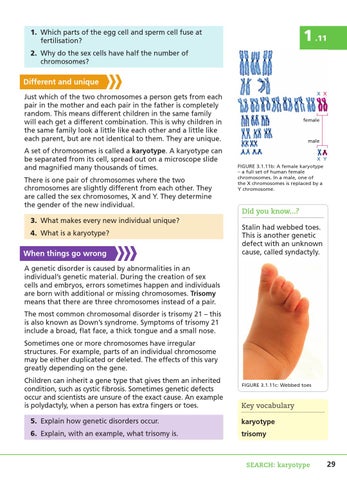
Just which of the two chromosomes a person gets from each pair in the mother and each pair in the father is completely random. This means different children in the same family will each get a different combination. This is why children in the same family look a little like each other and a little like each parent, but are not identical to them. They are unique. A set of chromosomes is called a karyotype. A karyotype can be separated from its cell, spread out on a microscope slide and magnified many thousands of times. There is one pair of chromosomes where the two chromosomes are slightly different from each other. They are called the sex chromosomes, X and Y. They determine the gender of the new individual. 3. What makes every new individual unique? 4. What is a karyotype?
When things go wrong
❯❯❯
female
male
X Y FIGURE 3.1.11b: A female karyotype – a full set of human female chromosomes. In a male, one of the X chromosomes is replaced by a Y chromosome.
Did you know...? Stalin had webbed toes. This is another genetic defect with an unknown cause, called syndactyly.
A genetic disorder is caused by abnormalities in an individual’s genetic material. During the creation of sex cells and embryos, errors sometimes happen and individuals are born with additional or missing chromosomes. Trisomy means that there are three chromosomes instead of a pair. The most common chromosomal disorder is trisomy 21 – this is also known as Down’s syndrome. Symptoms of trisomy 21 include a broad, flat face, a thick tongue and a small nose. Sometimes one or more chromosomes have irregular structures. For example, parts of an individual chromosome may be either duplicated or deleted. The effects of this vary greatly depending on the gene. Children can inherit a gene type that gives them an inherited condition, such as cystic fibrosis. Sometimes genetic defects occur and scientists are unsure of the exact cause. An example is polydactyly, when a person has extra fingers or toes.
FIGURE 3.1.11c: Webbed toes
Key vocabulary
5. Explain how genetic disorders occur.
karyotype
6. Explain, with an example, what trisomy is.
trisomy
SEARCH: karyotype
540235_P008_037.indd 29
29
24/04/2014 10:50