Biology
Investigating diffusion
We are learning how to: • Explain how diffusion makes breathing possible. • Observe the effects of diffusion. • Apply diffusion to our breathing system and ask questions to develop understanding.
Air particles are constantly moving because they have energy. As they move, they bump into each other and spread out. Diffusion allows us to smell food cooking, or a familiar person next to us! The gas exchange system also makes good use of diffusion. What is diffusion?
❯
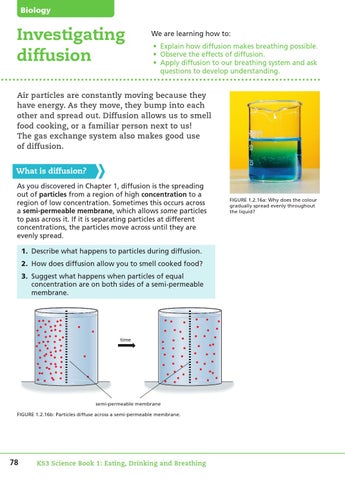
As you discovered in Chapter 1, diffusion is the spreading out of particles from a region of high concentration to a region of low concentration. Sometimes this occurs across a semi-permeable membrane, which allows some particles to pass across it. If it is separating particles at different concentrations, the particles move across until they are evenly spread.
FIGURE 1.2.16a: Why does the colour gradually spread evenly throughout the liquid?
1. Describe what happens to particles during diffusion. 2. How does diffusion allow you to smell cooked food? 3. Suggest what happens when particles of equal concentration are on both sides of a semi-permeable membrane.
time
semi-permeable membrane FIGURE 1.2.16b: Particles diffuse across a semi-permeable membrane.
78
KS3 Science Book 1: Eating, Drinking and Breathing
193885_P048_085.indd 78
09/12/2013 15:22