More about enzymes
❯❯
2 .11
Enzymes are known as biological catalysts – they speed up reactions. If we didn’t have enzymes, reactions such as respiration would go too slowly to keep us alive. Enzymes are specific. This means that they can only break down one type of molecule. Enzymes are sometimes described as ‘chemical scissors’ because they cut up large food molecules into smaller molecules. 4. Describe what would happen if protein was mixed with amylase. Explain your answer. 5. Explain why we need enzymes to act as ‘chemical scissors’ during digestion. 6. Sufferers of cystic fibrosis release very few enzymes into the small intestine. What are the consequences of this?
Modelling digestion
Did you know . . . ? Enzymes are added to washing powders to digest stains from protein and fats on clothes. They are also used in the production of cheeses, yogurts and wines.
❯❯❯
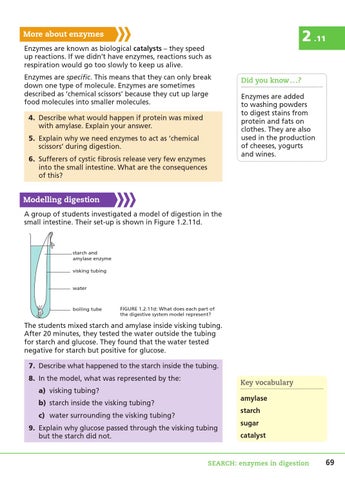
A group of students investigated a model of digestion in the small intestine. Their set-up is shown in Figure 1.2.11d.
starch and amylase enzyme visking tubing water
boiling tube
FIGURE 1.2.11d: What does each part of the digestive system model represent?
The students mixed starch and amylase inside visking tubing. After 20 minutes, they tested the water outside the tubing for starch and glucose. They found that the water tested negative for starch but positive for glucose. 7. Describe what happened to the starch inside the tubing. 8. In the model, what was represented by the:
Key vocabulary
a) visking tubing? amylase
b) starch inside the visking tubing?
starch
c) water surrounding the visking tubing? 9. Explain why glucose passed through the visking tubing but the starch did not.
sugar catalyst
SEARCH: enzymes in digestion
193885_P048_085.indd 69
69
09/12/2013 15:22