Nathan Lynch ’14
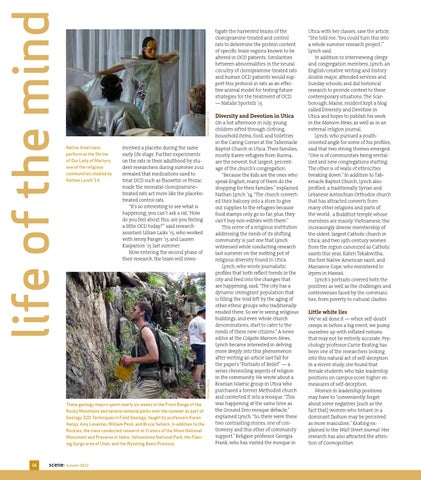
Native Americans perform at the Shrine of Our Lady of Martyrs, one of the religious communities studied by Nathan Lynch ’14.
received a placebo during the same early life stage. Further experiments on the rats in their adulthood by student researchers during summer 2012 revealed that medications used to treat OCD such as fluoxetin or Prozac made the neonatal-clomipramine– treated rats act more like the placebotreated control rats. “It’s so interesting to see what is happening; you can’t ask a rat, ‘How do you feel about this, are you feeling a little OCD today?’” said research assistant Lillian Laiks ’15, who worked with Jenny Panger ’15 and Lauren Kasparson ’15 last summer. Now entering the second phase of their research, the team will inves-
William Peck
life of the mind
tigate the harvested brains of the clomipramine-treated and control rats to determine the protein content of specific brain regions known to be altered in OCD patients. Similarities between abnormalities in the neural circuitry of clomipramine-treated rats and human OCD patients would support this protocol in rats as an effective animal model for testing future strategies for the treatment of OCD. — Natalie Sportelli ’15
These geology majors spent nearly six weeks in the Front Range of the Rocky Mountains and several national parks over the summer as part of Geology 320: Techniques in Field Geology, taught by professors Karen Harpp, Amy Leventer, William Peck, and Bruce Selleck. In addition to the Rockies, the class conducted research at Craters of the Moon National Monument and Preserve in Idaho, Yellowstone National Park, the Flaming Gorge area of Utah, and the Wyoming Basin Province.
16
scene: Autumn 2012
Diversity and Devotion in Utica
On a hot afternoon in July, young children sifted through clothing, household items, food, and toiletries in the Caring Corner at the Tabernacle Baptist Church in Utica. Their families, mostly Karen refugees from Burma, are the newest, but largest, percentage of the church’s congregation. “Because the kids are the ones who speak English, many of them do the shopping for their families,” explained Nathan Lynch ’14. “The church converted their balcony into a store to give out supplies to the refugees because food stamps only go so far; plus, they can’t buy non-edibles with them.” This scene of a religious institution addressing the needs of its shifting community is just one that Lynch witnessed while conducting research last summer on the melting pot of religious diversity found in Utica. Lynch, who wrote journalistic profiles that both reflect trends in the city and feed into the changes that are happening, said, “The city has a dynamic immigrant population that is filling the void left by the aging of other ethnic groups who traditionally resided there. So we’re seeing religious buildings, and even whole church denominations, start to cater to the needs of these new citizens.” A news editor at the Colgate Maroon-News, Lynch became interested in delving more deeply into this phenomenon after writing an article last fall for the paper’s “Portraits of Belief” — a series chronicling aspects of religion in the community. He wrote about a Bosnian Islamic group in Utica who purchased a former Methodist church and converted it into a mosque. “This was happening at the same time as the Ground Zero mosque debacle,” explained Lynch. “So, there were these two contrasting stories, one of controversy and this other of community support.” Religion professor Georgia Frank, who has visited the mosque in
Utica with her classes, saw the article. “She told me, ‘You could turn this into a whole summer research project,’” Lynch said. In addition to interviewing clergy and congregation members, Lynch, an English/creative writing and history double major, attended services and Sunday schools, and did historical research to provide context to these contemporary situations. The Scarborough, Maine, resident kept a blog called Diversity and Devotion in Utica and hopes to publish his work in the Maroon-News, as well as in an external religion journal. Lynch, who pursued a youthoriented angle for some of his profiles, said that two strong themes emerged: “One is of communities being revitalized and new congregations starting. The other is of walls of ethnicities breaking down.” In addition to Tabernacle Baptist Church, Lynch also profiled: a traditionally Syrian and Lebanese Antiochian Orthodox church that has attracted converts from many other religions and parts of the world; a Buddhist temple whose members are mainly Vietnamese; the increasingly diverse membership of the oldest, largest Catholic church in Utica; and two 19th-century women from the region canonized as Catholic saints this year, Kateri Tekakwitha, the first Native American saint, and Marianne Cope, who ministered to lepers in Hawaii. Lynch’s portraits covered both the positives as well as the challenges and controversies faced by the communities, from poverty to cultural clashes.
Little white lies
We’ve all done it — when self-doubt creeps in before a big event, we pump ourselves up with inflated notions that may not be entirely accurate. Psychology professor Carrie Keating has been one of the researchers looking into this natural act of self-deception. In a recent study, she found that female students who take leadership positions on campus score higher on measures of self-deception. Women in leadership positions may have to “conveniently forget about some negatives [such as the fact that] women who behave in a dominant fashion may be perceived as more masculine,” Keating explained to the Wall Street Journal. Her research has also attracted the attention of Cosmopolitan.