Book Excerpt / 1
Blitz spirit
An excerpt from the new book, The Country Formerly Known As Great Britain, by Ian Jack, published by Jonathan Cape
London’s response to the bombs showed what Londoners were made of, we would be cheerful, we would not be cowed, we would carry on as usual
This essay was originally published in Granta magazine in 2005
G
eneralisations about the national psyche – supposing there is one – must always be treated with suspicion. In 1997, the great crowds who mourned the death of the Princess of Wales with their tears, flowers and candles were taken as evidence that British behaviour had utterly changed. We were at last in touch with our feelings, prepared to show them, to hug strangers, to weep and tear our hair. We would never be the same again. Eight years later, in July this year [2005], our alleged conversion to the open emotions of (say) Brazil had been forgotten. The traditional strengths of stoicism, resilience and understatement hadn’t, after all, died with the princess in her Paris car crash. They were merely sleeping, to spring awake when three terrorist bombs went off in London tube trains and a fourth on a London bus, killing fifty-six people including the four bombers and injuring hundreds of others. London’s response to the bombs showed what Londoners were made of, we would be cheerful, we would not be cowed, we would carry on as usual. We showed ‘the spirit of London’, the same spirit of our citizen forebears during their bombing by the Luftwaffe – ’the Blitz’ – in 1940 and 1941. How such conclusions are reached, from
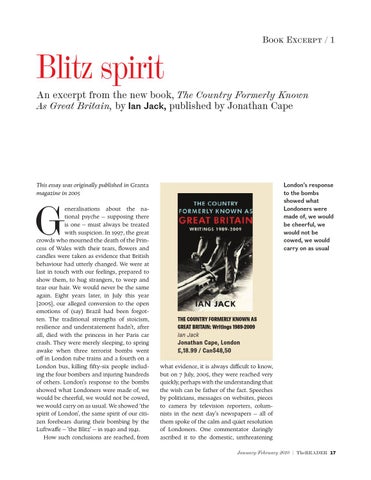
The Country formerly known as great Britain: Writings 1989-2009 Ian Jack Jonathan Cape, London £,18.99 / Can$48,50 what evidence, it is always difficult to know, but on 7 July, 2005, they were reached very quickly, perhaps with the understanding that the wish can be father of the fact. Speeches by politicians, messages on websites, pieces to camera by television reporters, columnists in the next day’s newspapers – all of them spoke of the calm and quiet resolution of Londoners. One commentator daringly ascribed it to the domestic, unthreatening January/February 2010 | TheReader 17