Insights ColdType
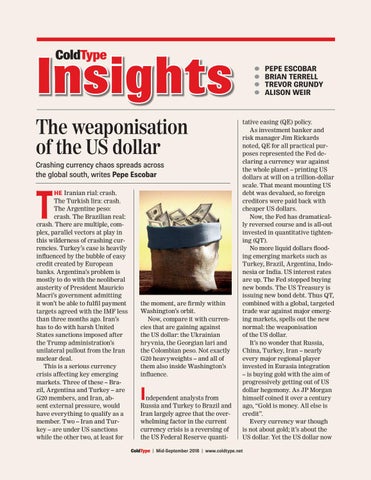
The weaponisation of the US dollar Crashing currency chaos spreads across the global south, writes Pepe Escobar
T
he Iranian rial: crash. The Turkish lira: crash. The Argentine peso: crash. The Brazilian real: crash. There are multiple, complex, parallel vectors at play in this wilderness of crashing currencies. Turkey’s case is heavily influenced by the bubble of easy credit created by European banks. Argentina’s problem is mostly to do with the neoliberal austerity of President Mauricio Macri’s government admitting it won’t be able to fulfil payment targets agreed with the IMF less than three months ago. Iran’s has to do with harsh United States sanctions imposed after the Trump administration’s unilateral pullout from the Iran nuclear deal. This is a serious currency crisis affecting key emerging markets. Three of these – Brazil, Argentina and Turkey – are G20 members, and Iran, absent external pressure, would have everything to qualify as a member. Two – Iran and Turkey – are under US sanctions while the other two, at least for
the moment, are firmly within Washington’s orbit. Now, compare it with currencies that are gaining against the US dollar: the Ukrainian hryvnia, the Georgian lari and the Colombian peso. Not exactly G20 heavyweights – and all of them also inside Washington’s influence.
I
ndependent analysts from Russia and Turkey to Brazil and Iran largely agree that the overwhelming factor in the current currency crisis is a reversing of the US Federal Reserve quanti-
l l l l
pepe Escobar Brian terrell Trevor Grundy Alison weir
tative easing (QE) policy. As investment banker and risk manager Jim Rickards noted, QE for all practical purposes represented the Fed declaring a currency war against the whole planet – printing US dollars at will on a trillion-dollar scale. That meant mounting US debt was devalued, so foreign creditors were paid back with cheaper US dollars. Now, the Fed has dramatically reversed course and is all-out invested in quantitative tightening (QT). No more liquid dollars flooding emerging markets such as Turkey, Brazil, Argentina, Indonesia or India. US interest rates are up. The Fed stopped buying new bonds. The US Treasury is issuing new bond debt. Thus QT, combined with a global, targeted trade war against major emerging markets, spells out the new normal: the weaponisation of the US dollar. It’s no wonder that Russia, China, Turkey, Iran – nearly every major regional player invested in Eurasia integration – is buying gold with the aim of progressively getting out of US dollar hegemony. As JP Morgan himself coined it over a century ago, “Gold is money. All else is credit”. Every currency war though is not about gold; it’s about the US dollar. Yet the US dollar now
ColdType | Mid-September 2018 | www.coldtype.net
45