Insights two books, written when the UK and US economies were booming, Bloodworth writes about working life in the years of austerity that followed the 2008 financial crisis – years that saw the coining of the term “gig economy”. He points out that the UK is enjoying “record levels of employment … but an increasing proportion of this work is poorly paid, precarious and without regular hours.” Bloodworth worked at Amazon’s Rugeley site, as a care worker in Blackpool, for an Admiral insurance call centre in South Wales, and with Uber in London, all either without contracts or on zero-hour conditions, to amass the material for his book.
T
wo aspects of Hired stand out: First, the defeat of the mineworkers by Margaret Thatcher’s Tory government in 1985 after a year-long strike is a constant backcloth to his writing, whether in Rugeley where Lea Hall Colliery opened in 1960 and closed in January 1991– throwing 1,250 men out of work, or amidst the demoralisation and deindustrialisation of the Welsh valleys. “The mines are all gone but so, almost, are the trade unions”, writes Bloodworth, as he speculates the fate of Arthur Seaton, the fictional hero of Alan Sillitoe’s classic book Saturday Night and Sunday Morning, 50 years on, trapped on a zerohours contract in a dingy warehouse, cowed and fearful.
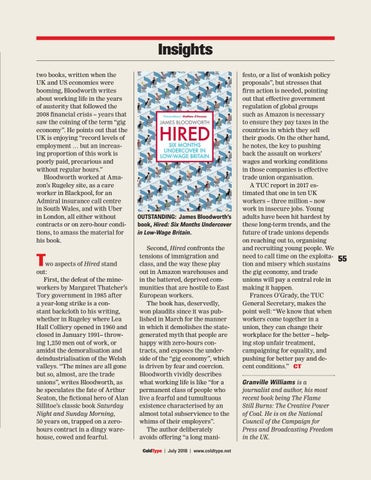
OUTSTANDING: James Bloodworth’s book, Hired: Six Months Undercover in Low-Wage Britain. Second, Hired confronts the tensions of immigration and class, and the way these play out in Amazon warehouses and in the battered, deprived communities that are hostile to East European workers. The book has, deservedly, won plaudits since it was published in March for the manner in which it demolishes the stategenerated myth that people are happy with zero-hours contracts, and exposes the underside of the “gig economy”, which is driven by fear and coercion. Bloodworth vividly describes what working life is like “for a permanent class of people who live a fearful and tumultuous existence characterised by an almost total subservience to the whims of their employers”. The author deliberately avoids offering “a long maniColdType | July 2018 | www.coldtype.net
festo, or a list of wonkish policy proposals”, but stresses that firm action is needed, pointing out that effective government regulation of global groups such as Amazon is necessary to ensure they pay taxes in the countries in which they sell their goods. On the other hand, he notes, the key to pushing back the assault on workers’ wages and working conditions in those companies is effective trade union organisation. A TUC report in 2017 estimated that one in ten UK workers – three million – now work in insecure jobs. Young adults have been hit hardest by these long-term trends, and the future of trade unions depends on reaching out to, organising and recruiting young people. We need to call time on the exploitation and misery which sustains the gig economy, and trade unions will pay a central role in making it happen. Frances O’Grady, the TUC General Secretary, makes the point well: “We know that when workers come together in a union, they can change their workplace for the better – helping stop unfair treatment, campaigning for equality, and pushing for better pay and decent conditions.” CT
Granville Williams is a journalist and author, his most recent book being The Flame Still Burns: The Creative Power of Coal. He is on the National Council of the Campaign for Press and Broadcasting Freedom in the UK.
55