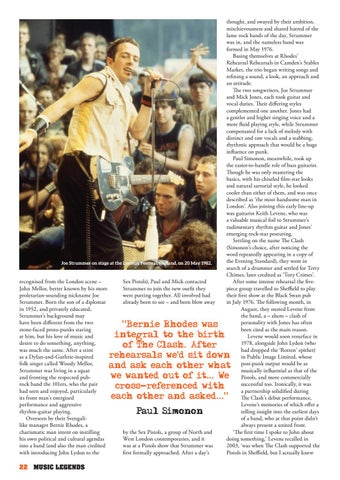
thought, and swayed by their ambition, mischievousness and shared hatred of the lame rock bands of the day, Strummer was in, and the nameless band was formed in May 1976. Basing themselves at Rhodes’ Rehearsal Rehearsals in Camden’s Stables Market, the trio began writing songs and refining a sound, a look, an approach and an attitude. The two songwriters, Joe Strummer and Mick Jones, each took guitar and vocal duties. Their differing styles complemented one another. Jones had a gentler and higher singing voice and a more fluid playing style, while Strummer compensated for a lack of melody with distinct and raw vocals and a stabbing, rhythmic approach that would be a huge influence on punk. Paul Simonon, meanwhile, took up the easier-to-handle role of bass guitarist. Though he was only mastering the basics, with his chiseled film-star looks and natural sartorial style, he looked cooler than either of them, and was once described as ‘the most handsome man in London’. Also joining this early line-up was guitarist Keith Levene, who was a valuable musical foil to Strummer’s rudimentary rhythm guitar and Jones’ emerging rock-star posturing. Settling on the name The Clash (Simonon’s choice, after noticing the word repeatedly appearing in a copy of the Evening Standard), they went in Joe Strummer on stage at the Lochem Festival, Holland, on 20 May 1982. search of a drummer and settled for Terry Chimes, later credited as ‘Tory Crimes’. After some intense rehearsal the fiveSex Pistols), Paul and Mick contacted recognised from the London scene – piece group travelled to Sheffield to play Strummer to join the new outfit they John Mellor, better known by his more their first show at the Black Swan pub were putting together. All involved had proletarian-sounding nickname Joe in July 1976. The following month, in already been to see – and been blow away Strummer. Born the son of a diplomat August, they ousted Levene from in 1952, and privately educated, the band, a – ahem – clash of Strummer’s background may personality with Jones has often have been different from the two ''Bernie Rhodes was been cited as the main reason. stone-faced proto-punks staring integral to the birth Levene would soon resurface in at him, but his love of music and 1978, alongside John Lydon (who desire to do something, anything, of The Clash. After had dropped the ‘Rotten’ epithet) was much the same. After a stint rehearsals we'd sit down in Public Image Limited, whose as a Dylan-and-Guthrie-inspired output would be as folk singer called Woody Mellor, and ask each other what post-punk musically influential as that of the Strummer was living in a squat we wanted out of it... We Pistols, and more commercially and fronting the respected pubsuccessful too. Ironically, it was rock band the 101ers, who the pair cross-referenced with a partnership solidified during had seen and enjoyed, particularly each other and asked...'' The Clash’s debut performance, its front man’s energised Levene’s memories of which offer a performance and aggressive telling insight into the earliest days rhythm-guitar playing. Paul Simonon of a band, who at that point didn’t Overseen by their Svengalialways present a united front. like manager Bernie Rhodes, a ‘The first time I spoke to John about charismatic man intent on instilling by the Sex Pistols, a group of North and doing something,’ Levene recalled in his own political and cultural agendas West London contemporaries, and it 2003, ‘was when The Clash supported the into a band (and also the man credited was at a Pistols show that Strummer was Pistols in Sheffield, but I actually knew with introducing John Lydon to the first formally approached. After a day’s 22
Music Legends