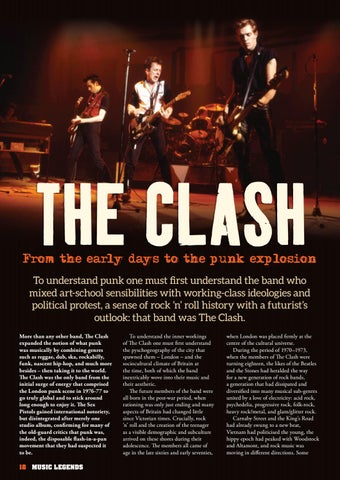
From the early days to the punk explosion To understand punk one must first understand the band who mixed art-school sensibilities with working-class ideologies and political protest, a sense of rock ’n’ roll history with a futurist’s outlook: that band was The Clash. More than any other band, The Clash expanded the notion of what punk was musically by combining genres such as reggae, dub, ska, rockabilly, funk, nascent hip-hop, and much more besides – then taking it to the world. The Clash was the only band from the initial surge of energy that comprised the London punk scene in 1976-77 to go truly global and to stick around long enough to enjoy it. The Sex Pistols gained international notoriety, but disintegrated after merely one studio album, confirming for many of the old-guard critics that punk was, indeed, the disposable flash-in-a-pan movement that they had suspected it to be. 18
Music Legends
To understand the inner workings of The Clash one must first understand the pyschogeography of the city that spawned them – London – and the sociocultural climate of Britain at the time, both of which the band inextricably wove into their music and their aesthetic. The future members of the band were all born in the post-war period, when rationing was only just ending and many aspects of Britain had changed little since Victorian times. Crucially, rock ’n’ roll and the creation of the teenager as a visible demographic and subculture arrived on these shores during their adolescence. The members all came of age in the late sixties and early seventies,
when London was placed firmly at the centre of the cultural universe. During the period of 1970–1973, when the members of The Clash were turning eighteen, the likes of the Beatles and the Stones had heralded the way for a new generation of rock bands, a generation that had dissipated and diversified into many musical sub-genres united by a love of electricity: acid rock, psychedelia, progressive rock, folk-rock, heavy rock/metal, and glam/glitter rock. Carnaby Street and the King’s Road had already swung to a new beat, Vietnam had politicised the young, the hippy epoch had peaked with Woodstock and Altamont, and rock music was moving in different directions. Some