Volume XLVIII, No. 1 • Winter 2023 • Lancaster Pennsylvania, London England
Classical Numismatic Group, LLC www.cngcoins.com
Classical Numismatic REVIEW
Contents
Editorial 1
Terms of Sale 2
How to Order 2 Calendar 3
Turtle Versus Owl – Rivalry and Coinage in Aegina and Athens
By David S. Michaels 4
Coins for Sale 7 The Handbook of Greek Coinage Series Information................................................... 99
Production Staff
Managing Director: Mike Gasvoda
Consulting Directors: Victor England, Jr. (U.S.) Eric J. McFadden (U.K.)
Director - Sales and Consignments: Dave Michaels Chief Financial Officer: Steve Pruzinsky Managing Numismatists: David Guest (U.K.) Paul Hill (U.K.) Kenneth McDevitt (U.S.) Bill Dalzell (U.S.)
Senior Numismatists Bradley R. Nelson (U.S.) D. Scott VanHorn (U.S.)
Numismatists (U.S.): Jeffrey B. Rill Lance Hickman
Tom Mullally Daniel Burch
Numismatists (U.K.): Caroline Holmes Stephen Lloyd
Lancaster Office Manager: Dylan Ossman
London Office Manager: Alexandra Spyra Office Staff: Julia Motter
Dawn Ahlgren
Jennifer Ventura
Customer Relations Manager: Kate Rill
Accounting: Sharon Pruzinsky (U.S.)
Manager - IT and Production: Travis Markel
Photography: Christian Ventura
Printing Control: Robert A. Trimble
IT Consultant: A.J. Gatlin
Classical Numismatic Review
Volume XLVIII, No. 1 Winter 2023
Welcome to our New York International Numismatic Convention Classical Numismatic Review (CNR). It is great to be back together again in New York for this most important ancient and world coin show of the year. By the time this CNR goes live on our website we will have just completed one of the finest Triton auctions we have ever offered. This is a testament to the strength of the coin market through uncertain worldwide economies and stock performance. Coins, as well as a host of other collectibles, remain quite strong and are seen as a safe haven for those with money to spend. I may sound like a broken record in saying this, but now truly is a great time to consign.
As for the coins in this CNR, we have some outstanding pieces on offer that have been acquired over the past year specifically to be offered at the NYINC. The Pantikapaion gold stater is in fabulous condition and has an incredible provenance dating back to 1901-4. We thank Dr. Ute Wartenberg Kagan for her help in researching this coin.
We have two outstanding Kaulonia Nomoi of the desirable incuse type in this list. Both have wonderful toning and excellent provenances. The design of this type is arguably the most artistic in the entire Magna Graecia incuse series.
One of my personal favorite types is represented by several examples in this CNR: Bar Kochba zuzim overstruck on Roman denarii showing clear undertypes of the host coin. On each example herein the Roman emperor portrait is quite distinct and easily discernable.
The Roman republican offering is very nice. Most coins fall into the top tier for their respective types. In particular, the denarius minted under L. Plautius Plancus – a CRI plate coin – is really superb and certainly among the best survivors of this issue.
The Claudius denarius is also among the finest known for its type. This coin, which at one time resided in my own collection of Twelve Caesars coinage, would be a perfect fit for a high grade Twelve Caesars portrait set. As those that collect this series know, a truly exceptional Claudius denarius is the most difficult portrait coin to find to complete a set.
The World and British sections of the CNR also have some noteworthy highlights. The Philip IV Petit Royal d’or is a wonderful coin in high grade. The Queen Cynethryth Penny is simply outstanding! And, certainly, the Edward VI sovereign is a coin to get excited about.
Perhaps most importantly, there are coins in this CNR at all price levels. It is fun to point out the expensive rarities but there are many exceptional collector coins in this Review at lesser pricing tiers.
We thank you for your consideration and wish you a happy and healthy new year!
Happy collecting!
Mike Gasvoda Managing Director CNG, LLC
1
Terms of Sale
1. General Information. The point of sale for all items online is Lancaster, Pennsylvania. All orders are sent from Pennsylvania.
2. Guaranty and Return Privilege. All items are guaranteed genuine. Any coin order may be returned within fourteen days of receipt for any reason. Coins that have been encapsulated (“slabbed”) by a grading and/or authentication service may not be returned for any reason, including authenticity, if they have been removed from the encapsulation (“slab”). The customer shall bear the cost of returning all items and shall insure them for their full value. Books are not sent on approval and are not subject to return.
3. Sales Tax. Several states require us to collect and remit sales tax. Where applicable the appropriate tax will be charged to the customer invoice.
4. Postage. All orders are charged for postage, insurance, and handling.
5. Payment. Orders may be paid by US$ check, credit card or wire transfer. US$ checks must be written on a US bank and may be sent to either office. We accept VISA and MasterCard; payment by credit card must be made within 14 days of the invoice date. Payment by credit card will be charged a 2.5% handling fee. Credit card payment may be arranged by phone, fax or mail. United States address and phone number: CNG, LLC, P.O. Box 479, Lancaster, PA, 17608., phone: 717-390-9194, fax: 717390-9978. United Kingdom address and phone number: CNG, LLC, 20 Bloomsbury St, London WC1B 3QA, phone +44 (20) 7495-1888, fax: +44 (20) 7499-5916. Office hours are 10AM to 5 PM Monday through Friday. US$ bank account for wire transfers will be provided by phone, fax or mail.
6. Shipment. Please provide a specific shipping address and advise us of any special shipping instructions. Unless other specific shipping instructions are indicated, coins are sent by U.S. Insured or Registered
A Note on How to Order
As with our normal monthly uploads, these coins are available for purchase on our website, www.cngcoins.com. If you are viewing the virtual catalog, you may click on an image, which will bring you to the online lot description, where you can add the coin to your cart as usual.
Digital Publications Archive
2
Digital versions of this and previous issues of the CNR are available to view or download in our Digital Publications Archive.
Major Show Schedule
Additional Shows Listed on Our Online Calendar
51st New York International January 12-15, 2023
InterContienental New York Barclay 111 East 48th Street, New York January 12, Noon-7PM Preview January 13-15, 10AM-7PM (3PM on the 15th)
Feature Auction Schedule
CNG 123 - 23-24 May 2023
A Live Online Auction to be conducted in Lancaster, Pennsylvania
CNG 124 - 19-20 September 2023
A Live Online Auction to be conducted in Lancaster, Pennsylvania
Triton XXVII - 9-10 January 2024
A Public Auction to be held in New York City
Consignment Deadlines
Feature Auction Consignment Deadlines
CNG 123 - 15 February 2023 CNG 124 - 15 June 2023
Triton XXVII - 15 September 2023
Deadlines for Electronic Auction Consignments Ongoing - About 90 days before scheduled sale
Contact us early, as sales do fill up in a hurry.
We may be contacted by email, fax, phone, or mail.
Classical Numismatic Group, LLC
Email: cng@cngcoins.com
Mailing addresses & Phone numbers:
Attention: Mike Gasvoda P.O. Box 479 Lancaster PA 17608 Phone: 717-390-9194 Fax: 717-390-9978 or
Attention: Paul Hill (Ancients) or David Guest (British and World) 20 Bloomsbury St. London WC1B 3QA
Phone: +44-20-7495-1888 Fax: +44-20-7499-5916.
3
Turtle Versus Owl Rivalry and Coinage in Aegina and Athens
By David S. Michaels
The volcanic island of Aegina sits in the Saronic Gulf off the coast of Attica, only 17 miles from the city of Athens. Though neighbors, these two great ancient cities were not friends – rather the opposite. From earliest recorded times, their peoples detested one another and competed vigorously, sometimes violently, for the trade that was so important to the ancient Greek economy. This nasty rivalry can be followed in their coinage of the sixth and fifth centuries BC.
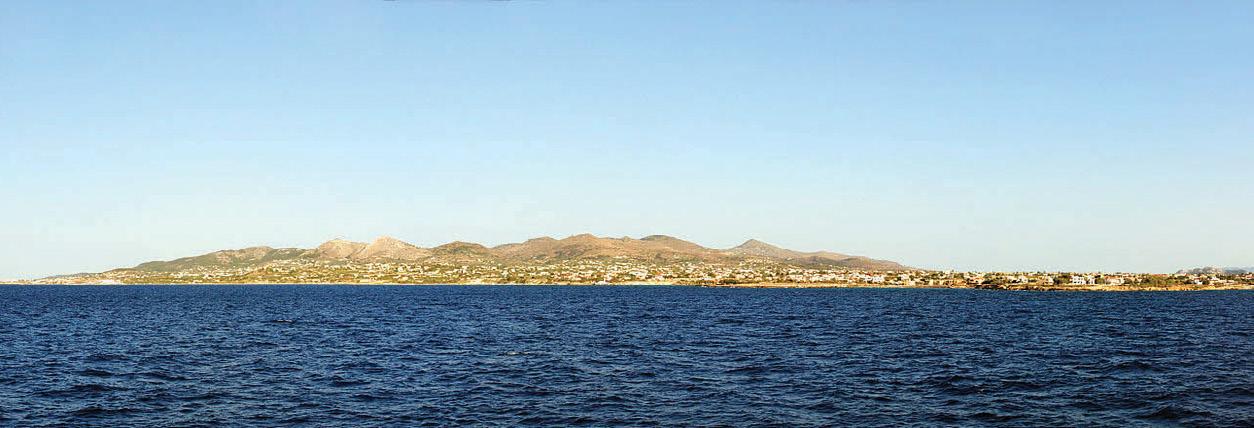
Aegina was supposedly named for a river nymph who, like so many others, was seduced by Zeus and gave birth to a hero named Aiakos, the island’s first king. While it possessed some good arable land suitable for grain, olives and figs, Aegina was mostly mountainous and, blessed with two fine harbors, ideally positioned for maritime trade. The seafaring Minoans placed a colony there that left behind a fabulous treasure of gold, dated to circa 1700 BC, found on the island in 1891. The Minoans were followed by Mycenaean and Doric settlers, the latter from the coastal city of Epidauros, who arrived in the 800s BC. They built a walled city named after the island and, more importantly, a fleet that sailed all over the ancient Aegean, establishing trading outposts in Egypt and Asia Minor, and funneling wealth back to the mother island, which was soon suitably embellished with temples dedicated to Aphrodite, Apollo and Dionysos.
At some point in the later 600s BC, Aegina broke away from the control of Epidauros, and during that revolt a group of Aeginetan sailors made off with a pair of sacred wooden cult images that Epidauros had originally gifted to Athens. It is a typically convoluted archaic tale too long to recount in detail here, but the upshot was that Athens demanded them back, Aegina refused, and thence commenced the feud between the two communities. Athenians took to referring to Aegina, easily visible from its port, as “the eyesore of the Piraeus.”
Of course, the real source of enmity was competition over trade routes and material wealth, which was greatly magnified by something the Aeginetans were the first to introduce to Europe: coined money.
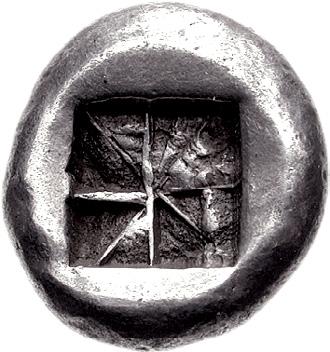
During their travels, Aegina’s merchants were exposed to the newly invented coins used by the Lydians and Ionians and took note of how they made transactions much easier. Although she had no native electrum or gold, Aegina had access to productive silver mines on the nearby island of Siphnos and so began to produce her own coins circa 550 BC. These early silver staters depicted on their obverses a sea turtle (emblematic of their marine interests, and perhaps a visual play on the island’s humped-
4
Figure 1: Aegina from the sea. Photo by Nickthestoned, courtesy Wikipedia.org.
Figure 2: Early Aegina “Turtle” Stater c. 550 BC, with smooth shell and “proto Union Jack” incuse. (CNG 76, Lot 504)
up shape viewed from the sea), while the reverses bore the imprint of the punch used to force metal into the obverse die. The weight standard was based on a drachm of about 6.1 grams; two of these made a stater weighing 12.2 grams, which became the most commonly struck denomination, although single drachms down to tiny fractions were also produced. The Aeginetan chelones (turtles) had a Mediterraneanwide circulation in the mid-sixth century making them Europe’s first important trade coin. They are still found in significant numbers today, a testament to how many millions must have been hammered out in ancient times.
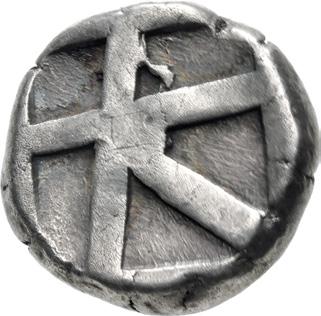
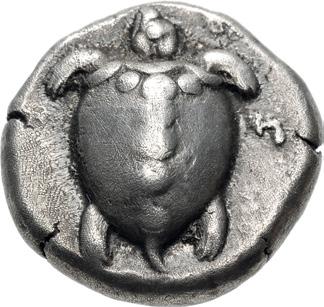

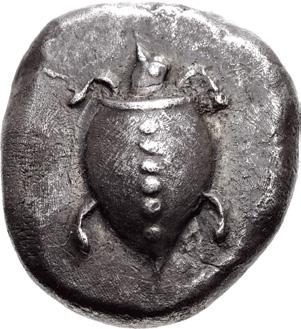
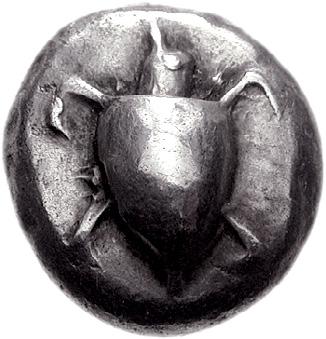
The early turtles took a number of forms, including animals with smooth shells, shells ornamented with rows of dots, and even segmented shells (the presence of flippers shows these are also sea turtles, not land tortoises). The reverse punch originally consisted of an eight-pronged design that produced eight triangles on the reverse, referred to as the “proto-Union Jack” type. This was followed by the “mill sail” incuse pattern around 525 BC, closely followed by the “skew” pattern. The obverse design was also modified by the addition of a row of large dots added at the collar from the earlier collared turtle design with a single row of dots down its shell, hence the name “T-back.”
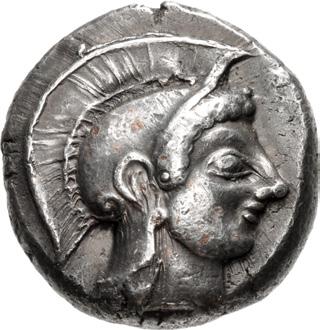
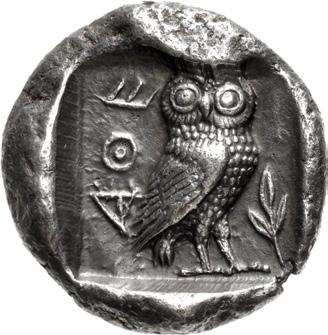
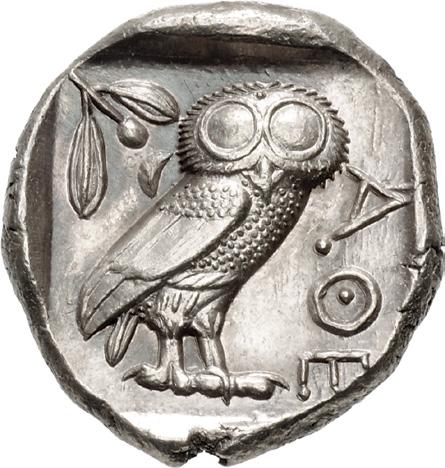
Across the Saronic Gulf, Athens viewed Aegina’s burgeoning wealth with envy and alarm. Within a decade of Aegina’s first turtles, Athenians began striking their own silver coins. After a brief period of experimentation with various designs (the so called “wappenmunzen”), Athens settled on a motif depicting a helmeted head of its patron goddess, Athena, on the obverse, and her companion, the owl, on the reverse. Athenians chose a different weight standard, the Attic, based on a drachm of about 4.5 grams, with the standard denomination valued at four drachms (tetradrachm). Unlike Aegina, whose coins remained essentially one-sided and anepigraphic (without legend), Athens’ silver pieces bore the legend ΑΘΕ on the reverse. One can almost hear an Athenian merchant proclaiming, “at least our patrons can read.”
Athenian “owls” entered circulation circa 510 BC, just in time for the first all-out war between Aegina and Athens, the so called “Heraldless War” of 506 BC. Aegina conducted several piratical raids on the Attic coastline on behalf of their ally, Thebes, and generally got the better of the fighting. Athens ultimately was forced to call a truce due to internal political turmoil fomented by another enemy, Sparta. Already seething, Athens was further infuriated when Aegina, probably because of its deep trading ties to the East, offered token submission to the Persian Great King on the eve of the Battle of Marathon.
At this point, events took a turn for the worse for Aegina as the supply of silver from Siphnos began to dry up. Whether this was due to action by Athens or a natural petering out of the mines is not well understood, but the production of Aegina’s turtles sharply decreased over the years 500-480 BC. Athens, meanwhile, had found a bountiful supply of silver at Laurion,
5
Figure 3: Turtle with decorated shell, c. 550 BC. (Triton XXIII, Lot 266)
Figure 4:”T-back” turtle with skew increase. (Winter 2023 CNR #5611877)
Figure 5: Early Athens owl c. 510 BC. (Triton XXIV, lot 512)
and began hammering out huge numbers of owls. When the Persians threatened to invade Greece again under Xerxes, Athens, new mistress of the Aegean, demanded Aegina hand over 10 leading citizens as hostages to ensure loyalty to the Greek cause; this time Sparta backed her up.
Although Aegina’s fleet acquitted itself superbly against the Persians in the naval battle of Salamis, this wasn’t enough to end the feud with Athens. After the Persian withdrawal, Aegina refused to join Athens’ defensive Delian League, which quickly morphed into an Athenian Empire. In 460 BC, Athens declared war on Aegina and, in a quick strike, captured 70 of its ships, effectively neutralizing its navy. Athenian troop landings followed, and the citadel of Aegina endured a brutal siege before capitulating in 458 BC. Aegina was now forced to join the Delian League headed by its hated rival, pay 30 talents of silver per year, and give up its fleet and proud maritime tradition.
While Aegina could continue striking coins, the loss of her sea power after 457 BC was symbolized by the permanent replacement of the smooth-shelled sea turtle with a segmented-shelled land tortoise, with stumpy legs instead of flippers. After the Athenian takeover the “skew pattern” reverse incuse also began to take a more schematic form. Within a few years letters and symbols began appearing on either side of the tortoise and within the sunken compartments of the reverse, probably to indicate the workshops and magistrates responsible for the issue. Thousands of these staters were no doubt handed over to Athens in payment of their war indemnity and were melted down and cast into blanks for Athenian owls, now being produced in staggering numbers.
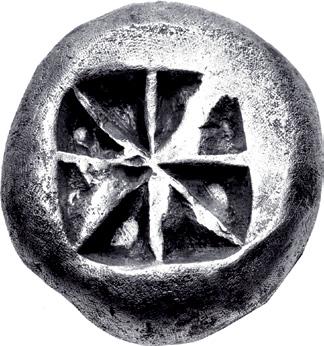
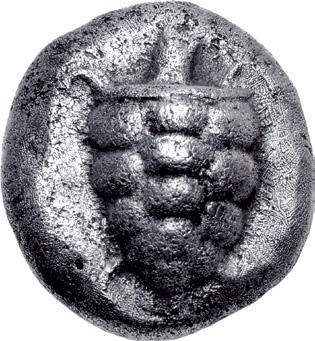
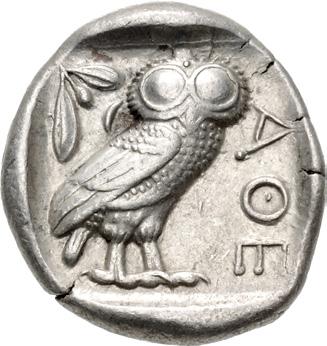
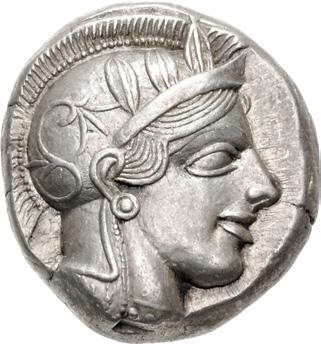
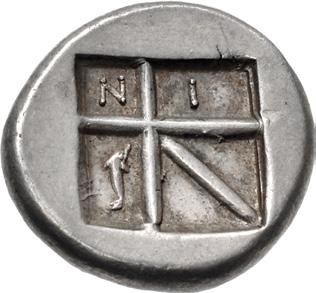
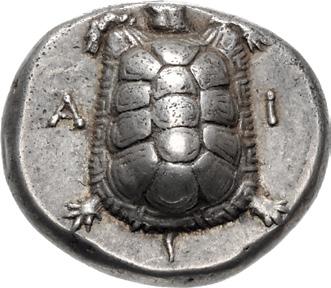
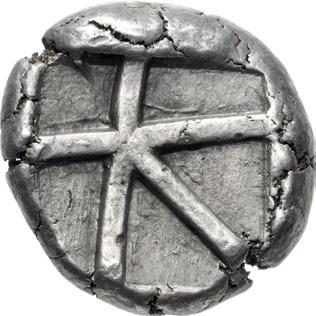
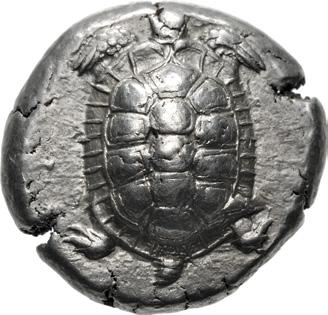
This was not the ultimate indignity for Aegina –that came in 431 BC, when the native Aeginetans were expelled from their homeland by Athens at the height of the Peloponnesian War, to be replaced by Athenian colonists. These, in turn, were kicked out by Sparta after her final victory over Athens in 405 BC, allowing the surviving Aeginetans to return.
The survivors resumed striking coins, but in numbers that were only a feeble echo of their glory years. In fact, both Athens and Aegina had been humbled, in different ways, and their mutual hatred finally gave way to a kind of commiseration as first Macedon, then Rome took command of the Aegean and Greece. Perhaps they recognized that centuries of enmity had ultimately produced little else but grief for all concerned.
That, and some very interesting and attractive coins!
6
Figure 7: Land tortoise with skew incuse. (Winter 2023 CNR #5624322)
Figure 8: Land tortoise with letters and symbols. (Winter 2023 CNR #5624581)
Figure 9: “Mass coinage” Athens owl, circa 454 BC. (Winter 2023 CNR #499023)
Figure 6: Early segmented-shell sea turtle, c. 525 BC. (CNG 87, Lot 468)
Three Gold Pieces from the Flesche Collection
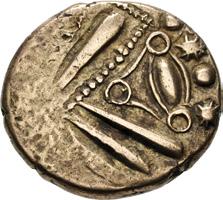
5612273. CENTRAL EUROPE, Vindelici. AV Stater (18mm, 7.78 g). Blank convex surface with central bulge / Fourray star with concave circular incuse. Kellner 2143; KMW 462; De la Tour –; Flesche 331 (this coin). Toned, a few edge splits. VF. Rare. $4500
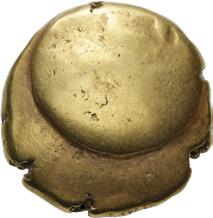
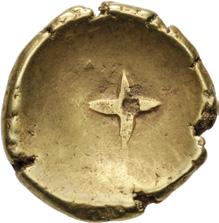
Ex Christian Flesche Collection; Lanz 92 (4 June 1999), lot 19.
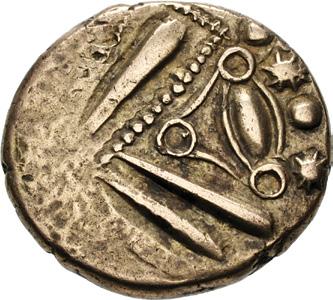
5612272. GAUL, Northeast. Morini Circa 60-30/25 B. AV Quarter Stater (1.51 g, 9h). Abstract image of boat with two riders right(?); pellet to left; all within border of small x-like ornaments / Central bar bisected by rooted tree; bent line below, crescent and three-pronged ornament in exergue. Scheers 116; D&T 249; Depeyrot, NC VI 295; Van Arsdell 69-1; SCBC 10; Flesche 226 (this coin). Lightly toned. Near VF. $2450
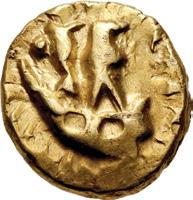
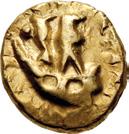
Ex Christian Flesche Collection; Gorny & Mosch 164 (17 March 2008), lot 3.
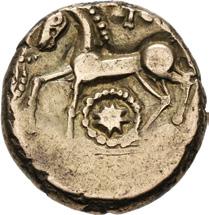
5612269. GAUL, Northeast. Treviri 50-30 BC. AV Stater (18mm, 5.55 g, 9h). APΔA type, Class VI. Celticized eye in profile; three stars to right, [pellets around] / Celticized horse prancing left on ground line; above, symbol flanked by pellets; star within pelleted circle below; [APΔA in exergue]. Scheers, Traité, 232; Depeyrot, NC VII 88; D&T 601 (Remi); Flesche 248 (this coin). Toned, traces of deposits, areas of peripheral weakness. Good VF. Rare. $3450
Ex Christian Flesche Collection; Gorny & Mosch 107 (2 April 2001), lot 1.
7
CELTIC
GREEK
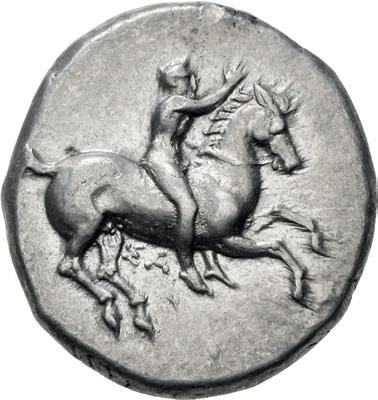
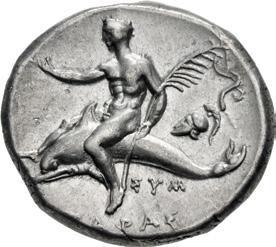
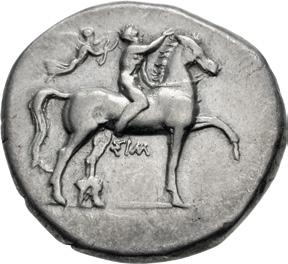
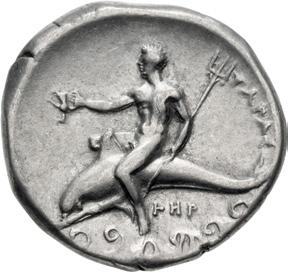
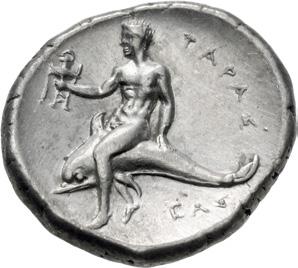
5619076. CALABRIA, Tarentum. Circa 330-325 BC. AR Nomos (23mm, 7.80 g, 11h). Nude youth on horse stepping right, holding rein in right hand and crowning horse with wreath in left; to left, small Nike flying right, crowning youth with open wreath held in both hands; s5Â below / Phalanthos, nude, holding kantharos in extended right hand and cradling trident in left arm, riding dolphin left; tÅrÅs to right, ^˙r and waves below. Fischer-Bossert Group 62, 786 (V308/R610); Vlasto 503; HN Italy 886; SNG Lockett 174 (same dies); SNG München 636 (same dies). Underlying luster, small die break on obverse. Near EF. Fine style. $2250
5619069. CALABRIA, Tarentum. Circa 315 BC. AR Nomos (20mm, 7.86 g, 3h). Nude youth on horse galloping right, holding rein in right hand and extending left hand; sÅ below / Phalanthos, nude, extending right hand and cradling filleted palm frond in left arm, riding dolphin left; to left, crested Corinthian helmet left; sUÂ and [t]ÅrÅs below. Fischer-Bossert Group 67, 806 (V319/R625); Vlasto 652 (same dies); HN Italy 886; SNG Copenhagen 859 (same dies). Underlying luster, minor die wear and small edge bump on obverse. Near EF. Well centered on a broad flan, struck from dies of fine style. $2750
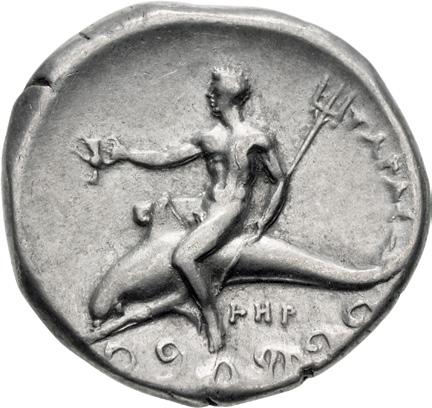
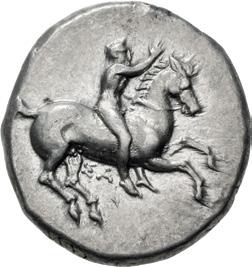
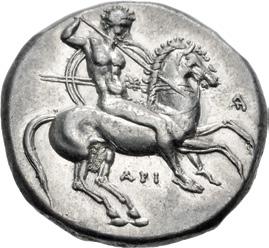
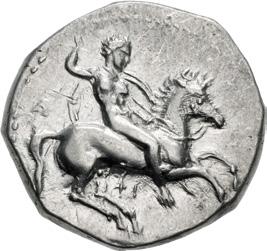
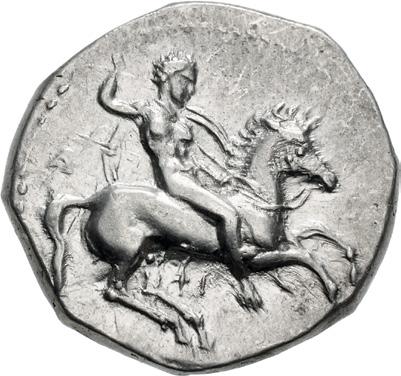
5619066. CALABRIA, Tarentum. Circa 315-302 BC. AR Nomos (21mm, 7.85 g, 11h). Warrior, nude, preparing to cast spear held aloft in right hand, holding two spears and shield with left hand, on horse rearing right; Å to right, År5 below / Phalanthos, nude, holding kantharos in extended right hand and cradling rudder in left arm, riding dolphin left; Å to upper left, tÅ-rÅs to right. Fischer-Bossert Group 74a, 907 (V355/R705); Vlasto 643 (same obv. die); HN Italy 939. Underlying luster, some die rust on obverse, flan flaw and die wear on reverse. EF. Well centered and struck from dies of fine style. $3750
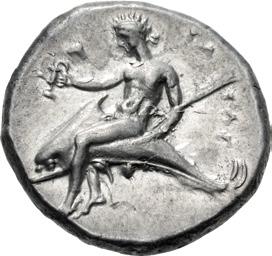
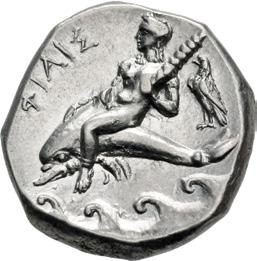
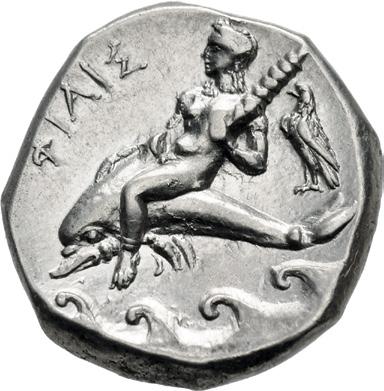
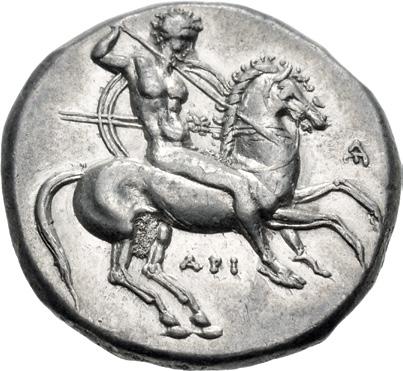
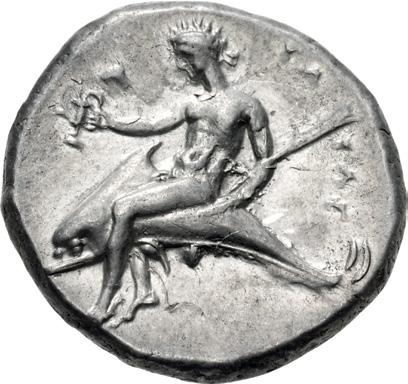
5619065. CALABRIA, Tarentum. Circa 290-281 BC. AR Nomos (21mm, 7.93 g, 3h). Nude warrior, holding shield and two spears in left hand, preparing to cast a third spear held aloft in right hand, riding horse leaping right; } to left, f5 below / Phalanthos, nude, holding distaff in right hand, riding dolphin left; to right, eagle, with wings closed, standing left; f5¬5s to left, waves below. Fischer-Bossert Group 78b, 1073 (V405/R827); Vlasto 571 (same dies); HN Italy 933; McClean 603 (same dies). Lustrous, some die wear on obverse. EF. $3250
8
5619068 5619060
5619068. CALABRIA, Tarentum. Circa 280 BC. AR Nomos (21.5mm, 7.83 g, 5h). Nude youth on horse stepping right, holding rein in right hand and crowning horse with wreath in left; sÅ to left, ÅrE>QW@ in two lines below / Phalanthos, nude, holding tripod in extended right hand, riding dolphin left; tÅrÅs to right, 1Ås below. Vlasto 666–7; HN Italy 957. Underlying luster, trace deposits, light hairlines. Near EF. Struck on a broad flan. $2750
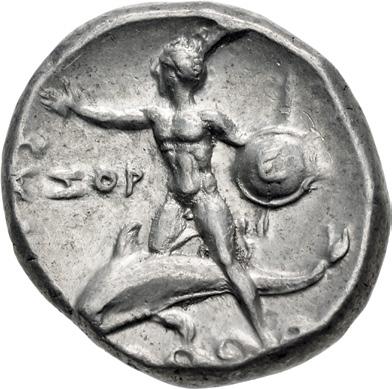
5619060. CALABRIA, Tarentum. Circa 280 BC. AR Nomos (21mm, 7.82 g, 5h). Nude youth on horse stepping right, holding rein in right hand and crowning horse with wreath in left; ˚rÅt>5@os in two lines below / Phalanthos, nude, holding kantharos in extended right hand, riding dolphin left; tÅrÅs to right, zor below. Vlasto 678 (same dies); HN Italy 957. Underlying luster, a few light scratches on reverse. Near EF. $1850
Marking a Pyrrhic Victory?
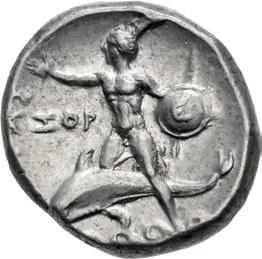
5619070. CALABRIA, Tarentum. Circa 280 BC. AR Nomos (19.5mm, 7.90 g, 7h). Warrior, nude but for crested helmet, wearing shield on left arm and holding spear in left hand, on horse prancing left; to left, Nike standing facing, restraining horse with both hands; [¬Uk5skos below] / Phalanthos, nude, extending his right arm, wearing shield inscribed E on his left arm and holding two spears in his left hand, riding dolphin left; [tÅr]Ås and zor to left, waves below. Vlasto 679–82; HN Italy 963. Underlying luster, minor die wear, a little die rust. Near EF. $3000
This unusual issue differs from the standard Tarentine nomos types by introducing a figure of Nike on the obverse restraining the horse; likewise, the reverse depiction of Phalanthos/Taras stands upright atop the dolphin in a fighting stance, instead of riding seated as usually shown. The new types surely reflect the presence of Pyrrhos of Epiros, who arrived at Tarentum with his army in 280 BC to begin his bloody war against Rome on behalf of the Greek city-states of southern Italy. The Pyrrhic victory at Heraclea the same year likely accounts for the presence of Nike leading the cavalryman. Although he continued to win battles, the term “Pyrrhic victory” would soon take on a very different connotation as the war dragged on.
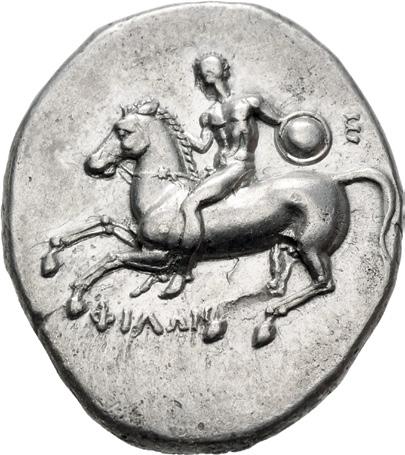
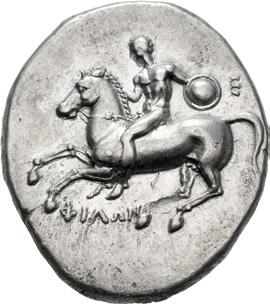
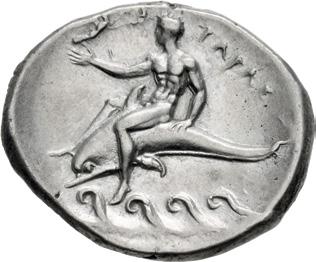
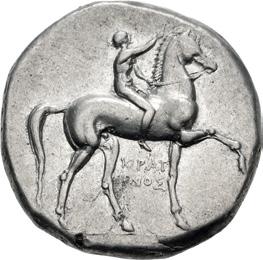
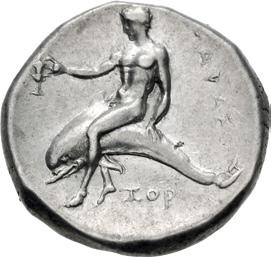
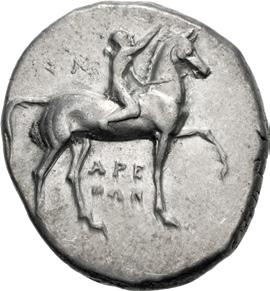
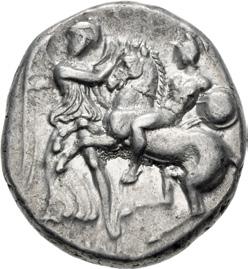
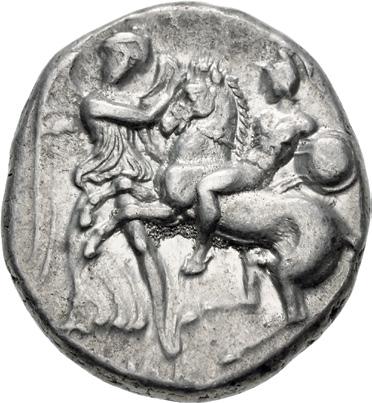
5619074. CALABRIA, Tarentum. Circa 280 BC. AR Nomos (21.5mm, 7.71 g, 9h). Nude youth, shield on left arm, placing right hand on head of horse he rides left; E[U] to right, f5¬W@ below / Phalanthos, nude, holding crowning Nike in extended right hand, riding dolphin left; tÅrÅs to right, waves below. Vlasto 685; HN Italy 964. Underlying luster, slight die wear. Near EF. Well centered, fine style. $4250
9
5619063. CALABRIA, Tarentum. Circa 280 BC. AR Nomos (22.5mm, 7.89 g, 12h). Nude youth, shield on left arm, placing right hand on head of horse he rides left; s5 to right, f5¬o˚¬˙s below / Phalanthos, nude, holding wreath in extended right hand, riding dolphin left; tÅrÅs to right, ¬U below. Vlasto 688–90; HN Italy 965. Underlying luster, die break on obverse, a little die rust on reverse. EF. Well centered and struck on a broad flan. $2500
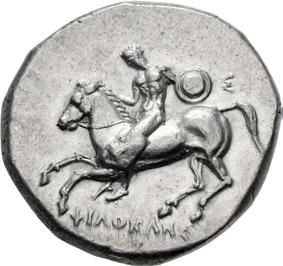
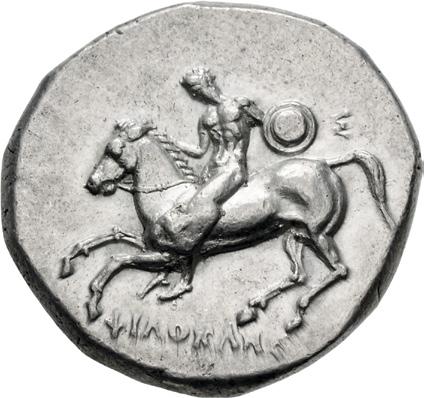
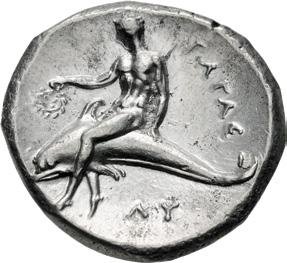
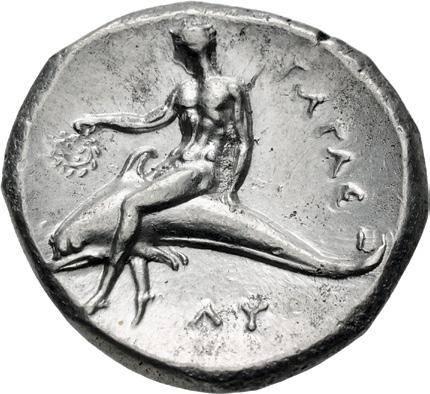
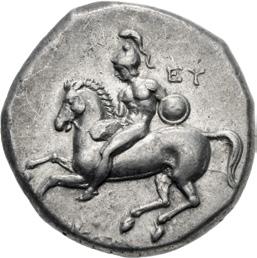
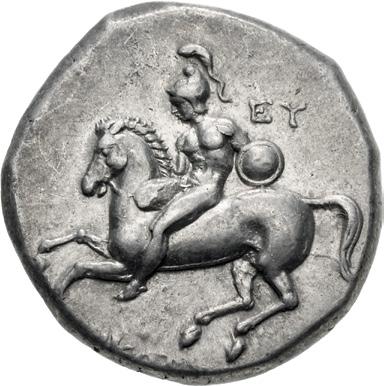
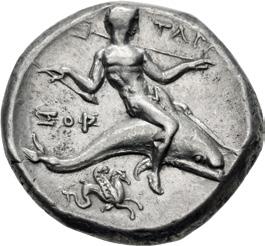
5619072. CALABRIA, Tarentum. Circa 280 BC. AR Nomos (20.5mm, 7.80 g, 10h). Warrior, nude but for crested helmet, shield on left arm, placing right hand on head of horse he dismounts left; EU to right, [@]5˚Wt[tÅs] below / Phalanthos, nude, holding spear in right hand and trident in left, riding dolphin right; tÅr[Ås] to upper right, zor to left; below, hippocamp right. Vlasto 700; HN Italy 968. Lightly toned, underlying luster. EF. Fine style. $3500
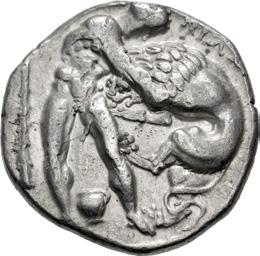
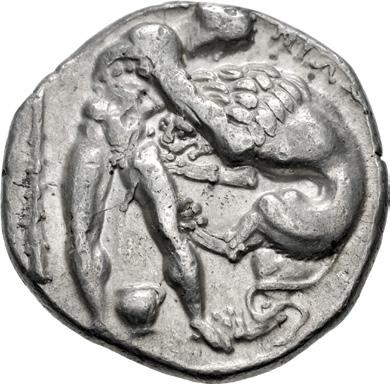
5619089. LUCANIA, Herakleia. Circa 390-340 BC. AR Nomos (20.5mm, 7.87 g, 6h). Head of Athena right, wearing single-pendant earring, necklace, and crested Attic helmet decorated with Skylla throwing stone held in right hand; EU to right / Herakles standing facing, torso right, strangling the Nemean Lion to right; [^˙rÅk¬]-E5W@ above, [Åπo¬] and club to left, oinochoe below. Work 47 (same dies); Van Keuren 51 (same obv. die as illustration); HN Italy 1378; Hunterian 7 (same dies); Weber 706 (same dies). Trace deposits, slight die wear on reverse. Good VF. Well centered. $2950
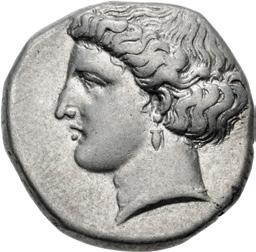
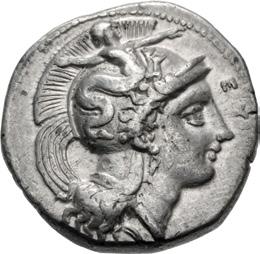
Herakleia was a relatively late foundation along the instep of the Italian “boot,” starting out as a compromise settlement between the warring city-states of Thourioi and Tarentum in circa 432 BC. Although widely regarded as a colony of Tarentum, Heraclea considered itself independent and played host to an annual meeting of envoys from all the Italo-Greek cities. Named after Herakles, the city’s coinage naturally depicted the powerful demigod on the reverse, here in a deadly embrace with the Nemean Lion.
Extremely Rare Issue
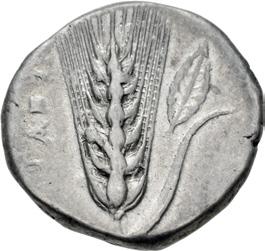
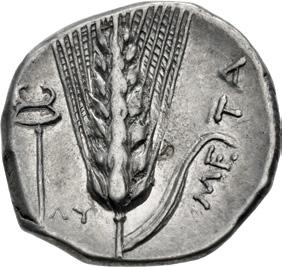
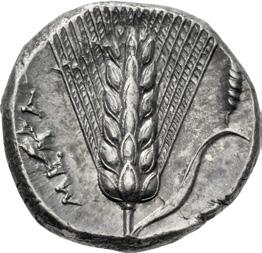
5619078. LUCANIA, Metapontion. Circa 400-340 BC. AR Nomos (20mm, 7.76 g, 5h). Head of Demeter left, wearing triple-pendant earring / Grain ear with leaf to right; [ÂE]t&πo@ upward to left, laurel leaf to right. Noe 524.1 (same dies); HN Italy 1545. Slightly off center. VF. Fine style. Extremely rare issue, only two examples noted in Johnston’s addenda to Noe (both in public collections), none in CoinArchives. $2950
10
5619084. LUCANIA, Metapontion. Circa 340-330 BC. AR Nomos (21mm, 7.80 g, 9h). Head of Demeter left, wearing wreath of grain ears, single-pendant earring, and pearl necklace / Barley ear with leaf to right; to left, kerykeion above ¬U; µE-tÅ upward to right. Johnston Class A, 1.5 (same dies); HN Italy 1556; SNG Lloyd 371 (same dies). Underlying luster, slightly weak at high points, small flan flaw on reverse. Good VF. Struck on a broad flan from dies of fine style. $1850
5619082. LUCANIA, Metapontion. Circa 340-330 BC. AR Nomos (20mm, 7.71 g, 7h). Head of Demeter right, wearing wreath of grain ears, veil, single-pendant earring, and pearl necklace; [tiny f to lower right] / Barley ear with leaf to right; ÂEtÅ upward to left, f to left of stem; to right, mouse right on leaf, f below. Johnston Class A, 8.10 (same dies); HN Italy 1570; SNG ANS 420 (same obv. die); Jameson 313 (same dies). Slight die wear, minor flan flaw on obverse. Near EF. Well centered. $1350
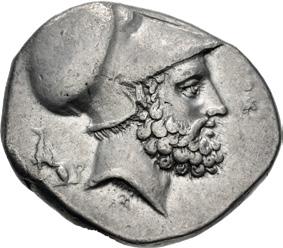
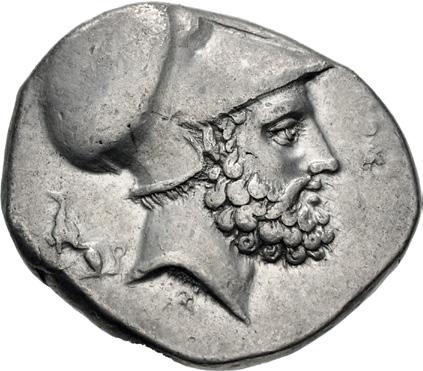
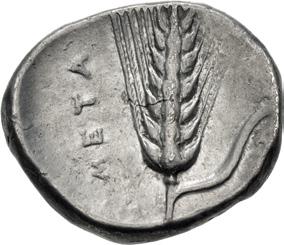
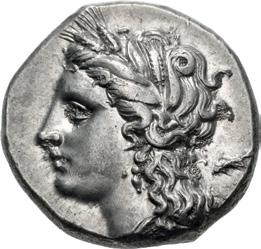

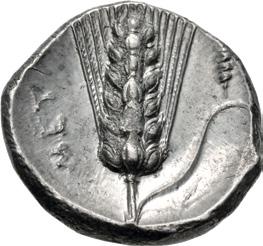
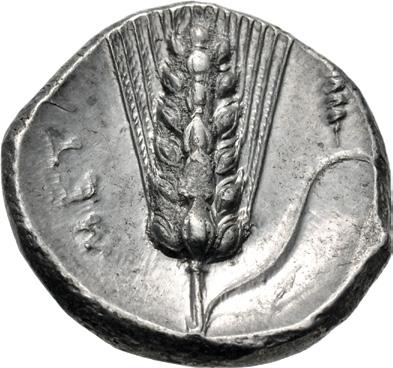
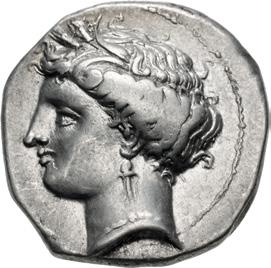
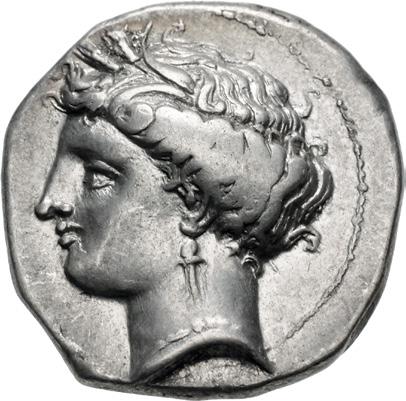
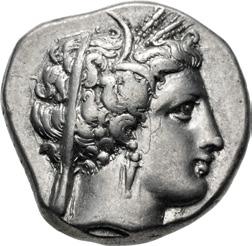
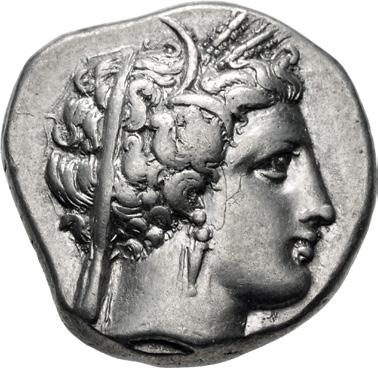
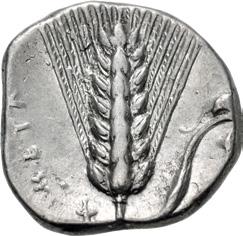
5619085. LUCANIA, Metapontion. Circa 340-330 BC. AR Nomos (22mm, 7.74 g, 12h). Head of Leukippos right, wearing Corinthian helmet; to left, dog seated left, raising forepaw; [¬EU˚5π]πos above, s below neck truncation / Barley ear with leaf to right; ÂEtÅ upward to left; [to right, bird seated right with open wings above leaf, ÅÂ5 below]. Johnston Class B, 3.20 (same dies); HN Italy 1576; SNG ANS 445 (same dies); SNG Ashmolean 736 (same dies). Slight die wear, a little off center, minor flan flaw on reverse. Good VF. $1750
Leukippos was revered as the founder of Metapontion, who led a band of Achaean settlers, but little is known about him aside from this. Several figures in Greek mythology and philosophy are named Leukippos, but none seem to be a match for the founder of Metapontion. He is shown here wearing a Corinthian style helmet pushed back on his head, indicating his status as a warrior and leader of men.
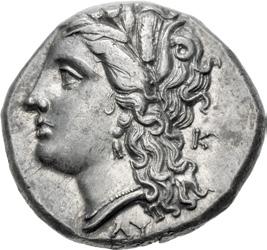
5619081. LUCANIA, Metapontion. Circa 290-280 BC. AR Nomos (20.5mm, 7.92 g, 3h). Head of Demeter left, wearing wreath of grain ears, single-pendant earring, and pearl necklace; d5 to right / Barley ear with leaf to right; ÂEtÅ upward to left, spindle above leaf. Johnston Class D, 1.2 (same dies); HN Italy 1612; SNG ANS 507 (same obv. die); SNG Ashmolean 776 (same obv. die). Underlying luster, die rust, some die wear on reverse. EF. $2950
11
5619080. LUCANIA, Metapontion. Circa 290-280 BC. AR Nomos (21mm, 7.91 g, 2h). Head of Demeter left, wearing wreath of grain ears, single-pendant earring, and pearl necklace; ˚ to right, ¬U below / Barley ear with leaf to right; ÂEtÅ upward to left, spindle above leaf. Johnston Class D, 1.4 (same dies); HN Italy 1612; SNG Fitzwilliam 507 (same dies). Lightly toned, underlying luster, a couple marks on obverse, minor die break on reverse. EF. $2950
Butting Bull
5619087. LUCANIA, Thourioi. Circa 400-350 BC. AR Dinomos – Distater (25mm, 15.62 g, 11h). Head of Athena right, wearing crested Attic helmet decorated on its bowl with Skylla scanning; d[5] vertically behind neck / Bull butting right; QoUr5W@ above; in exergue, fish right. Noe, Thurian, F16 (same obv. die); HN Italy 1805; Weber 878 (same obv. die). Small die break and area of weak strike on obverse. Good VF. Attractive, vigorous bull. $4750
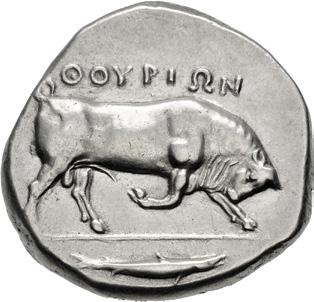
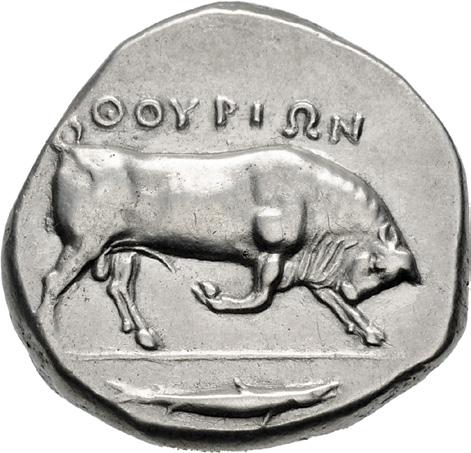
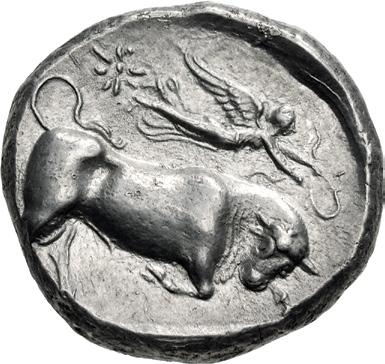
Thourioi arose out of the ashes of Sybaris, which had been first besieged and destroyed by neighboring Kroton in 510/9 BC. Attempts to refound the city were foiled by Kroton over the next decades, until the refugees from Sybaris appealed to Sparta and Athens for help in gaining back their homeland. Athens sent ships, soldiers and colonists who were able to repel the Krotoniates, allowing the city to be refounded, now as Thourioi, circa 446/5 BC. The new coinage of Thourioi would relate to both the support of Athens and to the foundation history of the original city. The helmeted head of Athena is the obverse type while the butting bull, recalling Sybaris, adorns the reverse. The city grew rich enough to strike a double denomination, the dinomos, seen here. The larger flan offered a talented die engraver the chance to depict a detailed figure of the monstrous Skylla adorning Athena’s helmet; normally Skylla is shown hurling a rock, but here she raises her hand to her brow, scanning the horizon ahead for ships to destroy.
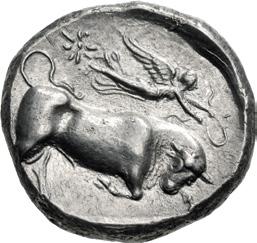
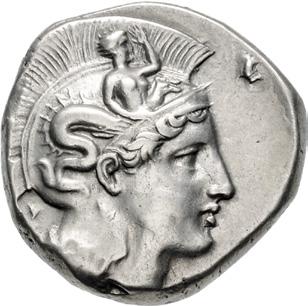
5619088. LUCANIA, Thourioi. Circa 300 BC. AR Nomos (20mm, 7.79 g, 1h). Head of Athena left, wearing triplepenant earring, pearl necklace, and helmet decorated
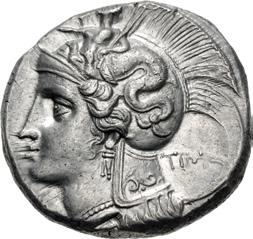
and holding rudder; t5Âo behind neck / Bull butting right; above, star and Nike flying right, crowning bull with wreath held in both her hands; [QoUr5W@ in exergue]. CNG 121, lot 77 (same dies); cf. HN Italy 1831/1879 (for obv./rev.); otherwise, unpublished in the standard references. Underlying luster, reverse a tad off-center. EF. Rare. $2950
12
with Skylla pointing
Two Choice Kaulonia Nomoi
Ex Fekula and Hunt Collections
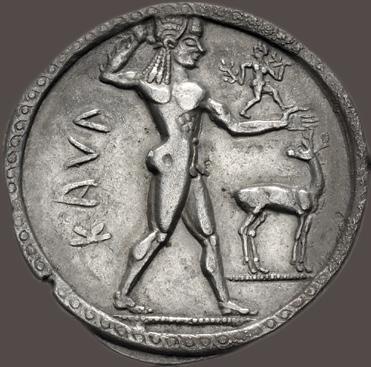
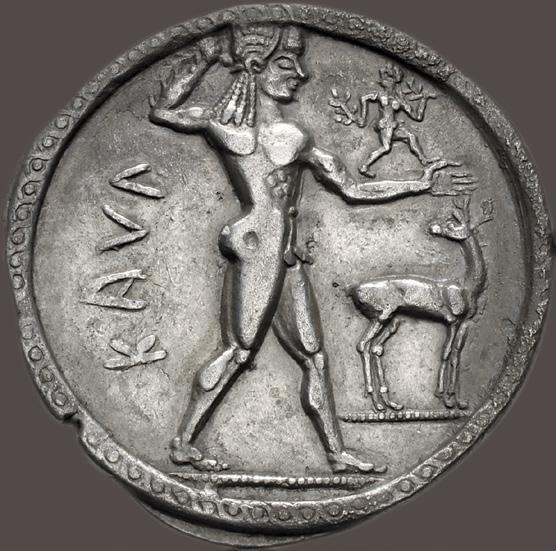
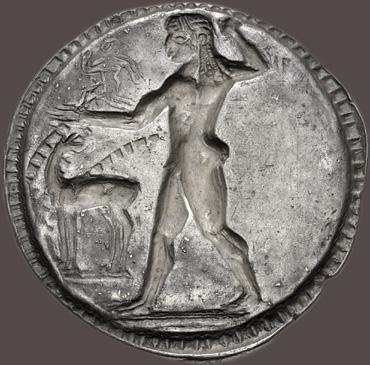
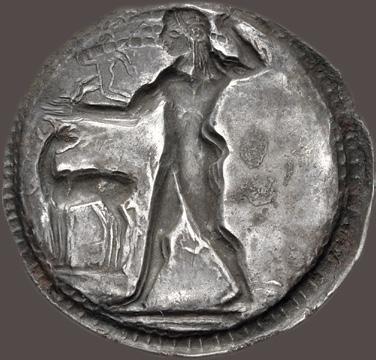
5611716. BRUTTIUM, Kaulonia. Circa 525-500 BC. AR Nomos (31mm, 7.72 g, 12h). Apollo advancing right, holding branch aloft in right hand, left arm extended, upon which a small daimon, holding branch in each hand, runs right; ˚å¨Ò to left; to right, stag standing right, head reverted; dot-and-cable border / Incuse of obverse, but daimon in outline and no ethnic; radiate border. Noe, Caulonia, Group A, 10 (same dies); Gorini 3; HN Italy 2035; SNG ANS 146 (same dies); Boston MFA 172 = Warren 138 (same dies); Jameson 408 (same dies). Attractively toned. Near EF. Struck from elegant dies. $35,000
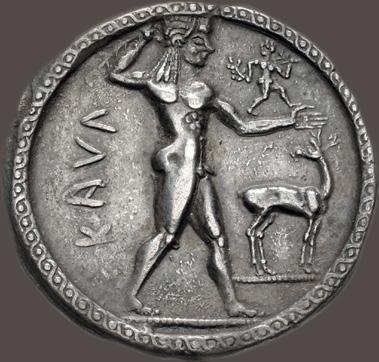
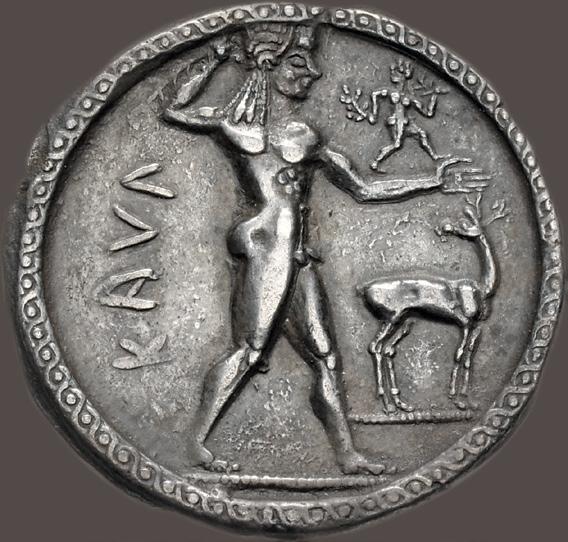
Ex George & Julia Fekula Collection (Classical Numismatic Group 87, 18 May 2011), lot 189; Nelson Bunker Hunt Collection (Sotheby’s, 19 June 1991), lot 45.
Kaulonia was one of a number of Achaian colonies established in Magna Graecia in the seventh century BC. It is not certain whether it was founded by new colonists from the Peloponnesos or whether it was founded by the Achaians of Kroton. Kaulonia’s coinage began in the later sixth century, and was one of the many incuse types that marked the beginning of coinage in Italy. Apollo, the patron deity of Kaulonia, and his associated iconography were the primary types featured on the coins. In the early fourth century Kaulonia joined with Sybaris and Kroton in a league that was defeated by Dionysios I of Syracuse in 389/8 BC. Although the city was left intact, this event marked the cessation of its coinage.
5624577. BRUTTIUM, Kaulonia. Circa 525-500 BC. AR Nomos (30.5mm, 7.93 g, 12h). Apollo advancing right, holding branch aloft in right hand, left arm extended, upon which a small daimon, holding branch in each hand, runs right; ˚å¨Ò to left; to right, stag standing right, head reverted; dot-and-cable border / Incuse of obverse, but daimon in outline and no ethnic; radiate border. Noe, Caulonia, Group A, 10 (same dies); Gorini 3; HN Italy 2035; SNG ANS 146 (same dies); Boston MFA 172 = Warren 138 (same dies); Jameson 408 (same dies). Attractive old collection tone, minor die rust on obverse. Choice EF. A splendid example of archaic Greek artistry. $29,500
Ex Father & Son Collection; Classical Numismatic Review XLV.1 (Winter 2020), no. 526710; Künker 326 (7 October 2019), lot 560; Tony Hardy Collection (Classical Numismatic Group 69, 8 June 2005), lot 58.
13
5611716 5624577
Pedigreed to 1933
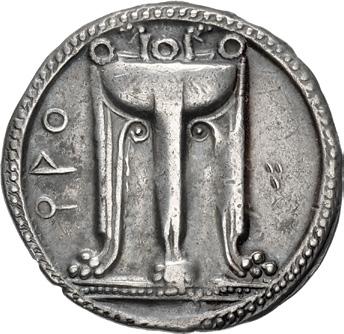
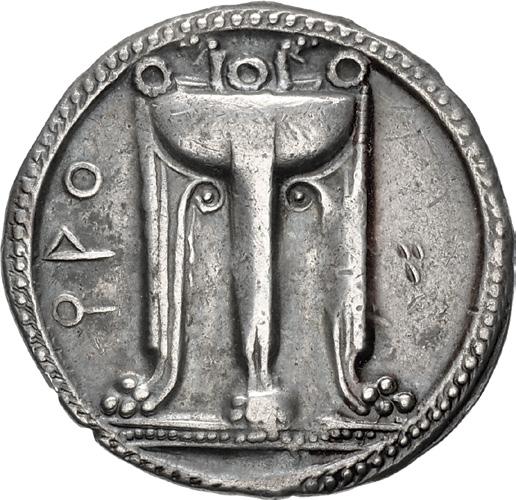
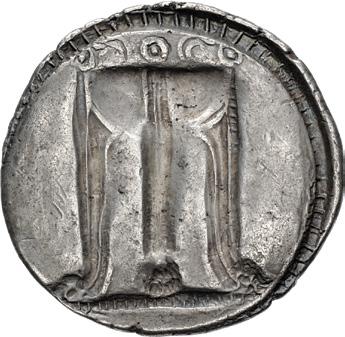
5620771. BRUTTIUM, Kroton. Circa 530-500 BC. AR Nomos (29mm, 7.95 g, 12h). Tripod, legs surmounted by wreaths and terminating in lion’s feet, two serpents rising from the bowl, set on basis of three lines, the center dotted; J®o to left / Incuse tripod as obverse, but wreaths and serpents in relief. Gorini 3 and p. 152–3 = Basel 194; Attianese 5; HN Italy 2075; SNG ANS 229; SNG Lewis 246; de Luynes 701. Lovely old collection tone, a few minor marks. Near EF. $12,500
Ex A. Page (19 June 1933), lot 86.
The Delphic tripod depicted on both the obverse (in relief) and reverse (incuse) derive from the city’s foundational legend. According to this, one Myskellos, obeying a directive of the oracle of Delphi, led a group of Achaean settlers to the site and founded the city around 710 BC. This divine sanction is represented by the tripod of the oracle, which became the civic badge of Kroton and is featured on its coinage. Kroton was among the first cities to produce coinage in Italy, its earliest being of the incuse type struck on the Achaian standard.
5620494.
From Dies of Fine Workmanship
5624578.
Ex
14
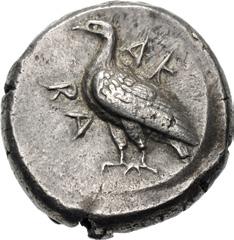
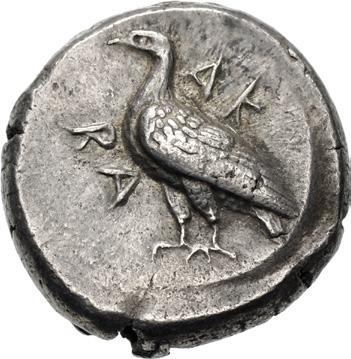
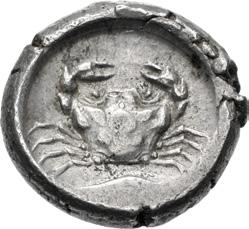
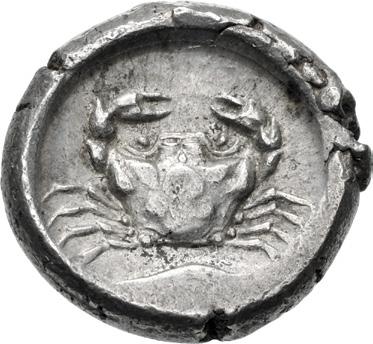
SICILY, Akragas. Circa 480/78-470 BC. AR Didrachm (19mm, 8.71 g, 3h). Sea eagle standing left; A˚-∞A around / Crab; grain ear below. Westermark, Coinage, Period I, Group IV, 264 (O88/R182); HGC 2, 97; SNG Fitzwilliam 899 (same dies); SNG München 56 (same dies). Lightly toned. Near EF. Well centered and struck. $6950
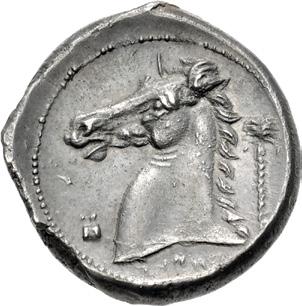
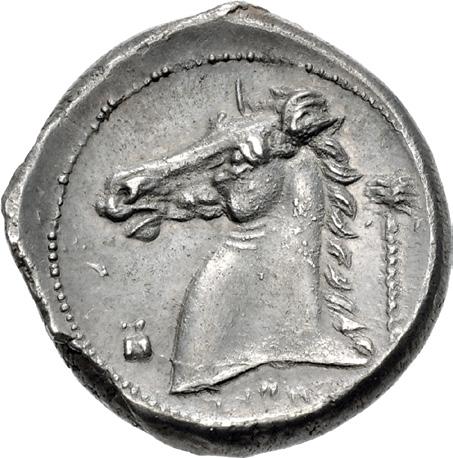
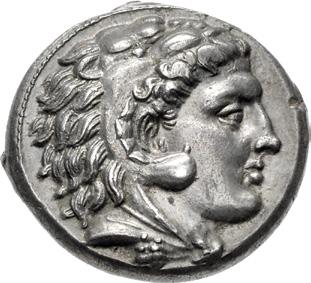
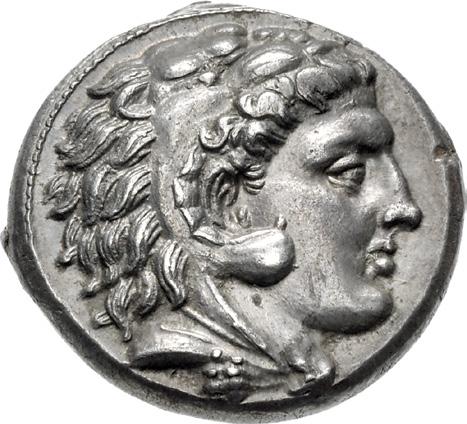
SICILY, Entella. Punic issues. Circa 300-289 BC. AR Tetradrachm (26mm, 16.71 g, 3h). Head of Herakles right, wearing lion skin / Head of horse left; astragalos to left, palm tree to right, MBßJM (Punic MHSBM) below. Jenkins, Punic, Series 5b, 367–9 var. (O115/R– [unlisted rev. die]); HGC 2, 295. Attractive deep iridescent toning, minor deposits on reverse. EF. Well struck from dies of fine workmanship. $14,500
Father & Son Collection (Classical Numismatic Group 118, 14 September 2021), lot 617; Nomos 19 (17 November 2019), lot 43; Classical Numismatic Group 61 (25 September 2002), lot 388.
Ex Collection of a Connoisseur - Harald Salvesen
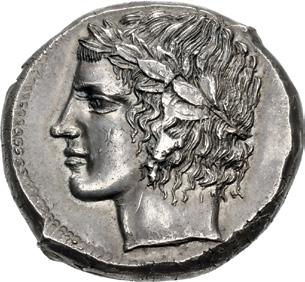
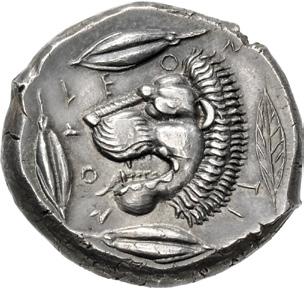
5616499. SICILY, Leontini. Circa 430-425 BC. AR Tetradrachm (24mm, 17.82 g, 1h). Head of Apollo left, wearing laurel wreath / Head of roaring lion right; 6E-o-n-t5-n-on around; three barley grains above, to left, and below; leaf behind. Boehringer, Münzgeschichte 55 (same dies); HGC 2, 671 (same dies as illustration); SNG ANS 257 (same dies); SNG Lloyd 1063 (same obv. die); Basel 353 (same dies); Rizzo pl. XXIV, 4 (same dies). Wonderful cabinet tone. Choice EF. Well centered and struck on a broad flan. $15,900
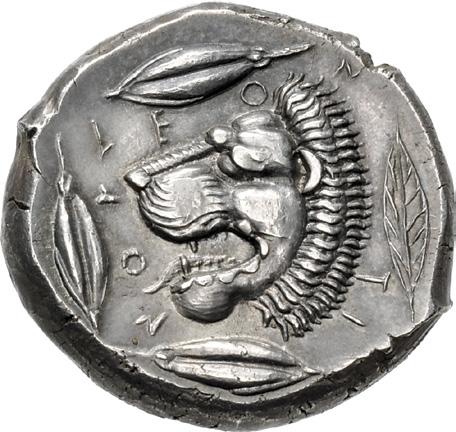
Ex Harald Salvesen Collection, purchased from Victor England, 1990s.
This attractive tetradrachm was probably struck about two decades after the initial introduction of the Apollo / Lion type. While early heads of Apollo were rendered in a highly stylized manner, here he appears as an idealized human. Apollo was especially revered at Leontini, as he was at the mother city of Naxos where there was a famous sanctuary of Apollo Archegetes. The lion was the emblem of Apollo but probably also represents a punning allusion to the city name. The surrounding barley-grains are indicative of the exceptional fertility of the Leontine territory and doubtless refer to the local worship of Demeter, the goddess of agriculture.
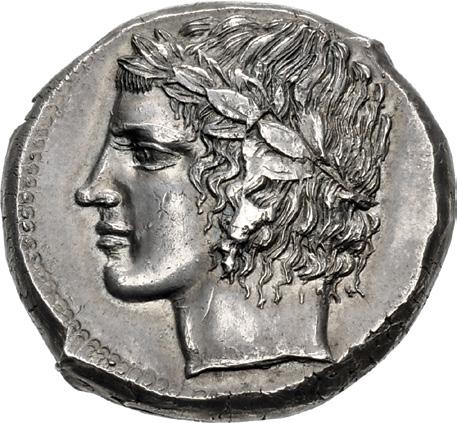
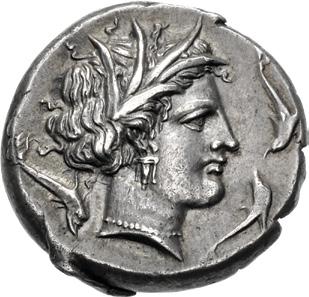
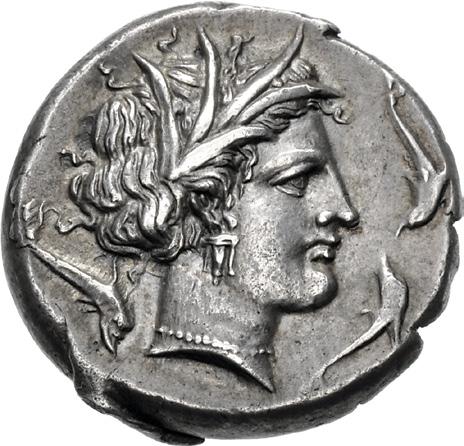
5620775. SICILY, Lilybaion (as ‘Cape of Melkart’). Circa 330-305 BC. AR Tetradrachm (25.5mm, 17.10 g, 11h). Charioteer, holding kentron in extended right hand and reins in left, driving fast quadriga right; above, Nike flying left, crowning charioteer with open wreath held in both hands; [[te]Q¬[Mße] (RŠMLQRT = “Raš Melqart” in Punic) in exergue / Head of Arethousa right, wearing wreath of grain ears, triple-pendant earring, and pearl necklace; three dolphins swimming around. Jenkins, Punic 38 (O14/R29); CNP 310; HGC 2, 741; Bement 364 (same dies); Jameson 597 (same obv. die); de Luynes 920 (same obv. die); Sartiges 453 (same obv. die); Weber 1297 (same dies). Attractive cabinet tone, some die rust and a few minor pits on obverse. Good VF. Well centered and struck. $26,750
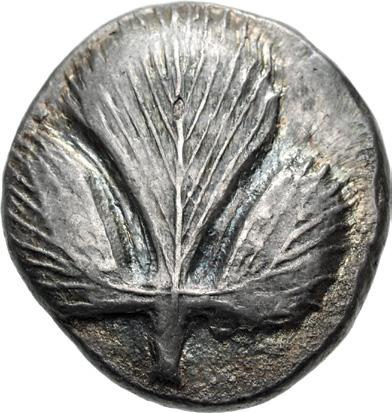
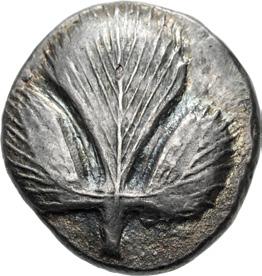
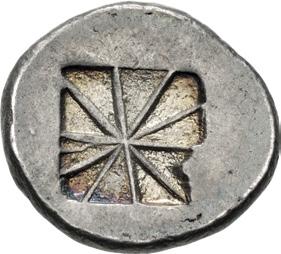
5624579. SICILY, Selinos. Circa 540-515 BC. AR Didrachm (20.5mm, 8.89 g). Selinon leaf; two tiny pellets in upper field / Incuse square divided into ten sections. Arnold-Biucchi Group I, 2; HGC 2, 1209. Attractive iridescent tone, underlying luster, tiny flan flaw on obverse. Good VF. $4275
Ex North River Collection, purchased from Brian Kritt, January 2000; Triton III (30 November 1999), lot 248.
15
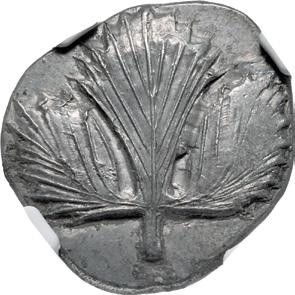
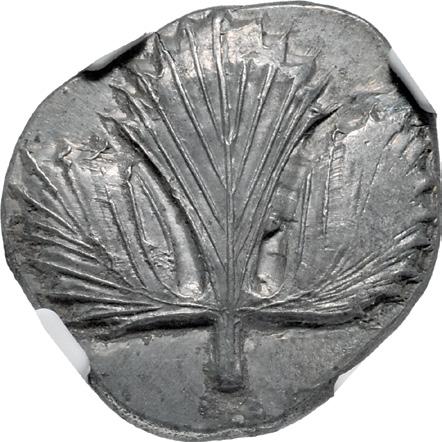
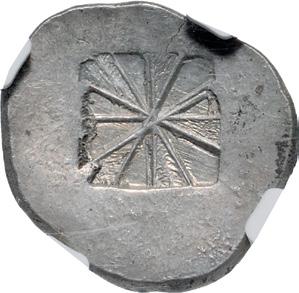
5620495. SICILY, Selinos. Circa 540-515 BC. AR Didrachm (24mm, 8.92 g). Selinon leaf / Incuse square divided into twelve sections. Arnold-Biucchi Group I, 3; HGC 2 1211. Toned with some iridescence. In NGC encapsulation 6327697-001, graded MS, Strike: 4/5, Surface: 4/5. $7750
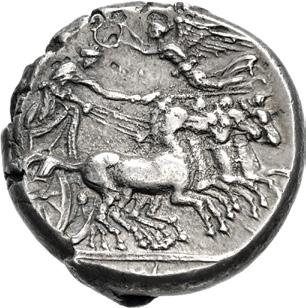
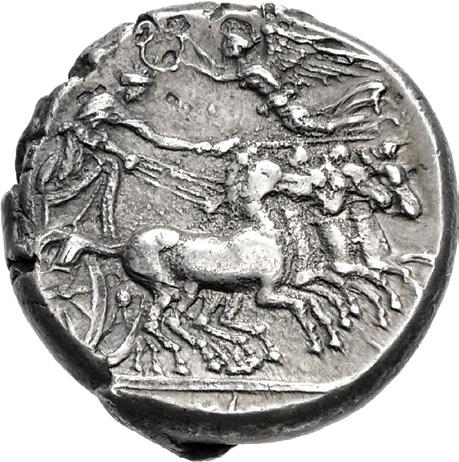
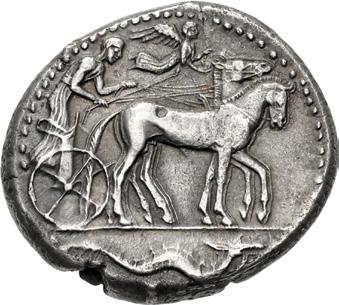
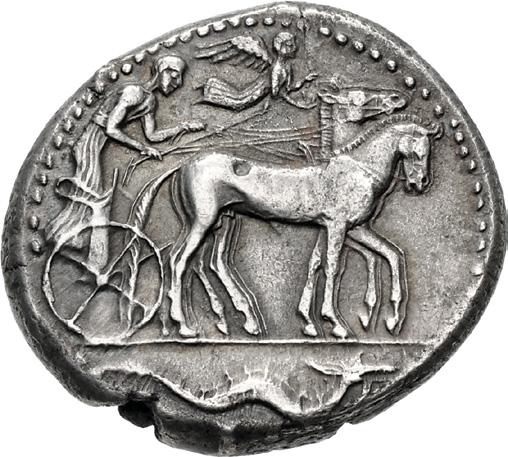
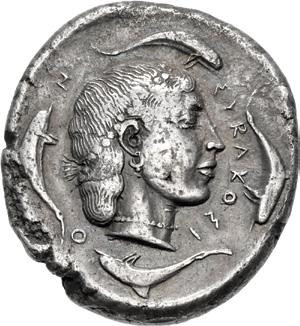
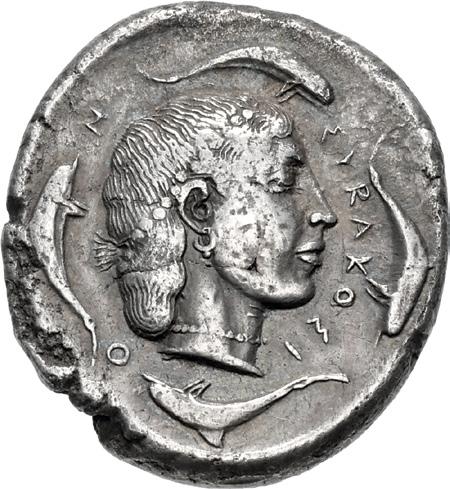
5620773. SICILY, Syracuse. Second Democracy. 466-405 BC. AR Tetradrachm (28mm, 16.96 g, 9h). Struck circa 460-450 BC. Charioteer, holding kentron in right hand, reins in both, driving slow quadriga right; above, Nike flying right, crowning horses with open wreath held in both hands; in exergue, ketos right / Head of Arethousa right, wearing pearl tainia, single-pendant earring, and necklace; sU‰Åkos5-o-˜ and four dolphins around. Boehringer Series XIVa, 477 (V255/R342); HGC 2, 1311; SNG ANS 144–5 (same rev. die); SNG München 1010 (same dies); Randazzo 535–6 (same dies); Ward 254 (same dies). Old collection tone, scattered light marks, minor flan flaw on reverse. VF. Perfectly centered. $9750
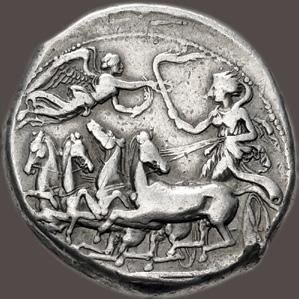
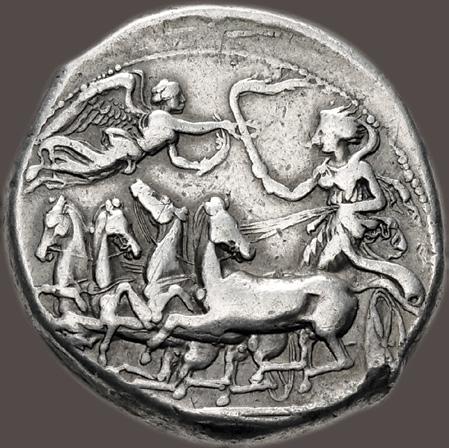 Signed by Phrygillos
5620774. SICILY, Syracuse.
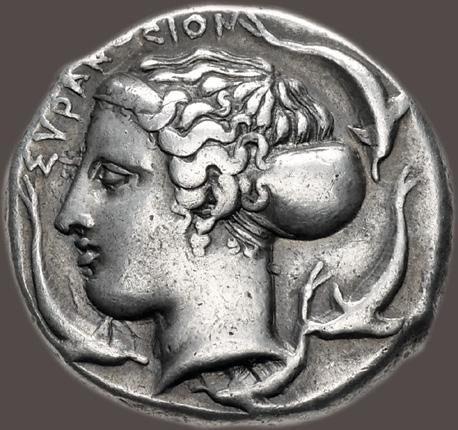
466-405 BC. AR Tetradrachm (25.5mm, 17.12 g, 3h). Obverse die signed by Phrygillos. Struck circa 415-409 BC. Head of Arethousa left, hair in ampyx, inscribed f[rU], and sphendone, wearing single-pendant earring; s¨rÅ˚os5o˜ above, four dolphins around / Charioteer, holding flaming torch in right hand and reins in left, driving fast quadriga left; above, Nike flying right, crowning charioteer with open wreath held in her extended hands; in exergue, grain ear left. Fischer-Bossert, Coins 51 (O18/R30); Tudeer 51; HGC 2, 1335; SNG Fitzwilliam 1246 (same dies); BMC 160 (same dies); Rizzo pl. XLIII, 13 = de Luynes 1216 (same dies); Weber 1604 (same dies). Attractive light toning. VF. $24,750
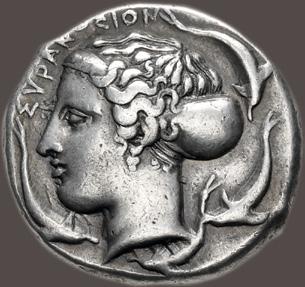
The magnificent artistic flowering in Sicily in the 5th century BC has its origins in times of great strife. By the middle of the century, the situation began to resemble that of Renaissance Italy, where local princes engaged in continual warfare among themselves while employing the finest artists and craftsmen of their time. The result was the patronizing of some of the most talented coin engravers in history. In Syracuse, by the late 5th century BC these engravers were proudly signing their work, preserving the names of Kimon, Euainetos, Eumenos, Sosion, Herakleidas, Eukleidas and others for posterity. Their handiwork included several collaborative efforts, including coins with obverse and reverse dies signed by different artists, as seen here.
16
Second Democracy.
Superb Syracusan “Pegasos”
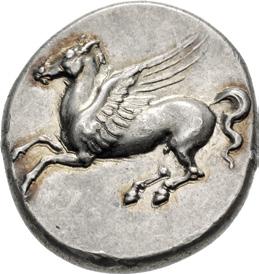
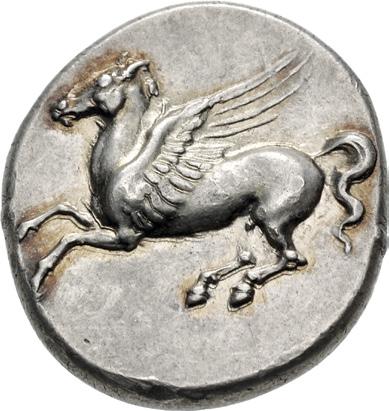
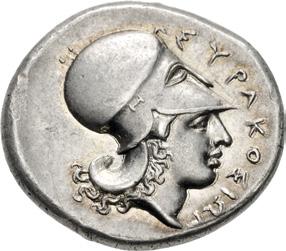
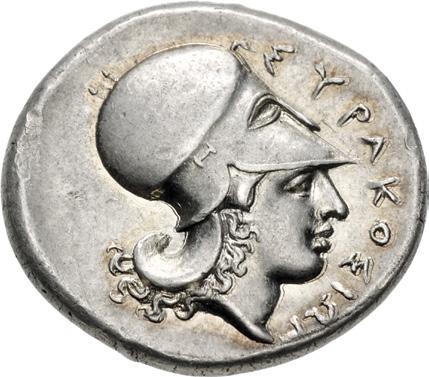
5611718. SICILY, Syracuse. Timoleon and the Third Democracy. 344-317 BC. AR Stater (20mm, 8.67 g, 9h). Struck under Timoleon, 344-339/8. Pegasos flying left / Head of Athena right, wearing Corinthian helmet; sUrÅkos5W@ to right. Pegasi 2; HGC 2, 1400; SNG ANS 494–507; SNG Lloyd 1442-3; Dewing 930–1; Gillet 673. Lightly toned with warm golden luster around the devices. Superb EF. An exquisite, wonderfully detailed example. $9500
Ex E. Hyrcyna Collection; Peus 392 (4 May 2007), lot 4206.
By the early 4th century BC, Syracuse had become highly factionalized, and the political turmoil was taken advantage of by the Carthaginians. Eventually a delegation was sent by the Syracusans to Corinth to appeal to their mother city for help. Timoleon, from a prominent Corinthian family, was chosen to take control of Syracuse, drive the Carthaginian-backed government from power, and restore tranquility and prosperity to the great Sicilian city. In this endeavor Timoleon was successful, and his rule sparked a cultural and political revival. In contrast to most political strongmen of the age, termed tyrants, Timoleon never abused his power and abided by the limits of the democratic constitution he helped to create. After five years in power, he retired from public life, although his opinion was frequently sought and respected by his successors. His ascendancy is reflected in the city’s coinage, including this beautiful silver stater. While superficially mimicking the popular Corinthian “Pegasi” circulating widely in Greece, the style, relief and execution are all uniquely Syracusan.
Artistic Dilitron of Timoleon
5616550.
(27mm,
5616551.
17
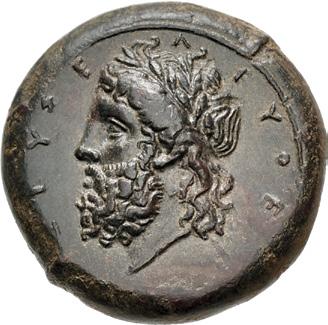
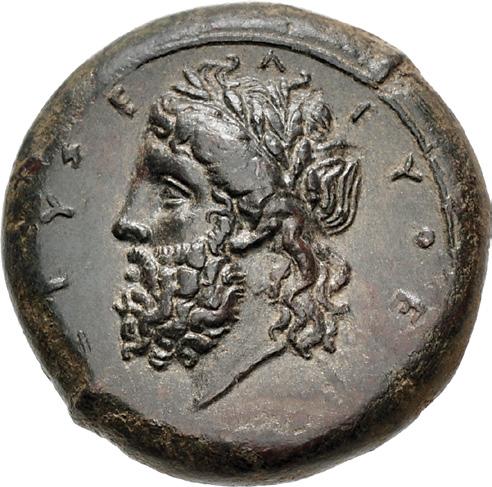
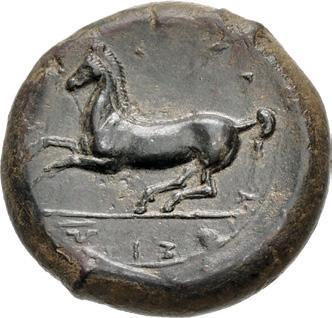
SICILY, Syracuse. Timoleon and the Third Democracy. 344-317 BC. Æ Dilitron
21.14 g, 10h). Timoleontic Symmachy coinage. 2nd series, circa 339/8-334 BC. Head of Zeus Eleutherios left, wearing laurel wreath; [z] EUs E-¬-EUQE[r5os] around / Horse rearing left; [sU]rÅ-˚-os5W-[@] around. Castrizio Series II, 1; CNS 80; HGC 2, 1439; SNG ANS 533-41; SNG Lloyd 1456-7; SNG Morcom 717; Basel 499; Favorito 17; Laffaille 225; Virzi 1500–14. Attractive green-brown patina, light earthen dusting. EF. An artisitic masterpiece. $12,750
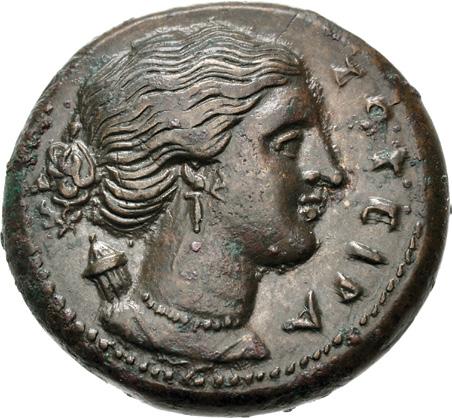
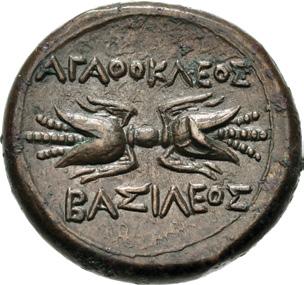
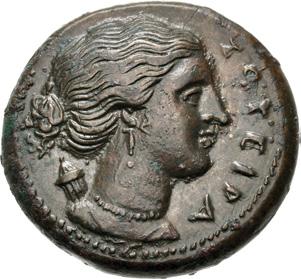
SICILY, Syracuse. Agathokles. 317-289 BC. Æ (24mm, 11.13 g, 12h). Struck circa 304-289 BC. Draped bust of Artemis Soteira right, with quiver over shoulder, wearing triple-pendant earring and pearl necklace; sWtE5rÅ to right / Winged thunderbolt; Å˝ÅQo˚¬Eos above, ∫Ås5¬Eos below. CNS 138; BAR Issue 20; HGC 2, 1537. Glossy greenbrown surfaces, trace deposits. EF. $1575
Extremely Rare Issue of Hiketas
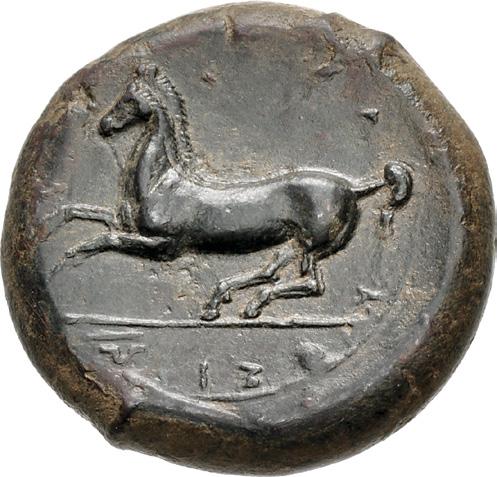
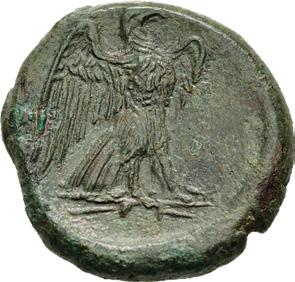
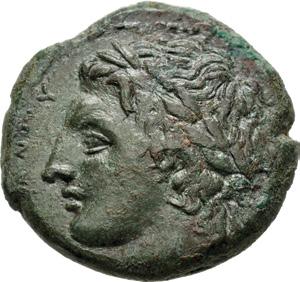
5616552. SICILY, Syracuse. Hiketas II. 287-278 BC. Æ Litra (23.5mm, 10.71 g, 5h). Struck circa 282-278 BC. Laureate head of young Zeus Hellanios left; [d5os E¬¬]Å@5oU to left / Eagle, wings spread, standing right on thunderbolt. CNS 165 corr. (no legend on rev.; same dies as illustrations); BAR –; HGC 2, –; Virzi 1776 (same dies). Green patina, trace brown deposits, slightly off center. EF. Extremely rare, only two examples noted in CNS, including the Virzi piece; none in CoinArchives. $1750
Interestingly, although Calciati (in CNS) incorrectly described the reverse as having the ethnic of Syracuse (as both examples he knew of actually lacked this feature), an example offered as lot 166 in CNG 61, from a different die pair, does have the legend.
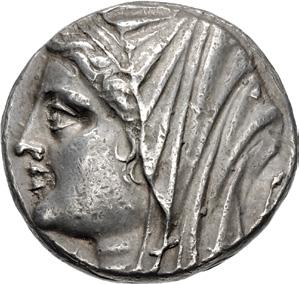
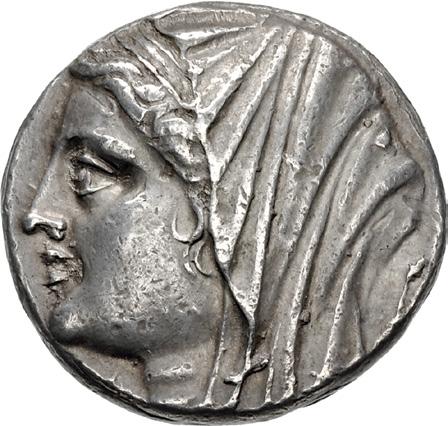
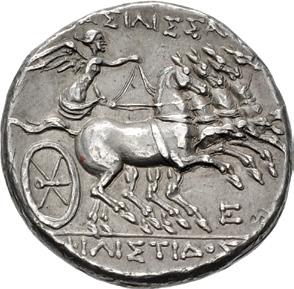
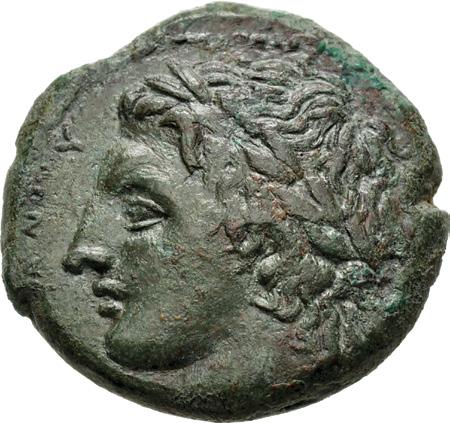
5602911. SICILY, Syracuse. Philistis, wife of Hieron II. 275-215 BC. AR 16 Litrai – Tetradrachm (25mm, 13.59 g, 4h). Struck circa 240-218/5 BC. Diademed and veiled head left; torch to right / ∫Å%5¬5%%Å% f5¬5%t5do%, Nike, holding reins in both hands, driving fast quadriga right; E below horses. CCO 49 (D12/R31); BAR Issue 65; HGC 2, 1554; SNG ANS 884 (same dies); SNG Ashmolean 2107 (same dies); SNG München 1357 and 1359 (same dies); McClean 1398 (same dies); Ward 337 (same dies); Weber 1707 (same dies). Lightly toned, minor die wear on obverse. Near EF. $6750
Ex Jacquier 49 (17 September 2021), lot 66.
Philistis was the daughter of an influential Syracusan named Leptines. Hieron, a mercenary refugee from the army of Pyrrhos of Epiros, took control of Syracuse after Pyrrhos’ withdrawal from the city in 275 BC. Hieron immediately sought out and married Philisitis to secure his position with the city’s elite. His coinage in her name commenced after he was proclaimed king (and she queen) in 265 BC and reflects the strong influence of Ptolemaic Egypt, depicting her veiled head in a manner reminiscent of Egyptian queens Arsinoe II and Berenike II.
Rare Second Punic War Gold
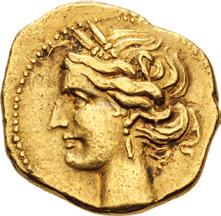
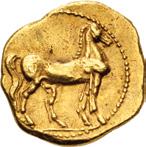
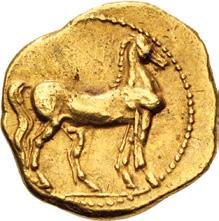
5620302. CARTHAGE, Second Punic War. Circa 203-201 BC. AV Quarter Stater (12mm, 1.84 g, 12h). Carthage mint. Head of Tanit left, wearing wreath of grain ears / Horse standing right. Jenkins & Lewis Group XIV, 464–7; MAA 76; SNG Copenhagen –; Pozzi 3310. Trace deposits, minor marks. Good VF. Rare. $5750
Ex F. David Collection.
18
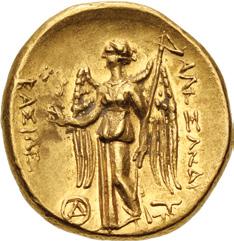
5620301. THRACE, Odessos. Circa 280-225 BC. AV Stater (18mm, 8.40 g, 12h). In the name and types of Alexander III. Head of Athena right, wearing crested Corinthian helmet decorated with coiled serpent / ∫Ås5¬E[Ws] ŬExÅ@dr[oU], Nike standing left, holding wreath in extended right hand and cradling stylis in left arm; ò below left wing, Ň below right wing. Topalov, Odesos 21; AMNG I –; Price 1144; HGC 3, 1582; Anadol 90–4. Underlying luster, light deposits. Near EF. Extremely rare, only one other in CoinArchives, one in ANS Photofile, one in Pella. $5500
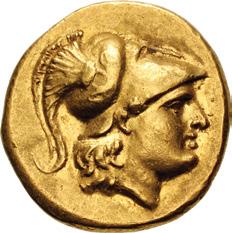
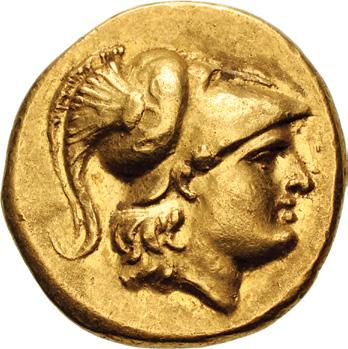
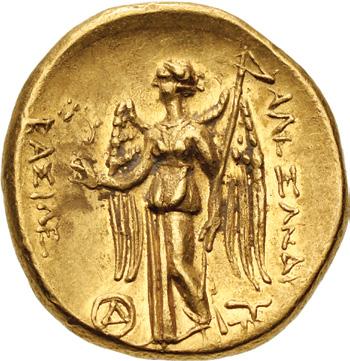
Ex F. David Collection. None of the five staters from the Anadol hoard were ever illustrated, thus some of the four other known examples may be from the hoard.
Artistic Portrait of Deified Alexander
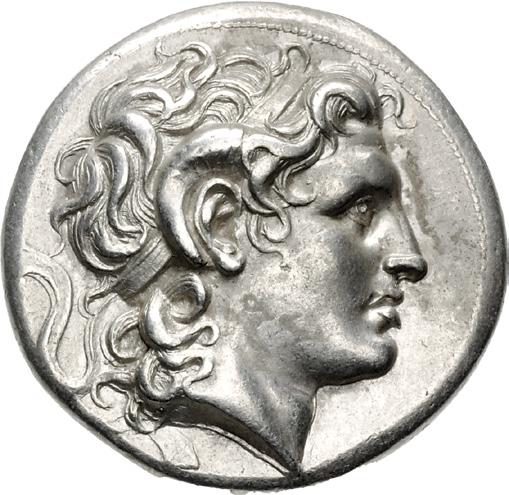
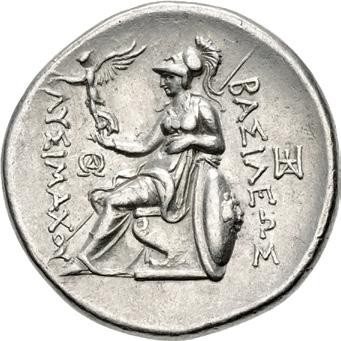
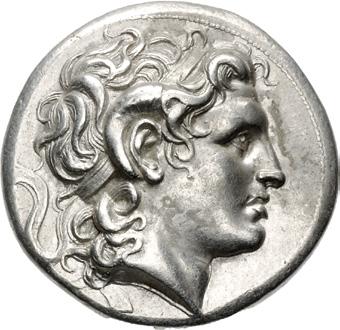
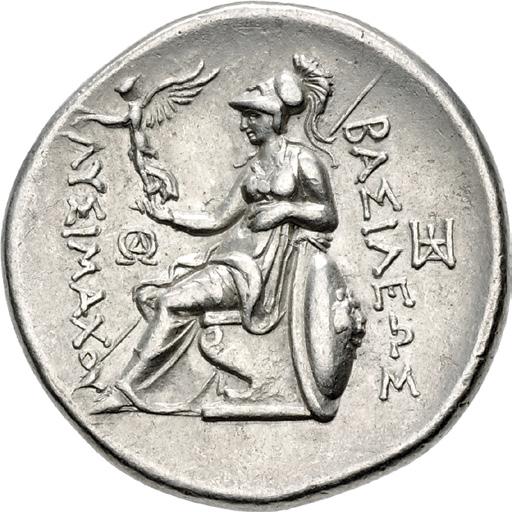
5616306. KINGS of THRACE, Macedonian. Lysimachos. 305-281 BC. AR Tetradrachm (28mm, 17.02 g, 12h). Lysimacheia mint. Struck circa 297/6-282/1 BC. Diademed head of the deified Alexander right, with horn of Ammon / ∫Å%5¬EW% ¬Us5ÂÅcoU, Athena Nikephoros seated left, left arm resting on shield, transverse spear in background; H to inner left, b to outer right. Thompson 12; Müller –; HGC 3, 1750a. Lightly toned, trace deposits on obverse. EF. Well centered and struck, with a wonderful portrait. $8950
19
Extremely Rare Edones Oktadrachm
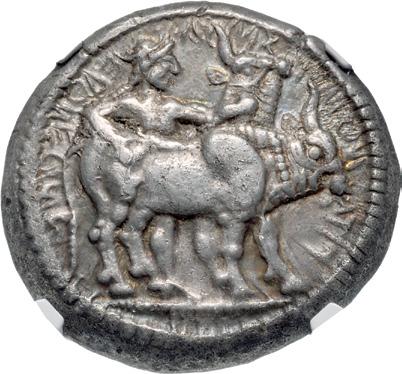
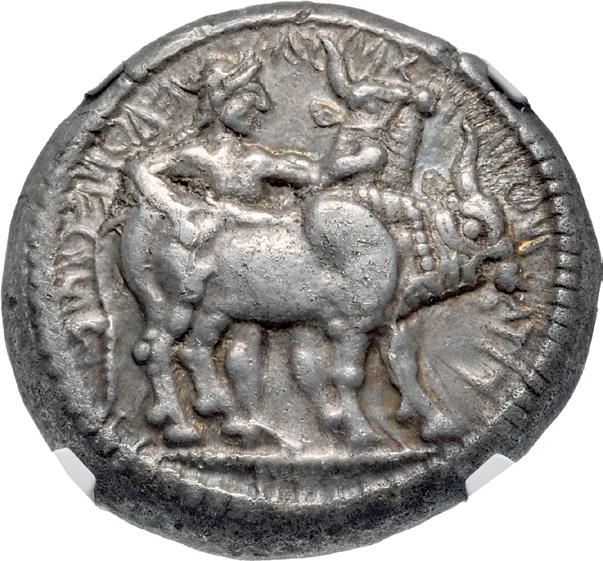
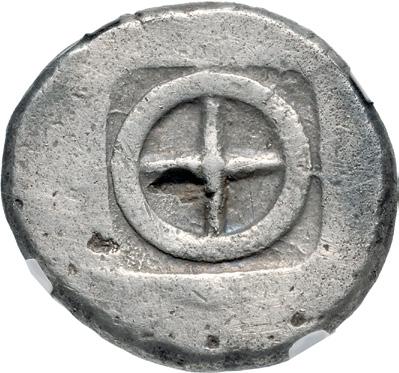
5624580. THRACO-MACEDONIAN TRIBES, Edones. Getas. Circa 492-464 BC. AR Oktadrachm (32.5mm, 29.09 g). Hermes, nude but for petasos, standing right, between two bulls that he guides right; Åt3˝ [ßo3¬-5-ß]-`∫ no3nod3 `-µß-µon clockwise around from right / Wheel with four spokes within shallow incuse square. Tatscheva Type I, 1 = ACGC 483 and p. 139, n. 4 = E.S.G. Robinson, “Dempartment of Coins and Medals” in BMQ 15 (1941–50), pl. XIX, 15 (same dies); Peykov C0050 (same dies as illustration); HPM –; HGC 3, 292; Heritage 3020, lot 24875 = Goldberg 69, lot 3100 = Tkalec, Oct. 2011, lot 25 (same dies). Toned. In NGC encapsulation 6555696-001, graded Ch XF★, Strike: 5/5, Surface: 3/5, flan flaw. Extremely rare, one of three known with this legend. $45,000
Ex Jonathan P. Rosen Collection; Lanz 155 (10 December 2012), lot 83 (hammer €48,000).
Coinage of the Chalkidian League
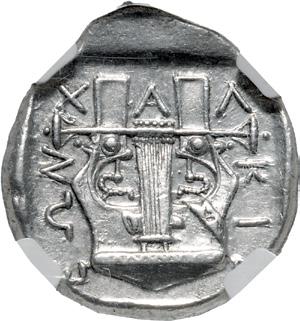
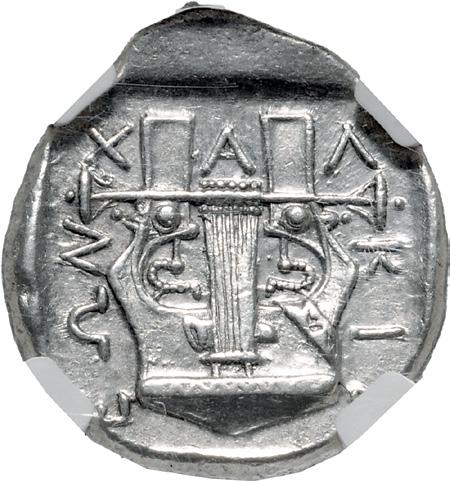
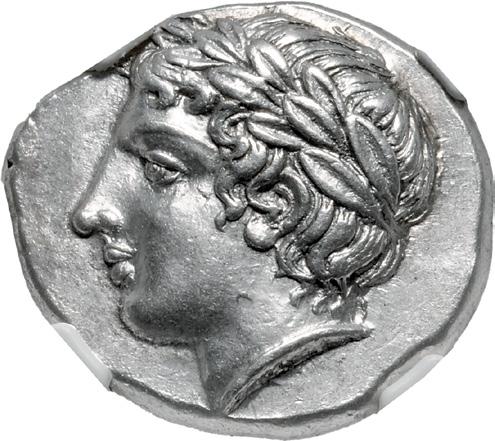
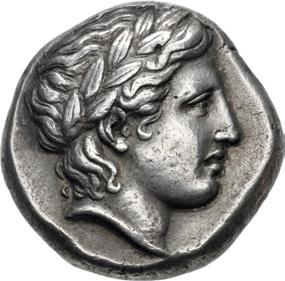
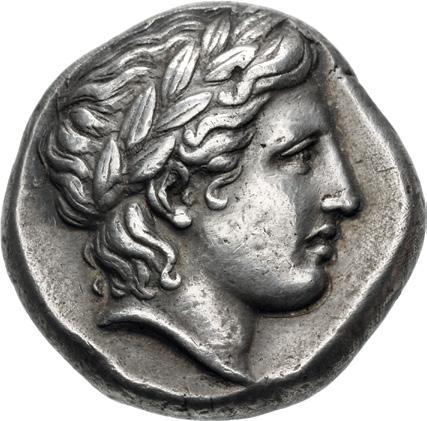
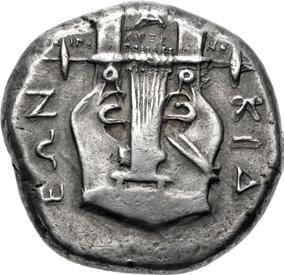
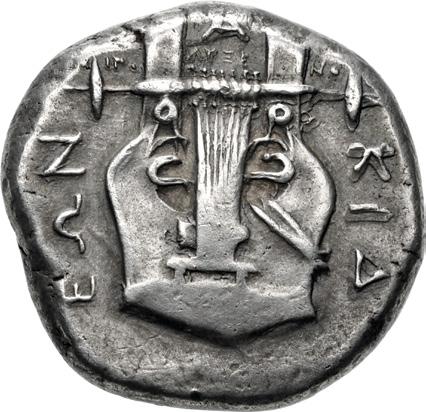
5620492. MACEDON, Chalkidian League. Circa 390 BC. AR Tetradrachm (26mm, 14.45 g, 2h). Olynthos mint. Head of Apollo left, wearing laurel wreath / Kithara; c-Å-¬-˚5d-EW@ around; all within incuse square. Robinson & Clement Group F, 6 (A6/P6); SNG ANS 471; HGC 3, 497. In NGC encapsulation 3808154-018, graded Ch AU★, Strike: 5/5, Surface: 4/5. $14,500
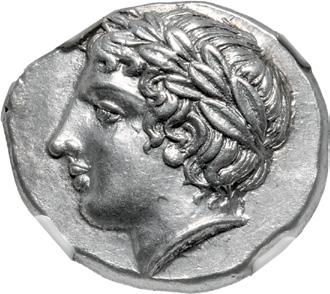
The Chalkidiki is a three-fingered spit of land extending from eastern Macedon into the Aegean Sea. Wary of Athenian imperialism and the rising power of the Macedonian Kingdom, the free cities of the Chalkidiki banded together in 432 BC to form a defensive coalition called the Chalkidian League, with its capital of Olynthos. The silver coinage struck at Olynthos was on the Macedonian standard, somewhat lighter than the Attic standard employed by most of Greece, and was legal tender at all cities belonging to the league. The standard design featured a head of Apollo, god of beauty, art and music, with a type of lyre called a kithara on the reverse. The heads of Apollo on these pieces are remarkable for the beauty of their style. Some of the most beautiful dies in the series were produced in the early fourth century BC, of which an outstanding example is seen here. Sadly, the Chalkidian League’s coinage came to an end with the capture and destruction of Olynthos by King Philip II of Macedon in 348 BC.
20
5616313. MACEDON, Chalkidian League. Circa 383/2 BC. AR Tetrobol (15mm, 2.34 g, 11h). Olynthos mint. Head of Apollo left, wearing laurel wreath / Kithara; c-Å-¬-˚5d-EW@ around. Robinson & Clement Group H, 60 (A47/P41) = SNG ANS 524 (same dies); HGC 3, 501. Underlying luster. EF. $1275
Ex Nomos 8 (22 October 2013), lot 71.
5620776. MACEDON, Chalkidian League. Circa 354 BC. AR Tetradrachm (22mm, 14.40 g, 2h). Olynthos mint; Polyxenos, magistrate. Head of Apollo right, wearing laurel wreath / Kithara; c-Å-¬-˚5d-EW@ around, [Eπ]-5 πo-¬U$E@o-[U] in tiny letters above crossbar. Robinson & Clement Group R, 101 (A67/P86); AMNG III/2, 9 (same dies); HGC 3, 500; SNG Lockett 1313 (same dies); BMC 9 (same dies). Attractive light toning. Near EF. Wonderful style. Rare issue of Polyxenos, only three in CoinArchives. $16,950
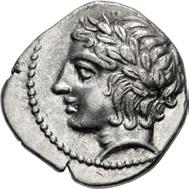
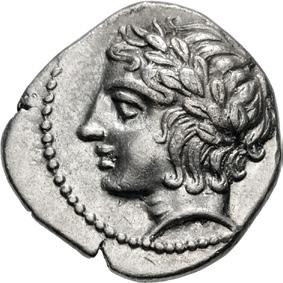
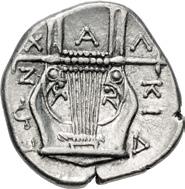
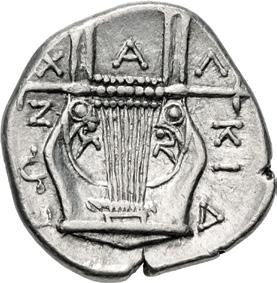
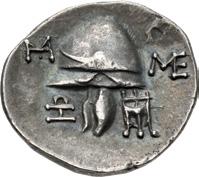
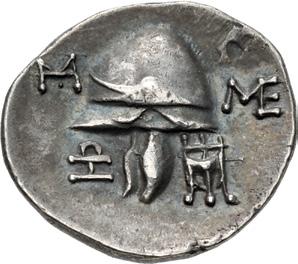
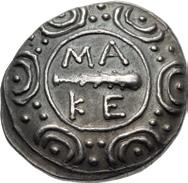
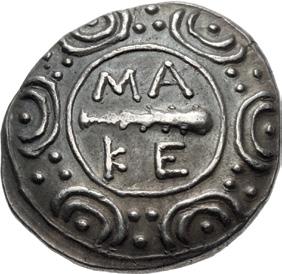
5620717. MACEDON, The Macedonians. Circa 196-168 BC. AR Tetrobol (15mm, 2.53 g, 2h). Struck under Philip V. Amphipolis mint. Struck circa 196-179 BC. Macedonian shield; ÂÅ/˚E divided by club on boss / Macedonian helmet left; 8 and / at sides, g and tripod head flanking cheek guards. ACULA Series III, Group 1B, Issue 19, 171 (O62/R104); AMNG III/2, 3; HGC 3, 324; SNG Saroglos 973 (same dies); de Luynes 1710 (same rev. die). Deep iridescent tone. EF. Well centered. $750
21
Artistic Inebriated Dionysos
564452.
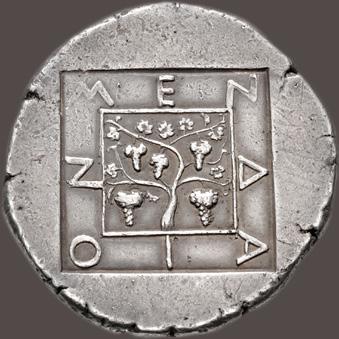
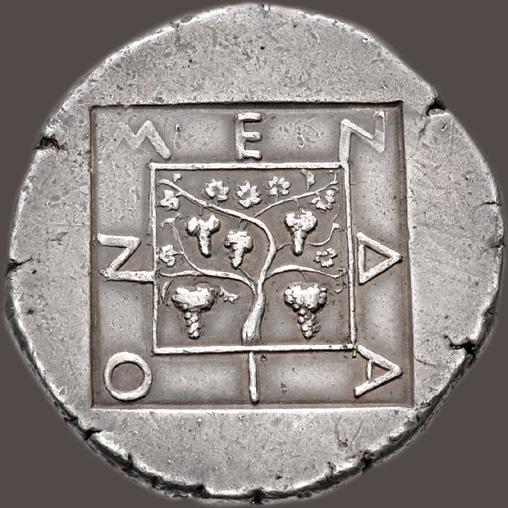
(28.5mm, 17.28 g, 6h). Inebriated Dionysos, wearing chiton draped from his waist, holding in right hand a kantharos propped on his right knee, reclining left on the back of an ass standing right; to right, crow standing right on branches / µE@-dÅ-5-o@ within linear square around vine of six grape clusters within linear square; all within shallow incuse square. Noe, Mende 62/58 (same obv./rev. dies); HGC 3, 545; SNG ANS 337 (same dies). Iridescent tone. Superb EF. An exceptional example. $75,000
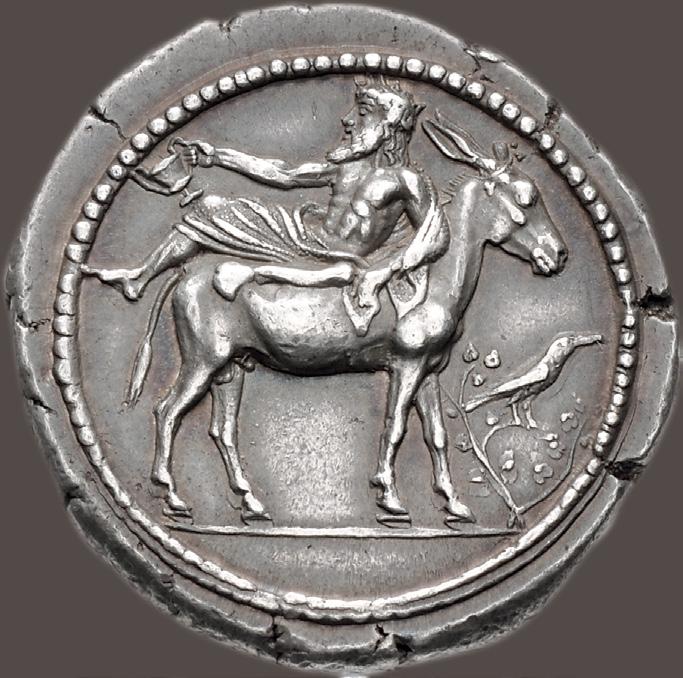
The city of Mende, located on the Pallene Peninsula on the eastern shore of the Thermaic Gulf, was, according to Thucydides (4.123.1), founded by Eretria in the 8th century. It later founded colonies of its own: Neapolis on the eastern coast of Pallene, and Eion at the mouth of the river Strymon near Amphipolis. Mende’s wealth is indicated by the high amounts of tribute paid to the Delian Confederacy: eight talents until 451-450 BC, and then amounts ranging form five to nine talents after 438-437 BC. During the Peloponnesian War (431-404 BC) Mende originally sided with Athens, but then, on the urging of the oligarchs, went over to the Spartan general Brasidas. It eventually returned to the Athenian side, but is not mentioned in connection with the Peace of Nicias. From 415-414 BC, Mende again appears in the Athenian Tribute Lists, but by the fourth century the city was only minting copper coins.The Dionysiac types of Mende proclaim it as a famous wine producing city, as attested by its amphoras that have been found throughout the Mediterranean. On this delightful coin, Dionysos, who rules wine and winemaking, is shown being carried home drunk from a symposion, a type of careless joy that links the world of men with the Olympians – at least until the morning.
22
MACEDON, Mende. Circa 460-423 BC. AR Tetradrachm
Fine Style Alexander Tetradrachm
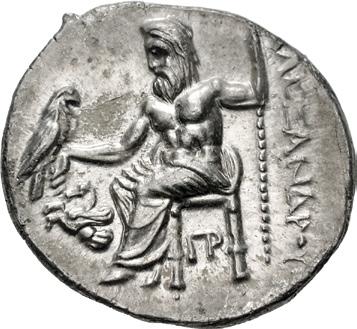
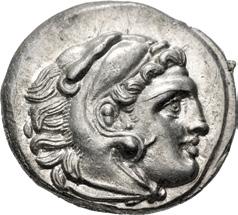
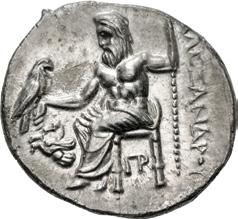
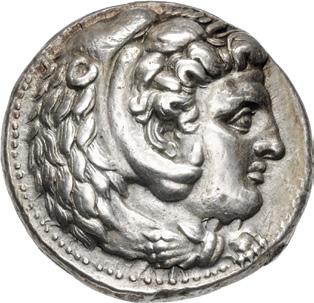
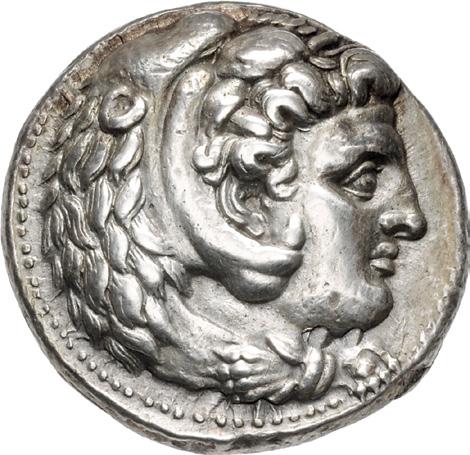
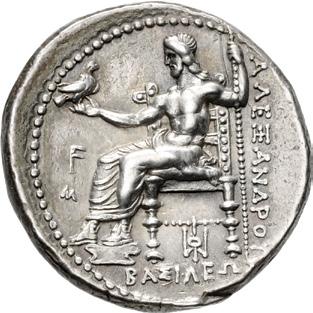
5616314. KINGS of MACEDON. Alexander III ‘the Great’. 336-323 BC. AR Tetradrachm (26mm, 17.17 g, 3h). Babylon mint. Struck under Stamenes or Archon, circa 323 BC. Head of Herakles right, wearing lion skin / ∫Ås5¬EWs ŬExÅ@droU, Zeus Aëtophoros seated left; in left field, upright hoe above Â, P below throne. Price 3677. Toned. Good VF. Fine style. $3475
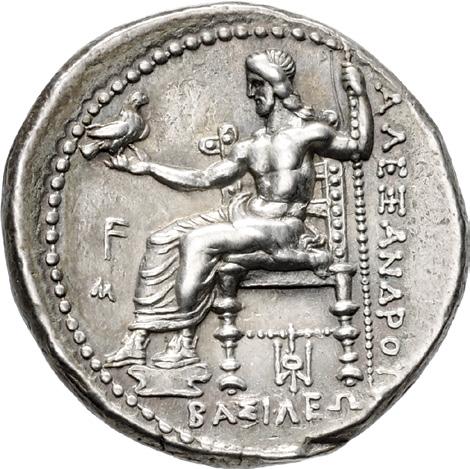
Ex DSV Collection; CNG inventory 851803 (July 2009).
NGC Graded MS 5/5, 5/5
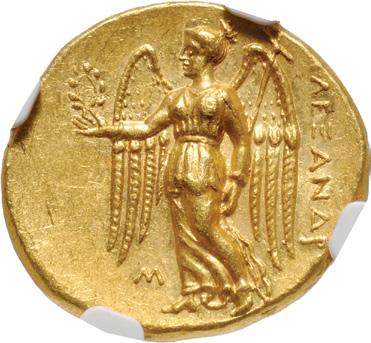
5620493. KINGS of MACEDON. Philip III Arrhidaios. 323-317 BC. AV Stater (18mm, 8.53 g, 1h). In the name and types of Alexander III. Sidon mint. Struck under Laomedon. Dated RY 12 of Abdalonymos (322/1 BC). Head of Athena right, wearing crested Corinthian helmet decorated with serpent, and pearl necklace / ŬExÅ@dr[oU], Nike standing left, holding wreath in extended right hand and cradling stylis in left arm; : (date) below left wing. Price 3497; Newell, Sidon 38 (dies X/– [unlisted rev. die]); DCA 874. In NGC encapsulation 3760811-004, graded MS, Strike: 5/5, Surface: 5/5. Extremely rare. $22,750
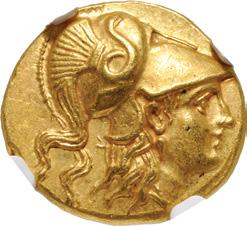
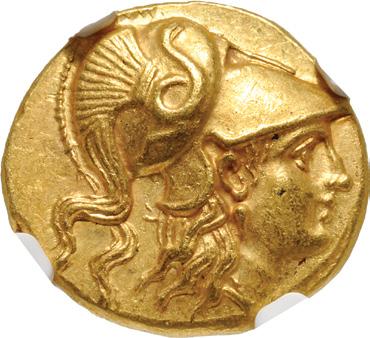
594496. KINGS of MACEDON. Antigonos I Monophthalmos. As Strategos of Asia, 320-306/5 BC, or king, 306/5301 BC. AR Drachm (19mm, 4.23 g, 12h). In the name and types of Alexander III. Lampsakos mint. Struck circa 310-301 BC. Head of Herakles right, wearing lion skin / [Å]¬E$Å@droU, Zeus Aëtophoros seated left; in left field, forepart of Pegasos left; Å5 below throne. Price 1385; ADM II Series XVIII. Underlying luster, trace deposits. Choice EF. Well struck on a broad flan. $1500
23
Antigonos Gonatas: Hellenisic Survivor
5620715. KINGS of MACEDON. Antigonos II Gonatas. 277/6-239 BC. AR Tetradrachm (33mm, 17.08 g, 6h). Amphipolis or Pella mint. Struck circa 252/1-246 BC. Horned head of Pan left, lagobolon over shoulder, in the center of a Macedonian shield / ∫Ås5¬EWs Å@t5˝o@oU, Athena Alkidemos advancing left, shield decorated with aegis on left arm, preparing to cast thunderbolt held aloft in right hand; crested Macedonian helmet to inner left, Ò to inner right. TEA Period II, Group 7, 32 (O5/R31); HGC 3, 1042. A few minor die breaks, light mark in field on reverse. Good VF. Well centered and struck. $2750
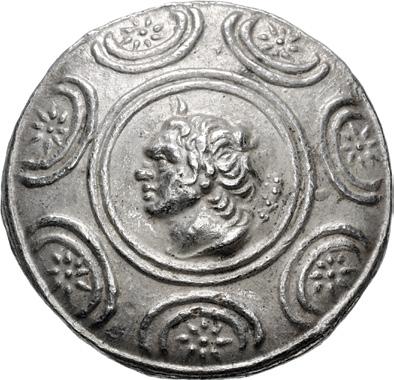
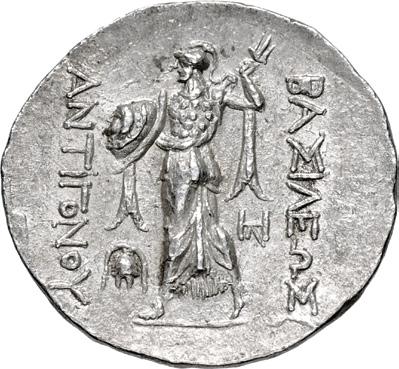
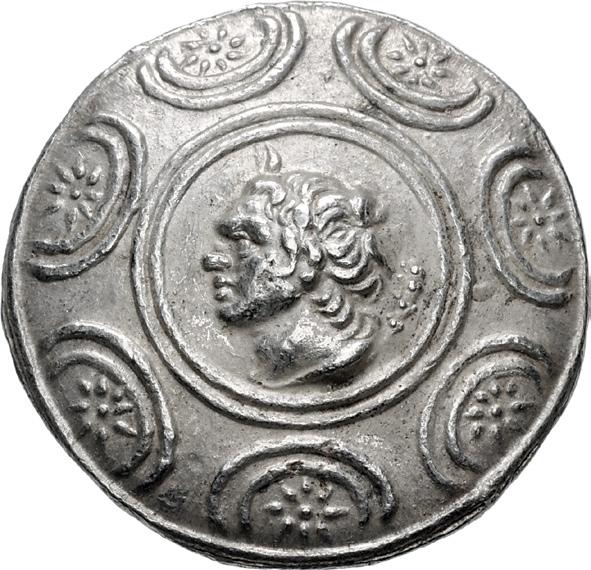
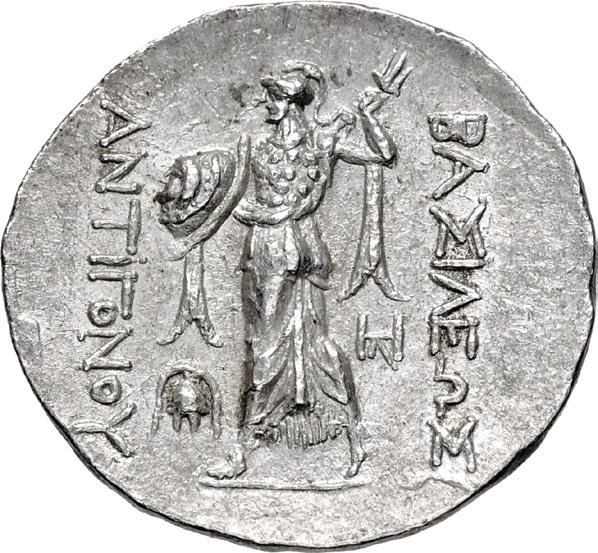
Antiogonos Gonatas was the son of Demetrios Poliorketes and grandson of Antigonos Monophthalmos (“one-eyed”). During the wars of succession, he participated with his father on campaign in Greece and Macedon. Upon his father’s death in 283 BC, Antigonos assumed the royal title and resolved to retake the Macedonian throne. Before he was able to invade Macedonia, in 279 BC, a huge wave of Galatians moved into the region from the north and ravaged as far south as Delphi. In 277 BC, Antigonos took his army north and decisively defeated the Celts in a victory that brought him recognition and acclaim across the Aegaean. Antigonos now seized the empty Macedonian throne and reigned successfully for nearly 30 years. His interesting coinage is made in the shape of a Macedonian shield, or aspis. In the tondo is a head of Pan, the god whom Antigonos credited with facilitating his victory over the Celts by spreading panic in their ranks.
NGC Graded MS 5/5, 5/5
Ex
24
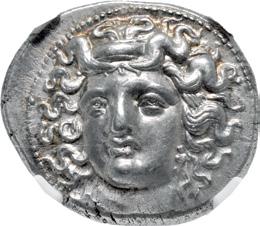
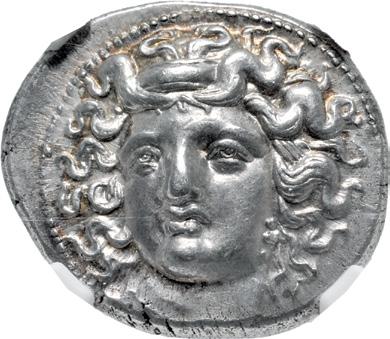
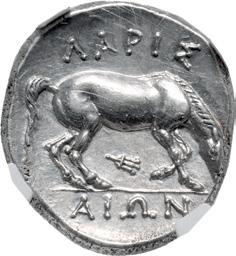
5615571. THESSALY, Larissa. Circa 344-337 BC. AR Drachm (20mm, 6.04 g, 9h). Head of the nymph Larissa facing slightly left, hair in ampyx / Horse standing right, preparing to lie down; trident head below; ¬År5s-Å5W@ above and below. Lorber, Hoard, Group L-IV; BCD Thessaly II 322; HGC 4, 454 corr. (trident not noted). Light iridescent tone, underlying luster. In NGC encapsulation 6323211-001, graded MS, Strike: 5/5, Surface: 5/5. $3575
William H. Birkinshaw Collection (Classical Numismatic Group 117, 19 May 2021), lot 121; Classical Numismatic Group 46 (24 June 1998), lot 256.
Dionysos’ Theban Origin
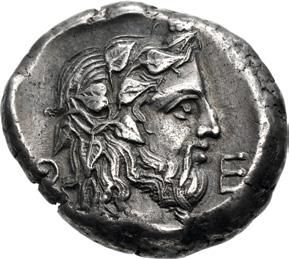
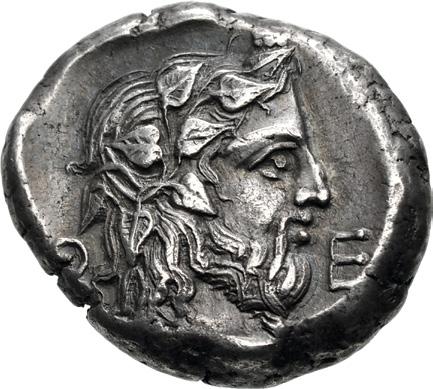
5620777. BOEOTIA, Thebes. Circa 425-395 BC. AR Stater (21mm, 12.19 g). Later style. Boeotian shield / Bearded head of Dionysos right, wearing wreath of ivy with berries at the crown; Q-E across lower field; all within incuse square. BCD Boiotia 442–4; Myron Hoard pl. B, 5; HGC 4, 1326. Old cabinet tone, a little porosity on obverse. Good VF. $19,750
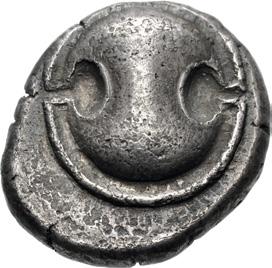
Though Dionysos was widely worshipped as god of the grape harvest and wine, according to the most widely quoted origin myth, he was only half-divine, being the product of Zeus’ dalliance with Semele, a mortal princess of Thebes. Semele was the daughter of Cadmus, founder of Thebes and one of the first Greek heroes. Semele was also a priestess of Zeus with whom the king of the gods became smitten. As was his wont with mortal women, Zeus began visiting her regularly in various guises until she conceived. Hera, getting wind of the affair, tricked Semele into demanding that Zeus reveal himself to her in all his godly glory, causing her to burst into flame. Zeus, however, rescued the fetal Dionysos and sewed him into his thigh. He was “born” a few months later, leading to one of Dionysos’ epithets as “twice born.”
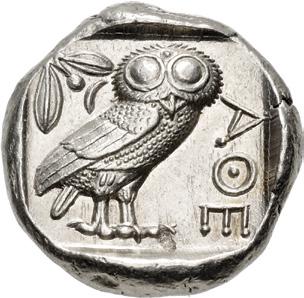
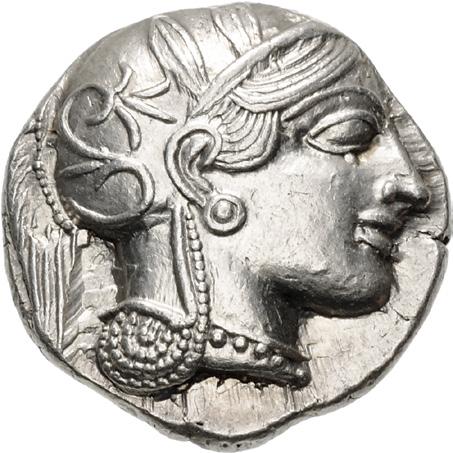
509535. ATTICA, Athens. Circa 454-404 BC. AR Tetradrachm (24mm, 17.20 g, 7h). Head of Athena right, with frontal eye, wearing earring, necklace, and crested Attic helmet decorated with three olive leaves over visor and a spiral palmette on the bowl / Owl standing right, head facing; olive spray and crescent to left, AQE to right; all within incuse square. Kroll 8; HGC 4, 1597. Minor die flaws. EF. $1450
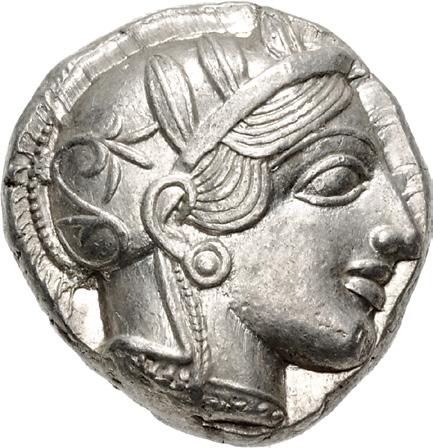
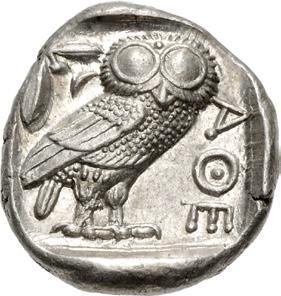
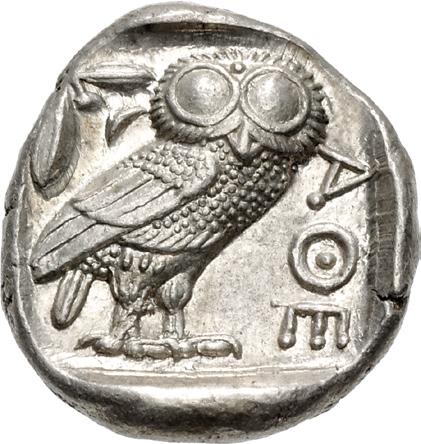
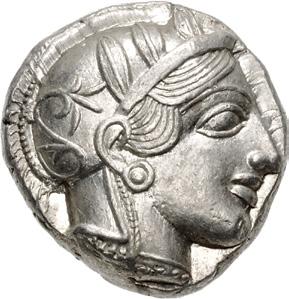
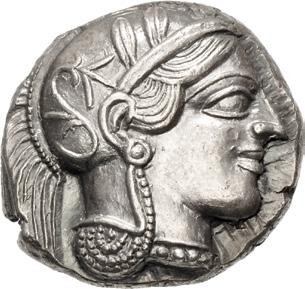
499032. ATTICA, Athens. Circa 454-404 BC. AR Tetradrachm (24.5mm, 17.18 g, 6h). Head of Athena right, with frontal eye, wearing earring, necklace, and crested Attic helmet decorated with three olive leaves over visor and a spiral palmette on the bowl / Owl standing right, head facing; olive spray and crescent to left, AQE to right; all within incuse square. Kroll 8; HGC 4, 1597. Lustrous fields. Choice EF. Well struck on a compact flan. $1450
25
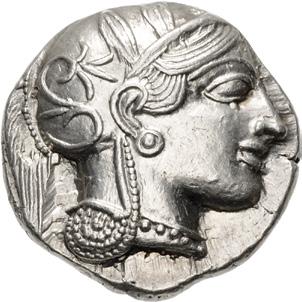
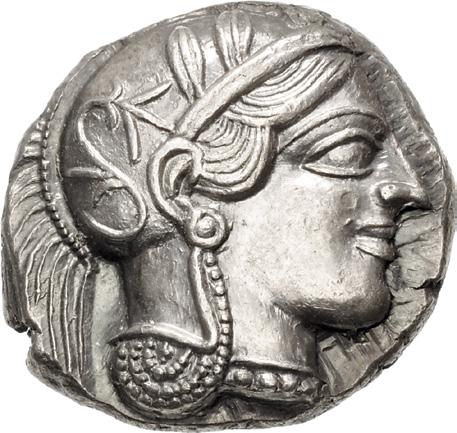
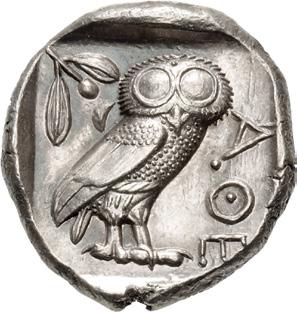
509684. ATTICA, Athens. Circa 454-404 BC. AR Tetradrachm (25mm, 17.23 g, 11h). Head of Athena right, with frontal eye, wearing earring, necklace, and crested Attic helmet decorated with three olive leaves over visor and a spiral palmette on the bowl / Owl standing right, head facing; olive spray and crescent to left, AQE to right; all within incuse square. Kroll 8; HGC 4, 1597. Attractive iridescent toning. EF. $1450
Turtle-To-Tortoise Transition
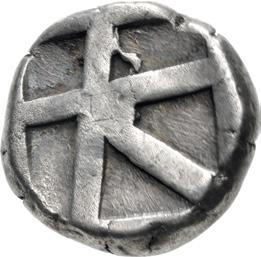
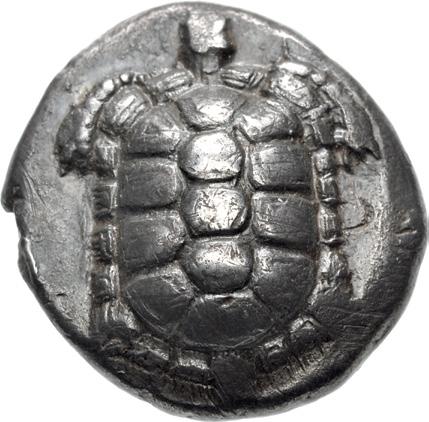
5611877. ISLANDS off ATTICA, Aegina. Circa 480-457 BC. AR Stater (20.5mm, 12.24 g, 1h). Sea turtle, head in profile, with ‘T-back’ design on shell / Large square incuse with skew pattern. Meadows, Aegina, Group IIIa; Milbank Period III, pl. I, 15; HGC 6, 435; SNG Copenhagen 507; SNG Delepierre 1522–6; ACGC 123; Boston MFA 1111–2; Dewing 1674–8; Gillet 947; Gulbenkian 523; Jameson 1199; Rosen 219. Toned, light granularity, minor die break in field on obverse, light graffito in center of reverse. Good VF. $13,500
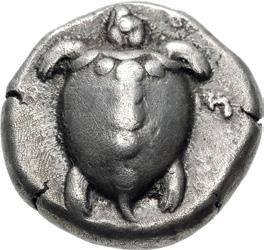
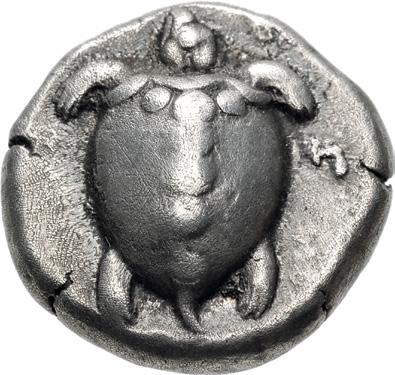
The first coins produced on the island of Aegina depicted a sea turtle (emblematic of the marine interests of the Aeginetans) on the obverse, while bearing on the reverse the imprint of the punch used to force metal into the obverse die. The reverse punch originally consisted of an eight-pronged design that produced eight triangles; with use the prongs broke and clogged, producing filled and absent incuses. This led to the adoption first of a “mill sail” pattern, followed by the development of a “skew” pattern. The obverse design was also modified by the addition of a row of dots added at the collar from the earlier collared turtle design with a single row of dots down its shell, hence the name “T-back,” circa 480 BC (the present example). The production of turtles decreased over the next twenty years as silver from the island of Siphnos was no longer available and Mediterranean trade was now dominated by Athens, the new mistress of the Aegean. In 457 BC, Athens conquered Aegina and stripped her of her maritime powers.
26
5624322.
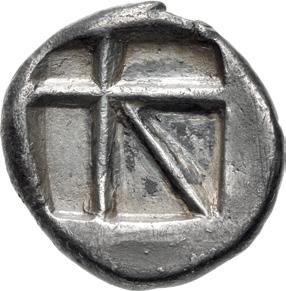
ISLANDS off ATTICA, Aegina. Circa 456/45-431 BC. AR Stater (21.5mm, 12.33 g, 2h). Land tortoise with segmented shell / Large square incuse with heavy skew pattern. Meadows, Aegina, Group IIIb; Milbank Period IV, pl. II, 12; HGC 6, 437; SNG Copenhagen 517; SNG Delepierre 1535–40; Boston MFA 116; Dewing 1683; Gillet 948; Jameson 1200; Pozzi 1635. Lightly toned, minor marks. EF. $9250
Ex Roma XIX (26 March 2020), lot 349.
The loss of Aegina’s sea power probably occasioned the replacement of the maritime turtle with the terrestrial tortoise as the emblem of the city and it was also at this time that she formed the reverse “skew” pattern in a more rectangular five-part incuse punch, finally including letters and symbols within each sunken section. Subsequently in 431 BC, the Aeginetans were expelled from their homeland by the Athenians, only returning after the conclusion of the Peloponnesian war.
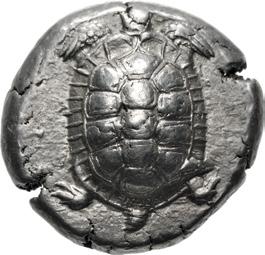
5611878. ISLANDS off ATTICA, Aegina. Circa 370 BC. AR Stater (22mm, 11.48 g, 3h). Land tortoise with segmented shell / Large square incuse with thin skew pattern. Milbank pl. II, 14; HGC 6, 438; SNG Delepierre 1545; SNG München 566–9; Dewing 1686. Deeply toned, traces of find patina, some light scratches, banker’s mark in field on obverse. Good VF. $8750
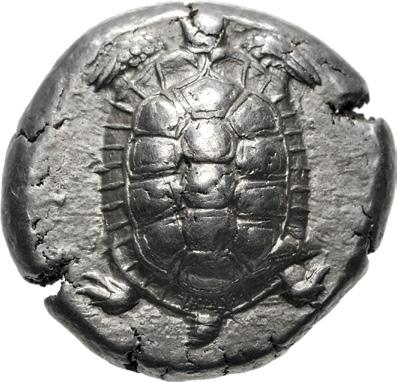
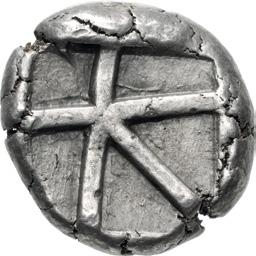
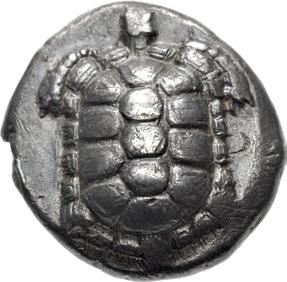
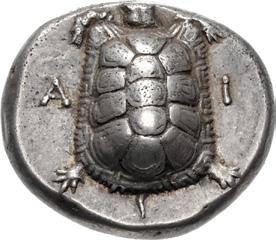
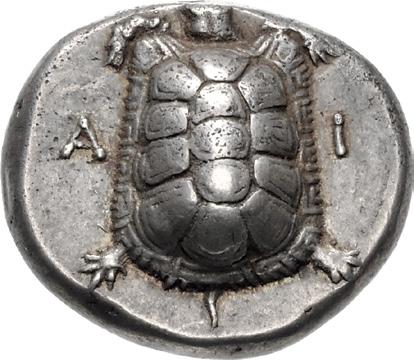
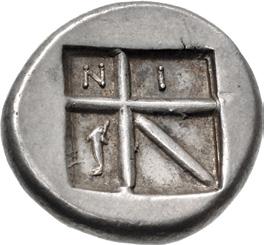
5624581. ISLANDS off ATTICA, Aegina. Circa 350-338 BC. AR Stater (23mm, 12.25 g, 1h). Ni–, magistrate. Tortoise with segmented shell; Å-5 flanking / “Thin skew” incuse pattern; @-5 in upper incuses, dolphin in lower left. Milbank p. 51, a; cf. HGC 6, 445 (drachm); SNG Copenhagen 526; SNG Lockett 1998; BMC 190; Hunt II 433; Pozzi 1639. Attractively toned, a touch of porosity, a little off center on obverse. Near EF. $6950
Ex Father & Son Collection; Künker 326 (7 October 2019), lot 781 (hammer €12,000). Reportedly ex inventory of Dr. Hans Nussbaum († January 7, 1939), circa 1902.
27
5624582. ISLANDS off ATTICA, Aegina. Circa 350-338 BC. AR Stater (21.5mm, 12.15 g, 10h). Ni–, magistrate. Tortoise with segmented shell; Å-5 flanking / “Thin skew” incuse pattern; @-5 upward in left incuses, dolphin in upper right. Milbank p. 51, a; cf. HGC 6, 445 (drachm); SNG Copenhagen 526; SNG Lockett 1998; BMC 190; Hunt II 433; Pozzi 1639. Deep old collection tone, minor encrustation on reverse. Good VF. High relief. $8750
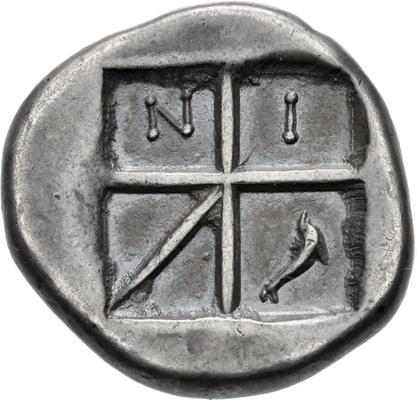
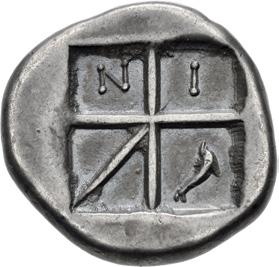
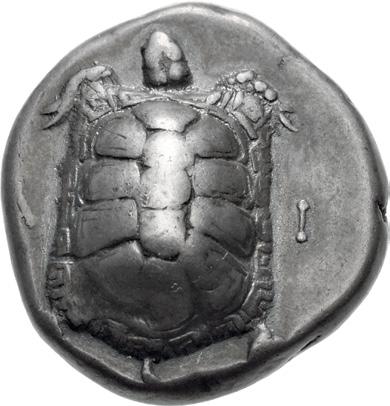
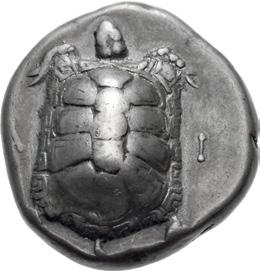
Ex North River Collection; Classical Numismatic Group 54 (14 June 2000), lot 601.
Spectacular Sikyon
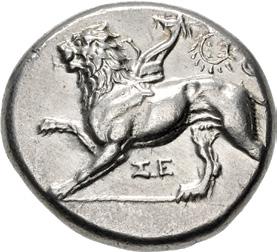
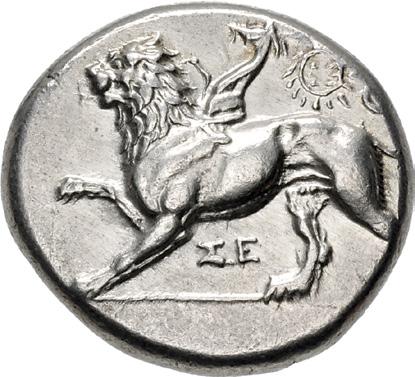
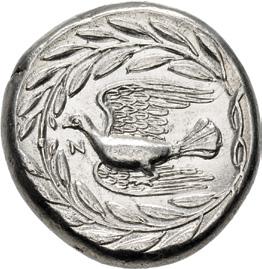
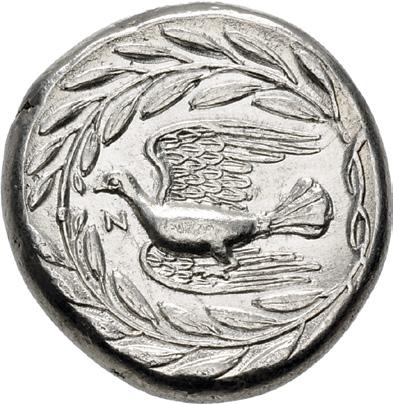
5616500. SIKYONIA, Sikyon. Circa 335-330 BC. AR Stater (23mm, 12.20 g, 9h). Chimaera standing left; wreath above, sE below / Dove flying left; @ to left; all within wreath tying to right. BCD Peloponnesos 218 (same obv. die); HGC 5, 201; BMC 57; Traité III 776. Lustrous. Superb EF. $15,250
The Chimaera was introduced as a design type on the coinage of Sikyon sometime in the fifth century BC. While the real reason will remain a mystery, the curious choice of this mythological beast (Sikyon – apart from some isolated and extremely rare issues from Macedon and Asia Minor – was one of only three cities to use the type as a design on their coinage) may derive from Sikyon’s association with Corinth, a city which also struck an issue featuring the Chimaera in connection with Bellerophon, the grandson of Sisyphos and the son of the Glaukos, king of Corinth. According to the myth related by Homer (Il. VI.155-203), Bellerophon was sent by Iobates, king of Lycia, to slay the Chimaera – a fire-breathing beast composed of the body of a lioness with a tail that terminated in a snake’s head and the head of a fire-breathing goat that arose from its back. To accomplish this, Bellerophon captured the winged horse, Pegasos. Flying high overhead to avoid the creature’s fire, Bellerophon slew the Chimaera by thrusting a spear, tipped with a block of lead, down its throat. The lead melted, suffocating the Chimaera, and Bellerophon returned victorious to Iobates.
28
Ex 1901–4 Mestia/Lantehki Raion, Georgia (“Kutais”) Hoard
Published By Regling in 1931
5620349. CIMMERIAN BOSPOROS, Pantikapaion. Circa 340-325 BC. AV Stater (21.5mm, 9.09 g, 11h). Head of Pan left, wearing ivy wreath / Griffin, holding spear in its mouth, standing left, head facing, forepaw raised, on grain ear; ∏-Å@ around. Prinkipo p. 37, dies υ/XII, Kutais 21 (this coin); Frolova, Catalogue, Group V, dies З/– (unlisted rev. die); Anokhin 1021; MacDonald 54; HGC 7, 20; SNG BM Black Sea 864; Gulbenkian 588–90; Hunt I 95 (same obv. die); Jameson 1361; Pozzi 1150; Sartiges 1580. Underlying luster, some minor scratches. Near EF. Well centered and struck. $125,000
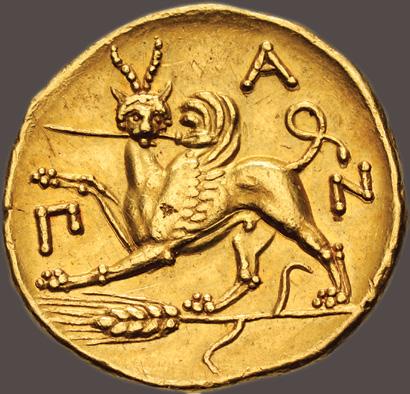
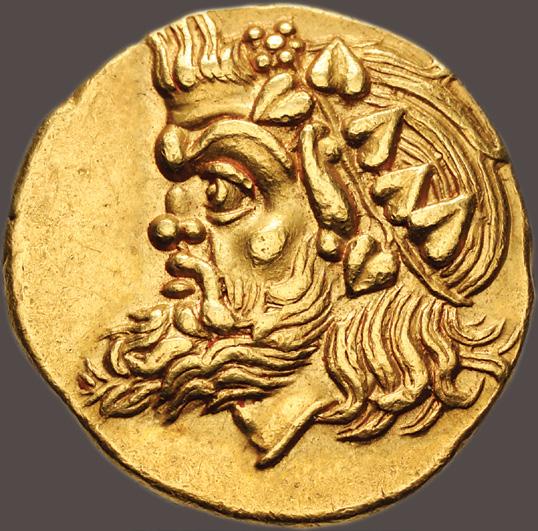
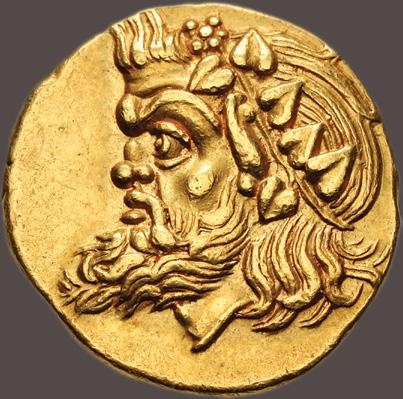
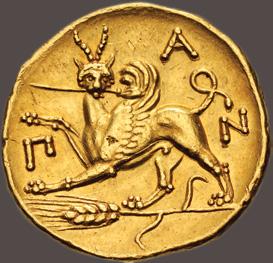
Ex 1901–4 Mestia/Lantehki Raion, Georgia (“Kutais”) Hoard (IGHC 1051). Reportedly ex R. Ratto inventory, 1939.
The 1901–4 Mestia/Lantehki raion, Georgia hoard was originally thought to have been discovered in Kutaisi, Georgia, the site of ancient Phasis, capital of Kochis. Thus, publications prior to IGCH refer to it as the Kutaisi (or Kutais) hoard. The hoard has not been published in detail, other than a brief note on its origin and the inclusion of some of its contents within a die study of the Pantikapaion staters in Regling’s analysis of the Prinkipo hoard in 1931. The exact contents of the find are uncertain, but it was reported that around 30 pieces were discovered by construction workers, most of which (if not all) appear to have been gold staters of the present type. Six of the staters were reported to have been acquired by a Russian grand duke, who Regling thought must have been Grand Duke Alexander Michailovich, while another 21 pieces were examined in the Berlin Cabinet, where they were recorded and casts were made. Traces of the casting material are present on this coin, and its cast is visible online, at https://ikmk.smb.museum/object?lang=de&id=18298319. Most of the hoard was subsequently dispersed into the market.
Pantikapaion was founded by Greek colonists from Miletos in the late seventh century BC. Situated on the west side of the Cimmerian Bosporos, in what is now called the Crimea, it achieved great prosperity through its exploitation of the abundant fisheries of the straits and the export of wheat from the Crimea. This wealth is attested by its splendid gold coinage, which commenced in the mid-4th century BC, and by the magnificently furnished rock tombs of its principal citizens in the same period. Later, it was to become a regional capital of the kingdom of Mithradates VI of Pontos (120-63 BC) and later still the seat of the kings of Bosporos (first century BC – fourth century AD). The coinage of Pantikapaion seems to have commenced with silver issues in the latter part of the fifth century BC, but it is for its beautiful gold staters that the mint is chiefly noted. They depict the head of the god Pan (a pun on the name of the city) and on the reverse, the griffin that Herodotos describes as being the guardian of the remote sources of gold.
We are grateful to Dr. Ute Wartenberg Kagan for her invaluable assistance in researching the pedigree for this coin.
29
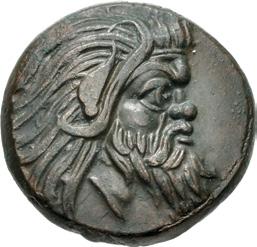
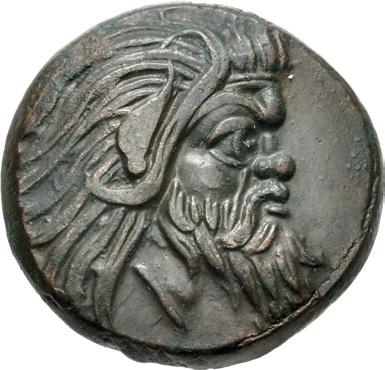
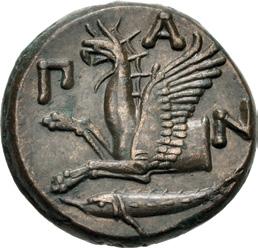
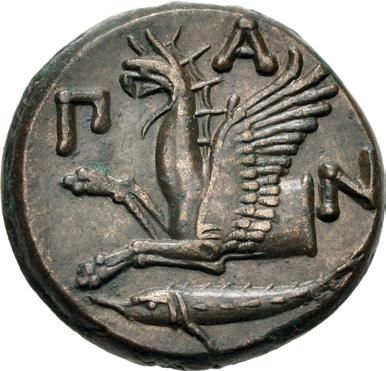
5620749. CIMMERIAN BOSPOROS, Pantikapaion. Circa 310-304/3 BC. Æ (20.5mm, 7.66 g, 6h). Bearded head of satyr right / Forepart of griffin left; below, sturgeon left. Anokhin 1023; MacDonald 69; HGC 7, 113. Green-brown surfaces. Near EF. Well centered. $875
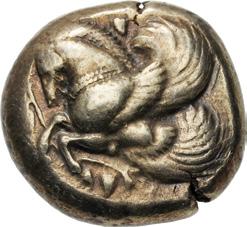
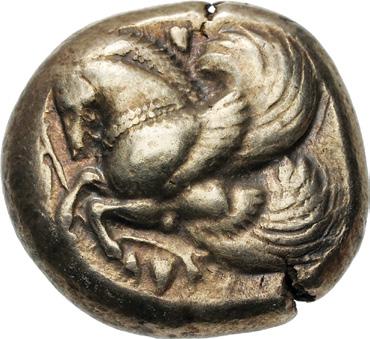
5615570. MYSIA, Lampsakos. Circa 525-500 BC. EL Stater (18mm, 15.28 g). Forepart of Pegasos left; grapevine around / Quadripartite incuse square. Baldwin, Electrum, Period I, Group II, 12; SNG BN 1111; SNG von Aulock 1292 var. (monogram below Pegasos); SNG Copenhagen Supp. 305 var. (same); Boston MFA 1582. VF. Well centered and struck. $7950
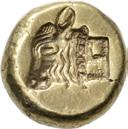
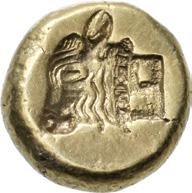
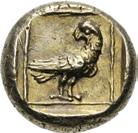
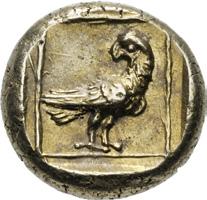
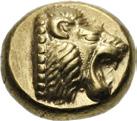
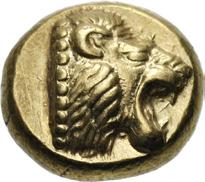
5624583. LESBOS, Mytilene. Circa 521-478 BC. EL Hekte – Sixth Stater (10.5mm, 2.58 g, 9h). Head of roaring lion right / Incuse head of calf left; rectangular punch to right. Bodenstedt Em. 12; HGC 6, 937. A few hairlines in fields. EF. Well centered and struck. $3750
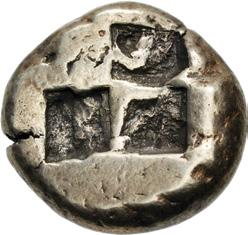
Ex North River Collection; Triton XVI (8 January 2013), lot 446.
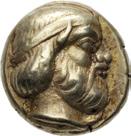
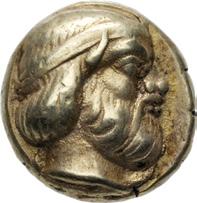
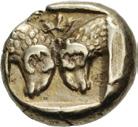
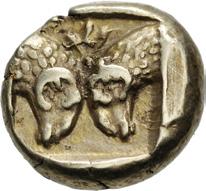
5624584. LESBOS, Mytilene. Circa 454-428/7 BC. EL Hekte – Sixth Stater (10mm, 2.52 g, 11h). Diademed head of Silenos right / Two ram heads butting each other; palmette above; all within incuse square. Bodenstedt Em. 37; HGC 6, 963. Trace deposits, light die wear, minor scrape in margin on reverse. Good VF. $2575
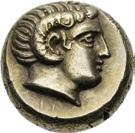
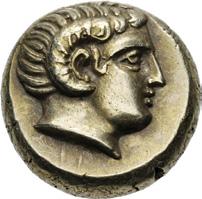
Ex Locksmith Collection.
5624585. LESBOS, Mytilene. Circa 377-326 BC. EL Hekte – Sixth Stater (10.5mm, 2.57 g, 3h). Head of Apollo Karneios right, with horn of Ammon / Eagle standing right, head reverted, in linear square within incuse square. Bodenstedt Em. 104; HGC 6, 1030. Lightly toned, underlying luster. Choice EF. $3450
Ex North River Collection; Triton IV (5 December 2000), lot 247.
30
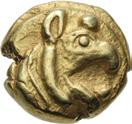
5624586. IONIA, Phokaia (or Teos). Circa 625/00 BC. EL Hekte – Sixth Stater (10.5mm, 2.78 g). Head of griffin right / Incuse square. Bodenstedt Em. E1; Matzke Series 0e2 (Teos?). Good VF. Well centered. Very rare. $2250
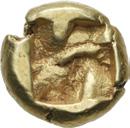
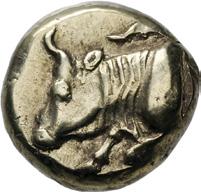
5620844. IONIA, Phokaia. Circa 625/0-522 BC. EL Hekte – Sixth Stater (9mm, 2.56 g). Head of boar left; below, small seal left / Incuse square. Bodenstedt Em. 14. Light die rust. VF. $1250
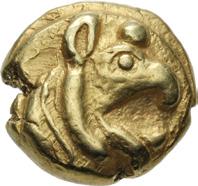
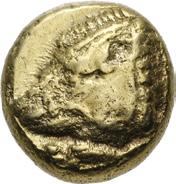
Ex Collection of a Well Known Author; Classical Numismatic Group Electronic Auction 450 (21 August 2019), lot 152.
5620323. IONIA, Phokaia. Circa 521-478 BC. EL Hekte – Sixth Stater (9mm, 2.55 g). Head of warrior left, wearing Corinthian helmet decorated with vine tendril on the bowl; below, small seal left / Quadripartite incuse square. Bodenstedt Em. 30. In NGC encapsulation 6327127-002, graded Ch AU★, Strike: 5/5 Surface: 4/5. Lustrous and sharply struck. $9500
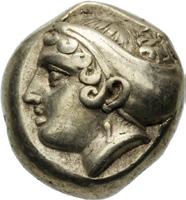
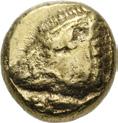
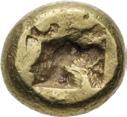
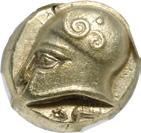
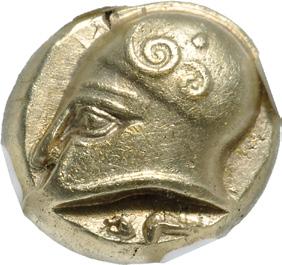
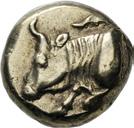
5620845. IONIA, Phokaia. Circa 478-387 BC. EL Hekte – Sixth Stater (10.5mm, 2.54 g). Forepart of bull left; above, small seal right / Quadripartite incuse square. Bodenstedt Em. 58. Lightly toned. Good VF. $2450
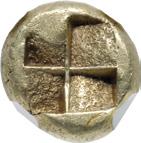
Ex Collection of a Well Known Author; Classical Numismatic Group Electronic Auction 402 (26 July 2017), lot 223.
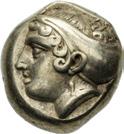
5620846. IONIA, Phokaia. Circa 478-387 BC. EL Hekte – Sixth Stater (10mm, 2.55 g). Female head left, hair bound in sakkos; [to right, seal downward] / Quadripartite incuse square. Bodenstedt Em. 92. Lightly toned. VF. $1975
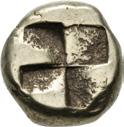
Ex Collection of a Well Known Author; Classical Numismatic Group Electronic Auction 391 (15 February 2017), lot 278.
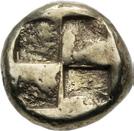
31
From the Beginning of Coinage
5620497. IONIA, Uncertain. Circa 650-600 BC. EL Hekte – Sixth Stater (12mm, 2.38 g). Lydo-Milesian standard. Plain globular surface / Two incuse squares. Weidauer Group I, 4; cf. Artemision 2 (myshemihekte); SNG Kayhan 674. In NGC encapsulation 5872644-043, graded Ch XF, Strike: 5/5, Surface: 5/5. $4500
Other than the literary tradition ascribing the origin of coinage to the kings of Lydia, there is little evidence for a more exact chronology of early Greek coinage. The tradition, buttressed by limited archaeological studies, does confirm Asia Minor as the place of origin, most likely Lydia or Ionia, and a date somewhere around 650-625 BC. The alloy used was a mixture of gold and silver known to the Greeks as elektron Although ancient sources indicated that this alloy was a natural ore found in nugget form in many riverbeds in the region, recent studies have concluded that this was actually not the case, and that the electrum used in coinage was, in fact, man-made. The earliest coins were of a globular shape and without design; later, simple striated and punched patterns of squares, rectangles, and swastikas were included. The earliest true types may have developed from the use of personal seals, the most widely known being the stater of Ephesos with a stag bearing the inscription “I am a seal of Phanes”. These devices later took on the characteristics of civic symbols, although it would be dangerous to link a specific symbol to a particular city in this early period. The most secure form of classification has been by weight standard, based on two major, and several lesser-used, standards. The Milesian standard, with a stater of roughly 14 grams, saw circulation in Lydia and parts of Ionia. The Phokaic standard of roughly 16 grams was also used in Ionia as well as Mysia. Persic, Aeginetan, and Euboic standards saw scattered use in early coinage, limited in time and extent of circulation. The intrinsic value of the early electrum, even down to the 1/96 stater, was too high for use in everyday commerce, and early coinage must have been used only for the transfer of large sums of money, such as mercantile transactions, payment of government expenses (mercenaries, tribute and such), and donatives, either for services rendered to individuals or the state, or to religious foundations. The Artemision deposits, hoards of early electrum found at the site of the temple of Artemis at Ephesos, are examples of the latter.
5620808. IONIA, Uncertain. Circa 650-600 BC. EL Forty-eighth Stater (4.5mm, 0.29 g). Lydo-Milesian standard. Flattened striated surface / Incuse square. Weidauer –; Artemision 55; Elektron –; Traité –; SNG Kayhan 683 and 1527. As made. Very rare denomination for type. $11,500
Ex Classical Numismatic Group Electronic Auction 397 (17 May 2017), lot 160.
5620534. IONIA, Uncertain. Circa 600-550 BC. EL Myshemihekte – Twenty-fourth Stater (6mm, 0.68 g). LydoMilesian standard. Head of calf (or lion?) right / Incuse square. Weidauer –; Traité I 89; SNG Kayhan –; SNG von Aulock 7774; Rosen 328. In NGC encapsulation 6327619-016, graded AU, Strike; 5/5, Surface: 3/5. $1750
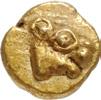
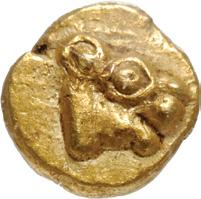

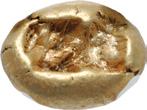
Ex Historical Scholar Collection; Roma VII (22 March 2014), lot 534.
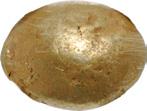
Ex Browne Collection – Pedigreed to 1935
5620778. ISLANDS off IONIA, Samos. Circa 408/4-380/66 BC. AR Tetradrachm (22mm, 15.01 g, 9h). Rhodian standard. Hegesianax, magistrate. Facing lion scalp / Forepart of bull right; [˙˝˙s5Å@Åx above], olive branch to left, sÅ and g below; all within shallow incuse square. Barron Class X, 117b (A53/P115 – this coin); HGC 6, 1218. Lovely old cabinet tone, slightly off center. Good VF. $17,500
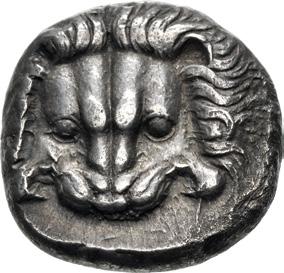
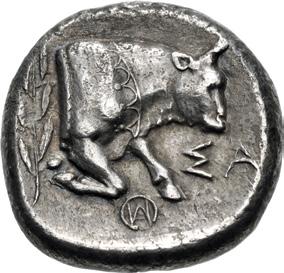
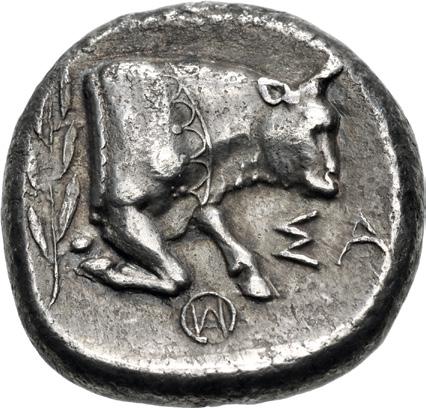


Ex C. C. Browne Collection (Sotheby’s, 25 March 1935), lot 338 (further pedigree to Helbing 1927 noted by Barron is erroneous).

32
Exceptional Specimen from the Pixodarus Hoard
5624588. SATRAPS of CARIA. Pixodaros. Circa 341/0-336/5 BC. AR Didrachm (20mm, 6.91 g, 12h). Halikarnassos mint. Head of Apollo facing slightly right, wearing laurel wreath, drapery around neck / Zeus Labraundos standing right; π5$odÅroU to right. Pixodarus 25h (A3/P11 – this coin); Konuk, Identities 30; HN Online 2216; SNG München 15 (same dies); Weber 6608 (same dies). In NGC encapsulation 6156139-005, graded Ch AU, Strike: 5/5, Surface: 5/5, Fine Style. $8250
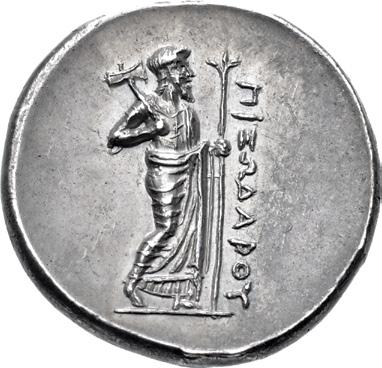
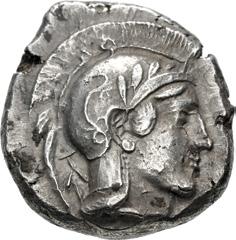
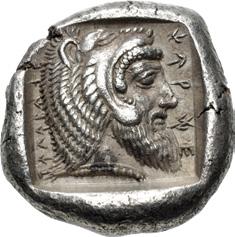
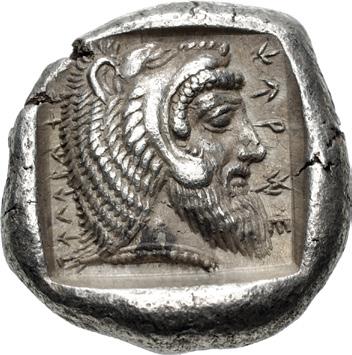
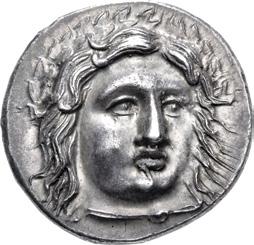
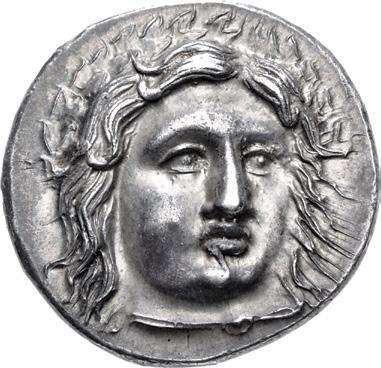
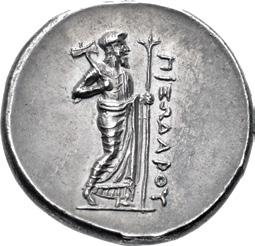
Ex Classical Numismatic Group 117 (19 May 2021), lot 240; Künker 333 (16 March 2020), lot 823; Gasvoda Collection (Triton XXII, 9 January 2019) lot 270; CNG inventory 995859 (January 2015); Numismatica Ars Classica 78 (26 May 2014), lot 318; Roma VI (29 September 2013), lot 656; Leu 91 (10 May 2004), lot 173; Peus 343 (26 April 1995), lot 150; Pixodarus Hoard (CH IX, 421).
Fine Style Facing Head of Helios
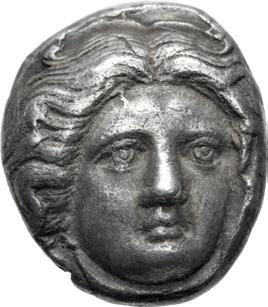
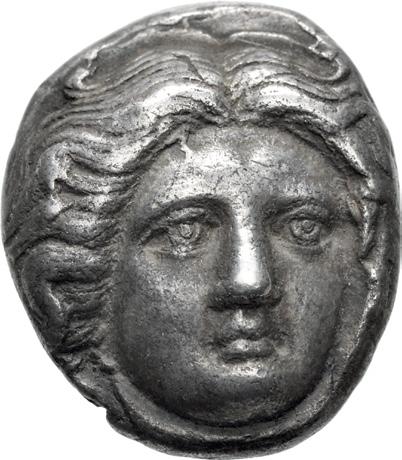
5620780. ISLANDS
$8275
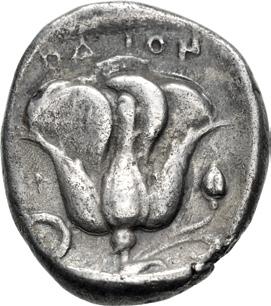
The polis of Rhodes was created out of a union of the cities of Ialysos, Kamiros, and Lindos in 408/7 BC, and immediately began to issue a coinage that endured until the Roman era. The rose was chosen as the perennial reverse type, a punning allusion to the city’s name (Rhodos). The obverse type was the head of Helios, the city’s patron deity. The first issue of Rhodian coinage was a brief issue of tetradrachms that stand among the finest pieces of Classical Greek numismatic art. On the obverse, the head of Helios is displayed in a nearly frontal position, with his hair dramatically swept back from a central part. Such facing head coins were not novel by this time, but the boldness of the design and the particularly high relief of the dies sets the Rhodian coinage apart from all others. Moreover, this facing head type remained the standard obverse type for most of the Rhodian issues into the first century AD. The city’s devotion to Helios led it to build a gigantic bronze statue of the sun god, the Colossus of Rhodes, one of the Seven Wonders of the Ancient World.
5620296. DYNASTS of LYCIA. Kherei. Circa 410-390 BC. AR Stater (18.5mm, 8.50 g, 12h). Telebehi (Telmessos) mint. Head of Athena right, wearing crested Attic
spiral palmette and three olive leaves; between neck guard and crest, t above j (TE in Lycian) / Bearded head of Herakles right, wearing lion skin; tf¬f∫fCE[Cf] (TELEBEHI[HE] in Lycian) to left, efrgE (KhERÊI in Lycian) to right; all within incuse square. Mørkholm & Zahle II 52 = SNG Copenhagen Supp. 451 var. (letters on obv.); Müseler VI, 62–4 (same dies); Falghera –; Reuter –; SNG von Aulock 4198 var. (same); Sunrise 79 (same dies); Triton XX, lot 319 (same dies); Triton XVIII, lot 683 (same dies). Lightly toned, traces of find patina, usual die wear on obverse. EF. $4250
Ex Elsen 119 (7 December 2013), lot 245.
33
off CARIA, Rhodos. Rhodes. Circa 404-385 BC. AR Tetradrachm (21mm, 14.65 g, 12h). Head of Helios facing slightly right / Rose with bud to right; rod5o@ above; to left, f above phiale; all within incuse square. Ashton 46; Hecatomnus 143 var. (A88/P– [unlisted rev. die]); HN Online 1042; HGC 6, 1418. Old cabinet tone, slight roughness, minor die break on obverse, light scratch in field on reverse. VF. High relief.
helmet decorated with
5611880. DYNASTS of LYCIA. Trbbenimi. Circa 390-375 BC. AR Stater (24mm, 9.86 g, 8h). Zagaba mint. Facing lion scalp / Triskeles with t in center; fish to left, z®u (ZAG in Lycian) around; all within incuse circle. Müseler VIII, 19 (this coin); Falghera 212 var. (no T on rev., same obv. die); Podalia 26 var. = SNG von Aulock 4208 var. (same); SNG Copenhagen Supp. –; CNG 99, lot 298 (same dies). Toned, some die wear on obverse. EF. Well centered and struck for issue. $7750
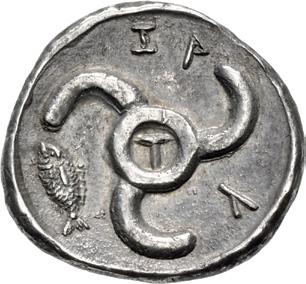
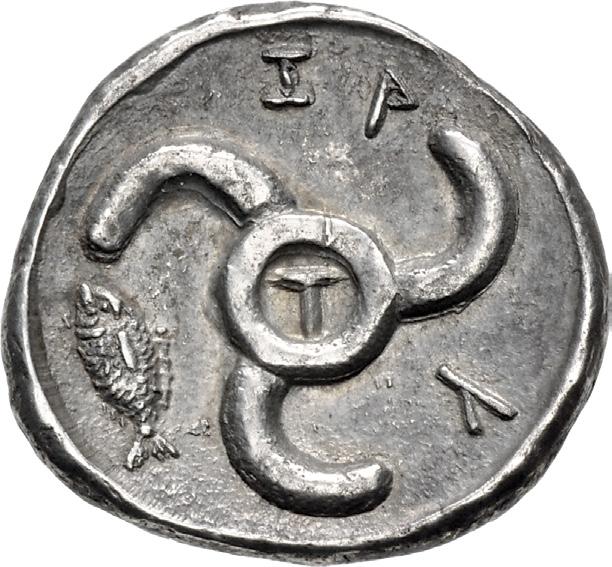
Ex Classical Numismatic Group 100 (7 October 2015), lot 1537; Hans Maag Collection (Peus 407, 7 November 2012), lot 794; Triton VIII (11 January 2005), lot 499.
5620498. CILICIA, Tarsos. Mazaios. Satrap of Cilicia, 361/0-334 BC. AR Stater (23mm, 10.76 g, 6h). Baal of Tarsos seated left, head and torso facing, holding eagle, grain ear, and grape bunch in extended right hand, lotus-tipped scepter in left; rt (TN in Aramaic) to left, M (M in Aramaic) below throne, zRtL`b (B’LTRZ in Aramaic) to right / Lion left, attacking bull left; ydzM (MZDY in Aramaic) above, å below. Casabonne Series 2, Group C; SNG BN –; SNG Levante 106. In NGC encapsulation 3763304-012, graded MS, Strike; 5/5, Surface: 4/5. $5750
Tarsos was a primary mint under the Achaemenid Persians, striking a diverse variety of coinage, particularly under the satrap Mazaios. His latest issues had an obverse type with Baal enthroned to left, as seen on this exceptional stater, that probably served as a model for the depiction of Zeus enthroned on the reverse of Alexander the Great’s silver coins after the Macedonians seized control of the city in 333 BC. The very close stylistic similarity between the Baal on the satrapal issues and the Zeus on the earliest Alexander issues indicates that there was no break in production and that the Alexander-type coinage at Tarsos was struck immediately upon the transfer of the city into Macedonian hands. The loyalties of many Achaemenid officials, many of them well versed in Greek culture, proved flexible. Indeed, Mazaios was one of the first Persian satraps to recognize Alexander as master of all Asia after the defeat of Persia in the battle of Gaugemela in 331 BC; in return, Alexander retained him as satrap of Babylon.
Boukephalas, or Seleukos’ Horse?
5621419. SELEUKID EMPIRE. Antiochos I Soter. 281-261 BC. AR Drachm (16.5mm, 3.94 g, 6h). Aï Khanoum mint. Struck circa 280-271 BC. Diademed head right / ∫Å%5¬E[W%] Å@t5ocoU, horned and bridled horse’s head right, with braided, flame-like forelock; ò to right. SC 431.3; SMAK A1DH-39–40 var. (a20/p– [unlisted rev. die]); HGC 9, 136. Toned, hairlines on obverse. Good VF. $2450
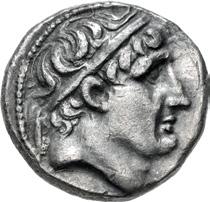
This coin is from one of the first issues of Seleukid coinage at Aï Khanoum, later a major Baktrian capital city. This unusual issue features the horned horse’s head, which had been a fairly common symbol in the reign of Seleukos I, father of Antiochos. While the exact identification of the steed is not certain the two prevailing theories are that it is either Alexander’s famed mount Boukephalas, or the horse that carried Seleukos to safety when he fled Babylon form the invading Antigonos Monophthalmos in 315 BC. Seleukos revered the horse, and had it deified and erected a monument to it at Antioch.
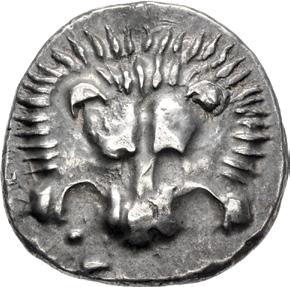
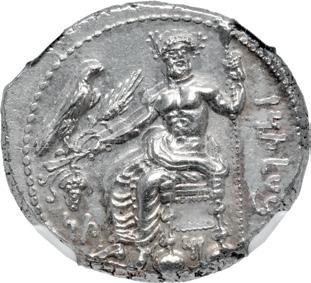
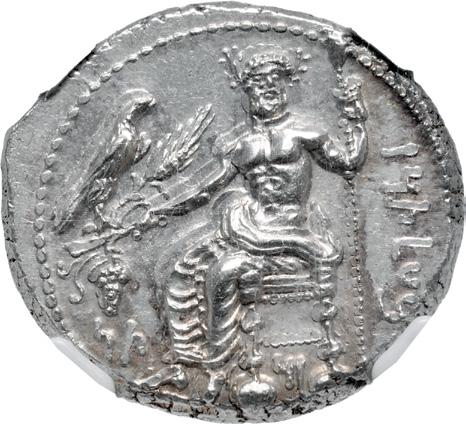
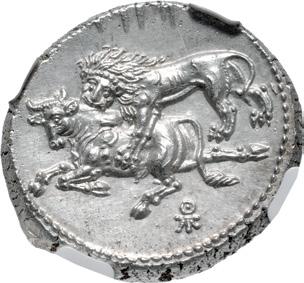
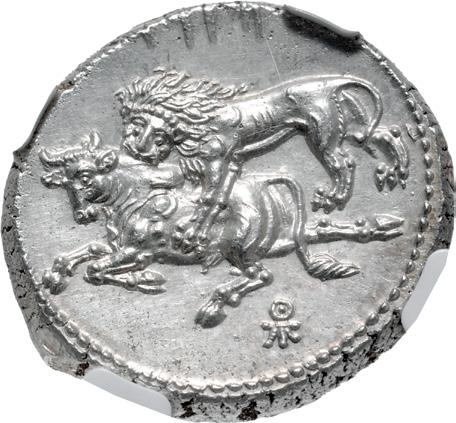
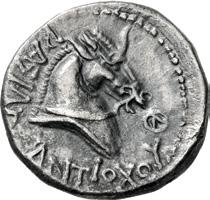
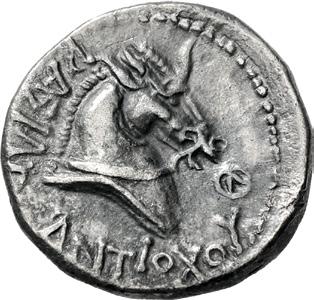
34
5620535.
PHOENICIA, Sidon. Ba`alšillem (Sakton) II. Circa 401-365 BC. AR Dishekel (26mm, 26.49 g, 12h). Phoenician galley left; B (B in Phoenician) above, waves below / Persian king, raising right hand, and driver, holding reins, in chariot left; to right, king of Sidon, in Egyptian style garments, holding cultic scepter in right hand, walking left. E&E-S Group IV.1.1a (unlisted dies); HGC 10, 236. Deep old cabinet toning, scratch. VF. $6750
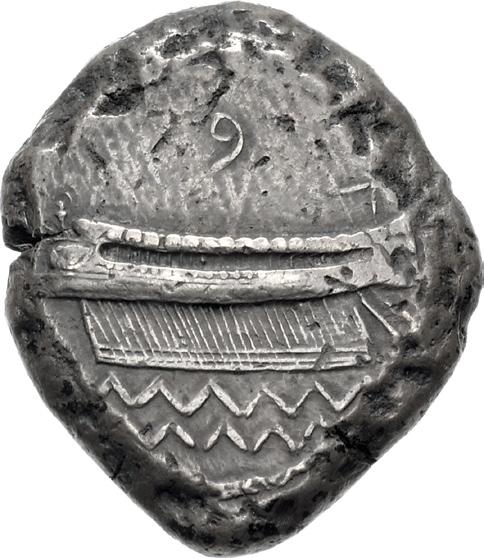
Ex Richard Winokur Collection (Classical Numismatic Group inventory 778165 [October 2006]).
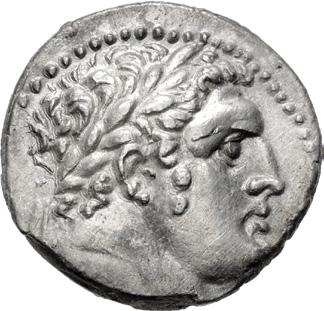
Sidon (modern Saida) was an important commercial center located on the coast of Phoenicia. Archaeological evidence dates the earliest remains to the Palaeolithic era. In the 10th century BC, the Phoenicians freed the city from Egyptian control and developed it into a maritime power through trade with other settlements throughout the eastern Mediterranean. During this time, it is thought that Tyre was founded by colonists from Sidon. Over the next five centuries, the city fell under Assyrian, Babylonian, and, eventually, Persian control. In the latter period, Sidon became the most important city of Phoenicia, and it was the first to develop a local coinage. These coins were struck under the local Sidonian king, and typically consisted of iconography representing the king and his overlord, the Great King of Persia, as well as a galley, the source of Sidonian wealth and power.
“Thirty Pieces of Silver”
5611721. PHOENICIA, Tyre. 126/5 BC-AD 65/6. AR Shekel (27mm, 13.28 g, 12h). Dated CY 65 (62/1 BC). Bust of Melkart right, wearing laurel wreath, [lion skin around neck] / Eagle standing left on prow; palm frond in background; to left, E$ (date) above club; … to right, b (B in Phoenician) between legs; tUroU 5Er`% ˚`5 `%U¬oU around. DCA Tyre 222; HGC 10, 357; DCA 919. Lightly toned. EF. $3750
Then one of the twelve, called Judas Iscariot, went unto the chief priests, and said unto them, “What will ye give me, and I will deliver him unto you?” And they covenanted with him for thirty pieces of silver.” (Matthew 26:14-15)
Since silver shekels and half-shekels of Tyre, Phoenicia were the only currency employed by the religious authorities in Jerusalem, they are considered by many the leading candidate for the Biblical “30 Pieces of Silver” paid to Judas Iscariot for betraying Jesus Christ. Although this issue is dated well before Christ’s lifetime, such coins often remained in circulation for many decades, if not centuries.
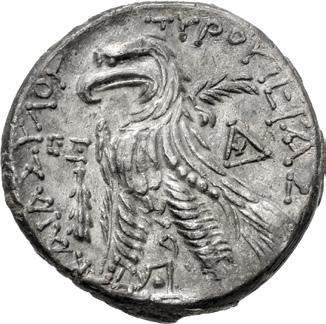
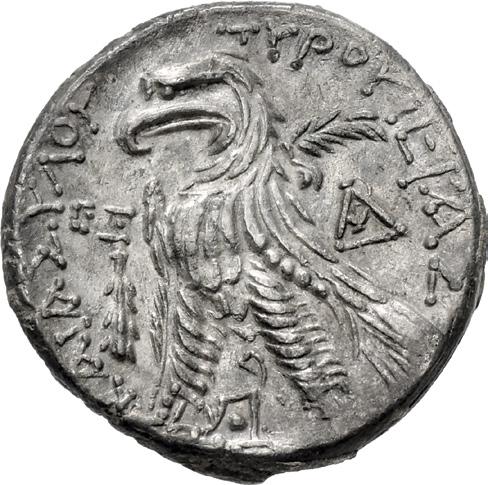
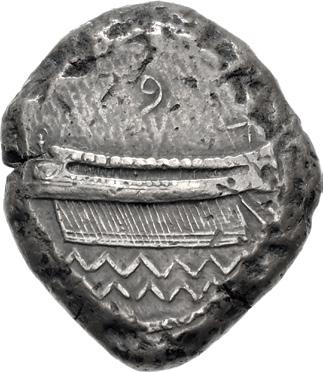
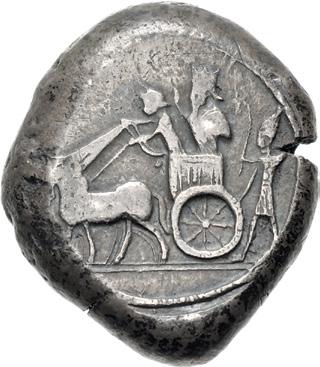
35
The Jewish War
5623897. JUDAEA, Jewish War. 66-70 CE. AR Shekel (22.5mm, 14.21 g, 1h). Jerusalem mint. Dated year 2 (67/8 CE). Omer cup; @c (“Y[ear] 2” in Hebrew = date) above, L!Rc¥ LQc (“Shekel of Israel” in Hebrew) around / Sprig of three pomegranates; YcurQY 2¥Lcur¥ (“Jerusalem the holy” in Hebrew) around. Deutsch 15 (O3/R13); Meshorer 193; Kadman 8; Hendin 6388; Bromberg II 376; Shoshana I 20202–3; Sofaer 7–8; Spaer 167–8. Minor metal flaw on reverse. EF. Well centered and struck. $9250
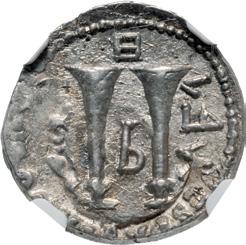
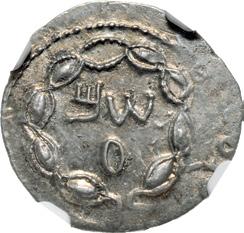
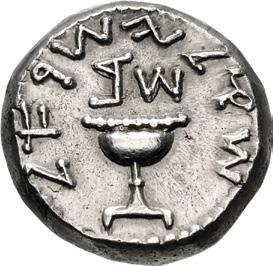
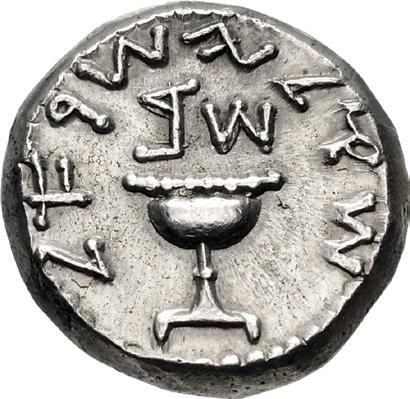
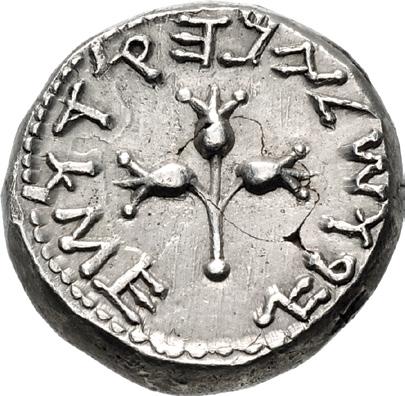
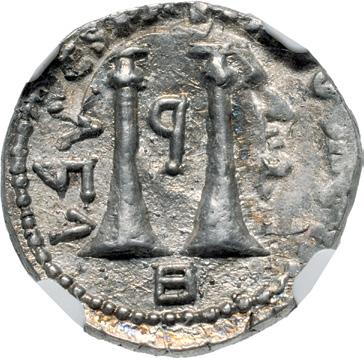
Struck during the Jewish War against Rome, which lasted for at least part of five calendar years, these silver Shekels demonstrate a separation from Roman authority. Unlike Roman coins, they bore no human portrait, in order to keep the commandment that “thou shalt not make a graven image.” Legends were written in the language of Jews, Hebrew; the lettering, however, was an archaic form known as “proto-Hebrew,” a form close to the Phoenician script from which it derived. Important religious imagery was the central design on either side; namely, the Omer cup, which held the “first fruits,” the measure of barley during Passover, and the sprig of three pomegranates, used as decoration on many religiously significant items.
Clear Profile of Vespasian on Undertype
5620501. JUDAEA, Bar Kochba Revolt. 132-135 CE. AR Zuz – Denarius (18mm, 3.25 g, 12h). Dated year 2 (133/4 CE). o2C (“Shim‘” in Hebrew) within wreath / Two trumpets upright; L!RC¥ RHL @C (“Y(ear) 2 of the Freedom of Israel” in Hebrew) around. Mildenberg 20 (O5/R14’); Meshorer 243 (same dies as illustration); Hendin 6421; Shoshana I 20293 (same dies). In NGC encapsulation 6327383-006, graded Ch AU, Strike: 3/5, Surface: 4/5, overstruck. Overstruck on a denarius of Vespasian, with a clear profile of the emperor visible. $4500
Here we have the interesting case of a coin of the second great Jewish revolt against Rome overstruck on a coin of the general, and later emperor, Vespasian, who led the Roman response to the first. As David Hendin notes, Bar Kochba’s historically important coins would mark an end to the minting of Jewish coins in antiquity. Though there was little financial incentive for the Jews to strike their own coins during the revolt as all of the Bar Kochba coinage was overstruck on a motley mix of coins already in circulation, Judaean coinage from this period played an integral role in the dissemination of political propaganda. As Meshorer notes: “Not only did [Bar Kochba] deface the portraits of despised emperors by this technique [of overstriking], he was also able to depict Jewish symbols and nationalistic inscriptions.” Coins were struck with hopeful slogans, such as “Jerusalem” and, in this case, “Year 2 of the Freedom of Israel.”
Overstruck on a Divus Vespasian Denarius
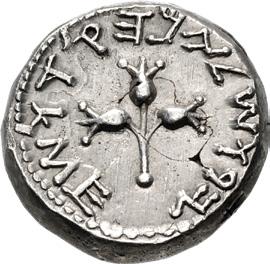
5620502. JUDAEA, Bar Kochba Revolt. 132-135 CE. AR Zuz – Denarius (18mm, 3.31 g, 1h). Undated, attributed to year 3 (134/5 CE). #⁄o2C (“Shim‘on” in Hebrew) within wreath / Elongated kithara with three strings; 2LC∑R¥ ¡∑RHL (“For the Freedom of Jerusalem” in Hebrew) around. Mildenberg 70 (O14/R42); Meshorer 272; Hendin 6446; Shoshana II 20226. In NGC encapsulation 6327383-005, graded Ch AU, Strike: 4/5, Surface: 4/5, overstruck. Overstruck on a denarius of Divus Vespasian (RIC II.1 357?). $4250
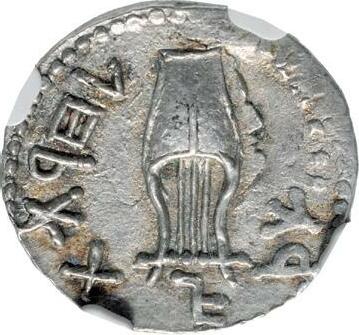
36
Overstruck on a Bostra Drachm of Trajan
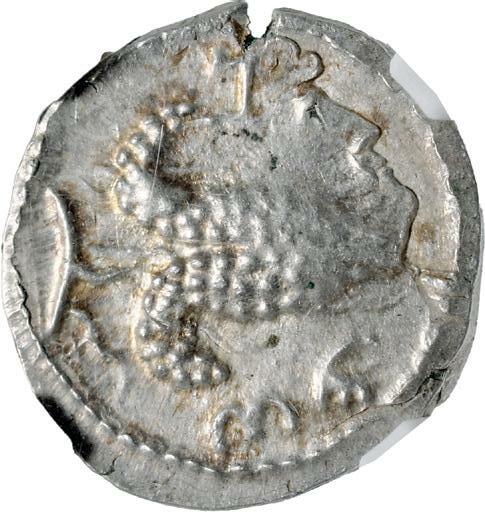
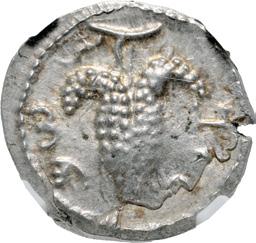
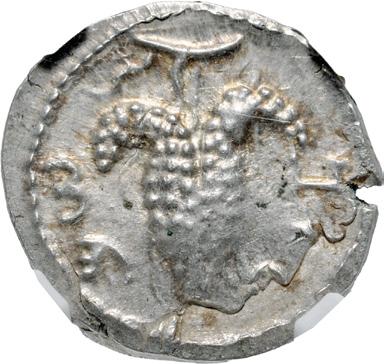
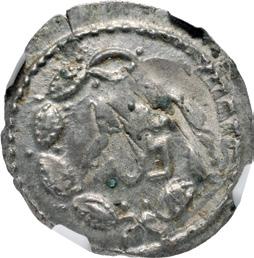
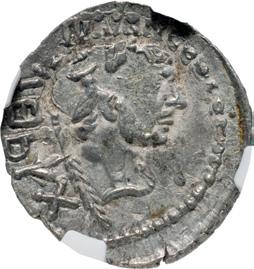
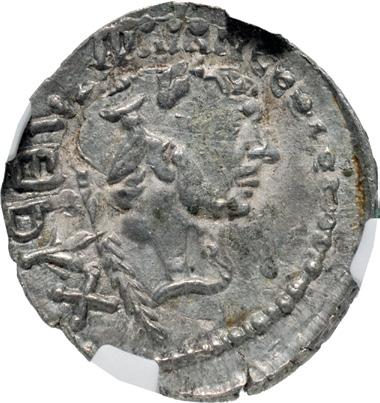
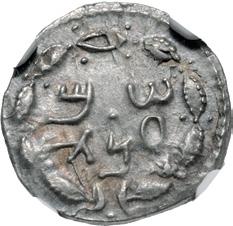
5620503. JUDAEA, Bar Kochba Revolt. 132-135 CE. AR Zuz – Denarius (21mm, 3.19 g, 12h). Undated, attributed to year 3 (134/5 CE). „o32c (“Shim‘on” in Hebrew, irregularly distributed) in two lines within wreath of thin branches wrapped around eight almonds / Fluted jug and branch; 2lc∑R¥ ¡∑Rjl (“for the freedom of Jerusalem” in Hebrew) around. Mildenberg 109 (O16/R76); Meshorer 283a; Hendin 6449; Shoshana I 20406 (same dies). In NGC encapsulation 6327383-003, graded AU, Strike: 3/5, Surface: 4/5, overstruck. Overstruck on a Bostra drachm of Trajan dated RY 16 (AD 112), cf. RPC 4072-4075. $4950
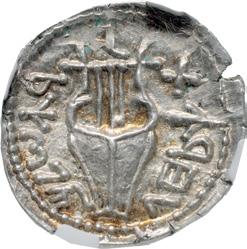
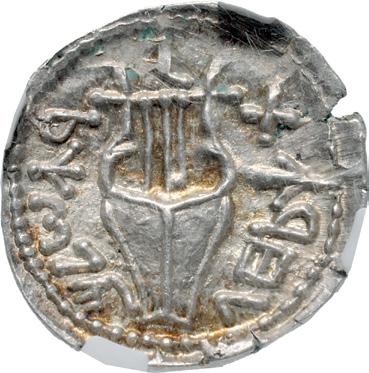
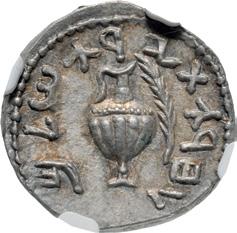
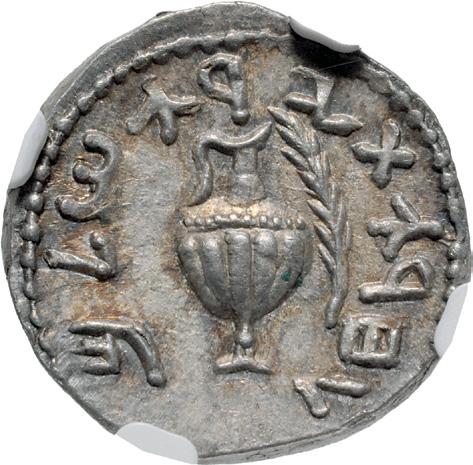
Finely Detailed Fluted Jug
5620504. JUDAEA, Bar Kochba Revolt. 132-135 CE. AR Zuz – Denarius (18mm, 3.21 g, 1h). Undated, attributed to year 3 (134/5 CE). „o32c (“Shim‘on” in Hebrew, irregularly distributed) in two lines within wreath of thin branches wrapped around eight almonds / Fluted jug and branch; 2lc∑R¥ ¡∑Rjl (“for the freedom of Jerusalem” in Hebrew) around. Mildenberg 134 (O19/R94); Meshorer 283 (same dies as illustration); Hendin 6454; Shoshana II 20240 (same dies). In NGC encapsulation 6327383-009, graded MS, Strike: 4/5, Surface: 5/5, overstruck. Overstruck on an uncertain issue with no visible traces of undertype. $3975
Clear Profile of Hadrian
37
5620506. JUDAEA, Bar Kochba Revolt. 132-135 CE. AR Zuz – Denarius (20mm, 3.42 g, 7h). Undated, attributed to year 3 (134/5 CE). Grape bunch on vine tendril; (“Shim‘on” in Hebrew) around / Elongated kithara; 2LC∑R¥ ¡∑RHL (“For the freedom of Jerusalem” in Hebrew) around. Mildenberg 204 (O24/R132); Meshorer 275 (same obv. die as illustration); Hendin 6462; Shoshana II 20287-8 (same obv. die). In NGC encapsulation 6327383-008, graded MS, Strike: 4/5, Surface: 5/5, overstruck. Overstruck on a denarius of Hadrian, with a clear profile of the emperor visible. $4750
5620499.
Mint State Tetradrachm of Ptolemy I as Satrap
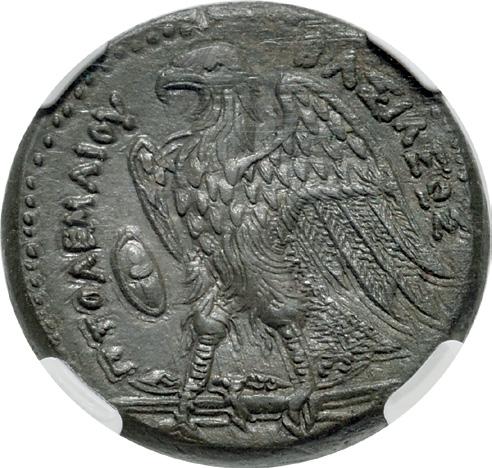
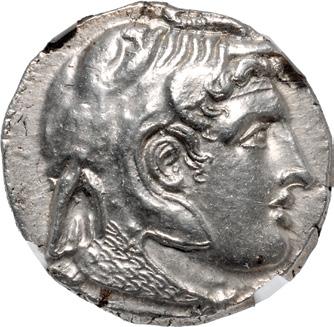
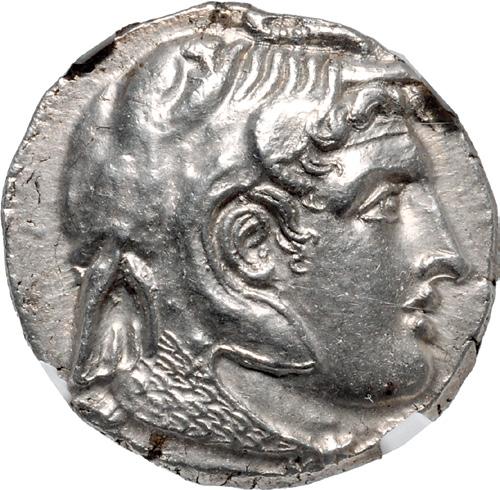
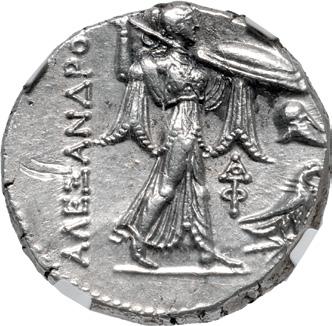
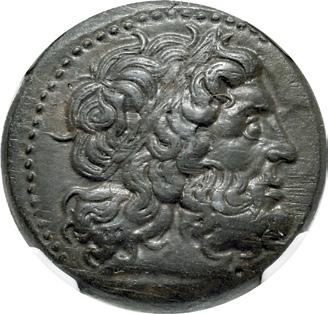
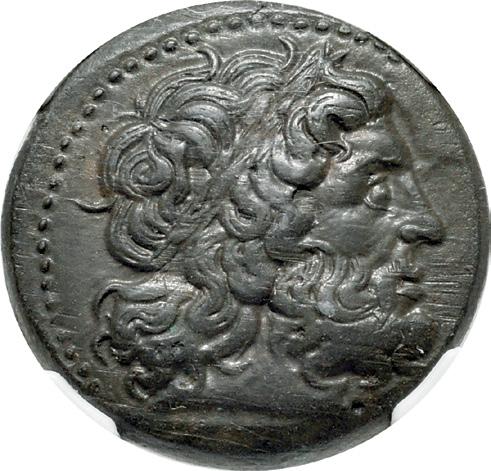
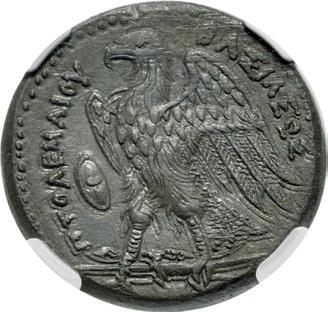
$19,500
The series of Ptolemaic bronze coins that display an obviously “Sicilian” style have long puzzled numismatic scholars and collectors. The latest research, by Daniel Wolf and Catharine Lorber in the 2011 Numismatic Chronicle, indicate these coins were struck in Sicily by Hieron II, in alliance with Ptolemy II Philadelphos of Egypt. Hieron was named Strategos (commanding general) of the Greek armies fighting Carthage in Sicily circa 269 BC. He likely made overtures to Ptolemy II, and the Egyptian king probably responded by sending a Ptolemaic contingent of soldiers, along with a large quantity of bronze to be made into coins to pay the troops. The Syracusan die engravers produced a close approximation to the contemporary bronze issues of Egypt, but with a more “western-looking” head of Zeus and lacking the distinctive beveled edges seen on Alexandrian bronzes. This coinage likely ceased in 264/3 BC, when Hieron proclaimed himself king and became embroiled in a conflict against Rome, another ally of Egypt, which then probably ended fiscal and military support for Syracuse.
38
PTOLEMAIC KINGS of EGYPT. Ptolemy I Soter. As satrap, 323-305/4 BC, or king, 305/4-282 BC. AR Tetradrachm (27mm, 15.44 g, 1h). Ptolemaic standard. In the name of Alexander III of Macedon. Alexandreia mint. Struck circa 306-300 BC. Diademed head of the deified Alexander right, wearing elephant skin, aegis around neck / ŬE$Å@droU, Athena Alkidemos advancing right, brandishing spear in right hand and wearing shield on extended left arm; to right, helmet, », and eagle standing right on thunderbolt. CPE 63; Svoronos 168; Zervos Issue 24, unlisted dies; SNG Copenhagen 19. In NGC encapsulation 4276144-001, graded MS, Strike: 5/5, Surface: 4/5.
NGC Graded MS★ 5/5, 5/5, Fine Style
5620500.
PTOLEMAIC KINGS of EGYPT. Ptolemy II Philadelphos. 285-246 BC. Æ (26mm, 17.68 g, 12h). Uncertain mint in Sicily. Struck circa 264–263 BC. Laureate head of Zeus right; dotted border / ∫Å%5¬EW% ∏to¬EÂÅ5oU, eagle standing left on thunderbolt; shield to left; dotted border. CPE B288; Svoronos 610; Wolf & Lorber, ‘Alexandrian’ Style, P01–54; SNG Copenhagen 114. In NGC encapsulation 2400929-009, graded MS★, Strike: 5/5, Surface: 5/5, fine style. $5750
Ex Jonathan K. Kern Collection.
ORIENTAL GREEK
5621421. KINGS of PARTHIA. Phriapatios to Mithradates I. Circa 185-132 BC. AR Drachm (21mm, 4.62 g, 12h). Hekatompylos mint. Head left, wearing bashlyk / ∫Å%5¬EW% ;E˝Å¬oU År%Å˚oU, archer (Arsakes I) seated right on omphalos, holding bow. Sellwood 10.1 (Mithradates I); Sunrise 254; Shore 12-13 (Mithradates I). EF. Broad flan, choice metal. $1150
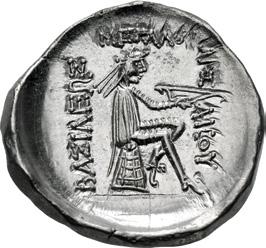
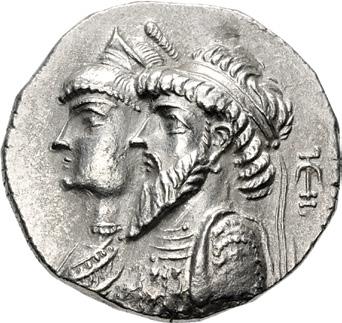
5621420. KINGS of PARTHIA. Artabanos VI. Circa AD 216-224. AR Drachm (19mm, 3.24 g, 12h). Ekbatana mint. Diademed and draped bust left, wearing tiara with ear flap; g⁄ (’r in Aramaic) to right / ArL1wLrtrA (’rtbnw’ in Aramaic) and ¬55¬@uiL above, uiu to right, Nu∏uä in exergue, x¬ui,
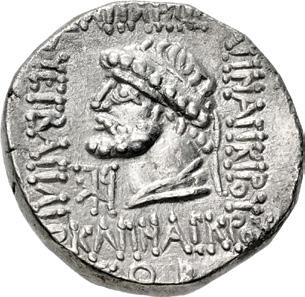
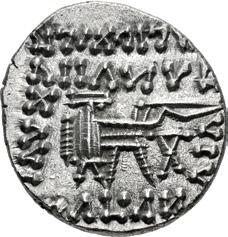
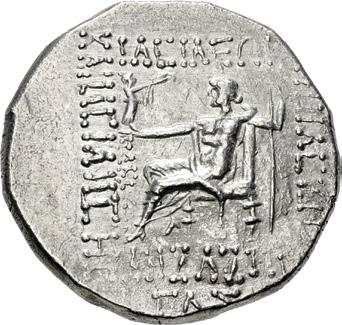
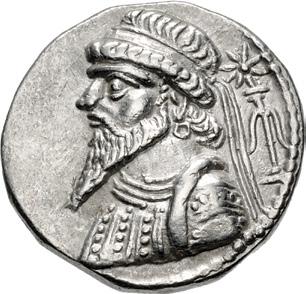
(Arsakes I) seated right on throne, holding bow; x monogram below bow. Sellwood 89.3 (Artabanos IV); Sunrise –; Shore 465 (Artabanos IV). Superb EF. Perfect centering, metal, and strike. $1750
Unrecorded Date
5621417. KINGS of ELYMAIS. Kamnaskires III, with Anzaze. Circa 82/1-73/2 BC. AR Tetradrachm (29mm, 15.99 g, 12h). Seleukeia on the Hedyphon mint. Dated SE 233 (80/79 BC). Conjoined busts of Kamnaskires III, diademed and draped bust and wearing long beard and torque, and Anzaze, draped and wearing stephane and necklace, left; anchor symbol to right / 5G45GE∑5 above, [˚G;]@G4˚55[oU] to right, ˚G5 5G45G54[4˙4] to left, 2@Z2Z˙5, Zeus-Belos enthroned left, holding in outstretched right hand Nike, standing right and holding wreath, and scepter in left; traces of ;G˚Ed∑@ to inner left; ˝2% (date) in exergue. van’t Haaff Type 7.1.1-1-2 (date unlisted); Alram 454 (date unlisted); Sunrise –. Light cleaning marks, scratch under chin, areas of weak strike. EF. Rare without the tooling or smoothing normally seen on this issue. $3450
The Kingdom of Elymais flourished as an autonomous sub-monarchy to the Seleukid and Parthian Kingdoms along the upper portion of the Persian Gulf, modern Khuzestan, Iran, from circa 188 BC to AD 222. The name derives from the ancient Biblical name for the region, Elam. Its earliest ruling dynasty, the Kamnaskirids, produced an intriguing coinage blending Hellenistic and Parthian elements. This attractive tetradrachm of Kamnaskires III depicts him alongside his wife, Anzaze, both of whom are named on the reverse as king and queen; both also sport royal diadems, indicating they ruled jointly.
5621418. KINGS of ELYMAIS. Kamnaskires V. Circa 54/3-33/2 BC. AR Tetradrachm (26mm, 14.78 g, 12h). Seleukeia on the Hedyphon mint. Dated SE 272 (41/40 BC). Diademed and draped bust left, wearing long beard and torque; to right, star above anchor symbol / ∫G55GE∑4 above, [˚Å]∏@Å55˚5roU to right, [t]oU ∫G45G5∑[5] to left, ˚G∏@G5˚roU below (sic), diademed and draped bust left, wearing short beard; À to left; So∫ (date) in exergue. van’t Haaff Type 9.1 (monogram and date unlisted); Alram –; Sunrise –; Zeno –; Berk 220, lot 117 = CNG 114, lot 465. Traces of porosity. EF. $1850
39
archer
ROMAN PROVINCIAL
Cited in RPC III
5611723.
Type B1, 1 (O1/R1); RPC III 968.28 (this coin); RSC 240b. Old cabinet tone, light golden iridescence. EF. Excellent portrait. $6750
Ex Roma XVII (28 March 2019), lot 644.
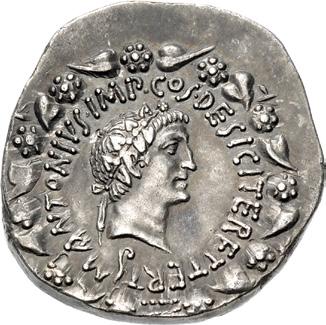
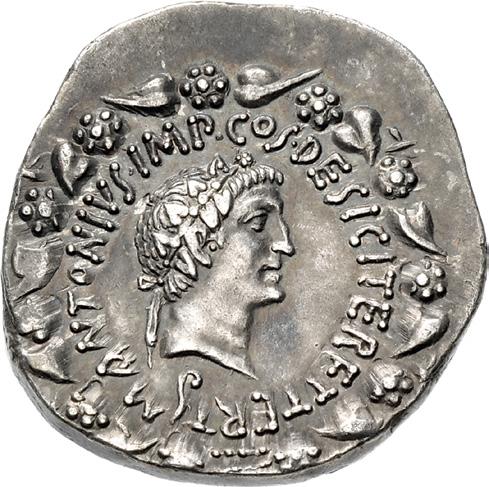
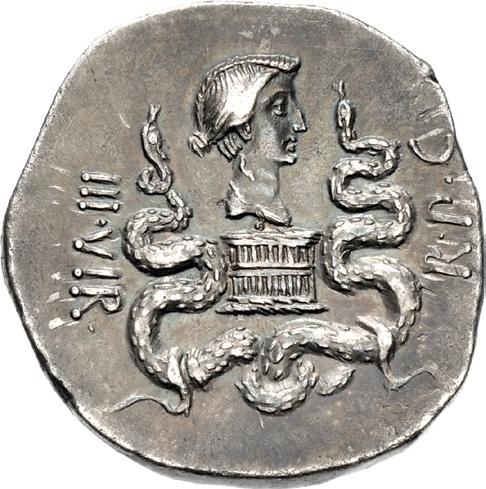
Superb Antony & Octavia
RPC I 2201; CRI 262; Sydenham 1197; RSC 2. Attractive cabinet toning with hints of iridescence, struck from fresh dies. Choice EF. Superb portraits of both Antony and Octavia. $7500
Ex Gorny & Mosch 280 (11 October 2021), lot 514.
Shortly after the Battle of Philippi in 42 BC, cracks began to appear in the Second Triumvirate. Antony’s affair with Cleopatra, queen of Egypt, and his designs on Rome’s eastern holdings, prompted Octavian to formulate a binding agreement that would buy him time. At Brundisium a pact was signed, bringing about a reconciliation and some semblance of peace. As a condition of this reconciliation, Antony was married to Octavian’s widowed sister, Octavia. She stayed with him in Athens while he continued to prepare for a war against Parthia, and where, in 39 BC, he was associated with the “New Dionysus.” In 37 BC, she helped negotiate the Pact of Tarentum, which renewed the triumvirate until 33 BC. Antony, by this time, however, had renewed his affair with Cleopatra. He remained in the East, where he married the queen, and subsequently fathered several children. In 32 BC, as a renewal of civil war became imminent, Antony divorced Octavia. In the aftermath of Antony’s death, Octavia, known for her loyalty and nobilty, brought Antony’s surviving children to Rome to live with her.
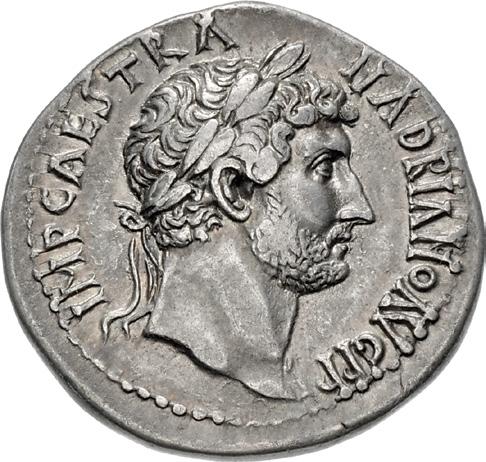
40
BITHYNIA, Koinon of Bithynia. Hadrian. AD 117-138. AR Cistophorus (27mm, 10.86 g, 7h). Nicomedia mint. Struck AD 128-138. IMP CAES TRA HADRIANO AVG P P, laureate head right / COM BIT, octastyle temple set podium with three steps, ROM S P AVG across frieze, pellet in pediment. Metcalf, Cistophori,
5624331. IONIA, Ephesus. Mark Antony and Octavia. Summer-autumn 39 BC. AR Cistophorus (27mm, 11.91 g, 12h). Â • ANTONiuÍ • iÂp • COÍ • DeÍig • iTer eT TerT, head of Antony right, wearing ivy wreath; lituus below; all within wreath of ivy and flowers / Draped bust of Octavia right above cista mystica, flanked by interlaced serpents with heads erect; iii • uir • r • p • C • at sides.
5624338. ASIA MINOR, Uncertain. Augustus. 27 BC-AD 14. AR Cistophorus (27mm, 11.96 g, 1h). Ephesus mint(?). Struck 28 BC. iÂp • CAeÍAr • Diui • F • COÍ • ui • LiBerTATiÍ • p • r • uiNDex, laureate head right / pAx, Pax standing left, holding caduceus; to right, serpent arising from cista mystica; all within laurel wreath. Sutherland Group I, – (unlisted dies); RPC I 2203; RSC 218; BMCRE 691; BN 908-10. Deep cabinet tone, scrape on obverse. Near EF. $4750
Ex Peter Corcoran Collection; Roma XVII (28 March 2019), lot 628.
Prosperity Under Augustus
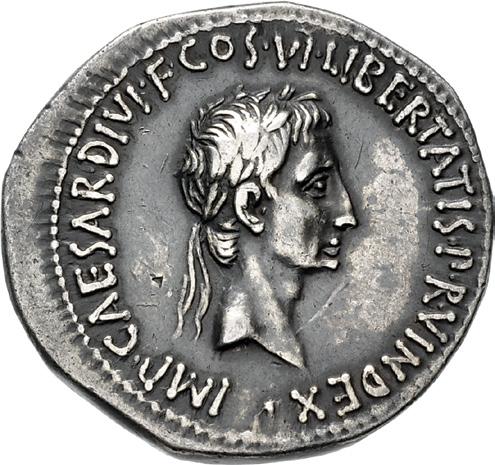
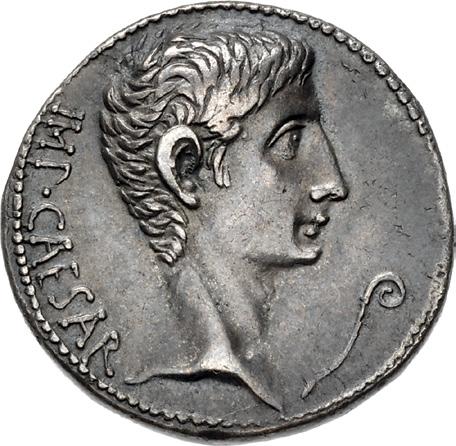
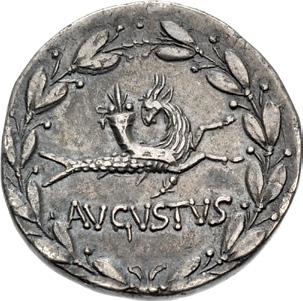
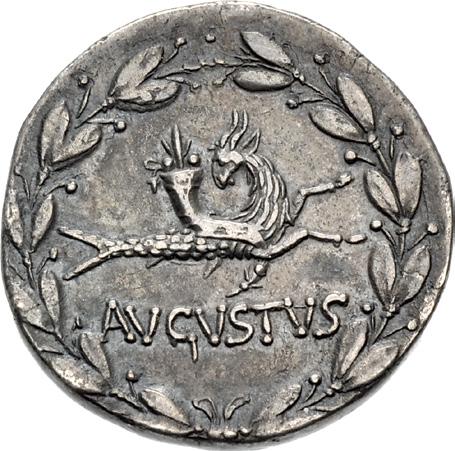
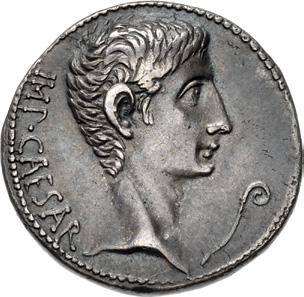
5621416. ASIA MINOR, Uncertain. Augustus. 27 BC-AD 14. AR Cistophorus (25mm, 11.88 g, 12h). Pergamum mint(?). Struck 27-26 BC. iÂp • CAeÍAr, bare head right; lituus before / AuGuÍTuÍ, capricorn right, head left, bearing cornucopia on back; all within laurel wreath. Sutherland Group IIIβ, – (O–/R7 [unlisted obv. die]); RPC I 2208; RSC 16a; BMCRE 698; BN 950-1. Deep cabinet tone, minor marks. Near EF. $5750
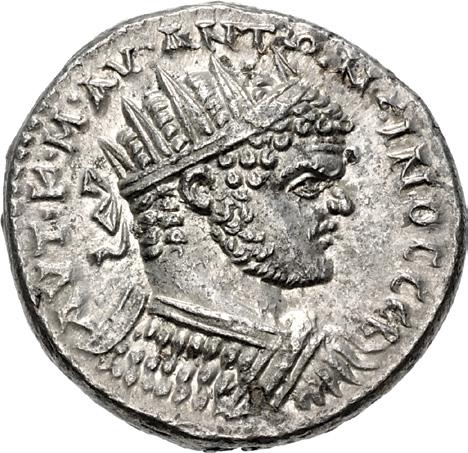
The capricorn represents Octavian’s birth sign and appeared often as a coin type during his reign. Adding the cornucopia, or horn of plenty, to the back of the capricorn symbolizes the prosperity brought about through his efforts, and his victories are symbolized by the laurel wreath.
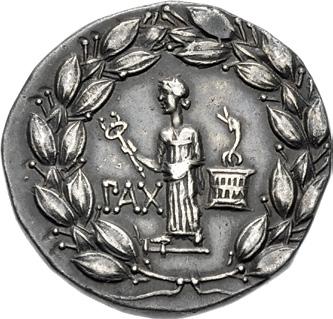
5623684. MESOPOTAMIA,
198-217.
(26mm, 13.81 g, 11h). Struck AD 215217. AVT · K · M · AV · ANTΩNЄINOC CЄB, radiate and cuirassed bust right / ΔHMAP·X · ЄΞ · VΠATOC TO · Δ, eagle standing facing, head and tail right, with wings displayed, holding wreath in beak; shrine with pediment between legs. Prieur 850 (same obv. die as illustration); Bellinger 139 (same obv. die as illustration). Attractive cabinet tone, a couple of insignificant deposits. Choice EF. $2950
Ex Triton XVIII (6 January 2015), lot 904.
41
Edessa. Caracalla. AD
AR Tetradrachm
Ex Weber Collection
5616504. EGYPT, Alexandria. Hadrian. AD 117-138. Æ Drachm (35mm, 23.64 g, 11h). Dated RY 12 (AD 127/8). AYT KAI TPAI AΔPIA CЄB, laureate, draped, and cuirassed bust right, seen from behind / Nilus reclining left on crocodile, holding reed and cornucopia from which emerges a Genius; Iς above, L ΔωΔЄK (date) in exergue. Köln 991; Dattari (Savio) 1806; K&G 32.461; RPC III 5717.93 = Weber 8336 (this coin); Emmett 1014.12. Brown and red patina with patches of green deposits. Good VF. $2750
Ex Hermann Weber Collection. Reportedly found in Luxor, 1894.
Ex Niggeler,
Magnaguti,
and Steger Collections
5624340. EGYPT, Alexandria. Hadrian. AD 117-138. Æ Drachm (36mm, 29.09 g, 11h). Dated RY 16 (131/2 AD).
AVT KAI TPAI A∆PIA CЄB, laureate, draped, and cuirassed bust right, seen from behind / Hadrian, laureate and togate, standing right in slow quadriga right, holding eagle tipped scepter in left hand and laurel branch in right; L Iς (date) in exergue. Köln 1047; Dattari (Savio) 1591 (same obv. die); K&G 32.522; RPC III 5790; Emmett 960.16. Dark brown patina, in excellent style. Superb EF. A bold and striking portrait. One of the finest specimens known, superior to any recorded in RPC or CoinArchives. $16,500
Ex Hess-Divo 339 (22 October 2020), lot 58; Walter Niggeler Collection (Part II, Leu/Munzen und Medallien, 21 October 1966), lot 707; Conte Alessandro Magnaguti Collection (Part III, Santamaria, 26 June 1950), lot 943; Dr. Hans Steger Collection (Münzhandlung Basel 6, 18 March 1936), lot 486.
42
Pedigreed to 1934
5616505.
Ex
ROMAN REPUBLICAN
The Roman Quadrigatus
5624371. Anonymous. Circa 225-212 BC. AR Didrachm – Quadrigatus (21mm, 6.62 g, 9h). Rome mint. Laureate head of Janus, no annulets at top of head, curved truncation / Jupiter, hurling thunderbolt with right hand and holding scepter in left, in galloping quadriga driven right by Victory, holding reins in both hands; rOÂa incuse on raised tablet in exergue. Crawford 28/3; Sydenham 64a; HN Italy 334; RSC 23; BMCRR Romano-Campanian 87; Kestner 88, 92–3, and 95; RBW 65. Lightly toned, some faint hairlines and minor marks. Choice EF. Elegant rendering of Janus. $5250
This, the first truly extensive Roman coinage in silver, began shortly before the outbreak of the Second Punic War and continued until it was superseded by the denarius reform of circa 211 BC. Some early Roman imperial texts refer to a coin called a “quadrigatus” that was used to make payments during the war against Hannibal; this is clearly the type that commenced circa 225 BC, bearing a youthful, laureate janiform head on the obverse and a quadriga carrying Jupiter and Victory on the reverse. The issue was quite large and included a number of variant subtypes, indicating several mints were involved in the production. Later issues were struck on smaller flans in debased silver, no doubt due to wartime shortages.
43
EGYPT, Alexandria. Hadrian. AD 117-138. Æ Drachm (33mm, 23.50 g, 11h). Dated RY 21 (AD 136/7). AYT KAIC TPAIAN AΔPIANOC CЄB, laureate, draped, and cuirassed bust right, seen from behind / Harpocrates of Mendes, crowned with skhent riding ram left, raising finger to lips and holding club, ram crowned with solar disk; L KA (date) in fields. Köln –; Dattari (Savio) 1737; K&G –; RPC III 6176.9 (this coin); Emmett 977.21(R5). Dark brown patina, minor flan cracks, small deposit on reverse. VF. $3250
Münzhandlung Basel 1 (28 June 1934), lot 924.
5619873. Anonymous. Circa 225-212 BC. AR Didrachm – Quadrigatus (21mm, 6.56 g, 6h). Uncertain mint. Laureate head of Janus, with indented truncation / Jupiter, hurling thunderbolt with right hand and holding scepter in left, in galloping quadriga driven right by Victory, holding reins in both hands; rOÂa raised on solid tablet in exergue. Crawford 29/3; Sydenham 64d; HN Italy 334; RSC 23/24; BMCRR Romano-Campanian 105; Kestner 104; RBW 75–6. Toned, some marks. Near EF. $2850
5624373. Anonymous. 206-200 BC. AR Denarius. Staff and Feather series. Uncertain mint. Helmeted head of Roma right, curl on shoulder; staff to right / The Dioscuri, each holding spear, on horseback riding right; feather below; rOÂa in exergue. Crawford 130/1a; Sydenham 206; RSC 20ee; BMCRR Italy 307; Kestner 1423-30; RBW 581. Lightly toned, minor flan crack. EF. $975
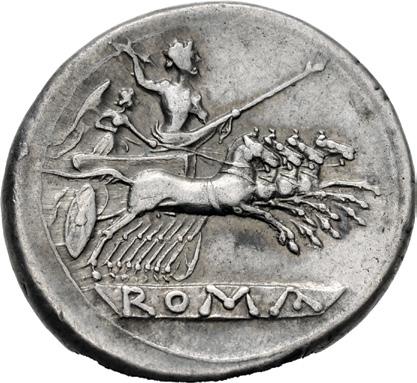
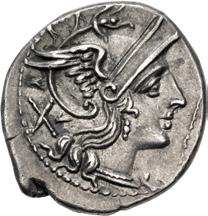
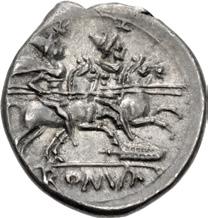
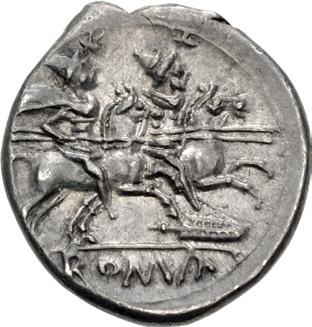
5612164. Anonymous. 206-195 BC. AR Denarius (18mm, 3.72 g, 5h). Rostrum Tridens (second) series. Rome mint. Helmeted head of Roma right; x (mark of value) to left / The Dioscuri, each holding spear, on horseback riding right; rostrum tridens below; rOÂa in tablet in exergue. Crawford 114/1; Sydenham 244; RSC 20x; BMCRR 448; Kestner 1295-1300; RBW 522. Toned, lustrous, minor flan crack. Choice EF. $1550
Ex Kricheldorf 46 (17 July 1998), lot 87; Sternberg XXI (15 November 1988), lot 234.
5616556. Anonymous. 206-195 BC. AR Denarius (18mm, 3.78 g, 10h). Rudder series. Rome mint. Helmeted head of Roma right; x (mark of value) to left / The Dioscuri, each holding spear, on horseback riding right; rudder below horses; rOÂa in tablet in exergue. Crawford 117A/1; Sydenham 261; RSC 20y; BMCRR 446-7; Kestner 1324-7; RBW 531. Dark toning with spots of iridescence, light scratch under tone. Near EF. $1575
44
5616557. C. Junius C.f. 149 BC. AR Denarius (17.5mm, 4.04 g, 6h). Rome mint. Helmeted head of Roma right; x (mark of value) to left / The Dioscuri, each holding spear, on horseback riding right; C • iuNi • C • F below; rOÂa in tablet in exergue. Crawford 210/1; Sydenham 392; Junia 1; BMCRR 660-3; Kestner 1995-6; RBW 893. Iridescent toning. EF. $1750
5612166. L. Cupiennius. 147 BC. AR Denarius (18.5mm, 4.17 g, 8h). Rome mint. Helmeted head of Roma right; cornucopia to left, x (mark of value) below chin / The Dioscuri, each holding spear, on horseback riding right; L • C(up) below horses, rOÂA in exergue. Crawford 218/1; Sydenham 404; Cupiennia 1; BMCRR Rome 850-5; Kestner 2070-1; RBW 937. Lightly toned with some luster under golden iridescence. EF $1350
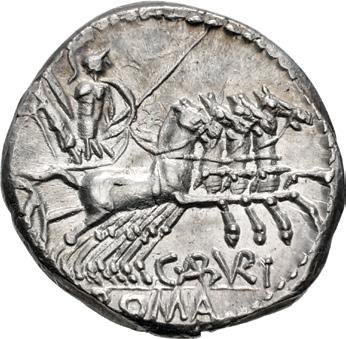
Ex Lanz 163 (7 December 2016), lot 170; Numismatica Ars Classica 8 (3 April 1995), lot 501.
Exceptional Servilius Denarius
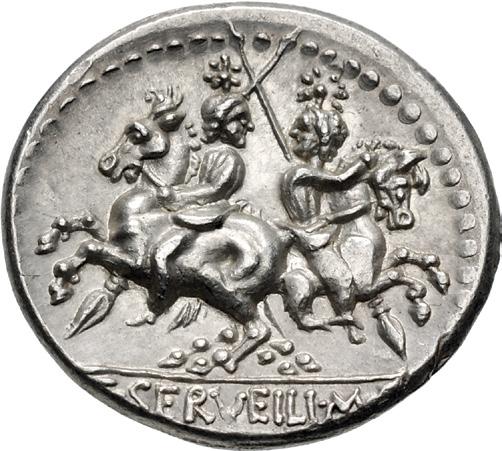
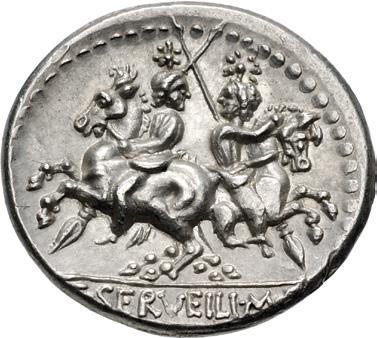
5624374. C. Servilius M.f. 136 BC. AR Denarius (20mm, 3.96 g, 5h). Rome mint. Head of Roma right, wearing winged helmet, ornamented with griffin’s head, the visor in three pieces, single-pendant earring, and pearl necklace; to left, wreath above • (mark of value); rOÂA below / The Dioscuri, each holding couched spear in right hand, and wearing chlamys, cuirass, and pileus surmounted by star, on horseback riding right; C • ÍerueiLi • Â • F in exergue. Crawford 239/1; Sydenham 525; Servilia 1; BMCRR Italy 540-7; Kestner 2154–5; RBW 984. Lightly toned, struck from fresh dies. EF. Superb reverse. $3250
5612171. C. Aburius Geminus. 134 BC. AR Denarius (19mm, 3.94 g, 10h). Rome mint. Head of Roma right, wearing winged helmet, ornamented with griffin’s head, the visor in three pieces, single-pendant earring and pearl necklace; ge to left, • (mark of value) below chin / Mars, holding trophy in right hand and spear, shield, and reins in left, driving galloping quadriga right; C • äœi below, rOÂA in exergue. Crawford 244/1; Sydenham 490; Aburia 1; BMCRR Rome 999; Kestner 2214–5; RBW 1006. Lustrous with a hint of toning. EF. $1650
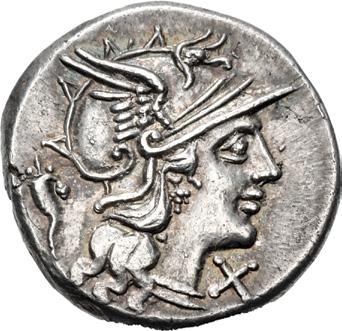
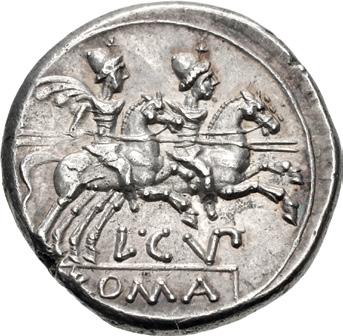
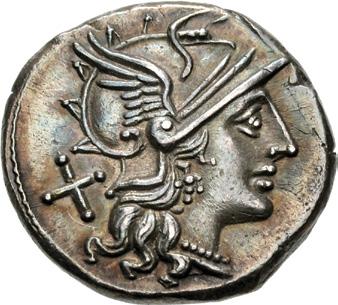
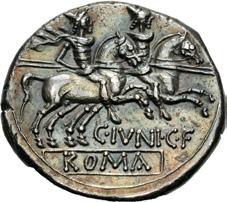
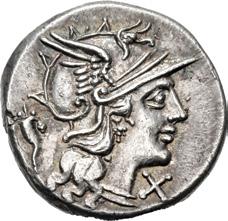
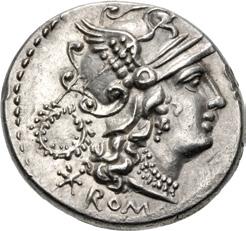
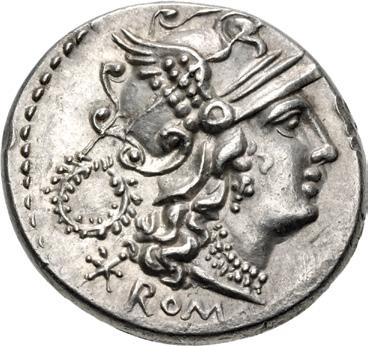
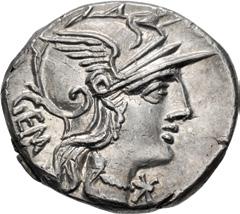
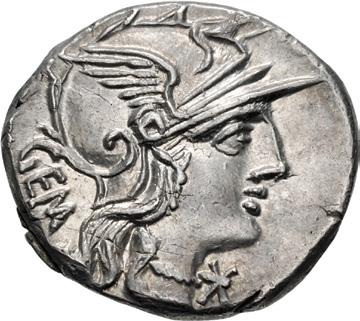
Ex Classical Numismatic Group Electronic Auction 115 (25 May 2005), lot 538.
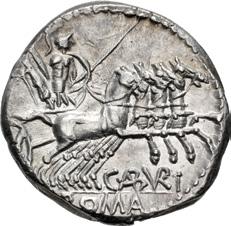
45
5612174. Numerius Fabius Pictor. 126 BC. AR Denarius (17mm, 3.95 g, 12h). Rome mint. Helmeted head of Roma right; xui (mark of value) to left, B below chin / The flamen Quirinalis, Q. Fabius Pictor, seated left, holding apex and spear; shield at side inscribed œui/riN in two lines, A to upper right, piCTOr to left, N • FABi to right, rOÂA in exergue. Crawford 268/1b; Sydenham 517a; Fabia 11; BMCRR Rome 1173-9; Kestner 2406; RBW –. Deep cabinet tone, struck on a compact flan. Near EF. $1575
Ex Classical Numismatic Group 76 (12 September 2007), lot 1171.
5616563. L. Philippus. 113-112 BC. AR Denarius (18.5mm, 3.86 g, 9h). Rome mint. Head of Philip V of Macedon right, wearing diademed royal Macedonian helmet with goat horns; ” to left, f below chin / Equestrian statue right on tablet inscribed L • phiLippuÍ; flower below horse, • (mark of value) in exergue. Crawford 293/1; Sydenham 551; Marcia 12; BMCRR Italy 532; Kestner 2494-5; RBW 1132. Deep cabinet tone, small edge flaw on reverse, slightly off center. EF. $1875
5611724. L. Torquatus. 113-112 BC. AR Denarius (18mm, 3.87 g, 8h). Rome mint. Head of Roma right; x (mark of value) below chin; all within decorated torque / Warrior, holding spear and shield, on horseback galloping left; œ to right, L • TOrœuA below, ex • Í • C in exergue. Crawford 295/1; Sydenham 545; Manlia 2; BMCRR Italy 518; Kestner 2506-7; RBW 135. Lightly toned, slightly off center obverse. Superb EF. $1750
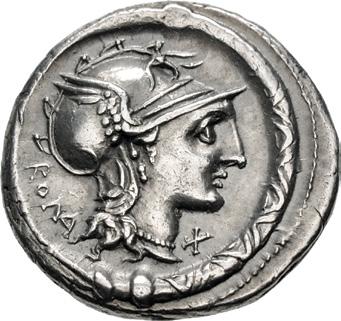

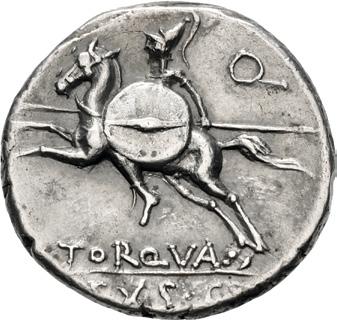
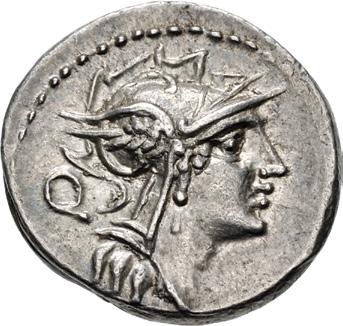
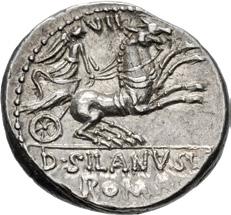
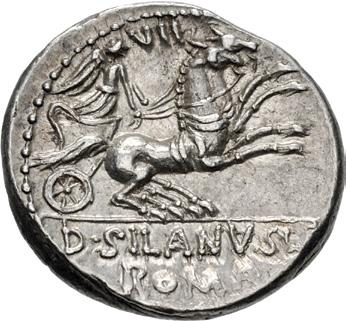
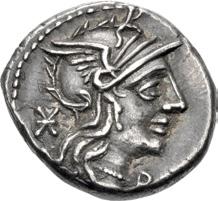
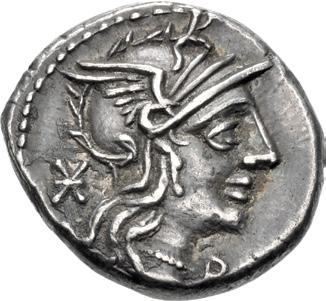
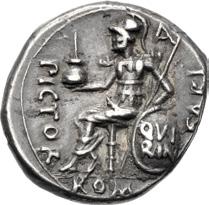
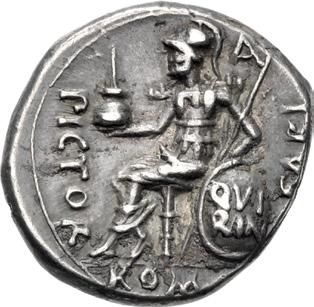
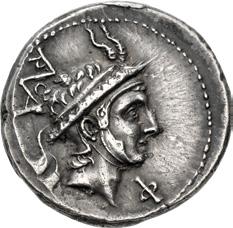
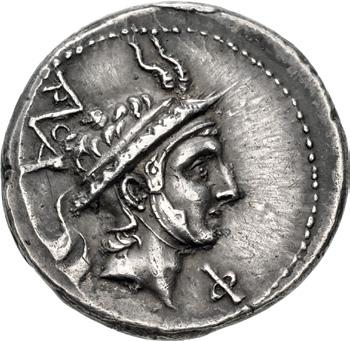
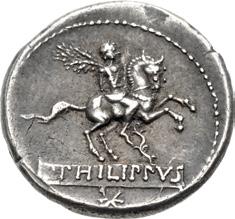
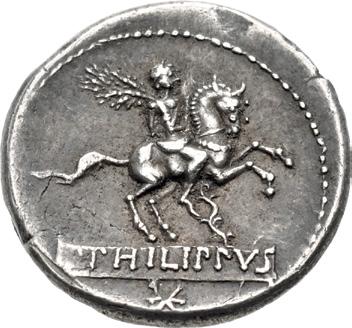
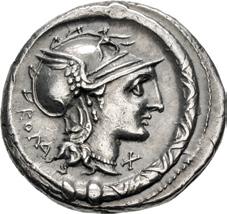
Ex Scipio Collection, purchased from J. Fernández, 1998; Numismatica Ars Classica 7 (2 March 1994), lot 560.
5612176.
Ex Tkalec (17 May 2010), lot 69.
46
D. Silanus L.f. 91 BC. AR Denarius (18mm, 3.95 g, 3h). Rome mint. Head of Roma right, wearing crested and winged helmet, the visor in three pieces, single-pendant earring and pearl necklace; C to left / Victory, holding reins in both hands, driving galloping biga right; uIi above, D • ÍiLANuÍ • L • F/ rOÂA in two lines in exergue. Crawford 337/3; Sydenham 646; Junia 15; BMCRR Rome 1777 var. (control); Kestner –; RBW 1233 var. (same). Hints of golden iridescence with underlying luster. EF. $975
5612177. Mn. Fonteius C.f. 85 BC. AR Denarius (20mm, 3.83 g, 11h). Rome mint. Head of Vejovis (or Apollo) right, wearing laurel wreath; • FO¸ei • C • F around, thunderbolt below neck / Infant winged Genius (or Cupid) seated on goat, standing right; pilei of the Dioscuri above, thyrsus with fillet in exergue; all within laurel wreath. Crawford 353/1c; Sydenham 724a; Fonteia 10; BMCRR Rome 2478–80; Kestner 3110–2; RBW 1351. Light golden iridescence, minor marks. EF. $1750
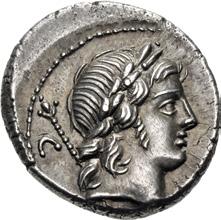
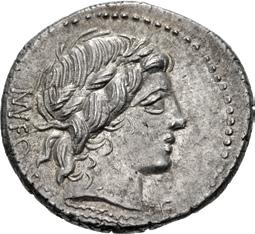
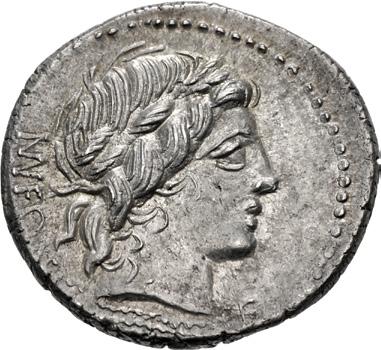
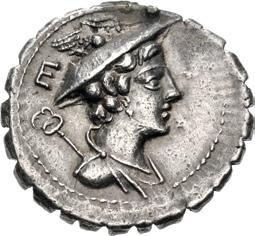
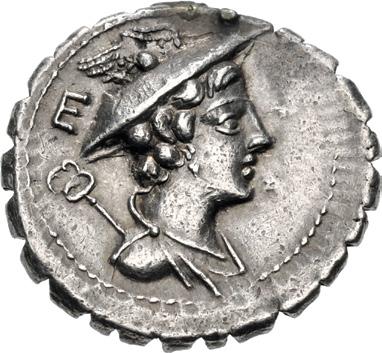
Ex Numismatica Ars Classica 15 (18 May 1999), lot 98.
5611883. Pub. Crepusius. 82 BC. AR Denarius (17.5mm, 3.94 g, 3h). Rome mint. Head of Apollo right, wearing laurel wreath, scepter over shoulder; C to left, [uncertain control below chin] / Warrior on horse rearing right, brandishing spear in right hand; [uncertain control to left], p • CrepuÍi in exergue. Crawford 361/1c; Sydenham 738a; Crepusia 1; cf. BMCRR Rome 2686; cf. Kestner 3149-5; cf. RBW 1369. Light cabinet tone, off center. EF. $1150
Ulysses Greeted by Argus
5616564. C. Mamilius Limetanus. 82 BC. AR Serrate Denarius (20mm, 4.07 g, 3h). Rome mint. Draped bust of Mercury right, wearing winged petasus; to left, e above caduceus / Ulysses, wearing pileus and mariner’s dress, walking right, leaning on staff in left hand and extending his right hand toward his dog, Argus, who advances toward him; C • ÂAÂiL downward to left, LiÂeëN upward to right. Crawford 362/1; Sydenham 741; Mamilia 6; BMCRR Rome 2719; Kestner 3151; RBW 1370 var. (control). Lightly toned, minor pits, small die flaw on obverse. EF. Superb detail. $1975
The obverse and reverse of this coin refer to the lineage of the gens Mamilia, who claimed their descent from Mamilia, the daughter of Telegonus, the son of Ulysses and Circe, and a descendant of Mercury. The reverse scene depicts the moment when, returning home from his long wanderings in the guise of a beggar so as to surprise and kill the many suitors of his wife Penelope, Ulysses’ aged dog Argus recognizes him. At last seeing his master after so many years, the old dog dies.
5616567. A. Postumius A.f. Sp.n. Albinus. 81 BC. AR Serrate Denarius (19.5mm, 3.92 g, 10h). Rome mint. Veiled head of Hispania right; hiÍpAN to left / Togate figure standing left, raising right hand; legionary eagle to left, fasces with ax to right; A •/ 8BiN/ N • Í across fields; pOÍT • A • F in exergue. Crawford 372/2; Sydenham 746; Postumia 8; BMCRR Rome 2839-42; Kestner 3186-8; RBW 1393. Lustrous, minor deposits. EF. $895
47
5616570. L. Scribonius Libo. 62 BC. AR Denarius (19mm, 3.91 g, 6h). Rome mint. Diademed head of Bonus Eventus right; LiBO downward to left; BON • eueNT downward to right / Puteal Scribonianum (Scribonian wellhead), decorated with garland and two lyres; hammer at base; RuTeAL above; ÍCriBON in exergue. Crawford 416/1a; Sydenham 928; Scribonia 8a; BMCRR Rome 3377-80; Kestner 3417–8; RBW 1500. Toned with iridescence, well centered on an oval flan, patches of original find patina. EF. $950
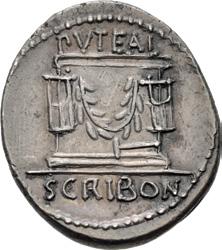
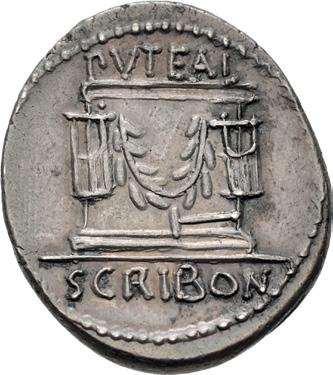
Pedigreed to 1960
5624367. M. Aemilius Lepidus. 58 BC. AR Denarius (18mm, 3.88 g, 8h). Rome mint. Laureate and diademed female head (Roma?) right, wearing hair collected into a knot, and falling in locks down neck; palm frond to left / Equestrian statue of M. Aemilius Lepidus right, holding trophy over shoulder; AN • xu • Pr • h • O • C • Í • to left, Â LepiDuÍ in exergue. Crawford 419/1c; Sydenham 830a; Aemilia 22a; BMCRR Rome 3644; Kestner –; RBW –. Old cabinet tone with iridescence, off center obverse. Good VF. $4250
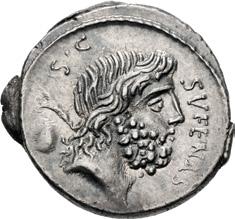
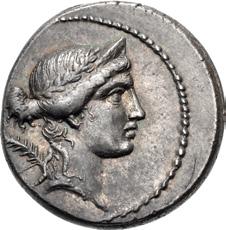
Ex Vogelberg Collection; Crippa FPL 2 (1971), lot 166; Giuseppe de Falco FPL 51 (December 1960), lot 203.
5624368. M. Aemilius Lepidus. 58 BC. AR Denarius (18mm, 3.99 g, 6h). Rome mint. Head of Alexandria right, wearing mural crown; ALexANDreA below / M. Lepidus standing left, crowning the young Ptolemy V, who stands facing, holding staff; T • uTOr • reg to left; Í • C above, pOá • ÂAx • to right; Â • LepiDuÍ in exergue. Crawford 419/2; Sydenham 831; Aemilia 23; BMCRR Rome 3648; Kestner 3430-1; RBW 1511 var. (rev. legend arrangement). Light cabinet tone with hints of iridescence, off center reverse. Superb EF. $12,500
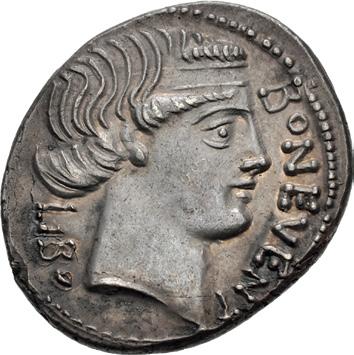
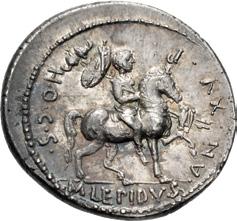
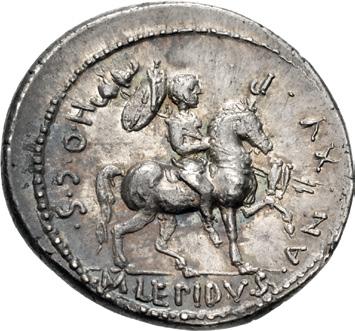
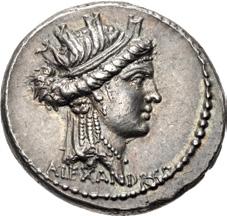
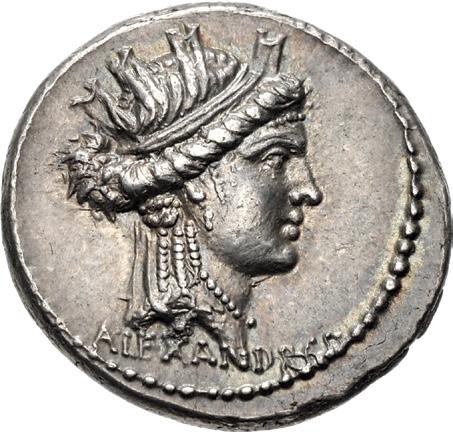
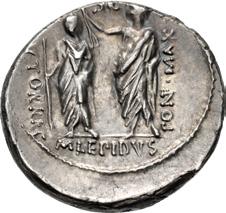
Ex Vogelberg Collection.
5611725.
Ex Scipio Collection, purchased from José A. Herrero, 1994.
48
M. Nonius Sufenas. 57 BC. AR Denarius (19mm, 3.95 g, 6h). Rome mint. Head of Saturn right; to left, harpa above baetylus (conical stone); Í • C upward to left, ÍuFeNAÍ downward to right / Roma seated left on pile of arms, holding vertical spear in right hand and sword in left, being crowned by Victory standing left behind her, holding wreath in right hand and palm frond over left shoulder in left hand; Íex • NONi in exergue; • pr • L • u • p • F around. Crawford 421/1; Sydenham 885; Nonia 1; BMCRR Rome 3820-4; Kestner 3436-7; RBW 1517. Lightly toned with a hint of blue iridescence on reverse, underlying luster, small metal flaw at edge. Superb EF. $1500
5616571. L. Marcius Philippus. 57 BC. AR Denarius (17mm, 3.97 g, 7h). Rome mint. Diademed head of Ancus Marcius right; lituus to left, ANCuÍ below / Equestrian statue right on arcade of five arches; flower below statue, phiLippuÍ downward to left, AœuA º within arches. Crawford 425/1; Sydenham 919; Marcia 28; BMCRR Rome 3890-2; Kestner 3451-2 and 3454; RBW 1524. Bright surfaces, some slight porosity and faint hairlines. EF. A wonderful portrait. $850
Hercules Musagetes – Conductor of the Muses
5620507. Q. Pomponius Musa. 56 BC. AR Denarius (18mm, 3.91 g, 5h). Rome mint. Diademed head of Apollo right, wearing hair in ringlets; œ • pOÂpONi downward to left, ÂuÍA upward to right / Hercules Musagetes, Conductor of the Muses, standing right, wearing lion skin on shoulders, playing lyre; club to right, herCuLeÍ downward to right, ÂuÍAru downward to left. Crawford 410/1; Sydenham 810; Pomponia 8; BMCRR Rome 3602-4; Kestner 3372-3; RBW –. Wonderful old cabinet toning and beautifully centered and struck. In NGC encapsulation 6327390-006, graded AU★, Strike: 5/5, Surface: 5/5. $9750
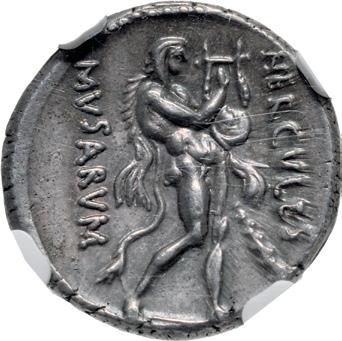
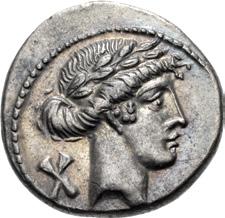
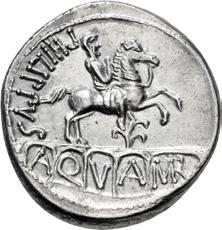
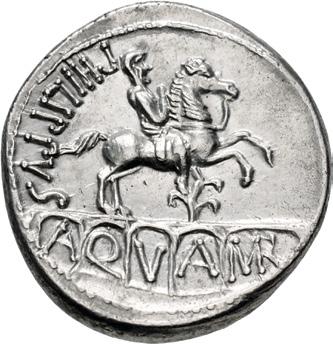
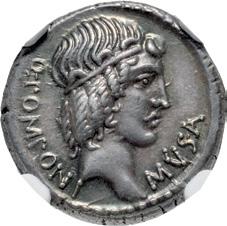
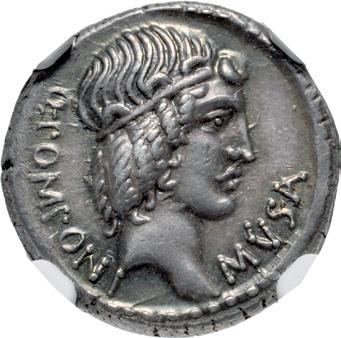
Although the moneyer Q. Pomponius Musa is unknown to history, his choice of Hercules Musagetes and the nine Muses as coin types is remarkable and clearly connected to his cognomen.
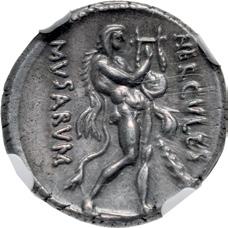
The reverses of this series – Hercules playing the lyre and the Muses, can be none other than the celebrated statue group by an unknown Greek artist, taken from Ambracia and placed in the Aedes Herculis Musarum, which was erected by M. Fulvius Nobilior in 187 BC after the capture of Ambracia in 189 BC (Plin. NH xxxv.66; Ov. Fast. vi.812). By the second century BC, Rome had overrun most of Greece and was captivated by Hellenic art and culture, not the least of which was its sculpture. Fulvius is said to have taken the statues to Rome because he learned in Greece that Hercules was a musagetes (leader of the Muses). Remains of this temple have been found in the area of the Circus Flaminius close to the southwest part of the circus itself, and northwest of the porticus Octaviae. An inscription found nearby, ‘M. Fulvius M. f. Ser. n. Nobilior cos. Ambracia cepit’ may have been on the pedestal of one of the statues. The official name of the temple was Herculis Musarum Aedes, which Servius and Plutarch called Herculis et Musarum Aedes.
Euterpe – Muse of Music and Lyric Poetry
5624366.
Ex Vogelberg Collection.
49
Q. Pomponius Musa. 56 BC. AR Denarius (18mm, 4.36 g, 6h). Rome mint. Head of Apollo right, wearing laurel wreath, hair rolled back and in loose locks over forehead; two crossed tibiae to left / Euterpe, the Muse of Music and Lyric Poetry, wearing long flowing tunic and peplum, standing right, supporting her head with her left hand by resting her elbow on column, and holding two tibiae in right hand; œ • pOÂpONi downward to left, ÂuÍA downward to right. Crawford 410/5; Sydenham 815; Pomponia 13; BMCRR Rome 3613; Kestner 3379-80; RBW 1487. Dark iridescent tone, slightly off center on obverse. EF. $8450
Calliope – Muse of Epic Poetry
5620508. Q. Pomponius Musa. 56 BC. AR Denarius (19mm, 3.68 g, 10h). Rome mint. Laureate head of Apollo right; plectrum behind / Calliope, the Muse of Epic Poetry, standing right, playing lyre which rests on column to right; œ · pOÂpONiuÍ to right, ÂuÍA to left. Crawford 410/2a; Sydenham 811; BMCRR Rome 3606; Kestner 3374; Pomponia 9; RBW –. In NGC encapsulation 6327390-008, graded Ch AU, Strike: 5/5, Surface: 4/5. $7950
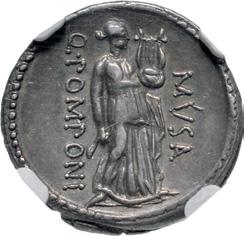
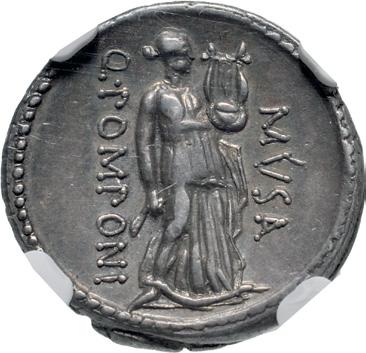
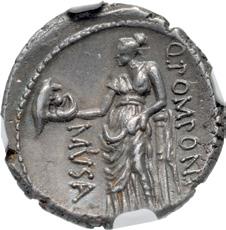
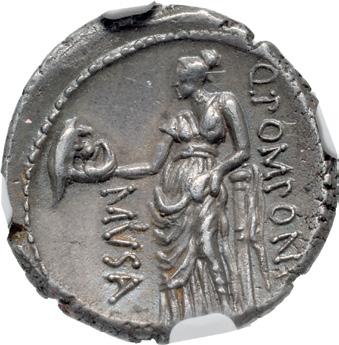
Ex Schweizerischer Bankverein 7 (27 April 1987), lot 738.
Terpsichore – Muse of Dance
5620509. Q. Pomponius Musa. 56 BC. AR Denarius (19mm, 3.74 g, 3h). Rome mint. Laureate head of Apollo right; tortoise to left / Terpsichore, the Muse of Dance, standing right, holding plectrum and lyre; œ · pOÂpONiuÍ to right, ÂuÍA to left. Crawford 410/7a; Sydenham 819a; BMCRR Rome 3619; Kestner 3381; Pomponia 18a; RBW –. In NGC encapsulation 6327390-004, graded XF★, Strike: 5/5, Surface: 4/5. $7750
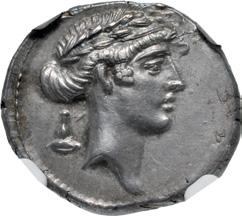
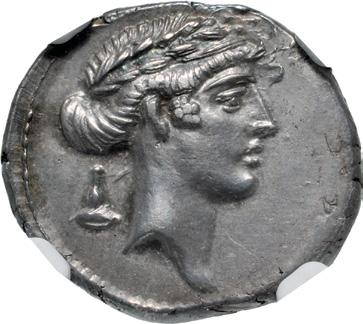
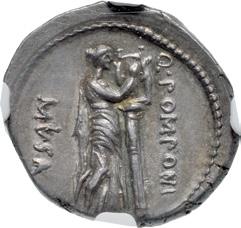
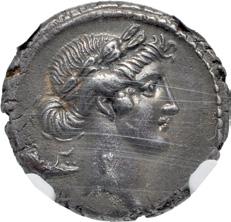
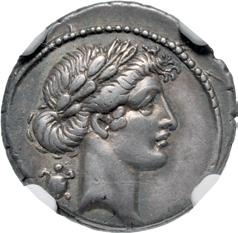
Ex Classical Numismatic Auctions V (9 December 1988), lot 294; Duke of Northumberland Collection (Sotheby’s, 4 November 1982), lot 341.
Thalia – Muse of Comedy
5620510. Q. Pomponius Musa. 56 BC. AR Denarius (19mm, 3.80 g, 2h). Rome mint. Laureate head of Apollo right; behind, sandal right / Thalia, the Muse of Comedy, standing left and leaning on column, holding persona (comic mask); œ · pOÂpONiuÍ to right, ÂuÍA to left. Crawford 410/9b; Sydenham 821; Pomponia 19; BMCRR Rome 3624; Kestner 3388; RBW –. In NGC encapsulation 6327390-010, graded AU, Strike: 5/5, Surface: 4/5. $7250
Ex Classical Numismatic Auctions V (9 December 1988), lot 296; Birkler & Waddell IV (9 December 1982), lot 318; Frederick S. Knobloch Collection (Part 2, Stack’s, 3 May 1978), lot 474.
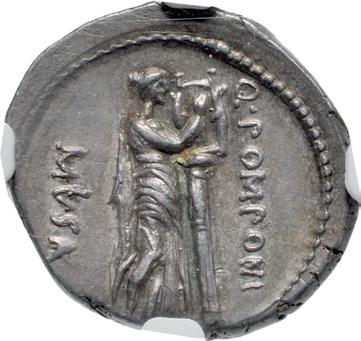
50
5624369. C. Memmius C.f. 56 BC. AR Denarius (20.5mm, 3.99 g, 6h). Rome mint. Head of Quirinus right, wearing laurel wreath; œuiriNuÍ downward to left, C • ÂeÂÂi • C • F downward to right / Ceres seated right, holding torch in left hand and three stalks of grain in right; to right, serpent erect; ÂeÂÂiuÍ • AeD • CeriALiA • preiÂuÍ • FeCiT around. Crawford 427/2; Sydenham 921; Memmia 9; BMCRR Rome 3940-2; Kestner 3463-4; RBW 1532. Toned, struck slightly off center, some porosity, minor die break. EF. Struck on a broad flan. $2450
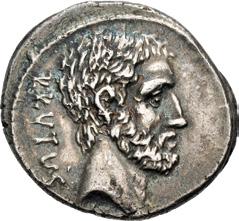
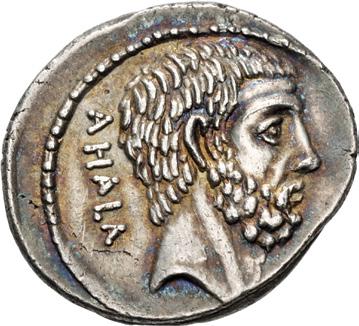
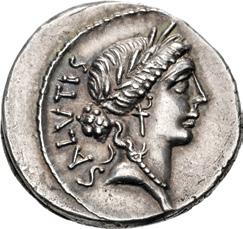
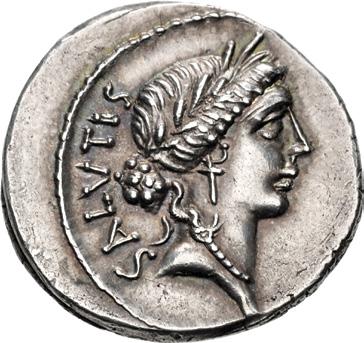
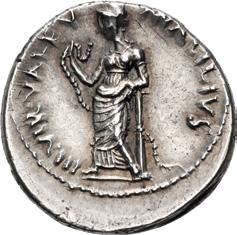
Ex Vogelberg Collection.
5616573. Q. Servilius Caepio (M. Junius) Brutus. 54 BC. AR Denarius (18.5mm, 4.01 g, 6h). Rome mint. Bare head of L. Junius Brutus right; BruTuÍ downward to left / Bare head of C. Servilius Ahala right; AhALA downward to left. Crawford 433/2; Sydenham 907; Junia 30; BMCRR Rome 3864-7; Kestner 3487-9; RBW 1543. Iridescent toning, surface crack, some die wear, marks and faint scratches. Good VF. $1950
5611884. Moneyer issues of Imperatorial Rome. Man. Acilius Glabrio. 49 BC. AR Denarius (19mm, 3.78 g, 9h). Rome mint. Laureate head of Salus right, wearing cruciform earring and necklace, hair ornamented with jewels collected into a knot behind, and two locks falling down neck; ÍALuTiÍ upwards to left / Valetudo (Salus) standing left, holding serpent in right hand, and resting left arm on column; the tail of the serpent encircles the column; • ACiLiuÍ iii • uir • uALe$ around. Crawford 442/1a; CRI 16; Sydenham 922; Acilia 8; BMCRR Rome 3946; Kestner 3511-3; RBW 1556. Iridescent toning and luster, struck slightly off center. EF. $1250
Ex Künker 52 (29 September 1999), lot 3234.
51
5627855. Moneyer issues of Imperatorial Rome. L. Plautius Plancus. 47 BC. AR Denarius (18mm, 4.07 g, 6h). Rome mint. Facing mask of Medusa with disheveled hair, coiled serpents at either side of face; L • pLAuTiuÍ below / Aurora, draped and winged, flying right, head facing slightly left, holding palm frond in left hand, conducting four rearing horses of the sun; pLANCuÍ below. Crawford 453/1a; CRI 29 (this coin illustrated); Sydenham 959; Plautia 15; BMCRR Rome 4004-7; Kestner 3561-2; RBW 1583. Attractive light toning in recessed areas. Choice EF. Perfectly centered with an exceptional strike and reverse detail. $7500
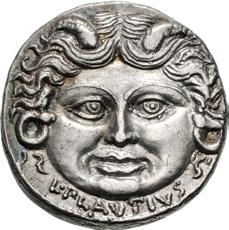
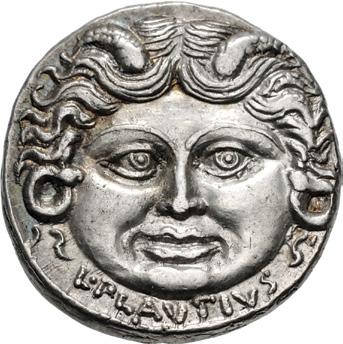
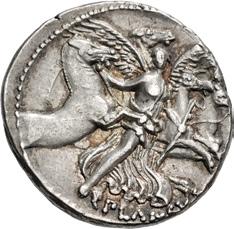
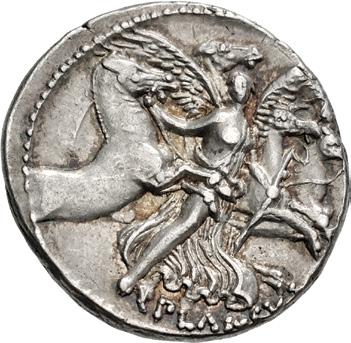
Ex Hess-Divo 317 (27 October 2010), lot 766; Numismatica Ars Classica 23 (19 March 2002), lot 1396.
Certainly this type is one of the most attractive of all Roman Republican issues, although it is notoriously difficult to obtain an example that is well struck on both sides, as is this superb specimen. The reverse type, remarkably, can be tied to a specific ancient work of art, a painting by the 4th century BC artist Nikomachos of Thebes, apparently in the possession of the Munatii and possibly the personal property of the moneyer, L. Plautius Plancus. Plautius was the brother of Lucius Munatius Plancus, who famously survived the precarious times by constantly switching sides. When the Second Triumvirate was formed in 43 BC, he reputedly demonstrated his loyalty by offering up his brother Plautius for proscription and execution. Munatius apparently inherited the painting as it is recorded that he dedicated it to the Capitol at his Gallic Triumph of the same year, raising the question of his motivation in surrendering his brother’s life.
The First Portrait of Brutus?
5620536. Moneyer issues of Imperatorial Rome. L. Servius Rufus. 43 BC. AR Denarius (22mm, 3.76 g, 6h). Uncertain Sicilian mint. Bare head (of Brutus?) right; L · ÍeruiuÍ ruFuÍ around / The Dioscuri standing facing, each holding spear and with sword hanging from waist. Crawford 515/2; CRI 324; Sydenham 1082; BMCRR Italy 351; Sulpicia 10; RBW 1793. In NGC encapsulation 6327424-005, graded VF, Strike: 4/5, Surface: 3/5, light marks. $9750
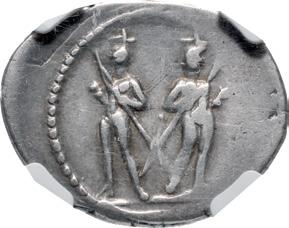
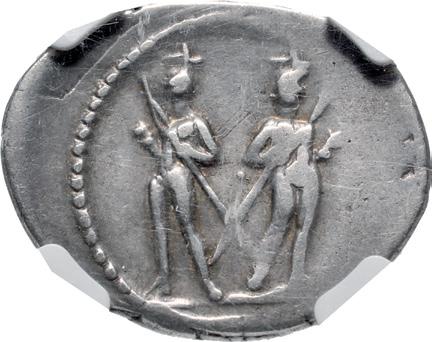
Ex Historical Scholar Collection; Numismatica Ars Classica M (20 March 2002), lot 2548; Birkler & Waddell IV (9 December 1982), lot 410.
The portrait on this type, issued during the confused period between the assassination of Julius Caesar in March of 44 BC and the formation of the Second Triumvirate in November 43 BC, is almost certainly that of Marcus Junius Brutus, Caesar’s lead assassin. Crawford assigned the date as 41 BC, which was followed by Sear; this was corrected to 43 by B. Woytek in Arma et Nummi (Vienna, 2003), pp. 433-445. In this context, the striking of a coin clearly favoring the anti-Caesarian faction seems to have been part of a Senatorial strategy aimed at hedging bets against all possible outcomes in the looming civil war. The moneyer, L. Servilius Rufus, is only known from his coins; as part of the Tresviri Monetales for the year, he clearly chose to favor the assassins, while the other two, M. Arrius Secundus and C. Numonius Vaala, struck coins with portraits resembling the young Octavian and the deceased Caesar (or possibly the current senior consul, Aulus Hirtius), respectively. Notably lacking is a portrait resembling Mark Antony, who was currently in rebellion against all the other factions. All of these coins are rare, indicating a rather limited issue, versus the extraconstitutional coinage being rapidly hammered out by the opposing sides in the buildup to war. The portrait on Rufus’s issue has also been assigned to an ancestor, Servius Sulpicius Rufus, but there is little or no basis for this attribution. Its close resemblance to surviving portrait busts and coins of Brutus, including the famous Eid Mar type, leaves little doubt of the subject’s true identity. As such it is the most affordable available coin type with a contemporary portrait of Brutus. Intriguingly, with Woytek’s dating, it seems clear this is also the first numismatic portrait of Brutus, anticipating the Eid Mar and other issues of Brutus by about a year.
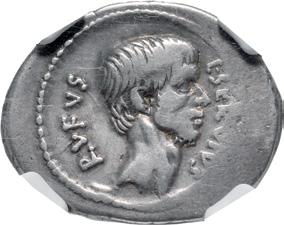
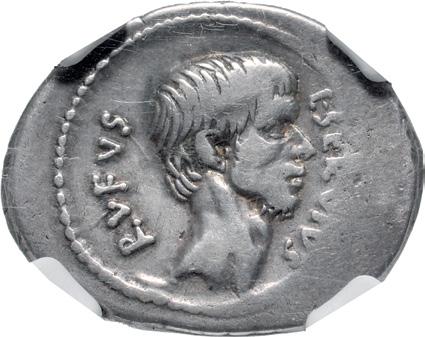
52 CRI
Plate Coin
Egyptian Goddess Sekhmet
5627857. The Pompeians. Q. Caecilius Metellus Pius Scipio and P. Licinius Crassus Junianus. 47- Spring 46 BC. AR Denarius (18.5mm, 3.88 g, 9h). Utica mint. Genius of Africa (Sekhmet) standing facing, holding ankh in right hand; g •T • A flanking head; ÍCipiO • iÂp upward to left; œ • ÂeTeL • pi[uÍ] downward to right / Victory standing left, holding winged caduceus in right hand, small round shield in left; [L]eG prO pr upward to left; p • CrAÍÍuÍ • iuN downward to right. Crawford 460/4; CRI 43; Caecilia 51; Sydenham 1050; BMCRR Africa 8; Kestner 3585; RBW 1604. Wonderful old cabinet tone. Near EF. The rarest denarius issued under Scipio. Choice for issue. $8975
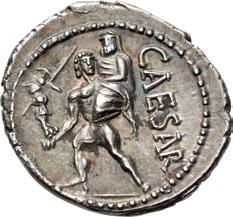
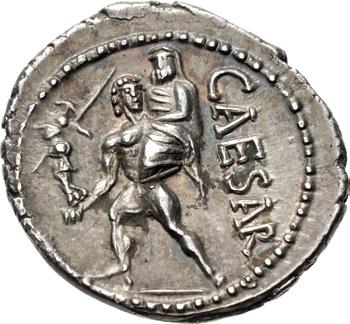
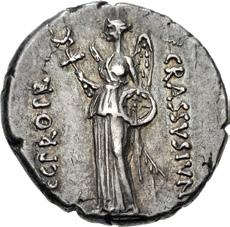
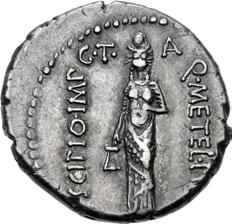
This remarkable type portrays the lion-headed figure of the Spirit of the land of Africa, as identified by the accompanying inscription, GTA (either Genius Tutelaris Africae or Genius terrae Africae), holding the symbol of life, or ankh. Grueber identifies the goddess as the Egyptian goddess Sekhmet, who personified the whole of North Africa. It is the only time a native Egyptian deity, one without a Greco-Roman counterpart, appears on a Roman coin. This is the rarest issue by far of Metellus Scipio, leader of the Anti-Caesarian forces in Africa.
5620537. The Pompeians. Sextus
37/6 BC. AR Denarius (20mm, 3.67 g, 10h). Uncertain Sicilian mint. Bare head of Pompey the Great right; capis to left, lituus to right; ÂAg • piuÍ • iÂp • iTer around / Neptune, nude but for chlamys on left arm, holding apluster and resting right foot on prow, standing left between the Catanaean brothers Anapias and Amphinomus running in opposite directions, bearing their parents on their shoulders; pr‰F above; CLAÍ • eT • Or‰/ºiT • ex • Í • C in two lines in exergue. Crawford 511/3a; CRI 334; Sydenham 1344; RSC 17 (Pompey the Great); BMCRR Sicily 7-10; Kestner 3783-4; RBW 1785. Attractive cabinet toning. EF. High relief and fine style. $7750
Ex Historical Scholar Collection; Leu 50 (25 April 1990), lot 264.
5612759. The Caesarians.
Caesar. April-August 49 BC. AR Denarius (18mm, 4.00 g, 8h). Military mint traveling with Caesar. Elephant advancing right, trampling on horned serpent; CAeÍAr in exergue / Emblems of the pontificate: simpulum, aspergillum, securis, and apex. Crawford 443/1; CRI 9; Sydenham 1006; RSC 49; BMCRR Gaul 27-30; Kestner 3515-8; RBW 1557. Lightly toned, minor lamination on obverse. EF. $6250
Ex Spink 228 (25 March 2015), lot 106; Classical Numismatic Group XXXII (7 December 1994), lot 340.
5616574. The Caesarians.
48-47 BC. AR Denarius (18mm, 3.82 g, 6h). Military mint traveling with Caesar in North Africa. Diademed head of Venus right / Aeneas advancing left, holding palladium and bearing Anchises on his shoulder; CAeÍAr downward to right. Crawford 458/1; CRI 55; Sydenham 1013; RSC 12; BMCRR East 31; Kestner 3577-9; RBW 1600. Iridescent toning, some light find patina, minor lamination error. EF. $2750
53
Pompey.
Julius
Julius Caesar. Late
Excellent Lifetime Caesar Portrait – Cited by Alföldi
5620840. The Caesarians. Julius Caesar. January-February 44 BC. AR Denarius (19mm, 3.91 g, 5h). Rome mint. L. Aemilius Buca, moneyer. Laureate head right; CAeÍAr • i downwards to right; to left, large crescent dividing p  / Venus Victrix standing left, holding Victory in extended right hand and leaning on scepter in left; L • AeÂiLiuÍ BuCA around from upper right. Crawford 480/4; Alföldi Type IV, 103 (A8/R4 – this coin); CRI 102 (same rev. die); Sydenham 1060; RSC 22; RBW –. Wonderful cabinet tone, old scratches under tone, struck from worn dies, a little off center on reverse. Near EF. $15,750
Ex Numismatica Ars Classica 78 (26 May 2014), lot 480; Sternberg XI (20 November 1981), lot 547.
Portait
5623683. The Caesarians. Julius Caesar. 42 BC. AR Denarius (18mm, 4.00 g, 2h). Rome mint; L. Mussidius Longus, moneyer. Laureate head right / Rudder, cornucopia on globe, winged caduceus, and apex; L • ÂuÍÍiDiuÍ • LONguÍ in semicircle above. Crawford 494/39a; CRI 116; Sydenham 1096a; RSC 29; BMCRR Rome 4238-9; Kestner 3750; RBW 1742. Deep cabinet toning, some porosity and marks, some minor die rust and a little off center on reverse. EF. Excellent portrait of Caesar. $15,000
Ex Künker 257 (10 October 2014), lot 8843.
5620538. The Caesarians. Julius Caesar. 40 BC. AR Denarius (21mm, 3.89 g, 9h). Rome mint; Ti. Sempronius Gracchus, quaestor designatus. Laureate head right; Í C flanking neck / Signum, aquila, plow, and decempeda (measuring rod); Ti · ÍeÂprONiuÍ above and to right; grACCuÍ below; · œ · DeÍig to left. Crawford 525/4a; CRI 327a; Sydenham 1129; RSC 47; RBW –. In NGC encapsulation 4164524-007, graded Ch VF, Strike: 5/5, Surface: 4/5. Fine Style. $8950
Ex Numismatica Ars Classica 46 (2 April 2008), lot 947.
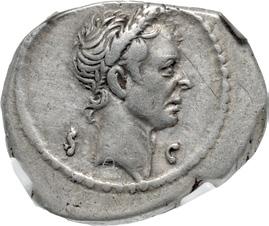
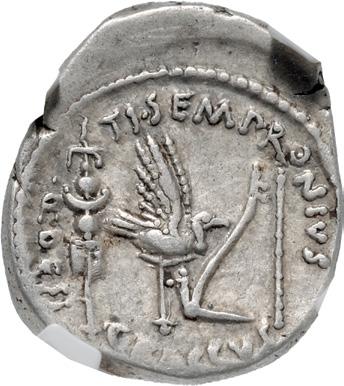
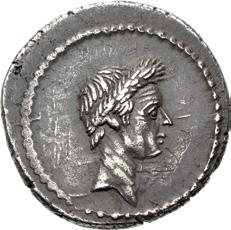
54
Bold Caesar
Superb Brutus Denarius
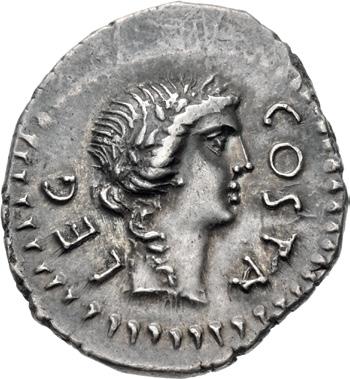
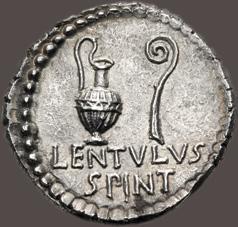
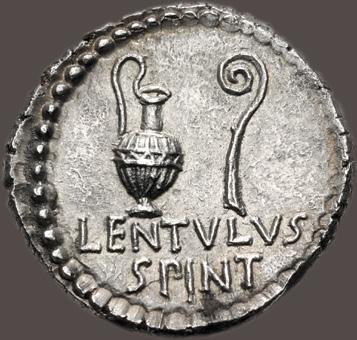
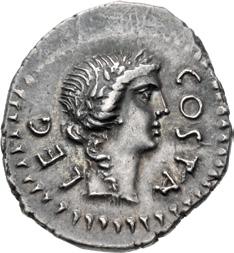
5611727. The Republicans. Brutus. Early 42 BC. AR Denarius (18.5mm, 3.75 g, 12h). Military mint, probably at Smyrna; P. Cornelius Lentulus Spinther, legatus. Emblems of the pontificate: securis, simpulum, and secespita; BruTuÍ below / Emblems of the augurate: capis and lituus; LeNTuLuÍ/ÍpiNT in two lines below. Crawford 500/7; CRI 198; Sydenham 1310; RSC 6; BMCRR East 80-1; Kestner 3770; RBW 1766. Attractive golden toning with substantial luster, some minor die rust in devices. Superb EF. Well centered. $12,500
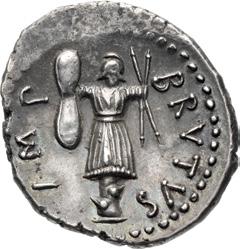

5611728. The Republicans. Brutus. Late summer-autumn 42 BC. AR Denarius (18mm, 3.83 g, 1h). Military mint traveling with Brutus and Cassius in western Asia Minor or northern Greece; Pedanius Costa, legatus. Laureate head of Apollo to right; Leg upwards to left, COÍTA downwards to right / Trophy composed of cuirass, crested helmet, oval shield with incurved sides, and two crossed spears; iÂp upwards to left, BruTuÍ downwards to right. Crawford 506/2; CRI 209; Sydenham 1296; RSC 4; BMCRR East 59-61; Kestner 3775-6; RBW 1778. Attractive cabinet toning with areas of iridescence. EF. $5500
Ex Santana Collection; Roma E-Sale 68 (27 February 2020), lot 921; Künker 326 (7 October 2019), lot 1194. Also includes old collection ticket written in English.
55
FFC Plate Coin
5611729. The Republicans. Brutus. Late summer-autumn 42 BC. AR Denarius (18.5mm, 3.94 g, 12h). Military mint traveling with Brutus and Cassius in western Asia Minor or northern Greece; P. Servilius Casca Longus, moneyer. Laureate and bearded head of Neptune right; trident below, CAÍCA upward to left, LONguÍ upward to right / Victory advancing right on broken scepter, holding palm frond in left hand over left shoulder and broken diadem bound with fillet in both hands; BruTuÍ upward to left, iÂp upward to right. Crawford 507/2; CRI 212; Sydenham 1298; RSC 3; BMCRR East 63-5; Kestner 3779; RBW 1780; FFC 2 (this coin illustrated). Lightly toned. Choice EF. $14,500
Ex Santana Collection; Alba Longa Collection (Áureo & Calicó 339, 14 November 2019), lot 1064; Münzen und Medaillen AG 53 (29 November 1977), lot 226.
Ahenobarbus, Great Grandfather of Nero – Pedigreed to 1958
5624589. The Republicans. Cn. Domitius L.f. Ahenobarbus. 41-40 BC. AR Denarius (19.5mm, 3.75 g, 8h). Uncertain mint in the region of the Adriatic or Ionian Sea. Bare head of Ahenobarbus right, wearing short beard; AheNOBAr upward to right / Prow right surmounted by a military trophy; CN • DOÂiTiuÍ • iÂp around from lower left. Crawford 519/2; CRI 339; Sydenham 1177; Domitia 21; BMCRR East 94-7; Kestner 3801-2; RBW 1803. Toned with areas of iridescence, minor lamination error. Near EF. $12,500
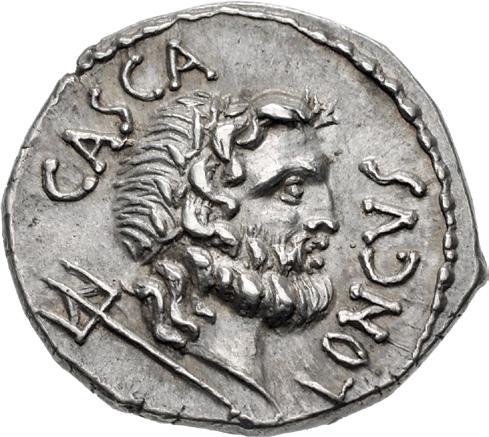
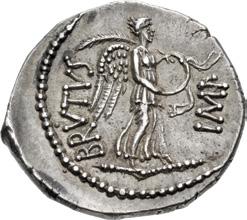
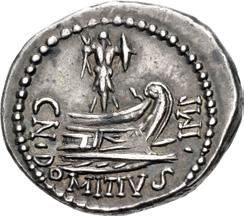
Ex Numismatica Ars Classica 120 (6 October 2020), lot 654; Nomisma 59 (14 May 2019), lot 139; Hans Schulman (14 February 1958), lot 1958.
Gnaeus Domitius Ahenobarbus commanded a fleet against the Triumvirs, achieving a minor victory in September of 42 BC. But that very day, the Triumvirs won the battle of Philippi, and Ahenobarbus found himself fighting for a lost cause. He became a piratical rogue, terrorizing the ports of the Adriatic like his western counterpart, Sextus Pompey, until he signed the Pact of Brundisium in 40 BC, which reconciled him to Mark Antony. His great-grandson would become the Emperor Nero (AD 54-68). The rare coinage of Ahenobarbus belongs to his stint as a “pirate king” 42-40 BC. This silver denarius bears an appropriately nautical reverse celebrating his victories at sea. The balding, bearded portrait on the obverse remains enigmatic; it may represent Gnaeus himself, or one of his ancestors.
5616503. The Triumvirs. Mark Antony and Octavian. Spring-early summer 41 BC. AR Denarius (20mm, 3.69 g, 12h). Ephesus mint; M. Barbatius Pollio, quaestor pro praetore. Bare head of Mark Antony right;  ANT • if Yg iii uir • r • p • C •  BArBAT œ p around / Bare head of Octavian right, with slight beard; CAeÍAr • iÂp • pONT • iii • uir • r • p • C • around. Crawford 517/2; CRI 243; Sydenham 1181; RSC 8a; BMCRR East 100; Kestner 3793-5; RBW 1798. Lightly toned, light hairlines. Choice EF. Excellent portraits. $12,750
56
ROMAN IMPERIAL
5620841. Agrippa.

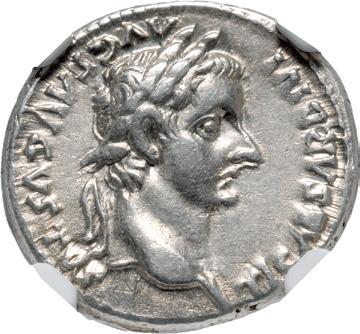
12 BC. Æ As (29mm, 11.77 g, 6h). Rome mint. Struck under Gaius (Caligula), AD 37-41. M • AGRIPPA • L • F • COS • III, head left, wearing rostral crown / S C across field, Neptune standing left, holding small dolphin in right hand and trident in left. RIC I 58 (Gaius); BMCRE 161-8 (Tiberius); BN 77-97. Green patina, smoothed, some marks, minor roughness on reverse. Good VF. Struck on a broad flan. $1450
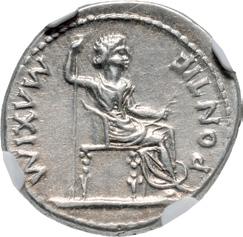
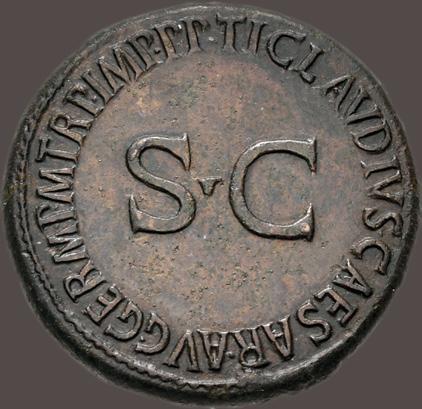
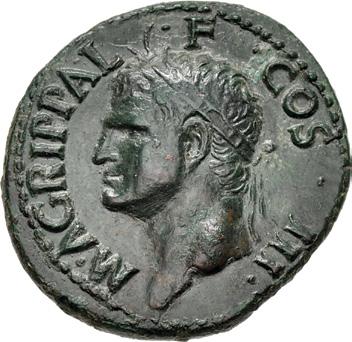
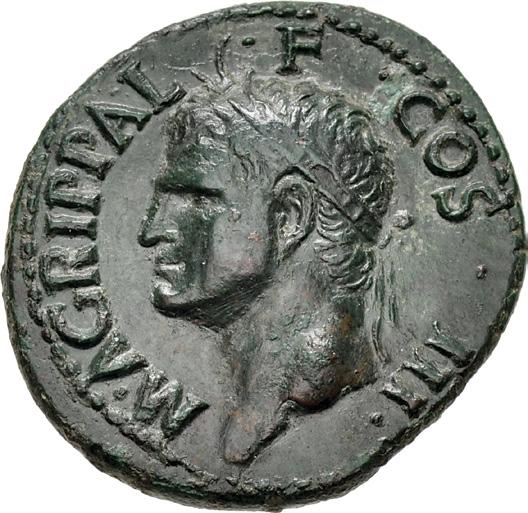
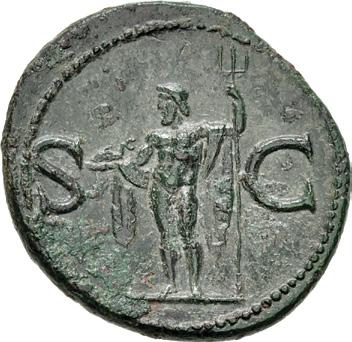
Ex Oslo Myntgalleri 6 (8 May 2015), lot 907.
5620511. Tiberius. AD 14-37. AR Denarius (18mm, 3.90 g, 3h). “Tribute Penny” type. Lugdunum (Lyon) mint. Group 6, AD 36-37. TI CΛESΛR DIVI ΛVG F ΛVGVSTVS, laureate head right; long, parallel ribbons / PONTIF MΛXIM, Livia, as Pax, seated right, holding scepter and olive branch, feet on footstool; ornate chair legs, single line below. RIC I 30; Lyon 154; RSC 16a. In NGC encapsulation 6158911-003, graded AU, Strike: 5/5, Surface: 4/5. $3750
Ex Benz, Garrett, and Delbeke Collections – Pedigreed to 1904
5612154.
• P • M TR • P • IMP • P • P • around large S • C. RIC I 102 (Claudius); von Kaenel Type 78; BMCRE 219-23 (Claudius); BN 236-40 (Claudius). Green and reddish-brown patina. Near EF. Beautiful portrait. $17,500
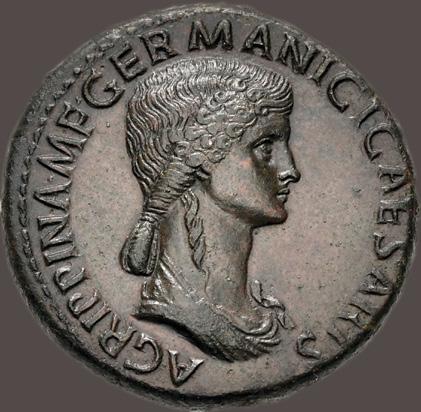
Ex Triton XVI (8 January 2013), lot 1032; Leo Benz Collection (Lanz 94, 22 November 1999), lot 185; John W. Garrett Collection (Part I, Numismatic Fine Arts & Leu, 16 May 1984), lot 734, purchased from M. Schulman, 1 April 1927; Baron Augustus Carolus Delbeke Collection; J. Hirsch XI (4 May 1904), lot 758.
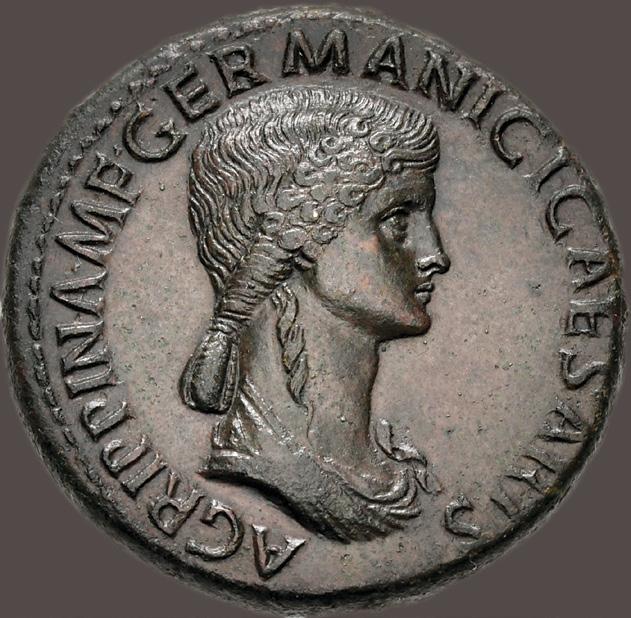
57
Died
Agrippina Senior. Died AD 33. Æ Sestertius (35mm, 29.68 g, 6h). Rome mint. Struck under Claudius, AD 42-43. AGRIPPINA • M • F • GERMANICI • CAESARIS, draped bust right / TI • CLAVDIVS • CAESAR • AVG • GERM
Ex Gasvoda Collection (Part II, Numismatica Ars Classica 94, 6 October 2016), lot 104; S. C. Markoff Collection (Numismatica Ars Classica 62, 6 October 2011), lot 2021; Waddell 98 (6 October 2005), lot 63; Tkalec (18 February 2002), lot 128.
This wonderful denarius boasts both a superior portrait of Claudius and a detailed depiction of Pax-Nemesis, Roman goddess of righteous retribution. Tiberius Claudius Nero had impeccable bloodlines as the son of Nero Claudius Drusus and Antonia, daughter of Marc Antony and niece of Augustus. But he lost his father in infancy and childhood maladies left him with a limp, a stammer, and uncouth qualities that made him the black sheep of the Julio-Claudians. While these problems barred him from politics, they also granted him immunity from the family’s murderous intrigues. Upon Caligula’s assassination in January, AD 41, Claudius was the sole surviving Julio-Claudian adult male and, when members of the Praetorian Guard found him cowering behind a curtain in the palace, they immediately acclaimed him as Emperor. Once installed in power, Claudius surprised everyone by ruling with intelligence and moderation. During his formative years, Claudius had devoted himself to scholarly studies and playing “fly on the wall” in the halls of government, all of which served him well. In AD 43, he ordered the invasion and annexation of Britain, the first major addition of territory to the Empire since the days of Augustus. The appearance of PaxNemesis on this coin, struck in the year of the Claudian invasion, probably alludes to the expected conquest of Britain, with Rome meting out “divine retribution” on the arrogant British tribes. “The Emperor’s peace” (PACI AVGVSTAE) presumably refers to Britannia being brought within the Pax Romana, albeit by force of arms.
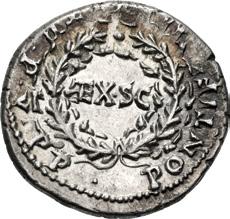
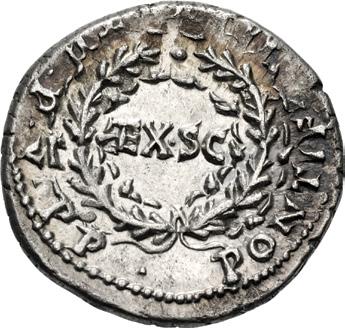
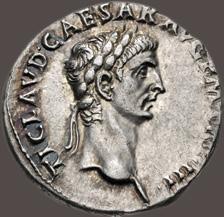
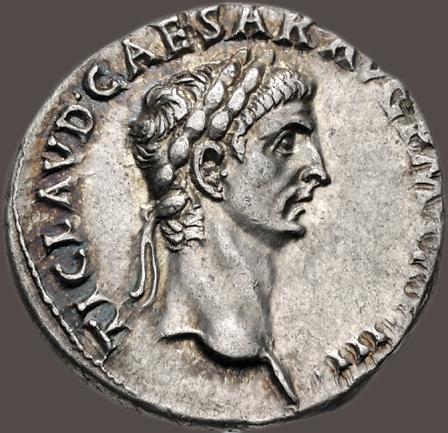
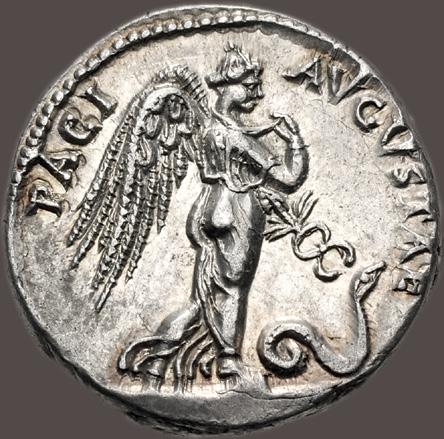
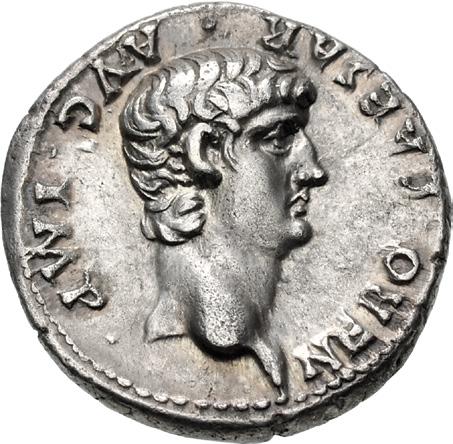
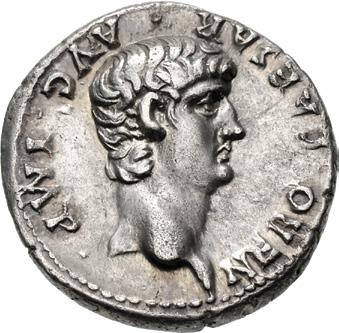
58
Ex Gasvoda and Markoff Collections
5627856. Claudius. AD 41-54. AR Denarius (18mm, 3.58 g, 3h). Rome mint. Struck AD 43-44. TI CLAVD • CAESAR AVG P M TR P • III • , laureate head right / PACI AVGVSTAE, Pax-Nemesis advancing right, holding out fold of drapery below chin with right hand, and holding in left hand winged caduceus, pointing down at snake erect, gliding right. RIC I 22; von Kaenel Type 19 (unlisted dies); RSC 53; BMCRE p. 167, note †; BN 38. Attractive light golden toning. Choice EF. Well centered and struck. A superb Claudius denarius suitable for the finest set of twelve Caesars coinage. $27,500
5624375. Nero. AD 54-68. AR
(18mm, 3.56 g, 4h). Rome mint. Struck AD 58-59. NERO • CAESAR • AVG • IMP •, bare head right / PONTIF • [MAX] TR • P • V • P P • around oak wreath enclosing EX • S C. RIC I 17; RSC 211; BMCRE 20; BN –. Attractively toned. EF. $5750
Excellent Youthful Nero Portrait
Denarius
5616291. Nero. AD 54-68. AR Denarius (19mm, 3.38 g, 12h). Rome mint. Struck AD 60-61. NERO • CAESAR • AVG IMP, youthful bare head of Nero right / [PON]TIF • MAX •TR • P • VII • COS • IIII • P • [P] around oak wreath enclosing EX • S C. RIC I 22; WCN 43; RSC 216; BMCRE 24; BN 30. Areas of flat strike. Good VF. Beautiful old cabinet tone. Wonderful portrait. $2275
Ex Peter Corcoran Collection; Berk BBS 198 (7 July 2016), lot 202; Lanz 138 (26 November 2007), lot 577.
Pedigreed to 1922
5612157. Vitellius. AD 69. AR Denarius (19.5mm, 3.33 g, 6h). Rome mint. Struck circa late April–20 December. Λ VITELLIVS GERMANICVS IMP, bare head right / CONCOR DIA P R, Concordia, draped, seated left, holding patera in right hand and cornucopia in left. RIC I 66; RSC 21; BMCRE 1; BN 31-2. Deep old cabinet tone. Near EF. $6250
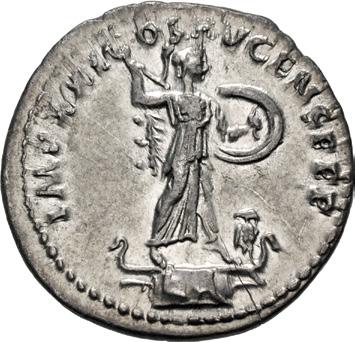

Ex Rauch 99 (8 December 2015), lot 120; Sternberg XIII (17 November 1983), lot 599; Sternberg [I] (30 November 1973), lot 72; Hess-Leu 24 (16 April 1964), lot 288; Ars Classica II (12 June 1922), lot 422.
5619872. Domitian. AD 81-96. AR Denarius (18.5mm, 3.08 g, 6h). Rome mint. Struck 1 January-13 September AD 90. IMP CAES DOMIT AVG GERM P M TR P VIIII, laureate head right / IMP XXI COS XV CENS P P P, Minerva standing right on capital of rostral column, brandishing spear in right hand and holding shield in left; to lower right, owl standing right, head facing. RIC II.1 690; RSC 262; BMCRE 166; BN 158. Lightly toned, hairline flan crack, a few faint scratches. EF. $750
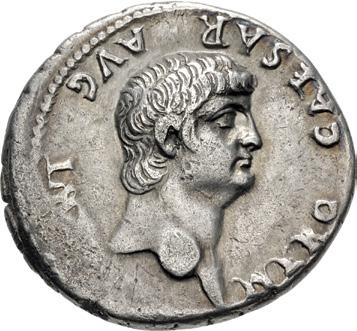
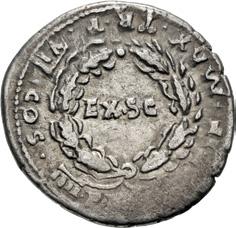
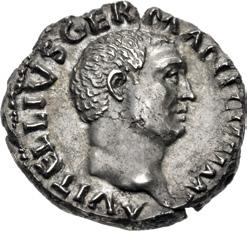
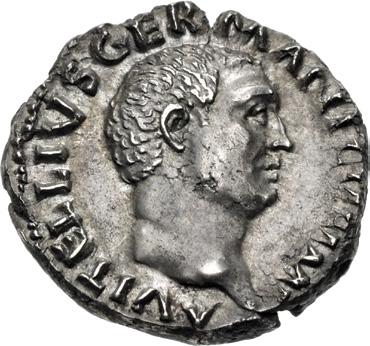
59
5620512. Trajan. AD 98-117. Æ Sestertius (33mm, 24.81 g, 6h). Rome mint. Struck AD 114-116. IMP CAES NER TRAIANO OPTIMO AVG GER DAC P M TR P COS VI P P, laureate and draped bust right / SENATVS POPVLVSQVE ROMANVS, FORT RED/ S · C in two lines in exergue, Fortuna Redux seated left, holding rudder and cornucopia. RIC II 652; Woytek 542v; Banti 66. Even brown patina. EF. Excellent surfaces. $5450
Ex T.R. Fehrenbach Collection (Heritage 3089, 21 January 2021), lot 32192; Triton II (1 December 1998), lot 890 and color plate 15.
5624590. Hadrian. AD 117-138. AR Denarius (18.5mm, 3.23 g, 7h). Rome mint. Struck circa AD 124-125. HADRIANVS AVGVSTVS, laureate bust right, slight drapery / COS III, Spes advancing left, holding flower in right hand and raising hem of skirt with left. RIC II.3 714; Strack 177α; RSC 390; BMCRE 417-20. Toned with underlying luster, slightly off center and small die break on reverse. EF. Detailed portrait in high relief. $1450
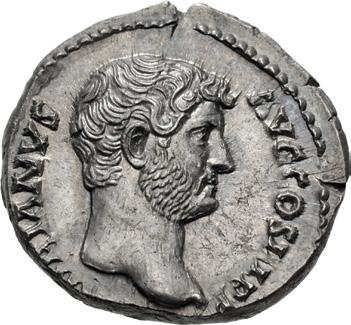
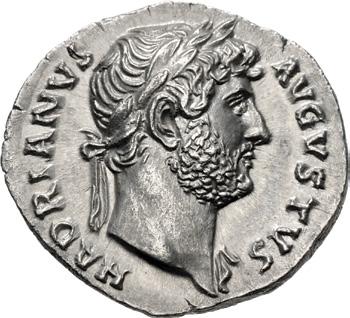
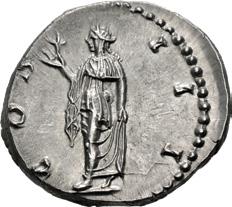
598999. Hadrian. AD 117-138. AR Denarius (18mm, 3.24 g, 5h). Rome mint. Struck AD 133-circa 135. [HA] DRIANVS AVG COS III P P, bare head right / SALVS AV G, Salus, draped, standing right, right hand extended, feeding out of patera in left hand snake coiled around and rising from altar to right. RIC II.3 2048; Strack 264δο; RSC 1335; BMCRE 717. Iridescent tone, a few shallow scratches under tone on reverse. Superb EF. Struck from fresh dies. $3250
Ex Ulysses Collection; Leu Numismatik 4 (25 May 2019), lot 646.
60
High Relief
5616840. Antoninus Pius. AD 138-161. AV Aureus (18.5mm, 7.24 g, 6h). Rome mint. Struck AD 153-154. ΛNTONINVS ΛVG PI VS P P TR P XVII, laureate head right / COS IIII, Antoninus Pius, togate, standing left, holding globe in extended right hand and volumen in left at side. RIC III 233b; Strack 270δ; Calicó 1527 (same obv. die as illustration); BMCRE 813; Adda 183; Biaggi 718 (same obv. die); Mazzini 312 (same obv. die). Lustrous. Superb EF. Well struck in high relief. $19,500

Ex Grand Haven Collection (Triton XXIV, 19 January 2021), lot 1093; Heritage 3075 (15 August 2019), lot 32051; Classical Numismatic Review XXVI.1 (Summer 2001), no. 103.
The mild, civilian nature of Antoninus’ government is exemplified by this aureus, which depicts him on the reverse wearing the toga, traditional garb of a Roman civil magistrate, and holding a globe and volumen, or scroll. The globe had been a symbol of universal rule since the emergence of classical Greece.
Exceptional Condition
61
5612762. Diva Faustina Senior. Died AD 140/1. Æ Sestertius (31mm, 23.72 g, 12h). Rome mint. Struck under Antoninus Pius, circa AD 146-161. DIVA • FAVSTINA, draped bust right, wearing hair bound in pearls on top of her head / ΛETE R NIT Λ S, S C across field, Juno, veiled and draped, standing left, raising right hand and holding transverse scepter in left. RIC III 1102 (Pius); Banti 14; BMCRE 1481 (Pius). Warm reddish-brown patina. Choice EF. A remarkable example in an amazing state of preservation. $6500
5620725. Lucius Verus. AD 161-169. AR Denarius (19mm, 3.44 g, 6h). Rome mint. Struck under Marcus Aurelius and Lucius Verus, AD 165. L VERVS ΛVG ARMENIΛCVS, laureate and cuirassed bust right / TR P V IMP II COS II, Roma, helmeted and in military dress, advancing left, holding Victory in right hand and trophy in left. RIC III 537 (Aurelius) var. (bust type); MIR 18, 103-14/35; RSC 270 var. (same); BMCRE 381-2 (Aurelius and Verus) var. (same). Attractive iridescent tone. EF. Struck from fresh dies. Very rare with this bust type. Only one other example in CoinArchives. $1575 Ex Numismatica Ars Classica 100 (29 May 2017), lot 1919.
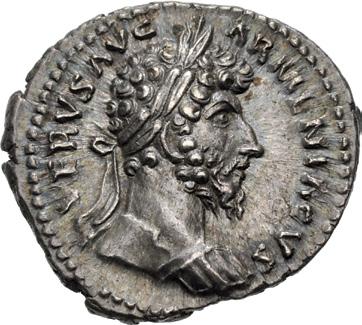

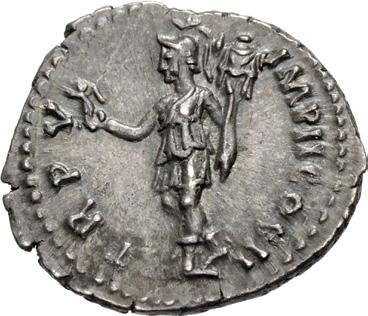
5624591. Commodus. AD 177-192. AV Aureus (20.5mm, 7.09 g, 12h). Rome mint. Struck AD 192. L AEL AVREL COM M AVG P FEL, laureate, draped, and cuirassed bust right / P M TR P XVII • IMP VIII COS VII P • P, Victory, winged and draped, advancing left, holding wreath in right hand and palm frond in left. RIC III 237a; MIR 18, 844-2/37; Calicó 2312 (same dies as illustration); BMCRE 327 (same dies); Biaggi 1006 var. (bust type; same rev. die); Jameson 151 var. (same; same rev. die); Mazzini 567 var. (same; same rev. die). Toned, underlying luster, traces of earthen deposits and a few shallow scratches on reverse. EF. Wonderful portrait. Rare. $22,500
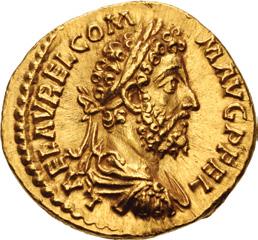
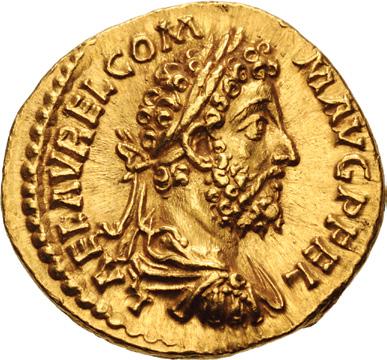
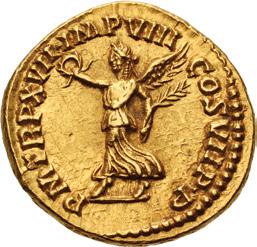
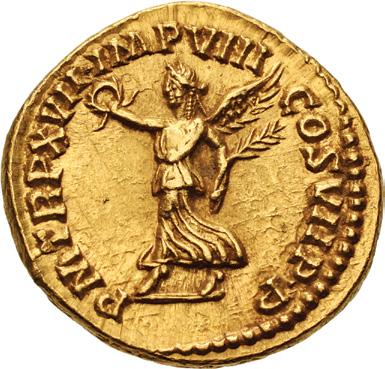
Slow Quadriga Bearing the Sacred Stone of Emesa
5627867. Elagabalus. AD 218-222. AR Denarius (19mm, 3.17 g, 6h). Antioch mint. Struck AD 218-219. ΛNTONINVS PIVS FEL ΛVG, laureate, draped, and cuirassed bust right / SΛNCT DEO SOLI, ELΛGΛBΛL in exergue, slow quadriga right, bearing the sacred stone of Emesa on which is an eagle, surrounded by four parasols. RIC IV 195; Thirion 360; RSC 268; BMCRE 284-5. Lustrous, rough edges. EF. $4250
Ex Nilus Coins inventory 006-50 (ND).
At the age of fourteen, Varius Avitus Bassianus (better known as Elagabalus or Heliogabalus) inherited the office of high priest of the sun god El-Gabal at Emesa in Syria. The deity was worshipped in the form of a conical sacred stone, or baetyl, likely a large meteorite. When an unlikely coup made him emperor in June of AD 218, Elagabalus determined to take the stone with him to Rome and introduce its worship to the whole empire. During his reign, the emperor was devoted to promoting the cult of El-Gabal, building a lavish temple on the Palatine Hill to house the stone. For a brief period, the exotic eastern deity nearly came to dominate the Roman Pantheon.
This issue, struck in AD 218-219 at the eastern metropolis of Antioch, likely refers to the journey from Emesa to Rome. The procession was repeated every year in the transfer of the stone from its principal temple in Rome to its “summer home,” a large and richly decorated temple in the suburbs. Describing the transfer, Herodian (V.6.7) writes:
A six-horse chariot bore the sun god, the horses huge and flawlessly white, with expensive gold fittings and rich ornaments. No one held the reins, and no one rode in the chariot; the vehicle was escorted as if the sun god himself were the charioteer. Heliogabalus ran backward in front of the chariot, facing the god and holding the horses’ reins. He made the whole journey in this reverse fashion, looking up into the face of his god.
62
5616497. Balbinus. AD 238. AR Denarius (20mm, 3.09 g, 6h). Rome mint. 1st emission. IMP C D CAEL BALBINVS AVG, laureate, draped, and cuirassed bust right / PROVIDENTIA DEORVM, Providentia, draped, standing left, holding wand over globe in right hand and cornucopia in left, fold of drapery over left arm. RIC IV 7; BMCRE 33; RSC 23. Lustrous. Superb EF. $1950
Ex Lanz 162 (6 June 2016), lot 353.
5620303. Trajan Decius. AD 249-251. AV Aureus (20mm, 4.05 g, 11h). Rome mint, 5th officina. 2nd-3rd emissions, late AD 249-mid AD 250. IMP C M Q TRAIANVS DECIVS AVG, laureate and cuirassed bust right / VICT ORIA AVG, Victory, winged and draped, advancing left, holding wreath in right hand and palm frond in left. RIC IV 29a var. (bust type); Calicó 3300 (same dies as illustration); Biaggi 1398 var. (same); Mazzini 107. Lustrous, hairlines in fields, small graffito on reverse. EF. $9500
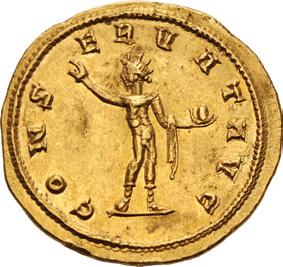
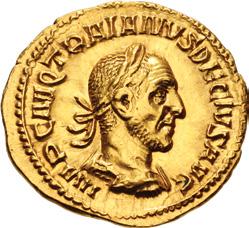
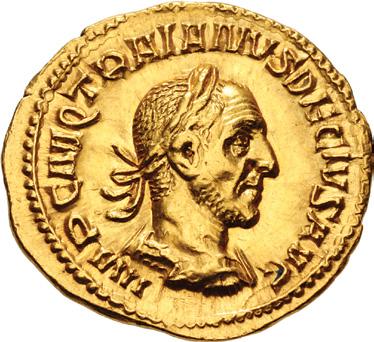
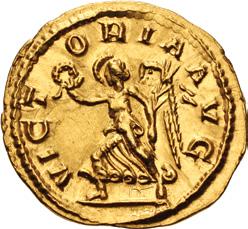
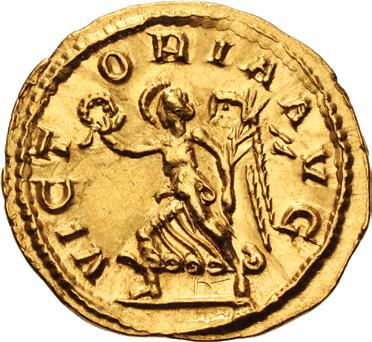
Ex Numismatica Ars Classica 111 (24 September 2018), lot 199; Künker 143 (6 October 2008), lot 655; Rauch 82 (23 April 2008), lot 491.
5620357. Probus. AD 276-282. AV Heavy Aureus (22mm, 6.54 g, 12h). Cyzicus mint. Struck AD 281. IMP C M AVR PROBVS AVG, laureate, draped, and cuirassed bust right / CONS ERVAT AVG, Sol, radiate, standing facing, head left, raising right arm and holding globe in left hand. RIC V 891; Pink VI/1, p. 40 (Antioch); Calicó 4149; Biaggi 1614; Mazzini 175. Some small marks on reverse, edge marks. EF. Rare. $9000
Ex MDC Monaco 7 (12 June 2021), lot 51.
5612763. Diocletian. AD 284-305. AR Argenteus (17.5mm, 3.04 g, 12h). Rome mint, 2nd officina. 2nd emission, AD 295-296. DIOCLET IANVS AVG, laureate head right / VICTORI A SARMAT, the four Tetrarchs sacrificing over tripod before city gate with six turrets; B. RIC VI 37a; Gautier, Argent 84a (same rev. die); RSC 488g. Iridescent toning, minor deposits. EF. $1575
Ex DMS Collection; Harlan J. Berk inventory cc62154 (nd).
63
5616841. Diocletian. AD 284-305. AV Aureus (20mm, 6.51 g, 1h). Cyzicus mint. Struck AD 284-286. DIOCLETIANVS AVGVSTVS, laureate head right / IOVI CO NSERV ATORI AVG, Jupiter Optimus Maximus standing left, holding thunderbolt in right hand and scepter in left; to left at feet, eagle standing left, head and tail right, with wings displayed, holding wreath in beak. RIC VI 298; Depeyrot 14/1; Calicó 4514 . Lustrous. Near EF. High relief. Perfectly centered. So rare that Calicó only has a line drawing of this issue. $19,750
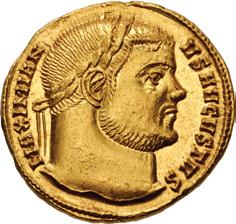
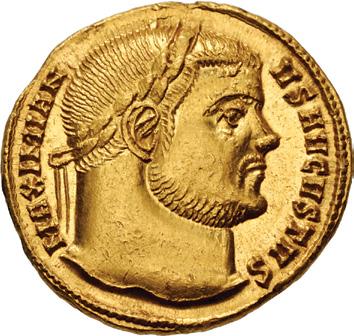
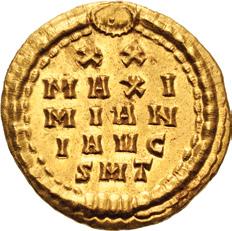
From the Willamette Valley Collection. Ex Monaco Collection (Heritage 3094, 19 August 2021), lot 32075; Roma XXI (24 March 2021), lot 717.
Diocletian’s tetrarchy (’rule of four’) was devised to replace the unstable system of family dynasties which was greatly responsible for the military chaos of the previous century. Central to this system was the founding of two imperial houses, each with an Augustus and Caesar, which would oversee respective portions of the empire. Diocletian modeled the imperial houses upon the Romans’ religious pantheon. As the senior Augustus and Caesar, Diocletian and Galerius comprised the ‘Jovian’ house, and thus enjoyed the protection of Jupiter, the chief deity of the Roman pantheon. This aureus of Diolcetian thus depicts IOVI CONSERVATORI AVG, “Jupiter, Protector of the Augustus”). Maximianus and Constantius were the members of the ‘Herculian’ house, and had the protection of Hercules, who was the right-hand lieutenant to Jupiter.
5620358.
Ex MDC Monaco 7 (12 June 2021), lot 53.
5611888.
Ex S.C.
5624592.
$15,000
64
Maximianus. First reign, AD 286-305. AV Aureus (19mm, 5.34 g, 5h). Vicennalia issue. Ticinum mint. Struck AD 303-304. MAXIMIAN VS AVGVSTVS, laureate head right / XX/MAXI/MIAN/I AVG/SMT in five lines within wreath with large central jewel. RIC VI 11b; Depeyrot 7/2; Calicó 4770; Biaggi –. Faint hairlines, a little die wear and tiny marks on obverse. EF.
Allectus. Romano-British Emperor, AD 293-296. Quinarius (19mm, 3.37 g, 6h). Londinium (London) mint. IMP C ALLECTVS P F AVG, radiate and cuirassed bust right / VIRTVS AVG, Galley left, with mast and five rowers, waves below; QL. RIC V 55; Rogiet 1017; Burnett, Coinage 111. Dark green patina, a couple of edge splits. EF. Wonderful surfaces for issue. $1650
Markoff Collection (Numismatica Ars Classica 62, 6 October 2011), lot 2084; Hauck & Aufhäuser 19 (21 March 2006), lot 414.
Constantius I. As Caesar, AD 293-305. AV Aureus (19mm, 5.34 g, 6h). Antioch mint. Struck AD 293-295. CONSTANTIVS NOB CAES, laureate head right / HERCVLI CONS CAES, Hercules standing facing, head left, leaning on club and holding lion’s skin and Apples of the Hesperides; SMAΣ*. RIC VI 8; Depeyrot 9/4; Calicó 4833; Adda 558 (same rev. die). Lustrous. NGC photo certified 6556104-001, graded Ch AU, Strike: 5/5, Surface: 4/5. $7500
The Fourth Known
5616498. Maximinus II. As Caesar, AD 305-309. AR Argenteus (19mm, 3.16 g, 12h). Alexandria mint, 2nd officina. 6th emission, 2nd series, AD 306-307. MAXIMIN VS NOB CAES, laureate head right / CONCOR DIΛ ΛVGG, Tyche of Alexandria standing facing, head left, holding a bust of Serapis in her extended right hand and a scepter with her left; B|–// ALE. RIC VI –; Gautier, Argent 65d (this coin); RSC –; NAC 52, lot 597 (same dies); Helios I, lot 585 (same dies); Gorny & Mosch 164, lot 448 (same dies). Attractive iridescent tone. Choice EF. Extremely rare. The fourth known example, all from the same dies. $16,950
Ex Triton XXI (9 January 2018), lot 845; Tetrarchy Collection (Nomos 3, 10 May 2011), lot 243; Freeman & Sear FPL 13 (Winter 2008), no. 72.
The Only Known Example
5620359. Constantine I. AD 307/310-337. AV Solidus (19mm, 4.48 g, 12h). Ticinum mint. Struck AD 324-325. CONSTANTI NVS P F AVG, laureate head right / ADVENTVS AVGVSTI N, Constantine on horseback left, raising right hand and holding spear in left; SMT. RIC VII –; Depeyrot –; Calicó –. Some scratches. Near EF. This type is known from Aquileia, Nicomedia, and Antioch mints. This is the only known example of the type from the Ticinum mint $15,000
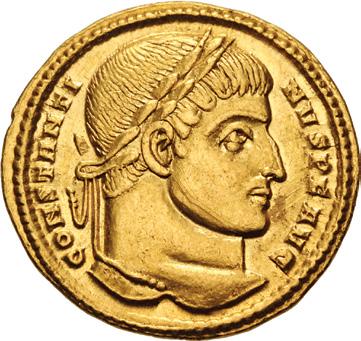
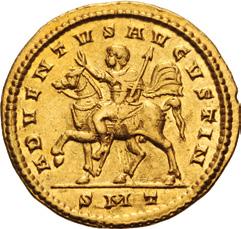
Ex MDC Monaco 8 (20 October 2021), lot 137.
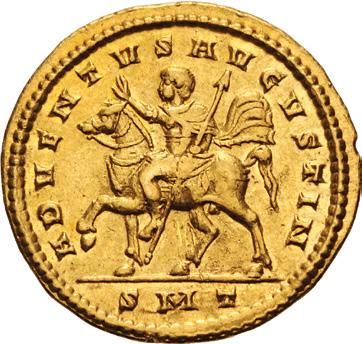
65
Superb Pedigreed Constantine Solidus
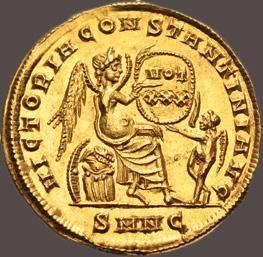
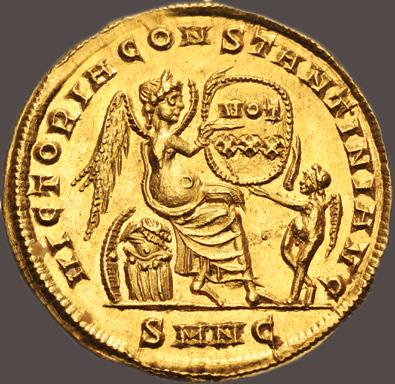
5606012. Constantine I. AD 307/310-337. AV Solidus (21mm, 4.45 g, 6h). Tricennalia issue. Nicomedia mint, 2nd officina. Struck AD 335. CONSTANTI NVS MAX AVG, rosette-diademed, draped, and cuirassed bust right / VICTORIA CONSTANTINI AVG, Victory, draped from her waist, seated right on shield and cuirass, holding shield with left hand, inscribing VOT/XXX in two lines with stylis held in her right hand; to right, Genius standing left, supporting shield with both hands. RIC VII 178; Alföldi 616; Depeyrot 44/2; Biaggi 2017 var. (officina); Jameson –; Mazzini 615/a var. (same). Lustrous, a few faint hairlines in the field on obverse, traces of deposits. Superb EF. Exceptional strike from fresh dies. $27,500
From the Willamette Valley Collection. Ex Classical Numismatic Group 112 (11 September 2019), lot 661; Dr. Klaus Berthold [“Friend of the Romans”] Collection (Münzen und Medaillen AG 92, 22 November 2002), lot 304; Münzen und Medaillen AG FPL 573 (March 1994), no. 53; Münzen & Medaillen AG FPL 566 (June 1993), no. 35; Numismatic Fine Arts XXIX (13 August 1992), lot 438.
Constantine I “the Great” was one of only three Roman Emperors to ever celebrate a Tricennalia marking 30 years of rule, an event celebrated by the issuance of this gold solidus type from the mint of Nicomedia in AD 335. Constantine had completely revolutionized the Roman world during his long and eventful reign, reunifying the empire after decades of internal division, moving the imperial capital to his own city Constantinople (the renamed Byzantium), and, most importantly, changing Christianity from a small, persecuted sect to the most favored religion of a huge multinational state. Even the visual iconography of coinage saw radical change: Here Constantine adopts an elaborate jeweled diadem in place of the former simple wreath worn by Roman rulers, and his long, carefully arranged hair presages the coiffeurs of medieval kings to come. However, Constantine was at pains to show some adherence to Roman tradition: The figure of Victory accompanied by a small winged Genius on the reverse does show continuity with the pagan past.
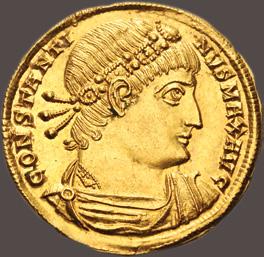
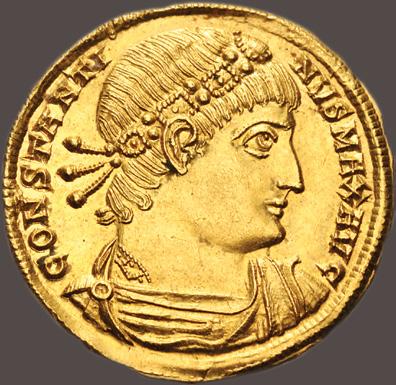
66
Very Rare Constantine II Solidus – Ex Dimitriadis, Dreesman, and Biaggi Collections
5606013. Constantine II. AD 337-340. AV Solidus (21mm, 4.46 g, 5h). Antioch mint. CONSTAN TINVS AVG, laureate, draped, and cuirassed bust right / VICTO RIA AVG, Victory advancing left, holding grounded trophy and palm frond; *|LXXII//SMAN•. RIC VIII 3; Depeyrot 1/1; Biaggi 2007 (this coin). Underlying luster, a few minor marks, tiny metal flaws on obverse. Near EF. Very rare. $9250
From the Willamette Valley Collection. Ex Heritage 3085 (5 August 2020), lot 30058; Dimitriadis Collection (Heritage 3032, 10 April 2014), lot 23659; Dreesmann Collection (Part I, Spink, 13 April 2000), lot 157; Ceresio [I] (26 September 1987), lot 339; Leo Biaggi de Blasys (1906-1979) Collection.
The LXXII in the right field indicates that 72 solidi were struck from a pound of gold, one of the few times a statement of value can be found on Roman gold coinage.
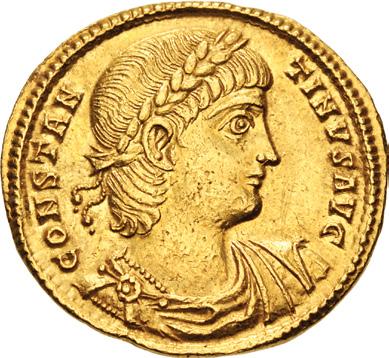
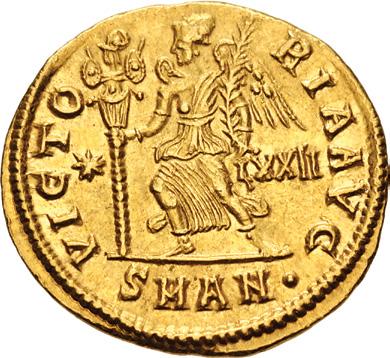
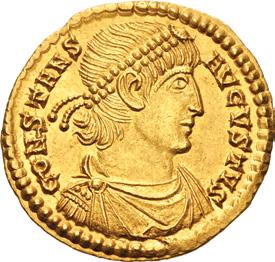
Flavius Claudius Constantinus, second son of Constantine I the Great, was about one when he was first proclaimed Caesar in AD 316, along with his adolescent half-brother, Crispus. The younger Constanine was one of three sons from his father’s marriage to Fausta, whose intrigues on behalf of her boys eventually led to the execution of Crispus in AD 326, followed by her own death a few months later. Thus at the age of 10, Constantine II found himself both motherless and senior heir to the Roman Empire. His brothers Constans and Constantius II were soon also raised to the rank of Caesar, though as eldest Constantine retained preeminence. He underwent years of military and governmental training, primarily at the Western provincial capital of Trier on the German frontier, and accompanied his father on several campaigns. In AD 335, the elder Constantine redrafted the succession, bringing in two nephews to create an unwieldy five-way split of the empire. But when Constantine died in AD 337, the three brothers arranged for the execution of the nephews and divided the empire between them. Despite his seniority, Constantine II emerged with only Britain, Gaul, Germany and Spain under under his control, perhaps the poorest and least populous regions of the Empire. Incensed at this treatment, Constantine insisted on his own seniority and demanded more territory from his brothers, leading Constans and Constantius to form an alliance against him. A three-way conference in June of AD 338 failed to resolve their differences. In April of AD 340, Constantine launched an invasion of Italy while Constans was away in the Balkans. Expecting little or no resistance, Constantine must have been shocked when his army was ambushed by a strong force near Aquileia. During the skirmish, a chance arrow struck Constantine, killing the 24-year-old emperor. Constans’ soldiers threw his body into a nearby river, but it was later retrieved and given an honorable burial. Due to the brevity of his reign, his gold coinage is much rarer than that of his namesake father or his more successful brothers.
5603528. Constans. AD 337-350. AV Solidus (22mm, 4.35 g, 6h). Decennalia issue. Treveri (Trier) mint. Struck AD 345. CONSTANS AVGVSTVS, pearl-diademed, draped, and cuirassed bust right / VICTORIAE DD NN AVGG, two Victories standing facing one another, holding wreath inscribed VOT/ X/ MVLT/ XX in four lines between them; TR. RIC VIII 135; Depeyrot 6/3. Choice EF. $6750
Ex Sternberg XIX (18 November 1987), lot 838.
67
From the Willamette Valley Collection. Ex Gorny & Mosch 257 (15 October 2018), lot 984; Numismatica Ars Classica 92 (Part I, 23 May 2016), lot 726.
Born around A.D. 303 to a British father and Frankish mother, Flavius Magnus Magnentius showed enough talent to rise high in the Roman army. In the 340s, the western emperor Constans appointed Magnentius as commander in his personal guard. Whatever Magnentius’ merits, gratitude was not among them, for in January AD 350, he staged a successful coup deposing his benefactor. Constans, who had made himself unpopular with the army, attempted to flee to his brother Constantius II, emperor of the East, but was captured and executed. After securing control of Italy, Magnentius attempted to negotiate with Constantius, but the eastern emperor would hear none of it. Taking a year to marshal his forces, Constantius struck in the summer of AD 351, but Magnentius defeated his initial thrust into Italy and went on the offensive, seizing the strategic town of Siscia and forcing a major engagement in the Balkans. The clash at Mursa on September 28, AD 351 proved one of the costliest battles in Roman history, leaving the ground strewn with 55,000 dead. Magnentius fared much the worse and retreated into Gaul. Constantius took his time in pursuit, invading Italy the following year and methodically tightening the noose around Magentius, who was forced to take refuge in the city of Lugdunum. Rather than surrender, Magnentius fell on his sword in August of AD 353. Although a usurper, Magentius had a long-lasting impact on the Roman Empire through the agency of his young widow, Justina, who later married Valentinian I and became a lynchpin in future dynastic politics.
Magnentius posed as a champion of the common people, a role reflected in his coin portraits, where he is usually shown without a diadem or other trappings of royalty. He is also depicted realistically as a heavy, almost bloated man, in contrast to the idealized and rather generic portraits of the Constantinian rulers.


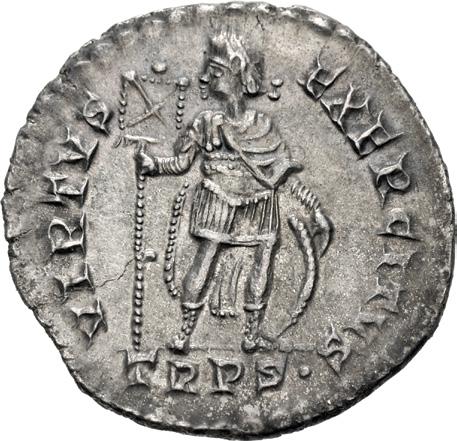
2020 Vale of Pewsey Hoard
Ex
A hoard of fourth and early fifth century Roman silver coins was recovered in September 2020 from farmland in the Vale of Pewsey, Wiltshire, by a team of three avid metal detectorists. Over the course of two days Rob Abbott, Dave Allen and Mick Rae discovered a total of 160 silver coins and coin fragments, which were subsequently submitted to the relevant authorities for processing according to the Treasure Act 1997. Following assessment and appraisal the British Museum decided to acquire two Miliarenses from the group for the Nation’s collection. The remaining coins were disclaimed and returned to the original finders, who chose to sell the hoard so that private scholars and numismatists may have the opportunity to acquire examples for their own collections.
68
5619094. Magnentius. AD 350-353. AV Solidus (23mm, 4.20 g, 6h). Treveri (Trier) mint. Struck January-February AD 350. IM CAE MAGN ENTIVS AVG, bareheaded, draped, and cuirassed bust right / VICTORIA AVG LIB ROMANOR, Victory, cradling palm frond in left arm, standing right, and Libertas, holding scepter in left hand, standing left, both with right hand supporting between them a shaft upon which is mounted a trophy; TR. RIC VIII 248; Bastien 4; Depeyrot 8/1; Biaggi 2197. Underlying luster, hairline flan crack, short scratch on reverse. EF. Rare. $14,500
Ex
5615562. Valens. AD 364-378. AR Light Miliarensis (24mm, 3.95 g, 6h). Treveri (Trier) mint. Struck AD 367-375. DN VALEN S P F AVG, pearl-diademed, draped, and cuirassed bust right / VIRTVS EXERCITVS, Valens standing facing, head left, holding labarum and shield; TRPS •. RIC IX 26b.2; Ghey 7e (this coin); RSC 71†c. Wonderful tone, hairline flan crack, a couple of minor marks. EF. An attractive coin in hand. $6500
Vale of Pewsey Hoard, Wiltshire (PAS BM–7D34D9, BM 2020 T702).
Superb Gratian Solidus – Ex Bastien & Platt Hall Collections
5616848. Gratian. AD 367-383. AV Solidus (21mm, 4.55 g, 5h). Thessalonica mint. Struck AD 378-383. D N GRATIA NVS P F AVG, pearl-diademed, draped, and cuirassed bust right / VICTOR IA AVGG, Gratian and Valentinian enthroned facing, each with right hand on globe between them; above, Victory facing with wings spread; palm frond between legs; TESOB. RIC IX 34a; Depeyrot 34/1; Biaggi –. Lustrous, a few very minor marks on obverse. Superb EF. $9750
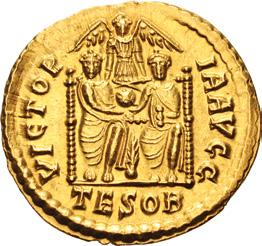
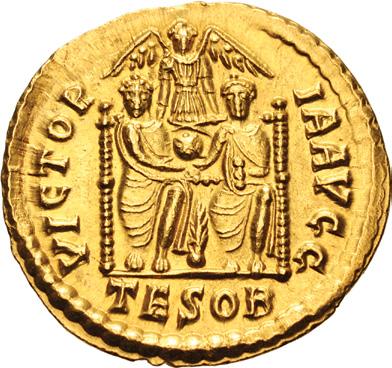
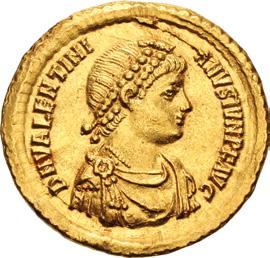
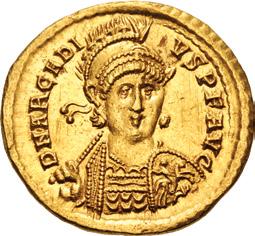
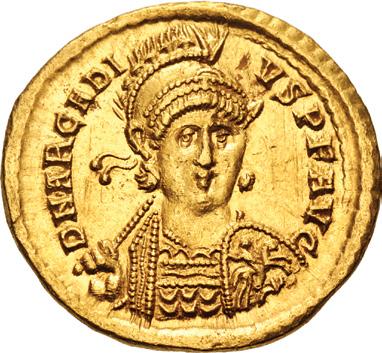
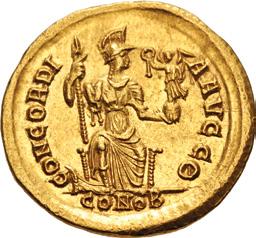
From the Willamette Valley Collection. Ex Edward J. Waddell Inventory 54487 (April 2021); Pierre Bastien Collection (Numismatica Ars Classica 111, 24 September 2018), lot 261; H. Platt Hall Collection (Glendining, 16 November 1950), lot 2072.
5616849. Valentinian II. AD 375-392. AV Solidus (21mm, 4.51 g, 11h). Quinquennalia issue. Antioch mint. Struck 9 Aug. AD 378 - Aug. 383. D N VALENTINI ANVS IVN P F AVG, pearl-diademed, draped, and cuirassed bust right / VICTORIA AVGVSTORVM, Victory seated right on cuirass, inscribing VOT/V in two lines on shield set upon knee; Christogram to right; ANOBS. RIC IX 39a.1; Depeyrot 42/1; Biaggi 2296. Lustrous, minor obverse die breaks, a few edge marks. EF. Excellent for issue. $5750
From the Willamette Valley Collection. Ex MDC Monaco 7 (12 June 2021), lot 57.
5615325. Arcadius. AD 383-408. AV Solidus (20mm, 4.45 g, 6h). Constantinople mint, 9th officina. Struck AD 395-402. D N ARCADI VS P F AVG, Pearl-diademed, helmeted, and cuirassed bust facing slightly right, holding spear in right hand over right shoulder and shield in left / CONCORDI A AVGG, Constantinopolis seated right, holding scepter in right hand and Victory on globe in left, right foot on prow; Θ//CONOB. RIC X 7; Depeyrot 55/1. Some luster, minor die marks. EF. $1875
69
5603531. Magnus Maximus. AD 383-388. AV Solidus (21mm, 4.46 g, 12h). Treveri (Trier) mint. Struck AD 385-386. D N MAG MA XIMVS P F AVG, rosette-diademed, draped, and cuirassed bust right / VICTOR IA AVGG, Theodosius I and Valentinian II enthroned facing, each with right hand on globe between them; above, Victory facing with wings spread; palm fond between legs; TROB. RIC IX 77b; Depeyrot 52/1; Biaggi 2311. Underlying luster, light scratches. EF. Rare. $12,750
Ex William H. Williams Collection (Triton VI, 14 January 2003), lot 1124; Frederick S. Knobloch Collection (Stack’s, 5 May 1984), lot 1460; Sir Charles Oman Collection.
A capable general of Spanish birth, Flavius Magnus Clemens Maximus was appointed military commander of Britain (Comes Britanniae) in AD 380. Three years later, Maximus made a bid for the throne of the Western Roman Empire, then ruled by the young Gratian and his brother Valentinian II. After disposing of Gratian, Maximus proposed a three-way division of the Empire, with himself ruling Britain, Gaul, Germany and Spain, Valentinian II ruling Italy and Africa, and Theodosius I, another Spaniard, holding the East. During this period of relative calm, Maximus struck this gold solidus at his capital, the mint city of Trier, with a reverse depicting him ruling in harmony with Theodosius and Valentinian. The uneasy equilibrium lasted about three years but, in AD 387, Maximus launched an invasion of Italy, provoking a final showdown with Theodosius. In a lightning campaign, Theodosius struck westward and defeated Maximus before he could fully marshal his forces. Both Maximus and his son Victor were summarily executed by Theodosius, who restored Valentinian II to the Western throne. Maximus’ grab for power proved ill-advised, igniting a destructive civil war and fatally weakening the Western Empire, particularly in Britain and northern Gaul. It is claimed, however, that a descendent of his ended up marrying Vortigern, king of the Britons, and is it through this union that several Welsh kings claimed Maximus as an ancestor.
A Second Vale of Pewsey Hoard Coin
5615566. Eugenius. AD 392-394. AR Siliqua (17mm, 1.90 g, 6h). Treveri (Trier) mint. D N EVGENI VS P F AVG, pearl-diademed, draped, and cuirassed bust right / VIRTVS RO MANORVM, Roma seated left on cuirass, holding Victory on globe in right hand and reversed spear in left; TRPS. RIC IX 106d; Ghey 80a (this coin); RSC 14†a. Attractive dark tone, a few shallow scratches under tone. EF. $1575
Ex Vale of Pewsey Hoard, Wiltshire (PAS BM–7D34D9, BM 2020 T702).
Here we have a second coin from the Vale of Pewsey Hoard, the discovery and disposition of which are described above in the entry for Valens Light Miliarensis (5615562). This provides collectors with another rare opportunity to acquire a piece that can be traced to a specific find spot.
70
Constantine III: Heroic Usurper
5620360. Constantine III. AD 407-411. AV Solidus (20.5mm, 4.43 g, 6h). Treveri (Trier) mint. Struck AD 408-411. D N CONSTAN TINVS P F AVG, pearl-diademed, draped, and cuirassed bust right / VICTORI A AAVGGG, Constantine III, in military attire, standing right, holding labarum in right hand and Victory on globe in left, left foot on captive seated left; TROBS. RIC X 1514; Depeyrot 57/1. Minor marks. Good VF. $9000
While the early fifth century AD saw the West Roman frontier collapse under waves of barbarian invaders, the island province of Britain remained relatively unscathed. The Roman legions still stationed in Britain watched in horror as the Germanic hordes ravaged Germany, Gaul and Spain, while the feeble emperor Honorius did little more than play with his pet chickens behind the walls of Ravenna. Accordingly, the soldiers took matters into their own hands and in quick succession raised up and deposed two pretenders to the throne, named Gratian and Marcus, before finally settling on a man with a far more illustrious name, Flavius Claudius Constantinus, known to history as Constantine III, in the spring of AD 407. Although only a common soldier, he appears to have had some charisma and no little ability. Crossing the channel with a small army, he quickly dove into the thick of the crisis engulfing the Empire. He fought his way across Gaul against both barbarian invaders and Roman forces sent by Honorius to crush him, before setting up court in Arles in May of AD 408. Spain, too, offered him recognition. Flush with success, Consantine made his son Constans co-emperor and contemplated invading Italy, but seems to have thought better of it. He wrote letters to Honorius in AD 409 explaining that he had only allowed himself to be acclaimed emperor in order to restore order in Gaul and offering a pact of mutual support. Honorius responded favorably, sending Constantine a purple Imperial robe. But at the peak of his success, Constantine’s closest backer, the general Gerontius, revolted and made common cause with the Visigoths, costing him all of his hard-won territory in Spain. Early in AD 411, Constans was captured and killed by Gerontius, who next besieged Constantine at Arles. An army sent by Honorius soon appeared on the scene and sent Gerontius packing, but instead of rescuing Constantine, it renewed the siege and demanded his surrender, affirming Honorius’ reputation for treachery. Cornered, Constantine attempted to take vows for the preisthood, but the gesture proved futile and he was captured and executed on the orders of Honorius.
The gold coins of Constantine III were struck at the Gallic mints of Lugdunum (Lyons), Treveri (Trier), and Arelate (Arles), and feature good style and crisp execution. The reverse inscription (VICTORIA AAVGGG) seems, in a muddled way, to acknowledge three legitimate Augusti, presumably himself, Honorius, and Theodosius II. Interestingly, his own son Constans does not seem to merit recognition.
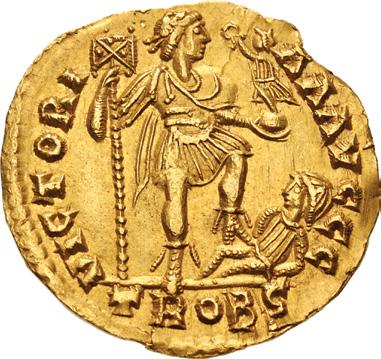
71
BYZANTINE
Choice Anastasius Solidus
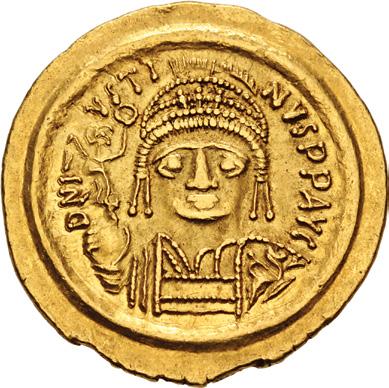
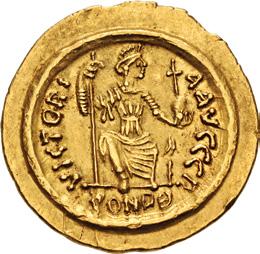
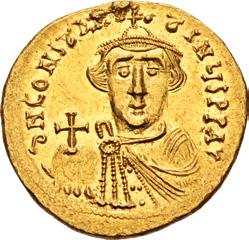
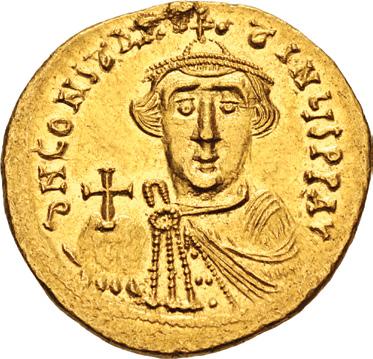
5616854. Anastasius I. 491-518. AV Solidus (21mm, 4.48 g, 6h). Constantinople mint, 10th officina. Struck 498-518. D N ANASTA SIVS PP AVC, helmeted and cuirassed bust facing slightly right, holding spear over shoulder and shield decorated with horseman motif / VICTORI AAVCCC, Victory standing left, holding staff surmounted by reversed staurogram; star to left; I//CONOB. DOC 7j; MIBE 7; SB 5. Fully lustrous. Superb EF. Sharply struck on a broad flan. $2750
From the Willamette Valley Collection. Ex Roma XIX (26 March 2020), lot 989; Leu Numismatik AG 4 (25 May 2019), lot 837.
5616856. Justin II. 565-578. AV Solidus (22mm, 4.44 g, 6h). Ravenna mint, 1st officina. D N I VSTI NVS PP AVC, helmeted, draped, and cuirassed bust facing, holding Victory on globus and shield decorated with horseman motif / VICTORI A AVCCC, Constantinopolis seated facing on throne, head right, holding scepter and globus cruciger; P//CONOB. DOC 210b2; MIBE 21; Ranieri 407; SB 407. Lightly toned. EF. Perfectly centered on a broad flan, with pronounced annular border. $2950
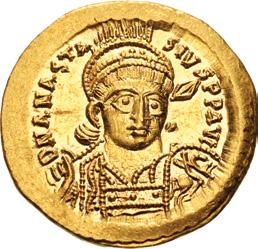
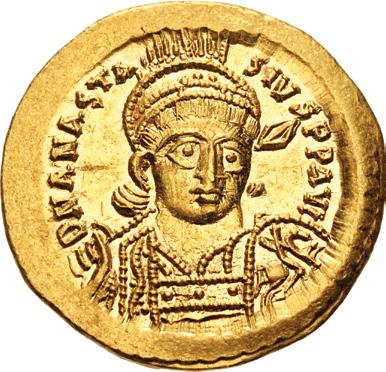
From the Willamette Valley Collection. Ex Heritage 3091 (6 May 2021), lot 32214.
5615333. Constans II. 641-668. AV Solidus (20.5mm, 4.50 g, 6h). Constantinople mint, 7th officina. Struck 641-646/7. ∂ N CONSτAN τINЧS P P AV, crowned and draped facing bust, holding globus cruciger / VICTORIA AVςЧ, cross potent set on three steps; Z//CONOB. DOC 1g.1; MIB 3b; SB 938. Light die rust, underlying luster. EF. $1250
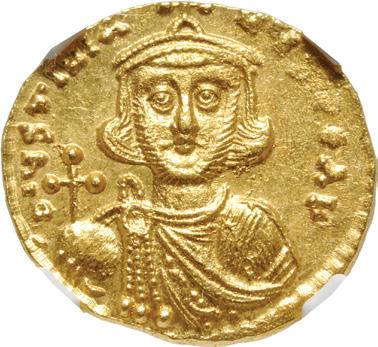
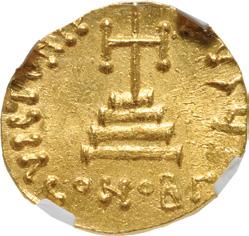
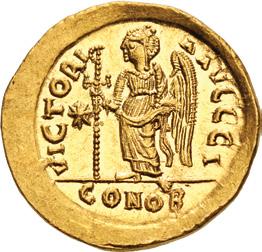
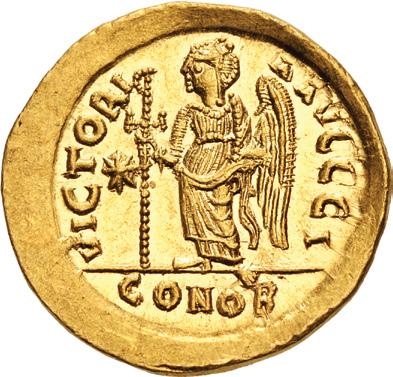
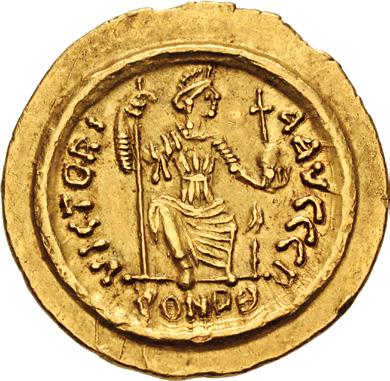
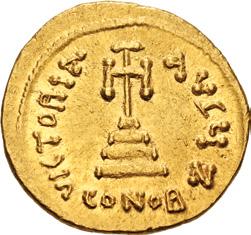
Ex European Ambassador Collection.
5615572.
Struck
4938331-001, graded Ch MS, Strike: 4/5, Surface: 5/5. $2850
72
Justinian II. First reign, 685-695. AV Solidus (20mm, 4.38 g, 6h). Class II. Constantinople mint, 6th officina.
687-692. D IЧSτINIA NЧS PP AV, crowned facing bust, wearing slight beard and chlamys, and holding globus cruciger / VICTORIA AVςЧ, cross potent set on three steps; ς//CONOBΓ. DOC 6c; MIB 7; SB 1247. In NGC encapsulation
5615334. Leontius. 695-698. AV Solidus (19.5mm, 4.47 g, 6h). Constantinople mint, 10th officina. D LЄO N PЄ [AV], crowned bust facing, wearing loros, holding mappa and globus cruciger / VICTORIA AVςЧ, cross potent set on three steps; I// CONOB. DOC (1i); MIB 1; SB 1330. Obverse slightly off center, hairlines on reverse, underlying luster. EF. $3750
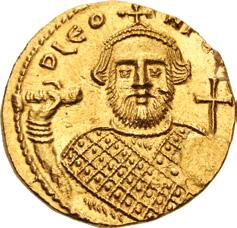
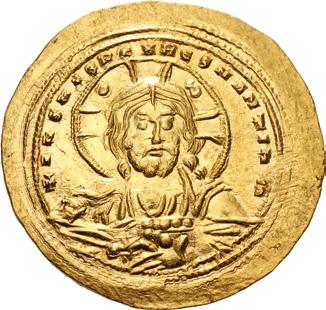
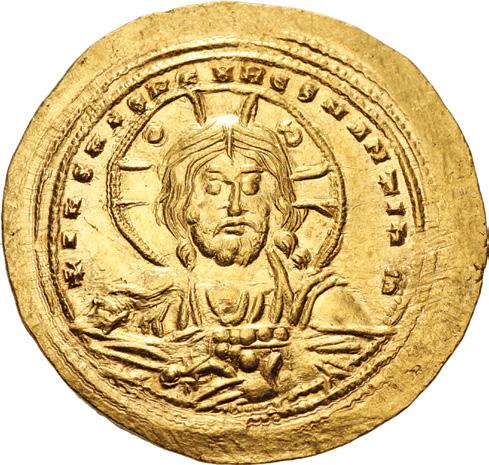
Ex European Ambassador Collection.
5615337. Tiberius III (Apsimar). 698-705. AV Solidus (20 mm, 4.47 g, 6h). Constantinople mint, 1st officina. D τIBЄRI ЧS PЄ AV, crowned and cuirassed bust facing, holding spear and shield decorated with soldier on horseback motif / VICTORIA AVςЧ, cross potent set on three steps; A//CONOB. DOC 1a; MIB 1; SB 1360. Lightly toned with underlying luster, traces of deposits in devices, minor marks, reverse slightly off center. EF. $1950
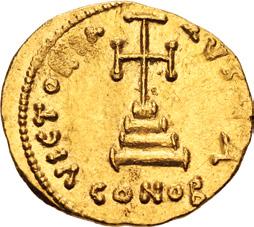
Ex European Ambassador Collection.
5615340. Basil II Bulgaroktonos, with Constantine VIII. 976-1025. AV Histamenon Nomisma (25.5mm, 4.42 g, 6h). Constantinople mint. Struck circa 1005-1025. + IҺS XIS RЄX RЄςNANTIҺm, facing bust of Christ Pantokrator; upturned crescent in upper two quarters of nimbus; pellet on nimbus / + ЬASIL Є COҺSτAҺτIҺ R, crowned half-length busts of Basil, wearing loros and being crowned from above by manus Dei, and Constantine, wearing chlamys, holding long cross between them. DOC 6a; Füeg II 6.B; SB 1800. Hairline die break on obverse, light die marks, lustrous. Choice EF $3450
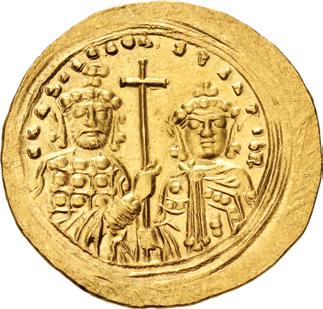
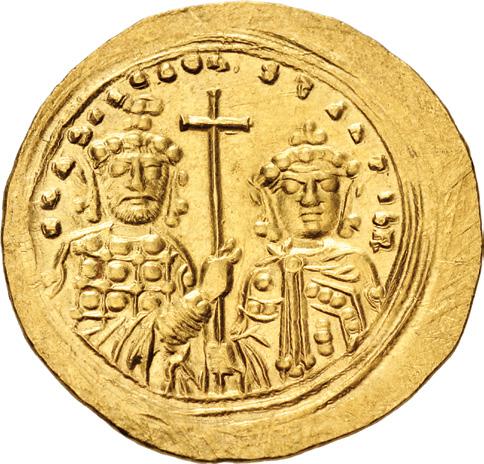
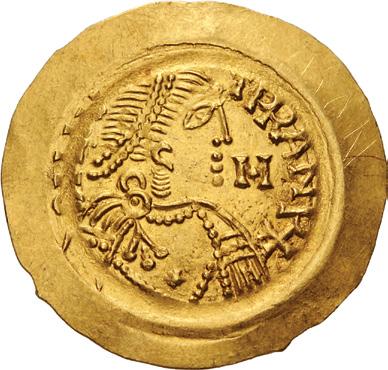
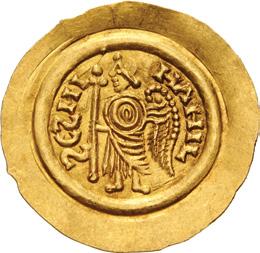
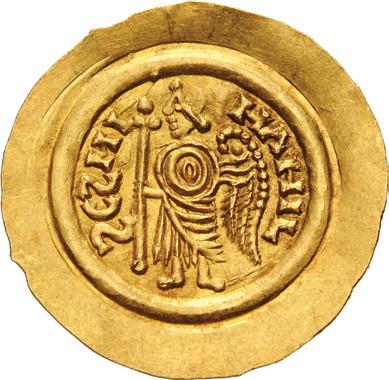
Ex European Ambassador Collection.
EARLY MEDIEVAL
5624808. LOMBARDS, Lombardy & Tuscany. Liutprand. 712-744. AV Tremissis (22mm, 1.31 g, 4h). Ā n ǮƩV ˶Pʽ©nʽᛸ , diademed, draped, and cuirassed bust right; ȵ before / ˝⍛˝ ȵƩ Ɗ©ƊƩǮ , St. Michael standing left, holding long cross and round shield. Bernareggi 78 corr. (rev. legend); cf. BMC Vandals 1; MEC 1, –; Adams I, lot 395. Well struck with underlying luster. $4250
73
5624593. AUSTRIA, Holy Roman Empire. Leopold V. Archduke, 1619-1632. AR Taler (41mm, 12h). Hall mint. Dated 1632, but struck under Archduke Ferdinand Karl, circa 1646. Crowned and armored half-length bust right, holding scepter and resting hand on hilt of sword / Crowned and collared coat-of-arms. Moser & Tursky 508 (same obv. die as illustration); Davenport 6338B; KM 629.4. In NGC encapsulation 2800496-006, graded AU 58. $795
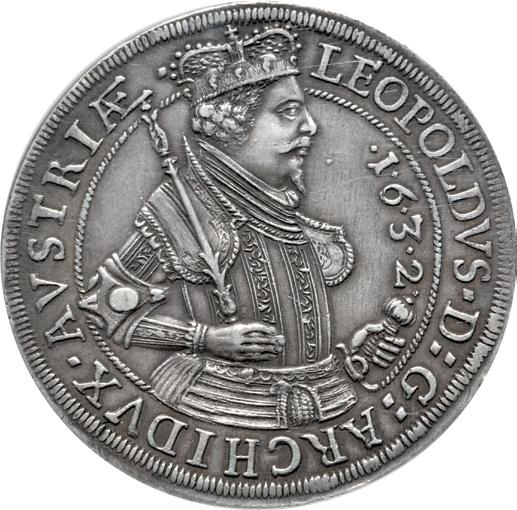
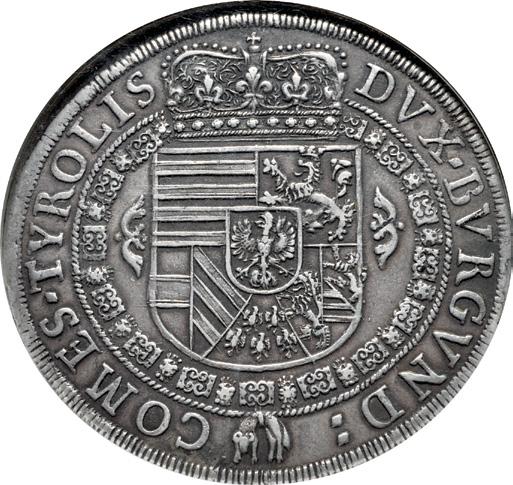
Ex Schulman 352 (28 January 2017), lot 782.
“Time of Dispute”
5627816. DENMARK. Stridsperioden (Civil War). 1044-1047. AR Penny (17mm, 1.02 g, 3h). Lund mint; Ilontat(?), moneyer. ม ɭ ዢዝ ዢዢዢ⎍ዝዜɭ , bird standing left / ม ዢ⌦/ ɭዧ˶ ©˶ ዧ ⌦⎍ዝ , voided long cross, with pellet at center and triplecrescent ends; crescent in first quarter. Becker rev. die 110; Hauberg 16 (Magnus the Good); Hede III, 43; Triton XVIII, lot 1496 (same dies). Toned, trace of double striking in obverse legend. EF. A very high grade example of this wonderful Viking type. $7250
Ex Karsten B. Kold Collection. The ‘Stridsperioden’ (literally meaning a ‘time of dispute’) is the name given by Danish historians to the period when rival Danish and Norwegian claimants (Magnus den Gode, Harald Hardråde, and Svend Estridsen) fought for the Danish throne. During this period, circa 1044-1047, Lund changed hands many times. Because of this, the mint produced a number of dies with the names blundered, so that any coins produced would be accepted by whichever king controlled the mint at a given time.
Charming Petit Royal d’or
Ex Ferdinand David collection.
Struck at the weight of the florin of Florence and tariffed at 10 sous tournois, the introduction of the charming Petit Royal d’or in 1290 marks the successful establishment of a French gold coinage.
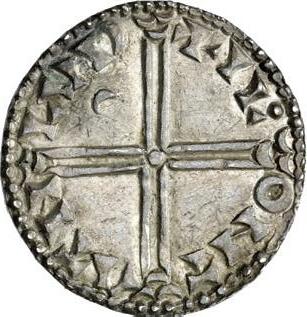
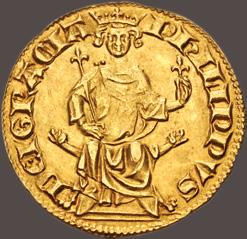
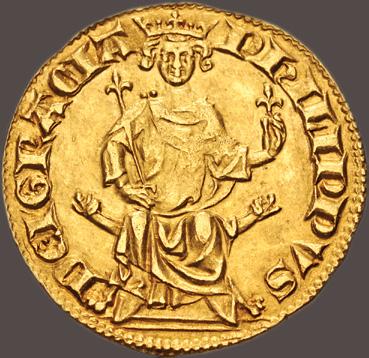
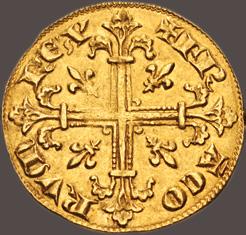
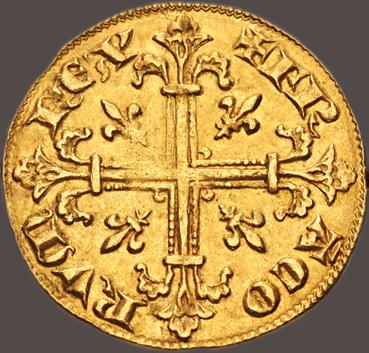
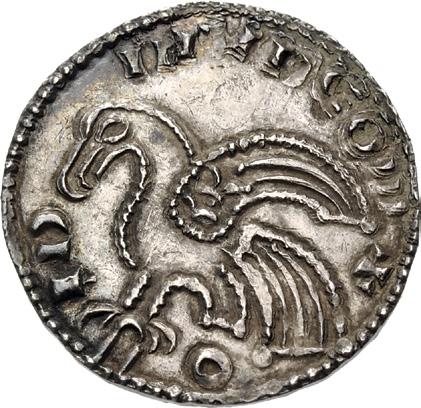
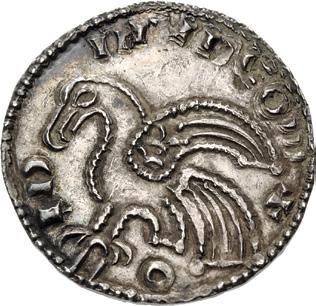
74 WORLD
ʖƌƱǭƱʖʖ⎍˫ ĕĚƱ ŷʼ_ýƱ_
๘ Ŗʼ _ýɭ ʼ⎍⍴ ʼĚҞ
5616437. FRANCE, Royal. Philippe IV le Bel (the Fair). 1285–1314. AV Petit royal d’or (19mm, 3.51 g, 2h). Authorized August 1290.
, Philippe enthroned facing on lion head throne, holding lis-tipped scepter and lis /
, cross feuillue and fleuronnée; lis in quarters. Duplessy 207; Ciani 193; Friedberg 255. Beautifully struck, lightly toned with underlying luster. In NGC encapsulation 6496498-001, graded MS 63. A superb specimen. The highest graded example at either NGC and PCGS. $35,000
A Run of Wildman Talers
5622753. GERMANY,
1613-1634. AR Taler (42mm, 8h). Zellerfeld or Goslar mint. Dated 1618. Coat-of-arms surmounted by five ornately crested helmets / Wildman standing left, holding tree trunk; flower to lower right. Welter 1057A; Davenport 6303; KM 52.1. Even golden iridescent toning. In PCGS encapsulation 45504821, graded MS 62. $3375
Ex Robert C. Knepper Collection, purchased from Robert Westfall.
5622771.
5622754.
62. $3450
Ex Robert C. Knepper Collection; Künker 80 (11 March 2003), lot 1813.
75
Braunschweig-Lüneburg (Duchy). Friedrich Ulrich.
GERMANY, Braunschweig-Lüneburg (Principality & Electorate). Georg I. As Prince & Elector, 16981727. AR Taler (45mm, 11h). Zellerfeld mint. Dated 1722 C. Crowned coat-of-arms within garter, with lion and unicorn supporters / Wildman standing left, holding trunk of tree to left. Smith 32; Welter 2236; Davenport 2076; KM 114. In PCGS encapsulation 45178402, graded AU 58. $1750
GERMANY, Braunschweig-Wolfenbüttel (Duchy). August der Jüngere (the Younger). 1635-1666. AR Taler (46mm, 6h). Zellerfeld mint; mm: crossed keys. Dated 1663 HS. Coat-of-arms surmounted by five ornately crested helmets / Wildman standing right, holding uprooted tree in both hands. Welter 822; Davenport 6341; KM 442.1. Richly toned. In PCGS encapsulation 45194449, graded MS
76
5622757. GERMANY, Braunschweig-Wolfenbüttel (Duchy). Rudolf August & Anton Ulrich. 1685-1704. AR Taler (46mm, 10h). Zellerfeld mint. Dated 1686. Coat-of-arms surmounted by five ornately crested helmets / Two wildmen standing facing, each holding trunk of two intertwined trees. Welter 2068; Davenport 6393; KM 571. Toned. In PCGS encapsulation 45194456, graded MS 63. $5950
5622759. GERMANY, Braunschweig-Wolfenbüttel (Duchy). Rudolf August & Anton Ulrich. 1685-1704. AR Taler (46mm, 2h). Zellerfeld mint. Dated 1701 RB. Coat-of-arms surmounted by five ornately crested helmets / Wildman standing left, holding two branches of tree to right. Welter 2070; Davenport 2112; KM A637. Toned. In PCGS encapsulation 45178394, graded AU 55. $1950
5622762. GERMANY, Braunschweig-Wolfenbüttel (Duchy). August Wilhelm. 1714-1731. AR Taler (46mm, 2h). Zellerfeld mint. Dated 1718 HH. Coat-of-arms surmounted by five ornately crested helmets / Wildman standing right, head left, holding trunk of tree to right. Welter 2376; Davenport 2126; KM 739. Even golden-gray toning with traces of luster. In PCGS encapsulation 45178397, graded MS 61. $2850
Though the die duplicate in Helsinki is described as Hiberno-Norse, the anomalous style of the bust, the irregular lettering forms (eg. the X instead of + in REX), the alignment of the initial cross on both obverse and reverse, as well as the fabric of the coin are all strongly indicative of a Scandinavian origin.
77
5624942. JAPAN, Edo Period. Shotoku-Kyoho Eras. 1714-1736. AR Chogin (88x30mm, 136.29 g). Kyoto or Edo (Tokyo) mint. Six rectangular stamps reading Jozein Hanji characters, or depicting Daikoku (God of Wealth) / Rough textured surface. Hartill, Japanese 9.34; JNDA 09-65. Richly toned, central depressions as made, with numerous banker’s marks. Good VF. A handsome example. $3250
Ex H. Selig Collection; Sotheby’s (20 March 1986), lot 155. Scandinavian Imitation of a Dublin Penny
ዟ ʼX
ዟ/ ® ʼዞዦ ዧ ዦ/ɭ ዝӎዟ⌦
5624854. SCANDINAVIA. Early 11th century AD. AR Penny (20mm, 1.27 g, 1h). Imitating a Hiberno-Norse Long Cross type of Sihtric III Olafsson. ม ZዢዢዢͿʼ
ӎዟዢዡ⌦⌦ɭ , diademed and draped bust left /
X
, voided long cross with triple-crescent ends and pellet at center; pellets in crescent ends. Malmer – (but cf. 196-7/1150 and 101-2/1151 for other imitations of Sihtric); SCBI 25 (Helsinki), 921 (Hiberno-Norse; same dies). Toned, slightly crimped. Near EF. Extremely rare. $2750
BRITISH
5624943.
ANGLO-SAXON, Secondary Sceattas. Circa 720-735/50. AR Sceatt (12mm, 1.06 g, 8h). Series H, type 49. Hamwic mint. Wodan’ head within pelleted border; ten pellets-in-annulets around / Bird standing right; rosette below head, various arrangements of pellets below feet and tail. Abramson 48-1010; MEC 8 Series Hc, 333; SCBI 69 (Abramson), 375-6; SCBI 63 (BM), 461; North 103; SCBC 801A. Lightly toned. Near EF. $1950
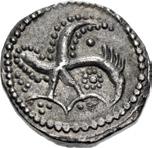
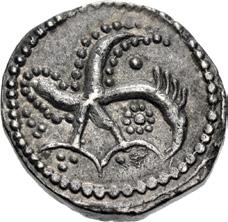
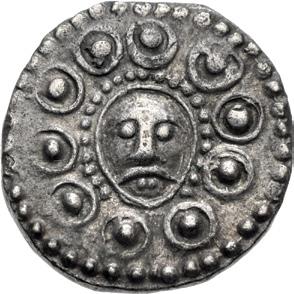
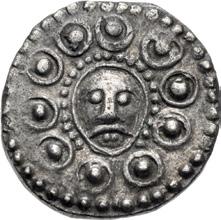
Ex Spink Numismatic Circular CV.1 (February 1997), no. 68 (priced at £750).
571170. ANGLO-SAXON, Kings of Northumbria. Aldfrith. 685-705. AR Sceatt (10mm, 1.11 g, 12h). York mint. ม aዢčŊ l ዢčк˝ , pellet-in-annulet / Quadruped with forked tail standing left. SCBI 69 (Abramson), 827 (this coin); Booth, Sceattas 3 (dies A/c); Chapman 1-8; Pirie, Guide 1.2; North 176; SCBC 846. Attractive find patina. Near EF. Rare in this grade. $3250
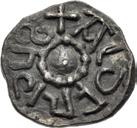
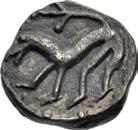
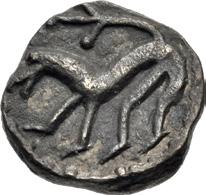
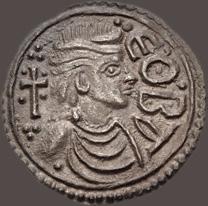
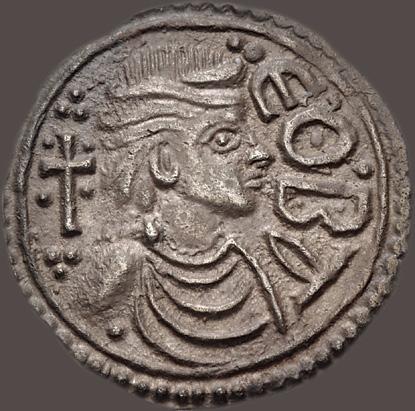
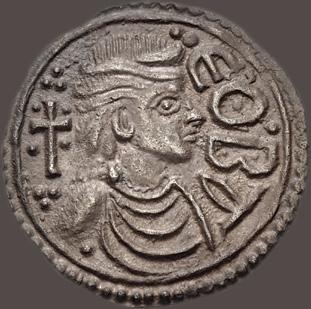
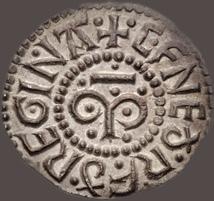
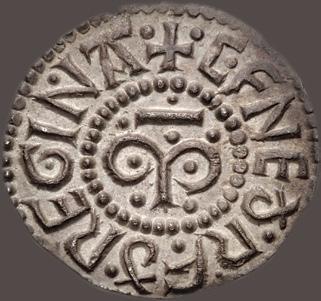
Ex Tony Abramson Collection. Found near Lincoln, Lincolnshire, 2012.
Exceptional Queen Cynethryth Penny
5628011. ANGLO-SAXON, Kings of Mercia. Cynethryth. Wife of Offa, 757-796. AR Penny (17mm, 1.27 g, 9h). Light coinage, portrait type. Canterbury mint; Eoba, moneyer. Struck c. 784/5. Draped bust right; to left, Latin cross with pellets in angles; Ḩ Ḩ // ģ/∂/ዛ/⌃ around / ม / ü/Ŋ⌭⌓ D /⎀Ŋ/ D / ⎀⌓ŻƗn¥ / around M in pelleted circle. Chick 140d (this coin); SCBI 36 (Berlin), 71 (same obv. die); cf. SCBI 67 (BM), 654 (for similar); North 339; SCBC 909; Naismith, Money and Power in Anglo-Saxon England (Cambridge, 2012), p. 63, fig. 3.5, a (this coin illustrated). Toned. EF. A magnificent coin struck from dies of the most elegant style. Undoubtedly one of the finest portrait pennies of Cynethryth known, and certainly the best in private hands. $75,000
Ex Triton V (16 January 2002), lot 2431.
In his groundbreaking study Money and Power in Anglo-Saxon England Rory Naismith writes, ‘Offa’s Light coinage, almost uniquely for early medieval western currency, presents an instance of another eminently Roman custom: coinage with the image of a female consort (Figure 3.5a [the coin offered here]). Like the equally accomplished portrait coins of her husband, the pennies of Cynethryth have attracted much comment from both numismatists and historians. They were the work of single, particularly favoured moneyer, implying special circumstances of production... the design used for most of the portraits of her coinage was strongly influenced by Roman models particularly those of Faustina, wife of Antoninus Pius.’
78
Beornwulf of Mercia
5621506. ANGLO-SAXON, Kings of Mercia. Beornwulf. 823-825. AR Penny (19mm, 1.23 g, 2h). Mint in East Anglia (Ipswich?); Eacga, moneyer. Beɭʼnዩ⎍⌦ō ʼe , diademed bust right / e©ü⎍ ⍴ɭNeℽ , cross crosslet with pellets in outer angles. Naismith 21e (same dies); SCBI 67 (BM), 268; North 397; SCBC 929. Light porosity. Slightly wavy flan. Toned. Good VF. Very rare. $14,500
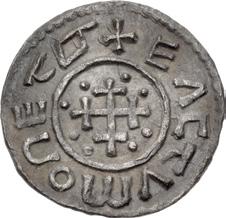
The Earliest Coin From the Watchet Mint
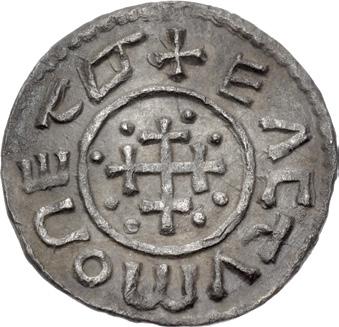
596626. ANGLO-SAXON, Kings of All England. Æthelred II. 978-1016. AR Penny (21mm, 1.46 g, 1h). First Hand type (BMC iia, Hild. B1). Watchet mint; Sigeric, moneyer. Struck circa 978-979. ม ®T ዞ⌦ʼዞዝ ʼዞҟ ©nű⌦ j, diademed and draped bust right / ม Ӳዢűዞʼዢü ዦ!ɭ ዩዞüዞዝ , manus Dei descending from clouds; barred © ѽ flanking. Blackburn, Mint 2 (dies B/b) and ‘unseen coins’ b (this coin); SCBI –; Hild 3887 (same dies); BMC 336 var. (obv. type); North 766; SCBC 1144. Tiny rim perforation and mark in obverse field under rich old tone. VF. The earliest coin of the Watchet mint and depicting a bust of very unusual style with reversed drapery. Extremely rare. $4950
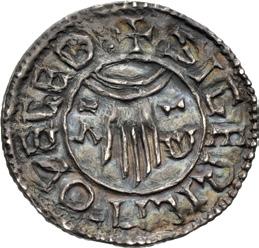
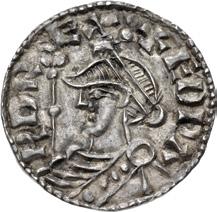
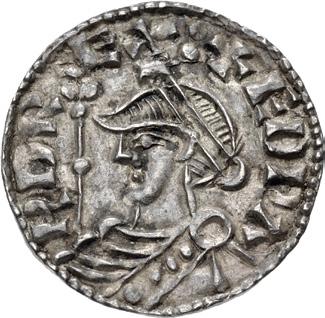
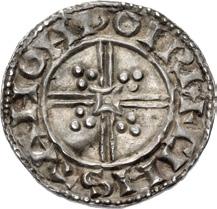
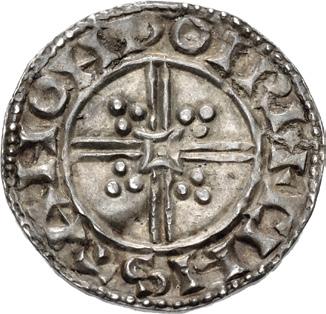
Ex T.H. Gardiner (St. James’s, 5, 27 September 2006), lot 24; R.C. Lockett (English Part I, Glendining’s, 6 June 1955), lot 669 (part of).
5627678. ANGLO-SAXON, Kings of All England. Edward the Confessor. 1042-1066. AR Penny (18mm, 1.14 g, 7h). Trefoil Quadrilateral type (BMC iii, Hild. C). Dover mint; Cynestan, moneyer. Struck circa 1046-1048. Ḧ ม ዞዝዩ© ʽዝ ʽ ዞҟ , diademed and draped bust left; scepter pommée to left / ม üዢዡS˶²n ɭn ዝɭዢʽዢ , quadrilateral, with pellet in center and trefoils at angles, over voided short cross. Freeman 23 (this coin cited); SCBI –; Hild –; BMC 171; North 817; SCBC 1174. Richly toned. Good VF. $1450
Ex Dr. J. Hulett (Part II, Dix, Noonan, & Webb 143, 12 December 2017), lot 686; W.J. Conte (Classical Numismatic Group 60, 22 March 2003), lot 2258; Spink 103 (4 July 1994), lot 80; F. Elmore-Jones (Glendining’s, 12 May 1971), lot 267; Duke of Argyll Collection.
79
5627677. ANGLO-SAXON, Kings of All England. Edward the Confessor. 1042-1066. AR Penny (18mm, 1.14 g, 3h). Trefoil Quadrilateral type (BMC iii, Hild. C). York mint; Ioli, moneyer. Struck circa 1046-1048. ม ዞዝዩዞ Ḧ ʽዝ ʽዞม Ḧ , diademed and draped bust left; scepter pommée to left; trefoil of pellets to left / ม ዢɭ⌦² ɭn ዞɭዟዞʽዩዢüü / , quadrilateral, with pellet in center and trefoils at angles, over voided short cross. Freeman 193; SCBI 2 (Hunterian), 1018 (same dies); Hild –; BMC –; North 817 var. (trefoil on obv.); SCBC 1174 var. (same). Richly toned. Good VF. Very rare variety. $1650 Ex Dr. J. Hulett (Part II, Dix, Noonan, & Webb 143, 12 December 2017), lot 688.
5609465. ANGLO-SAXON, Kings of All England. Edward the Confessor. 1042-1066. AR Penny (20mm, 1.66 g, 7h). Expanding Cross type, heavy issue (BMC v, Hild. E). Bedford mint; Swot, moneyer. Struck circa 1050-1053. ม ዞዝዩዞ Ḧ / ʼዝ ʼዞҟ / , diademed bust left; scepter to left / ม Sዩɭ˸ ɭn ዛዞዝዞ , voided short cross with expanding limbs; at center, circle around pellet-in-circle. Freeman 55; SCBI –; Hild –; BMC 21 (same dies); North 823; SCBC 1177. Splendid deep iridescent cabinet toning. Good VF. Very rare. $2450
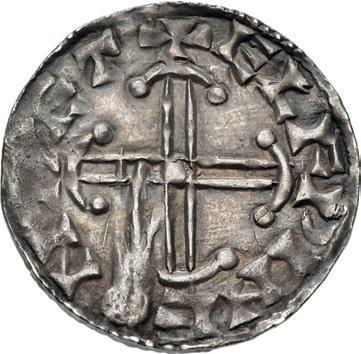
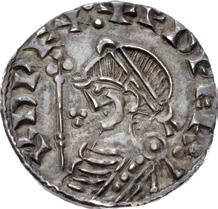
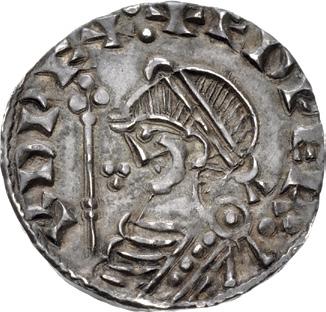
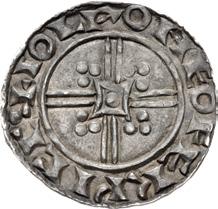
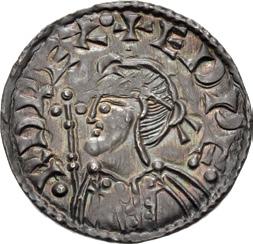
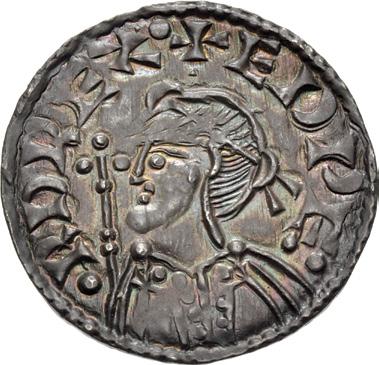
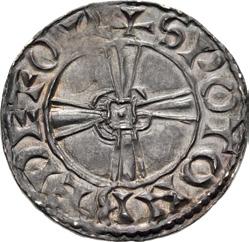
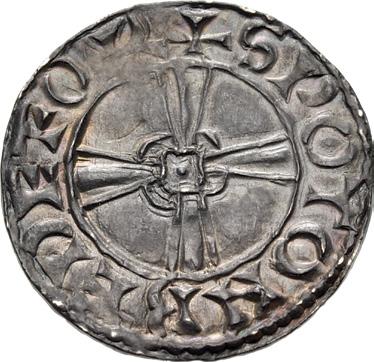
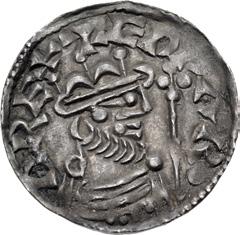
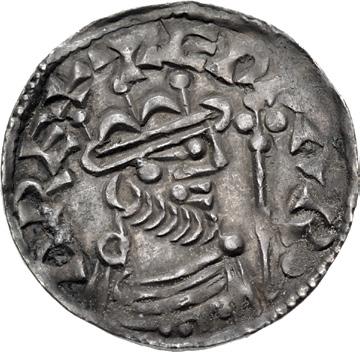
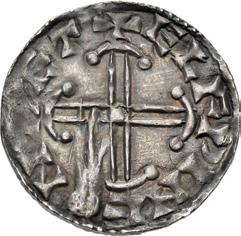
Ex Tooze (Dix, Noonan, Webb 163, 18 September 2019), lot 1060; N.T. Bagshawe (Spink Numismatic Circular LXXIX.12 [December 1971]), no. 11480; Duke of Argyll Collection.
5627681. ANGLO-SAXON, Kings of All England. Edward the Confessor. 1042-1066. AR Penny (19mm, 1.33 g, 2h). Hammer Cross type (BMC xi, Hild. G). Thetford mint; Ælfwine, moneyer. Struck circa 1059-1062. ม ዞዝዩ©ʼ / ዝ ʼዞม , crowned bust right, scepter before / ม ዞ⌦ዟዩዢnዞ ɭn T ዞͿ , voided cross, arms terminating in inward-facing crescents; extra lines cut into third quarter. Freeman 28; SCBI 1 (Fitzwilliam), 930 (same dies); North 828/1; SCBC 1182. Richly toned. Good VF. Rare ‘gouged die’ variety. $1350
For a discussion of the die markings, or cancelations, that occur at the Thetford mint during the reign of Edward the Confessor see R.A.G. Carson’s article in the 1949 volume of the Numismatic Chronicle. Carson believed these markings were added by the moneyers themselves and not at the central die cutting workshop. Perhaps they were ‘to mark off the coins struck after say the receipt of some fiscal instruction’ or maybe they were indicative that the moneyer ‘had paid some interim fee for the prologation of the use of the dies.’
80
5624944. NORMAN. William I ‘the Conqueror’. 1066-1087. AR Penny (19.5mm, 1.31 g, 8h). Canopy type (BMC iii). Wallingford mint; Brandr, moneyer. Struck circa 1070-1072. ม ዩዢ⌦⌦ዞዦ ² ʼዞҟ , crowned facing bust within canopy of two columns / ม ዛʼ²nዝ ɭn ዩ²⌦⌦ዢnűዢ , double quadrilateral, with incurved sides, annulet at center, and fleur at each limb. SCBI 20 (Mack) 1386 (same dies); BMC 215; North 843; SCBC 1252. Toned, spot of red wax. Good VF. Struck on a broad flan. $3250
Ex Spink Numismatic Circular XCIX.10 (December 1991), no. 7980 (there as ‘about EF’).
5624945. NORMAN. William II Rufus. 1087-1100. AR Penny (20mm, 1.38 g, 9h). Cross Voided type (BMC iii). Wallingford mint; Kolbjorn, moneyer. Struck circa 1092-1095. ม ዩዢ⌦⌦ዞ⌦ዦ ʼዞዢ , crowned facing bust; stars flanking / ม üɷ⌦ዛዞʼn ɭn ዩዢዢ⌦ , voided cross pattée, with annulet at center; all over cross annulettée. SCBI 9 (Ashmolean), 203 (same dies); BMC –; North 853; SCBC 1260. Richly toned, legend weak in part. Good VF. Sharp portrait. Very rare. $3750
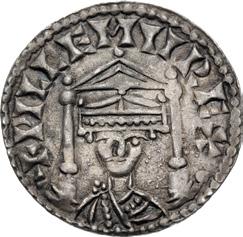
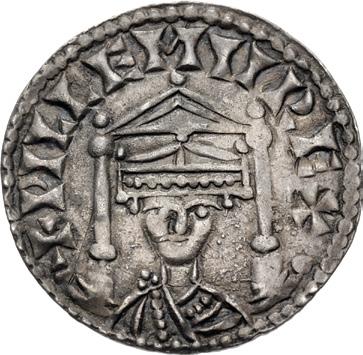
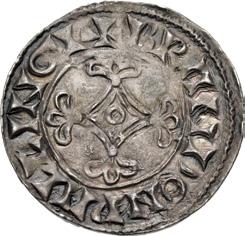
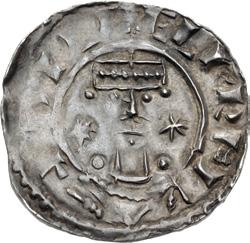
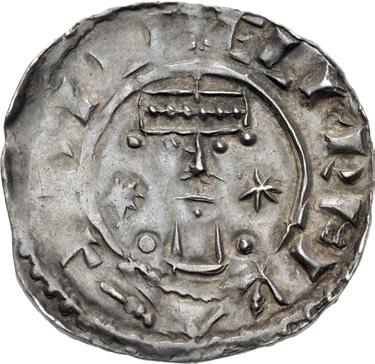
Ex Spink Numismatic Circular LXXV.10 (October 1967), no. 6461.
81
Superb Series B/A Noble
5621439. PLANTAGENET. Edward III. 1327-1377. AV Noble (33mm, 7.75 g, 4h). Fourth coinage, pre-treaty period, series B/A mule. Tower (London) mint. Struck 1351. ģd Ѿ¥ʼd=ი dģƱ ი gʼ¥ ი ʼģҢ ი ¥Ƀg⌦=ი Ԥ ი Ŗʼ¥Ƀæ ი d ი ƌӎB= , Edward standing facing in ship, holding sword and shield; ornaments 1-11-11-1, ropes 3/3, quatrefoils 4/3, lis 3 / ๘ Ʊƌý Ḻ Ϳˊ¨N˫ƱĚN˫
ʁĚˊ Ḻ ⍴ĚĕƱ⎍⍴
Ʊǭǭɨˊ⎍⍴ Ḻ ƱB¨Ϳ Ḻ , voided short cross potent over cross fleurée; in each angle, crown over lion passant over trefoil; at center, ዑ within quadrilobe; all within polylobe, with trefoils in spandrels; lis in second quarter. Lawrence A/–; cf. Schneider 9 (for type); North 1139; SCBC 1485. Lustrous. In NGC encapsulation 6489289-003, graded MS 62. Struck from dies of very fine workmanship. A most pleasing example of this very rare early issue. $19,500
On 20 July 1351, in the aftermath of the Black Death and the far reaching economic changes it wrought, Edward III made an indenture with Henry of Brussels and John of Chichester for a new coinage which provided for gold nobles of 6 shillings 8 pence struck in fine gold at a reduced weight of 120 grains. Whereas the earlier gold Leopard and Noble coinages of 1343, 1344 and 1346 had struggled to gain acceptance this new coinage proved popular and the standards stipulated in the 1351 indenture were to remain in place till 1408. Among the earliest and rarest nobles of this new coinage were those struck from reverse dies of Lawrence’s series A. These dies are readily distinguished from those of later series by the occasional inversion of the E in the centre of the floriate cross, the cross patty mint mark, double saltire stops, the exceptionally fine broad lettering, and the omission of AVTEM in the legend. No obverse dies for the noble and its fractions are known of series A. Lord Stewartby in English Coins notes that the dies ‘of group A can only have been produced for a very short time, perhaps even days, before the new lettering of group B was introduced.’ This smaller group B lettering was better suited to the smaller flans of the new coinage.
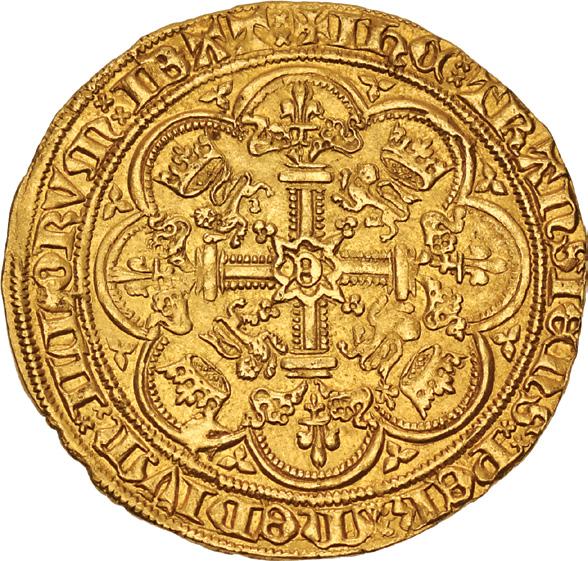
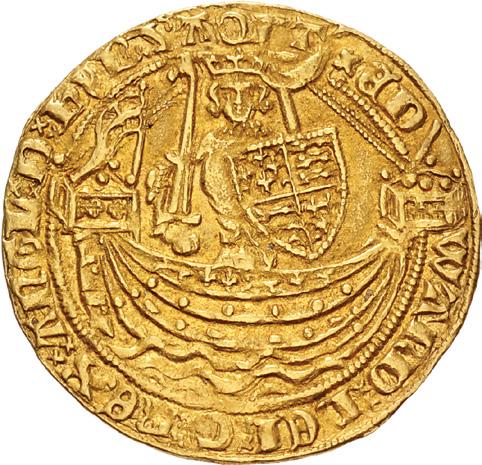
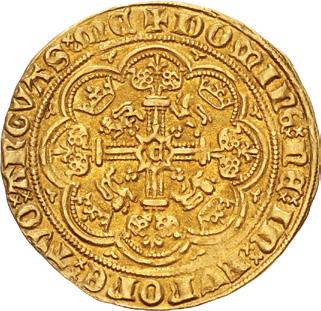
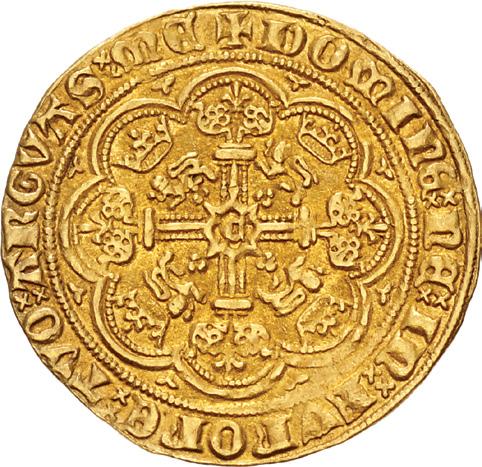
Calais Half Noble
5625752. PLANTAGENET. Edward III. 1327-1377. AV Half Noble (27mm, 3.87 g, 12h). Fourth coinage, Treaty period. Calais mint. Struck 1361-1369. ED ѾaRD Ḻ D
, Edward standing facing in ship, holding sword and shield; ornaments -11-11, ropes 3/2, quatrefoils 2/2, lis 4; flag at stern / ๘ DɨMiNE Ḻ iN Ḻ ŖѝRɨRE Ḻ Ϳѝɨ
aRŷѝaS Ḻ ME , voided short cross potent over cross fleurée; in each angle, crown over lion passant over voided trefoil; at center, ý within quadrilobe; all within polylobe, with trefoils in spandrels. Lawrence 1-2; Schneider 95; North 1940; SCBC 1508. Toned. Near EF. Well struck on a broad flan. An exceptional example of the first Half Noble struck at Calais. Rare. $11,500
Ex Dr. Baumhauer Collection; Dolphin Coins FPL 10 (October 1996), no. 71; Strauss (Sotheby’s, 26 May 1994), lot 47; R.C. Lockett (English Part II, Glendining, 11 October 1956), lot 1253 (“in beautiful condition and very rare,” hammer £27/-/-).
82
Ḻ
Ḻ
Ḻ
Ḻ
$ ⎜ $ aʠ Ϳ=
Ḻ
Ḻ ŷRa Ḻ REҞ Ḻ aNŷǹ
D
ƌҼÝ
5625114. LANCASTER. Henry VI. First reign, 1422-1461. AV Noble (6.92 g, 2h). Annulet issue. Tower (London) mint; im: lis. Struck 1422-circa 1430. ƌ ENˆiý= ჭ Di= $ ŷˆ¨= $ ˆEҞ $ ¨NŷȄ= $ ⎜ $ fˆ¨Ný= $ DNS $ ƌһÝ= , Henry standing facing in ship, holding sword and shield; annulet to left of hand; ornaments: –11–1; quatrefoils: 3/3; f type 1 and N type 2 / Ⴀ iƌ=ý ᛌ ¨ѝͿ= ი Ϳˆ¨NSiENS ი ʖEˆ ი MEDiѝM ი iǣǣɨˆѝ= ი iݨͿ , voided short cross potent over cross fleurée; in each angle, crown over lion passant over trefoil; at center, ƌ within angled quadrilobe; all within polylobe, with annulet and trefoils in spandrels; N type 2, ʁ type 1. Whitton, Heavy 3b; Schneider 274; North 1414; SCBC 1799. Rich orange toning. Well struck. POR
Ex Forbes-Ward Collection (formed before September 1947).
Very Rare Coventry Mint Ryal
5627978. YORK. Edward IV. First reign, 1461-1470. AV Ryal (35mm, 7.69 g, 11h). Light coinage, type VI. Coventry mint; im: –/sun. Struck 1465-1466. Ŀē Ѿaʽē= Ḝ ēƩ ! ŷʽa Ḝ rĿҢ aɇŷǺ Ḝ Ӳ Ḝ Œrɇý !! ēɇS= Ḝ Ʃ Ḝ Ù= Ḝ , Edward standing facing in ship, holding sword and shield; Ŀ on banner at stern, rose on hull, ý in waves / ᛔ Ʃƌý= Ḝ aѝ= Ḝ ʽaɇSƩĿɇS Ḝ ʖĿʽ ! ȎĿēƩѝȎ ! ƩǺǺɨʽѝȎ ! Ʃ ! Ùa= Ḝ , rose over sun with fleurs, crowns, and lions; large fleurs in spandrels. Blunt & Whitton Type VI, var. 1 (pl. X, 7 – same obv. die); Schneider 421 var. (rev. legend stops; same obv. die); North 1551; SCBC 1955. Richly toned. Light mark on reverse. Near EF. Struck on a broad flan. A most handsome example of this very rare Ryal. $24,500
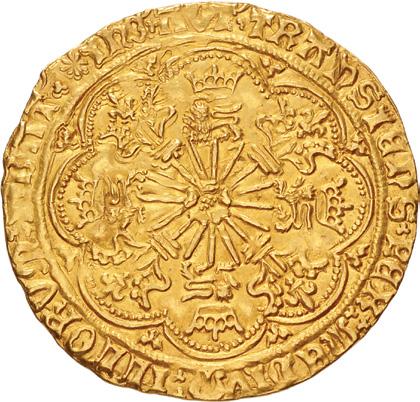
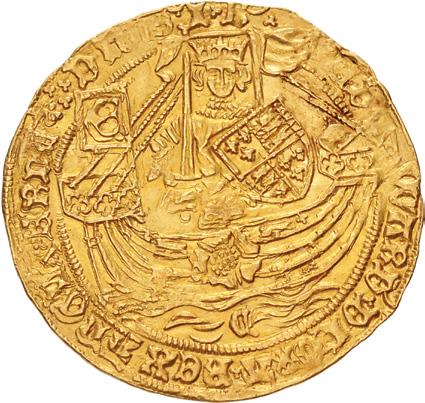
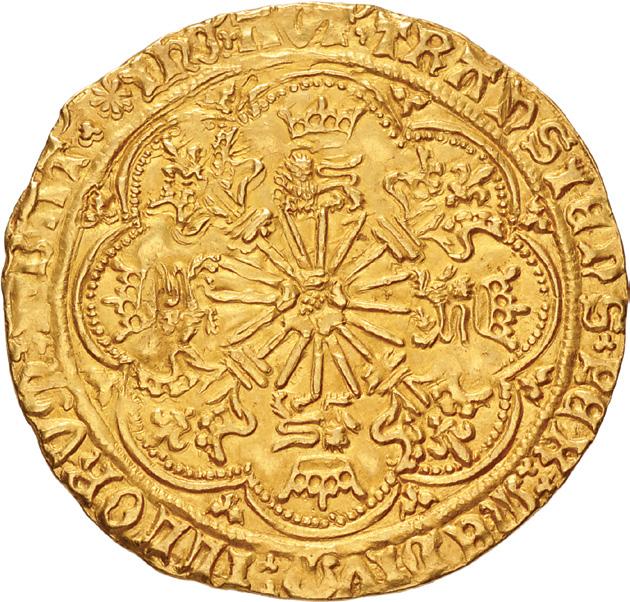
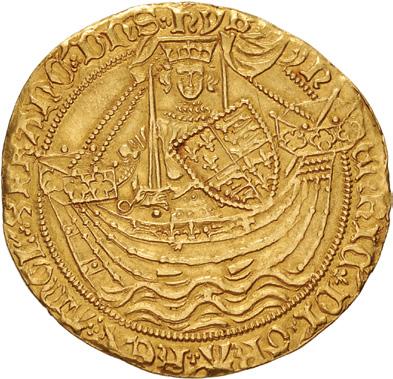
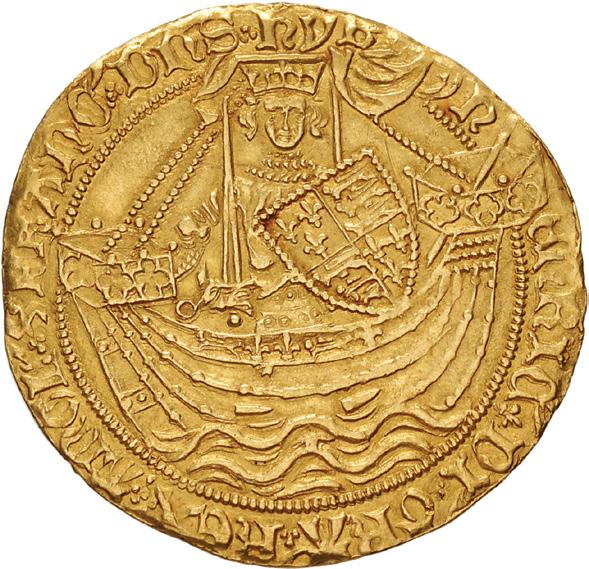
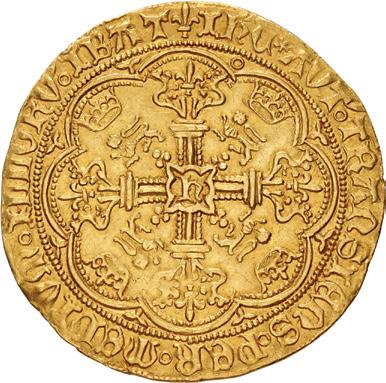
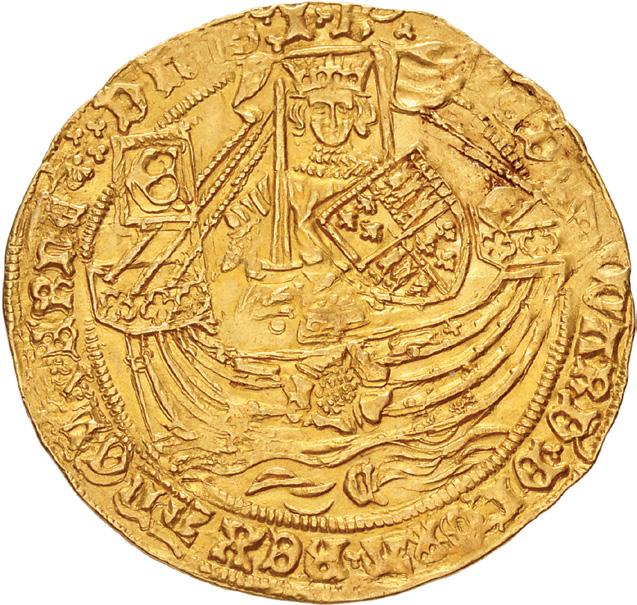
Ex Sheffield (Spink Noble 43, 17 November 1993), lot 2649; E.M. Norweb (Part III, Spink 56, 19 November 1986), lot 887.
The Coventry mint was open for a mere 72 days at the beginning of Edward IV’s Light coinage.
83
5616438. YORK (Restored). Edward IV. Second reign, 1471-1483. AV Half Angel (21mm, 2.44 g, 8h). Type XVI. Tower (London) mint; im: cross on annulet. Struck 1473-1477. (cross in circle) ĚĕѾaʼĕ ᛆ ĕĚƱ ŷˆ¨= ˆĚҢ ᛆ ¨ɀŷǭĚ= , Archangel Michael slaying the Dragon / (cross in circle) Ḻ ɭ Ḻ ýˆѝҢ ¨ѝĚ შ ˫PĚ˫ ᛆ ѝɀƱý¨ Ḻ , ship bearing shield and cross; Ě and rose flanking cross. Blunt & Whitton type XVI; Schneider 476 (same dies); North 1630; SCBC 2093. Hairline edge split. Good VF. An unusually full and detailed specimen. $6500
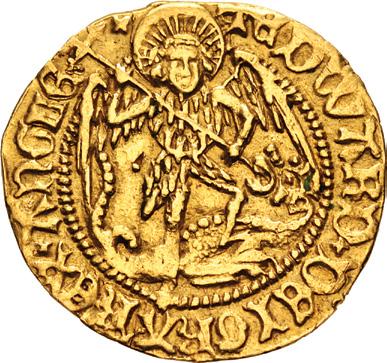
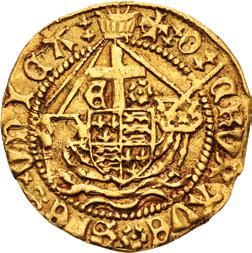
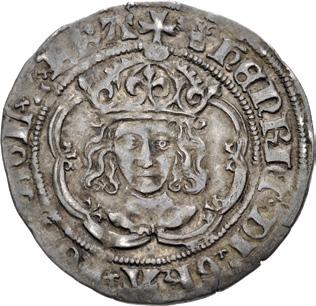
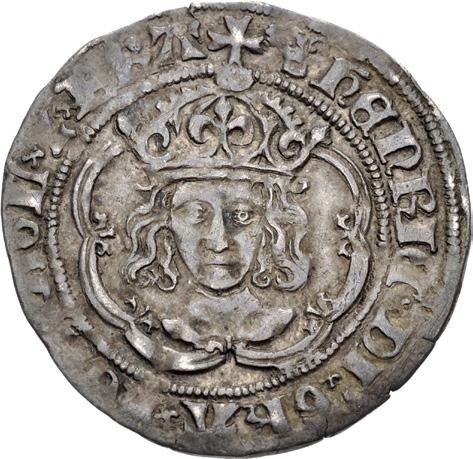
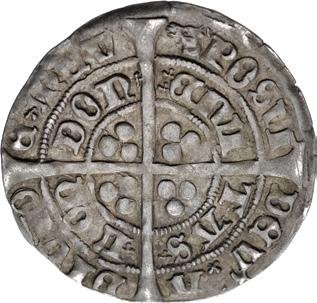
Ex Fernarnd David Collection.
Cf. Baumhauer collection Sincona 75, lot 41 for an example from the same pair of dies and in similar condition (Graded MS65), which hammered at 12000 CHF.
5624850.
VII. 1485-1509.
g,
Ex Marshall Collection (Spink 167, 31 March 2004), lot 87; Spink Numismatic Circular L.12 (December 1942), no. 17371.
84
ƇEɀˆƱý⎡ ĕƱ⎡ ŷˆa⎡ ˆEҢ ᛆ aɀŷȄ⎡ Z ᛆ Ŗˆa
(greyhound’s
ʖɨ˫ѝƱ ĕEѝ⎡ aĕƱѝͿɨ E⎡ ⍴Eѝ / Ḻ ýƱѝƱ Ϳa˫ ᛆ ᛆ Ȅɨɀ ĕɨɀ ᛆ
TUDOR. Henry
AR Groat (25.5mm, 2.82
5h). Facing Bust issue, type III. London (Tower) mint; im: greyhound’s head. Struck 1502-1504. (greyhound’s head)
, crowned facing bust within tressure of arches /
head)
, long cross pattée; triple pellets in quarters. North 1705c; SCBC 2199. Toned. Good VF. $750
Fine Style Early Laker Bust D
5628087. TUDOR. Henry VIII. 1509-1547. AR Groat (25mm, 2.79 g, 3h). Second coinage. Tower (London) mint; im: rose. Struck 1526-1544. ḥ ƇEɀˆƩý⎡ѝƩƩƩ⎡ ĕ⎡ ŷ⎡ ˆ⎡ ɀŷȄ⎡ Z ᛆ Ŗˆaɀý⎡ , crowned bust (Laker D) right / ḥ ʖɨ˫ѝƩ ĕEѝ=Ḻ a ĕƩѝͿɨˆ E=Ḻ ⍴Eѝ , coat-of-arms over long cross fourchée; saltires in forks. Whitton (i); North 1797; SCBC 2337E. Lightly toned with considerable luster. EF. A very early example of this Laker bust D type with portrait more upright than usually encountered. Very rare, especially in this exceptional state of preservation. $3500
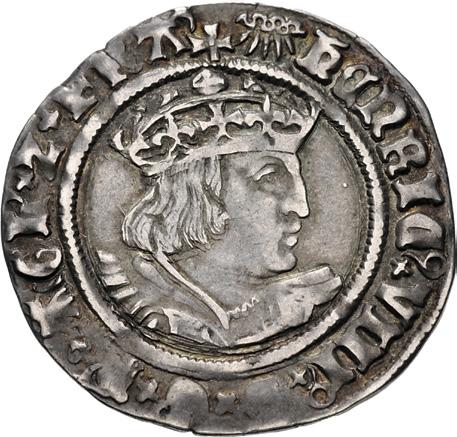
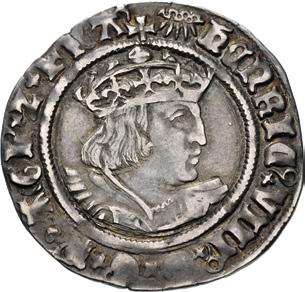
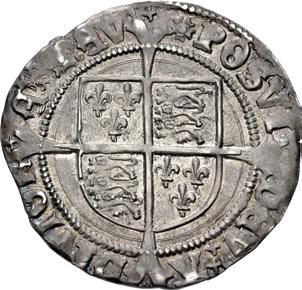
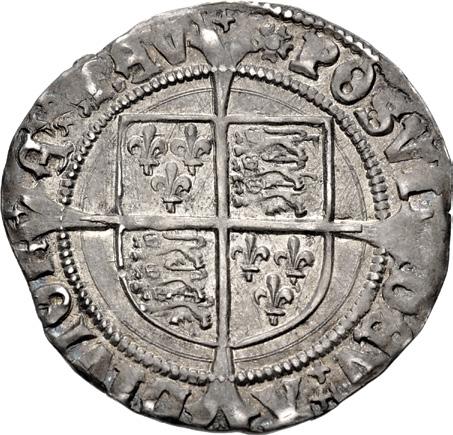
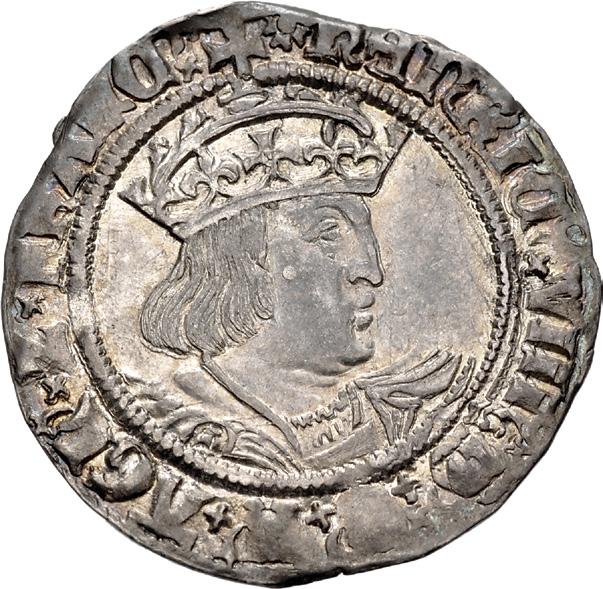
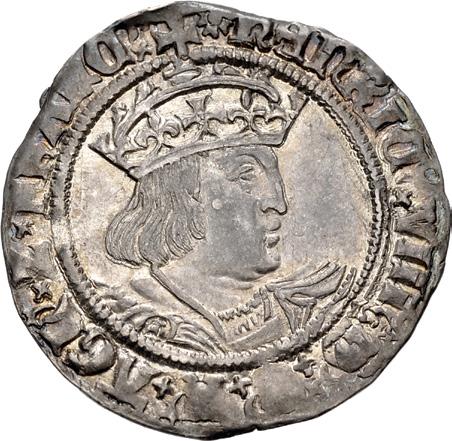
Sunburst Initial Mark
5624851. TUDOR. Henry VIII. 1509-1547. AR Groat (25mm, 2.71 g, 7h). Second coinage. Tower (London) mint; im: sunburst. Struck 1526-1544. (sunburst) ƇEɀˆƩý⎡ѝƩƩƩ⎡ ĕ⎡ ŷ⎡ ˆ⎡ ɀŷȄ⎡ Z ᛆ Ŗˆa= , crowned bust (Laker D) right / (sunburst) ʖɨ˫ѝƩ ĕEѝ=Ḻ a ĕƩѝͿɨˆ E=Ḻ ⍴Eѝ , coat-of-arms over long cross fourchée; saltires in forks. Whitton (v), 1; North 1797; SCBC 2337E. Toned, a very light scratch on face. VF. With a clear mintmark. Rare. $1450
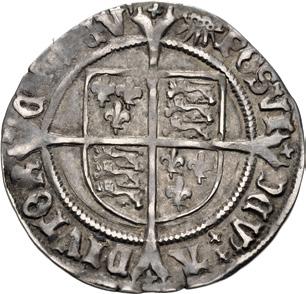
Among the scarcer marks on Henry VIII’s silver coinage, the sunburst likely held some special function beyond that of the usual initial marks. It likely commemorates the birth of Henry’s son and successor Edward, born to Jayne Seymour on 12th October 1537 in Hampton Court Palace.
85
Handsome Sovereign of Edward VI
5627754. TUDOR. Edward VI. 1547-1553. AV Sovereign (36mm, 11.19 g, 5h). Third period, crown gold coinage. Tower (London) mint; im: У. Struck 1551–1553. ӄ ; ĚĕѾ⍒ˆĕ= / ѝƟ ; ĕ= / ŷ= / ⍒ŷǭ= / fˆ⍒N= ; Z ; ƌƟB= ; ˆĚҢ ; , crowned and armored half-length bust right, holding sword over right shoulder and globus cruciger in left hand / ӄ / ƟƌS= / ⍒ѝ˸Ě⍴ ; ˸ˆ⍒NýƟ= / ʖĚˆ ȎĚĕƟѝ= ; ƟȄȄɨˆ= ; ƟB⍒˸ / , crowned coat-of-arms with crowned leopard and griffin supporters; all set on ornate frame with central titulus inscribed ⌓ˊ . Schneider 690 (same dies); North 1927; SCBC 2450. Well struck and richly toned, some very minor flan flaws on obverse. Rare, especially with this initial mark. $65,000
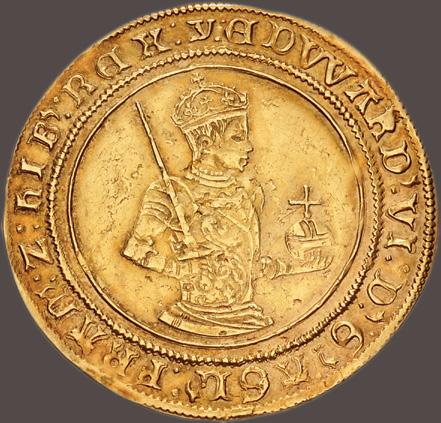
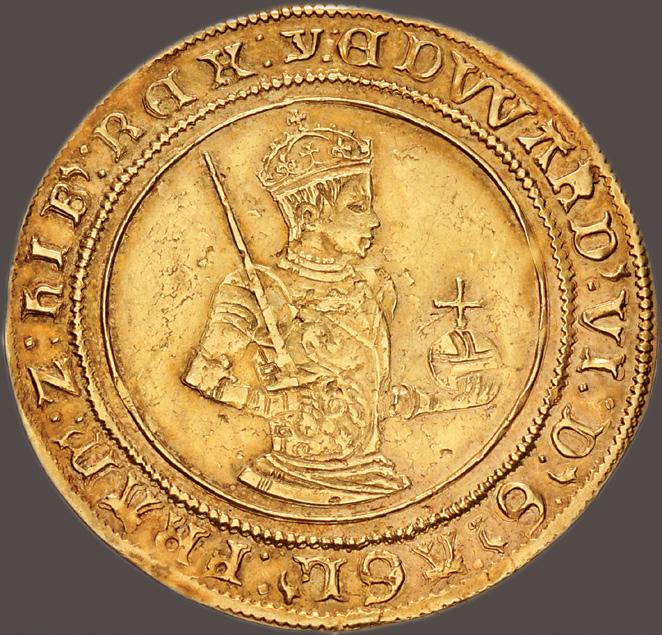
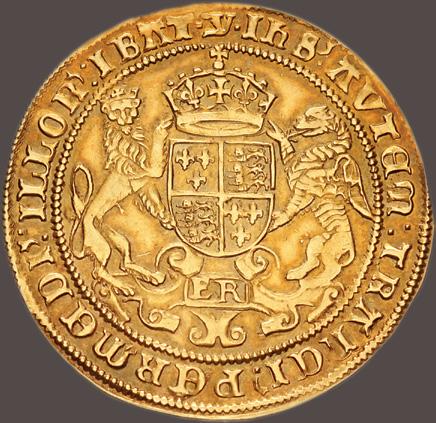
Ex St. James 24 (23 September 2013), lot 43; Spink 208 (22 June 2011), lot 651.
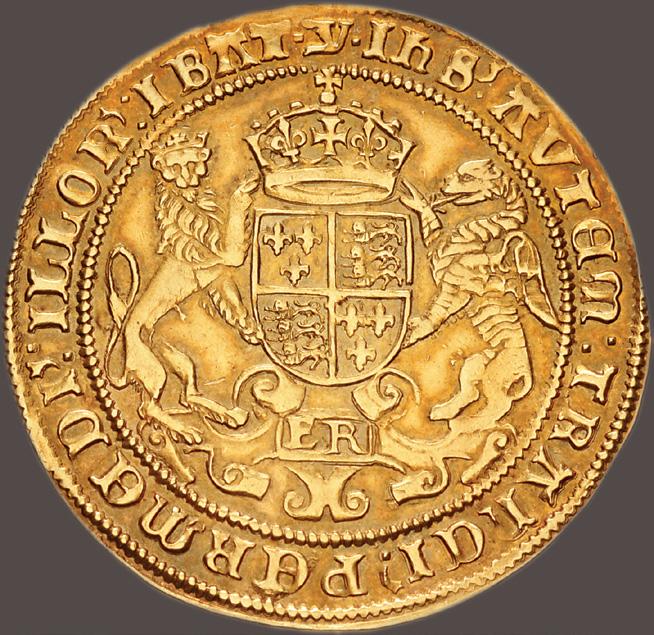
86
Extremely Rare Gold Half Crown of Edward VI
5617778. TUDOR. Edward VI. 1547-1553. AV Half Crown (19mm, 1.20 g, 4h). Third period, crown gold coinage. Tower (London) mint; im: tun. Struck 1551–1553. (tun) ĚĕѾ⍒ˆĕ= / ѝƟ ; ĕ / ŷ= / ⍒= / fˆ= / Z ; ƌƟB=/ ˆĚҢ ; , crowned and armored half-length bust right, holding sword over right shoulder and globus cruciger in left hand / (tun) / ˫ýѝͿѝ⍴ / ŖƩĕEƩ / ʖˆɨͿEŷ / ⍴Eѝ⍴ / , crowned royal coat-of-arms with crowned leopard and griffin supporters; all set on ornate frame with central titulus inscribed ⌓ˊ . Schneider 699 (same dies); North 1930; SCBC 2453. Richly toned, creased as usual, minor flan crack. Near VF. An extremely rare small gold denomination. $14,500
Ex D. Dupree Collection (with his ticket).
5625115. TUDOR. Elizabeth I. 1558-1603. AR Shilling (32mm, 5.85 g, 10h). Sixth issue. Tower (London) mint; im: hand. Struck 1590-1592. (hand) ELIZAB’ D’ · G’ · ANG’ · FR’ · ET · HIB’ · REGI’ ·, crowned bust 6B left, wearing ruff / (hand) POSVI DEV’ · AD IVTORE M · MEV’ ·, coat-of-arms over long cross fourchée. BCW HA-1/HA-b; North 2014; SCBC 2577. Toned. VF. Strong portrait and initial mark. $1100
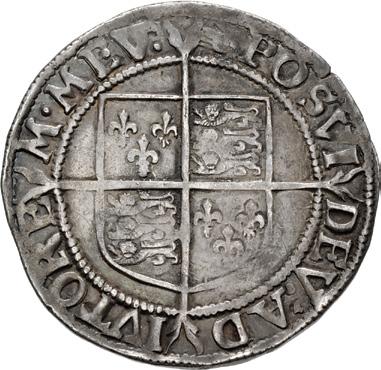
Ellerby Hoard
5625121. STUART. James I. 1603-1625. AV Laurel (35mm, 9.04 g, 8h). Third coinage, crown gold. Tower (London) mint; im: lis. Struck 1623-1624. ჭ IACOBVS D : G : MAG : BRI : FRAN : ET HIB : REX, laureate, draped, and cuirassed bust left; XX (mark of value) to right / FACIA M EOS IN GENTEM VNAM ჭ , crowned coat-of-arms over long cross fourchée. Schneider 86 var. (arrangement of laurel ties); North 2114; SCBC 2638B. In NGC encapsulation 6380983-017, ‘genuine’. In our opinion the finest coin of James I in the hoard. $6250
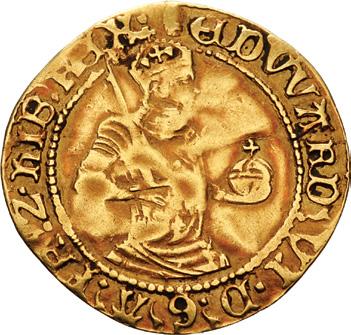
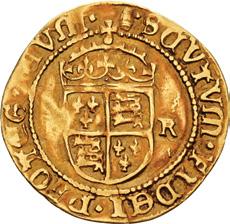
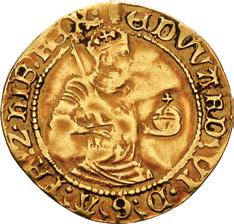
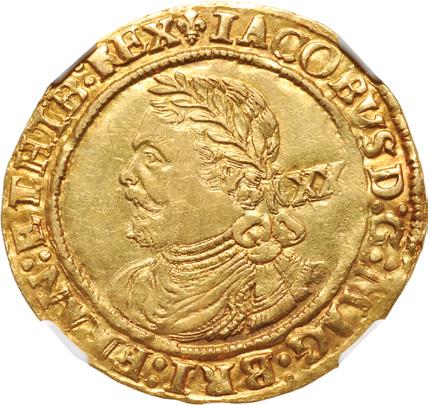
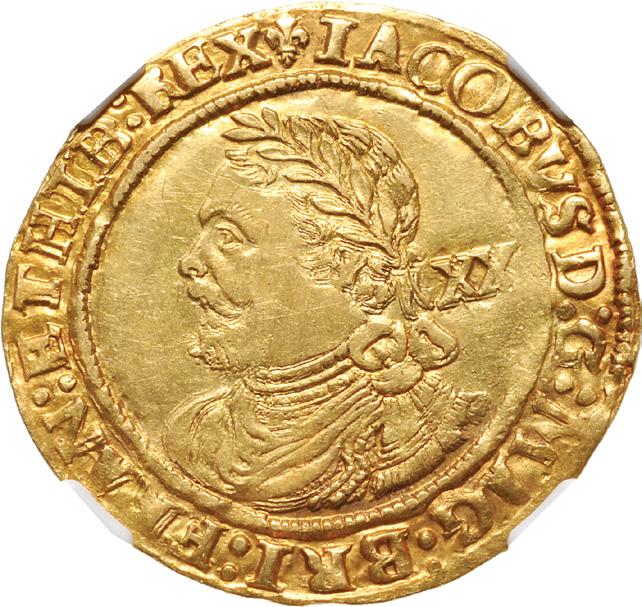
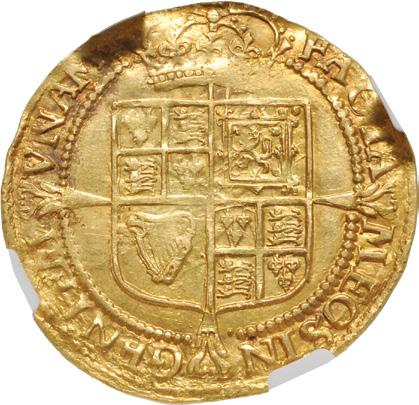
Ex 2019 Ellerby Hoard (PAS: YORYM-18E848).
In 2019, a couple were undertaking renovations to their eighteenth century home in the village of Ellerby near Hull in North Yorkshire when they discovered a hoard of 266 gold coins in a stoneware vessel under their kitchen floor
87
Ex
The Earliest Angel of Charles I Sole Example in Private Hands
5627632. STUART. Charles I. 1625-1649. AV Angel (26mm, 4.00 g, 8h). Fine gold coinage. Tower (London) mint; im: lis. Struck 1625. CAROLVS · D · G : MAG : BRI : FR : ET · HI : REX ჭ , Archangel Michael slaying dragon lying at his feet to right / ჭ AMOR’· POPVLI’· PRÆSIDIVM’· REGIS :, ship bearing coat-of-arms. Schneider, Tower dies O-1/R-1 (this coin cited); Schneider –; Brooker –; North 2143; SCBC 2682A. Toned, pierced for use as a touch piece. Good VF. Extremely rare example of this first type and mint mark. Only one other specimen known, in the British Museum. $12,000
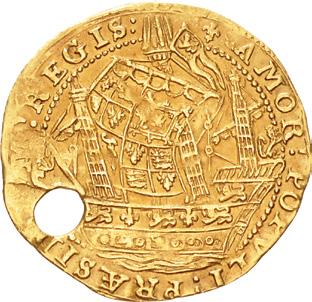
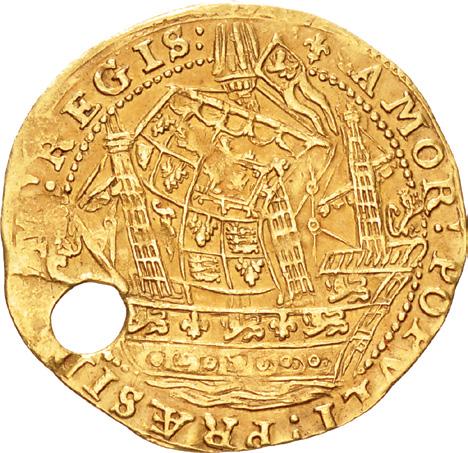
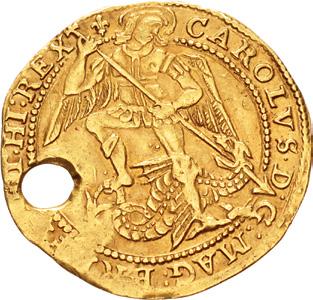
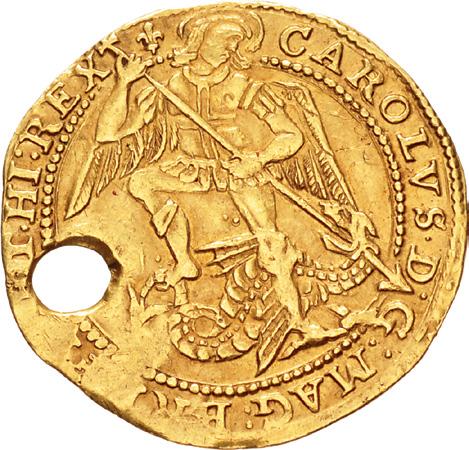
Ex C. F. Noon (Spink 165, 8 October 2003), lot 299; W.L. Raynes (Glendining, 15 February 1950), lot 219.
By the reign of Charles I the gold Angel was struck substantially for use in the Touching ceremony; the ancient rite whereby the monarch, as God’s appointed, would cure sufferers of Scrofula (‘The King’s Evil’) by the laying on of hands. This belief was actively encouraged by the Stuarts as an adjunct to their theory of the Divine Right of Kings. Consequently, under James I and Charles I the Touching ceremony become more formalised and elaborate.
Three distinct types of Angels were struck for Charles I. Type 1, issued for the first two years of the reign bears no mark of value. Type 2, issued from 1626 to 1639, has a mark of value in the field to the right of Saint Michael. This second type was issued from 1626 alongside Type 3, which has the mark of value in the field to the left of the Saint, up to August 1642 when Parliament seized control of the Tower mint. Of these three types by far the rarest is the first which is found with the first two mint marks of the reign: lis and cross calvary. The extreme rarity of Angels of the lis mint mark - introduced on 7 July 1625 - is almost certainly a result of the outbreak of the plague that year which meant access to court was forbidden, Parliament was removed to Oxford and the coronation was postponed to February 1626. According to Helen Farquhar it is possible that Charles only touched using mint mark lis Angels in early June 1626. The succeeding mint mark, cross Calvary, was introduced on 29th June of that year. Only two examples of the lis mint mark are known; the example offered here and the specimen in the British Museum. Both coins are pierced for use in the Touching ceremony.
MACDUFF: What’s the disease he means?
MALCOLM: ‘Tis call’d the evil: A most miraculous work in this good king; Which often, since my here-remain in England, I have seen him do. How he solicits Heaven, Himself best knows: but strangely-visited people, All swoln and ulcerous, pitiful to the eye. The mere despair of surgery, he cures; Hanging a golden stamp about their necks, Put on with holy prayers: and ‘tis spoken, To the succeeding royalty he leaves The healing benediction.
MACBETH, Act IV, Scene 3.
88
5621493. STUART. Charles I. 1625-1649. AR Crown (44mm, 300.12 g, 8h). Tower (London) mint; mm: portcullis. Struck 1633-1634. (portcullis) · CAROLVS · D’· G’· MAG’· BRI’· FRA’· ET · HI’· REX · , Charles on caparisoned horse left, holding sword in right hand and reins in left / · CHRISTO · AVSPICRE · REGNO · (portcullis) ·, coat-of-arms; plumes above. Cooper, Silver dies XIV/XVIII; Brooker 253 (same dies); North 2196; SCBC 2759. Toned with considerable underlying luster. Good VF. A rare and most handsome coin. $14,500
Ex Mark & Lottie Salton Collection; Spink Numismatic Circular LX.8-9 (August/September 1952), no. 8345 (“EF and rare,” £21/10/-).
5622568. STUART. Charles I. 1625-1649. AR Halfcrown (35mm, 14.82 g, 10h). Group I, type 1a1. Tower (London) mint; im: lis. Struck 1625. ჭ CA ROLVS D · G · MAG · BR · FR · ET HI · REX, Charles on caparisoned horse left, holding sword in raised right hand, reigns in left; plume on horse / ჭ CHRI STO AV SPICE REGNO, coat-of-arms over long cross fleurée. Bull 5/1d-I; Brooker 277 (same obv. die); North 2200; SCBC 2763. Attractive toning with shades of blue iridescence, minor flan flaws. VF. Bold strike. Rare. $2500
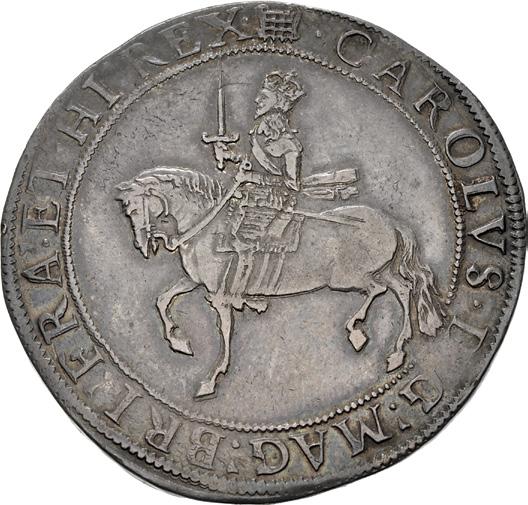

5622569. STUART. Charles I. 1625-1649. AR Halfcrown (35mm, 15.07 g, 8h). Group V, type 5. Tower (London) mint; im: sun. Struck under Parliament, 1645-1646. [ ṓ ) · C]AROLVS · D’· G’· MAG’· BRI’· FRA’· ET · HIB’· REX, Charles on horseback left, holding sword in raised right hand, reigns in left / ṓ · CHRISTO · AVSPICE · REGNO, coat-of-arms. Bull 536E/33; Brooker 377 (same obv. die); North 2215; SCBC 2780. Toned, areas of weak strike, slightly double struck. Good VF. A finely detailed horseman. $1000
89
Lustrous Charles I Crown
Ex Countryman (M. Rasmussen FPL 22 [Winter 2011/2012]), no. C22.
5624852. STUART. Charles I. 1625-1649. AR Groat (23mm, 1.99 g, 4h). Aberystwyth mint; im: book. Struck 1638/91642. (book) CAROLVS · D’ · G’ · M’ · BR’ · F’ · ET · HI’ · REX, crowned bust left; plumes to left, IIII (mark of value) to right / · CHRISTO · AVSPICE · REGNO (book) ·, coat-of-arms; plumes above. Morrieson, Aberystwyth, A-2; Brooker 769 (same obv. die); North 2338; SCBC 2893. Richly toned with hints of luster. Good VF. $595
Ex F. Bartlett Collection; Glenister (Part I, Spink 190, 27 September 2007), lot 493, purchased from Baldwin’s, 1945.
5622579. STUART. Charles I. 1625-1649. AR Halfcrown (35mm, 14.65 g, 5h). Bridgnorth-on-Severn mint; im: plume/–. Dated 1646. (plume) · CAROLVS D : G: MAG : BR : FR : ET · HIB : REX ·, Charles on horseback left, holding sword in left hand; plumes to upper right and below / · EXVRGAT · DEVS · DISSIPENTVR · INIMICI ·, REL : PRO :/ LE : AN : LI : PA in two lines; above, three plumes and scroll; below, 1646. Morrieson, Lundy B/5; Bull 650/5; Brooker 1126; North 2513; SCBC 3037. Toned, cleaning marks and scratches. VF. A bold portrait of the king. Very rare, especially with this reverse die. $3750
Ex Seaby Coin & Medal Bulletin 587 (July 1967), no. 9097; Sotheby’s (21 March 1947), lot 136.
5621455. HANOVER. George II. 1727-1760. AR Halfcrown. Dated 1750 and VICESIMO QUARTO. ESC 609; Bull 1692; SCBC 3696. Most attractive deep tone. In NGC encapsulation 6489889-005, graded MS 62. $3500
Ex H. Manville (Spink 9, 4 June 1980), lot 305 (‘practically mint state and beautifully toned’); Spink Numismatic Circular 492 (May 1959), no. 13354.
90
5617781. HANOVER. George III. 1760-1820. AV Half Guinea. Dated 1764. MCE 407; SCBC 3732. Toned with underlying luster. In NGC encapsulation 6479215-003, graded AU 58. $2500
Ex Norweb, Brand, Ferrari, and Murdoch
5625754. HANOVER. George III. 1760-1820. Pattern CU Halfcrown (37mm, 23.60 g, 12h). London mint. By B. Pistrucci, after T. Wyon. Dated 1816. GEORGIUS III DEI GRATIA, laureate bust right, seen from behind; 1816 below / BRITANNIARUM EX FID : DEF :, crowned coat-of-arms within garter. Edge: DECUS ET TUTAMEN ANNO REGNI QUINQUAGESIMO SEPTIMO. L&S 151 (this coin cited); Bull 2089; ESC 615A. In NGC encapsulation 2130724-009, graded MS 62 BN. $4500
Ex E.M. Norweb (Part II, Spink 48, 13 November 1985), lot 587; Virgil M. Brand Collection; ‘The Famous and Remarkable Collection of a Nobleman [Baron Phillipe de Ferrari la Renotiere]’ (Sotheby, Wilkinson & Hodge, 27 March 1922), lot 86 (part of); J.G. Murdoch (Part II, Sotheby, Wilkinson & Hodge, 11 May 1903), lot 330 (part of).
The Bruce
5627979. SCOTLAND. Robert Bruce. 1306-1329. AR Penny (19mm, 1.36 g, 7h). Class I. Berwick(?) mint. Struck 1318-early 1320s. ๘ Ḧ ˆɭBĚʽ˶⎍S Ḧ ĕĚƱ Ḧ ŷˆ¨ Ḧ , crowned head left; lis-tipped scepter to left / Sýɭ ˶ɭʽ ⎍n ˆĚҢ ๘ , long cross pattée; mullets in quarters. H&S dies 8/K; Burns 1 (fig. 225); SCBI 35 (Ashmolean & Hunterian), 318-20; SCBC 5076. Deep cabinet toning. Good VF. Rare. $2950

91
5627762. SCOTLAND. Mary. 1542-1567. AR Half Testoon (24mm, 3.13 g, 10h). Second period, Francis and Mary, Type II. Edinburgh mint. Dated 1560. ՟ FRAN · ET · MA · D · GR · R · FRANCO · SCOTO(RX) Q ·, coat-of-arms surmounted by Scottish crown; cross to left, saltire to right / · FECIT · LEO · DE · TRIBV · IVDA · 1560 ·, crowned FM monogram; crowned lis and thistle flanking. Burns 5 (fig. 887); SCBI 58 (Edinburgh), 1038 (same obv. die); SCBC 5620. Toned. Good VF. Rare. $1650
“Unbalanced” Balance Half Merk
5627763. SCOTLAND. James VI. 1567-1625. AR Balance half merk (30mm, 4.67 g, 2h). Sixth coinage. Edinburgh mint. Dated 1591. * · IACOBVS · 6 · D · G · R · SCOTORVM · 1591 ·, crowned coat-of-arms; thistles flanking / * · HIS DIFFERT · REGE · TYRANNVS ·, balance over sword. Burns 1 (fig. 937); SCBI 58 (Edinburgh), 1493 (same dies); SCBC 5491. Toned. Good VF. High grade for type. A dramatic flip-over double strike makes this a bit of an ‘unbalanced’ Balance half merk. $2450
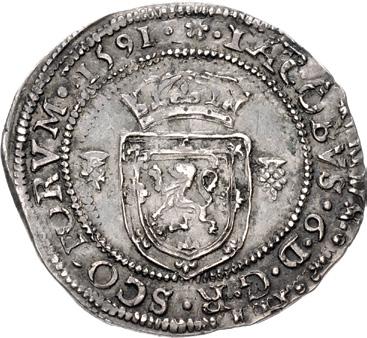
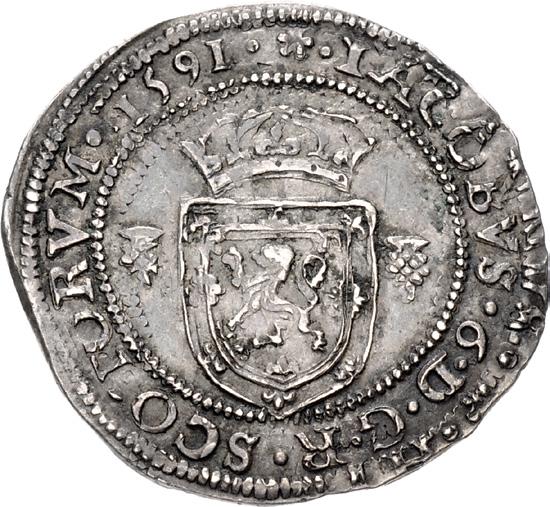
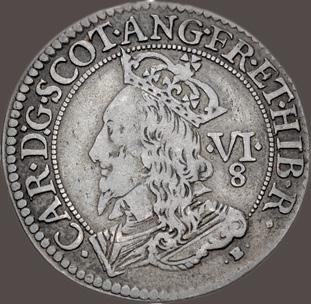
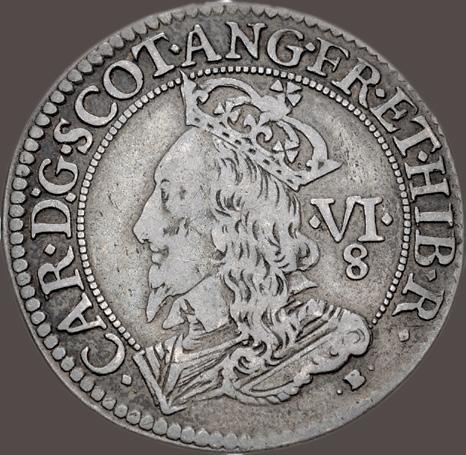
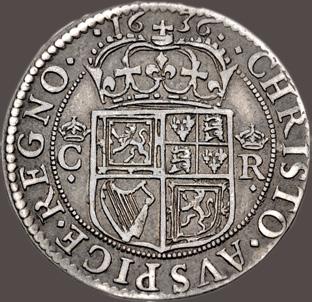
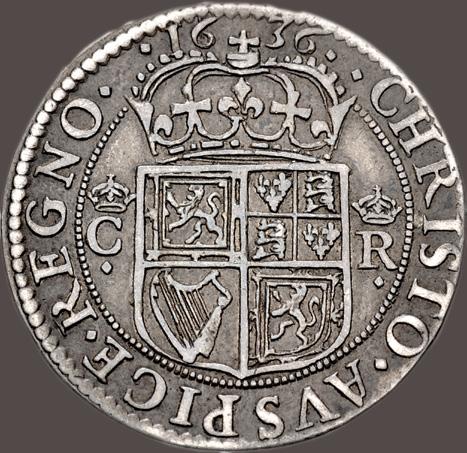
Briot’s Pattern Milled Half Merk
5627764. SCOTLAND. Charles I. 1625-1649. Pattern AR Half Merk (25mm, 3.35 g, 6h). Second coinage, Briot’s pattern milled coinage. Dies by N. Briot. Dated 1636. · CAR · D : G · SCOT · ANG · FRA · ET · HIB · R ·, crowned bust left; · VI ·/8 to right; small ·в· below / · CHRISTO · AVSPICE · REGNO · 16 36, crowned coat-of-arms; crowned C R flanking. Murray p. 132; Burns p. 454-5; SCBI 35 (Ashmolean & Hunterian), –; SCBC 5547. Toned. Near VF. A handsome and important pattern. Extremely rare. $4250
Reportedly ex H. Lingford Collection. This extremely rare pattern was presumably created by Briot in an attempt to convince the Edinburgh mint to adopt his new machinery.
92
Though not used for the 1636 coinage, it would be adopted the following year.
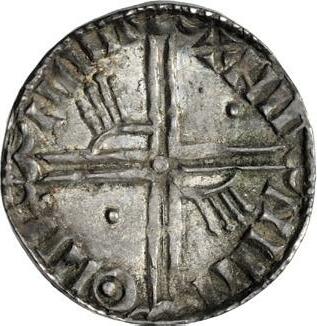
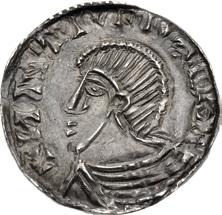
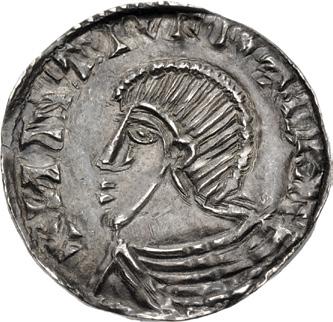
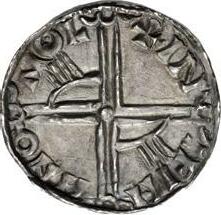
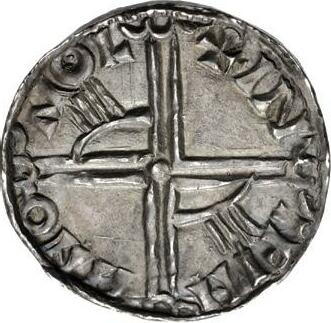
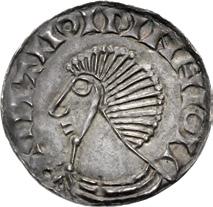
An Important Offering of Hiberno-Norse Pennies
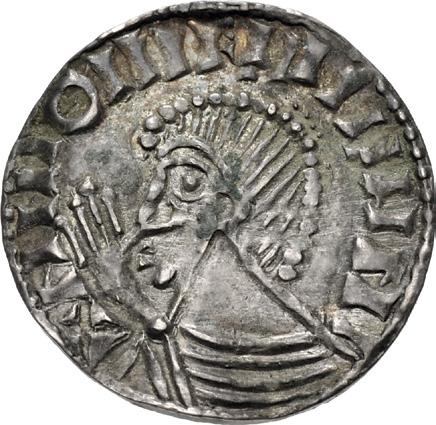
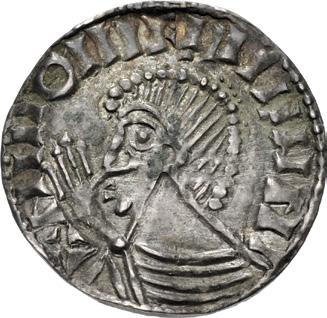
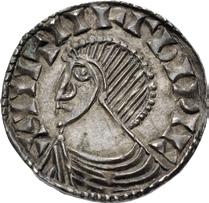
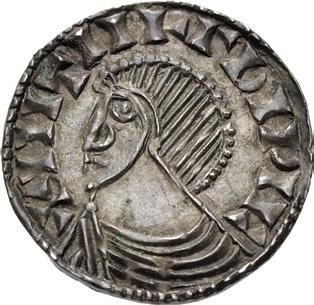
5624856.
IRELAND, Hiberno-Norse. Phase III. Circa 1035-1055/60. AR Penny (18mm, 1.05 g). Phase III coinage, Long Cross type. Draped bust left; hand to left / Voided long cross, with triple crescent ends; ‘hand’ symbols and pellets in alternating quarters. SCBI 8 (BM), 105 (same dies); SCBI 22 (Copenhagen), –; SCBI 32 (Ulster), –; D&F 24; SCBC 6130. Toned, spot of hard green deposit, slightly wavy. Good VF. Extremely rare type with hand before face. $3750
5624855. IRELAND, Hiberno-Norse. Phase III. Circa 1035-1055/60. AR Penny (18mm, 0.94 g, 12h). Phase III coinage, Long Cross type. Draped bust left / Voided long cross, with triple crescent ends; ‘hand’ symbols in second and third quarters. Cf. SCBI 8 (BM), 118; cf. SCBI 22 (Copenhagen), 109; cf. SCBI 32 (Ulster), 141; D&F 24; SCBC 6132. Toned. EF. Bold, fluid style. Rare. $1950
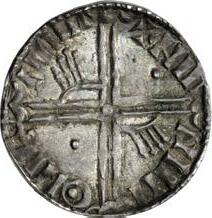
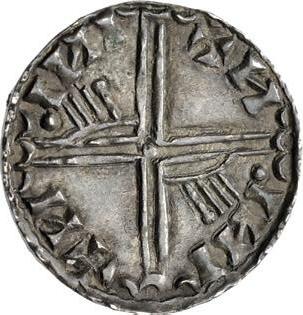
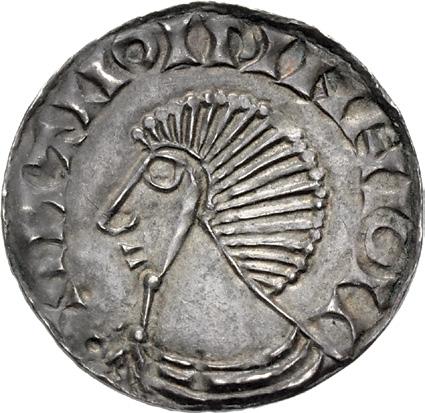
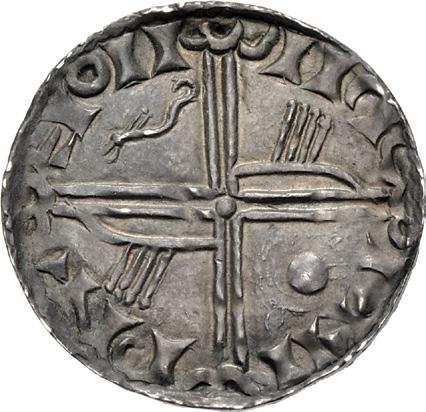
5624858. IRELAND, Hiberno-Norse. Phase III. Circa 1035-1055/60. AR Penny (17mm, 0.92 g). Phase III coinage, Long Cross type. Draped bust left / Voided long cross, with triple crescent ends; ‘hand’ symbols in first and fourth quarters. SCBI 8 (BM), 121 (same dies); cf. SCBI 22 (Copenhagen), 126-7; cf. SCBI 32 (Ulster), 142; D&F 24; SCBC 6132. Richly toned, tiny green deposit. EF. $1650
Ex Baldwin’s 18 (12 October 1998), lot 1909.
Exceptional Serpent Penny
5624859.
IRELAND, Hiberno-Norse. Phase III. Circa 1035-1055/60. AR Penny (17mm, 0.80 g). Phase III coinage, Long Cross type. Draped bust left / Voided long cross, with triple crescent ends; ‘hand’ symbols in first and fourth quarters, ‘serpent’ in second, and pellet in third. SCBI 8 (BM), –; SCBI 22 (Copenhagen), –; cf. SCBI 32 (Ulster), 137-140 (for obv. style); D&F 24; SCBC 6132A. Richly toned. Choice EF. Extremely rare, with this serpent type missing from all major published collections of Hiberno-Norse. An extraordinary coin of considerable iconographic interest. $6500
93
5624860.
IRELAND, Hiberno-Norse. Phase III. Circa 1035-1055/60. AR Penny (16mm, 0.89 g). Phase III coinage, Long Cross type. Draped bust left / Voided long cross, with triple crescent ends; ‘hand’ symbols in third quarter, X in fourth. SCBI 8 (BM), –; SCBI 22 (Copenhagen), 190 (same dies); SCBI 32 (Ulster), 246-8 (same dies); D&F 24; SCBC 6132A. Toned. Near EF. Very rare symbol. $1750
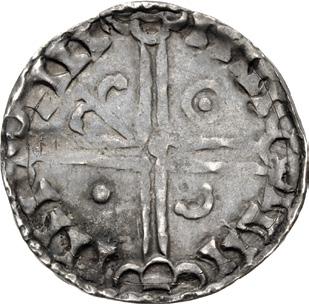
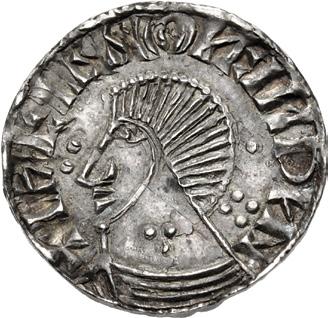
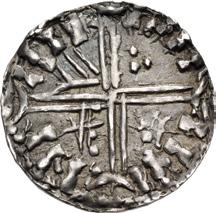
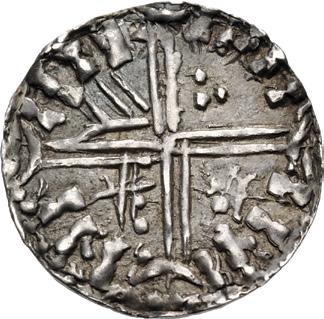
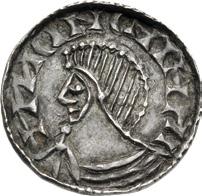
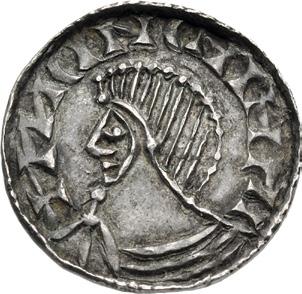
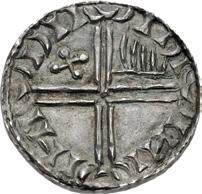
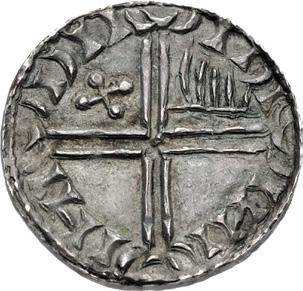
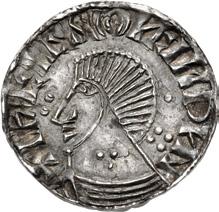
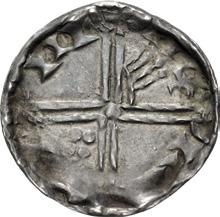
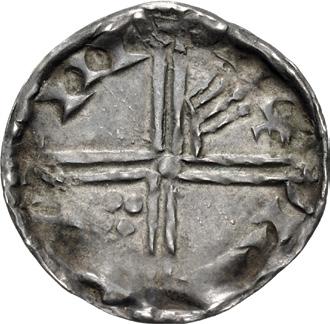
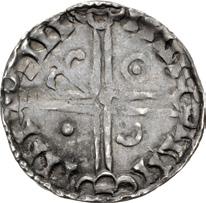
5624864. IRELAND,
Phase IV. Circa 1055/60-1065. AR Penny (17mm, 1.09 g). Phase IV coinage, Long Cross ‘scratched die’ type. Draped bust left; two pellets to left, single pellet over quatrefoil of pellets to right; trefoil of pellets on neck / Voided long cross, with triple crescent ends; trefoil of pellets in first quarter, crude star in second, ‘hand’ symbol in third, scratched cross and pellets(?) in fourth. SCBI 8 (BM), 147 (same obv. die); SCBI 22 (Copenhagen), –; SCBI 32 (Ulster), 314/313 (same obv./rev. dies); D&F 25; SCBC 6134.
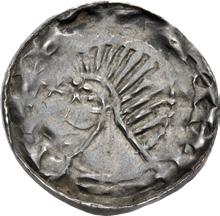
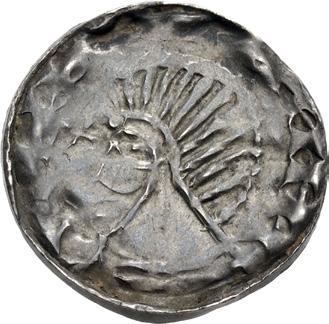
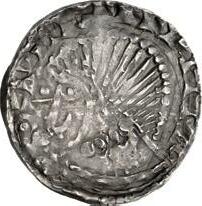
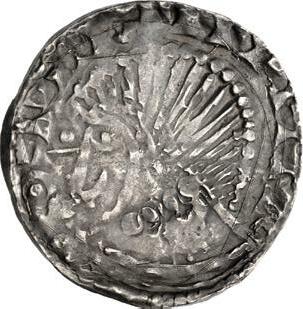
Ex Terenure (Whyte’s, 20 February 1998), lot 18.
5624867.
5624868.
94
Hiberno-Norse.
Richly toned. Near EF. Rare. An excellent example of the ‘scratched die’ issue. $2250
IRELAND, Hiberno-Norse. Phase V. Circa 1065-1085/95. AR Penny (18mm, 0.97 g). Phase V coinage, Long Cross type. Draped bust left; X to left / Voided long cross, with triple crescent ends; ‘hand’ symbol and quatrefoil of pellets in opposing quarters. SCBI 8 (BM), 208; SCBI 22 (Copenhagen), –; SCBI 32 (Ulster), –; D&F 28; SCBC 6138. Toned, flat strike with areas of weakness. VF. Extremely rare. $2250
IRELAND, Hiberno-Norse. Phase V. Circa 1065-1085/95. AR Penny (17mm, 0.99 g). Phase V coinage, Long Cross type. Draped bust left; pellet to left, cluster of pellets on neck / Voided long cross, with triple crescent ends; pellet, lis, crescent, and pellet-in-annulet in quarters. SCBI 8 (BM), 164-6 (same dies); SCBI 22 (Copenhagen), –; SCBI 32 (Ulster), –; D&F 28; SCBC 6138 var. (symbols). Toned, obverse double struck, a few light scratches. VF. Extremely rare. $2250
5624870.
IRELAND, Hiberno-Norse. Phase V. Circa 1065-1085/95. AR Penny (17mm, 0.72 g). Phase V coinage, Long Cross/Cnut Short Cross types. Draped bust left; pelleted line and annulet to right, pellet-in-annulet and two trefoils of pellets on neck / Voided short cross. Cf. SCBI 8 (BM), 175; SCBI 22 (Copenhagen), –; SCBI 32 (Ulster), –; D&F 28; SCBC 6142. Rich cabinet toning, minor edge loss. VF. Extremely rare. $3500
Ex MacDuinssleibhe (Bonham’s, 24 February 2004), lot 86; ‘Viking’ Collection (Spink 150, 14 March 2001), lot 1137; Spink 23 (21 September 1982), lot 111.
5624871.
IRELAND, Hiberno-Norse. Phase V. Circa 1065-1085/95. AR Penny (18mm, 0.93 g). Phase V coinage, Long Cross/Edward the Confessor Short Cross types. Draped bust left; three pellets on neck / Short cross pattée over cross saltire with triple pellets at each end. SCBI 8 (BM), 219; cf. SCBI 22 (Copenhagen), 260-1; SCBI 32 (Ulster), –; D&F 28; SCBC 6149. Toned, usual crude strike with peripheral weakness. VF. Extremely rare. $3950
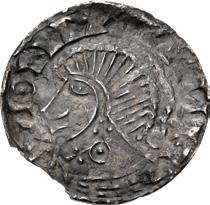
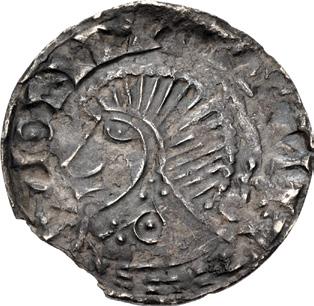
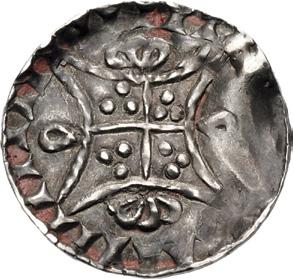
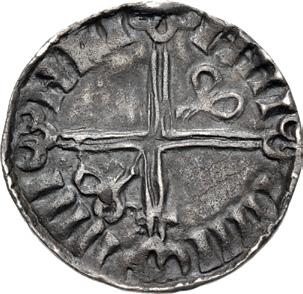
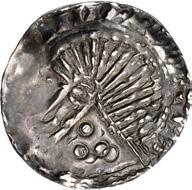
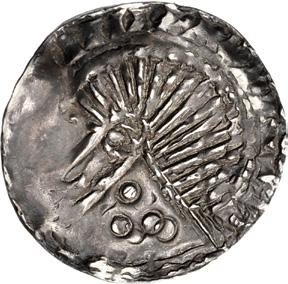
Ex Glendining (24 January 1996), lot 74.
5624872.
IRELAND, Hiberno-Norse. Phase V. Circa 1065-1085/95. AR Penny (16mm, 0.67 g). Phase V coinage, Long Cross/William I Two Stars type. Draped bust left; three pellets on neck / Cross botonnée with central annulet over quadrilateral with incurved sides. Cf. SCBI 8 (BM), 230-1; cf. SCBI 22 (Copenhagen), 277; SCBI 32 (Ulster), 357 (all with hand on neck); D&F 29; SCBC 6154B. Richly toned, crimped in pats with areas of weakness, red wax deposits. VF. Extremely rare. None in the major collections with this obverse symbol. The reverse derived from the Two Stars type of William I. $6500
‘Viking’ Collection (Spink 150, 14 March 2001), lot 1139; Glendining (13 April 1988), lot 226.
Extremely Rare ‘Spectacles’ Symbols
5624874.
IRELAND, Hiberno-Norse. Phase V. Circa 1065-1085/95. AR Penny (16mm, 0.94 g). Phase V coinage, Long Cross type. Draped bust left; triquetra to left / Voided long cross, with triple crescent ends; ‘spectacles’ in opposing quarters. SCBI 8 (BM), –; SCBI 22 (Copenhagen), –; SCBI 32 (Ulster), –; D&F 28; SCBC 6161 var. (bust left). Richly toned. Good VF. Extremely rare. $4250
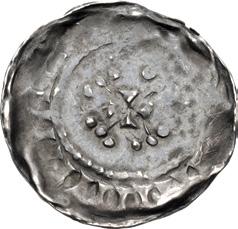
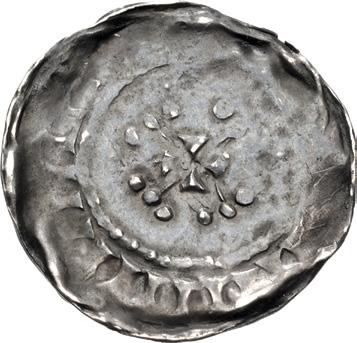
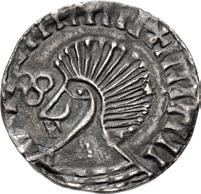
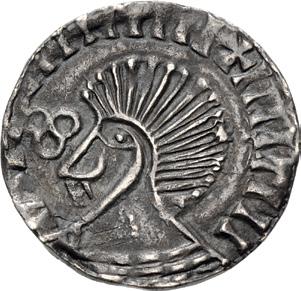
95
5624875. IRELAND, Hiberno-Norse. Phase VI. Circa 1095/1100-1150. AR Penny (18mm, 0.38 g). Phase VI coinage, Long Cross type. Draped bust left; crozier to left / Voided long cross, with triple crescent ends; scepters and pellets in alternating quarters. SCBI 8 (BM), 245-6; SCBI 22 (Copenhagen), 288-9; SCBI 32 (Ulster), 371-4; D&F 32; SCBC 6187. Toned, some ghosting. Good VF. Rare. $1250
5624877. IRELAND, Hiberno-Norse. Phase VI. Circa 1095/1100-1150. Base AR Penny (18mm, 0.44 g). Phase VI coinage, Long Cross type. Draped bust left; crozier to left / Voided long cross, with triple crescent ends; scepters and pellets in alternating quarters. SCBI 8 (BM), 232-6; SCBI 22 (Copenhagen), 282-4; SCBI 32 (Ulster), 376-85; D&F 32; SCBC 6187. Toned. Good VF. An attractive example for the issue. Rare. $1750 5624878. IRELAND. John. As Lord of Ireland, 1172-1199. AR Halfpenny (14mm, 0.80 g, 6h). Second (‘DOMinus’) coinage, type Ib. Dublin mint; Adam, moneyer. Struck circa 1190-1199. ม ƱɭH¥nnģS ĕɭɭ , facing diademed head / ม ¥ĕ¥ዦ ɭ ë Ѿģ , voided cross potent, with annulet in each quarter. Withers VI 6/a; D&F 40a; SCBC 6205. Richly toned with traces of luster. Good VF. $595
5624880. IRELAND. Edward IV. Second reign, 1471-1483. AR Penny (15mm, 0.63 g, 12h). Light ‘Cross and Pellets’ coinage. Dublin mint. Struck circa 1473-1478. [ ๘ ĚĕѾ¥ˆĕ=/ ĕƩ=/ ] ŷˆ¥=/ ĕNS=/ ƌӎBĚˆ , crowned facing bust; saltires flanking / ýƩѝƩ ˸¥S ĕѝB⌦ [ ƩN ...], long cross pattée; triple pellets in quarters. IHP DU-14; D&F 126; SCBC 6362. Toned. VF. Struck on an unusually broad flan from dies of good style. $875
Exceedingly Rare Edward IV Halfpenny
5624882. IRELAND. Edward IV. Second reign, 1471-1483. AR Halfpenny (11mm, 0.23 g, 6h). Bust with suns and Roses/Rose on Cross coinage. Dublin mint. Struck circa 1478-1483. [...] ĕNS ƌӎB , crowned facing bust; saltires flanking crown / [ ýƩѝƩ ˸¥ ] S ĕѝB ⌦ƩN , long cross pattée with rose at center. Withers –; D&F –; SCBC 6398. Toned, slightly off center. VF. Extremely rare, the first CNG has handled. $3500
96
5624884. IRELAND. Henry VII. 1485-1509. AR Groat (25mm, 2.10 g, 12h). Late Portrait issues, type IA. Dublin mint. Struck circa 1496-1505. ๘ ƌĚNˆƩý / ĕĚƩ / ŷˆa / ˆĚҞ [...], crowned facing bust within tressure of arches / ʖɨSѝƩ ĕĚѝ⍴ a ĕƩѝ ˸ɨˆ
/ ýƩѝƩ ˸aS ĕѝB ⌦ƩN , long cross pattée; triple pellets in quarters. D&F 194; SCBC 6455. Toned, double struck. Near EF. An unusually high grade example. $1150
5624889. IRELAND. Edward VI. 1547-1553. AR Sixpence (26mm, 2.58 g, 10h). Old Head coinage. Dublin mint; im: P. Struck in the name of Henry VIII, 1547-circa 1550. [+] HENRIC : 8 : D : G : [AGL: FRA :] HIB : REX, crowned facing bust / P CIVI TAS DVB LINIE, coat-of-arms over long cross fourchée. D&F 218; SCBC 6488. Traces of luster, minor areas of weak strike. Good VF. Excellent surfaces for issue. $950
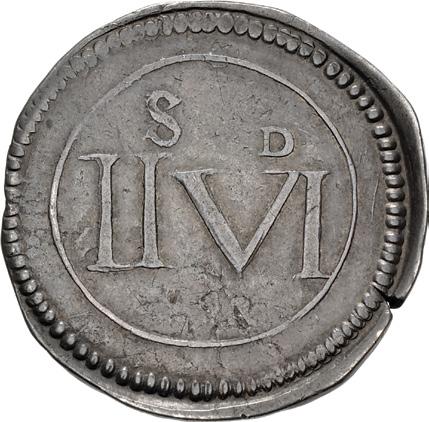
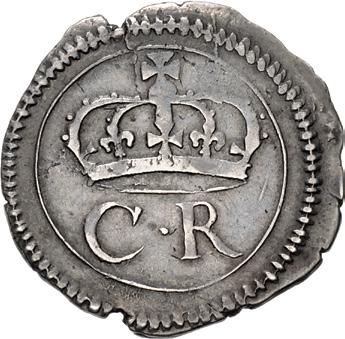
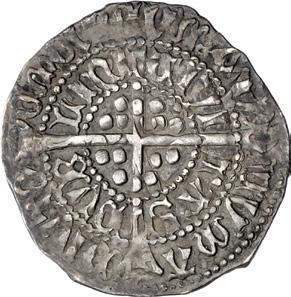
Issues of the Lord Justices
5624891. IRELAND, The Great Rebellion. Issues of the Lords Justices. 1642-1649. AR Halfcrown (36mm, 14.75 g, 2h). “Ormonde Money” issue. Struck 1643-1644. Large C • R; crown above; all within linear and beaded border / Large II VI; S D above; all within linear and beaded border. D&F 296; SCBC 6545. Toned. Choice VF. Evenly struck on a broad flan. $3250
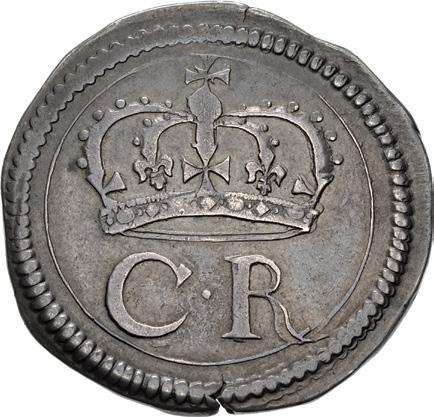
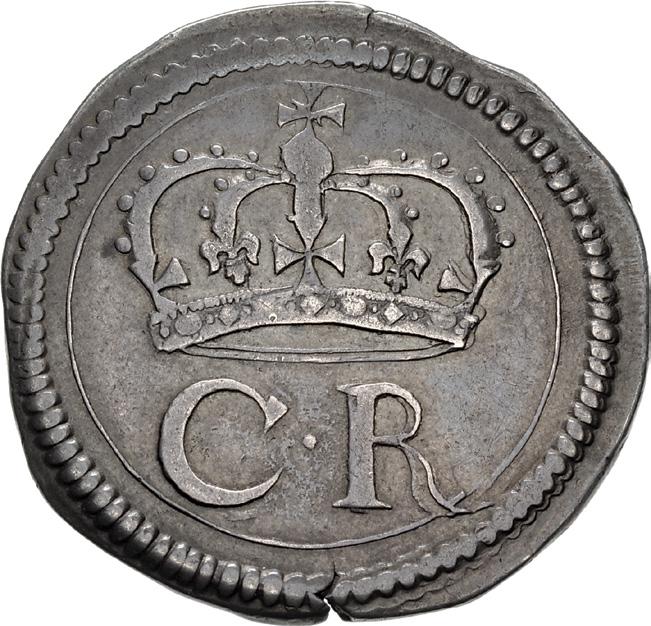
Ex H.M. Lingford Collection, purchased from Spink, November 1943.
5624892. IRELAND, The Great Rebellion. Issues of the Lords Justices. 1642-1649. AR Shilling (29mm, 5.82 g, 1h). “Ormonde Money” issue. Struck 1643-1644. Large C • R; crown above; all within linear and beaded border / Large X II; D above; all within linear and beaded border. D&F 297; SCBC 6546. Toned, edge split, minor mark. Good VF. Struck on a broad flan. $1450
97
Ě ⍴Ěѝ
GENERAL BIBLIOGRAPHY
Please refer to our online bibliography at www.cngcoins.com for a complete listing of specialized and general references used, and abbreviations.
ANCIENT
Banti A. Banti. I grandi bronzi imperiali. 9 Vols. Florence. 1983-1986.
BMC Various authors. Catalogue of Greek Coins in the British Museum. 29 Vols. London. 1873-1927.
BMCRE H. Mattingly et al. Coins of the Roman Empire in the British Museum 6 Vols. London. 1932-1962.
BN J. Giard. Bibliothèque Nationale, catalogue des monnaies de l’empire romain. 3 Vols. Paris. 1976-present. Bodenstedt F. Bodenstedt. Die Elektronmünzen von Phokaia und Mytilene. Tübingen. 1981. Boehringer E. Boehringer. Die Münzen von Syrakus. Berlin and Leipzig. 1929. Bopearachchi O. Bopearachchi. Monnaies Gréco-Bactriennes et Indo-Grecques. Paris. 1991. Depeyrot G. Depeyrot. Les monnaies d’or (Diocletian à Constantin I, Constantin II à Zenon). Wetteren. 1995-1996. Calicó X. Calicó. The Roman avrei catalogue. 2 Vols. Barcelona. 2002.
CNS R. Calciati. Corpus Nummorum Siculorum: la monetazione di bronzo. 3 Vols. Italy. 1983-87. Crawford M. Crawford. Roman Republican Coinage. 2 Vols. Cambridge. 1974.
CRI D. Sear. The History and Coinage of the Roman Imperators 49-27 BC. London. 1998. Fischer-Bossert W. Fischer-Bossert. Chronologie der Didrachmenprägung von Tarent 510-280 v.Chr. Berlin 1999. Flament C. Flament. Le monnayage en argent d’Athènes. De l’époque archaïque à l’époque hellénistique (c. 550-c. 40 av. J.-C.). Lovainla-Neuve. 2007.
Hendin D. Hendin. Guide to Biblical Coins. 6th Edition. New York. 2021.
HN Italy N.K. Rutter, ed. Historia Numorum. Italy. London. 2001.
Kumar S. Kumar. Treasures of the Gupta Empire. A Catalogue of Coins of the Gupta Dynasty. San Francisco. 2017.
Meshorer Y. Meshorer. A Treasury of Jewish Coins from the Persian Period to Bar Kokhba Jerusalem. 2001.
MK R. Göbl. Münzprägung des Kušanreiches. Vienna. 1984.
MIR R. Göbl, et al. Moneta Imperii Romani. 5 Vols. Vienna. 1984-present.
Price M.J. Price. The Coinage in the Name of Alexander the Great and Philip Arrhidaeus London. 1991.
Prieur M. Prieur. A type corpus of the Syro-Phoenician tetradrachms and their fractions from 57 BC to AD 253. Lancaster. 2000.
RIC H. Mattingly, et al. The Roman Imperial Coinage. 10 Vols. London. 1923-1994.
RPC A. Burnett, et al. Roman Provincial Coinage 3 Vols and 2 Suppls. London and Paris. 1992-present.
RSC D. Sear, et al. Roman Silver Coins. 5 Vols. London. 1978-1987.
SC A. Houghton & C. Lorber. Seleucid Coins: A Comprehensive Catalog. 2 Parts. Lancaster. 2002 and 2008.
Sellwood D. Sellwood. An Introduction to the Coinage of Parthia. 2nd edition. London. 1980.
SNG ANS Sylloge Nummorum Graecorum, American Numismatic Society. New York. 1969-present.
SNG BM Black Sea Sylloge Nummorum Graecorum, British Museum, 1: The Black Sea London. 1993.
SNG Copenhagen Sylloge Nummorum Graecorum, Danish National Museum. Copenhagen. 1942-1979.
SNG BN Sylloge Nummorum Graecorum, Cabinet des Médailles, Bibliothèque Nationale. Paris. 1993-2001.
SNG Kayhan Sylloge Nummorum Graecorum, Turkey 1: The Muharrem Kayhan Collection Istanbul. 2002.
SNG Levante Sylloge Nummorum Graecorum, Switzerland; E Levante - Cilicia. Bern. 1986.
SNG Lloyd Sylloge Nummorum Graecorum, Lloyd Collection. London. 1933-1937.
SNG Lockett Sylloge Nummorum Greacorum, Lockett Collection London. 1938-1949.
SNG München Sylloge Nummorum Graecorum, München Staatlische Münzsammlung. Berlin. 1968-present.
SNG von Aulock Sylloge Nummorum Graecorum, Sammlung Hans Von Aulock. Berlin. 1957-1968.
Starr C. Starr. Athenian coinage 480-449 BC. London. 1970.
Svoronos J. Svoronos. Τὰ νομίσματα τοῦ κράτους τῶν Πτολεμαίων. Athens. 1904-08.
Traité E. Babelon. Traité des monnaies grecques et romaines 9 Vols. Paris. 1901-1932.
Weidauer L. Weidauer. Probleme der frühen Elektronprägung. Fribourg. 1975.
BYZANTINE, MEDIEVAL, WORLD, and BRITISH
Album S. Album. A Checklist of Popular Islamic Coins. 3rd ed. Santa Rosa. 2011.
Biaggi E. Biaggi. Monete e zecche medievali italiane dal seculo VIII al seculo XV. Torino. 1992.
Bitkin V. Bitkin. Composite Catalogue of Russian Coins. 2 vols. Kiev. 2003.
BMC Vandals W. Wroth. Catalogue of the Coins of the Vandals, Ostrogoths and Lombards and of the Empires of Thessalonica, Nicaea and Trebizond in the British Museum. London. 1911. (Reprinted as Western and Provincial Byzantine Coins in the British Museum.)
CIS S. Goron and J.P. Goenka. The Coins of the Indian Sultanates. New Delhi. 2001.
CNI Corpus Nummorum Italicorum. 20 Vols. Rome. 1910-1943.
Davenport J.S. Davenport. Various works on European crowns.
ESC H.A. Seaby & P.A. Rayner. The English Silver Coinage from 1649. London. 1992.
Friedberg R. Friedberg. Gold Coins of the World. 8th ed. Clifton. 2009.
KM C.L. Krause & C. Mishler. Standard Catalogue of World Coins Krause Publications. Iola.
Levinson R.A. Levinson. The Early Dated Coins of Europe. Clifton, NJ. 2007.
Lunardi G. Lunardi. Le monete delle repubblica di genova. Genoa. 1975.
MEC P. Grierson & M. Blackburn. Medieval European Coinage Cambridge. 1986.
MIB W. Hahn. Moneta Imperii Byzantini. 3 Vols. Vienna. 1973-81.
MIBE W. Hahn and M.A. Metlich. Money of the Incipient Byzantine Empire. Vienna. 2000.
MIR Various. Monete Italiane Regionali. 5 Vols. Pavia. ND.
NM G. Depeyrot. Le numéraire mérovingien. 5 vols. Wetteren. 1998-2001.
North J.J. North. English Hammered Coinage 2 Vols. London. 1963, 1975.
SB D. Sear, et al. Byzantine Coins and Their Values. 2nd edition. London. 1987.
SCBC Standard Catalogue of British Coins. London. Annually.
SCBI Various authors. Sylloge of the Coins of the British Isles.
98
The handbook of Greek CoinaGe SerieS by Oliver
D.
Hoover
More than three decades have passed since David Sear published Greek Coins & Their Values, his revision of Gilbert Askew’s A Catalogue of Greek Coins published by B. A. Seaby in 1951. Since then, the field of ancient numismatics and the hobby of collecting ancient coins have changed so much that now Greek Coins & Their Values would require a complete revision to include all of the most current numismatic information available, list the many new types and varieties unknown to Sear, and determine an approximate sense of rarity for all of these issues. In order to encompass this new material and create a viable reference for the beginning and specialized collector, such a handbook would have to be more than the two volumes which Sear found necessary. As a result, Classical Numismatic Group is publishing The Handbook of Greek Coinage Series, written by Oliver D. Hoover, in a series of 13 volumes, each covering a specified area of Greek coinage with the first being The Handbook of Syrian Coins: Royal and Civic Issues, Fourth to First Centuries BC (Volume 9 in the series). This series is designed to aid the user in the quick, accurate, and relatively painless identification of Greek coins, while providing a cross-reference for each entry to a major work, which will allow the inquirer to pursue more in-depth research on the subject. The subject-matter of each volume is arranged chronologically for royal issues, and regionally for the civic issues; within each region, cities are listed directionally, depending on the region. For those rulers or cities that issued coins concurrently in all three metals, these issues will be arranged in the catalog with gold first, followed by silver, and then bronze; each metal is arranged by denomination, largest to smallest. Known mints for the royal coinage are listed below the appropriate type, making an easy search for a specific mint. Each entry will include a rarity rating based on the frequency with which they appear in publications, public and private collections, the market, and/or are estimated to exist in public or private hands. No valuations are listed, since such values are generally out of date by the time of publication. An online valuation guide at will allow interested individuals the opportunity to gauge the market, and reduce the need for repeated updates of this series. Whether one purchases the entire set for their reference library, or the individual volume pertaining to one’s area of specialization, The Handbook of Greek Coinage Series should provide a useful staging-point from which collectors and interested scholars can pursue their research and interests.
Hoover, Oliver D. Handbook of Coins of Macedon and Its Neighbors. Part I: Macedon, Illyria, and Epeiros, Sixth to First Centuries BC [The Handbook of Greek Coinage Series, Volume 3]. 2016. lxxviii and 431 numbered pp. Hardbound. (GR332) $65
Hoover,
4]. 2014. lxxvii + 563 numbered pages (GR333) $65
Hoover,
. Fifth Century BC to First Century AD. [The Handbook of Greek Coinage Series, Volume 12]. 2013. lxxxiv + 389 numbered pages. (GR341) $65
Please see our website for additional volumes.
99
Oliver D. Handbook of of Coins of Northern and Central Greece: Achaia Phthiotis, Ainis, Magnesia, Malis, Oita, Perrhaibia, Thessaly, Akarnania, Aitolia, Lokris, Phokis, Boiotia, Euboia, Attica, Megaris, and Corinthia. [The Handbook of Greek Coinage Series, Volume
Oliver D. handbook of CoinS of bakTria and anCienT india Including Sogdiana, Margiana, Areia, and the Indo-Greek, Indo-Skythian, and Native Indian States South of the Hindu Kush
100
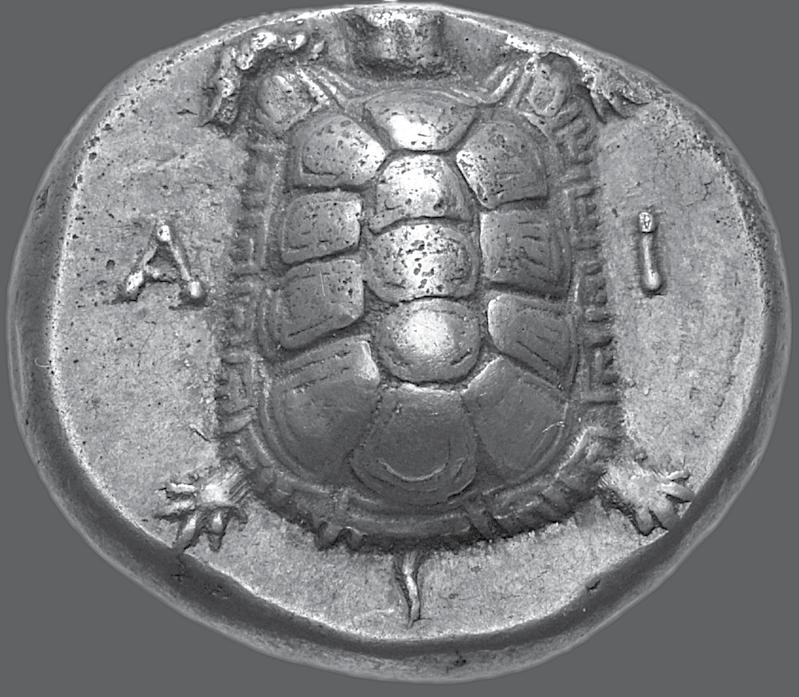
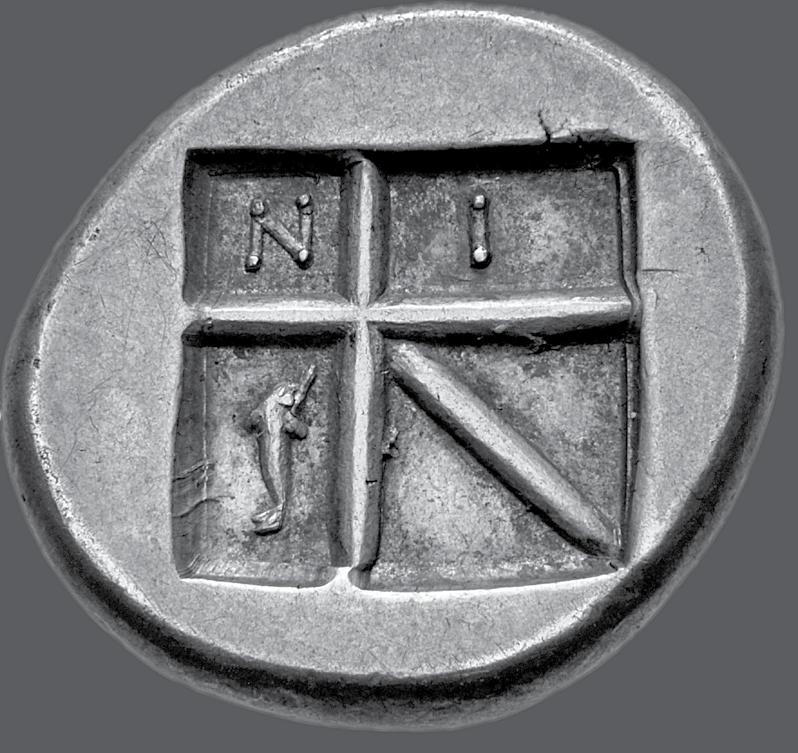
CNG Classical Numismatic Group, LLC Classical Numismatic Group, LLC (PA License Number AY002406) Jeffrey B. Rill (PA License No. AU006206); Brian Callahan (PA License No. AU005870) US OFFICE PO Box 479, Lancaster, PA 17608-0479 Phone (717) 390.9194 Fax (717) 390.9978 UK OFFICE 20 Bloomsbury Street, London WC1B 3QA, UK Phone +44.20.7495.1888 Fax +44.20.7499.5916 EU OFFICE 64A Noordeinde The Hague, Netherlands ZH 2514 GK EMAIL & WEBSITE Email cng@cngcoins.com Website www.cngcoins.com
