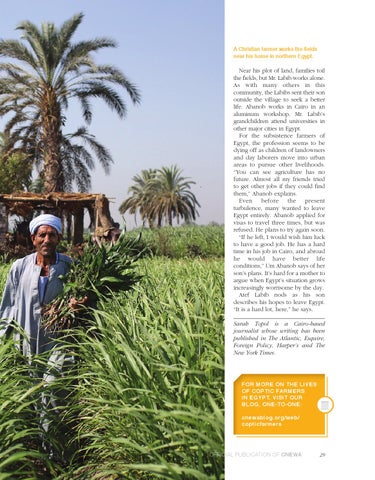
A Christian farmer works the fields near his home in northern Egypt.
Near his plot of land, families toil the fields, but Mr. Labib works alone. As with many others in this community, the Labibs sent their son outside the village to seek a better life. Abanob works in Cairo in an aluminum workshop. Mr. Labib’s grandchildren attend universities in other major cities in Egypt. For the subsistence farmers of Egypt, the profession seems to be dying off as children of landowners and day laborers move into urban areas to pursue other livelihoods. “You can see agriculture has no future. Almost all my friends tried to get other jobs if they could find them,” Abanob explains. Even before the present turbulence, many wanted to leave Egypt entirely. Abanob applied for visas to travel three times, but was refused. He plans to try again soon. “If he left, I would wish him luck to have a good job. He has a hard time in his job in Cairo, and abroad he would have better life conditions,” Um Abanob says of her son’s plans. It’s hard for a mother to argue when Egypt’s situation grows increasingly worrisome by the day. Atef Labib nods as his son describes his hopes to leave Egypt. “It is a hard lot, here,” he says. Sarah Topol is a Cairo-based journalist whose writing has been published in The Atlantic, Esquire, Foreign Policy, Harper’s and The New York Times.
FOR MORE ON THE LIVES OF COPTIC FARMERS IN EGYPT, VISIT OUR BLOG, ONE-TO-ONE:
__ __ __ __ __
cnewablog.org/web/ copticfarmers
OFFICIAL PUBLICATION OF CNEWA
29