Founded by the Holy Father, CNEWA shares the love of Christ with the churches and peoples of the East, working for, through and with the Eastern churches.
Volume 52 Number 1
CNEWA connects you to your brothers and sisters in need. Together, we build up the church, affirm human dignity, alleviate poverty, encourage dialogue — and inspire hope.
Publisher
Msgr. Peter I. Vaccari
Executive Editor
Michael J. La Civita
Editorial
Laura Ieraci, Editor
David Aquije, Contributing Editor
Barb Fraze, Contributing Editor Elias D. Mallon, Contributing Editor
Creative
Timothy McCarthy, Digital Assets Manager
Paul Grillo, Senior Graphic Designer
Samantha Staddon, Graphic Designer
Elizabeth Belsky, Copy Writer
Officers
Most Rev. Ronald A. Hicks, Chair and Treasurer
Msgr. Peter I. Vaccari, Secretary Tresool Singh-Conway, Chief Financial Officer
Editorial Office
220 East 42nd St, New York, NY 10017 1-212-826-1480; www.cnewa.org
It’s a question many of us are asking these days. You believe in unity, not division. Peace, not bombs. Love, not violence. You believe in the God-given dignity of every person, and you stand with those who protect the vulnerable.
•
Yet in this endlessly fractured — and fractious — world, it seems as if we’re all searching for our flock. Our people. Our communitas.
Your monthly gift to CNEWA qualifies you to join ours: Communitas CNEWA, a special program for our most devoted supporters with like minds, eager to be a part of a worldwide network of Catholic aid.
• In an era of cruelty and division, become a part of something greater. Join today. cnewa.org/donate
Connections to CNEWA’s world
CNEWA Welcomes New Chair
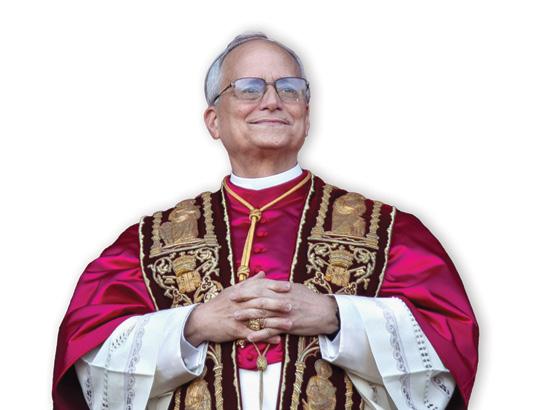
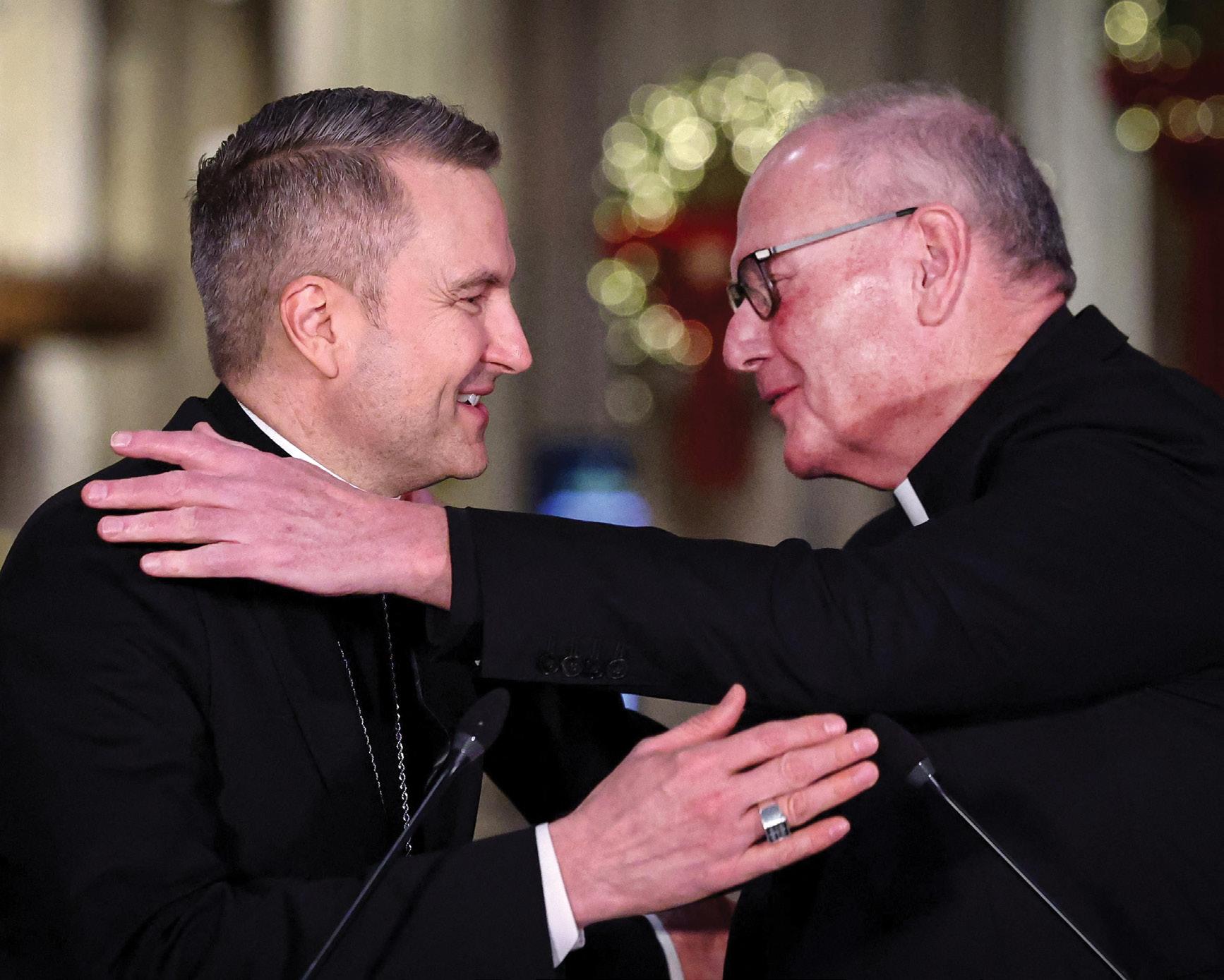
CNEWA welcomes Archbishop Ronald A. Hicks as the new chair and treasurer, ex officio, of its international board of trustees, a role he assumed when he became archbishop of New York. The archbishop took possession of his see during his installation Mass, 6 February, succeeding Cardinal Timothy Dolan, who served as the archbishop for 17 years.
Msgr. Peter I. Vaccari, CNEWA president, thanked Cardinal Dolan and prayed the Blessed Mother would “bless both men as they continue to witness the Gospel as shepherds of his sheep.”
Archbishop Hicks was born on 4 August 1967, in the Chicago suburb of Harvey and grew up in South Holland, Illinois. After priestly ordination, he served five years in El Salvador as regional director of Nuestros Pequeños Hermanos, a network of homes caring for more than 3,400 orphaned and abandoned children in nine Latin American and Caribbean countries.
On 1 January 2015, he was named vicar general of the Archdiocese of Chicago and, three years later, Pope Francis appointed him auxiliary bishop of Chicago, where he served until he assumed the role of shepherd in the Diocese of Joliet in mid-2020.
Ad multos annos!
Prayers for the Middle East
Msgr. Vaccari issued a statement after receiving news of the IsraeliU.S. strikes on Iran on 28 February and Iran’s subsequent strikes throughout the Arab world, praying for “a return to dialogue, diplomacy, justice and peace.”
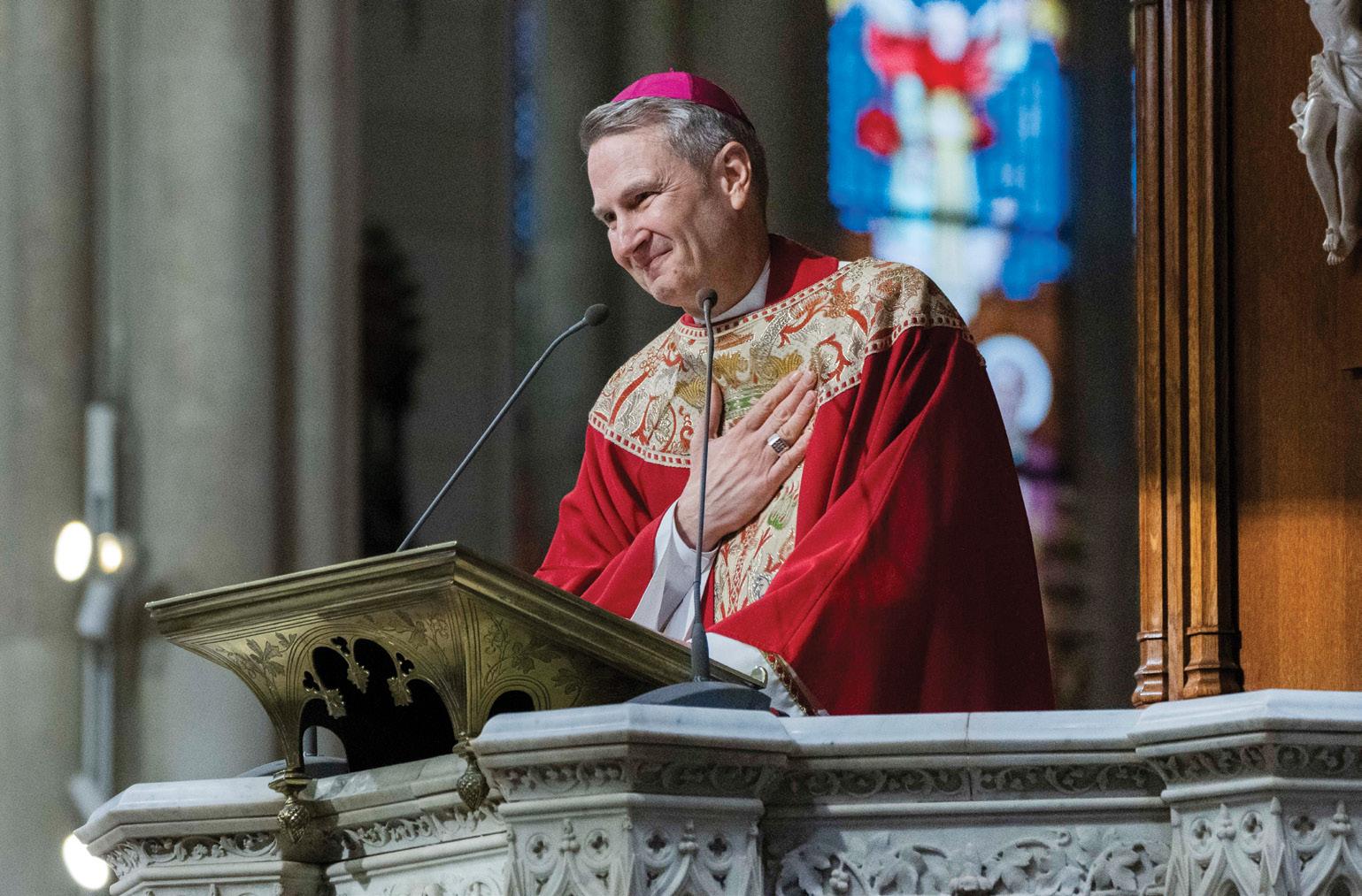
Archbishop Ronald A. Hicks addresses the congregation during his installation Mass as the 11th archbishop of New York at St. Patrick’s Cathedral, 6 February.
Msgr. Vaccari spoke to each regional director at CNEWA offices in the Middle East, namely in Beirut, Jerusalem and Amman, to inquire about the situation on the ground and to share his solidarity, prayer and concern for them, their families and the people they serve.
“Highest immediate priority is the safety of our staff and their families,” he said.
Msgr. Vaccari said the “great and heroic work” carried out on the ground by CNEWA’s regional teams, who are “there for everyone,” are “extraordinary testaments, living witness” to the agency’s mission.
“Our teams throughout the region work long hours on behalf of the churches and peoples whom we are committed to serve,” he said. “Their lives and schedules are the living translation of the Gospel question, ‘Who is my neighbor?’ ”
CNEWA Support to Palestine
As CNEWA’s support for the humanitarian and pastoral work of the churches in Palestine and Israel continues, a report issued by the regional director of CNEWA’s Jerusalem office, Joseph Hazboun, indicates that CNEWA distributed $3 million across 93 projects in Palestine and Israel in 2025, a $500,000 increase over 2024.
In 2025, 7 percent of the funds were channeled to projects in Israel, while 93 percent supported work in Gaza and the West Bank. The latter was distributed as food assistance, including fresh vegetables, drinking water, nonfood essentials, psychosocial support and health care in Gaza, and employment, medical and emergency tuition assistance in the West Bank.
Most of these funds were raised from CNEWA’s North American benefactors and donors in Europe and the United Kingdom, all
committed to supporting the work of the church in the Holy Land.
Food Insecurity in Ethiopia
Up to 15 percent of Ethiopians are expected to face acute food insecurity at crisis or emergency levels between April and July of this year, according to reports issued by U.N. agencies. Argaw Fantu, who directs CNEWA operations in Ethiopia, reports malnutrition rates are “alarmingly high,” and emergency conditions are emerging in certain areas, including regions still suffering from the 2020-2023 drought.
Ongoing conflict, insecurity, economic decline and shortfalls in international aid are also drivers of the pending crisis, he adds. Nevertheless, CNEWA helps support the church’s response, addressing food insecurity, malnutrition and the educational needs of affected children, reaching nearly 23,000 people last year — a fraction, he admits.
To help the church reach more families in desperate need throughout Ethiopia, visit cnewa.org/what-we-do/ help-us-rush-help
The Rise of Global Fascism
Cardinal Christoph Schönborn, archbishop emeritus of Vienna and acting ordinary for Byzantine Catholics in Austria, spoke of the global rise of fascism during a 90-minute meeting with representatives of nine different aid agencies, including CNEWA, on 29 January in Vienna.
The cardinal, who hails from a prominent Central European family long engaged in the region’s cultural, political and socioeconomic affairs,
noted how intolerance targeted the church and its leaders, pointing to a painting in his residence vandalized on 6 October 1938, by Nazi youth who intended to murder then-Cardinal Theodor Innitzer of Vienna. The cardinal escaped. However, one month later Nazi leaders coordinated a night of terror throughout Austria, Germany and Sudetenland — what has become known as Kristallnacht — that torched 1,400 synagogues and vandalized countless Jewish businesses and homes.
Msgr. Vaccari, Tresool Singh-Conway, chief financial officer, and Brian McGinley, director of development, were among those present for the reception during a conference on Catholic aid to the churches of Central and Eastern Europe.
CNEWA Marks 100 Years!
CNEWA launched its centennial year on 1 December 2025, with its annual Healing & Hope Gala, raising more than $250,000 in support of CNEWA’s mission.
Michèle Burke Bowe, ambassador of the Sovereign Order of Malta to Palestine and president of Holy Family Hospital of Bethlehem Foundation, which supports maternity care initiatives in the West Bank, received CNEWA’s Faith & Culture Award.
Metropolitan Borys Gudziak, archbishop of the Ukrainian Greek Catholic Archeparchy of Philadelphia, was the guest of honor.
This December, CNEWA’s chair, Archbishop Hicks, will celebrate a centennial Mass at St. Patrick’s Cathedral in New York City on Sunday, 13 December; a reception will follow. Two days later, CNEWA will hold its annual Healing & Hope Gala at the Plaza Hotel. Frà John Dunlap, prince and 81st grand master of the Sovereign Military Order of Malta, will be the guest of honor. Sister Raffaella Petrini, F.S.E., president of the Pontifical Commission for Vatican City State and president of the Governorate of Vatican City State, will receive CNEWA’s Faith & Culture Award.
Stay tuned for more details or visit: cnewa.org/events
Grant Monies Received
CNEWA received a $50,000 grant toward the Italian Hospital in Jordan from the Raskob Foundation for Catholic Activities. We are grateful to our donors, whose generosity brings the mission of CNEWA to life. To learn more about CNEWA’s grant program, contact Bradley Kerr at bkerr@cnewa.org.
A CENTURY OF HEALING AND HOPE
Crisis. Formation. Explosion.
by Michael J. La Civita
From the editors: This edition of ONE launches a special series of four articles highlighting CNEWA’s centennial. The series — which begins with the fallout throughout Europe and the Middle East after World War I and the establishment of the agency — will be assembled into a special commemorative book entitled, “A Century of Healing and Hope,” and published in 2027.
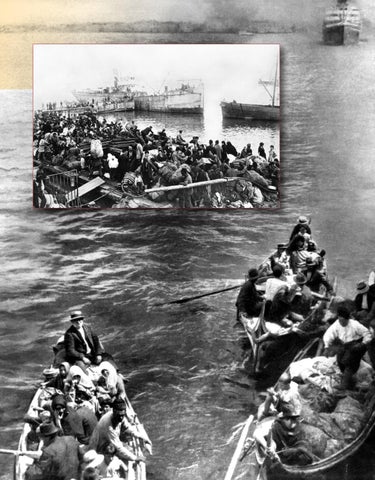
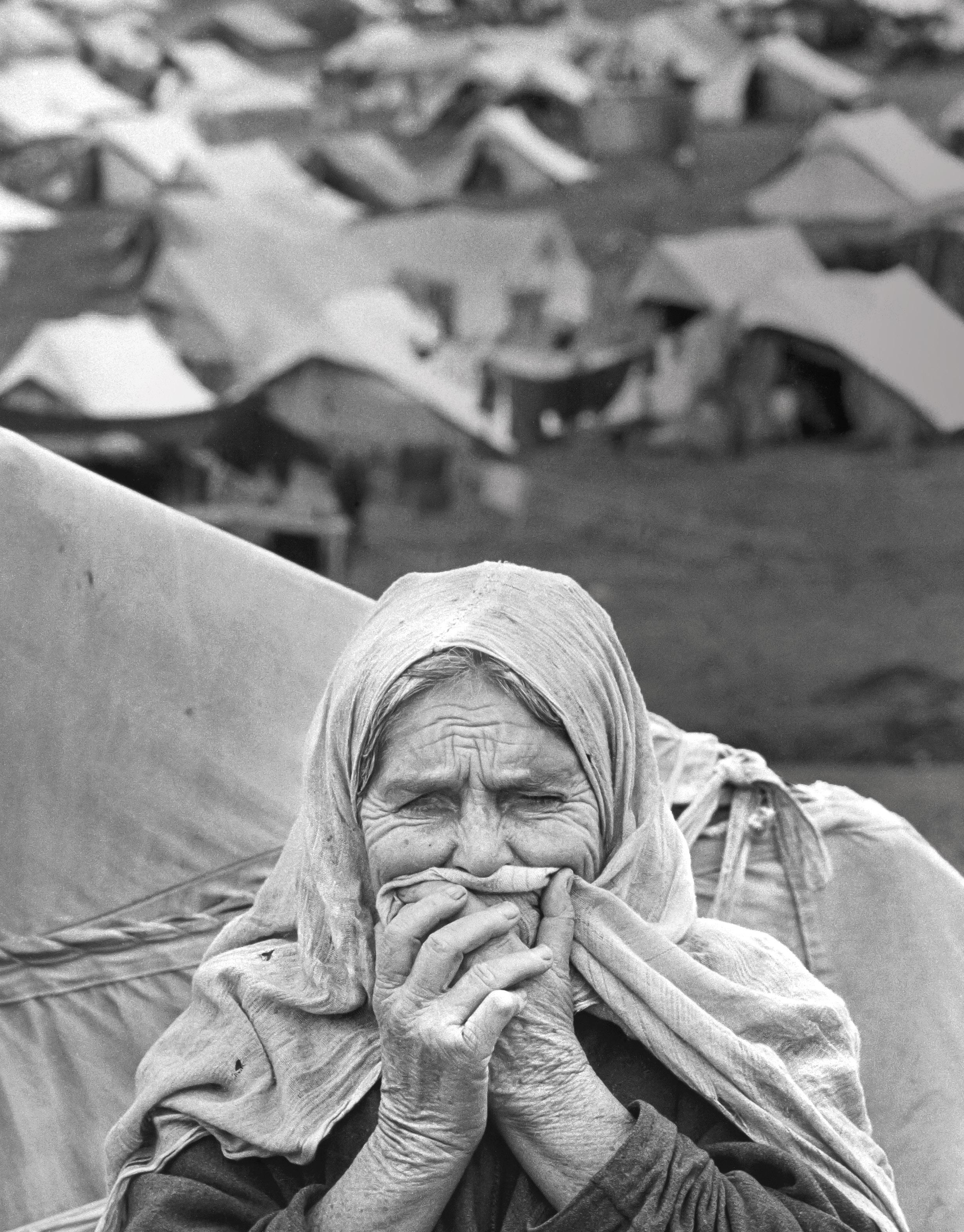
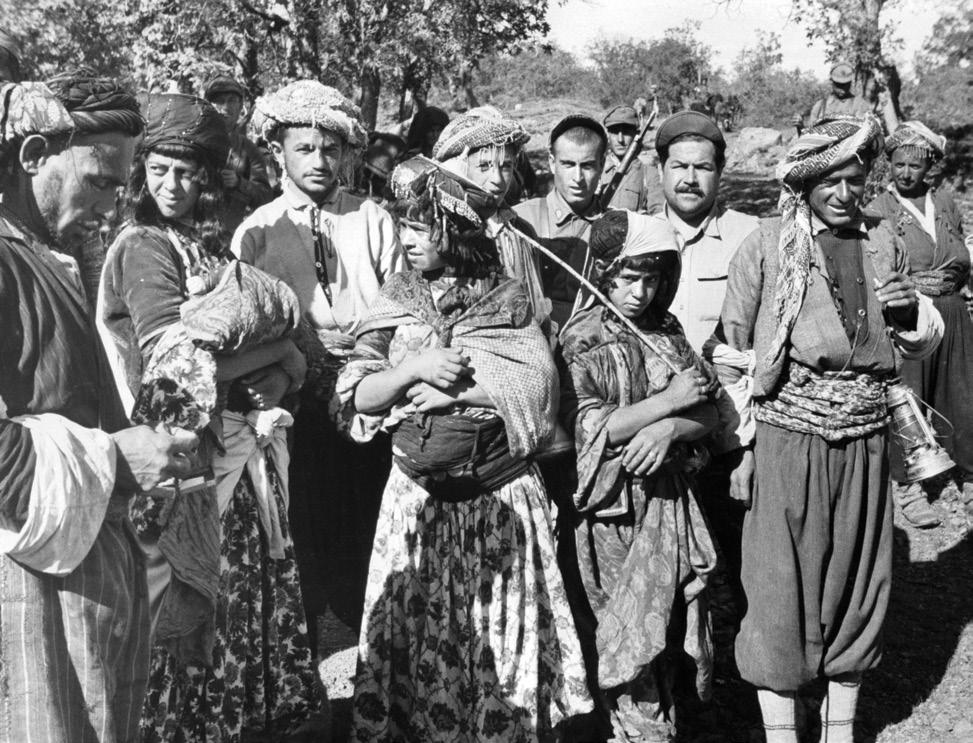
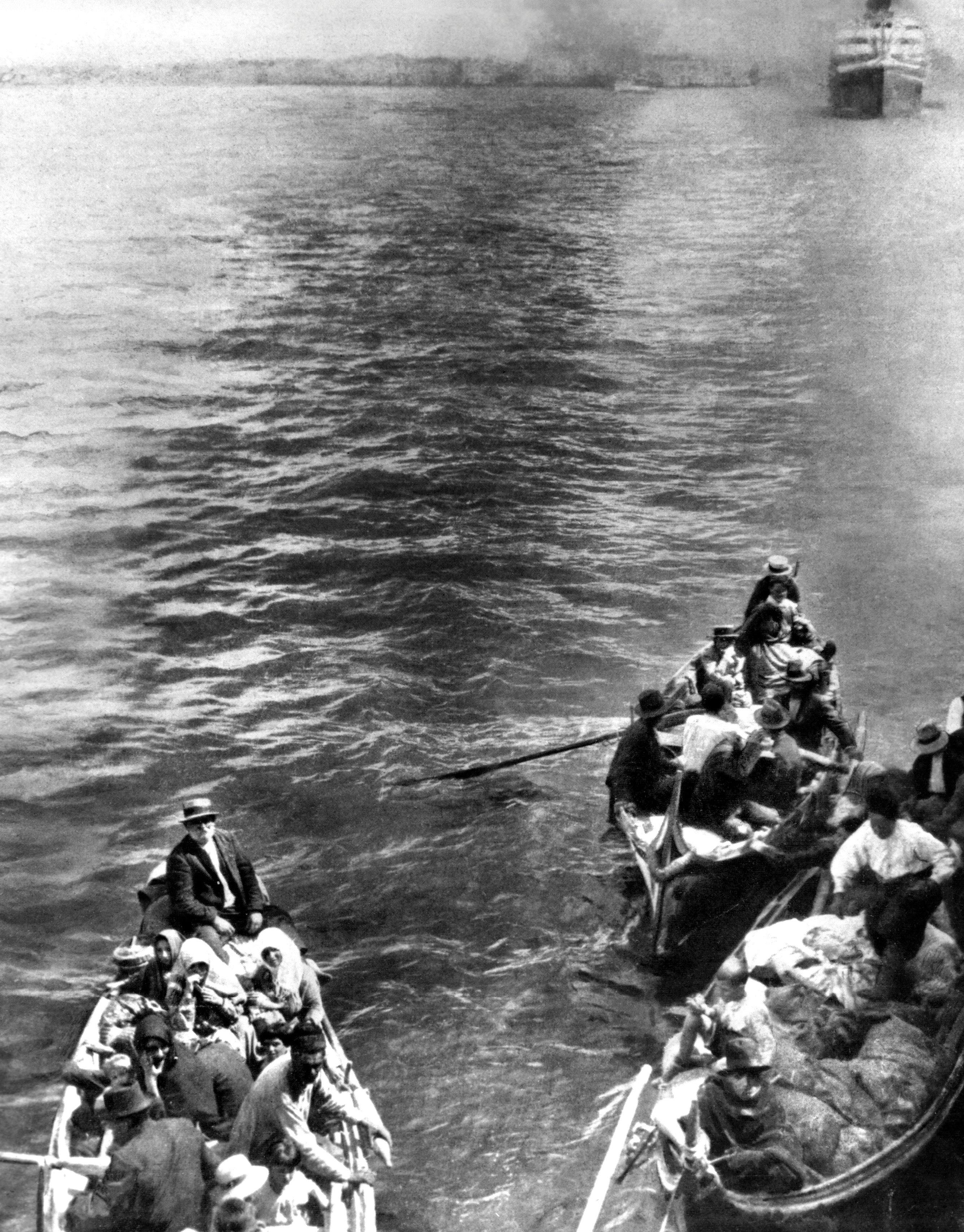
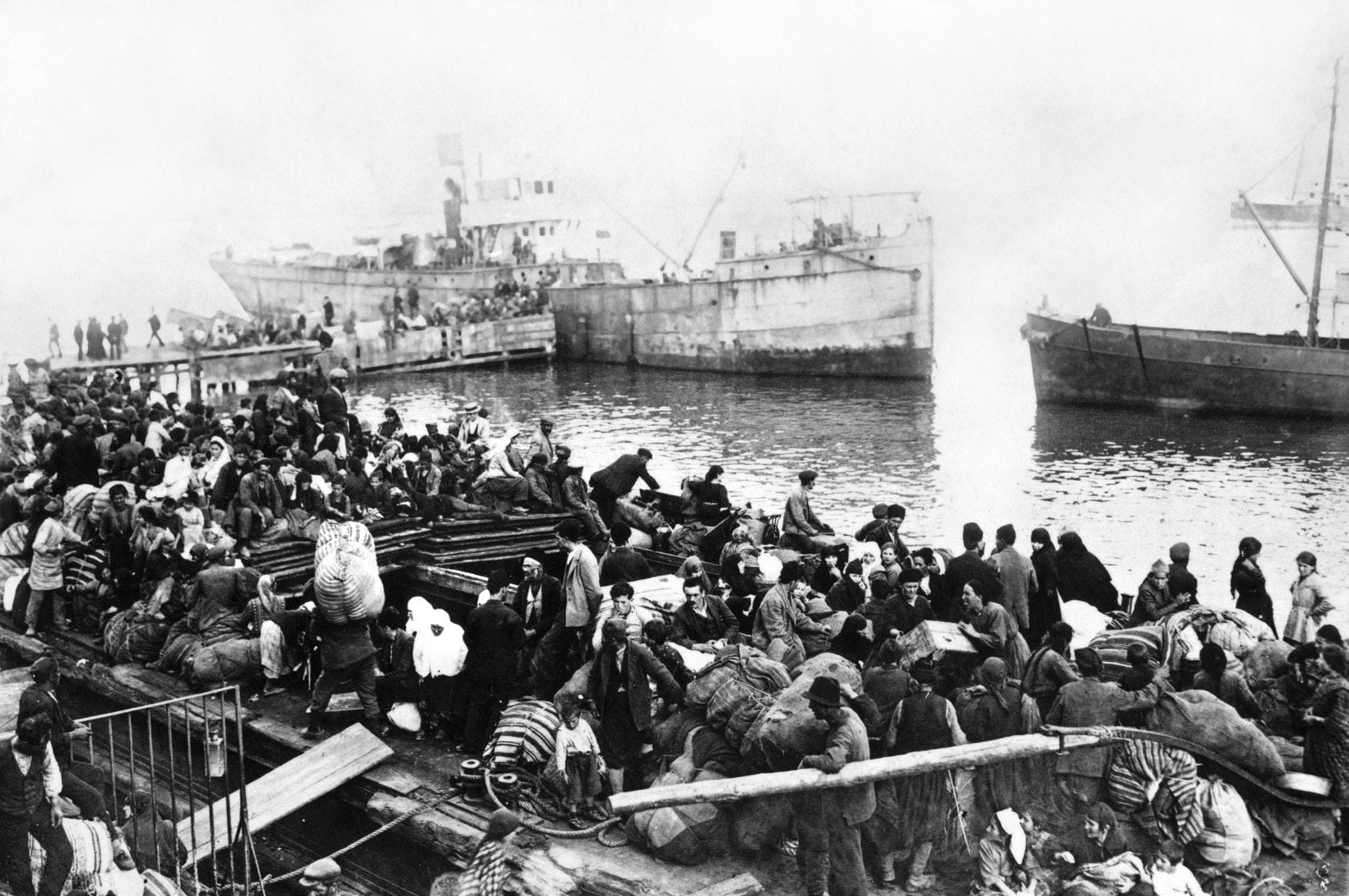
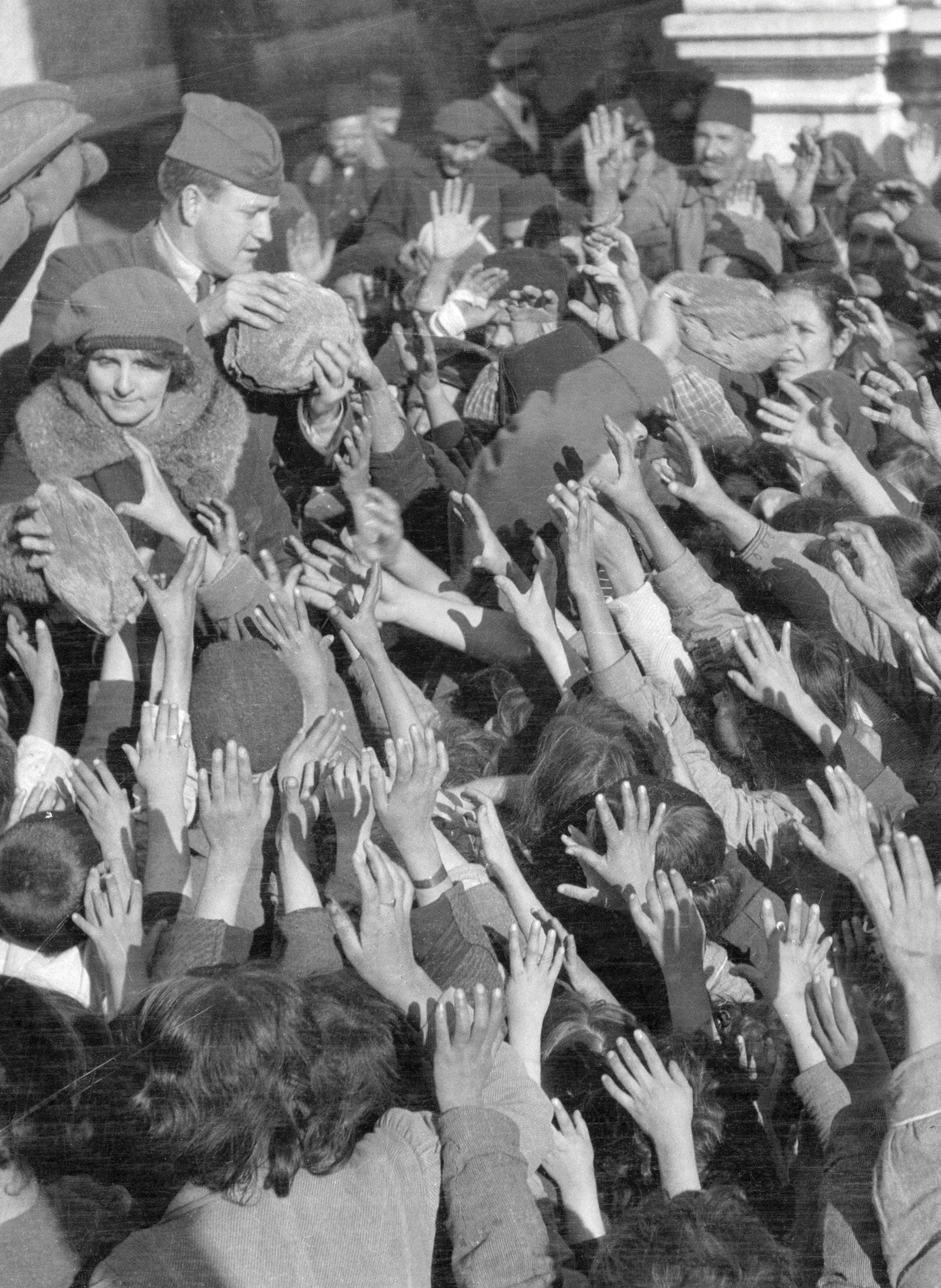
The transition of the Ottoman Empire to the Republic of Turkey included the ethnic cleansing of its territories, beginning with the expulsion and killing of the Armenian and Assyro-Chaldeans during World War I, followed by the deportation of the Kurds in the 1920s, above, and concluded with the flight of its Greeks during the Greco-Turkish war, 1919-1922, at right.
Catholic Near East Welfare Association has been building community for 100 years. This fellowship spans continents; bridges divisions in age, caste, class, color, income, language, politics, race and religion; and joins generations from among the living and from those who have gone before us marked with the sign of faith.
United in purpose, this CNEWA community advances the common good through the men and women of the Eastern churches: priests, religious and laity. Since their founding by the apostles, these communities of faith have formed the backbone and provided the lifeblood for so many who seek healing and hope with open hearts and minds throughout the Middle East, Northeast Africa, India and Eastern Europe.
This CNEWA fellowship has made a powerful impact on the people served by the Eastern churches, walking side by side with them in times troubled and tranquil; praying with them when they were attacked; comforting them when they grieved; feeding them when they hungered; bandaging them when they bled; sheltering them when they had lost all; rejoicing with them in life’s all too infrequent moments of joy and happiness.
Fueled by faith, vision and purpose, CNEWA’s mission is enlivened thanks to the prayerful generosity of generations of friends and benefactors, who without fail have responded — for 100 years — to answer that question put to Jesus, “And who is my neighbor?”
I. The early years:
CNEWA is formed and reformed, 1917-1941
The story of CNEWA begins with the collapse of the Austro-Hungarian, tsarist Russian and Ottoman Turkish empires provoked by World War I. Much of southwest Asia — the “Near East” in the English of the time — and Central and Eastern Europe was caught up in the economic, humanitarian and sociopolitical tumult that followed.
More than a million ethnic Greeks — expelled from their homes in communities founded in Asia Minor by their ancestors more than 2,000 years earlier — sought refuge in Istanbul. Those ethnic Armenian and Assyro-Chaldean Christians, who had survived the genocidal death marches that followed their expulsion from their homes in 1915, sought refuge in what is now Syria, Lebanon and Palestine. Revolution, civil
war and famine drove millions from the devastated lands of the former tsars to havens such as Berlin, Istanbul, Paris and Prague.
At the time considered the largest violent displacement of humanity ever, this postwar turmoil impacted the global Catholic community and moved its leaders and members to respond. They rallied support for the humanitarian and pastoral efforts directed by Pope Benedict XV (1914-1922) and Pope Pius XI (19221939), such as the Papal Relief Mission to Russia. Many of those who supported these papal initiatives were Catholics in the United States, including the founder of the Franciscan Friars of the Atonement, the Rev. Paul Wattson, a zealous advocate of church unity.
Moved by the pope’s appeals for help, Father Paul encouraged his supporters, mainly in the pages of his monthly magazine, The Lamp, to fund Greek Catholic Bishop George Calavassy and English military chaplain Msgr. Richard Barry-Doyle. Together, they worked among the tens of thousands of Armenians, AssyroChaldeans, Greeks and Russian refugees inundating Istanbul, which lies at the crossroads of Asia and Europe.
In December 1924, Father Paul, Msgr. Barry-Doyle and a group of prominent U.S. Catholic laymen established in Philadelphia “the Catholic Near East Welfare Association” to assist Bishop Calavassy’s work with the displaced Christians of the “Near East.” Msgr. BarryDoyle stormed concert halls across the country — including Manhattan’s Carnegie Hall — with his “Call of the East,” entertaining audiences eager for news from the Old World and raising awareness and funds to help CNEWA address the needs of the displaced, particularly of orphaned children.
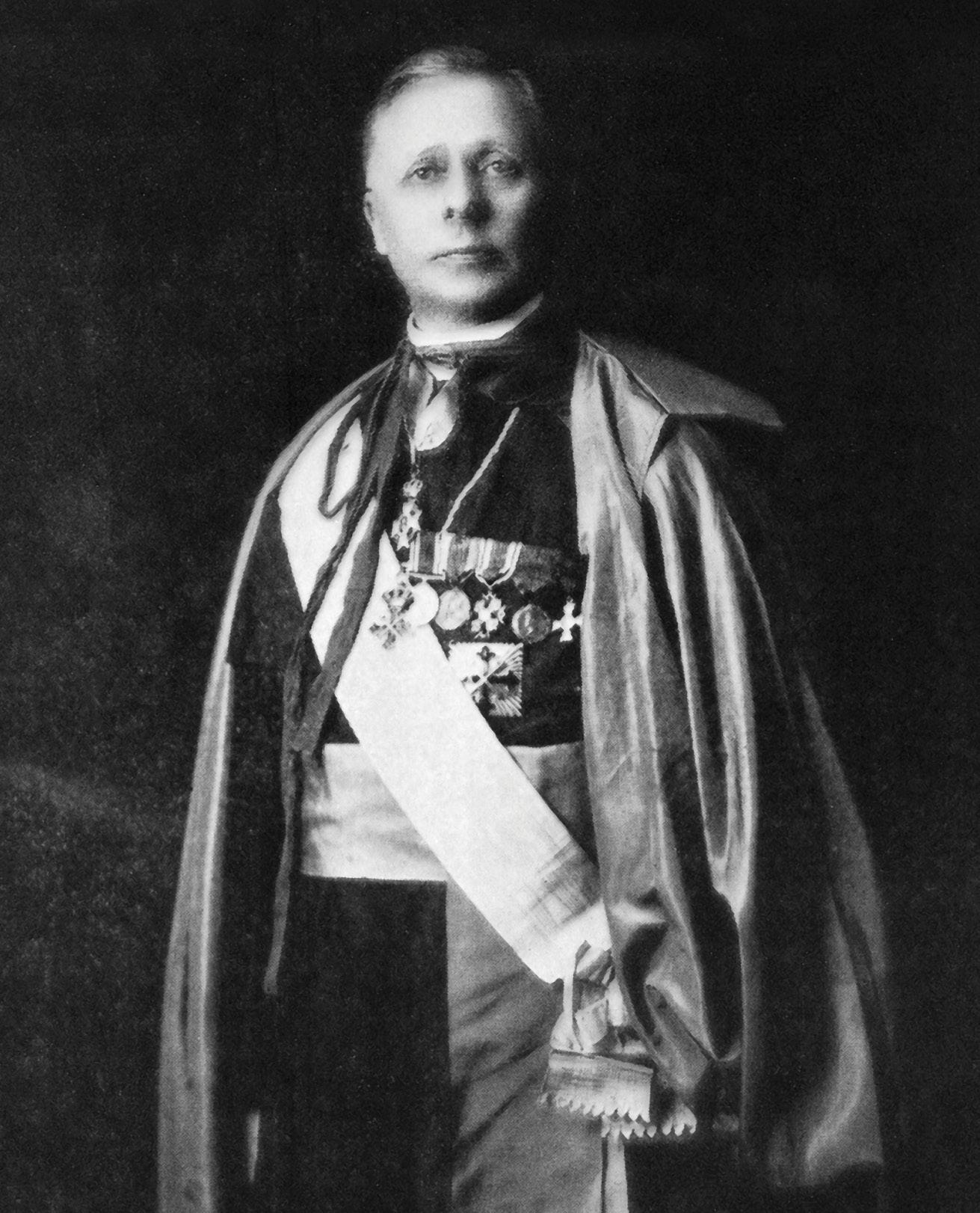
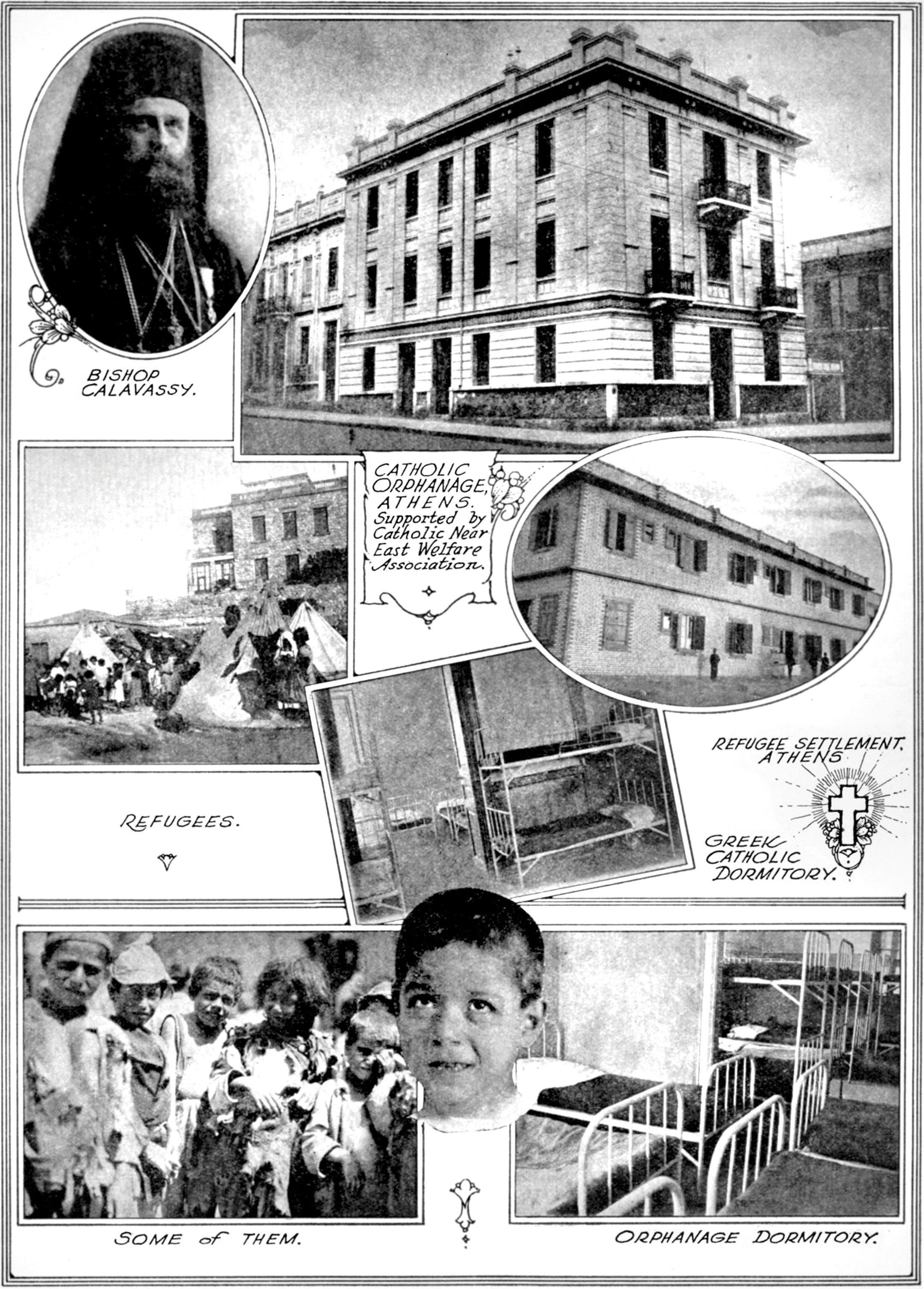
Left, Msgr. Richard Barry-Doyle fundraised extensively for CNEWA. Opposite, a page from “The Papal Annual,” which CNEWA published in 1927, illustrates the agency’s support for the works in Athens of Bishop George Calavassy, whose ministry among the dispossessed prompted CNEWA’s founding.
The activities of the “Children’s Crusader,” as Msgr. Barry-Doyle was called, complemented the work of a German Benedictine, Augustine von Galen. A scion of a prominent noble family, Father von Galen had traveled to North America in 1924 at the behest of the Holy See’s Sacred Congregation for the Eastern Church to raise the profile of Catholic Union, which advocated for the reunion of the Catholic and Orthodox churches promoted enthusiastically by popes Benedict XV and Pius XI.
Relief and reunion were not mutually exclusive and, on 11 March 1926, with the urging of members of the U.S. Catholic hierarchy (who were concerned with the flood of foreign clergy seeking funds from their parishioners), Pius XI consolidated these two organizations into one papal agency. This new papal organization retained the name, “Catholic Near East Welfare Association,” and the pontiff appointed Jesuit Father Edmund A. Walsh, who had led U.S. and papal famine relief efforts in Russia, its first president.
The U.S. bishops formally endorsed this new organization in September that year as “the sole instrumentality authorized to solicit funds for Catholic
interests in those regions and shall be so recommended to the entire Catholic population of the United States.”
Quickly, the Jesuit went to work, building on the heightened profile of CNEWA raised by Msgr. BarryDoyle and Atonement Father Paul Wattson. He launched the “One Million Dollar Fund,” focusing on dollar gifts from one million U.S. Catholic women, and reached that goal in little over a year. The funds collected supported Bishop Calavassy’s work with refugees, which had to move from volatile Istanbul to a more secure Athens; schools, orphanages and hospitals in Lebanon, Palestine and Syria; programs for Russian refugees in Belgium and Poland; and the work of the Holy See’s Congregation for the Eastern Church and the pontifical Oriental Institute and Russian College in Rome.
Emboldened by his fundraising and programmatic successes, Father Walsh planned an ambitious role for CNEWA as the Holy See’s central humanitarian relief agency — far beyond the original scope intended for it by the pope. His ambitions collapsed, however, with the October 1929 stock market crash in New York and the onset of the Great Depression.
By May 1931, as available funds in the United States evaporated, the Holy See reorganized CNEWA further, naming the archbishop of New York ex officio president, chair and treasurer, and charging him to name an executive officer among the diocesan clergy. CNEWA’s fundraising initiatives were curtailed, limited to the reception of a fraction of the annual World Mission Sunday collection, and its programming focused on the “spiritual ends and necessities” of the communities dependent on “the Sacred Congregation for the Eastern Church and the Pontifical Commission for Russia.”
With this restructuring, the original cast of CNEWA exited the stage, including Fathers Walsh and Wattson, and Patrick Cardinal Hayes of New York appointed Msgr. James B. O’Reilly to lead the agency. With these reduced circumstances, the New York priest guided CNEWA through the Depression and focused on maintaining the agency’s profile among U.S. Catholics as a resource on the Eastern churches by advertising in the Catholic press; sponsoring annual conferences on the Eastern churches at Fordham University; and bolstering priestly formation among the Eastern churches with a seminarian sponsorship program.
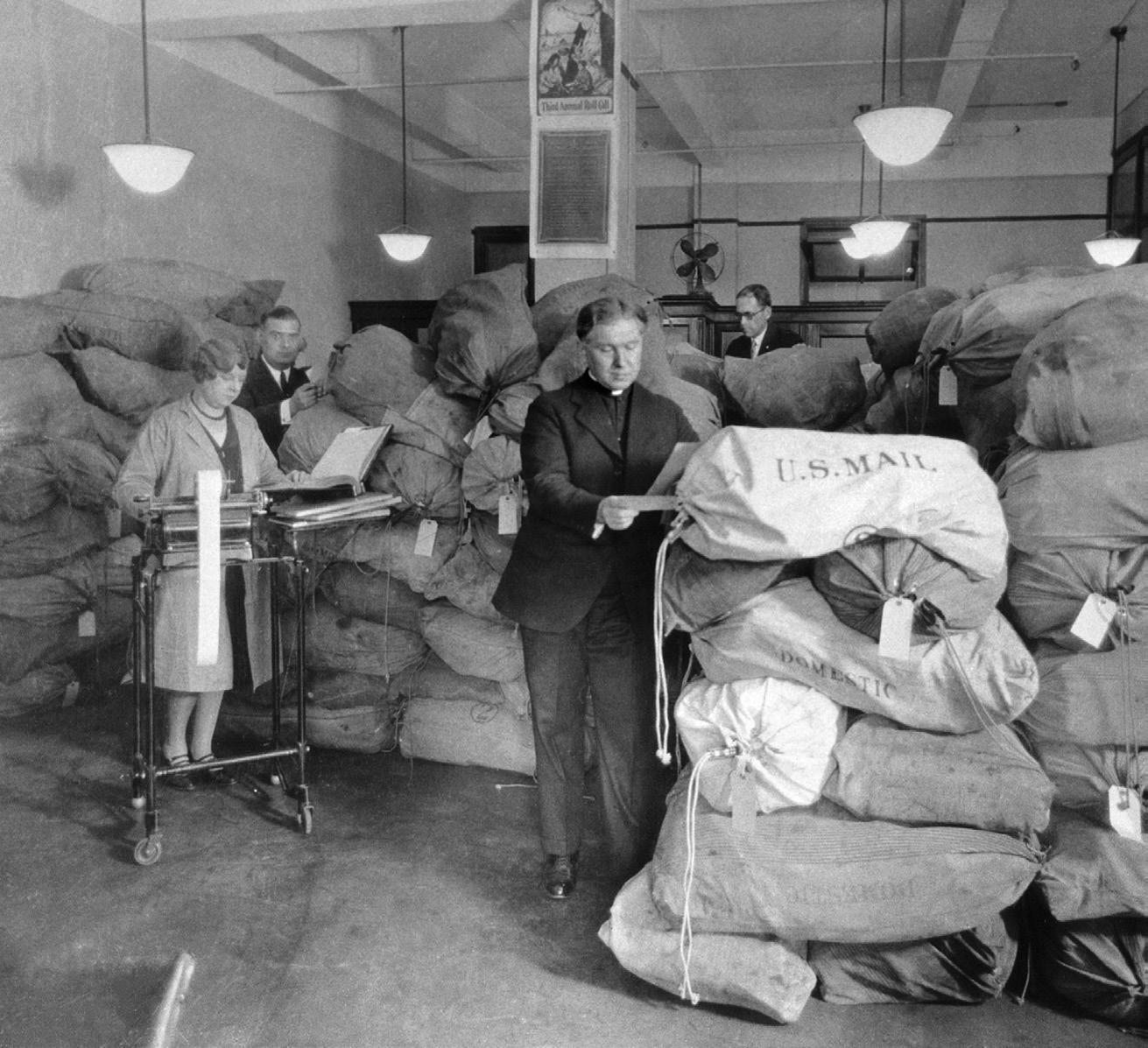
Jesuit Father Edmund A. Walsh, the first president of CNEWA, sifts through the mail at CNEWA’s offices in New York City.
II. The world explodes: CNEWA galvanizes
worldwide Catholic aid, 1941-1960
In 1941, New York Archbishop Francis Joseph Spellman appointed Msgr. O’Reilly as pastor of “the Actor’s Chapel,” Manhattan’s Church of St. Malachy, and as CNEWA president installed a priest and social worker, Msgr. Bryan McEntegart, to charge the agency as its national secretary.
A noted child advocate, the Brooklyn-born priest (who later served as the ordinary of Brooklyn with the personal title of archbishop from 1957 to 1968) had assisted the Hoover and Roosevelt administrations as a member of the White House Committee on Child Welfare and later directed the Child Welfare League of America. His tenure at CNEWA was brief, however, with his appointment as bishop of Ogdensburg, New York, in 1943, where he also assumed the role as the founding executive director of War Relief Services, the refugee aid agency of the U.S. Catholic bishops, today known as Catholic Relief Services.
Regardless, Archbishop McEntegart’s legacy at CNEWA was in securing Msgr. Thomas J. McMahon as his assistant and later his successor.
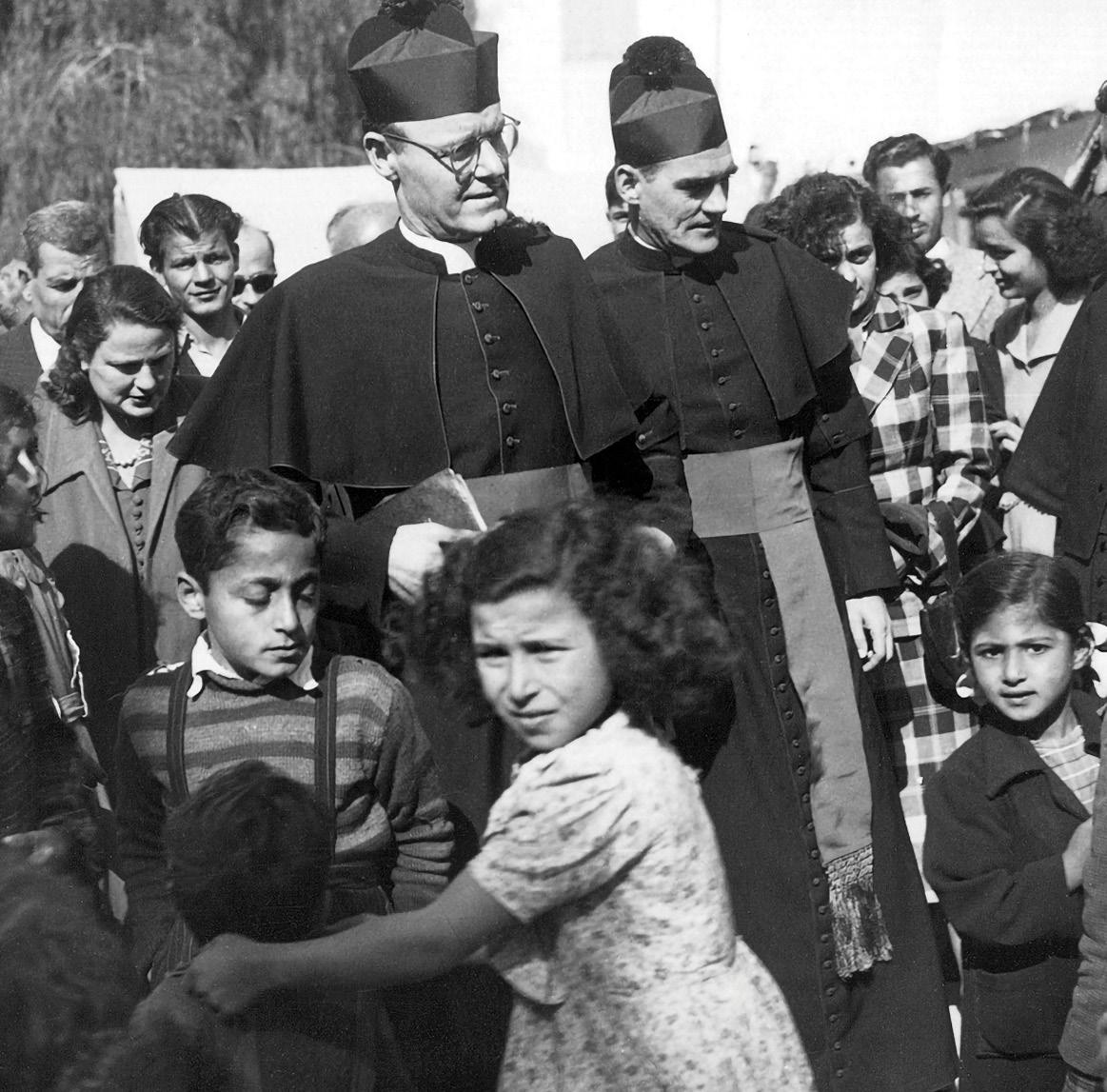
With World War II winding down in Europe, CNEWA under Msgr. McMahon continued its course of advocacy and education until the legendary prefect of the Sacred Congregation for the Eastern Church, Eugene Cardinal Tisserant, dispatched him to the Middle East in 1948 on a fact-finding mission for the Holy See. Violently, the Arab world had rejected the partition of Palestine and the establishment of the State of Israel, pitting Arabs and Jews in a decades-old conflict that has since destroyed generations of families and communities, and displaced millions.
“Every day of those four months among the Palestinian refugees was filled with sorrowful thoughts and even more sorrowful sights,” he later wrote after war plunged Palestine into chaos.
“From the day we landed at Haifa and began our treks through mud and snow in Israel, Arab Palestine,
Transjordan, Syria, Lebanon and Egypt, our pilgrim’s progress was beset with tears. …
“Many thousands of little refugee kiddies are being safely sheltered in our schools and orphanages. One day we stood among four hundred of these. They had all fled miles on foot. The eyes of one little child of five still held terror …
“We knew that a heavy rain would spell death for the little babes or the beginning of an epidemic for all. Some of the babes would be placed at the doorstep of a convent or a foundling hospital, and mother church would repeat her age-old story of tender and loving care. … Everywhere the church was in evidence. …
“It is a lesson to the world that Palestine is a microcosm, the crossroads of the world, the capital of three
Refugee children in Gaza surround Msgr. Thomas J. McMahon, first head of Pontifical Mission for Palestine, in January 1951.
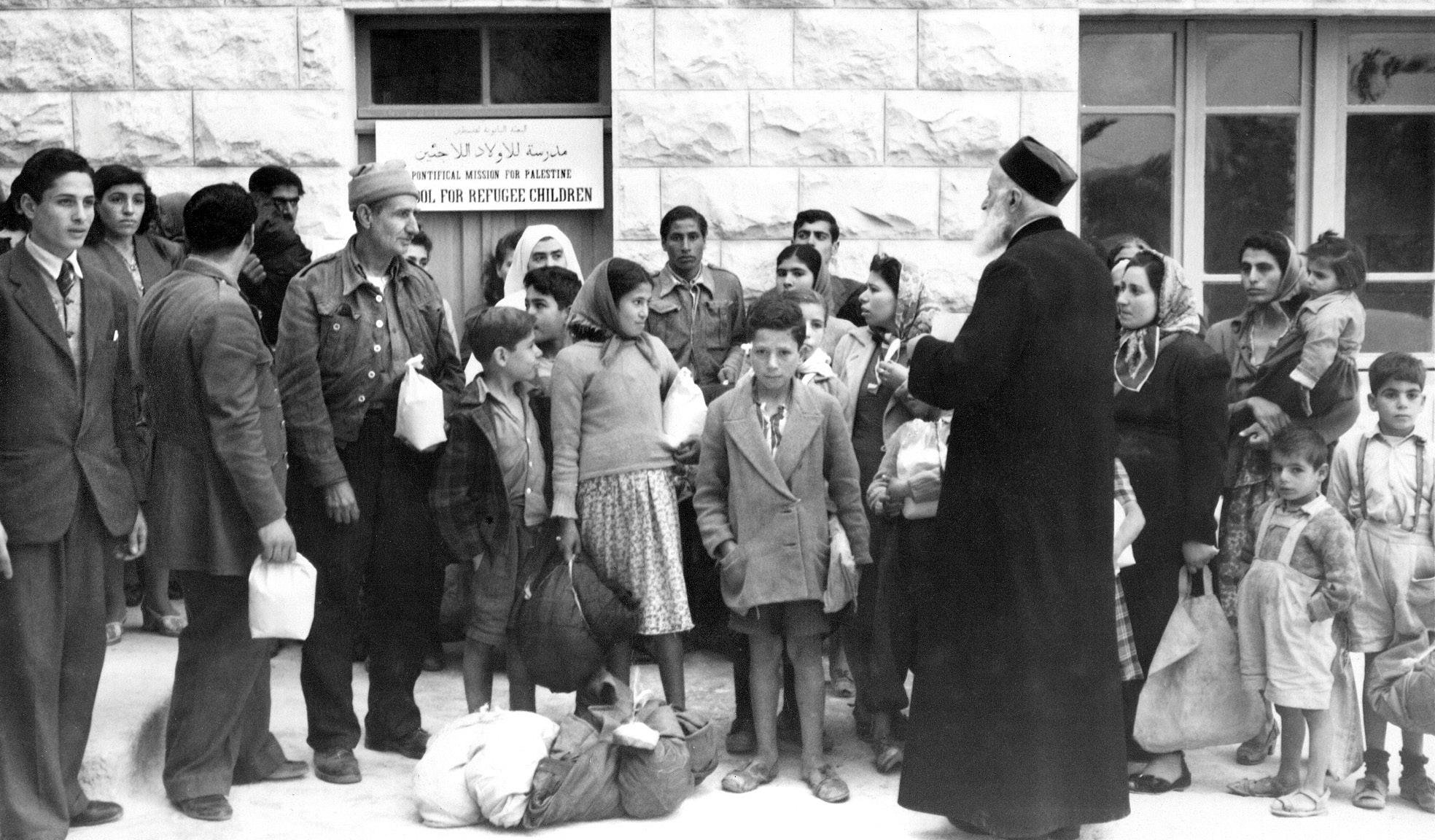
In its early years of operation, Pontifical Mission for Palestine opened, administered and ran facilities for refugees, such as this school for refugees in Dbayeh, Lebanon.
religions, whose rights make it imperative that that land can never be exclusionist and that no solution can be lasting, if it obscures these indigenous rights.”
“During those months at the close of 1948 and the beginning of 1949,” Msgr. McMahon later concluded, “as I helped the bishops and a thousand priests and sisters for the relief of the Middle East, I could see the absolute need for a special Pontifical Mission for Palestine, coordinating the efforts of the whole Catholic world. … This had been the idea of the Holy Father and all those around him.”
One of those around the pope was Msgr. Giovanni Battista Montini, the future Pope Paul VI, who had organized and directed Pope Pius XII’s refugee relief efforts during World War II. At a November 1948 meeting, where the idea of a papal mission to Palestine was discussed, Msgr. Montini penciled the name of Msgr. McMahon as the candidate to lead such an agency.
When Msgr. McMahon returned to the Holy Land in the spring of 1949, he did so not only as national
secretary of CNEWA, but also as the papally appointed president of Pontifical Mission for Palestine, which the Holy See had entrusted to CNEWA for its administration and direction.
“It has been decided,” wrote Cardinal Tisserant in a directive dated 18 June 1948, “to bring together under the Pontifical Mission, operating in the Holy Land, all those organizations and associations which are engaged in activities concerning the East, and which are scattered throughout many countries of Europe and other continents.”
Immediately, Msgr. McMahon formed seven local committees in those areas where more than 700,000 Arab Palestinians had found refuge: the West Bank, Egypt, Lebanon, Syria, Jordan, Israel and Gaza. These committees included papal delegates, bishops, clergy, laity and leaders of Catholic social service organizations. In Beirut — then accessible to the West and to the refugees affected by the violence — he set up the field operations center for the new Pontifical Mission for Palestine. Together, with local volunteers and CNEWA colleagues in New York, Msgr. McMahon began coordinating the activities of global and national organizations ministering to the needs of three-quarters of a million refugees — more than half of whom were under the age of 15.
Partners in these relief efforts included the emergency relief fund of the U.S. Catholic bishops, U.S. National Catholic Welfare Conference, U.S. National Council of Catholic Women, Catholic Medical Mission Board, Equestrian Order of the Holy Sepulchre of Jerusalem and the Society of St. Vincent de Paul. Religious communities for men, particularly the friars of the Franciscan Custody of the Holy Land, and religious communities of women working in the region, joined Pontifical Mission for Palestine in its service to the refugees. CNEWA/Pontifical Mission for Palestine also developed a strong working relationship with the United Nations Relief and Works Agency for Palestinian Refugees in the Near East (UNRWA), founded in December 1949.
“In the field, Msgr. McMahon was responsible for distributing goods and services to an exhausted refugee population,” wrote Peg Maron, a member of the editorial team of this magazine, in the July-August 2001 edition. “He excelled in organizing resources to erect housing, schools, clinics and churches for the refugees. He had extensive correspondence with the United Nations Special Committee on Palestine and two secretaries general of the United Nations: Trygve Lie and Dag Hammarskjold.”
Manuel Abu Issa, who carried out the field operations of Pontifical Mission for Palestine in Jerusalem, remembered going out to the field every day and “visiting refugees in the camps set up by the United Nations. We would distribute wheat, rice, barley and sometimes sugar. We were always in the field,” he said, “and always pressed to do more.”
Ten years after the start of the Arab-Israeli conflict, Msgr. McMahon’s successor, Msgr. Peter P. Tuohy, reported that, in a nine-year period, Pontifical Mission for Palestine had released more than $34 million in food, clothing, medicine and services; distributed more than 8,000 tons of food, 6,000 tons of clothing and 55 tons of medical supplies from 273 centers to an estimated 425,000 refugees, nearly half of the refugee population; sheltered some 20,000 people and educated more than 34,000 children in 343 schools.
“Your name,” wrote Cardinal Tisserant to Msgr. McMahon upon the latter’s retirement in March 1955, “is held in grateful memory by thousands of refugees from Palestine, who without your timely and effective intervention would have been lost.” The exhausted priest died on 6 December 1956, at the age of 47.
100 YEARS AND COUNTING
more than a century, we’ve been here.
Nevertheless, the work continued with Msgr. Tuohy, declaring in November 1955 that “until the resolutions of the United Nations are implemented, the church shall continue her worldwide aid to refugees. … We shall continue this relief assistance until justice and charity have been rendered to every single Palestinian refugee.”
A decade later, and with no resolution in the Holy Land in sight, the leadership of CNEWA transitioned the programmatic activities of Pontifical Mission for Palestine throughout the Middle East from emergency, crisis relief, to more sustainable, long-term initiatives:
“If you want to help a man,” wrote Carol Hunnybun, a 20-year veteran of Pontifical Mission for Palestine in Beirut and Jerusalem, “you don’t buy him apples; you help him plant an apple tree.”
Read the next installment in the June issue.
Executive Editor Michael J. La Civita is director of communications and marketing.
A Mission to Do More
Ukraine’s churches form lay leaders to uphold and advance the dignity of all human life amid war and what may follow
by Anna Klochko
In the Cathedral of St. George in Lviv — the spiritual heart of the Ukrainian Greek Catholic Church — more than 500 people lingered after Divine Liturgy on 17 January for a rare chance to experience the comfort of sacred silence under the daily weight of war.
Most were teachers from across Ukraine, who had traveled to Lviv for a conference on inclusive education. The liturgy the next day highlighted outstanding educators.
In the crypt below lie the tombs of Metropolitan Andrey Sheptytsky and Major Archbishop Josyf Slipyj, both of whom promoted a vision of the church as a school of responsibility, and education as a long-term strategy, for a principled society.
With few Catholic schools in Ukraine, this vision has inspired members of the local church, including the Rev. Yuriy Karvatskyi, to start educational initiatives that engage the wider society.
Father Karvatskyi, 31, cofounded the Father Yulian Dzerovych Educational Center of the Archeparchy of Lviv in 2017. In partnership with public schools, the center cultivates educational spaces where spiritual formation and professional growth converge with the aim of integrated human development.
“We saw a chance to offer more than professional training, to accompany the person as a whole, not in their functions, but as a human being,” he says.
“Education is not only about lessons. It’s a triangle of parents, teachers and children,” he continues.
Father Karvatskyi speaks of the need for leaders in Ukraine who
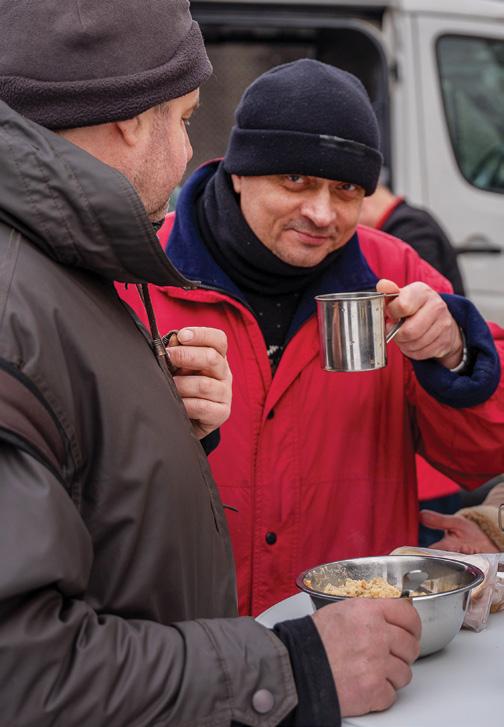
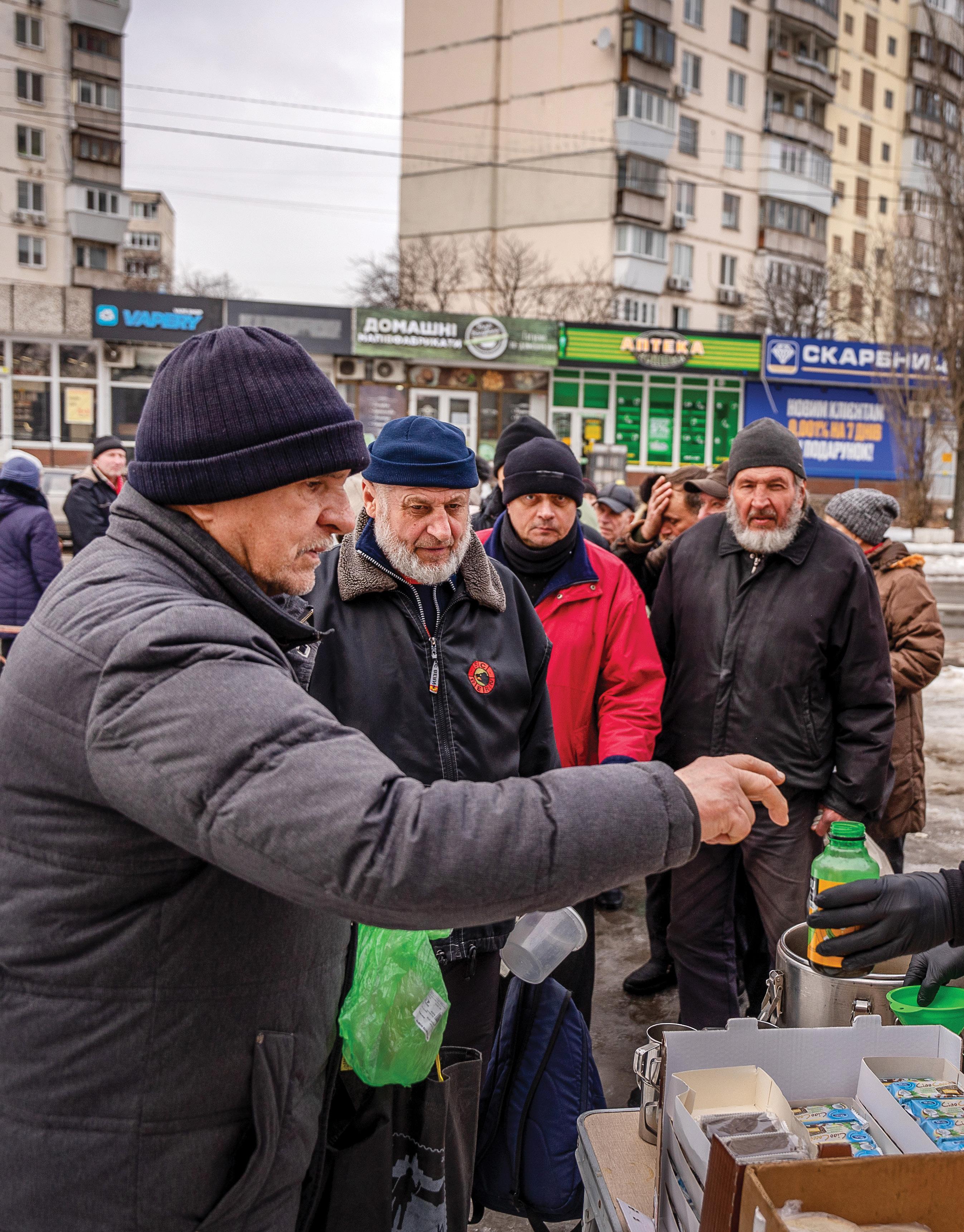
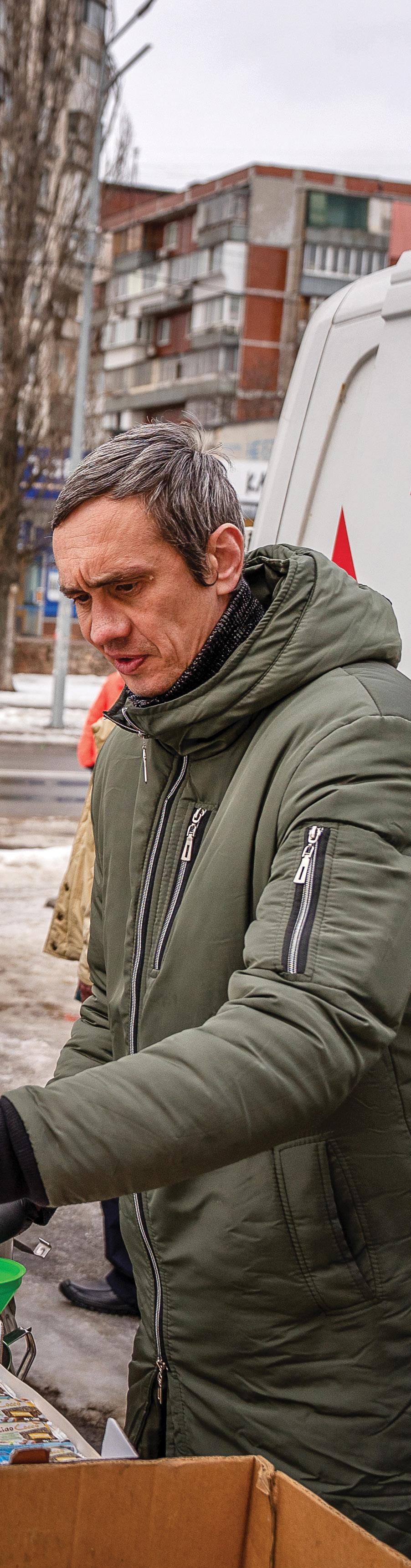
A volunteer with Caritas-Spes in Kyiv distributes food and drink to people who lost power in their homes due to Russian missile attacks.
can guide others toward solidarity, resilience and recovery. Last November, his center organized the School of National Consciousness at Ivan Franko National University of Lviv to promote identity and civic responsibility among young adults. The daylong program included a panel discussion, lectures and hands-on workshops.
“We can have good schools and good universities, but if a teenager does not understand why they are there, even the best education will not bear fruit,” he says. “You have to show them: You can be a leader, you can change your country, you can be part of a larger process.”
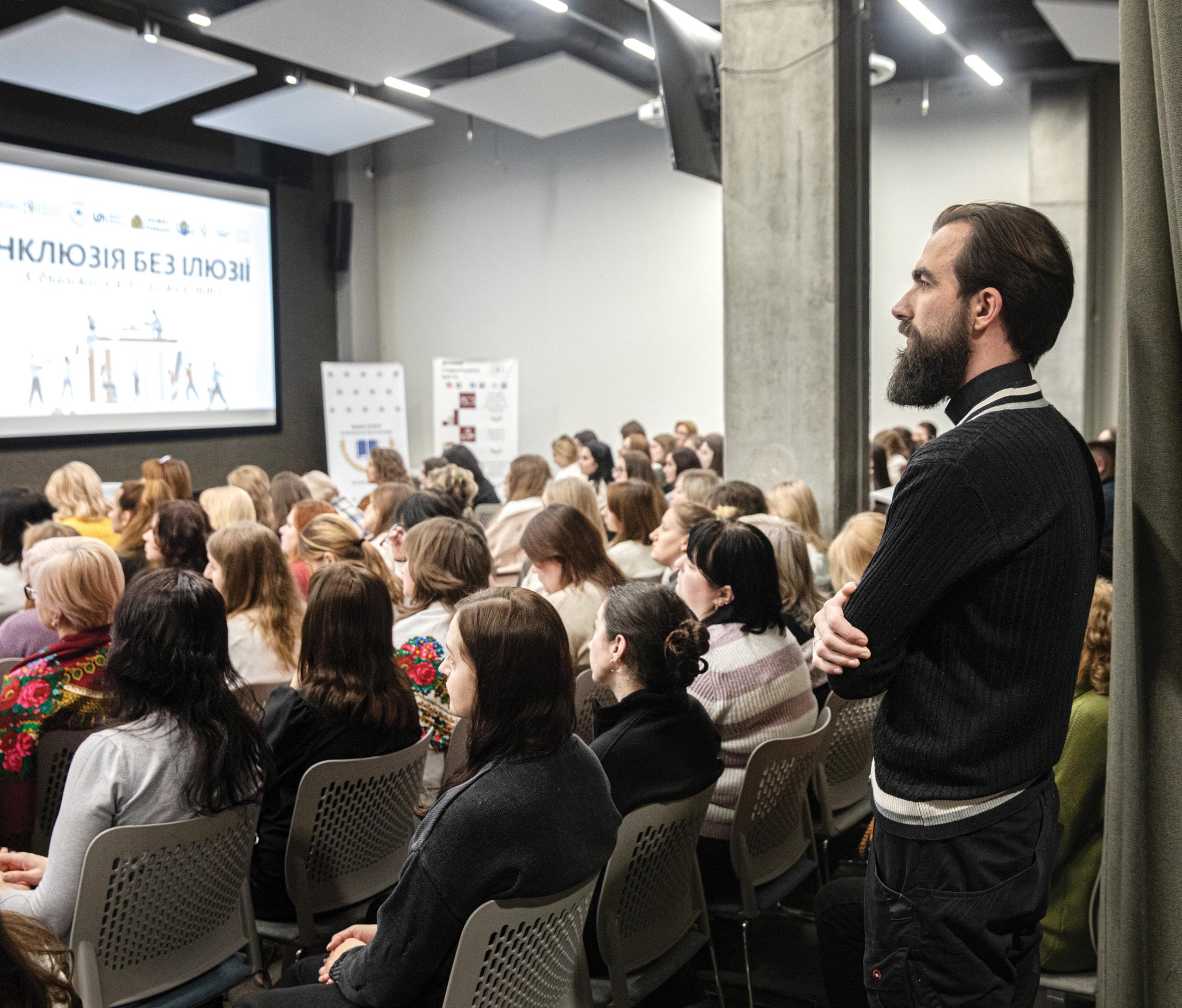
The center organized a similar day on the theme, “Inclusion Without Illusions,” in partnership with Ukrainian Catholic University (UCU), for educators, psychologists and resource specialists at St. George Cathedral in Lviv on 16 January. The aim was to equip those responsible for inclusive education to stand with the vulnerable and to respond to their needs.
Dmytro Sherengovskyi, 38, vice rector for outreach and social engagement at UCU, says faithdriven education must be tangible beyond the theology class in disciplines that appear purely secular.
At the university, based in Lviv, faith-based values also permeate campus life through volunteering, communal living, formation programs, and the steady presence of prayer and liturgy, he adds.
“What matters here is not only what you study but how you then live and act,” Mr. Sherengovskyi says. “That is what forms a person.”
UCU has more than 2,500 students across 12 undergraduate and 18 master’s programs. The private university receives no state funding and is sustained through donations and tuition.
ACCOMPANYING THE CHURCH
The CNEWA Connection
CNEWA has been on the ground in Ukraine since its independence from the Soviet Union, building deep and lasting relationships with its churches and supporting their many works. Since Russia’s full-scale invasion on Ukraine in 2022, CNEWA has provided more than $10 million in aid to Ukraine aimed at supporting church-led initiatives, supplying food, shelter, medical care and generators for those displaced by the conflict. CNEWA also supports seminaries and houses of religious formation, Ukrainian Catholic University, and the nationwide parish-based social ministries of Caritas Ukraine.
To support CNEWA’s work in Ukraine, call 1-866-322-4441 (Canada) or 1-800-442-6392 (United States) or visit cnewa.org/donate.
Ivanna Mohyliak, 46, who heads the student life office, says formation is woven into the university’s daily rhythm and reflected in its motto, “A University That Serves.” All 480 first-year students must take a course called “Service,” in which they “work in groups and develop ideas for social projects,” she says.
Many join initiatives that support soldiers and children. Others organize outreach activities that seek to restore community and a sense of stability for those
displaced by the ongoing war with Russia.
Andriy Hlushko, a second-year theology student, lives at the Collegium, the university’s oncampus residential community, where daily life is shaped with intentionality.
Mr. Hlushko says he has learned a lot from Emmaus House, a home for adults with special needs, which is integrated into the Collegium. In those intentional daily encounters, he says, one learns to accept people
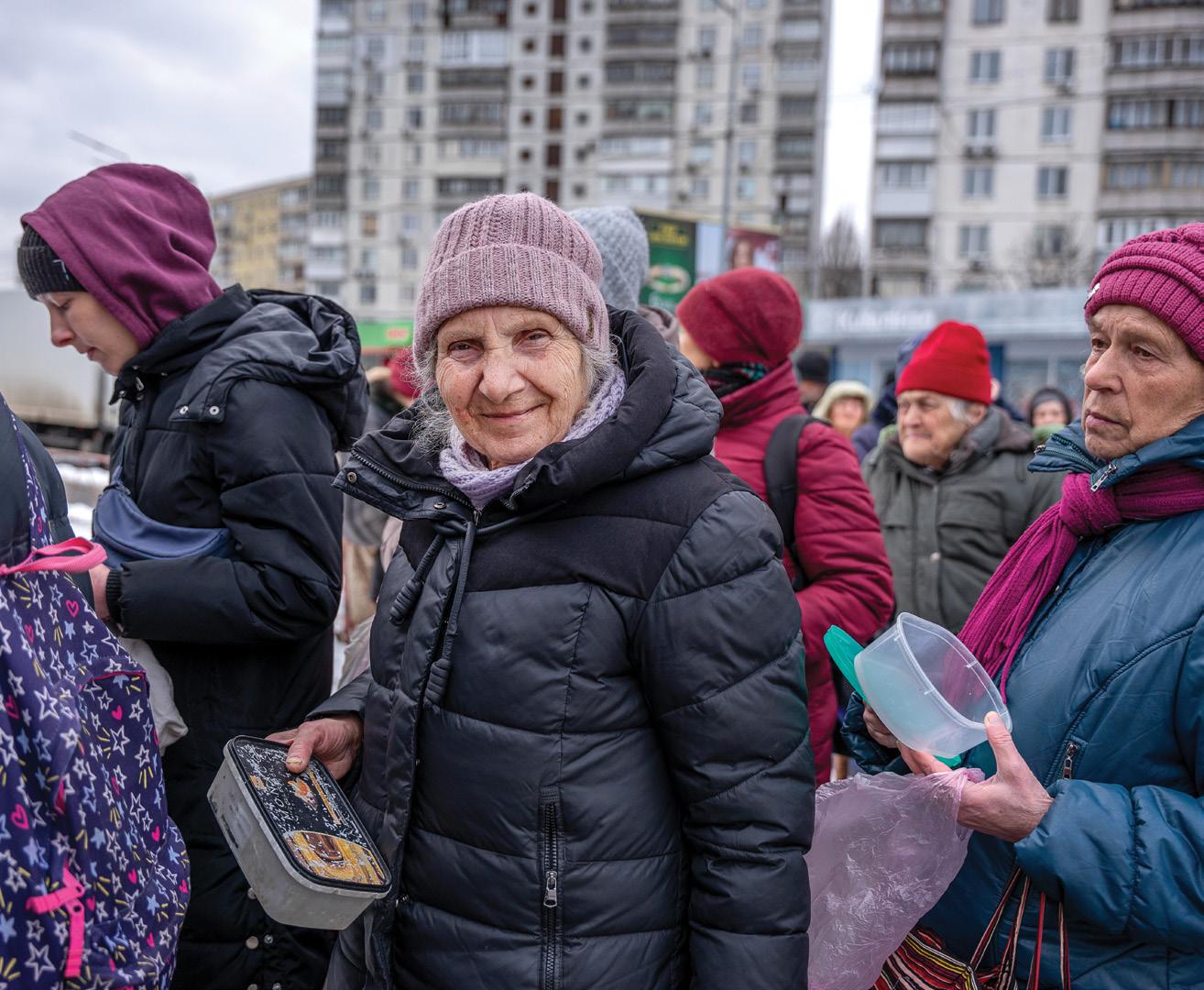
People in Kyiv stand in line for a warm meal, offered by Caritas-Spes, after Russian attacks cut power in their homes. Opposite, Father Yuriy Karvatskyi, standing, listens to a speaker at an educators conference he organized in Lviv.
unconditionally — a practice that matters for anyone who later will shape institutions, policies and communities.
This past winter, Mr. Hlushko’s volunteer work included traveling to the front lines in the Zaporizhzhia region with UCU’s student choir to sing Christmas carols and spend time with communities under the constant strain of war.
Sister Mariia Radist Hrynyk, I.V.E., deputy master of the Collegium, coordinates a formation track that accompanies academic study. Its purpose, she says, is to help young adults grow spiritually and witness to faith in their actions and behavior.
Anzhelika Stakhovska, 37, a recent UCU graduate, joined the national office of Caritas-Spes Ukraine in 2022. Caritas-Spes is the charitable arm of the Roman Catholic community in Ukraine.
“I had a great job,” she says. “But, for me, it was work without a mission. I wanted to do something that had meaning and put my talents at the service of my country.”
Trained as a linguist, she began as a translator, then moved into safeguarding — a field that at the time had almost no resources available in Ukrainian. With strong English skills and access to international training, she began translating global best practices into policy. Helping to build the safeguarding system from the ground up became her central achievement and the topic of her master’s thesis at UCU’s Institute of Leadership and Management.
“In a humanitarian crisis, the church must know how to help professionally.”
“This is the only program in Ukraine for nonprofit organizations,” she says. “Programs abroad do not provide our [Ukrainian] context.”
“Over a year and a half of study, my understanding of the sector — and of myself within it — changed completely,” she says. “We have a moral, spiritual and human obligation to provide assistance in a way that does not harm a person’s dignity.”
The safeguarding system today functions as a coherent mechanism
that includes training and testing for staff and volunteers, updated policies, internal procedures and a regional network of coordinators, she says.
Ms. Stakhovska also developed verified communication pathways with up-to-date contacts and services designed for reporting that functions in real time.
Caritas-Spes has grown quickly under the humanitarian demands of a war now in its fourth year. According to the U.N. Human Rights Monitoring Mission in
Ukraine, at least 15,000 civilians have been killed and more than 40,000 injured; it says with verification difficult in areas with limited access, the true toll is likely higher.
“At the beginning of the fullscale invasion [in 2022], there were 15 people in the national office,” Ms. Stakhovska says. “Now we have more than 100.”
Caritas-Spes operates close to the front lines in eastern Ukraine, within the dioceses of Kharkiv–Zaporizhzhia and of Odesa–
Across
churches and confessions, compassion is being paired with competence.
Simferopol, where Catholic communities have been small historically. The organization had to work hard to overcome the perception that its mission was only to “help its own.”
Trust, Ms. Stakhovska has learned, is built in small, consistent ways, and not all priorities and key values, such as the spiritual foundation of the work, can be captured in policy language.
“The Catholic Church’s social teaching gave me an inner foundation,” she says. “It kept reminding me that at the center of everything must be the dignity of the human person.”
Church institutions in Ukraine — Catholic and Orthodox — are increasingly thinking long-term, not only in responding to crises, but about investing in teams and training that will sustain communities through war and rebuilding.
These programs point to a larger shift: Across churches and confessions, compassion is being paired with competence.
“Competence without values is dangerous, and values without competence do not always work,” says Myroslava Chekh, 41, who heads UCU’s graduate program in
Kateryna Lutsyk attends class at Ukrainian Catholic University in Lviv.
public management and administration.
She describes leadership as a form of service and as power reimagined as responsibility and accountability to people.
The Rev. Serhiy Dmytriyev, who works in the social service department of the Orthodox Church of Ukraine, describes leadership as a disciplined practice of service that makes the church an active part of civil society.
He is also the board chairman of Eleos Ukraine, which unites
15 regional organizations in a church-linked network that coordinates and delivers structured assistance to vulnerable people.
A distinct focus is trauma care. In wartime, priests are often the first point of stability, and Eleos has launched long-term interconfessional training in accompaniment, crisis support and referral pathways to qualified mental health professionals.
“We are preparing people both for the church and for the wider social environment,” he says. “In a humanitarian crisis, the church must know how to help professionally.”
Some Eleos team members study in UCU’s Institute of Leadership and Management, and the organization has drawn on the university’s expertise for strategic planning — practical cooperation that he says is one of the most honest forms of ecumenical dialogue.
Solomia Maksymovych, director of the UCU institute, says the graduate program in nonprofit management “gives a full picture of how to build a civil-society organization, from strategy to project management” and draws both young professionals and seasoned leaders with MBAs and management experience.
Graduate Kateryna Lutsyk, 29, now leads a support space for veterans in Khmelnytskyi, western Ukraine, where she helps soldiers and their families return to civilian life.
Upon graduating from medical college, Ms. Lutsyk enlisted as a volunteer combat medic with an air assault unit. She served from 2015 to 2021. During Russia’s military incursion into eastern Ukraine, she moved with the battalion across multiple sectors, saving more than 200 lives, until the unarmored car in which she was traveling came under
sniper fire. She was left with irreversible damage: a brain hemorrhage, deafness in one ear and partial atrophy of her optic nerves. She now undergoes treatment and monitoring every six months to reduce the risk of stroke.
Adapting to civilian life took time, she says of its challenges, but she soon moved into advocacy, promoting internationally — including at the United Nations, the World Bank and the U.S. Senate — the recognition of women in the Ukrainian military. Women who had served in combat were recorded as cooks or seamstresses, a bureaucratic erasure that also meant lost protections, pay and benefits.
In 2019, Ukraine passed legislation granting women access to 63 combat roles and 450 noncombat roles previously closed to them.
Ms. Lutsyk was in Khmelnytskyi three years later, when Russia launched its full-scale invasion. She says she and other veterans had been warning of a full-scale invasion, preparing, planning trainings and sketching emergency protocols.
Within hours of the invasion, the city center filled with hundreds of people. “You could see fear in everyone’s eyes, and they wanted someone to tell them what to do,” she recalls.
Her new mission crystallized in this moment of crisis, and she decided the graduate program at UCU would give her the framework — values, tools and community — and the skills to lead a team, build a system and drive change to bring her new mission to life.
“This isn’t just formal education,” she says. “It’s about the dignity of every person.”
Anna Klochko is a multimedia journalist based in Kyiv.
On the Verge of Collapse
With a shortage of medical staff and supplies, Gaza’s health sector struggles to offer much-needed care
by Diaa Ostaz
In post-war Gaza, survival is a daily negotiation, not a guaranteed right.
The airstrikes have stopped, but the consequences of two years of sustained shelling — which have killed at least 71,000 people — continue to emerge in its hospitals, clinics and overcrowded shelters.
Gaza’s health care system was already fragile before the war that began in October 2023, after Israel invaded Gaza in retaliation for Hamas’s attack on civilians in Israel, which included the killing of 1,200 people and the hostagetaking of an additional 254 people.
At that time, Gaza had 38 hospitals with approximately 3,680 beds. In mid-January, only 18 hospitals were operating on a partial basis, with about 1,700 beds — a 54 percent reduction in capacity. During the war, entire medical specialties disappeared; cardiac surgery, organ transplants and advanced cancer treatment either stopped completely or functioned at a symbolic level.
The hospitals that survived have been working with continual shortages of electricity, fuel, medical staff and supplies. More than 1,700 medical workers, including 150 specialized doctors, died during the war, and at least 700 health care professionals left, creating a lasting brain drain, according to Gaza’s Health Information Unit.
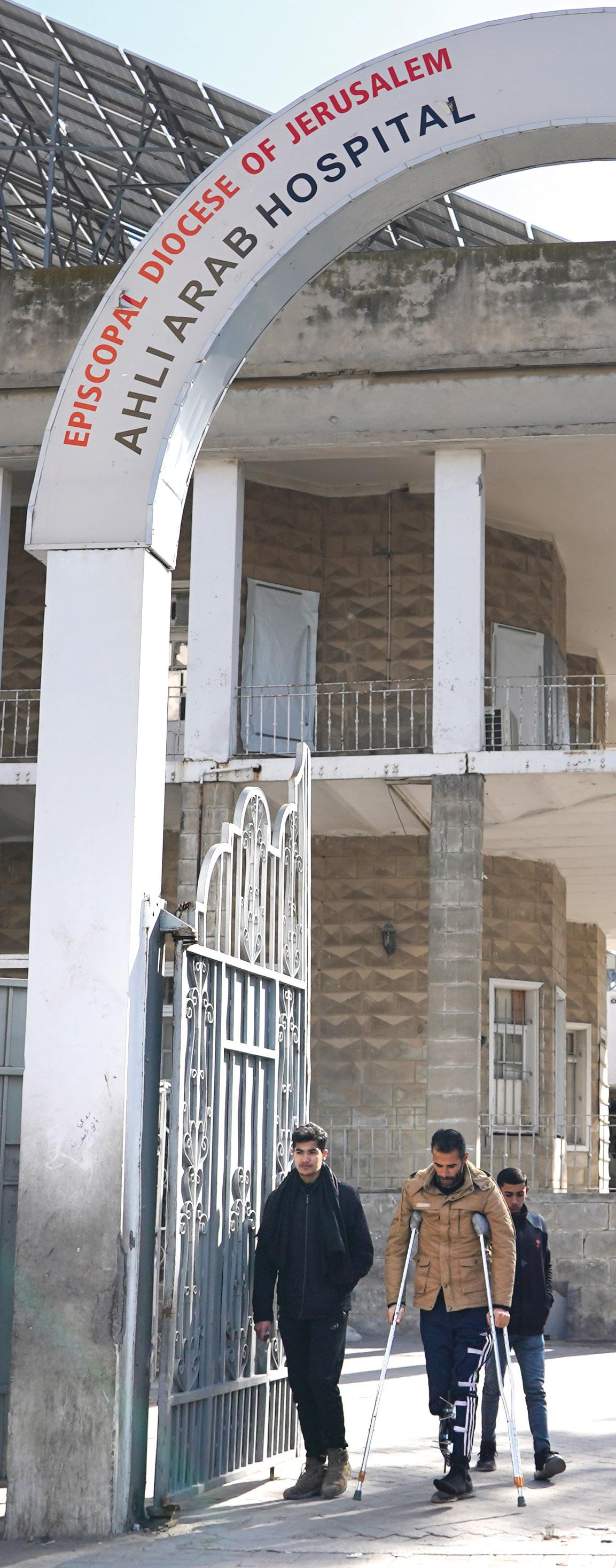
After the ceasefire took effect last October, thousands of patients returned to Al-Ahli Arab Hospital in Gaza City with health conditions that had been neglected during the years of bombardment, displacement and survivalfocused care.
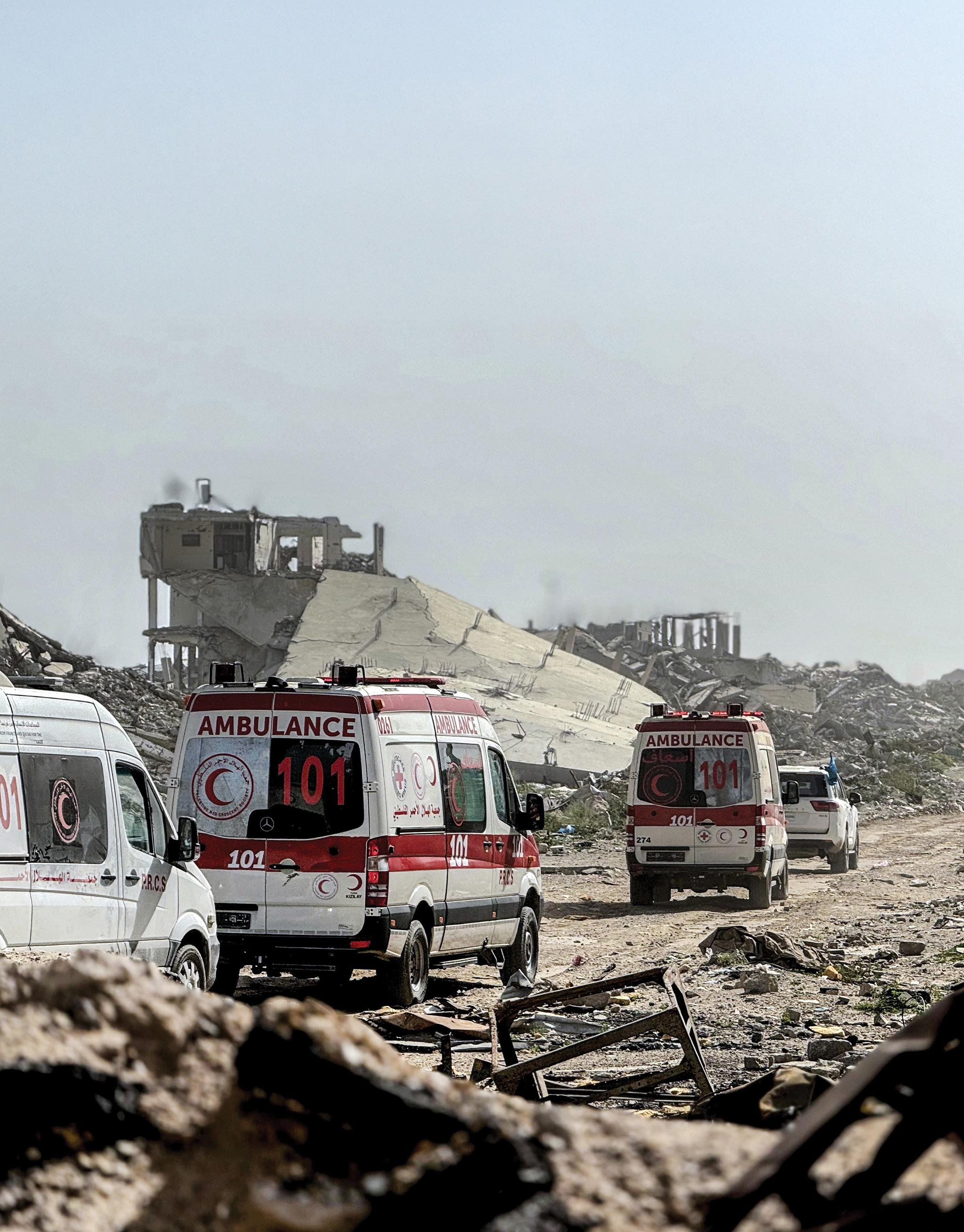
Ambulances transport patients from
In an interview three months after the ceasefire, Dr. Maher Ayad, hospital director, said “medical problems are still getting worse and worse, with the shortage of medicine and supplies.
“Until now, hospitals in Gaza did not receive any medicine, or any equipment or any supplies needed for patients,” he said.
During the war, Al-Ahli — as with most hospitals in Gaza — prioritized emergency trauma cases. Airstrike injuries, wounds suffered from collapsing buildings, burns and shrapnel-related amputations consumed operating rooms and exhausted medical staff. Elective surgeries and chronic disease management were postponed indefinitely.
Since the ceasefire, Dr. Ayad has seen surviving cancer patients and those suffering from abdominal diseases, such as hernias and gallbladder conditions, returning for treatment.
The hospital was bombed several times during the war and, in mid-January, was functioning out of damaged buildings with compromised infrastructure. Entire departments required reconstruction, while others were functioning with limited equipment and improvised solutions.
“We need major repairs, new equipment and supplies, especially for patients who require daily wound dressings,” Dr. Ayad said.
As of publication, across Gaza, 73 percent of essential medicines were out of stock, including anesthesia drugs and intensive care medications. At Al-Ahli Hospital alone, more than 150 patients required daily wound care for war-related injuries that had gone untreated for months.
“We urgently need antibiotics, particularly specialized antibiotics based on culture and sensitivity tests,” Dr. Ayad said. “But advanced
laboratory testing is largely unavailable in Gaza.”
This diagnostic collapse has extended throughout Gaza. Of the seven M.R.I. machines in Gaza before the war, none functioned in mid-January. Only six of 17 CT scanners operated at the time; most worked intermittently due to electricity shortages, lack of spare parts and insufficiently trained personnel.
“Our CT machine operates once every two or three days, while cancer patients wait as their conditions worsen,” Dr. Ayad said.
Gaza City resident Boshra Awad, 75, is one of many patients whose health deteriorated during the war.
Her illness began suddenly.
“I woke up with severe pain in my leg,” she recalled. “My children carried me in a wheelchair. The doctor drained fluids from my knee, but later my leg swelled, and I couldn’t walk.”
After the ceasefire, she was admitted to Al-Ahli Hospital and underwent surgery, despite her weakened heart — a risk compounded by limited diagnostic tools and medication shortages.
“Thank God we are in the hospital and our condition is stable,” Ms. Awad said from her hospital bed, her daughter at her side. “Before the war, life was much better. Now everything is harder.
“The streets are destroyed, transportation is very difficult, and the cold makes everything worse,” she continued. “Sick people cannot tolerate this, but what can we do? This is what God wrote for us.”
Her experience reflects a broader public health crisis. With 85 percent of water and sewage facilities out of service, infections, skin diseases and chronic illnesses have been spreading rapidly, especially among displaced families living in tents and makeshift shelters where hygiene has been nearly impossible.
RESPONDING TO HUMAN NEEDS
Khan Younis, Gaza Strip, to the crossing at Rafah for medical treatment in Egypt.
“Without real peace, these problems will continue,” Dr. Ayad said. “Peace is the only way life can return to normal.”
For many families, the ceasefire did not end their fear, but transformed it — from fear of sudden death to the fear of a slow but sure deterioration and painful death.
“We waited for the bombing to stop so we could do the operation,” said Mazen Sakani, whose brother, injured during the war, underwent surgery at Al-Ahli.
“He came out of surgery, and there is no medicine for him,” Mr. Sakani said. “Where do we go? Where do we get medicine?”
Throughout Gaza, 71 percent of medical supplies — including gauze, sutures, disinfectants and plaster — were unavailable in mid-January. Even basic wound care supplies were rationed, forcing doctors to reuse supplies.
“My nephew was killed during the war,” Mr. Sakani said. “And now we cannot even find medicine for the living.”
“Humanitarian aid is not a favor. It is a legal obligation.”
Winter has exacerbated conditions. “There are no blankets, no proper bedding,” he added. “They say aid is entering, but we see nothing and we are suffocating.”
Humanitarian organizations remain a critical lifeline under these conditions. Many face operational restrictions, however, that threaten their ability to function.
On 1 January, Israel announced it would revoke the operating licenses of 37 humanitarian groups
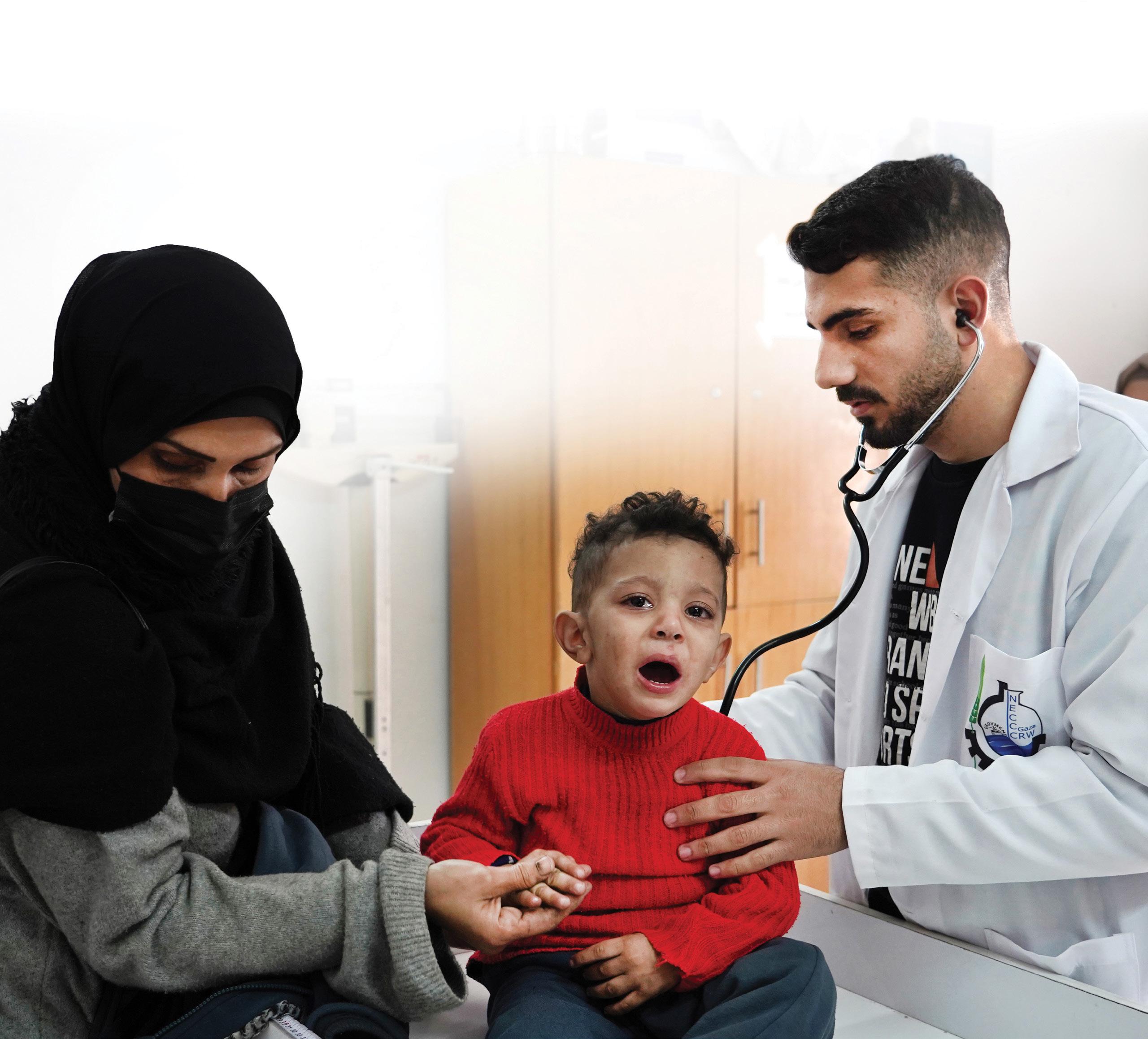
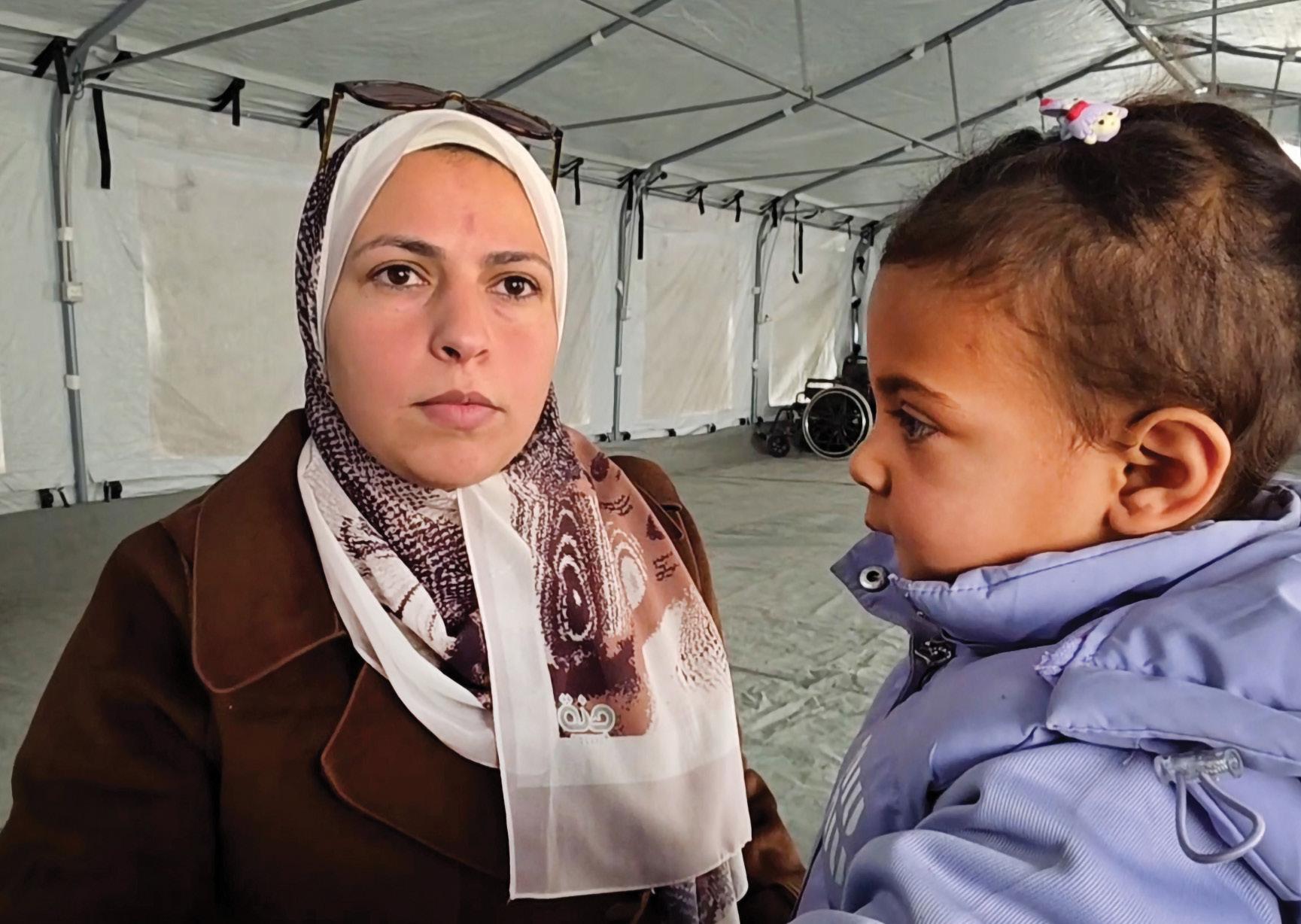
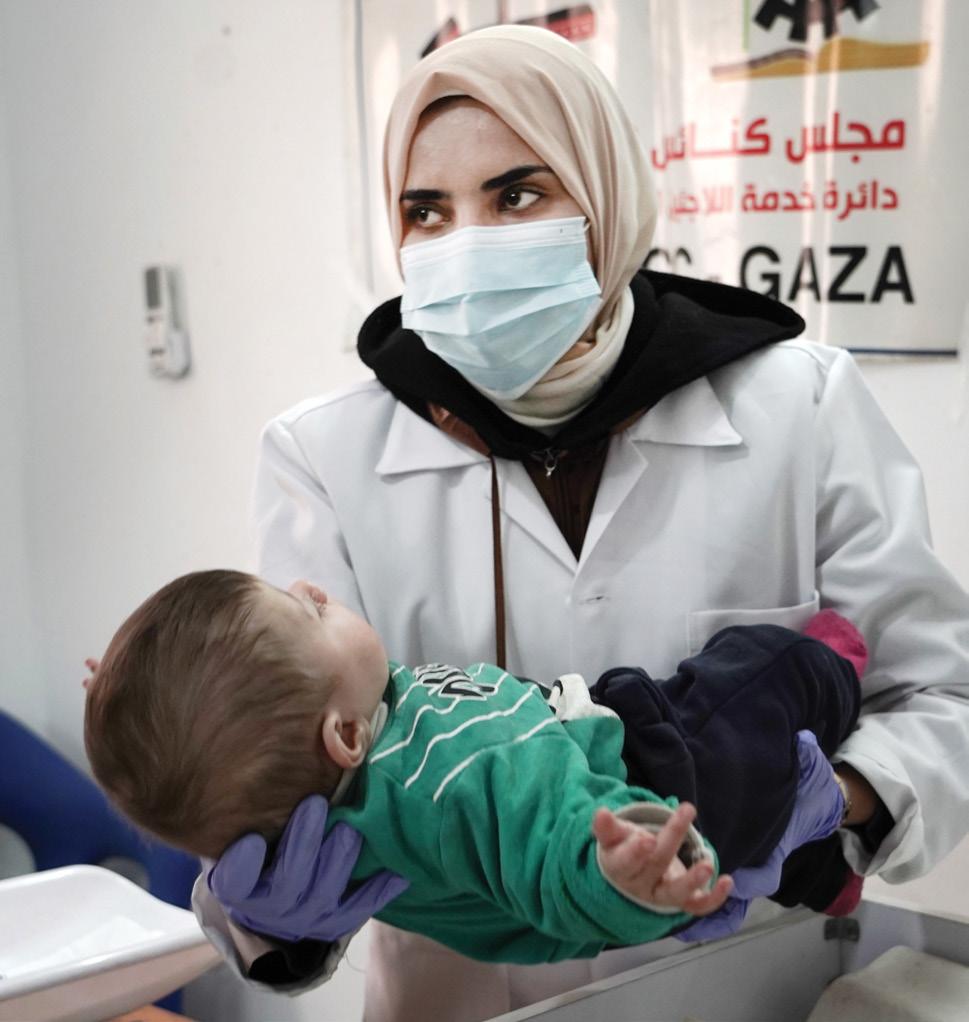
Shaimaa Abu Reida and her daughter, Jumana Al-Najjar, 3, wait in Khan Younis to be transported to Egypt for medical care. Opposite, a doctor treats a child at a mobile clinic of the Near East Council of Churches in Gaza.
working in the Palestinian Territories of Gaza and the West Bank, effective March 1, including those supporting health care. However, the Israeli Supreme Court issued a temporary injunction on 27 February blocking the ban, after 17 of these groups filed a petition to the court on 22 February.
The Near East Council of Churches (NECC), a longstanding CNEWA partner that provides medical and humanitarian services across the region, was among the 37 groups impacted by this policy.
“We represent Orthodox, Catholic, Anglican and Protestant churches, and we have always operated transparently and legally,” said board member Moussa Ayad.
Despite the destruction of its facilities, NECC has continued to provide health care services through its three mobile clinics, which were relocated repeatedly during the war. In mid-January, these mobile clinics provided more than 1,000 medical services daily, especially to displaced populations suffering from malnutrition, respiratory illnesses, skin infections and diseases linked to cold and overcrowding.
The international charity Doctors Without Borders (M.S.F.) was impacted by Israel’s January decision as well. At the time, the organization was supporting one in five hospital beds in Gaza and assisting one in three births.
“In 2025 alone, M.S.F. treated more than 100,000 trauma cases and performed nearly 23,000 surgeries,” said Claire Nicolet, M.S.F. emergency coordinator.
The CNEWA Connection
CNEWA, through its operating agency in the Middle East, Pontifical Mission for Palestine, works through its partners on the ground in the Gaza Strip. For years it has supported Al-Ahli Arab Hospital, Gaza’s only Christian hospital, which continues to treat patients under dire circumstances, despite having been hit multiple times during the Israel-Hamas war and the chronic shortage of medical supplies and equipment. CNEWA/PMP has long subsidized the work of the Near East Council of Churches, including its now-destroyed maternity clinics, its mobile outreach and medical checkpoints.
To support CNEWA’s work in Gaza, call 1-866-322-4441 (Canada) or 1-800-442-6392 (United States) or visit cnewa.org/donate
Doctors Without Borders also provided hundreds of thousands of outpatient consultations, mental health sessions and millions of gallons of clean water — essential services amid the destruction and collapse of Gaza’s weak public infrastructure.
Restricting humanitarian organizations, Ms. Nicolet said, would push an already collapsed system into irreversible failure.
“Humanitarian aid is not a favor,” she said. “It is a legal obligation.”
NECC clinics and Doctors Without Borders operate as parallel health systems, reaching communities that formal institutions cannot serve.
“When I hear the word ‘closure,’ it sends shivers down my spine,” said NECC’s Moussa Ayad.
“It is not easy at all after years of providing continuous services to the public. The health system is on the verge of collapse, and withdrawing licenses from those institutions will cause a deeper collapse.”
While major hospitals struggle to survive, Caritas Jerusalem, a member of Caritas Internationalis, the global charitable arm of the Catholic Church, chose adaptation over withdrawal.
“Caritas has been present in Gaza long before the war,” said Dr. Jihad al-Hessi, its medical consultant.
During the war, Caritas clinics were displaced repeatedly, along with the local population — from Gaza to Rafah, Deir al-Balah and Nuseirat, then back to Rafah and Khan Younis. In mid-January, Caritas was running nine medical points across Gaza — three
were providing advanced care — and working in coordination with the Palestinian Ministry of Health to open a tenth center in Gaza City.
Caritas Jerusalem provides care for “infectious diseases, chronic illnesses, malnutrition and maternal health” to more than 1,000 people daily, Dr. Hessi said. Yet even this flexibility cannot compensate for the collapse of
secondary and specialized care, he added.
“More than two-thirds of Gaza’s hospitals were destroyed or rendered non-operational. Primary care helps reduce pressure, but it cannot replace a functioning hospital system,” he said.
“We hope the wars will come to an end and that peace will prevail, not only in Gaza but throughout the entire world.”
“Now we cannot even find medicine for the living.”
In mid-January, more than 19,500 patients required urgent medical evacuation, and at least 1,200 were reported to have died since the start of the war while waiting for permission to leave.
The Rafah crossing between Gaza and Egypt — then the only land crossing into the Gaza Strip — was closed in May 2024 after an Israeli military invasion, intensifying the humanitarian crisis.
With the start of the ceasefire’s second phase, however, the crossing was reopened on 2 February on a limited basis and under strict supervision. Travel through the crossing for medical treatment was tightly restricted, with Israeli authorities granting permissions only to the most critical cases and under complex conditions, including that patients prove their illnesses could not be treated in Gaza. Yet, even approvals were limited and unpredictable.
During the first three days of the reopening, 150 patients were supposed to leave with 300 companions, but Israeli restrictions limited that number to 96 people — patients and companions — authorized to travel. The crossing was then closed for two days, 6-7 February, reportedly due to confusion regarding procedures, before reopening.
Shaimaa Abu Reida, whose 3-year-old daughter was wounded by Israeli rocket fragments last August, had requested permission to cross into Egypt. Her daughter suffered severe internal injuries to her liver, stomach and intestines.
“Treatment in Gaza is nearly impossible,” Ms. Abu Reida reported on 3 February as she waited at Al-Amal Hospital in Khan Younis, southern Gaza, where the World Health Organization was
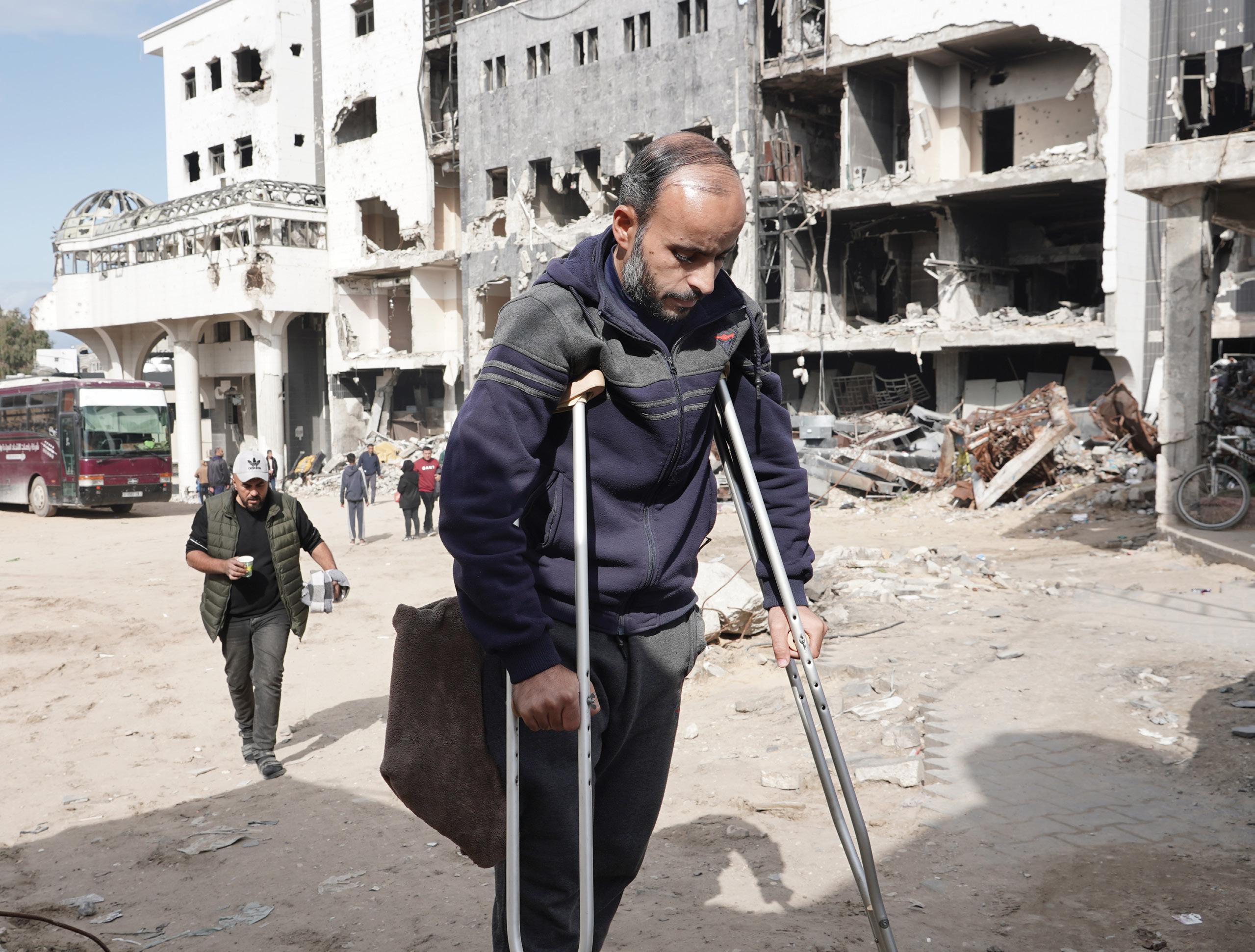
An injured Palestinian passes by the mostly destroyed Al-Shifa Hospital in Gaza City.
preparing patients for the crossing. Those who received clearance were transported by bus or ambulance to Rafah, accompanied by Israeli military vehicles.
“I only agreed to travel because my daughter needs care,” she said. “We put our trust in God and hope she can recover and come back home. Once she gets better, we will return to Gaza immediately.”
For Sabah al-Raqab, 56, returning to Gaza in February was more arduous than crossing into Egypt for treatment for a serious heart condition in March 2025. When the Palestinian Embassy in Egypt informed her that she had received permission to return to Gaza with her 17-year-old daughter, she thought her ordeal was over.
“Our joy was indescribable,” she said on 5 February from Al-Mawasi, where she was living in a temporary shelter with her husband and children among other displaced families. “I was ready to live in a tent, as long as I could come back.”
Their journey home, however, turned into a series of humiliations: long hours of waiting at the Israeli checkpoint near the crossing in Gaza and repeated searches and confiscation of personal belongings, including essential medicines and children’s toys. From there, she and others were transported to Khan Younis in a bus surrounded by military Jeeps before being interrogated.
“Gaza is my country,” she said. “Why do I need permission to enter it?”
Despite losing her home in Khan Younis and everything she owned in the war, Ms. Raqab insisted she would stay in Gaza.
“I’d rather sit on the rubble or under a tree than be a refugee outside Gaza.”
Journalist Diaa Ostaz reports from Gaza.
BRINK
The Church as Field Hospital
India’s Eastern churches reach the margins of society, providing dignity in life and death for all
text by Anubha George with photographs by Sajeendran V.S.
Born with developmental and intellectual disabilities, Vipin Valiyannukaran has required round-the-clock care his entire life. His grandmother served as his primary caretaker while his mother, Mary, worked in a convent as a cook. When his grandmother died four years ago, Mary became Vipin’s sole caretaker. Despite the challenges, Mary has persevered, until diagnosed with Parkinson’s and depression two years ago.
Mary’s daughter invited them to live with her, her husband, four sons and parents-in-law, but the situation deteriorated quickly, with arguments an almost daily occurrence. A relative then suggested Vipin, 37, and Mary, 64, live at Damien Institute.
Damien Institute is situated in the hills of Mulayam in Kerala’s Thrissur district, southern India. Its 185 acres are planted with pineapple, banana and coconut trees, and rice grows in low-lying areas.
The institute, founded in 1953, is an apostolate of the Syro-Malabar Catholic Archeparchy of Trichur and named for St. Damien de Veuster, a Belgian priest who cared for those suffering with Hansen’s disease — commonly known as leprosy — banished to the Hawaiian island of Molokai. Eventually, he contracted the disease and died at age 49 in 1889.
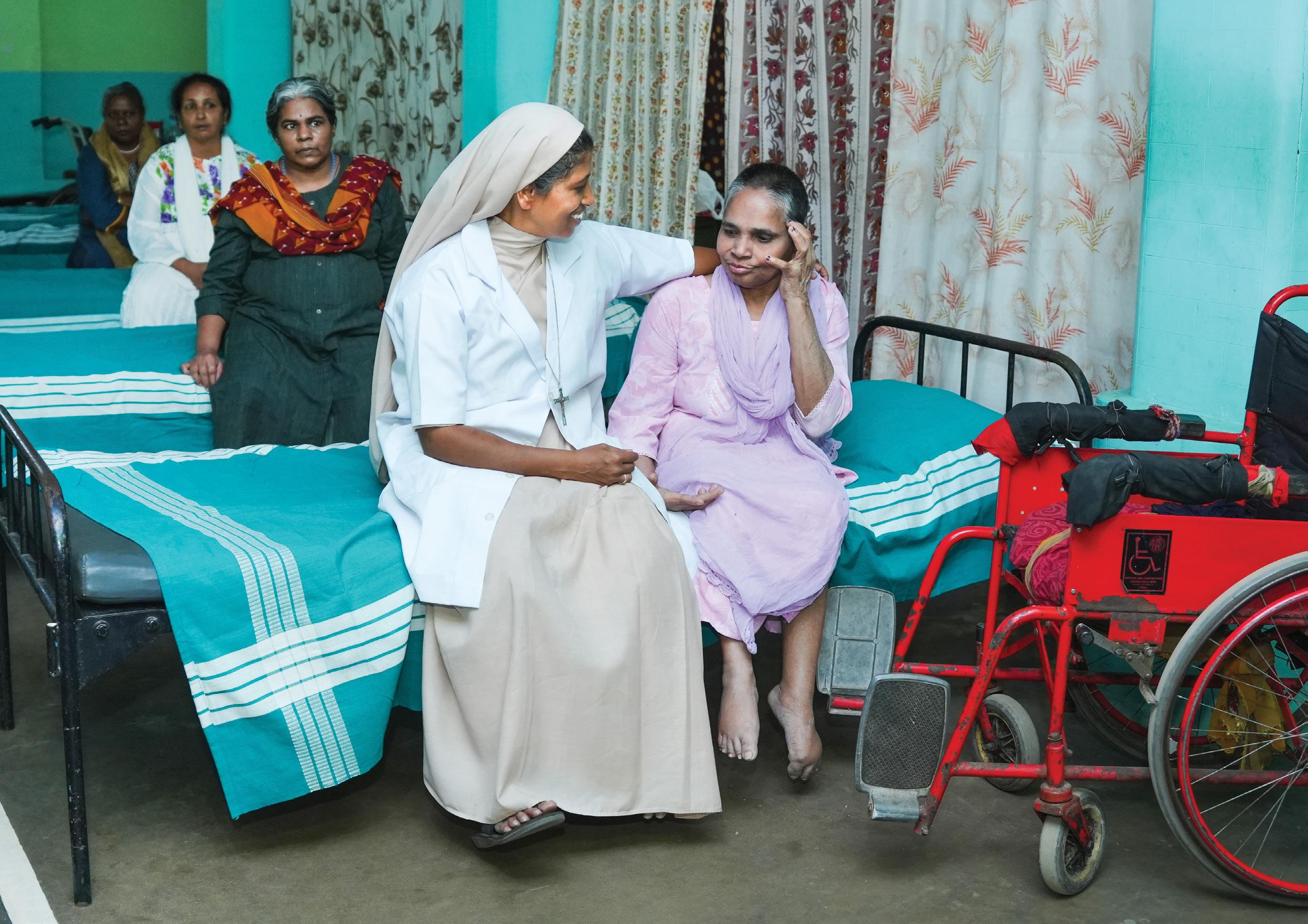
Sister Lissy Valloppally runs Damien Institute. Before arriving three years ago, she worked at a leprosy hospital in Hyderabad, India.
“We have 42 patients here altogether,” she says. “Most of them suffer from mental health conditions, such as schizophrenia, mania, etc.
“There are also four leprosy patients who have been in the clear for years now, but there’s nowhere for them to go, so they stay here. There are also some patients who show up on outpatient days.”
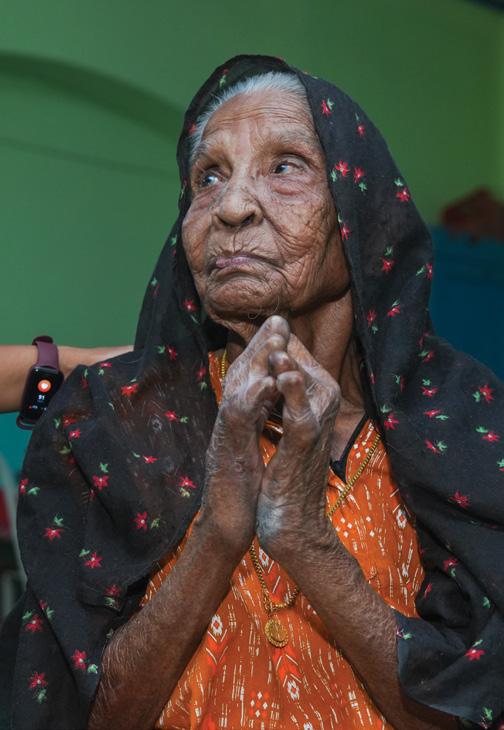
Pathu Muthu, 92, has deformity in her hands and feet from leprosy.
“She has been here 38 years,” Sister Lissy says. “She’s been given the all-clear, but her hands and feet still need dressing twice a week or it gets smelly.”
A doctor visits the institute twice a month, and a psychiatrist visits monthly. Residents can receive physiotherapy weekly; they receive blood tests monthly. The 10-member staff includes nurses, caregivers and administrators.
Improvements in public health globally have nearly eradicated the disease worldwide — about 95 percent of the world’s population is not susceptible — and it is not a communicable disease spread through sexual activity or pregnancy. India declared leprosy eradicated in 2005, under its National Leprosy
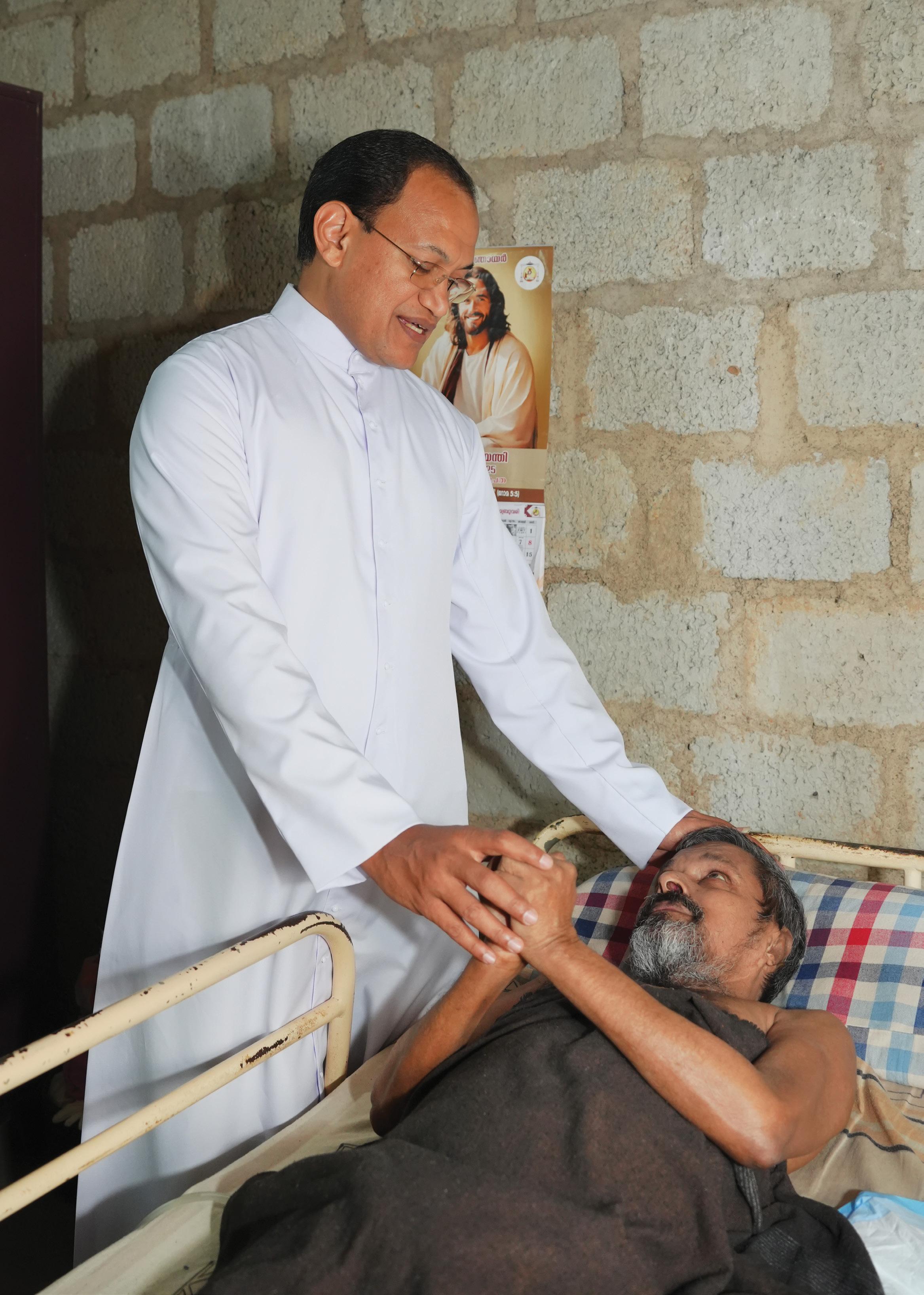
Father Shaju Chirayath visits with Joy Thaliyan, a patient of Hrudaya Palliative Care Program.
RESPONDING TO HUMAN NEEDS
Eradication Program. Government figures show India’s leprosy prevalence rate fell from 57.2 per 10,000 people in 1981 to just 0.57 in 2025. However, between 120,000 and 130,000 new cases of leprosy are reported every year in India, representing nearly 60 percent of new cases globally.
Damien Institute had 350 leprosy patients at its peak in 1962. When the government declared leprosy eradicated, the institute shifted its mission to care primarily for people with mental health issues.
“After COVID in 2020, we also took in some patients who had nowhere to go,” says the Rev. Simson Chiramel, institute director.
In 2020, just before COVID-19 hit, Jaison Johnson, 29, graduated with a degree in economics and was holding down a job at a pharmacy while managing his schizophrenia.
During the pandemic, however, Mr. Johnson, his mother and brother, who also have mental health issues, roamed the streets all day and night. A relative took them to Jubilee Mission Hospital, also
part of the Archeparchy of Trichur’s health care network, but they refused to take the prescribed medication. When Mr. Johnson’s mental health declined further, he was admitted to the hospital for a two-month stay. His doctor referred him to Damien Institute, where he has been living for the past two years.
“We work together with the residents here to make them more independent,” Father Chiramel says. “When you put love together with care, it gives them a sense of belonging.”
“When you put love together with care, it gives them a sense of belonging.”
Ayyappan Kutty, 80, is very fit, a benefit of a life climbing coconut trees and picking the fruit. He lives in Karalam, where he cares for his sister Shantha, 54, who was diagnosed with metastatic breast cancer. His other sisters, Kochumol and Valleyamma, have mental health needs.
The four siblings are supported by Hrudaya Palliative Care Program, a social action initiative of the Syro-Malabar Catholic Eparchy of Irinjalakuda. The eparchy includes 260,000 Syro-Malabar Catholics and about 140 parishes. The program’s staff of 30 provides care for 1,500 families.
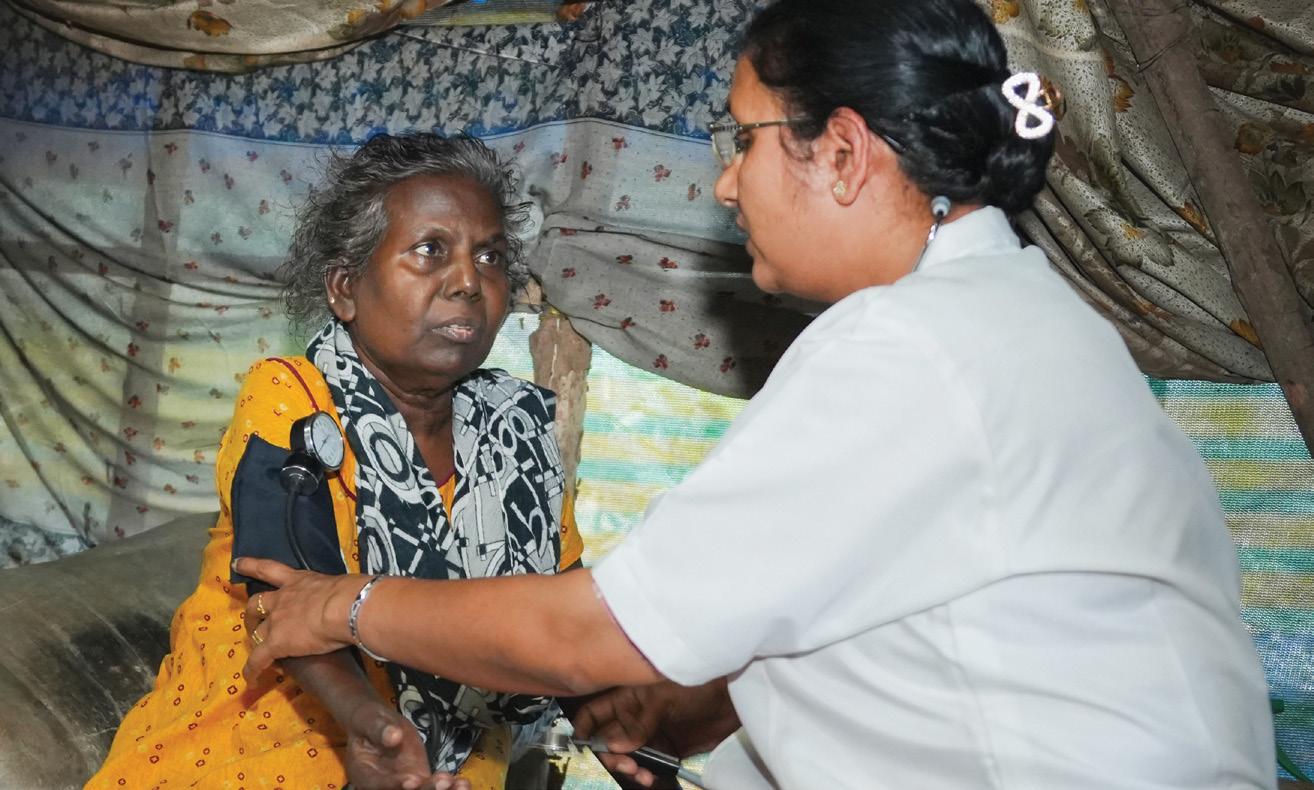
“We offer free, comprehensive care to people who are bedridden with conditions such as cancer, strokes, spinal cord injuries and other complex illnesses that are difficult to fully recover from,” says the director, the Rev. Shaju Chirayath.
“We provide medicines absolutely free to people receiving palliative care,” he says. “We make sure that those in greatest need have access to essential medication that can help improve their quality of life.”
In the village of Vellani, Jewel Mary Jijoy, 6, lives with a rare condition that can cause seizures and defects in limbs.
Jewel Mary’s mother, Dhanya Jijoy, is her primary caretaker. “It is difficult to look after her because she needs 24-hour care,” says Mrs. Jijoy. Jewel Mary’s brother, 14, and sister, 9, help as much as they can, she adds.
Jewel Mary’s father drives a taxi in another city and returns home every weekend. His earnings are not
Sister Lissy Valloppally visits with Juvan at Damien Institute. Above, a nurse greets a cancer patient of Hrudaya Palliative Care Program.
The CNEWA Connection
CNEWA accompanies India’s Syro-Malabar and Syro-Malankara Catholic churches in their social and health care ministries serving the most vulnerable and marginalized populations, including the works featured here. CNEWA’s decades-long support of Damien Institute includes funds for its operations, patient medication and food. A CNEWA grant to Hrudaya Palliative Care Program provides airbeds for the prevention of sores; oxygen cylinders for respiratory support; wheelchairs for mobility and accessibility; mobile freezers for storing temperature-sensitive medicines and ambulances for emergency transportation. CNEWA also funds the scholarship program of Malankara Social Service Society for Dalit children.
To support CNEWA’s work in India, call 1-866-322-4441 (Canada) or 1-800-442-6392 (United States) or visit cnewa.org/donate.
enough to support the family, nor Jewel Mary’s specific health needs.
“A Hrudaya coordinator told us about the condition of this family,”
Father Chirayath says. “We came and saw how we could help them. Hrudaya pays for Jewel Mary’s medication, which costs almost $250 a month.”
“If it wasn’t for Hrudaya, I don’t know how we would have managed,” says Mrs. Jijoy, a daily churchgoer. “Jesus works in mysterious ways.”
Joy Thaliyan, 56, in Thumbakode earned a living for his family as a woodcutter until a fall from a rubber tree seven years ago left him paralyzed.
“Things are difficult,” says his wife, Annie Joy. “But Hrudaya is helpful. Father Shaju visits regularly, and that gives us a lot of support and solace.”
Father Chirayath says Hrudaya also provides doctor and nurse visits and helps people with health-related needs, like providing diapers. “It’s important we stay connected with people and not leave them to be socially isolated,” he says. “Emotional, spiritual and religious support is very important for human beings.”
Hrudaya Hospice Center helps those who require end-of-life care.
“Education is by far the best gift you can give someone.”
“We want people to have dignity in both life and death. That’s why programs such as Hrudaya are necessary,” Father Chirayath says.
Since the 1970s, Kerala transitioned into one of India’s most affluent and developed states. Life expectancy is 73 for men and 79 for women, driven largely by professional health care facilities, high literacy and improved sanitation.
More than 5 million people from Kerala work abroad, mostly in the Persian Gulf states, contributing significantly to wealth in the state. The economy is largely service driven, relying heavily on tourism, health care, IT and trade rather than manufacturing.
The average per capita income in Kerala is $1,950, according to 2024-2025 government statistics, yet, despite socioeconomic and technological growth, the state continues to rely on its churches for poverty alleviation — more than a quarter of Kerala’s population is Christian,
and the churches’ networks of schools, health care and social service programs impact Christians and non-Christians alike.
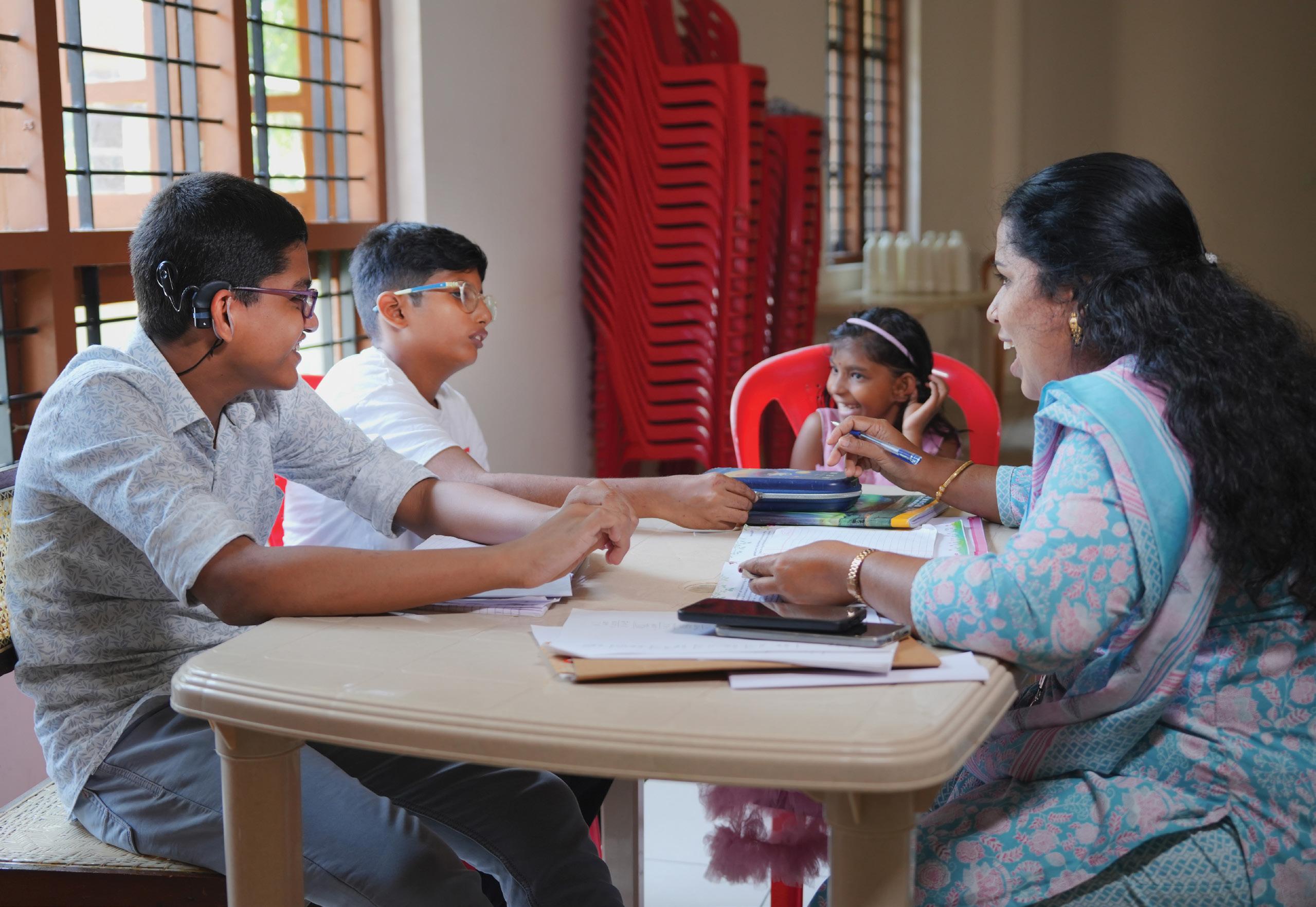
In addition to care for the marginalized, church-run organizations provide employment training and significant funding toward community development. They also manage an extensive network of educational institutions and hospitals, particularly in remote or underserved areas, soup kitchens and welfare programs for families facing economic hardship or loss.
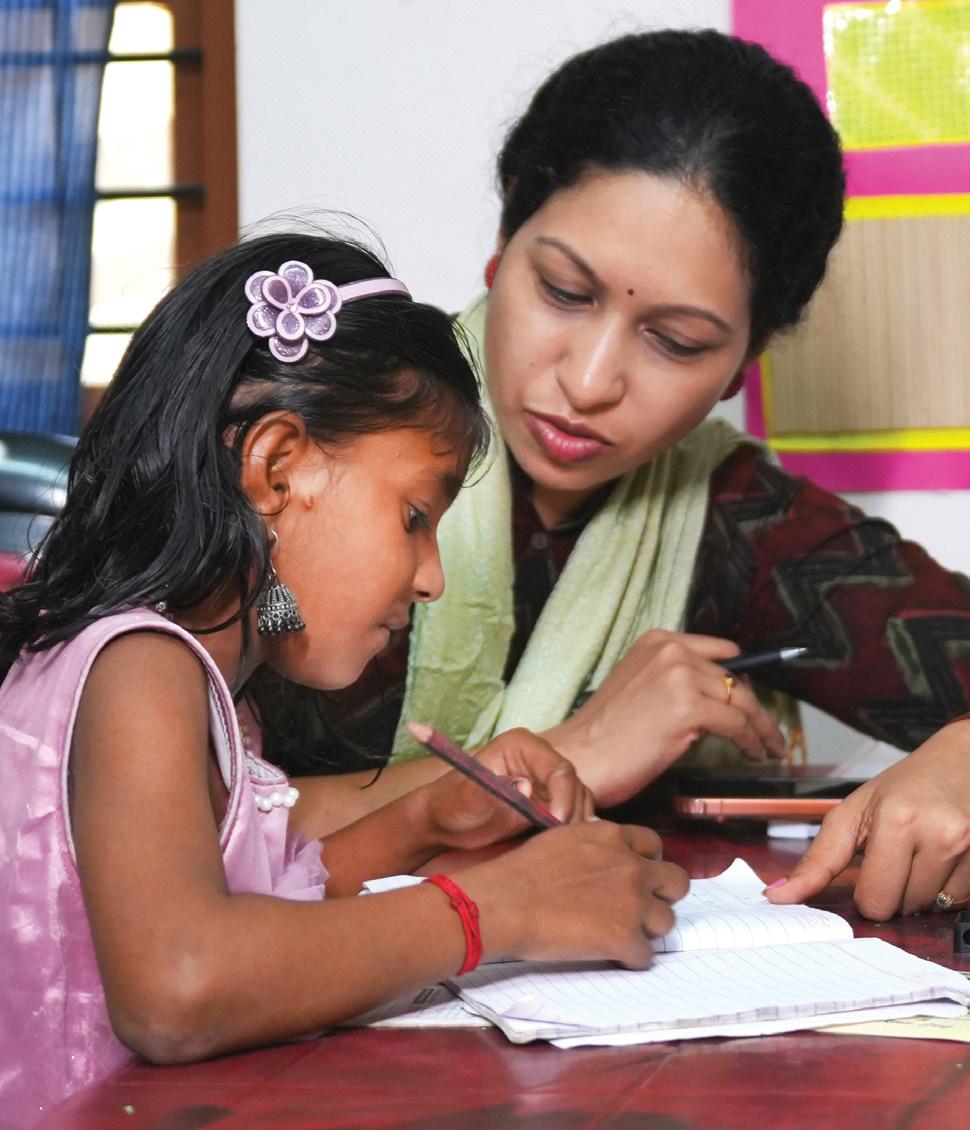
Teacher Brinda Ajith meets with children with special needs at Malankara Social Service Society.
In addition, the church is a major support to the government for crisis intervention, such as during natural disasters, floods and landslides, filling the gaps in government aid with immediate support, including food, medicine, safe drinking water and makeshift camps.
Dhiya R.V. plays with her friends at the community center of the Malankara Social Service Society (M.S.S.S.) in Thiruvananthapuram, Kerala’s capital city. M.S.S.S. is the social ministry arm of the Syro-Malankara Catholic Archeparchy of Trivandrum.
Dhiya, 9, was born with Triple X syndrome — a random genetic condition that occurs in about 1 in 1,000 females who are born with three X chromosomes instead of two. The syndrome is often mild, and many cases go undiagnosed. However, it can cause developmental delays, learning disabilities, speech, hearing and language issues.
Dhiya’s mother left with another man after Dhiya’s diagnosis, so Dhiya’s paternal grandmother has raised her.
Dhiya has a severe hearing impairment, a learning disability and displays hyperactive behavior.
“But coming here has helped her,” says the Rev. Varghese Kizahakkekara, M.S.S.S. director. “She is able to play and mix with other children who are like her.”
These children are part of the organization’s Sparsh program. “We support them through education, counseling, therapy and communication classes,”
Father Kizahakkekara says.
Sparsh’s 15 staff serve 76 children. Its teachers also go into public schools that have partnered with M.S.S.S. to provide learning support to children with special needs.
Sparsh has been running a lunch program, from Monday to Saturday, at the M.S.S.S. compound for more
than 100 people since 2020. Beneficiaries include people of all ages, students and laborers.
“Anyone can come here to eat,” Father Kizahakkekara says. “The meal is healthy and, while considering the menu, we keep in mind that it gives you everything — protein, carbohydrates, vitamins and minerals.”
M.S.S.S. received special consultative status from the United Nations in 2016, which identifies the church organization as a reputable receiver of foreign grants.
“We have been serving the poor, needy, marginalized and unorganized sections of people irrespective of their caste, religion or gender,” Father Kizahakkekara says, noting the ministry serves the entire Indian subcontinent.
Among other marginalized groups in Kerala, M.S.S.S. assists widows, through the Sneha Suraksha program, as well as Dalit children. Sneha Suraksha, which relies mostly on donations from parishioners and benefactors, supports 130 single mothers with a monthly $11 stipend.
“We’re trying, in our small way, to improve the socioeconomic structures of widows who are also single mothers,” Father Kizahakkekara says.
M.S.S.S. provides scholarships for children of the marginalized Dalit community. The scholarships are used for books, school fees and tuition, and student loan repayment.
“There are many poor families in our parishes,” Father Kizahakkekara says, citing support from donors.
“Education is by far the best gift you can give someone.”
Anubha George is a former BBC editor. She is a columnist and writer for various publications. She is based in Kerala, India.
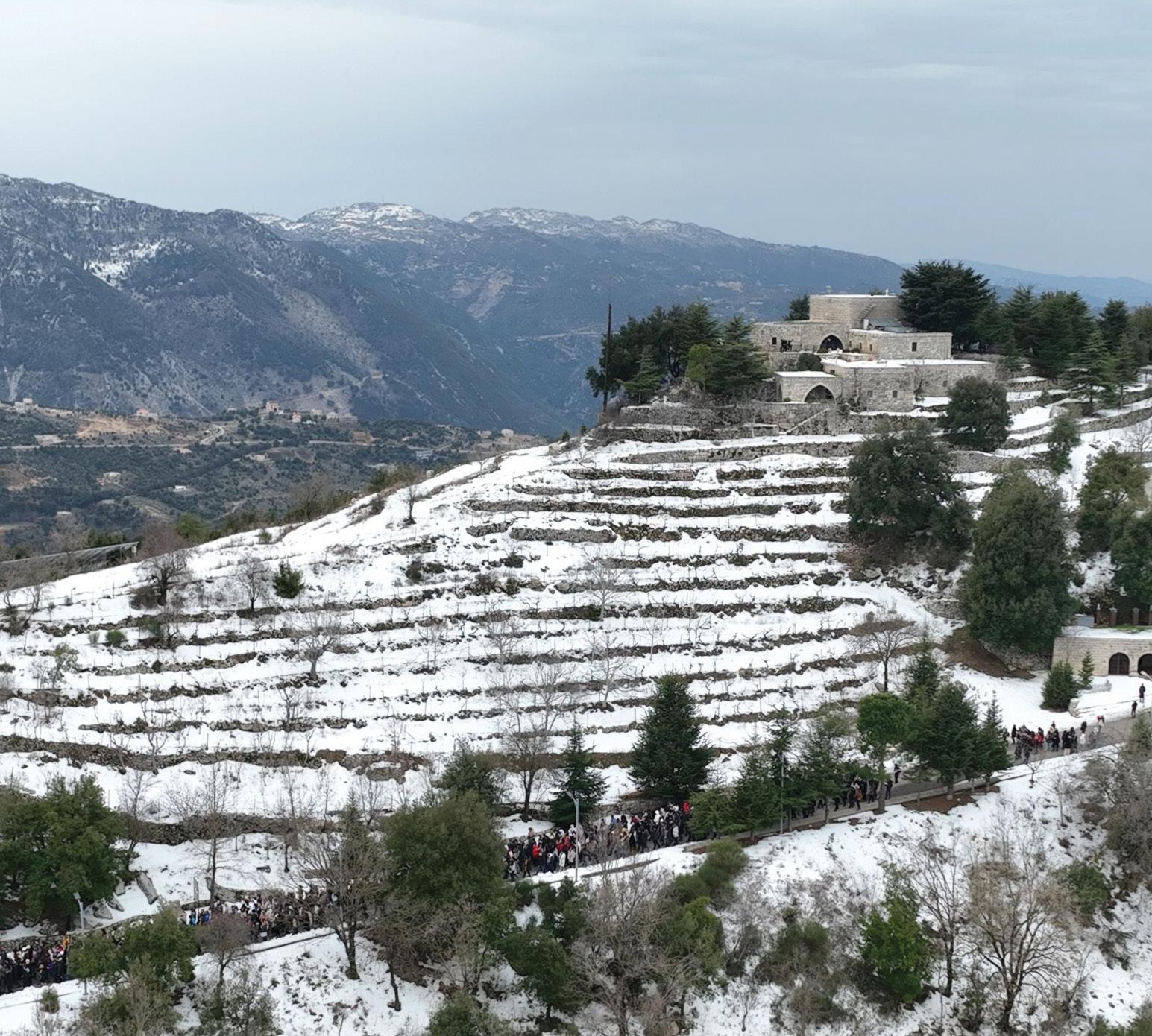
Wearing warm hats and winter coats, a small group of pilgrims pray the Hail Mary in hushed tones in a mountaintop church in Annaya, Lebanon. The church sits within Sts. Peter and Paul Hermitage, part of a monastic complex where the renowned Maronite monk, St. Charbel Makhlouf, lived for nearly three decades.
The thick stone walls of the hermitage block out January’s strong winter winds. The only sound is the footsteps of pilgrims on the ancient tile floor. As the pilgrims move from the church to the saint’s cell and then to the chapel, the silence is awash with solace and contemplation.
Shortly before nine o’clock, having finished their prayers, the pilgrims step out and find a dramatic view. Situated 4,300 feet above sea level and 42 miles north of Beirut, the site offers a panorama of Lebanon, from its snow-capped mountains to the Mediterranean Sea.
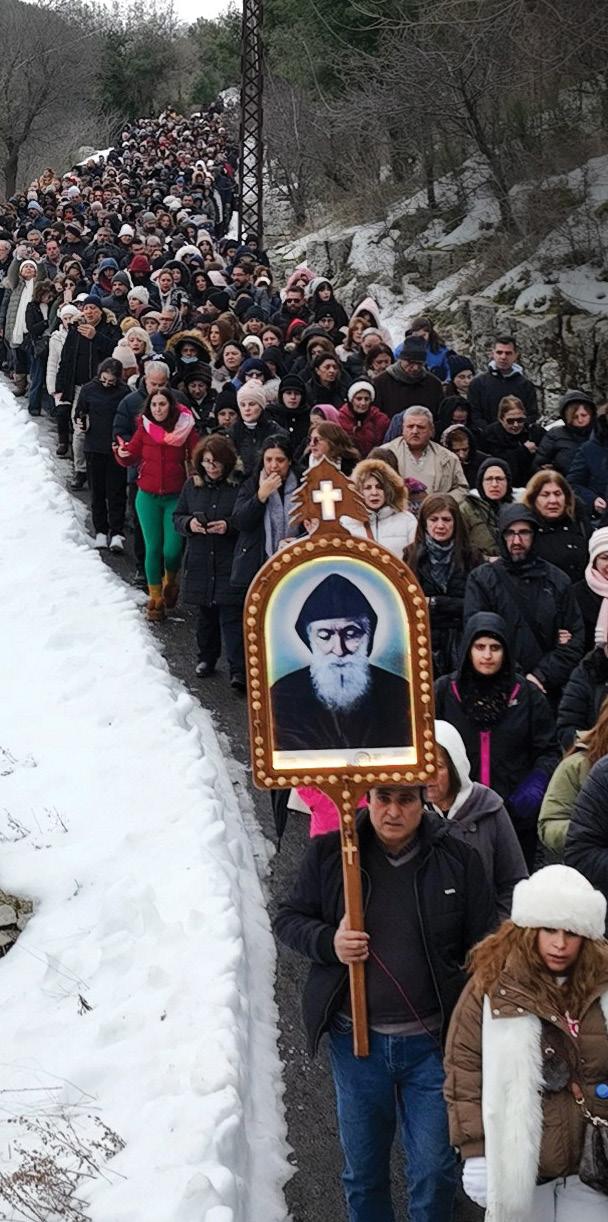
It is the 22nd day of the month, when thousands of pilgrims, Lebanese and non-Lebanese, gather in Annaya for the monthly pilgrimage in honor of St. Charbel, setting out along a winding road to the Monastery of St. Maron. Built in 1828 after the hermitage was established, the monastery houses the tomb and relics of the Maronite monk and hermit.
At the entrance to the monastery, some pilgrims collect and consume the soil from the site of the tomb where he was first buried. Then, pilgrims pray in St. Maron Church, light candles in the courtyard and pray before his actual tomb.
Alemnesh Tafara and Asrati Beletamengstu, two Ethiopian
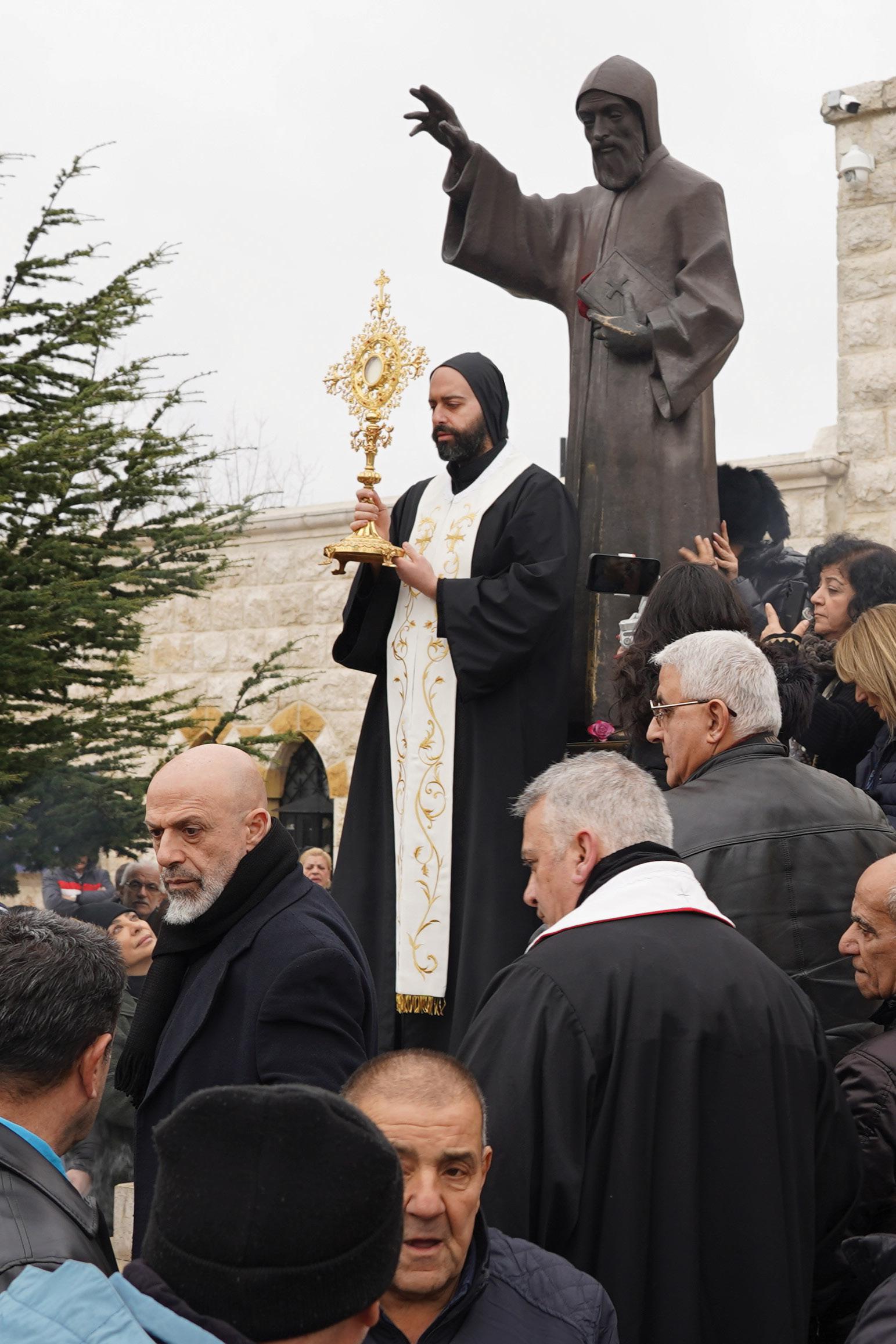
Pilgrims process to the Monastery of St. Maron in Annaya, Lebanon, in honor of St. Charbel on 22 January.
Lebanon’s Beloved Saint
St. Charbel, an unknown hermit during his lifetime, is revered worldwide for his faith and miracles
text by Laure Delacloche with photographs by Raghida Skaff
PEOPLE, LOOK EAST
women who work in Lebanon, joined the January pilgrimage.
“I ask St. Charbel to heal me. He is the only one who can,” says Ms. Tafara, 46, who has breast cancer and is unable to afford health care. She and her friend, both domestic workers, attend the pilgrimage monthly and take sacred oils, water and oak leaves back to Beirut. St. Charbel used to pray in the shade of an oak tree, which later became a relic, from which pilgrims have taken leaves and bark.
Elie Bilem, 34, has attended the pilgrimage every month for 10 years in thanksgiving for his answered prayers.
“I asked him to find me work, and he did,” says the ski instructor and bar owner. “Here I feel calm, I reflect on what has happened in my life, and on what I will do next.”
St. Charbel was born Joseph Makhlouf in 1828 in Bqaa Kafra, a village of Mount Lebanon. He entered the Monastery of St. Maron, a monastic community of the Maronite Church, an Eastern church of the Syriac tradition in full communion with the bishop of Rome. At 23, he took the name Charbel after an early Christian ascetic. He was ordained a priest at age 31 and, after spending 16 years in the monastery, he retreated to the hermitage in 1875. There, Father Charbel led a secluded life, dedicating his days to prayer and work in the nearby fields, undisturbed by the tremendous societal shifts occurring in Lebanon at the time, including the transition from Ottoman rule to the rule of the French and British. He died on Christmas Eve, 1898, and was buried at the monastery, where an oily substance oozed from his incorrupt body for more than 60 years. He was canonized in 1977.
Since St. Charbel’s death, more than 29,680 miracles have been attributed to his intercession, says Father Louis Matar, O.L.M., monastery bookkeeper and member of the Lebanese Maronite Order, whose main task is to assess and record these miracles.
“Around 10 percent of them happened to non-Christians,” Father Matar says.
In January, the monastery recorded two additional healings, one in the United States and the second in Lebanon.
her: “I performed the surgery to help people regain their faith. I ask you to visit my hermitage in Annaya on the 22nd of every month and attend Mass regularly for the rest of your life.”
When Mrs. Shami awoke, she had two neck scars. These scars opened and bled on the 22nd of each month. She did as St. Charbel instructed until her death last May.
Other people who have experienced miracles have shared similar stories of “surgeries” being performed on them in a dream.
“There are 10 million Maronites outside Lebanon, which helps spread the story of St. Charbel.”
However, the miracle that catapulted devotion to the saint was reported by Nohad al-Shami, a mother of 12, who suffered a stroke on 9 January 1993, and was left partially paralyzed. Her eldest son, Saad, went to the hermitage the following week, 18 January, appealed to the saint and took blessed oil and soil back to his mother.
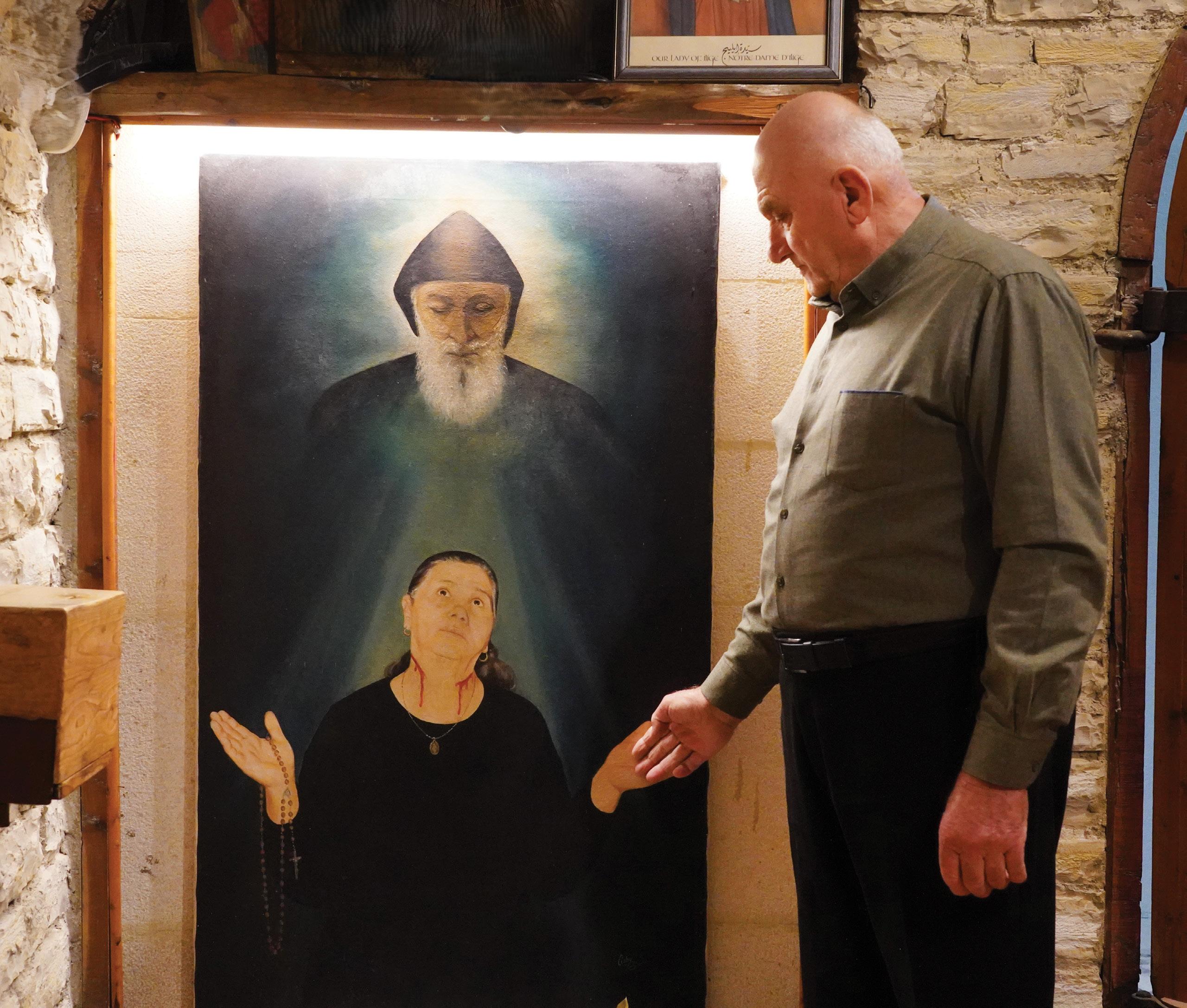
“I said to him, ‘Please heal my mother, we still need her, and, if you heal her, we will make your name known all over the world,’ ” said Mr. Shami, 72, during an interview in his home, surrounded by pictures and paintings of his mother.
On 22 January 1993, Mrs. Shami had a dream, in which St. Charbel, accompanied by another monk, performed surgery on her and told
Antonio Ishaac, 28, stopped all his treatment for Crohn’s disease in December 2024. In May 2025, he went to the monastery, consumed soil from the saint’s first tomb, and prayed to Jesus and to the saint, saying: “Either you heal me or I will die from this illness. I accept it.”
“After two days, during one entire night, I experienced the equivalent of two years of pain,” he recounts. “When I woke up, the pain had vanished. I took some tests several months later, and the disease had disappeared.”
Saad al-Shami stands by a painting depicting St. Charbel and his mother, Nohad al-Shami, who experienced a healing attributed to the intercession of St. Charbel.
His miracle was recorded at the monastery last October, along with a miracle reported by Nancy Nehme. A university English instructor, Ms. Nehme had been suffering from a herniated disk that caused debilitating pain in her back and leg.
“One night [in 2017], I had been praying to St. Charbel before a picture of him, but I could not sleep and I was in pain. So, I told him that I was disappointed in him and that I would not pray to him anymore, and then I felt guilty for saying such a thing,” she says.
“I suddenly felt someone standing behind me in my bedroom and I was certain that it was St. Charbel,” she continues. “I felt two hands pressing hard on me and turning me upside down on my bed, when I heard a voice say, ‘Your body is going to see heaven.’ ”
An M.R.I. in 2024 indicated the disk was “back to normal,” she said. “Now, we often visit St. Charbel; he has become part of the family.”
Roula Talhouk, director of the Institute for Muslim-Christian Studies at Saint Joseph University of Beirut, says St. Charbel “is the most beloved saint for the Lebanese.”
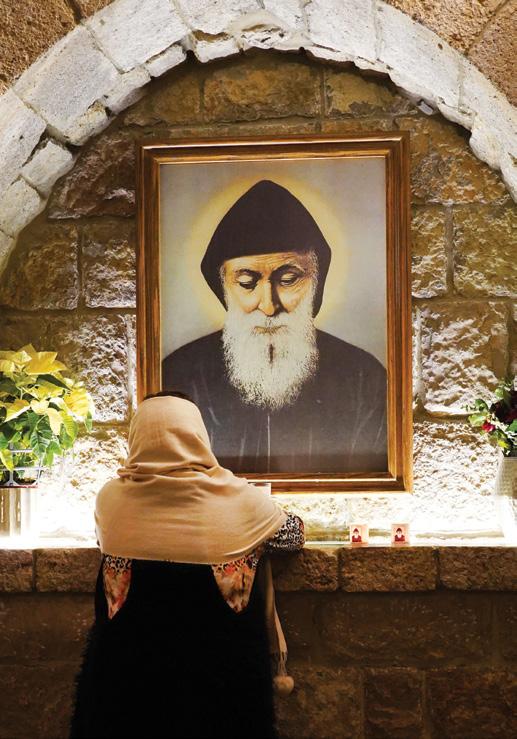
Across Lebanon, St. Charbel, depicted with lidded eyes, a long white beard and a black monastic hood, is a familiar face. His image is in countless homes, hanging from rear-view mirrors and encased in outdoor shrines on street corners.
“I ask St. Charbel to heal me. He is the only one who can.”
He “was Maronite, spoke our language — the Lebanese Arabic language — and remained present [spiritually] throughout all the wars and difficulties we faced,” Ms. Talhouk says.
“These miracles are extraordinary, and people enjoy them,” she adds. The monastery is open round the clock, which fosters a feeling of proximity to the saint, she says.
“All this makes it a place of pilgrimage and prayer for theologians, believers and anyone seeking quick answers. It is the place where one has the best chance of experiencing a miracle,” she says.
“It is very human, yet very beautiful: The Lebanese allow themselves to talk to St. Charbel in a filial way.”
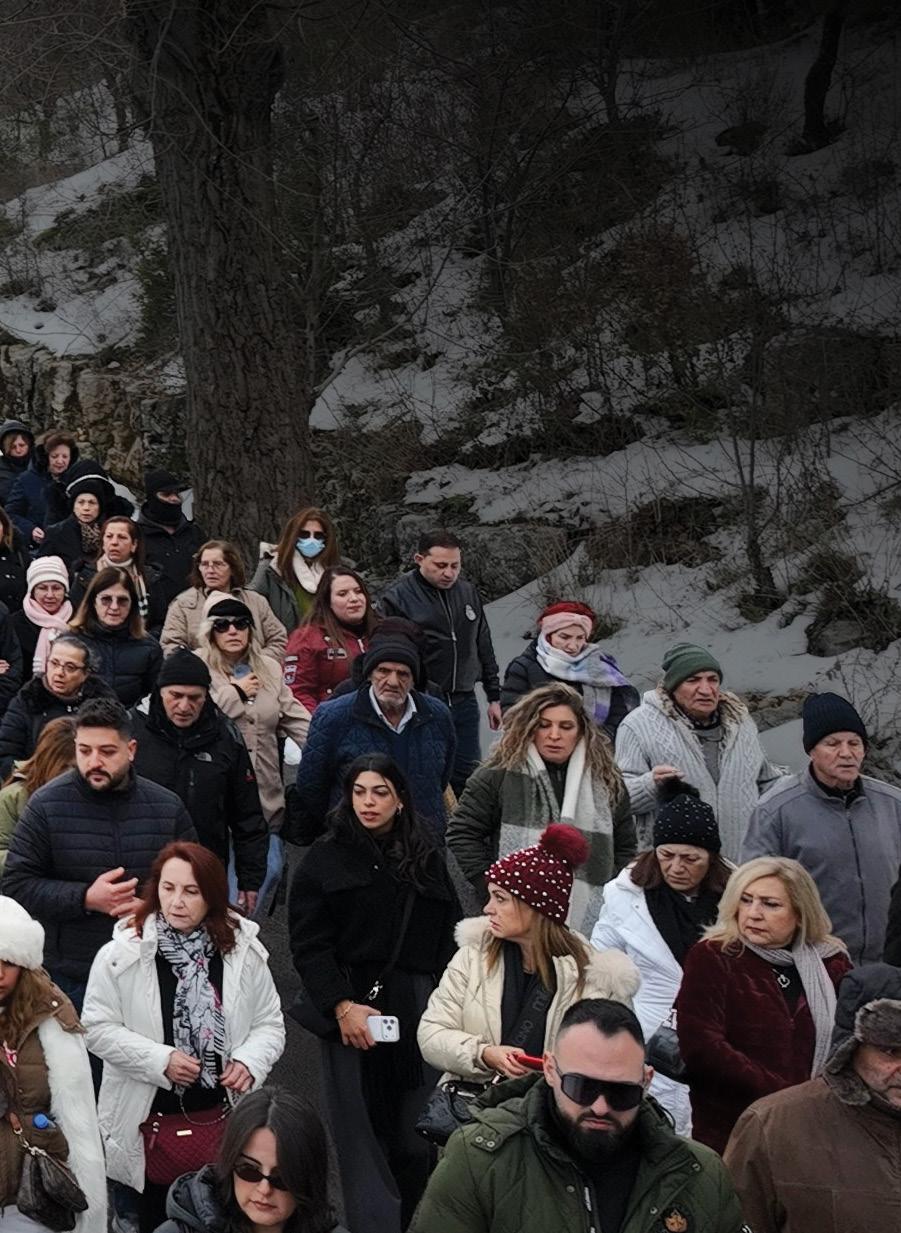
The monthly pilgrimage to the Monastery of St. Maron can draw up to 30,000 people — Christians, Druze, Hindus and Muslims — and sometimes even 75,000 people, Father Matar says. Before COVID-19, some 4.5 million pilgrims visited the monastery each year.
“Now, with the war in Europe and the Middle East, we receive fewer visitors,” Father Matar adds. Still, the shrine will go through 13 tons of incense per year and up to five tons of candles per month.
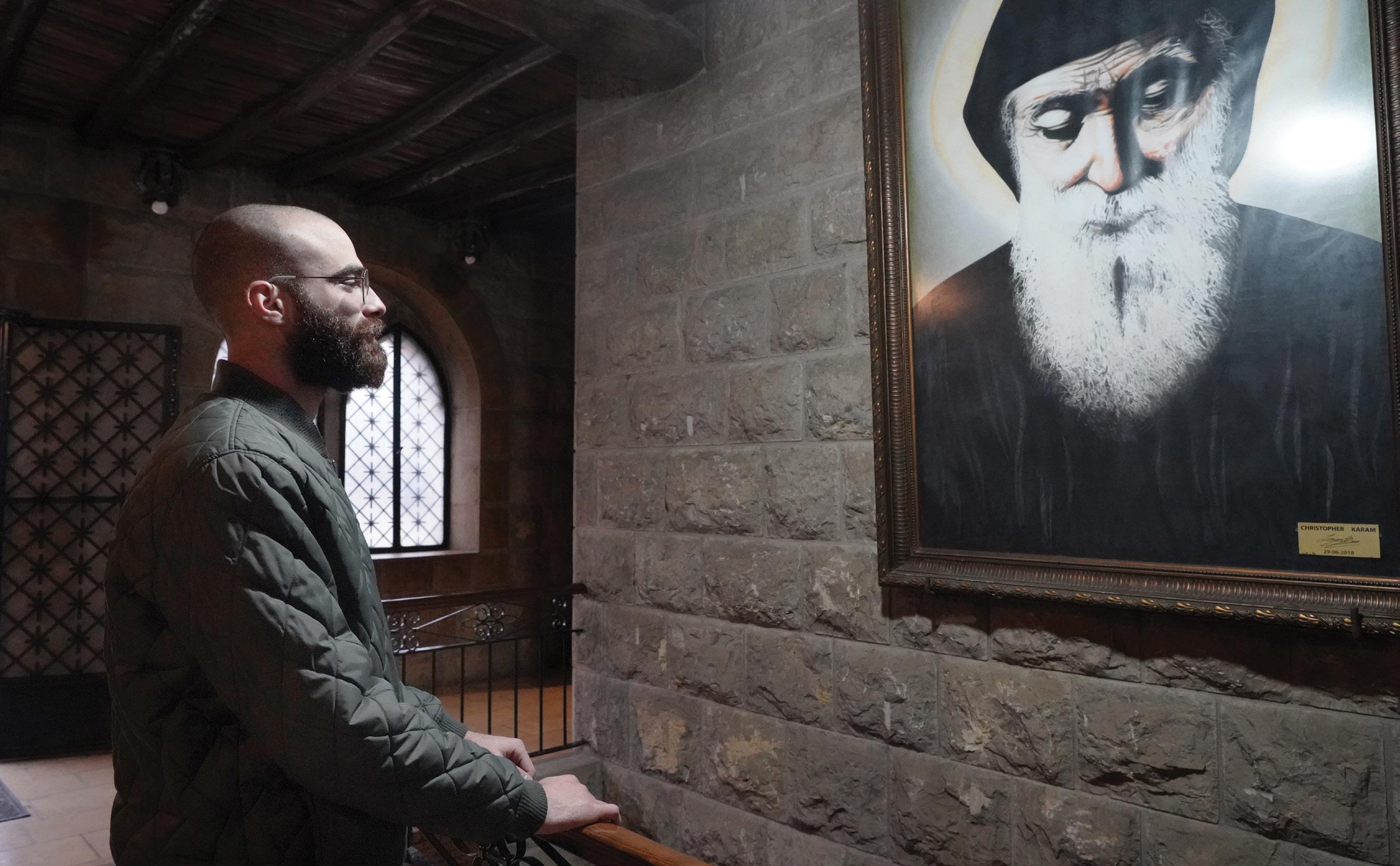
Antonio Ishaac, who says St. Charbel answered his prayer for healing, gazes upon an image of the saint. Opposite, before a crowd of pilgrims at the Shrine of St. Charbel, a Maronite priest holds up a monstrance for Eucharistic adoration.
In December, Pope Leo XIV became the first pope to visit the monastery and pray at St. Charbel’s tomb.
“He wrote nothing and lived a hidden and silent life, yet his reputation spread throughout the world,” the pope said of St. Charbel’s legacy.
“The Holy Spirit shaped and created him, to teach prayer to those whose lives were without God, to teach silence to those who live in noise, to teach humility to those who seek to stand out, and to teach poverty to those who seek wealth. All of these are situations that go against the tide, and that is why they are attracted to him,” he said.
Abbot Tannous Nehme recalls Pope Leo’s visit with great emotion, saying it “was a confirmation that the church’s journey begins with prayer, and St. Charbel’s life shows that the pursuit of God is our foremost duty.”
However, the saint’s renown has not prevented his misappropriation for partisan cultural and political agendas.
“In Lebanon, religion is exploited by politics,” Ms. Talhouk says. Statues up to 88 feet tall have been erected and large processions organized “to signal the strength of the Christian presence in certain areas.”
Yet, outside Lebanon and its partisan politics, St. Charbel continues to gain in popularity.
Last November, a monastery dedicated to St. Charbel opened in France, while in New York the shrine dedicated to the saint in St. Patrick’s Cathedral draws thousands daily.
“There are 10 million Maronites outside Lebanon, which helps to spread the story of St. Charbel. And social media play a role as well,” as new miracles are announced on these platforms, Ms. Talhouk says.
“St. Charbel Makhlouf has become a universal saint,” says the Rev. Paul Matar, a priest of the Maronite Archeparchy of Beirut, who serves on the formation team at the patriarchal seminary.
The saint’s popularity “is not only due to his miracles, but to the depth of his God-centered life,” he says. He has observed how the saint “is celebrated in a manner that is popular, liturgical and deeply existential.”
St. Charbel “lived everything contained in the Scriptures.” His faith, “radically centered on God,” was marked by silence, prayer and “total self-sacrifice,” and his spirituality was “interior, faithful and persevering,” he explains.
“In a country marked by profound economic, political and social crises, St. Charbel thus becomes a companion on the journey.”
Laure Delacloche is a journalist in Lebanon. The BBC and Al Jazeera have published her work.
Take a closer look at this story through ONE’s exclusive audio and video content. u
The Last Word
Perspectives from the president
by Msgr. Peter I. Vaccari
“Then I saw a new heaven and a new earth. The former heaven and the former earth had passed away, and the sea was no more. … I heard a loud voice from the throne saying, ‘Behold God’s dwelling is with the human race. He will dwell with them and they will be his people and God himself will always be with them [as their God].
“ ‘He will wipe every tear from their eyes, and there shall be no more death or mourning, wailing or pain, [for] the old order has passed away.’ ”
(Rev 21:1,3-4)
In CNEWA’s founding documents, both in the letter of the Congregation for the Eastern Church, 10 March 1926, and in the letter of the secretary of state, 11 March 1926, Pope Pius XI established Catholic Near East Welfare Association under the direction of the archbishop of New York.
This year, CNEWA celebrates its 100th anniversary. We take this opportunity to mark a moment of historic transition in the governance of CNEWA. We express our profound gratitude to His Eminence Timothy Cardinal Dolan for his nearly 17 years of service as the chair of CNEWA’s International Board of Trustees. His leadership has been marked by apostolic zeal and love for the first and most ancient Catholic churches in their places of origin.
Over the years, motivated by his pastoral zeal, he has visited many of the locations where CNEWA serves, including India, Iraq, Lebanon, Ukraine, Jerusalem, Bethlehem and Palestine. Often these visits were made under very difficult circumstances. Cardinal Dolan, thank you!
On 6 February, Archbishop Ronald Hicks, formerly bishop of Joliet, Illinois, was installed as the 11th archbishop of New York, becoming chair of CNEWA’s International Board of Trustees. We offer him our prayers, our loyalty and our support. We look forward to his leadership, his wise and prudent counsel, and his prayers. Archbishop Hicks, welcome!
As this issue of ONE was going to press — and the hope for a lasting ceasefire in Gaza started to take root — the situation in the Middle East, where CNEWA works, was plunged into yet another crisis with the Israeli-U.S. strikes on Iran on 28 February, and Iran’s retaliation throughout the Arab world, putting the lives of tens of millions of people in peril.
My thoughts went immediately to our staff on the ground at our offices in Beirut, Jerusalem and Amman, and to their families and the people they serve. Their heroic work among those in need is an extraordinary and living witness to the Gospel and to the mission of CNEWA. I ask that you join me in praying for them and for the immediate return to dialogue, diplomacy, justice and peace.
CNEWA was founded as a Gospel response to the geopolitical crises of the early 20th century. Today, 100 years later, the mission of CNEWA is still much needed, perhaps now more than ever.
This issue of ONE will look back at CNEWA’s founding with the first article of a yearlong series by Michael J. La Civita, executive editor of ONE and director of communications and marketing, that will mark the centennial. Mr. La Civita, who has been serving CNEWA for more than three decades, will trace CNEWA’s major milestones and the ways in which it has responded to the changing needs of the Eastern churches, impacted by the significant shifts in
the regions where CNEWA works.
This issue also includes a report on the near collapse of the health care network in Gaza; the commitment of the church in Ukraine to form lay leaders and professionals in the shadow of the fourth anniversary of Russia’s war on Ukraine; the work of the Syro-Malabar and the SyroMalankara Catholic churches in health care and social services in southern India, despite the growing affluence in the region; and a feature on the enormously popular Shrine of St. Charbel in Lebanon and its patron, a monk of international renown.
As with previous issues, ONE also has planned features for publication online only, namely on the increasing daily challenges of Ukrainians under ongoing Russian attacks, and the growing devotion to the Rev. Miklos Soja, a Hungarian Greek Catholic priest, whose life was dedicated to the pastoral care of the Gypsy community in eastern Hungary, by Laura Ieraci, editor of ONE
My column in December 2025 offered reflections on how we might approach the centennial. My hope is that we will remain open to the movement of the Spirit, the intercession of the Virgin Mary, and God’s daily graces to guide our journey, our partnerships and our strategies. My hope in this 100th year is that we will remain open and strive to broaden the opportunities to build a culture of encounter and dialogue on ecumenical and interfaith levels.
My heartfelt prayer is that the Scripture passage from the Book of Revelation quoted above will provoke a deep passion within each of us to be agents of healing and hope in realizing that God’s dwelling is with us! God dwells with us, here and now, today!
Are we not called to be God’s missionary servants in wiping away the tears of those who suffer and live in fear: victims of war, religious persecution or natural disasters; migrants, refugees and the internally displaced; those in need of health care, psychosocial
Cardinal Timothy M. Dolan, right, greets then-Bishop Ronald A. Hicks of Joliet, Illinois, at a news conference on 18 December, announcing Bishop Hicks as the next archbishop of New York.
counseling or education, and victims of human trafficking in any of its pernicious forms?
Permit me to share with you some events we have planned later this year to mark our centennial:
13 December: Mass at St. Patrick’s Cathedral, New York City, 10:15 a.m.
15 December: CNEWA Centennial Gala Dinner
The guest of honor will be Frà John Dunlap, 81st grand master of the Sovereign Military Order of Malta. CNEWA’s Faith & Culture Award recipient will be Her Excellency Sister Raffaella Petrini, F.S.E., president of the Pontifical Commission for Vatican City State and president of the Governorate of Vatican City State. The gala will be held at the Plaza Hotel in New York City.
With my gratitude and prayers for your support of the mission of CNEWA/PMP!
Peter I. Vaccari President
Catholic Near East Welfare Association (CNEWA)
220 East 42nd Street, New York, NY 10017 | 1-800-442-6392 | cnewa.org