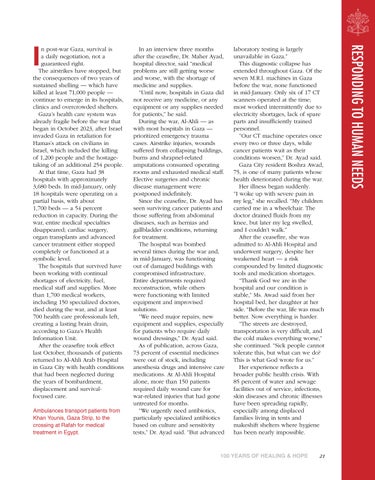
Ambulances transport patients from Khan Younis, Gaza Strip, to the crossing at Rafah for medical treatment in Egypt.
In an interview three months after the ceasefire, Dr. Maher Ayad, hospital director, said “medical problems are still getting worse and worse, with the shortage of medicine and supplies. “Until now, hospitals in Gaza did not receive any medicine, or any equipment or any supplies needed for patients,” he said. During the war, Al-Ahli — as with most hospitals in Gaza — prioritized emergency trauma cases. Airstrike injuries, wounds suffered from collapsing buildings, burns and shrapnel-related amputations consumed operating rooms and exhausted medical staff. Elective surgeries and chronic disease management were postponed indefinitely. Since the ceasefire, Dr. Ayad has seen surviving cancer patients and those suffering from abdominal diseases, such as hernias and gallbladder conditions, returning for treatment. The hospital was bombed several times during the war and, in mid-January, was functioning out of damaged buildings with compromised infrastructure. Entire departments required reconstruction, while others were functioning with limited equipment and improvised solutions. “We need major repairs, new equipment and supplies, especially for patients who require daily wound dressings,” Dr. Ayad said. As of publication, across Gaza, 73 percent of essential medicines were out of stock, including anesthesia drugs and intensive care medications. At Al-Ahli Hospital alone, more than 150 patients required daily wound care for war-related injuries that had gone untreated for months. “We urgently need antibiotics, particularly specialized antibiotics based on culture and sensitivity tests,” Dr. Ayad said. “But advanced
laboratory testing is largely unavailable in Gaza.” This diagnostic collapse has extended throughout Gaza. Of the seven M.R.I. machines in Gaza before the war, none functioned in mid-January. Only six of 17 CT scanners operated at the time; most worked intermittently due to electricity shortages, lack of spare parts and insufficiently trained personnel. “Our CT machine operates once every two or three days, while cancer patients wait as their conditions worsen,” Dr. Ayad said. Gaza City resident Boshra Awad, 75, is one of many patients whose health deteriorated during the war. Her illness began suddenly. “I woke up with severe pain in my leg,” she recalled. “My children carried me in a wheelchair. The doctor drained fluids from my knee, but later my leg swelled, and I couldn’t walk.” After the ceasefire, she was admitted to Al-Ahli Hospital and underwent surgery, despite her weakened heart — a risk compounded by limited diagnostic tools and medication shortages. “Thank God we are in the hospital and our condition is stable,” Ms. Awad said from her hospital bed, her daughter at her side. “Before the war, life was much better. Now everything is harder. “The streets are destroyed, transportation is very difficult, and the cold makes everything worse,” she continued. “Sick people cannot tolerate this, but what can we do? This is what God wrote for us.” Her experience reflects a broader public health crisis. With 85 percent of water and sewage facilities out of service, infections, skin diseases and chronic illnesses have been spreading rapidly, especially among displaced families living in tents and makeshift shelters where hygiene has been nearly impossible.
100 YEARS OF HEALING & HOPE
21
RESPONDING TO HUMAN NEEDS
I
n post-war Gaza, survival is a daily negotiation, not a guaranteed right. The airstrikes have stopped, but the consequences of two years of sustained shelling — which have killed at least 71,000 people — continue to emerge in its hospitals, clinics and overcrowded shelters. Gaza’s health care system was already fragile before the war that began in October 2023, after Israel invaded Gaza in retaliation for Hamas’s attack on civilians in Israel, which included the killing of 1,200 people and the hostagetaking of an additional 254 people. At that time, Gaza had 38 hospitals with approximately 3,680 beds. In mid-January, only 18 hospitals were operating on a partial basis, with about 1,700 beds — a 54 percent reduction in capacity. During the war, entire medical specialties disappeared; cardiac surgery, organ transplants and advanced cancer treatment either stopped completely or functioned at a symbolic level. The hospitals that survived have been working with continual shortages of electricity, fuel, medical staff and supplies. More than 1,700 medical workers, including 150 specialized doctors, died during the war, and at least 700 health care professionals left, creating a lasting brain drain, according to Gaza’s Health Information Unit. After the ceasefire took effect last October, thousands of patients returned to Al-Ahli Arab Hospital in Gaza City with health conditions that had been neglected during the years of bombardment, displacement and survivalfocused care.