Health + Wellness
Living healthier together.
Spring 2017 | cheshiremed.org
A healthy start for mother and baby −in life and recovery.
The Mothers in Recovery Program at CMC/DH offers help for expecting mothers seeking recovery from opioid use disorder.
Medical Center Update
Making Healthy Choices
Health Education & Support
Cheshire Health Foundation
Affiliation is expanding our capabilities
Better resilience can improve health outcomes
Don’t miss this spring’s line-up of programs
We live here, we give here−making a difference locally
FROM THE CEO/PRESIDENT/CHIEF MEDICAL OFFICER
Cheshire Medical Center Update Brand Alignment is the next step in our affiliation with Dartmouth-Hitchcock Health
Continuing our legacy of evolving with our community’s needs Healthcare is a constantly changing landscape. A lot has changed since our Medical Center was first established as Elliott Hospital 125 years ago. What has not changed is the commitment to compassion, health, and sustainability we share with our community. We have a long history of living healthier together with our neighbors. In these pages, we will highlight updates and developments that effect our patients at our nonprofit medical center, information and tools to help you make choices to live healthier, and stories from our community about how members of our region are coming together to make a difference. The Summer 2016 issue of Health Quarterly magazine (recast as Health + Wellness with our Fall 2016 issue) looked at how the opioid crisis has affected state guidelines for opioid prescribing, and ways in which CMC/ DH physicians and providers partner to promote safe prescribing practices consistently across our campus. In this issue, we will further the discussion of how we are partnering to reduce opioid misuse through our Mothers in Recovery (MIR) program. MIR is a collaboration between teams in Women’s Health at CMC/DH and community partners to offer prenatal through postpartum support and care for expectant mothers with opioid use disorders and their babies. Our Center for Population Health Strategy and Practice staff are working to help improve the health of individuals beyond medical treatment, by connecting them with available community resources. Family stability, jobs, safety, education, physical activity, and resiliency are all recognized as principal components of better health and wellbeing. Our ability to manage stress and adversity is evidenced to impact health outcomes. I encourage our readers to view the robust offering of free resiliency workshops in the spring programs listing.
Don Caruso, CEO/President/Chief Medical Officer
2 Spring 2017 | Health + Wellness
There are numerous benefits to our affiliation with the larger health system. Exciting opportunities are materializing in the care and services our Medical Center provides to our local patients. A major change is the unifying of our campus. You may have noticed that we are no longer referred to as a “hospital and clinic”. We are no longer Cheshire Medical Center, the hospital, sharing a campus with the Dartmouth-Hitchcock Keene clinics. We are now one Cheshire Medical Center, affiliate of the DartmouthHitchcock Health system−providing a continuum of care spanning primary care and specialty medicine, to surgical services and acute inpatient care. The changes to our logo reflect the changes through our affiliation. We are still your local nonprofit community medical center, with the foundational support of the larger DartmouthHitchcock Health system. We are Cheshire Medical Center/Dartmouth-Hitchcock.
Shawn LaFrance, Vice President of Population Health & Health Systems Integration Shawn LaFrance has joined our administrative team as Vice President of Population Health & Health Systems Integration. Shawn will build upon the vital work of his predecessor, Dr. José Montero, in leading our Center for Population Health Strategy and Practice in achieving our goals to improve health and wellness in the Monadnock Region. “I’m excited to continue to work to improve health and health care in our state as Vice President of Population Health & Health Systems Integration at
Affiliation is expanding our capabilities
TeleICU is expanding our capabilities in the continuum of critical care
CELEBRATING OUR LEGACY C
HE
SHIR E
Our Walk-In Care clinic at the Center at Colony Mill was recognized as Best Local
David Finley, MD has joined forces with the CMC/DH Oncology Team at the Norris Cotton Cancer Center-Kingsbury Pavilion. Dr. Finley, Thoracic Surgeon, Director, Comprehensive Thoracic Oncology Program at Dartmouth-Hitchcock in Lebanon, and Associate Professor of Surgery, Geisel School of Medicine, Dartmouth, is now seeing patients here in Keene two times a month. At times, patient care requires a surgery provided through the larger academic medical center in Lebanon. Receiving pre and post-operative care close to home will relieve some of the stress associated with extended travel for our oncology patients undergoing Thoracic Surgery at D-H in Lebanon.
1892-2017
YEARS OF CARING
D
E
New website for CMC/DH Walk-In Care Clinic
Thoracic Surgeon at CMC/DH benefits Oncology patients
M
January of this year we launched our TeleICU program, illustrating the benefits and power of our affiliation with DartmouthHitchcock Health. Through this advanced system, a team of critical care specialists works in partnership with our CMC/ DH ICU staff using state-of-the-art video conferencing and monitoring. This system provides an extra layer of observation for critically ill patients and additional support for staff around the clock. All CMC/DH ICU beds are equipped with TeleICU monitoring technology and our ICU staff have integrated the virtual team into the daily care of ICU patients. TeleICU is expanding our capabilities in the continuum of critical care and is made possible through DartmouthHitchcock Connected Care.
Urgent Care Center by the Keene Sentinel 2016 Reader’s Choice Awards for the second year in a row. Patients seeking non-emergency medical care benefit from the seamless connections among CMC/DH Walk-In Care, Family Medicine, and Specialty Medicine. What many may not realize is that Walk-In Care is an extension of Family Medicine at CMC/ DH, conveniently located in the heart of the business center of Keene. At Walk-In Care, you’ll never need an appointment to be seen by one of our Cheshire Medical Center/ Dartmouth-Hitchcock Family Medicine staff. Now the Walk-In Care clinic can further support our patients’ experiences with a new responsive, mobile-friendly website at cheshiremedwalkin.org.
ER
Cheshire Medical Center/DartmouthHitchcock. It is an organization and a region that has demonstrated a commitment and leadership in a community approach to health. I look forward to meeting new colleagues and people in the Monadnock region.” said Shawn of his new position. Prior to joining CMC/DH, Shawn was the Executive Director of the New Hampshire Foundation for Healthy Communities. His more than 20 years of experience in planning and implementing projects to address community health issues in the government, foundation, and private sectors makes him uniquely qualified to lead our organization’s community health objectives.
IC
AL CEN
T
September 21, 2017 marks the 125th anniversary of the founding of Elliot City Hospital, Keene’s first public hospital. Throughout the coming months we invite you to join us in opportunities to celebrate our long shared history of caring and compassion, and the bright future ahead. Visit cheshiremed.org and click on the 125 Years of Caring icon to see more celebration details. Coming this Spring Celebrating our Elliot and Cheshire Babies Were you born at Elliot Community Hospital or Cheshire Medical Center? Please share your baby photo for a special anniversary display! Email photos to galexander@cheshire-med.com, or make and leave a copy of your photo at the Volunteer Services department at the Medical Center, MondayFriday, 8 am to 4:30 pm. Please include the baby’s name and year of birth.
Keene’s Healthcare History: From Elliot City Hospital to Cheshire Medical Center, and Into the Future Public talk presented by Don Caruso, MD, MPH, CEO/President, CMO, CMC/DH Wednesday, May 31, 2017 6:30-7:30 pm North Conference Room 1 Register online at cheshiremed.org/ celebration or by calling (603) 354-5460.
Health + Wellness | Spring 2017 3
Medical Center Update FEATURE STORY
The Mothers in Recovery Program For expecting mothers and their babies A new program at CMC/DH Women’s Health Center provides a key component to the Monadnock region’s collaborative, communitybased substance abuse treatment services.
I
n 2016, the Women’s Health Center at Cheshire Medical Center/ Dartmouth Hitchcock launched Mothers in Recovery (MIR), a program offering expectant mothers with opioid use disorder a combination of medication-assisted treatment (MAT) and comprehensive prenatal through postpartum care−delivering a healthier start for their babies. “In 2015, overdose deaths in New Hampshire reached an all-time high of 439, most of them from opioids,” says obstetrician/gynecologist Karen Bradley, MD, FACOG. “At [the time of publication], the projected number of overdose deaths for New Hampshire in 2016 is 478. Per
4 Spring 2017 | Health + Wellness
capita, our state has the second-highest opioid-related death rate of any state except West Virginia. “It’s a real problem, and pregnant women aren’t immune,” she adds. “These moms are members of our community, and it’s really important to give them the compassionate care they deserve, not only for themselves but for their babies,” This compassionate care begins with SBIRT—Screening, Brief Intervention, and Referral to Treatment—for every mom who comes to the center. This evidencebased practice helps identify women who may be misusing alcohol and illicit drugs. “This is a universal policy; we don’t profile patients,” explains Mindy
Glasschroeder, BSN, RNC-OB, clinical leader of the medical center’s Women and Children’s Health Unit. “Last year, over 400 women delivered here and, of these, 4 percent scored positive for the presence of opioids. That’s significant for a small community like ours.” But pregnant women struggling with opioid use disorder can seek out the Mothers in Recovery program on their own. In fact, the earlier in their pregnancy these moms-to-be get involved with the program, the better their chances of having a safe birth and healthy baby.
What the program entails “The program provides medication management, weekly group therapy, and
Resources for those seeking help for substance misuse or mental health care services As always, if you are experiencing a medical emergency, call 911. The New Hampshire Statewide Addiction Crisis Line is available 24 hours a day at: 1-844-711-HELP (4357) You can also visit the website: dhhs.nh.gov/ dcbcs/bdas/crisis-line.htm
Pictured: Amanda Hitchings, PsyD listens to a mother in recovery.
“
The best thing I can do for my children is to be in recovery. I felt hopeless for the longest time. Now I have real hope for the future. I’m more resilient than I realized. And I’m not alone.
”
−Participant in the Mothers in Recovery Program
specialized prenatal and postpartum care,” notes clinical psychologist Amanda Hitchings, PsyD, who assesses each woman’s candidacy for the program. Medication management involves careful, ongoing administration of a maintenance drug called buprenorphine (brand name Subutex). This medication helps to decrease cravings and manage withdrawal symptoms, increasing the mother’s likelihood to be successful in treatment and maintain sobriety. Group therapy, led by Dr. Hitchings, is held weekly, three weeks out of every four. The fourth week is devoted to group prenatal care, also referred to as the Centering Pregnancy model—a standard
part of prenatal care offered at CMC/ DH. Also standard is the involvement of certified nurse-midwives during every labor and birth. When MIR babies are born, they are screened for neonatal abstinence syndrome. NAS can occur when a baby is exposed to drugs while in the womb, then goes through withdrawal after birth. “We partner with the parents so they understand how to comfort newborns who are affected,” says Glasschroeder. Group therapy and medical management also continue postpartum. “This support is extremely important to help reduce relapse,” Hitchings says. “The focus is not only on substance use therapy
The National Suicide Prevention Lifeline is available 24 hours a day no matter what problems you are dealing with to help you find a reason to keep living. When you call, you’ll be connected to a skilled, trained counselor at a crisis center in your area. 1-800-273-TALK (8255) The NH Alcohol and Drug Treatment Locator offers a map of treatment agencies and individual practitioners for substance use disorder services around the state: nhtreatment.org Download a user-friendly guide to navigating the world of insurance coverage when it comes to substance use disorder and mental health services at: dhhs.nh.gov/ dcbcs/bdas/documents/resource-guideconsumers.pdf Cheshire County’s 24/7 helpline to assist individuals and families struggling with substance misuse and addiction: Cheshire County Addiction Assisted Recovery Initiative (ChAARI) 1-844-604-7878 Cheshire County’s single point of contact for assessment and referral for substance use disorders: Southwestern Community Services’ Coordinated Access Point Program (CAPP) 1-844-604-7878 Keene Serenity Center offers peer recovery support services: 603-283-5015 keeneserenitycenter.org Phoenix House offers comprehensive treatment services for drug and alcohol addiction: 1-888- 671-9392 phoenixhouse.org
Health + Wellness | Spring 2017 5
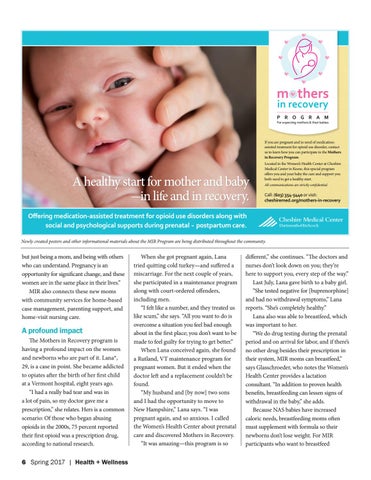
m thers in recovery
P R O G R A M
For expecting mothers & their babies
If you are pregnant and in need of medicationassisted treatment for opioid use disorder, contact us to learn how you can participate in the Mothers in Recovery Program.
A healthy start for mother and baby —in life and in recovery.
Located in the Women’s Health Center at Cheshire Medical Center in Keene, this special program offers you and your baby the care and support you both need to get a healthy start. All communications are strictly confidential.
Call: (603) 354-5440 or visit: cheshiremed.org/mothers-in-recovery
Offering medication-assisted treatment for opioid use disorders along with social and psychological supports during prenatal - postpartum care. Newly created posters and other informational materials about the MIR Program are being distributed throughout the community.
but just being a mom, and being with others who can understand. Pregnancy is an opportunity for significant change, and these women are in the same place in their lives.” MIR also connects these new moms with community services for home-based case management, parenting support, and home-visit nursing care.
A profound impact The Mothers in Recovery program is having a profound impact on the women and newborns who are part of it. Lana*, 29, is a case in point. She became addicted to opiates after the birth of her first child at a Vermont hospital, eight years ago. “I had a really bad tear and was in a lot of pain, so my doctor gave me a prescription,” she relates. Hers is a common scenario: Of those who began abusing opioids in the 2000s, 75 percent reported their first opioid was a prescription drug, according to national research.
6 Spring 2017 | Health + Wellness
When she got pregnant again, Lana tried quitting cold turkey—and suffered a miscarriage. For the next couple of years, she participated in a maintenance program along with court-ordered offenders, including men. “I felt like a number, and they treated us like scum,” she says. “All you want to do is overcome a situation you feel bad enough about in the first place; you don’t want to be made to feel guilty for trying to get better.” When Lana conceived again, she found a Rutland, VT maintenance program for pregnant women. But it ended when the doctor left and a replacement couldn’t be found. “My husband and [by now] two sons and I had the opportunity to move to New Hampshire,” Lana says. “I was pregnant again, and so anxious. I called the Women’s Health Center about prenatal care and discovered Mothers in Recovery. “It was amazing—this program is so
different,” she continues. “The doctors and nurses don’t look down on you; they’re here to support you, every step of the way.” Last July, Lana gave birth to a baby girl. “She tested negative for [buprenorphine] and had no withdrawal symptoms,” Lana reports. “She’s completely healthy.” Lana also was able to breastfeed, which was important to her. “We do drug testing during the prenatal period and on arrival for labor, and if there’s no other drug besides their prescription in their system, MIR moms can breastfeed,” says Glasschroeder, who notes the Women’s Health Center provides a lactation consultant. “In addition to proven health benefits, breastfeeding can lessen signs of withdrawal in the baby,” she adds. Because NAS babies have increased caloric needs, breastfeeding moms often must supplement with formula so their newborns don’t lose weight. For MIR participants who want to breastfeed
Healthier Together SPOTLIGHT exclusively, the program will soon offer a supply of safe, donated breast milk through the Mother’s Milk Bank of New England.
Future program enhancements Additional program enhancements underway including recruiting and training volunteer “cuddlers” for MIR babies, and additional support from the Cheshire Doula volunteer program. Doulas are trained professionals who provide emotional, physical, and educational support to a mother during labor and birth. While all maternity patients benefit from the CMC/DH Women’s Health Center collaborative care model for pregnancy and birth, expectant mothers in recovery from opioid misuse require special support—exemplified by the MIR program. “All these women want to get sober and wean off maintenance medication, but they know it’s what’s best for themselves and their babies for now—and that’s what motivates them,” says Dr. Hitchings. “The outcomes of our program are very good in terms of patients having improved psychosocial connections, medical outcomes and, most importantly, healthy babies,” notes Dr. Bradley. “This work is some of the most gratifying that I do.” *Name has been changed to protect patient privacy. To learn how you can participate in the Mothers in Recovery Program, call 603-354-5440. Tune in to WKBK (107.5FM/1290AM) Monday, May 15 at 9:00 a.m. for Health Matters with Dan Mitchell. In honor of Mother’s Day, special guests Mindy Glasschroeder, BSN, RNC-OB, CBC and Autumn Vergo, CMN will join Dan Mitchell to discuss the unique health services available through CMC/DH for expecting mothers and their babies.
A collaborative team approach to supporting mom and baby The Women’s Health Center at CMC/DH uses a patient-centered approach with all their patients, combining quality services with compassionate support and education. This collaborative care model is the basis of the Mother in Recovery Program. Here are some of the experts that make up the team that supports MIR.
Karen Bradley, MD
Dr. Bradley, Chief of Obstetrics at CMC/DH, practices with a focus on overall wellness for women. Her clinical expertise includes specialized areas of OB/GYN for women from adolescence through adulthood.
Amanda Hitchings, PsyD
Dr. Hitchings practices clinical psychology in the Women’s Health Center with a focus on integrated behavioral health in women’s health, pediatrics, and pain medicine. Additional interests include weight management, trauma, anxiety, and depression.
Mindy Glasschroeder, BSN, RNC-OB, CBC
As the Clinical Leader in the family centered Women & Children’s Health Unit (WACHU), Mindy manages the daily activities of providing quality, compassionate care for patients across the generations on the Unit. Additionally, she provides clinical and education support for WACHU nurses.
Autumn Vergo, CMN
As a certified nurse-midwife, Autumn provides care for women throughout their life—performing annual exams, guiding them through pregnancy and birth, and addressing healthcare needs relating to contraception, nutrition, bone health,and menopause. She works with obstetricians, gynecologists, nurses, partnering with patients to determine the best treatment and birthing options for each individual.
Health + Wellness | Spring 2017 7
Making Healthy Choices TIPS & TOOLS
Enhancing our wellbeing by building resilience What is resilience and why does having more of it matter? In short, resilience is our capacity to face and bounce back from life’s challenges and adversities. And it matters because experience and research tell us that increasing your resilience is a primary path to improved physical and emotional wellbeing. Essentially, being more resilient means that you cope with stress more effectively. And in so doing you reduce the likelihood of an assortment of health and psychological issues, have better relationships, experience more joy and satisfaction, find more meaning and purpose in life and some research suggests we live longer and with a better quality of life. What are the principles and practices of resiliency that strengthen our ability thrive amidst challenges and increase our wellbeing? The first has been summarized by many as “training your brain”. This involves increasing our mind’s ability to focus and be mindful in order to compete with our brain’s natural tendency and wiring towards mind wandering and “stewing” in negative ways. The day-to-day practice of mindfulness is an excellent example of this skill. Training your brain also includes developing a more flexible and constructive mindset. This mindset looks for the good, is optimistic and hopeful and compassionate to ourselves and others and connects and engages our heart. The second resilient principle and practice focuses on connections with others. Research has shown that connection with others at all stages of life may be the most robust contributor to increased resilience and wellbeing. Engaging with others is not just about socializing, but about the power of feeling connected to others and what affect that has in changing our brain. The third principle and practice of resiliency
8 Spring 2017 | Health + Wellness
Participants of the Cheshire Walkers program enjoy camaraderie along with exercise and opportunities to learn about our beautiful region.
focuses on attitudes and activities that reinforce a sense of meaning and purpose in our life. It supports the notion that each day provides an opportunity for us to live in a way consistent with our deepest principles and values. The Resilient Living programs offered through CMC/DH provide participants an opportunity to learn more about the principles highlighted above and to actively bring these principles into daily practice. Our goal is to offer programs that are accessible, interesting, reflecting current knowledge regarding resilience and wellbeing and in support of increasing the overall resiliency of our community as we grow healthier together.
Senior Connections programs offer opportunities to socialize One of the greatest challenges to our health and wellbeing outside poor nutrition, lack of physical activity and tobacco use is the growing epidemic of loneliness and social isolation in the aging and senior population. Nearly half of older adults in the United States experience some degree of loneliness according to AARP. Being isolated increases the risk of cancer, heart disease and stroke, increases blood pressure, lowers mood and increases the risk of suicide, and even increases of susceptibility to infection. Knowing what we do about loneliness and isolation, it is increasingly important to shed light on the issue and begin to look for
Healthier Together SPOTLIGHT
Monadnock Voices for Prevention
Reducing the impact of substance misuse through education, evaluation, and advocacy ways to ensure that a sense of belonging and connection happen here in the region. In order to alleviate loneliness, aging adults and seniors are encouraged to stay active and be social. This includes getting out at least weekly to volunteer, socialize, or attend religious services, nurturing relationships and making strong connections with family and friends, focusing attention on quality relationships that bring us joy, and finally, taking advantage of local resources. We are fortunate to live in an area with a robust senior center, home health care agency, family fitness organization, engaged libraries and education system that supply resources to the region by creating accessible and supportive programs for the aging population. As we focus more attention of the increasing aging population of our region, Cheshire Medical Center/Dartmouth Hitchcock offer Senior Connections, a set of programs and classes that work to connect older adults and seniors to one another and to relevant and meaningful information. Each night and every weekend day, you will find Senior Passport members enjoying a hot, healthy meal from the cafeteria. The Senior Passport Program is open to community members and patients 60 years and older. Members receive a free passport to better health information and discounted meals. Additionally, Wednesdays mornings you can join the Cheshire Walkers Program, a series of walks and hikes throughout the Monadnock region. Members walk every Wednesday in the Fall and the Spring in order to increase physical activity, foster social connection, and learn about the region’s rich history. Call (603) 354-5460 to find out more about Senior Connections programs.
Monadnock Voices for Prevention (MVP) is a regional network of community partners, as well as a wide range of volunteers, government agencies, civic groups, faith leaders and health care organizations, all of which have been working for years to reduce the impact of substance misuse and build our region’s resiliency. By bringing together this diverse group of people, MVP aims to increase collaboration and efficiency in addressing substance misuse in our community. Below are two of the individuals that help make that happen.
Developing resiliency skills early is key to prevention As the Substance Misuse Prevention Coordinator for the Greater Monadnock Region at the CMC/DH Center for Population Health, Hope Driscoll is working on initiatives to increase healthy behaviors in order to reduce the risk factors that contribute to substance misuse. Hope works with a variety of community individuals, organizations, educational Hope Driscoll institutions and businesses to collaboratively promote meaningful understandings about the importance of prevention in addressing the issue. “Prevention really does take a village,” says Hope, “Families, schools, businesses, and community organizations have a role in establishing protective factors that contribute to resiliency. All of us working together to raise protective factors, such as a strong relationship with a caring adult and building self-esteem, early in a child’s life is a key component to prevention. And it’s never too late to start. Building resiliency also supports treatment and recovery efforts, for individuals and for their families.”
Learning about what makes addiction so powerful and recovery so valuable Natalie Neilson works for the CMC/DH Center for Population Health as the Continuum of Care Facilitator for the Greater Monadnock Region. This role involves engaging community partners in integrating substance misuse prevention, intervention, treatment and recovery resources in order to create a more comprehensive and effective continuum Natalie Neilson of care. Natalie’s upcoming Health + Wellness workshop, Understanding Substance Use Disorder: A Brain Disease (see page 14 for details) aims to offer a presentation and dialogue about what is occurring in the body when someone experiences addiction and why reducing stigma matters. “When I walk into a room for a presentation, I often hear the question asked, ‘Have you or someone you love experienced addiction?’ Every hand goes up. With an issue that has such wide-reaching impact, one thing we can do as individuals, families, and community members is to learn about what makes addiction so powerful and recovery so valuable. Through understanding addiction and the barriers created by stigma and shame, we can help create communities that value recovery and those who need it.”
Health + Wellness | Spring 2017 9
Health Education & Support SPRING PROGRAM LISTINGS
Please join us! At Cheshire Medical Center/DartmouthHitchcock (CMC/DH), we believe that the health and wellness of every member of our community matters. And we are committed to being community partners in support of healthy and resilient living for all. Please join us for one or more of this Spring’s line-up of programs designed to provide learning opportunities and supportive connections with others on similar paths to optimal wellbeing.
Together, we can be our healthiest. These classes and programs are brought to you by CMC/DH’s Center for Population Health Strategy and Practice (Center) and are part of the many ways we are working to help our community be one of the nation’s healthiest. CMC/DH established the Center as a department dedicated to guiding and facilitating the implementation of community-based health and wellness projects and policies, integrating our clinical care into these efforts, and providing resources for education, outreach, and support to individuals, families, work-sites, schools, and the community. The Center is part of the Council for a Healthier Community, a group of 30+ individuals representing schools, organizations, coalitions and businesses that oversees the Healthy Monadnock Community Engagement Initiative. All of the Center’s project priorities align with the Healthy Monadnock Initiative and CMC/ DH is a proud member of the Healthy Monadnock Organizational Champions program. that oversees the Healthy Monadnock Community Engagement Initiative. All of the Center’s project priorities align with the Healthy Monadnock Initiative and CMC/DH is a proud member of the Healthy Monadnock Champions program.
10 Spring 2017 | Health + Wellness
Health Education and Support for the Monadnock Region You may notice that our listings are organized differently this Spring. With the exception of the Prenatal and New Parenting classes on the last page, the programs are listed in chronological order and fall into two major categories:
+ Heathly Living with a focus on topics that support our overall health
+ Resilient Living with a focus on topics that support our overall wellbeing
In addition, we’ve added a designation if a program is suited for either seniors in our community or families with children. New icons at the end of listings help you find a perfect fit: S = open to all, but may be of interest to seniors N = special focus on nutrition = consider enjoying a healthy, affordable meal at the Art Nichols Café after the program. If you are 60 years or older use your senior passport for a discounted meal. To find out more about the Senior Passport Program, call The Center for Population Health Strategy and Practice at (603) 354-5460. All programs are held at CMC/DH, 580-90 Court St., Keene, NH unless otherwise noted. All programs require registration and are free, unless otherwise noted. If special accommodations are required for you to attend any of our programs, please call The Center for Population Health Strategy and Practice at (603) 354-5460. PLEASE NOTE: To register for Prenatal and Parent Education Programs, call (603) 354-5454 ext. 8388 or visit cheshiremed.org/pregnancy.
REGISTER TODAY by calling (603) 354-5460 or visiting events.cheshiremed.org.
Spring 2017
Programs + Healthy Living
Living with Diabetes: Self-Management Training Patti Schuman, RDN, LD, CDE, CMC/DH Learn more about diabetes—each session covers different aspects of diabetes self-care, including but not limited to diabetic complications and how to avoid them, what to eat, activity and diabetes control, stress management, and goal setting. Get practical self-care tips along with support and suggestions from others with diabetes. Call 354-5454 ext. 3815 to register. Spouses and significant others are encouraged to attend. S N Choose a 4 week series: Tuesdays, April 18-May 9 9:00-11:00 a.m. North Conference Room 2 Wednesdays, May 17-June 7 5:30-7:30 p.m. North Conference Room 2
+ Resilient Living
Train Your Brain, Engage Your Heart−How to Manage Stress and Build Resilience Jennifer Begley and Tom Stearns, PhD., CMC/DH Resilient Living Team Ongoing stress has a negative effect on health, happiness, and relationships. Resilience is the ability to adapt well to stress and to even thrive amidst adversity. In this workshop, you’ll learn why and how your brain and mind work so hard to keep you stressed and everyday exercises to train your attention and interpretations with the intention of decreasing stress and enhancing resilience and well-being. Tuesday, April 18 5:30-7:00 p.m. Auditorium A & B
+ Healthy Living
Learn How to Use myDH KEENE Dana Carley, CMC/DH Patient Portal Concierge CMC/DH has an online patient portal that makes managing your health information and communicating with your doctor and health care team easier than ever. Viewing your records, requesting appointments and medication refills, asking questions of your health care team, receiving appointment reminders and viewing test and lab results are just a few of the features you will enjoy as a myDH Keene user. In this class we will walk you through how to 1) request an account, 2) access your information and 3) review the features within the portal. The last 15 minutes of class will be set aside to assist those that want to sign up and connect to the Patient Portal. There will be a few computers available to sign in if you wish, so remember to bring your username and password if you would like to try navigating your portal during class. Choose a date: Thursday, April 20 11:00 a.m.-12:30 p.m. North Conference Room 1 Tuesday, May 23 2:00-3:30 p.m. Auditorium A Wednesday, June 21 6:00-7:30 p.m. Auditorium B
+ Healthy Living
Nutrition Science 101 Dietetic Interns, Keene State College Nutrition is both a hard science and a social science; combining the worlds of biochemistry, biology, psychology and more. Brigham Young University defines nutrition science as “the study of the effects of food components on the metabolism, health, performance and disease resistance of humans and animals.” You don’t have to pursue an advanced degree to learn about or benefit from nutrition science. In this 90 minute crash course, we will walk you through the basics of macronutrients, micronutrients, how the body processes food and how what we eat impacts our life and the lives of those around us. S N Thursday, April 20 3:00-4:30 p.m. North Conference Room 2
+ Healthy Living
How to Lower Blood Pressure Naturally! Patti Schuman, RDN, LD, CDE, CMC/DH Did you know that high blood pressure can silently damage your heart, brain, and kidneys for years? Learn how to choose and prepare nutritious foods that taste good while increasing your chances of lowering or eliminating the need for blood pressure medication. S N Thursday, April 20 4:30-5:30p.m. North Conference Room 2
+ Healthy Living
Advance Care Planning: It’s About the Conversation! Jennifer McCalley, MSW, ACHP-SW Program Coordinator, Honoring Care Decisions or Nicole Boudle, RN, Collaborative Care Nurse, CMC/DH and Lori Guyette, RN Collaborative Care Nurse, CMC/DH What if a sudden illness or injury left you unable to speak for yourself? Who would you want to speak for you? What would you want them to know about your values and wishes? Advance care planning is a process that helps any adult at any state of health think about your values and goals; consider health care choices you may have to make in the future; talk about your choices with your doctor and your loved ones; and make or update a written plan for the future (advance directive). Join us in thought-provoking conversation to help make your wishes known. Learn vocabulary, reflect on your values, choose a healthcare agent, explore goals for treatment, and take the first steps toward completing an advance directive. You will have the opportunity to complete or update your advance directive if you are ready or sign up for a 1:1 meeting with a trained Honoring Care Decisions facilitator for a more in depth conversation. S Choose a date: Thursday, April 27 3:00-4:30 p.m. Auditorium B Wednesday, May 24 12:00-1:30 p.m. Auditorium B Thursday, June 29 10:00-11:30 a.m. North Conference Room 2
Health + Wellness | Spring 2017 11
Health Education & Support SPRING PROGRAM LISTINGS + Resilient Living | Family & Parenting
Understanding Personalities, Preferences, and Profiles Jamie Champney, Certified Human Behavior Specialist Children are not things to be molded, but people to be unfolded. This session is designed to reveal the essence of every child and what nurtures their greatness. Understanding the seven major influences on behavior and development is critical to ensuring that every child we relate to and interact with is visible, valued, and supported in their own way. Together we will discover the layers of possibilities waiting to unfold and the strengths each child brings to this world. These will be revealed through a research-based model of temperament that honors the differences among us. Tuesday, May 2 4:30-6:00 p.m. North Conference Room 2
+ Healthy Living
Too Many Treasures: An Overview of Hoarding Lora Wise, Dartmouth Centers for Health and Aging Many people feel they have too many things cluttering up their lives. At what point does this become a problem that needs to be resolved? Hoarding disorder occurs when possessions begin to impact an individual’s quality of life. This workshop will not cover ‘decluttering’ or ‘downsizing’ but will address the different types of hoarding, root causes of the condition, and ineffective and effective strategies for addressing hoarding behavior. Kate Tibbs (Program Specialist for the Southwestern Vermont Hoarding Task Force) will also be present to answer questions about the Hoarding Task Force in Vermont. Thursday, May 4 2:30-4:00 p.m. Auditorium A & B
+ Healthy Living | Family & Parenting (with children ages 4-8)
Kids in the Kitchen: Sneaky Vegetables
Dietetic Interns, Keene State College Whether fresh, frozen, or canned, more matters when it comes to fruits and vegetables! It can be hard for parents and kids alike to eat enough vegetables in a day. Come and learn how to incorporate more vegetables into traditional family favorites in ways that everyone will enjoy! N
+ Healthy Living
Freedom from Tobacco Made Easy! Kate McNally, MS, TTS, CMC/DH Center for Population Health Nicotine addiction is one of the hardest addictions to conquer, but you can do it. This seminar will give you the tools you need to quit and the support you need to remain tobacco free. If you’re ready to give it a try, we’re here to help. Choose a time: Wednesday, May 10 12:00-1:30 p.m. Auditorium A Wednesday, May 10 6:00-7:30 p.m. Auditorium A
+ Healthy Living
How to Lower Blood Pressure Naturally!
Patti Schuman, RDN, LD, CDE, CMC/DH Did you know that high blood pressure can silently damage your heart, brain and kidneys for years? Learn how to choose and prepare nutritious foods that taste good while increasing your chances of lowering or eliminating the need for blood pressure medication. S N Thursday, May 11 1:00-2:00 p.m. Auditorium A
+ Healthy Living
Gluten Free Living Dietetic Interns, Keene State College Learn more about the differences between food allergies, sensitivities, and intolerances and how to adapt your eating habits to accommodate any level of severity. We will discuss the nutritional impacts of gluten free living and what foods are naturally gluten free. Learn how to incorporate more naturally gluten free foods into your diet and leave empowered with a list of foods you CAN eat instead of a list of foods you CAN’T eat. SN Thursday, May 11 3:00-4:30 p.m. Auditorium A & B
+ Healthy Living
First Steps in Preventing Type 2 Diabetes
Thursday, May 4 4:30-6:00 p.m. Keene State College, Joslin Foods Lab
Registered Dietitian/Diabetes Educator and Exercise Physiologist, CMC/DH During this free one hour informative program learn what steps can be taken to delay or prevent the onset of type 2 diabetes. Practical tips are provided. S N
+ Healthy Living | Senior Connections
Monday, May 15 4:30-5:30 p.m. Auditorium A
Welcome to Medicare
Kim Lauer, Medicare Counselor, Monadnock ServiceLink Turning 65 soon? Need help understanding Medicare? This workshop will focus on the fundamentals of “How Medicare Works” and is designed for anyone who is close to Medicare age, or people who may be retiring and switching from Employer Group Health Insurance to Medicare. S Tuesday, May 9 6:00-7:30 p.m. Auditorium A & B
12 Spring 2017 | Health + Wellness
+ Healthy Living
So You Want to be 100: Strategies for Living a Longer, Healthier Life Dr. Rudy Fedrizzi, CMC/DH Most of us hope to live a long and active life. Recent attention has focused on communities around the world that have an unusually high percentage of people living productively beyond their 90’s. Study of these so called “Blue Zones” has provided
Spring 2017
Programs insights into the habits and lifestyle choices that contribute to a long and satisfying life. We will discuss some of the factors that are associated with longevity and address how to make practical lifestyle changes fit into everyday life. S N Tuesday, May 16 3:00-4:30 p.m. Auditorium A
+ Resilient Living
Train Your Brain, Engage Your Heart–Building Resilience and Well-being
4 Week Advanced Program (prerequisite: participation and attendance of a past offering of the 2 hour Train Your Brain, Engage Your Heart Introductory Program). Jennifer Begley and Tom Stearns, PhD., CMC/DH Resilient Living Team Due to popular demand, we are offering this more intensive opportunity to learn more about managing stress and building resilience and well-being, and take further steps integrating them into daily life. Through four weekly sessions we will dig more deeply into the following areas: • Varieties and practice of attention training and mindfulness • Evolving understanding of how our brain/mind works and how that informs practices that build well-being • How to increase day-to-day positive experiences and “take in the good” • Increasing psychological flexibility and healthier mindsets • Enhancing capacities that foster positive interactions and connections with others • Facilitating a sense of meaning in everyday life Sessions will include presentation of relevant content, time for more discussion and reflection and the creation of personal plan to bring these practices into your daily life. Additionally appropriate handouts and suggested readings/resources will be provided. As each session builds upon the previous one we strongly encourage participation in all sessions.
+ Healthy Living | Family & Parenting (with children ages 9-12)
Kids in the Kitchen: Put Your Best Fork Forward− Each Bite Counts
Dietetic Interns, Keene State College Dining out can get expensive and isn’t always the healthiest. Wouldn’t it be wonderful to prepare some of your restaurant favorites at home? In celebration of National Nutrition Month, Keene State College Dietetic Interns are here to help you prepare family favorites at home using healthier ingredients. Making small changes, one bite at a time, can have a huge impact on your body and budget without sacrificing taste or enjoyment. Tuesday, May 23 4:30-6:00 p.m. Keene State College, Joslin Foods Lab
+ Healthy Living
For Men Only—10 Things You Need to Know! Martin Gross, MD, Urology Department, CMC/DH Every man has questions and concerns about his sexual health but may not feel comfortable coming to the office. In this program, Dr. Gross, our specialist in male sexual health, will present an overview of 10 important conditions for which men often seek treatment. This will be followed by an informal Q&A session for men only. Tuesday, May 23 6:00-7:30 p.m. Auditorium A & B
+ Healthy Living
Chair Yoga
Betty Christiansen, Certified Yoga Instructor Chair Yoga is a gentle form of yoga practiced sitting in a chair or standing, using a chair for support. As with other forms of yoga this exercise helps to reduce stress and to improve balance, strength, and flexibility. Perfect for anyone new to yoga, or for anyone who is uncomfortable getting onto the floor. S 4 week series: Wednesdays, May 24-June 14 10:00 -11:00 a.m. Auditorium A
Tuesdays, May 16–June 6 5:30-7:00 p.m. North Conference Room 1
+ Healthy Living
+ Healthy Living
Dr. Dale Pollack, MD, Ophthalmology Department, CMC/DH Many eye diseases don’t have symptoms in their early stages, so without an eye exam you won’t know what steps you can take to make sure that you are seeing your best. We will discuss how to keep your eyes healthy and safe and provide an overview of common eye problems such as conjunctivitis, astigmatism, macular degeneration, cataracts, and glaucoma. S
Dietetic Interns, Keene State College Perhaps you want to host a few friends or bring a dish to a community potluck. It can be challenging to know where to start and how to stay on a budget. Come learn how as KSC dietetic interns demonstrate how to prepare nutrient dense, budgetfriendly, delicious meals to share with groups. Your friends will be impressed as you try out new recipes or you can simply make these dishes for yourself at home and have leftovers for the week! Participants will walk away with samples and recipes. S N
Thursday, May 18 6:00-7:30 p.m. Auditorium A & B
Thursday, May 25 3:00-4:30 p.m. Auditorium A & B
Eye Spy: Healthy Eyes
Cooking for Small Gatherings
Health + Wellness | Spring 2017 13
Health Education & Support SPRING PROGRAM LISTINGS + Resilient Living
Difficult Dialogues Dottie Morris, Chief Officer of Diversity and Multiculturalism, Keene State College How can we have complicated or difficult dialogues with our friends, families, and co-workers during a time when our country seems to be more divided than ever? Please join us as we explore ways to find common ground with people who may have very different worldviews from our own. S Thursday, May 25 6:00-7:30 p.m. Auditorium A & B
+ Healthy Living
Understanding Substance Use Disorder: A Brain Disease Natalie Neilson, CMC/DH The way we understand and speak about addiction matters. Stigma creates many barriers that keep individuals from accessing and asking for support. Learning about addiction and recovery is one way you can help bring awareness to an issue that is often misunderstood. In this class you will learn about the risk factors for Substance Use Disorders, the mechanisms involved in addiction, and how you can help. You will also learn about Narcan, which is a lifesaving medication used to reverse the symptoms of an opioid overdose. Learn the signs and symptoms of an overdose, as well as when and how to administer this medication. A free Narcan kit will be provided to you at the end of the training if you would like one. Tuesday May 30 6:00-7:30 p.m. Auditorium A & B
+ Healthy Living
Fix It Safely
Christine Parshall, UNH Cooperative Extension Food borne illness is something we all want to avoid, so maybe it is time to update your knowledge of food safety in the home and learn four simple steps for preventing food borne illness. Understand how proper sanitation practices in the home can also help reduce food waste. Give your kitchen a Home Food Safety Inspection and set a safe food goal. S N Thursday June 1 5:00-6:30 p.m. Auditorium A & B
+ Healthy Living
The Power of One Alberta L. Grunbeck, RN, CTBS, New England Donor Services – an affiliation of LifeChoice and New England Organ Bank There are currently more than 120,000 men, women, and children in the United States waiting for a life-saving transplant. More than 5,000 of these individuals live in the New England region. Every 12 minutes another name is added to the national waiting list and an average of 22 people die each day waiting for their transplant. Learn what it means to be a donor, how to properly identify yourself as a donor, and hear stories from those that have received the miracle of a donated organ. Tuesday, June 6 6:00-7:30 p.m. North Conference Rooms 1 & 2
14 Spring 2017 | Health + Wellness
+ Healthy Living | Family & Parenting (with children ages 4-8)
Kids in the Kitchen: Great Grains - Exploring New Tastes, Textures, and Uses for Whole Grains
Dietetic Interns, Keene State College Maybe you’ve heard of brown rice and whole wheat pasta but how about amaranth, farro, and bulgur? Join us as we take you on a sensory exploration of these ancient grain varieties and more. You will have a chance to prepare dishes featuring whole grains and learn how to easily and affordably incorporate them into meal time at home. Thursday, June 8 4:30-6:00 p.m. Keene State College, Joslin Foods Lab
+ Healthy Living
Understanding Erectile Dysfunction Martin Gross, MD, Urology Department, CMC/DH Erectile Dysfunction (ED) is a frustrating condition in which a man can’t get an erection and/or keep it long enough for sexual intercourse. Join Dr. Gross to learn more about the many solutions that are available. Gentlemen and ladies are welcome to this inspiring and hopeful session. S Tuesday, June 13 3:30 -5:00 p.m. Auditorium A & B
+ Resilient Living
Resilient Living Book Group Book selection: Are You Fully Charged? Jennifer Begley and Tom Stearns, PhD., CMC/DH Resilient Living Team This book selection focuses on changes we can make to create better days for ourselves and others. It will challenge you to stop pursuing happiness and start creating meaning instead, lead you to rethink your daily interactions with the people who matter most, and show you how to put your own health first in order to be your best every day. We will discuss the book, connect the research and principles described in the book to our current understanding of the ingredients that foster resilience and well-being, and set a plan on ways to integrate these skills into our daily lives. Please come prepared having read the book. Wednesday, June 21 5:30-7:00 p.m. North Conference Rooms 1 & 2
+ Healthy Living
Summer Cooking: Fresh Foods that Beat the Heat Dietetic Interns, Keene State College There are plenty of ways to beat the heat and still maintain a healthy diet in the summer. KSC dietetic interns are here to share ways to prepare food that won’t add extra heat to the house and make dishes that highlight the abundant local summer produce. Participants will walk away with samples and recipes. S N Thursday, June 22 3:00-4:30 p.m. Auditorium A & B
Spring 2017
Programs Prenatal and Parent Education Programs Childbirth Education – 4 Weeks
Fee: $75.00
This fun class prepares expectant parents for the normal process of labor and birth. Learn labor coping strategies, interventions, medication options and tour the Women and Children’s Health Unit. Mondays, May 22-June 12 6:30-8:30 p.m.
Childbirth Express Class – 1 day class
Fee: $75.00
This fast paced class gives expectant families an overview of the normal process of labor and birth. Learn labor coping strategies, interventions, medication options and tour the Women and Children’s Health Unit. Saturday, May 13 9:00 am-4:00 p.m. Saturday, June 24 9:00 am-4:00 p.m. Saturday, July 29 9:00 am-4:00 p.m.
Beyond Birth – Caring For Baby
Fee: $25.00
This class focuses on the care of your new baby. Learn about normal newborns, signs of illness, bathing, diapering, swaddling, newborn behavior, sleep and more! Thursday, April 27 6:30-8:30 p.m. Thursday, June 22 6:30-8:30 p.m.
Breastfeeding 101
Fee: $25.00 Certified Lactation Consultant
This class prepares expectant families for breastfeeding their new baby. Topics include mechanics of nursing−including latch and position, how to know the baby is getting enough milk, pumping and storing milk and avoiding breastfeeding roadblocks. Thursday, May 4 6:30-8:30 p.m. Thursday, June 8 6:30-8:30 p.m. Thursday, July 13 6:30-8:30 p.m.
Introduction to Baby Wearing
Fee: $15.00
Certified Baby Wearing Consultant This innovative class introduces expectant and new parents to baby carriers and how to use them. Learn about types of carriers, picking the right carrier for you and your baby, safety and more! Monday, May 8 6:30-8:30 p.m. Monday, July 10 6:30-8:30 p.m.
Keeping Baby Safe
Fee: $25.00
This important class covers the basics of Infant CPR, choking, first aid, baby proofing your home and other important safety topics! Recommended for all new parents. Tuesday, April 18 6:30-8:30 p.m. Tuesday, July 25 6:30-8:30 p.m.
Childbirth Education Package Fee: $100.00
Includes 4 week OR Express Class, Beyond Birth – Caring for Baby, and Breastfeeding 101.
Complete New Parent Package Fee: $125.00
Includes 4 week OR Express Class, Beyond Birth–Caring for Baby, Breastfeeding 101, Introduction to Babywearing and Keeping Baby Safe.
Sibling Class
Free
A class for big brothers and sisters! See a room where Mom will stay and learn all about new babies. Recommended for ages 2-8. Sunday, May 7 9:00-10:00 a.m. Sunday, July 16 9:00-10:00 a.m.
Prenatal Aquatic Exercise Class
Fee: $5.00 per class
To register, call (603) 354-6630 by the 1st Tuesday of each month. The buoyancy effect of water decreases stress on the joints and reduces swelling, pain and promotes wellness, as well as prepares you for birth. Tuesdays-ongoing 5:00-6:00 p.m. Farnum Outpatient Clinic
Prenatal Yoga – 6 weeks Fee: $60.00 per 6-week session
Register online or call 603-354-5454 ext. 8388 Practice postures and breathing techniques that will leave you relaxed, strengthened and rejuvenated. Learn ways to relieve common aches and pains, and labor techniques. Saturdays, May 20-June 24 8:30-9:30a.m.
New Moms Club
Free
Certified Lactation Consultant Topics discussed include mom and baby wellness, breastfeeding, sleep issues, and adjusting to parenting. For moms with newborns to 18 month olds. Tuesdays-ongoing 10:00-11:30 a.m.
Prenatal Smoking Cessation & Support Group
Free
Pregnant moms and partners learn ways to help reduce or quite smoking, and meet other moms for support. Call Prenatal Coordinator for dates and times (603) 354-6641 PLEASE NOTE: To register for Prenatal and Parent Education Programs, call (603) 354-5454 ext. 8388 or visit events.cheshiremed.org. Payment for class is by check or credit card. Payment is taken at first class. Scholarships are available, call Childbirth Education coordinator at (603) 354-5454 ext. 8388 for information.
Health + Wellness | Spring 2017 15
Cheshire Health Foundation MAKING A DIFFERENCE
We live here, we give here
Cheshire CareGivers are neighbors helping neighbors Participants find fundraising event a powerful and positive experience Keith Thibault, this year’s Bald is Beautiful model, has been a part of the fundraising in past years to honor those close to him who have been affected by cancer and because “it’s the most positive event I am involved with.” Keith has raised funds to honor a neighbor and a cousin who were both diagnosed with cancer. He supports Bald is Beautiful because, in addition to raising donations, the process and event itself gives the families of those with cancer something positive to be a part of during a difficult time. “Cancer rips people away from you, and this event gives participants a way to be connected and do something positive,” Keith explains. “It’s cathartic.” The positive energy at the event itself− whether it’s while having his head shaved or from families and friends who come to support participants−is another reason Thibault continues to support Bald is Beautiful. “Everyone is positive all day long,” he shares. “It’s an uplifting event.” On Saturday, May 6, members of our community will gather again in support of cancer patients receiving treatment at CMC/ DH’s Kingsbury Pavilion at the 9th annual Bald is Beautiful event. Participants who have collected donations from their neighbors, co-workers, family and friends will have their heads shaved* by MJD & Co. Designs. Funds raised through Bald is Beautiful allow the Kingsbury Pavilion to extend its reach of care beyond the hospital walls, where the real healing begins, with all proceeds of the event supporting the
16 Spring 2017 | Health + Wellness
Please join us at this year’s fundraising event
9:00 am-2:00 pm Saturday, May 6th
Colony Mill Marketplace 222 West Street | Keene, NH Patient Relief and Cancer Care Funds. The Patient Relief Fund provides financial assistance to local patients receiving care at the Kingsbury Pavilion who have difficulty covering daily living costs like gas, heating fuel, and groceries. The Cancer Care Fund supports the purchase of equipment and items for patient care and comfort at the Kingsbury Pavilion, such as blanket warmers and television monitors for chemotherapy infusion chairs. Donations are tax deductible to the extent allowed by law. *You do not need to shave your head to support the Patient Relief and Cancer Care Funds. Please see the event website for additional options.
Keith Thibault takes a seat to get bald and beautiful at the 2016 event.
Meet Andrew and Vickie Riggio in their video interview about participating in the Bald is Beautiful event at bald-is-beautiful.org. To register, join a team, or to make a donation to support the Patient Relief and Cancer Care Funds, please visit bald-is-beautiful.org. To learn more about the event, please contact Genny Alexander at 603-354-5454 ext. 2116 or via email at galexander@cheshire-med.com.
Healthier Together SPOTLIGHT
Tim Ahern, Cheshire CareGiver and CMC/DH employee, walks the talk A family’s thoughtful request inspires gifts that go directly to support of local cancer patients Every year individuals lovingly memorialize their family members by directing contributions in lieu of flowers to Cheshire Health Foundation. CHF is honored to be the recipient of such meaningful sentiments.
Robert F. “Bob” Tebo spent his life in the Monadnock Region and was a resident of Keene for many years. On Sept. 12, 2016 Bob passed away following a long and Robert F. “Bob” Tebo courageous battle with cancer. Bob’s family requested that, in lieu of flowers, donations be made in his memory to the Patient Relief and Cancer Care Funds as an expression of gratitude for the quality and compassionate care Bob received from the caring physicians, nurses, and staff at Cheshire Medical Center and the Norris Cotton Cancer Center-Kingsbury Pavilion. The family’s thoughtful act inspired 12 individuals to make donations in support of local patients receiving treatment at Norris Cotton Cancer Center-Kingsbury Pavilion. To learn more about Gifts in Memorial and Tribute and other ways you can support the care of patients, visit the Cheshire Health Foundation online at CheshireHealthFoundation.org.
I am a CHESHIRE CAREGIVER!
“I give because it is the right thing to do. A smile, a kind word, a financial gift, can all have a positive effect on people’s lives.”
-Tim Ahern
Since its altruistic beginning 125 years ago as Elliot City Hospital, Cheshire Medical Center/Dartmouth-Hitchcock (CMC/DH) has relied upon the partnerships and goodwill within the community. “The Medical Center, charged with caring for and supporting the health and wellbeing of our region, would not be possible without the care and support of the people we serve,” explains Dr. Don Caruso, CEO/President and Chief Medical Officer. Often, the “people we serve” Dr. Caruso references, are also physicians, associate providers, staff, and volunteers at the Medical Center. Most employees and volunteers at CMC/DH, along with their family and friends, receive their healthcare at the Medical Center. Living, working, and raising families in the Monadnock Region gives CMC/DH employees a unique personal investment in the health and wellbeing of our community. Tim Ahern, Desktop Analyst in the Information Services Department at CMC/ DH is a Cheshire CareGiver in many ways. Tim takes pride in the work he does to insure the reliability of the various computer systems used by Medical Center employees in the care of patients. He is a local father caring for his 13-yr-old daughter, Mia, and a volunteer who shaves his head to raise funds for the annual Bald is Beautiful event, providing support for local Cancer Center patients in treatment. Tim also supports the Caring & Sharing Fund−providing financial assistance for local patients of the Medical Center.
Health + Wellness | Spring 2017 17
Cheshire Health Foundation MAKING A DIFFERENCE
What philanthropy makes possible
C&S Wholesale Grocers’ approach to supporting employees and their families includes investments in local healthcare
T
he greater Keene community has a well-deserved reputation for community spirit and taking action to support the health and wellness of people in the Monadnock Region. A notable example is C&S Wholesale Grocers, Inc.’s leadership gift to CMC/DH’s Initiative for Community Wellness fundraising campaign. As a result of our Initiative for Community Wellness launched in 2015, more than 400 individuals, businesses and foundations contributed $2.3 million to help redesign and Left to Right: C&S Wholesale Grocers employees, Danna renovate our Emergency Department, and Hatfield, Gina Goff, Todd Jackson, Erin Temmen, Eric expand Healthy Monadnock, the community- Winn, Rahul Kalke, Andrew Connell, Devoney Erickson, Mora Thornton, Bill Umscheid, Michael Newbold. wide health initiative. d This past December, in recognition of the “We’re proud to support Cheshire company’s leadership gift to the Initiative, Medical Center,” said Rick Cohen, the Medical Center’s new, state-of-the-art Chairman & CEO, C&S Wholesale Grocers. 11,000 square foot Emergency Department “Cheshire’s medical teams provide expert was named the C&S Wholesale Grocers care to people in the region, including to our Emergency Department. C&S Wholesale employees and their families. Their vision Grocers, Inc., headquartered in Keene, is the and work toward making this area the largest wholesale grocery supply company healthiest in the nation is inspiring.” in the U.S. and is one of the region’s largest The Hoffman Family Foundation, employers. Savings Bank of Walpole, the Timken “We are truly grateful for C&S Wholesale Foundation of Canton, Ohio, Melanson Grocers’ charitable support of our mission,” Company, Inc., Cogswell Benevolent said Don Caruso, MD, MPH, the Medical Trust, and the Putnam Foundation also Center’s CEO/President and Chief Medical provided significant financial support to Officer. “Their generosity demonstrates their the Initiative for Community Wellness. longstanding commitment and steadfast In addition to the Emergency support of the community’s health and Department renovation, funds raised wellness and of our hospital.” through the Initiative enabled the hiring C&S Wholesale Grocers’ leadership of five critical staff members who are support, donations from individuals and building partnerships with employers, businesses, and grants from foundations schools, and other organizations to expand all helped the medical center transform Healthy Monadnock’s work throughout the curtained open-bay treatment spaces into community. private treatment rooms for Emergency The Healthy Monadnock initiative seeks Department patients and their families, to increase opportunities for healthy eating, acquire state-of-the-art cardiac monitoring physical activity, smoke-free living, and devices, and add dedicated space for family resilience in all the places residents behavioral health patients in crisis.
18 Spring 2017 | Health + Wellness
“
We’re proud to support
Cheshire Medical Center. Cheshire’s medical teams provide expert care to people in the region, including to our employees and their families. Their vision and work toward making this area the healthiest
”
in the nation is inspiring. — Rick Cohen
Chairman & CEO C&S Wholesale Grocers, Inc.
live, learn, work, and play—and ultimately improve the health of the entire community. “We’re honored that C&S Wholesale Grocers chooses to continue the longstanding tradition of supporting local healthcare,” notes Jim Putnam, chair, Cheshire Health Foundation Board of Trustees. “I invite the community to join me in extending our gratitude to C&S Wholesale Grocers and to all donors who made such a difference by supporting The Initiative for Community Wellness.”
Healthy Monadnock:
Making the healthy choice the easy choice... ...with bike and pedestrian friendly roadways.
Health and wellness is influenced by the places in which people live, learn, work, and play. We celebrate our community’s progress with the Complete Streets Program, making the choice to walk or bike easier and safer.
“
People have responded positively to the idea of Complete Streets, because they can see the benefits to their children, their parents or grandparents, and to themselves.
”
−Mari Brunner, Planner Southwest Region Planning Commission
healthymonadnock.org
NON PROFIT ORG. US POSTAGE
PAID
580-90 Court Street, Keene, NH, 03431
MANCHESTER, NH PERMIT # 197
Š 2017 Cheshire Medical Center/Dartmouth-Hitchcock
If you would like to be removed from the Health + Wellness mailing list, please call (603) 354-5454 ext. 2188.
125 years of innovation With our new TeleICU, we are expanding our capabilities in the continuum of critical care. This advanced system involves a team of critical care specialists who work in partnership with our ICU staff using state-of-the-art video conferencing and monitoring, providing an extra layer of observation for critically ill patients and additional support for staff around the clock, every day.
Caring for the health and wellness of our community for 125 years and counting. cheshiremed.org