4.1. Linear Regression φM −1 (x)
yK (x, w)
φ1 (x)
...
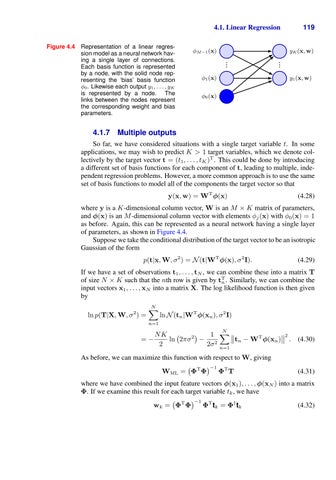
Representation of a linear regression model as a neural network having a single layer of connections. Each basis function is represented by a node, with the solid node representing the ‘bias’ basis function φ0 . Likewise each output y1 , . . . , yK is represented by a node. The links between the nodes represent the corresponding weight and bias parameters.
...
Figure 4.4
119
y1 (x, w)
φ0 (x)
4.1.7 Multiple outputs So far, we have considered situations with a single target variable t. In some applications, we may wish to predict K > 1 target variables, which we denote collectively by the target vector t = (t1 , . . . , tK )T . This could be done by introducing a different set of basis functions for each component of t, leading to multiple, independent regression problems. However, a more common approach is to use the same set of basis functions to model all of the components the target vector so that y(x, w) = WT φ(x)
(4.28)
where y is a K-dimensional column vector, W is an M × K matrix of parameters, and φ(x) is an M -dimensional column vector with elements φj (x) with φ0 (x) = 1 as before. Again, this can be represented as a neural network having a single layer of parameters, as shown in Figure 4.4. Suppose we take the conditional distribution of the target vector to be an isotropic Gaussian of the form p(t|x, W, σ 2 ) = N (t|WT φ(x), σ 2 I).
(4.29)
If we have a set of observations t1 , . . . , tN , we can combine these into a matrix T of size N × K such that the nth row is given by tT n . Similarly, we can combine the input vectors x1 , . . . , xN into a matrix X. The log likelihood function is then given by ln p(T|X, W, σ 2 ) =
N X n=1
=−
ln N (tn |WT φ(xn ), σ 2 I)
N NK 1 X 2 ln 2πσ 2 − 2 tn − WT φ(xn ) . (4.30) 2 2σ n=1
As before, we can maximize this function with respect to W, giving −1 T WML = ΦT Φ Φ T
(4.31)
where we have combined the input feature vectors φ(x1 ), . . . , φ(xN ) into a matrix Φ. If we examine this result for each target variable tk , we have −1 T wk = ΦT Φ Φ tk = Φ† tk (4.32)