Readers Share I Glaze Recipes
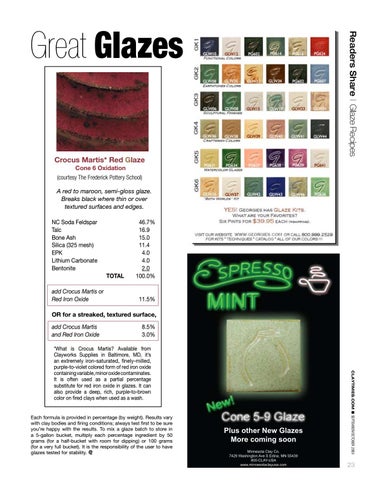
Great Glazes Crocus Martis* Red Glaze Cone 6 Oxidation (courtesy The Frederick Pottery School) A red to maroon, semi-gloss glaze. Breaks black where thin or over textured surfaces and edges. NC Soda Feldspar Talc Bone Ash Silica (325 mesh) EPK Lithium Carbonate Bentonite add Crocus Martis or Red Iron Oxide
TOTAL
46.7% 16.9 15.0 11.4 4.0 4.0 2.0 100.0%
11.5%
OR for a streaked, textured surface, add Crocus Martis and Red Iron Oxide
8.5% 3.0%
Each formula is provided in percentage (by weight). Results vary with clay bodies and firing conditions; always test first to be sure you’re happy with the results. To mix a glaze batch to store in a 5-gallon bucket, multiply each percentage ingredient by 50 grams (for a half-bucket with room for dipping) or 100 grams (for a very full bucket). It is the responsibility of the user to have glazes tested for stability. [
Plus other New Glazes More coming soon Minnesota Clay Co. 7429 Washington Ave S Edina, MN 55439 800-CLAY-USA www.minnesotaclayusa.com
CLAYTIMES·COM n SEPTEMBER/OCTOBER 2009
*What is Crocus Martis? Available from Clayworks Supplies in Baltimore, MD, it’s an extremely iron-saturated, finely-milled, purple-to-violet colored form of red iron oxide containing variable, minor oxide contaminates. It is often used as a partial percentage substitute for red iron oxide in glazes. It can also provide a deep, rich, purple-to-brown color on fired clays when used as a wash.
23