Perspectives I As Far As I Know
Cone 6 Tomato Reds colors produced in those tests were also good. Tests using “natural” red iron oxide were as red as those made with Spanish red iron oxide, if not redder. These tests seemed to indicate that the source of the iron used wasn’t as important as the relative purity of that source, and as long as the raw qualities of the iron didn’t cause other problems (like crawling), then a variety of iron sources would work.
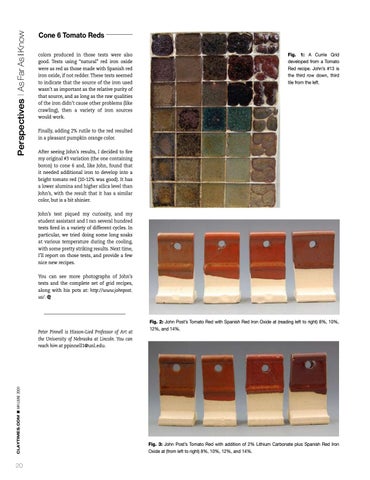
Fig. 1: A Currie Grid developed from a Tomato Red recipe. John’s #13 is the third row down, third tile from the left.
Finally, adding 2% rutile to the red resulted in a pleasant pumpkin orange color. After seeing John’s results, I decided to fire my original #3 variation (the one containing boron) to cone 6 and, like John, found that it needed additional iron to develop into a bright tomato red (10-12% was good). It has a lower alumina and higher silica level than John’s, with the result that it has a similar color, but is a bit shinier. John’s test piqued my curiosity, and my student assistant and I ran several hundred tests fired in a variety of different cycles. In particular, we tried doing some long soaks at various temperature during the cooling, with some pretty striking results. Next time, I’ll report on those tests, and provide a few nice new recipes. You can see more photographs of John’s tests and the complete set of grid recipes, along with his pots at: http://www.johnpost. us/. [
CLAYTIMES·COM n May/June 2009
Peter Pinnell is Hixson-Lied Professor of Art at the University of Nebraska at Lincoln. You can reach him at ppinnell1@unl.edu.
20
Fig. 2: John Post’s Tomato Red with Spanish Red Iron Oxide at (reading left to right) 8%, 10%, 12%, and 14%.
Fig. 3: John Post’s Tomato Red with addition of 2% Lithium Carbonate plus Spanish Red Iron Oxide at (from left to right) 8%, 10%, 12%, and 14%.