November 2018
CLASSICAL ASSOCIATION OF IRELAND
(Photographs: on previous page and left, courtesy of Peter Crawford; front page and below, courtesy of Joan Wright; next page, courtesy of Raoul McLaughlin) After a break for tea and coffee, Dr Cressida Ryan (Oxford) asked ‘Why is tragedy entertaining?’ and used lyrics from the popular song Tragedy (formerly by Steps and the Bee Gees) to illustrate her answer. Cressida referred to Aristotle’s Poetics which details the rules which tragedy must follow, and then moved on to Hitchcock’s concept of suspense versus surprise, whereby the audience know more than the characters on stage: compare Sophocles’ Oedipus Tyrannus, in which the audience know that Oedipus has married his mother and the entertainment of the play lies in the characters discovering the truth. CANI’s Barry Trainor, a postgraduate student at QUB, presented on ‘Entertainment at Sparta’, a city we usually think of as austere and militaristic. Barry discussed the importance placed on Spartan religious festivals, one of which caused Sparta to miss the Battle of Marathon. He then focused on ancient laughter, something we might not associate with Sparta but which was actively encouraged by the lawgiver Lykourgos, who believed it was an important way for Spartans to relax and unwind. Young Spartans were encouraged to mock one another and to humiliate the Helot slaves as a means of subjugation. The final talk was delivered by Helen McVeigh who posed the question: ‘Who read ancient novels?’ Focusing on Chariton’s Callirhoe, written around 50 AD, she considered both who the novels might have been intended for as well as their actual readership. While women may not have received formal education, many could read but would have neither recognised nor appreciated the quotes from popular ancient stories throughout the text. Helen concluded that the ancient novels may have had a wide-ranging readership, but in the case of Callirhoe, only highly educated males would have been able to understand and appreciate Chariton’s text.
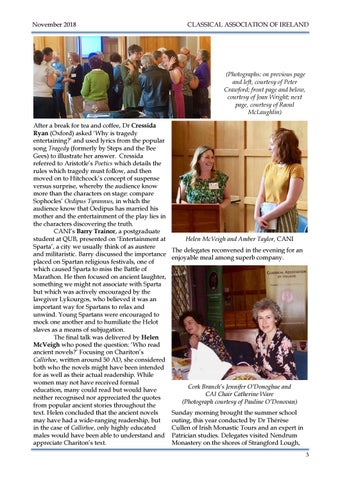
Helen McVeigh and Amber Taylor, CANI The delegates reconvened in the evening for an enjoyable meal among superb company.
Cork Branch’s Jennifer O’Donoghue and CAI Chair Catherine Ware (Photograph courtesy of Pauline O’Donovan) Sunday morning brought the summer school outing, this year conducted by Dr Thérèse Cullen of Irish Monastic Tours and an expert in Patrician studies. Delegates visited Nendrum Monastery on the shores of Strangford Lough, 3