CLASSICAL ASSOCIATION OF IRELAND
NEWSLETTER ISSUE 2, NOVEMBER 2018 ISSUE 2, NOVEMBER 2013
Belfast Ancient Languages Summer Mauris imperdiet. Duis nec purus non dui School auctor consequat. Maecenas faucibus. Ut quis velit ac mi lacinia euismod.
CAI Summer School: Queen’s University, Belfast, 2018
2-4
Classical Association of Ireland – Teachers 2017-2018 Update Mauris imperdiet. Duis nec purus non dui
4 auctor consequat. Maecenas faucibus. Ut quis velit ac mi lacinia euismod. IIHSA Study Tour 2018
6
The ‘Black Book’ of Mauris imperdiet. Duis nec purus non dui Limerick
auctor consequat. Maecenas faucibus. Ut quis velit ac mi lacinia euismod. 7
Notices; Branch and University News Mauris imperdiet. Duis nec purus non dui auctor consequat. Maecenas faucibus. Ut quis velit ac mi lacinia euismod. 8-12
5
From the Editor Season’s greeetings to members of the Classical Association of Ireland and to all our readers! Time has flown since the last Newsletter, the weeks packed with classical events to suit every comer, from lectures and language classes, to outings and plays. The summer, too, was long on interesting and enjoyable occasions, especially the annual CAI Summer School, ably organised by the Classical Association in Northern Ireland (pp. 2-4), and the IIHSA study tour abroad (p. 5).
At the time of writing, we are looking forward to this year’s CAI Presidential Address: Tom Seaver, one of the founders of the Limerick Branch (p. 8), will detail ‘A Century of Classics in Ireland’ and present medals to the year’s highest achievers in the Junior and Leaving Certificate exams. All CAI members and friends are warmly welcome to attend, and to join us at a reception afterwards! Selga Medenieks
CLASSICAL ASSOCIATION OF IRELAND
November 2018
The annual CAI Summer School
Queen’s University Belfast, 17-19 August 2018
Queen’s University Belfast was the setting for the 2018 Classical Association of Ireland Summer School. Upwards of 50 delegates arrived on the afternoon of Friday, 17 August, and business kicked off at 7pm with the CAI AGM, which was well-attended by representatives from all corners of Ireland. Following the AGM, the summer school proper began with welcomes from Dr John Curran (QUB) and Helen McVeigh (CANI). The guest speaker for the summer school was Natalie Haynes. She describes herself as a former comedian, but she is known for being a classics advocate and author of classically-themed novels, as well as the excellent non-fiction work, The Ancient Guide to Modern Life. Natalie’s fast-paced talk discussed female characters in Greek tragedy and how they are not the focus of the works which have been named after them. She highlighted Aristotle’s theory of tragedy and how
2
producers of contemporary soap operas have been known to “Greek it up” when they are in need of an exciting plotline. Natalie’s talk concluded with a reading from her latest novel, The Children of Jocasta, which tells the Oedipus myth from the point of view of the women in the story. Saturday morning dawned with a meeting of the CAI Central Council, followed by a Q&A with Natalie Haynes. With CANI’s Helen McVeigh asking the questions, Natalie discussed her BBC Radio 4 programme Natalie Haynes Stands up for the Classics, in which celebrity and classicist guests discuss personages from ancient history such as, in the current fourth series, Phryne, Livy, Horace and Euripides. Natalie talked about her forthcoming novel, A Thousand Ships, which retells the story of the Trojan War, its causes and its consequences, from the perspectives of its women. Questions from the floor followed. Our next speaker was Professor Helen Lovatt from the University of Nottingham, introduced by Dr Laura Pfuntner (QUB). Helen’s lecture was entitled ‘Fun and Games in Ancient Epic’ and Laura began by asking the audience what the epic heroes do for fun. Helen’s answer was feasting, and ritualistic and commemorative games. She considered Roman architecture; the sheer size of the Colosseum and Circus Maximus suggest the importance ancient Romans placed on the activities which took place there. Helen discussed a number of epic representations of funeral games, including Homer’s Iliad 23, Virgil’s Aeneid 5 and Statius’ Thebaid 6.
November 2018
CLASSICAL ASSOCIATION OF IRELAND
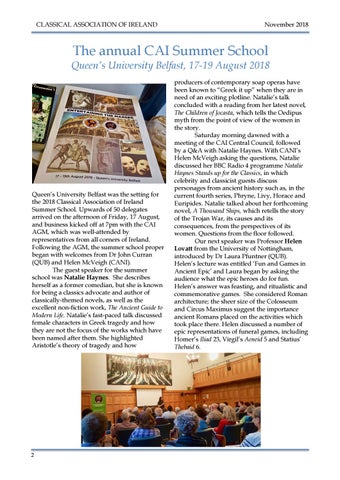
(Photographs: on previous page and left, courtesy of Peter Crawford; front page and below, courtesy of Joan Wright; next page, courtesy of Raoul McLaughlin) After a break for tea and coffee, Dr Cressida Ryan (Oxford) asked ‘Why is tragedy entertaining?’ and used lyrics from the popular song Tragedy (formerly by Steps and the Bee Gees) to illustrate her answer. Cressida referred to Aristotle’s Poetics which details the rules which tragedy must follow, and then moved on to Hitchcock’s concept of suspense versus surprise, whereby the audience know more than the characters on stage: compare Sophocles’ Oedipus Tyrannus, in which the audience know that Oedipus has married his mother and the entertainment of the play lies in the characters discovering the truth. CANI’s Barry Trainor, a postgraduate student at QUB, presented on ‘Entertainment at Sparta’, a city we usually think of as austere and militaristic. Barry discussed the importance placed on Spartan religious festivals, one of which caused Sparta to miss the Battle of Marathon. He then focused on ancient laughter, something we might not associate with Sparta but which was actively encouraged by the lawgiver Lykourgos, who believed it was an important way for Spartans to relax and unwind. Young Spartans were encouraged to mock one another and to humiliate the Helot slaves as a means of subjugation. The final talk was delivered by Helen McVeigh who posed the question: ‘Who read ancient novels?’ Focusing on Chariton’s Callirhoe, written around 50 AD, she considered both who the novels might have been intended for as well as their actual readership. While women may not have received formal education, many could read but would have neither recognised nor appreciated the quotes from popular ancient stories throughout the text. Helen concluded that the ancient novels may have had a wide-ranging readership, but in the case of Callirhoe, only highly educated males would have been able to understand and appreciate Chariton’s text.
Helen McVeigh and Amber Taylor, CANI The delegates reconvened in the evening for an enjoyable meal among superb company.
Cork Branch’s Jennifer O’Donoghue and CAI Chair Catherine Ware (Photograph courtesy of Pauline O’Donovan) Sunday morning brought the summer school outing, this year conducted by Dr Thérèse Cullen of Irish Monastic Tours and an expert in Patrician studies. Delegates visited Nendrum Monastery on the shores of Strangford Lough, 3
CLASSICAL ASSOCIATION OF IRELAND
Saul church, and Inch Abbey (above). Most exciting of all was the visit to Downpatrick Cathedral and the opportunity to see current excavations which are being carried out by Queen’s University archaeologists. On behalf of CANI I would like to thank all the delegates for making the trip to Belfast for the summer school. We thoroughly enjoyed the weekend, and hope you did too. We very much look forward to the 2019 summer school in Sligo. Helen McVeigh
November 2018 have been maintained in the Junior Cycle Curriculum. There is scope for teachers to upskill in the Latin and Ancient Greek languages, and also great potential for schools without a classical tradition to offer our subjects in the form of 100-hour Short Courses. We believe that this new course will be instrumental in revitalising the Classics in Ireland. At this year’s Annual Conference in Mullingar, our speaker Dr Arlene HolmesHenderson echoed this sentiment. Dr HolmesHenderson, an international expert in Classics Curriculum Development, delivered two inspiring presentations, both of which highlighted exciting new opportunities and resources for classics teachers. Those of us in the audience who had spent some time working with the NCCA in formulating the Junior Cycle Specification were relieved to hear that our new curriculum exemplifies the best of classics courses internationally and stands out as an ideal humanities subject for young people to engage with in this day and age.
Classical Association of Ireland – Teachers It has been a busy few years at the CAI-T. In addition to hosting our annual student events for 2017/2018, with all the curriculum developments our teachers have also been contributing to the NCCA’s Specification for Junior Cycle in Classics and the NCCA’s review of Leaving Certificate Classical Studies. From our CAI-T Annual Conference and AGM in October 2017 to the EGM at Blackrock Education Centre on 28 April 2018, and most recently the NCCA Public Consultation, CAI-T has very much appreciated all of the ideas, inputs and feedback received in this process. We are pleased that all the hard work of the various stakeholders has been paying off. The CAI-T feels very positively about the Junior Cycle Classics Specification, and in particular welcomes the fact that all three subjects (Ancient Greek, Latin and Classical Studies) 4
Dr Arlene Holmes-Henderson is an expert in education and the Classics based at both Oxford University and King’s College London. She is a language education specialist who has conducted research into the cognitive benefits of studying Greek and Latin, and provides teacher training worldwide. Many thanks to the CAI-T committee for an excellent and productive year, in particular Sue Whyte, Delia Donohoe, Bronwyn Ambrose, Tom Giblin, Adam Conry, UCD, and TCD for their instrumental work in putting on our conferences and student events this year. I would of course like to thank the members of our committee, especially Ciara Byrne and Seamus O’Sullivan, for all their hard work in updating our website, classicsteachers.com, and online presence with new Twitter and Facebook accounts. Aryn Penn, CAI-T
November 2018
CLASSICAL ASSOCIATION OF IRELAND
IIHSA Study Tour 2018 The IIHSA Study Tour was an overall excellent experience and I would highly recommend it to any Classical Studies student. Starting with an extensive exploration of Ancient Athens, we got up close and personal with the major ancient monuments that characterise the classical period, such as the Parthenon. We traveled extensively throughout the Greek countryside as well, stopping at Mycenae, Olympia, and Delphi to both the archaeological sites and their museums. My personal favourite site was the Temple of Apollo Epidaurus at Bassae. This was a stunningly well-preserved temple, the first to feature a Corinthian column, surrounded by beautiful scenery from the mountainside. I believe seeing these archaeological sites in person has really helped me expand my understanding of ancient Greece, and gave me new insights into the impressive architectural remains of the civilization. In addition to the ancient culture, I also got a wonderful exposure to the modern-day culture present in Greece through exploring both major cities and small villages. I absolutely adored the quaint seaside town of Itea, where I received possibly the best authentic Greek dinner of the whole trip in a beautiful, sea-view restaurant. I believe this trip could benefit any Classical Studies student in both an academic sense and a personal sense, through exposing them to great archaeology and great fun. Lisa Murnane (pictured below, left, at Bassae)
This year I seized the perfect opportunity to engage with and experience a region of the Mediterranean world, visiting the most beautiful landscapes throughout Greece organised by the Irish Hellenic Society and through participation in a structured study tour with Trinity College. This was one of the most incredible experiences of my life. Walking the paths of the ancient Greeks and visiting the archaeological sites of Athens, Marathon, Delphi, Olympia, Messene, Sparta, Mystras, Mycene, and Corinth was key to bringing the ancient world vividly to life. Our tour guides, Eleni and Christina, were both extremely competent, engaging and enthusiastic; the entire study tour was well-planned and allowed for quality discussions and interaction. Meeting like-minded people of all ages made for an enriching and very enjoyable experience. The IIHSA tour is an amazing opportunity for students of ancient Greek history and archaeology to explore ruins and archaeological sites, to sit in a classical theatre, visit majestic Greek temples such as the Parthenon, explore wonderful monasteries, and marvel at exquisite sculptures, vases and pottery, that should simply not be missed. Brenda Richardson (pictured above, far right, with Siobhan Brennan) 5
CLASSICAL ASSOCIATION OF IRELAND
Belfast Ancient Languages Summer School In July 2018, 35 students and seven staff gathered at Queen’s University Belfast for the third Belfast Summer School in Latin and Classical Greek. Many students came from Belfast and the surrounding areas and some travelled from as far as Enniskillen, L/Derry, County Donegal, County Clare, Birmingham, Kent, and even Massachusetts, USA. Nineteen students signed up for Latin at Beginners, Intermediate and Advanced level. The Intermediate class reviewed grammar and Advanced students read Ovid’s Metamorphoses in the original language. Ten students studied Greek at Beginners level, with the remainder taking Lower Intermediate and Intermediate classes. Intermediate level provided a grammar review, while the Lower Intermediate Greek class was intended for students who had completed the Beginners level course. This year we also introduced translation workshops on the Saturday. The Classical Greek workshop was led by Dr Martine Cuypers (TCD), examining the beginning of Homer’s Odyssey, while the Latin workshops were led by our tutors, in which students looked at a few unadapted extracts from texts including Catullus, Caesar, and the beginning lines of Virgil’s Aeneid. All of our students performed admirably with these difficult texts after only a week of study. The range of students was as diverse as previous years. In the Beginners Greek class alone there were high school students, a postgraduate student about to embark on the study of Anglo-Saxon, Norse and Celtic, and an English graduate entering his training for the ministry. Among the Latin classes there was a GCSE student who wanted to read a Latin text as preparation for A level, a solicitor returned to her Latin roots having rediscovered the “Ecce Romani” books from her schooldays, and a trainee primary school teacher who hopes to inject some Classics into her lessons. Many others said they were taking the course for fun. Each of our students had their own story and it was a joy to meet them and chat with them during the course of the week. In particular, Anita, Amber and Ava have attended the summer school for three years running. In 2016 Ava had just completed her GCSEs though her school did not offer any Classics subjects: she is self-taught in 6
November 2018 Latin and learned Greek from the summer school. We are extremely proud that she has been accepted to study Classics this autumn at the University of Cambridge. The summer school prides itself on the language skills of its tutors. Each year the number of classes has increased and this year’s new appointments to the staff were Dr Laura Pfuntner (QUB, Advanced Latin) and Dr Steph Holton (Newcastle University, Intermediate Greek). Other tutors were Dr Kerry Phelan (Maynooth University/UCD, Beginners Greek), Helen McVeigh (Lower Intermediate Greek), Stephen McCarthy (Maynooth University, Beginners Latin) and Stephen Strickland (Intermediate Latin). Solomon Trimble, a student of Greek and Latin at Belfast Inst, was the summer school assistant. Academic talks were presented by Intermediate Greek tutor Dr Steph Holton, who spoke about the interpretation of dreams in ancient Greek medicine, and CANI’s Dr Peter Crawford, who offered evidence in a mock trial of Gaius Julius Caesar. On both occasions, there was standing-room only for these fascinating talks, with many interesting questions offered from the floor. Many thanks to both of our speakers. An informal dinner took place in Town Square on Botanic Avenue and was also attended by members of the CANI Board. After the concluding classes on Friday morning, certificates of attendance were presented to the students by Dr John Curran from the Queen’s School of History, Anthropology, Politics and Philosophy. Dr Curran congratulated the students on completing an intense week of study, and thanked all the staff for their hard work and enthusiasm. Plans are afoot for next year’s summer school. Student feedback this year was overwhelmingly positive, in many cases expressing a desire for a longer course, more Greek and Latin! Other comments included: “I would like to thank CANI for this amazing opportunity”; “I liked the instructor’s energy and enthusiasm and want to come back next year for another class”; “(The course) was very absorbing, thoroughly planned and a real pleasure to attend”. We could not have had such great success without our wonderful students. We love teaching Latin and Classical Greek and clearly there is an audience for these languages. Helen McVeigh
CLASSICAL ASSOCIATION OF IRELAND
November 2018
The Black Book of Limerick The manuscript known as the ‘Black Book of Limerick’ is a compilation of documents written on vellum and preserved in the Diocesan Archives in Limerick. Most of the documents date from 1222 to 1300 but they are not in chronological order. The earliest document, “Carta Donaldi regis Lymericensis”, concerning the re-endowment of St Mary’s Cathedral by King Donald (1194), is on page 108. The latest document is an indenture (a contract under seal) by Stephen, Bishop of Limerick (1360-1369) in the year 1362. Last November Dr Catherine Swift, lecturer in Medieval History in Mary Immaculate College, Limerick, convened a meeting about the Black Book and a group of historians, archaeologists, representatives from the Limerick Branch of the CAI, among others, began revisiting the MS and translating the transcribed Latin in a 1907 dissertation on the text. This is a work in progress. Description of the MS The MS consists of 152 pages, 10x7in, with 29 lines to the page. Pages 127-134 show smaller writing, with 53 lines to the page and closer lines. The writing is clear and distinct; the contractions used are as in Latin documents of that time; the titles of entries and the capital letters are rubricated and, in some cases, the opening letters of items are slightly ornamented. The vellum in the earlier portion (up to page 134) is remarkably beautiful and different from the quality employed towards the end. The MS is in a good state of preservation with some little blotting over at pages 134 and 136-138. It is illegible on pages 142 and 143. The text is on both sides and generally in single columns. The earlier portion of the work, as was usual at the time, was not paged but numbered by folios, by Roman characters and, only later, in Arabic characters. It was the subject of a Dissertation by James MacCaffrey in 1907 (African Missions Library).
History of the MS The MS was preserved in the Diocesan Archives until the Reformation. It passed to the Protestant Bishops. Bishop Bernard Adams (1603-1625) added a portion regarding repairs to St Mary’s Cathedral between 1604 and 1611. Bishop George Webb (1634-1642) was besieged in Limerick Castle by Confederate forces and, on capitulation, the MS fell into the possession of Irish soldiers. Nothing further is known of it until the nineteenth century when it was given to Bishop Young (1796-1814) by a Protestant gentleman. Young added short notes. Bishop George Butler (1864-1886) loaned it to Dr Rehenan, V.P. Maynooth (1834-45), and on Rehenan’s death it passed to the library in Maynooth College. Bishop Jeremiah Newman (1974-95) obtained the MS and it is now in Limerick Diocesan Archives. Paula Keane 7
CLASSICAL ASSOCIATION OF IRELAND
November 2018
Tom Seaver
Aeschylus’ AGAMEMNON is presented as a one-man show in a new translation by actor and director William Mann. One actor dressed in black on a simple carpet will perform the play taking on all the roles by using coloured scarfs and props to differentiate characters. This is an intimate, chamber version which concentrates on the ritual elements and language of the play. The production will tour Ireland beginning with Cork on 22 November, and the School of Education, Maynooth University, on 7 December. More dates and venues to be confirmed. If you are interested in seeing the play, or would like the production to perform at your school, University or association, please contact William Mann at william@oresteia.org or check the website www.oresteia.org, below.
CLICK: https://youtu.be/SGDC6B1qAhs 8
As Honorary President of CAI for 2018, Mr Tom Seaver will be delivering the Presidential Address at UCD on 30 November. Tom was born in Dublin in 1934, graduated in Classics at UCD, and subsequently taught in Glenstal and Gormanston before retiring to live near Glenstal in Murroe, Co. Limerick. He is a life-long active member of the Classical Association of Ireland, and served as President and in numerous offices of its predecessor, ‘The Association of Classical Teachers’, whose handbook he edited for many years. In retirement he helped found the Limerick Branch of the Classical Association and has been a key member of its organising committee. Together with Patrick Ryan he initiated the highly successful Latin and Greek classes for adults in Limerick. Recently Tom published his first novel, A 1916 Fingallian Rebel, based on the story of his father, a 1916 Volunteer. Andrew Smith
CLASSICAL ASSOCIATION OF IRELAND
November 2018
CAI BRANCH & UNIVERSITY NEWS CAI CORK The Cork Branch began its series of autumn lectures with Prof. Stephen Boyd from the Dept of Spanish, Portuguese and Latin American studies in UCC. The lecture centred on Velázquez’s painting ‘The Feast of Bacchus’ currently in the Prado Museum, Madrid. It was painted in 1629 and is composed of a mixture of Renaissance-style figures (peasants and the god Bacchus) in the open countryside. Ovid’s Metamorphosis was a source for the painting and it merges the mythological world and the ordinary world together as classical figures are depicted as ordinary men and women. The painting throws up many questions. Why does Velázquez put Bacchus in the centre of the painting with his gaze focused outside of the canvas? The cult of Bacchus was thought to make men effeminate: is it for this reason perhaps that soldiers are on the canvas? The painting is a rather sober view of the quality of drunkenness! But, perhaps there are Christian elements at large in the painting, too. The bowl of wine is in the centre like a chalice, the men kneeling are like the Magi, and the light shining from heaven represents the Christian god. Whatever you see in the painting, it is worth a look if you find yourself in Madrid. Monday, 5 November, saw us welcome Dr David Woods, Head of Classics at UCC. The lecture focused on the Emperor Gallienus and the young Jupiter: ‘Gallienus, the Young Jupiter and an alleged transgender Imperial Portrait.’ Gallienus was part of the Valerian dynasty and his rule was relatively short (AD 260-268 as Augustus). The image under discussion was from a coin, one of only two extant, one in Paris and the other in Vienna. Coins are a great source of history and tell stories which are fascinating to the initiated. This one depicted, on the reverse, a goat suckling a baby while another baby was between the front legs of the animal. An eagle
was facing this child. This medallion was obviously a ceremonial one and was struck in Milan. The problem is that it looks like two children are present under this goat. It is reminiscent of the story of the young Jupiter who was reared by the goat Amalthea. In the story there is only one child, but here there are two! Dr Woods put forward the idea that the second child was the same child as the one suckling and merely an extension of the narrative, advancing the story. Firstly, the child was feeding; then the child was dealing with the eagle. This would make it fit with the Jupiter/Amalthea myth. The second half of the lecture centred around an image of Gallienae Avgvstae, a male head with a wheaten wreath and a feminine ending on the inscription. The question is, was there a misspelling, or the use of the vocative? Dr Woods proposed that although there are examples of the vocative used as inscriptions on coins, rare though they may be, the more likely explanation is that the emperor was providing corn for the empire. The wreath and the inscription have nothing to do with gender or religion, merely showing that it is the emperor who provides! The coin depicts peace and prosperity. One wonders what archaeologists and classicists of the future will make of the coins in our pockets today? What stories will they tell? One can almost guarantee that whatever they tell will not be as interesting as the ones from the Roman Empire. The final lecture in the autumn series will be Patrick Ryan from the Limerick Branch speaking on ‘Homo sum, humani nihil a me alienum puto’ (‘I am human, I consider nothing human alien to me’): Publius Terentius Afer. An account of the lecture will appear in the next issue. We will be back in February; details of the spring 2019 programme can be found on the association website from mid-January. The Cork Branch wishes all its members a happy and a joyful Yuletide! J. O’Donoghue 9
CLASSICAL ASSOCIATION OF IRELAND
CAI DUBLIN The Dublin Branch year began with our annual dinner, held at Roly Saul restaurant in Dundrum. The evening was a great success, with over thirty members attending. We had a room to ourselves and the well-served meal was delicious – the conversation even more so! On Tuesday, 27 March, at UCD Margaret Desmond spoke to us on ‘Ancient Rome as a fire regime’. This was a highly interesting, unusual subject, and gave us new insights into the perils of living in ancient Rome, particularly if you were poor. Dr Samantha McAuliffe talked to us on Tuesday, 10 April, about ‘Market life in early 20th century Dublin’. The lecturer concentrated on a single group of buidings – the Dublin markets, now closed for redevelopment – and showed how much the builder and architect owed to Roman antecedents. On Tuesday, 24 April, Dr Catherine Ware gave a fascinating talk on violence in the arena, ‘Spectacular justice: the arena in Claudian’s panegyrics’. She discussed how Claudian used epic metaphors and amphitheatral imagery to present the political downfall and death of Rufinus (the enemy of his patron Stilicho) as a scene in the arena. The annual Branch outing took place on Saturday, 19 May, this time to South Wexford. Sixteen intrepid explorers left Belfield at 9am (missing the royal wedding!). En route we paused at the Ferrycarrig Hotel for tea, coffee and scones in a bar facing the river Slaney. We then proceeded to New Ross, where we took part in the ‘Dunbrody Irish Emigrant Experience’. This consisted especially of reminders of the Irish Famine, with posters advertising ships to America in 1845; a film showing the wretched poverty of the Irish cottager; and finally a visit to The Dunbrody, a replica of an 1840s famine ship. Two women illustrated the horrors of the voyage, one who travelled steerage and the other first class. It took fifty days to reach New York and many died, their bodies thrown overboard. Our group then travelled to Café Nutshell, where we partook of a delicious lunch, and then south to Tintern Abbey, for an excellent guided tour of the buildings. Much of the abbey still exists owing to the Colcloughs (pronounced Coakley), who purchased the abbey and lands in the 16th century and then 10
November 2018 proceeded to build a house inside the abbey structure. The abbey itself was built about 1200 owing to a vow! William Marshal, Strongbow’s successor as Lord of Leinster, was nearly shipwrecked off the south coast of Ireland. He vowed that if he survived, he would found an abbey. He landed at Bannow Bay and had an abbey built behind the bay. He brought twelve monks from Tintern Abbey in Wales, hence the name in medieval times ‘Tintern de voto’ (Tintern of the vow). We finished our visit with coffee and cakes! The group then returned to Belfied, satiated with culture and happy with extra knowledge! Brian O’Connell
CAI LIMERICK The Branch continues to flourish, with a growing membership and a flurry of activities, which include a lecture programme, classes in Greek and play readings. At the Annual General Meeting, which was held on 27 September in the Limerick Education Centre (L.E.C.), the following officers were re-elected for 2018-2019: Chairperson: Ms Paula Keane Vice-chair: Mr Séamus Ó Flaithbheartaigh Secretary: Mr Tom Seaver Treasurer: Ms Mary Walsh-Seaver Delegate to Council & P.R.O.: Mr Patrick Ryan Classes in Greek have resumed under the tutorship of Patrick Ryan. Patrick also played host at his Newport home, on October 6, to a play reading of Kumonosu-jo (‘Throne of Blood’), by the Japanese screenwriter Akira Kurosawa. The play reading was interspersed by soundtrack music from the film. Our programme of lectures for the Autumn term is at the halfway stage. We have had the pleasure of hearing Damhlaic MagShamhráin on ‘Death and the Afterlife among Greeks and Romans’ and Isabella Bolger on ‘Wool and Textile Production in the Roman World’. The Limerick Branch sends Tom Seaver, its Hon. Secretary, every good wish for his Presidential Address, ‘A Century of Classics in Ireland’, in UCD on Friday, 30 November. The Branch has expressed its sincere thanks to the Director and staff of the L.E.C. for making the premises available to us throughout the year. Tom Seaver Branch Secretary
November 2018
MAYNOOTH UNIVERSITY Wednesday, 10 October 2018, and a special lecture by Professor George Huxley, Adjunct Professor in the Department of Ancient Classics, Maynooth University, ‘Style and Sensibility in the Lyric Poetry of Sappho’ set our academic year off to a unique start. George mixed interesting material about Sappho’s lifetime and some textual criticism to create a ‘Sappho’ not only for the age, but for the day and for his enthralled audience of University President, Professor Philip Nolan, students, staff, graduates and distinguished guests. We enjoyed a wonderful set of ‘refreshments’ after the lecture. Wine and food was superbly organised thanks to Ms Breege Lynch, our Department Administrator. Debate about Sappho continued amongst all, thanks to George. The next instalment of the Maynooth Classics Seminar was held on 9 November in John Hume Lecture Theatre 7, when Dr William Desmond (Maynooth University) spoke on ‘“The biggest and the best history that I know (believe me!)”: Superlative Numbers in Herodotus’. William’s lecture was open to all and attracted a wide audience on a rainy Friday afternoon. We are delighted that Dr Christine Morris (Trinity College Dublin) has found time out of her busy schedule to address us on 30 November. ‘“Cretomania”: The Representation and Use of the Minoans in Modern Culture’ replete with Christine’s enthusiasm and erudition is something to look forward to. An Dr Brian O Catháin (Maynooth University, Department of Modern Irish/Rionn na NuaGhaeilge) is ‘bringing it all back home’ for our Christmas celebrations with his talk ‘Kevin O’Nolan (1917-1987): Scholar, Editor, and Littérateur’ on 14 December. This and all talks are held in John Hume Lecture Theatre 7. Last April our colleague Dr Gordon Campbell exported the Maynooth mania for seminars with him to the conference ‘Material World: The Intersection of Art, Science, and Nature in Ancient Literature and its Renaissance Reception’. The conference was held in Istituto Universitario Olandese di Storia dell’Arte in Florence. He spoke on ‘Botticelli, Lucretius, and Empedocles on Love and Strife’. Well done to Gordon.
CLASSICAL ASSOCIATION OF IRELAND We celebrated not one but two prize winners in the Dr H. H. Stewart Literary Scholarships and Prizes (2018) sponsored by the NUI. Maynooth University’s Michael Cusack won First Prize, the ‘Dr H. H. Stewart Literary Scholarship’, and his fellow student Darya Vorobyeva won Third Prize in the same competition. Both achieved excellent results in their First Arts Latin examinations and received their awards from the Chancellor of the National University of Ireland, Dr Maurice Manning, on 13 November in the Round Room at the Mansion House in Dublin (photo below, courtesy of NUI staff). Michael is continuing with his Latin studies in Maynooth. Darya was an Erasmus student and visited just for the academic year 2017-2018, but she certainly made the most of her time with us. Congratulations to Michael and to Darya from all the staff and students in the Department of Ancient Classics on their wonderful achievement. Dr Maeve O’Brien
TRINITY COLLEGE DUBLIN Trinity’s Classics department in September welcomed two new colleagues. Historian Dr Rebecca Usherwood joined us as Assistant Professor in Late Antique and Early Byzantine Studies, an area also boosted by the continued vibrancy of the International Byzantine Greek Summer School (pictured on the next page), which for the third year in a row brought students from all over the world to Trinity to study late antique and medieval Greek in July and August. Rebecca, a specialist on the age of Constantine, will bring her expertise to our degrees in ancient and medieval history. Teaching Fellow Dr Charlie Kerrigan, appointed thanks to a generous philanthropic donation, will primarily strengthen the department’s Latin teaching, but he will also be responsible for outreach activities with schools and the community. 11
CLASSICAL ASSOCIATION OF IRELAND
November 2018
Our Museum was also open to guests to take in the shade and view our collection. In other museum news, our Assistant Curator Phoebe Nolan has extended the Ancient Egypt exhibition to allow for the inclusion of a bronze figurine, a ceramic scarab, and a section of mummy linen. In August we had the pleasure of welcoming our new staff member, Dr Christopher Farrell, a Greek historian with an interest in Persia and the Near East. Dr Farrell is from New York and earned a BA from Brandeis Level 3 of the International Byzantine Greek University followed by an MA and a PhD from Summer School at work – after two weeks with King’s College London. In October Dr Viola Hesychius and Gregory of Nyssa, Cavafy Starnone from the Scuola Normale di Pisa constituted a welcome dessert! joined the School to work with Dr Helen Dixon on a project relating to Virgil’s Aeneid funded On 31 October – 2 November, Dr Jenny by a one-year IRC Government of Ireland Bryan of the University of Manchester delivered Postdoctoral Fellowship. the biennial W.B. Stanford Memorial Lectures. In July we had the pleasure of Under the title ‘a man of rare knowledge’ she welcoming Professor Nick Sekunda from the provided a fresh take on the philosopher University of Gdansk as the keynote speaker for Empedocles, whose ideas about wisdom, the International Ancient Warfare Conference knowledge and understanding are often 2018, organised by Dr Alexander Thein. dismissed as eccentric without any real attempt In October we also hosted a highly to situate them within the context of early Greek successful interdisciplinary conference, philosophy. ‘Conflicting Chronologies in the Pre-modern Within the Trinity Education Project, World: Measuring Time from Antiquity to the curriculum renewal has kept everyone in Trinity Middle Ages and Renaissance’, co-organised by very busy. The current academic year saw the Dr Helen Dixon and Dr Rebecca Stephenson introduction of a fully semesterised academic from the UCD School of English, Drama and year structure, new approaches to assessment, Film. The keynote speakers were Professor and ambitious graduate attributes. For 2019/20 Stephen Heyworth (University of Oxford) and we look forward to the launch of a new Dual Professor Roy Liuzza (University of Tennessee). Degree B.A. with Columbia University (in which In other UCD news, Professor Theresa students will study 2 years in Dublin and 2 years Urbainczyk has used her retirement to publish in New York) and a new multidisciplinary B.A. her first novel, Father’s Day, now available on in Classics, Ancient History and Archaeology, Kindle: with separate Single Honour exit routes in https://www.amazon.co.uk/Fathers-DayClassical Languages, Ancient History and Theresa-Urbainczyk-ebook/dp/B07JGV4G7G Archaeology, and Classical Civilisation. The Joint Alexander Thein Honours (TSM) options have also been refreshed and revised, with new subject combinations, exit routes, electives and degree options available from 2019/20. Martine Cuypers
UNIVERSITY COLLEGE DUBLIN Roman army re-enactors from Legion Ireland in Cork were out in full force for the UCD Festival on 9 June (right). The University hosted over 15,000 people on a day of spectacular weather. 12
(Photographs, above and on cover, courtesy of Phoebe Nolan)