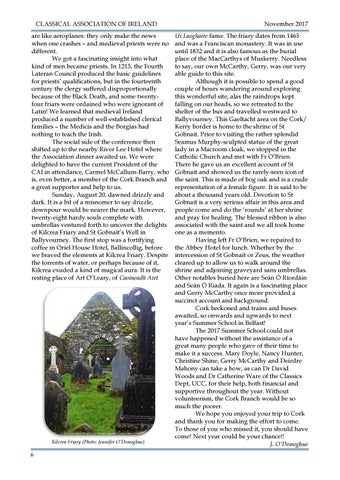
CLASSICAL ASSOCIATION OF IRELAND are like aeroplanes: they only make the news when one crashes – and medieval priests were no different. We got a fascinating insight into what kind of men became priests. In 1215, the Fourth Lateran Council produced the basic guidelines for priests’ qualifications, but in the fourteenth century the clergy suffered disproportionally because of the Black Death, and some twentyfour friars were ordained who were ignorant of Latin! We learned that medieval Ireland produced a number of well-established clerical families – the Medicis and the Borgias had nothing to teach the Irish. The social side of the conference then shifted up to the nearby River Lee Hotel where the Association dinner awaited us. We were delighted to have the current President of the CAI in attendance, Carmel McCallum-Barry, who is, even better, a member of the Cork Branch and a great supporter and help to us. Sunday, August 20, dawned drizzly and dark. It is a bit of a misnomer to say drizzle, downpour would be nearer the mark. However, twenty-eight hardy souls complete with umbrellas ventured forth to uncover the delights of Kilcrea Friary and St Gobnait’s Well in Ballyvourney. The first stop was a fortifying coffee in Oriel House Hotel, Ballincollig, before we braved the elements at Kilcrea Friary. Despite the torrents of water, or perhaps because of it, Kilcrea exuded a kind of magical aura. It is the resting place of Art O’Leary, of Caoineadh Airt
Kilcrea Friary (Photo: Jennifer O’Donoghue)
6
November 2017 Ui Laoghaire fame. The friary dates from 1465 and was a Franciscan monastery. It was in use until 1832 and it is also famous as the burial place of the MacCarthys of Muskerry. Needless to say, our own McCarthy, Gerry, was our very able guide to this site. Although it is possible to spend a good couple of hours wandering around exploring this wonderful site, alas the raindrops kept falling on our heads, so we retreated to the shelter of the bus and travelled westward to Ballyvourney. This Gaeltacht area on the Cork/ Kerry border is home to the shrine of St Gobnait. Prior to visiting the rather splendid Seamus Murphy-sculpted statue of the great lady in a Macroom cloak, we stopped in the Catholic Church and met with Fr O’Brien. There he gave us an excellent account of St Gobnait and showed us the rarely-seen icon of the saint. This is made of bog oak and is a crude representation of a female figure. It is said to be about a thousand years old. Devotion to St Gobnait is a very serious affair in this area and people come and do the ‘rounds’ at her shrine and pray for healing. The blessed ribbon is also associated with the saint and we all took home one as a memento. Having left Fr O’Brien, we repaired to the Abbey Hotel for lunch. Whether by the intercession of St Gobnait or Zeus, the weather cleared up to allow us to walk around the shrine and adjoining graveyard sans umbrellas. Other notables buried here are Seán Ó Ríordáin and Seán Ó Riada. It again is a fascinating place and Gerry McCarthy once more provided a succinct account and background. Cork beckoned and trains and buses awaited, so onwards and upwards to next year’s Summer School in Belfast! The 2017 Summer School could not have happened without the assistance of a great many people who gave of their time to make it a success. Mary Doyle, Nancy Hunter, Christine Shine, Gerry McCarthy and Deirdre Mahony can take a bow, as can Dr David Woods and Dr Catherine Ware of the Classics Dept, UCC, for their help, both financial and supportive throughout the year. Without volunteerism, the Cork Branch would be so much the poorer. We hope you enjoyed your trip to Cork and thank you for making the effort to come. To those of you who missed it, you should have come! Next year could be your chance!! J. O’Donoghue