CLASSICAL ASSOCIATION OF IRELAND
NEWSLETTER ISSUE NOVEMBER 2017 ISSUE 2, 2, NOVEMBER 2013
The Classical Association in Northern Ireland: public reading of Homer’s Odyssey
The CAI Presidential Address 2017: Dr Carmel McCallumBarry
2-‐3 Octavia at the Orchard Yard
3 The CAI annual Summer School, Cork: ‘Maritime Matters’
4-‐6
From the Editor Season’s greetings to our members and friends of the CAI! We hope that you have enjoyed this extraordinarily busy summer and first term, packed with diverse events and activities organised by our Branches, affiliated universities and societies. We have had a wealth of opportunities to indulge our enthusiasm for Classics! In these pages you will find reports on the highlights of our annual calendar: the Presidential Address, given this year by Ms
7
The Classical Youth Society of Ireland
8 Branch and University News
9-‐11 Obituary: Professor Colm Luibhéid
11-‐12
Carmel McCallum-Barry on the engrossing topic of the historiography of women in Classics; and the CAI Summer School, hosted superbly by Cork Branch, with a fascinating keynote address by Cambridge’s Professor Martin Millett on the challenging archaeological investigations of the Roman harbour cities Ostia and Portus. This Newsletter also features the very first report from our new affiliate organisation, the Classical Youth Society of Ireland. We welcome the group to our Association and look forward to hearing more about their projects. Wishing you a happy and memorable festive season, Dr Selga Medenieks
CLASSICAL ASSOCIATION OF IRELAND
November 2017
The CAI Presidential Address 2017 Dr Carmel McCallum-Barry: Women in Classics: some landmark achievements from the Renaissance to the twentieth century
Ms Carmel McCallum-Barry, Honorary President of the Classical Association of Ireland, with the Classical Association of Ireland medal winners 2017 (Photo: Isabella Bolger)
The CAI Presidential Address took place at UCD on Friday, 24 November. The Chairperson, Isabella Bolger, invited the Honorary President for 2017, Dr Carmel McCallum-Barry, to address the members. Her lecture title was ‘Women in Classics: some landmark achievements from the Renaissance to the twentieth century’. This was a very interesting talk about the contribution made by women to the translation and reception of ancient classics, including works by Plato, Livy and Tacitus. The President’s research revealed the astounding body of work undertaken by a variety of women throughout history. The vast majority were the daughters of learned men, tutored by their fathers and protected within the class system, and their role was a private one. The work of Italian translators Isotta Nogarola (1418-1466) of Verona and Cassandra Fedele (1470-1556) of Venice were considered and contrasted with that of English translators Mary More Roper (1504-1544), daughter of Sir Thomas More, and the Cooke sisters, Mildred and Anne. We learned that Lady Jane Lumley (1537-1578) was the first person to translate Euripides into English. Studies of the Bible, including writings of the Church Fathers, were translated extensively at this time. The children of King Henry VIII studied ancient Greek and Latin: Queen Elizabeth I read ancient Greek. 2
The work of other translators was also considered, including African-American educators Lucy Laney (1854-1933) and Anne Julie Cooper (1858-1964). Reference was also made to the huge contribution made by the English editor and translator Betty Radice (1912-1985), who was editor of Penguin Classics for many years. The lecture cast a light on the immense volume of translated texts contributed by women which quietly permeates the literary canon of Classical study. The audience showed great appreciation for a fascinating account of this extremely interesting topic, which will no doubt come up for discussion in future. A vote of thanks on behalf of the Association was given by Dr Martine Cuypers, Assistant Professor in Greek at Trinity College Dublin. The Association is committed to encouraging study of the Classics. In this regard it awards two medals annually in recognition of the achievements of second-level students: the Centennial Medal and the Jack Henderson Medal. These awards are presented to the winners by the CAI Honorary President following the Presidential Address. This year the Association conferred additional honours, the President’s Awards. Medals were presented to each of the students who attained the highest mark in a Classical subject (Ancient Greek, Latin, and Classical Studies) in Junior and Leaving Certificate examinations.
November 2017 The 2017 Jack Henderson medal was awarded to Julian Jimenez Ospina of Clongowes Wood College, taught by Mr Adam Conry (Mr Chris Lumn, School Principal). Julian attained the overall highest mark of Junior Certificate Classical subjects for his performance in the Latin examination. The 2017 Centennial Medal was awarded to Eva Glynn of Loreto College Foxrock, taught by Ms Louise Potter (Ms Bernadette Prendeville, School Principal). Eva attained the overall highest mark of Leaving Certificate Classical subjects for her performance in the Classical Studies examination. A President’s Medal was awarded to Simon Wilson of Gonzaga College, taught by Ms Aryn Penn (Mr Damon McCaul, School Principal). Simon attained the highest mark in the Junior Certificate Ancient Greek examination. A President’s Medal was awarded to Liam Ryan of Gonzaga College, taught by Ms Aryn Penn (Mr Damon McCaul, School Principal). Liam attained the highest mark in the Leaving Certificate Ancient Greek examination. A President’s Medal was awarded to Jill FitzPatrick of Holy Faith Secondary School, Clontarf, taught by Mr Ian Maguire (Ms Deirdre Gogarty, School Principal). Jill attained the highest mark in the Junior Certificate Classical Studies examination. A President’s Medal was awarded to James Gabriel Thomas Kelly of Blackrock College, taught by Ms Sara Henchy (Mr Alan MacGinty, School Principal). James attained the highest mark in the Leaving Certificate Latin examination. Final proceedings were held in the Staff Common Room where refreshments were served. This opportunity to catch up with friends and partake in lively discussion was enjoyed by all. A huge amount of planning and work was put into organising a very successful and enjoyable occasion which afforded members an opportunity to come together and celebrate their interest in ancient Classics. Congratulations to the organising team for their commitment and attention to detail. Go raibh maith agaibh go léir. Isabella Bolger
CLASSICAL ASSOCIATION OF IRELAND
Octavia at the Orchard Yard Its authorship is unknown, and with no record of its ever having been acted in antiquity, Octavia is an unusual and in many ways unique play. The Orchard Yard Players undertook to revive it at our 2017 production, held on October 14th in our new covered amphitheatre, which removes all threats from adverse weather for the future. The drama is set over three days in the year 62 AD, and must have appeared some time after the Great Fire of Rome two years later, since reference is made to Nero’s threat to burn the City in his rage at the citizens’ (represented by the Chorus) support for his first wife Octavia, whom he divorces to marry Poppaea Sabina. As well as the forward reference to the fire, the play recalls Nero’s past crimes, including the murder of his mother Agrippina, whose ghost appears to tell the story. The play was for centuries thought to be the work of the philosopher L. Annaeus Seneca, but almost all modern scholarship denies that claim. Seneca appears in the play in the role of counsellor, attempting to rein in the Emperor’s worst rages and excesses. The unfortunate Octavia finally comes to accept her fate, shipped away from Rome to exile and death. With its strong anti-imperial stance, the play almost certainly was impossible to stage in public in its time, and possibly represents a genre of the Roman republican underground, intended for group reading in private settings. The readers were: Claudia Octavia: Jennifer O’Donoghue; Nero: Patrick Ryan; Poppaea Sabina: Paula Keane; other parts: Anne Murphy & Tom Seaver. Sound effects were provided by Orla Coffey. Patrick J. Ryan
3
CLASSICAL ASSOCIATION OF IRELAND
November 2017
CAI annual Summer School CORK: 18-20 August 2017
‘Maritime Matters’
This year was a busy one for the Cork Branch. Not only had we Branch matters to contend with, but also we were hosting the annual Summer School, which comes around like a Leap Year, every four years! The conference took place in the Cork Education Support Centre on the Western Road, which is ideal as there are many B&Bs close by. This year the theme was Maritime Matters, as Cork is a port city. Professor William O’Brien, Head of the School of the Human Environment, UCC, of which Classics is a part, performed the official opening. This was a fortuitous choice as the keynote speaker was Prof. Martin Millett, Laurence Professor of Classical Archaeology in the University of Cambridge. Both gentlemen had shared a number of digs in recent years. Prof. Millett’s talk on Friday night centred around ‘Ostia and Portus: new light on the harbour cities of Imperial Rome’. We discovered that Rome, an enormous city, had difficulty feeding its population. The food itself was not the only issue, but the transportation of it caused difficulties. In 4BC, the harbour was full of silt. Grain ships had to sail into Naples and then the grain had to be transported overland to Rome. Surely a logistical nightmare, even to the practically minded Romans! In 2BC, under Claudius and Trajan, a new port was developed, Portus, designed to be linked to Ostia. It was simply enormous. The capacity of the warehouses at Portus was probably in the region of 145,000m2 while that at Ostia was known to be about 31,883m2. Rome was fed daily by barges coming up the river from the Portus warehouses. The conclusion drawn was that the harbour and warehouses at Portus were supplying the state and were set up for bulk shipments, while Ostia catered more for private enterprise and much smaller quantities. Saturday morning, August 19, dawned bright and sunny, which cannot be said for the following day, of which more anon! Prof. Millett was to the fore again, this time talking about 4
Prof. Martin Millett and Prof. William O’Brien (Photo: Selga Medenieks)
‘Remote Sensing and the Roman City.’ This was a fascinating talk on the relationship between science and archaeology. Ground penetrating radar allows the archaeologist to walk over a site, albeit with a machine either attached or pushed, and be able to discern what lies under the ground. This discovery does not make detection a simple process, but it does allow for greater accuracy when it’s known there is something down there rather than just digging on spec. One gets the feeling that Sir Arthur Evans would have found Knossos a lot faster had he access to the gizmos that Prof. Millett had! The second speaker on Saturday morning was Dr Philip De Souza (UCD) whose talk ‘Piracy in Classical Antiquity’ centred around armed robbers on ships! The earliest notion of a pirate or raider comes from Homer. His were heroes who plundered and pillaged but they were the Odysseus of the stories; as they were raiding to devastate enemy territory, which was a common tactic in war, the term pirate does not sit well. As the ages passed, the attitude to these raiders changed. Polybius in the Histories called pirates the “common enemy of all mankind.” Augustus in Res Gestae 25 remarked that “I made the sea peaceful and freed it of pirates”. St Augustine took a more philosophical attitude in his City of God when he said: “If you molest the sea with a little ship, you are a pirate. You do it with a great fleet, you are an emperor.” To bring us back to earth after all these swashbuckling events, Dr De Souza was at pains to remind us that only the victors write the histories!
November 2017
CLASSICAL ASSOCIATION OF IRELAND
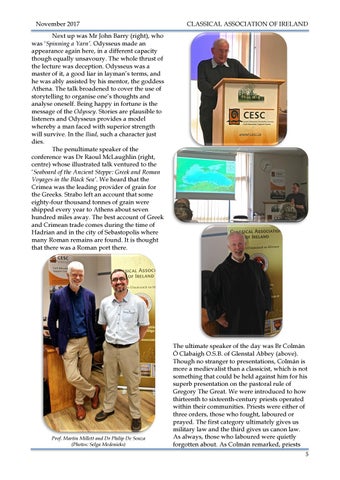
Next up was Mr John Barry (right), who was ‘Spinning a Yarn’. Odysseus made an appearance again here, in a different capacity though equally unsavoury. The whole thrust of the lecture was deception. Odysseus was a master of it, a good liar in layman’s terms, and he was ably assisted by his mentor, the goddess Athena. The talk broadened to cover the use of storytelling to organise one’s thoughts and analyse oneself. Being happy in fortune is the message of the Odyssey. Stories are plausible to listeners and Odysseus provides a model whereby a man faced with superior strength will survive. In the Iliad, such a character just dies. The penultimate speaker of the conference was Dr Raoul McLaughlin (right, centre) whose illustrated talk ventured to the ‘Seaboard of the Ancient Steppe: Greek and Roman Voyages in the Black Sea’. We heard that the Crimea was the leading provider of grain for the Greeks. Strabo left an account that some eighty-four thousand tonnes of grain were shipped every year to Athens about seven hundred miles away. The best account of Greek and Crimean trade comes during the time of Hadrian and in the city of Sebastopolis where many Roman remains are found. It is thought that there was a Roman port there.
Prof. Martin Millett and Dr Philip De Souza (Photos: Selga Medenieks)
The ultimate speaker of the day was Br Colmán Ó Clabaigh O.S.B. of Glenstal Abbey (above). Though no stranger to presentations, Colmán is more a medievalist than a classicist, which is not something that could be held against him for his superb presentation on the pastoral rule of Gregory The Great. We were introduced to how thirteenth to sixteenth-century priests operated within their communities. Priests were either of three orders, those who fought, laboured or prayed. The first category ultimately gives us military law and the third gives us canon law. As always, those who laboured were quietly forgotten about. As Colmán remarked, priests 5
CLASSICAL ASSOCIATION OF IRELAND are like aeroplanes: they only make the news when one crashes – and medieval priests were no different. We got a fascinating insight into what kind of men became priests. In 1215, the Fourth Lateran Council produced the basic guidelines for priests’ qualifications, but in the fourteenth century the clergy suffered disproportionally because of the Black Death, and some twentyfour friars were ordained who were ignorant of Latin! We learned that medieval Ireland produced a number of well-established clerical families – the Medicis and the Borgias had nothing to teach the Irish. The social side of the conference then shifted up to the nearby River Lee Hotel where the Association dinner awaited us. We were delighted to have the current President of the CAI in attendance, Carmel McCallum-Barry, who is, even better, a member of the Cork Branch and a great supporter and help to us. Sunday, August 20, dawned drizzly and dark. It is a bit of a misnomer to say drizzle, downpour would be nearer the mark. However, twenty-eight hardy souls complete with umbrellas ventured forth to uncover the delights of Kilcrea Friary and St Gobnait’s Well in Ballyvourney. The first stop was a fortifying coffee in Oriel House Hotel, Ballincollig, before we braved the elements at Kilcrea Friary. Despite the torrents of water, or perhaps because of it, Kilcrea exuded a kind of magical aura. It is the resting place of Art O’Leary, of Caoineadh Airt
Kilcrea Friary (Photo: Jennifer O’Donoghue)
6
November 2017 Ui Laoghaire fame. The friary dates from 1465 and was a Franciscan monastery. It was in use until 1832 and it is also famous as the burial place of the MacCarthys of Muskerry. Needless to say, our own McCarthy, Gerry, was our very able guide to this site. Although it is possible to spend a good couple of hours wandering around exploring this wonderful site, alas the raindrops kept falling on our heads, so we retreated to the shelter of the bus and travelled westward to Ballyvourney. This Gaeltacht area on the Cork/ Kerry border is home to the shrine of St Gobnait. Prior to visiting the rather splendid Seamus Murphy-sculpted statue of the great lady in a Macroom cloak, we stopped in the Catholic Church and met with Fr O’Brien. There he gave us an excellent account of St Gobnait and showed us the rarely-seen icon of the saint. This is made of bog oak and is a crude representation of a female figure. It is said to be about a thousand years old. Devotion to St Gobnait is a very serious affair in this area and people come and do the ‘rounds’ at her shrine and pray for healing. The blessed ribbon is also associated with the saint and we all took home one as a memento. Having left Fr O’Brien, we repaired to the Abbey Hotel for lunch. Whether by the intercession of St Gobnait or Zeus, the weather cleared up to allow us to walk around the shrine and adjoining graveyard sans umbrellas. Other notables buried here are Seán Ó Ríordáin and Seán Ó Riada. It again is a fascinating place and Gerry McCarthy once more provided a succinct account and background. Cork beckoned and trains and buses awaited, so onwards and upwards to next year’s Summer School in Belfast! The 2017 Summer School could not have happened without the assistance of a great many people who gave of their time to make it a success. Mary Doyle, Nancy Hunter, Christine Shine, Gerry McCarthy and Deirdre Mahony can take a bow, as can Dr David Woods and Dr Catherine Ware of the Classics Dept, UCC, for their help, both financial and supportive throughout the year. Without volunteerism, the Cork Branch would be so much the poorer. We hope you enjoyed your trip to Cork and thank you for making the effort to come. To those of you who missed it, you should have come! Next year could be your chance!! J. O’Donoghue
November 2017
CLASSICAL ASSOCIATION OF IRELAND
CLASSICAL ASSOCIATION IN NORTHERN IRELAND Latin student. The oldest contributors CANI’s public reading of the Iliad in were septuagenarians: my father was December 2016 proved so successful possibly the oldest reader of the day. that we immediately began plans for It was delightful to hear the timeless another: we read Homer’s Odyssey on story of Odysseus’ journey home Saturday, 17 June, in the Ulster from Troy told by participants of all Museum. The Museum has many ages and from a variety of diverse amazing spaces available for hire, but backgrounds, including school and the entrance foyer was perfect for our university students, teachers and reading, which took place during the lecturers, a retired journalist, a Museum’s opening hours: we doctor, a university administrator, commenced at 10am and concluded at civil servants – and we even approximately 4.30pm. persuaded one of the Museum guides We used Richmond Lattimore’s to read! verse translation and County Antrim The reading was brought to actor, Jimmy Kearney, started us off, a close by Dr John Curran at reading the famous first lines from approximately 4.30pm at book 23, book 1: Tell me, Muse, of the man of line 296: ...They then / Gladly went many ways, who was driven / far journeys, together to bed, and their old ritual. after he had sacked Troy’s sacred citadel. As before, we sought 36 reading slots of 10 minutes donations for charity. The Ulster each were available for hire and the Museum’s charity for 2017 is majority were allocated well in Macmillan Cancer Support, and advance of the event. A total of 34 CANI was glad to be able to donate readers participated, two of these £84.41 raised by Odyssey readers. remotely: Laura Jenkinson in Thanks go to all the CANI Portsmouth and Heather Parsons in team – Barry, Erin, John, Katerina, Tasmania. Laura, of Greek Myth Laura, Barry, Peter and Raoul – Comix fame and Clare at the Ulster Museum, (greekmythcomix.wordpress.com), for making the day such a success. also provided us with art activities for We are delighted with the exposure the young (and the young-at-heart!), that our public readings have including colouring-in sheets, cut-out brought CANI, and my mailing list Odysseus with clothes, and more relating has grown considerably. There is indeed an to the Odyssey. Both children and adults alike ever-growing audience in Northern Ireland for were active in the art corner, concentrating the events which CANI seeks to provide, and fiercely with the coloured markers, and were we aim to continue to heighten our public supervised by CANI stalwarts, Peter and Raoul. profile. Our next venture Like Odysseus, some of will be a reading of Virgil’s our readers journeyed over the Aeneid and we will be back sea: thanks to Mark McCahill CLICK TO WATCH in the McClay Library at for coming from Glasgow, and Laura Jenkinson read: Queen’s University Belfast Marco Palone, from Italy via on Thursday, 7 December, Edinburgh! Closer to home, we commencing at 10am. had participants who came to Donations from readers will Belfast from Dublin, Maynooth be sought for the Simon and Derry. We are grateful that Community NI. Contact me those readers made the trip (helenmcveigh@gmail.com) specifically to attend the to reserve a 10-minute reading. The youngest reader reading slot. on this occasion was Solomon https://youtu.be/6yZTGKdbE9c Trimble, a GCSE Greek and Helen McVeigh
7
CLASSICAL ASSOCIATION OF IRELAND
November 2017
CLICK TO WATCH
Classical Youth Society of Ireland The Classical Youth Society of Ireland was founded in 2014 with the goal of popularising Classical Studies among secondary school students. It intends to allow students the opportunity to broaden their understanding of the ancient world, while simultaneously allowing those not given the opportunity to study Classics in school a chance of engaging with it. To begin with, our outreach projects were limited, with talks hosted in rented space in coffee shops. As interest in the Society grew, we were kindly offered use of the Classics Seminar room in Trinity College Dublin. Our weekend seminars have been wide-ranging, with such topics as ‘Latin love poetry and counter culture’, ‘Piracy in the Graeco-Roman world’, and ‘Alcibiades in the Roman world’. The next seminar will be after Christmas, when Phoebe Nolan will speak about ‘Beekeeping in the Ancient World’. In 2015 our focus broadened to include the advancement of Latin and ancient Greek. On foot of our efforts, we were lucky enough to be invited to host a segment on RTÉ radio 1 and to visit the Classics department in Oxford University. Furthermore, at the end of 2015, we began CYSI’s most successful initiative – our podcasts. Conversing the Classics aims to bring academic research on the ancient world to a wider audience. Each episode is recorded in an interview format, aimed at introducing an academic’s area of focus. Series one featured a broad range of topics, with contributions by Philip de Souza, Christine Morris, Charlie Kerrigan, and Brian McGing, to name but a few. With the podcasts receiving positive feedback, we decided a second series was in order. We were fortunate to receive funding from the Classical Association of Ireland. Series two was filmed over a two-week period with academics all over the UK. It featured a multitude of Classicists, including Paul Cartledge, Gideon Nesbit, John Prag, and Robert Parker. The series is currently in postproduction and we are aiming for a launch in late February. All available episodes can be found on our YouTube channel (please see links in the box at right). In my time as Chairperson of the Society, I have been privileged to collaborate with a multitude of dedicated Classicists, young and old. Special thanks go to the rest of the Committee: vice chair Chris Joyce; secretary Michael Mac Nulty; and podcast editor Michael Fuller. Further thanks must be extended to the Classical Association of Ireland, for funding series two of Conversing the Classics; Dr Christine Morris, for organising a space for us to host events; and Delia Donohoe, for all her help and support. Oscar McHale 8
the CYSI YouTube channel https://www.youtube.com /channel/UC8WSPJ0uPrq VNp16xDKsUg?view_as=subscriber
Conversing the Classics: Athens
Conversing the Classics: Catullus
Conversing the Classics: Flames in the Forum
Conversing the Classics: Meet the Minoans!
For more information on the Classical Youth Society of Ireland, please see our social media pages: Facebook: https://www.facebook.com/Cl assicalYouthSocietyIreland/ Twitter: @CYSI_ E-mail: CYSIofficial@gmail.com
November 2017
CLASSICAL ASSOCIATION OF IRELAND
CAI BRANCH & UNIVERSITY NEWS CAI CORK By the time you read this, the Cork Branch will have completed its autumn programme. October saw us welcome Dr Daragh O’Connell from the Italian Dept of UCC. Darragh spoke to us about Virgilian Hauntings: Dante and Heaney, Reading Aeneid VI. We learned that Dante was a mediating figure between Virgil and Heaney. Virgil is Dante’s guide but Virgil is not a Christian so he is relegated to limbo. Dante believes Virgil cannot believe in Christianity: “Without faith, doing good is no good.” We look forward to Dr Michael Williams of Maynooth University in November and John Ware of UCC in December. More detail of these lectures will appear in the spring newsletter. J. O’Donoghue
CAI DUBLIN The Branch year began on 19 January with Dr Anna Jurkewicz leading the Latin Reading Group in a consideration of some correspondence between the late Roman poet Ausonius and his former pupil Paulinus of Nola, bishop and saint. The following evening the Dublin Branch annual dinner was held in Roly Saul, Dundrum. The food, the environment and, most of all, the company were idyllic – an exhilarating atmosphere and a successful occasion. On 5 February Gearóid Ó Broin conducted the Latin Group through a translation and appreciation of an excerpt from Lucretius’ De Rerum Natura. A Branch lecture was given on 21 February by Lucia Mariani. The subject was Hermione from Greek literature to Rossini. The lecturer is a PhD student at the Università del Piemonte Orientale and a visiting PhD student at UCD. She is also an accomplished violinist. Her Hermione was strong and jealous, as is shown in the works of Euripides, Ovid, Racine, and Rossini.
At the Latin Group meeting on 8 March Prof. Andrew Smith introduced readings from Virgil’s Aeneid to explore Aeneas’ rejection of Dido, with passages of Seneca and Augustine illustrating ancient concepts of duty vs desire. On 28 March Dr Jacopo Tabolli (TCD) gave a powerful lecture on women’s roles in pre-Roman Italy. He has a PhD from La Sapienza, the University of Rome, and specialises in Etruscan burials. He also delved into recent archaeological discoveries in Etruria. Dr Joan Wright introduced the Latin Group reading on 5 April to passages from Ovid’s Metamorphoses with the theme of bird transformation, including Halcyon and Ceyx, and the story of Philomela, Procne and Tereus. Dr Kerry Phelan (Maynooth) gave a fascinating lecture on 25 April dealing with the problem of citizenship in Athens. This was based on a law court speech by Demosthenes in favour of a man trying to regain his lost status as a citizen. If his action failed, slavery could result, hence the importance of the case. Ms Geraldine FitzGerald took the Latin Group on 3 May through three of Horace’s Odes from Books II and IV, reading, translating and discussing the poet’s thoughts and intentions. The annual Branch outing took place on 13 May to Kells Priory, Co. Kilkenny, and the 8th-9th century High Crosses at Ahenny, Co. Tipperary, with a delicious lunch at Langton’s in Kilkenny city. A brochure was distributed and Brian O’Connell gave extra information. There was no session leader at the Latin Group meeting on 30 May; instead, each participant brought along their own delicia Latina, explained their choice of text, then had their piece read, translated and discussed by the group. The meeting took place in the Library Bar of the Central Hotel and was appropriately sanctified by the requisite libations. On 11 October Dr Alexandra Eckert led the Latin Group through De Crudelitate, the first time the Group had read material from Valerius Maximus, and his discussion of cruelty. Brian O’Connell 9
CLASSICAL ASSOCIATION OF IRELAND
November 2017
meetings are on Fridays at 4pm in John Hume Lecture Theatre 7. Everyone is welcome. Maynooth denizen Dr The Annual General Meeting of the Limerick Michael Williams, The Politics of Heresy Branch was held on September 27, in the Lecturer in Roman in Ambrose of Milan Limerick Education Centre. There was a small History, has produced Community and Consensus in Late Antique Christianity but lively attendance. The outgoing Chairman, yet another volume, The Michael Stuart Williams Mr Patrick Ryan, held that the Branch was in Politics of Heresy in good shape entering a new academic year. The Ambrose of Milan: Latin and Greek classes would continue and the Community and Secretary, whom he congratulated on being Consensus in Late Antique chosen as Honorary President of the Association Christianity, out this for 2018, already had a programme of lectures to October and published hand. After making a passionate plea for new by Cambridge members – anyone joining after October 1, he University Press. said, would be in good standing for the whole of Congratulations to Michael from all his 2018 – he concluded by thanking the officers and colleagues and students here in the Department members for their support during his term of of Ancient Classics! I know he will be happy to office. After the Secretary and Treasurer had answer questions on Ambrose, or maybe on the given their reports, the following officers were politics of heresy, when he lectures to our Cork elected for 2017-2018: Chairperson: Ms Paula Branch in the Cork Education Support Centre Keane; Vice-chairman: Séamus Uasal Ó on Monday, 6 November, at 7.30pm. Michael’s Flaitheartaigh; Secretary: Mr Tom Seaver; talk, provided with the kind support of the Treasurer: Ms Mary Walsh-Seaver. Dept of Classics, UCC, has the interesting title Tom Seaver ‘The representation of gender in Argonautica’. Dr Maeve O’Brien
CAI LIMERICK
over, ‘Arian’ heresy. Yet almost all of the evidence comes from Ambrose’s own writings, and from pious historians of the next generation who
represented him as a champion of orthodoxy. This detailed study argues
Ambrose himself, lumping together critics and outsiders in order to secure
and justify his own authority. Along with new interpretations of Ambrose’s election as bishop, his controversies over the faith and his clashes with the imperial court, this book provides a new understanding of the nature and significance of heretical communities in late antiquity. In place of rival
congregations inflexibly committed to doctrinal beliefs, it envisages a world
Williams. 9781107019461. PPC. C M Y K
of more fluid allegiances in which heresy – but also consensus – could be a matter of deploying the right rhetorical frame.
Michael Stuart Williams is Lecturer in Roman History in the Maynooth University Department of Ancient Classics. He has published widely on the history and culture of late-antique Christianity. His books include Authorised Lives in Early Christian Biography: Between Eusebius and
Augustine (Cambridge, 2008) and (with E.P. Moloney) an edited volume on Peace and Reconciliation in the Classical World (2017).
Printed in the United Kingdom
The Politics of Heresy in Ambrose of Milan
instead that an ‘Arian’ opposition in Milan was largely conjured up by
Williams
Ambrose of Milan is famous above all for his struggle with, and triumph
Cover illustration: Stories of Saint Ambrose, by Bernardino Butinone and Bernardo Zenale, 1490–1493, 15th Century, fresco, Mondadori Portfolio/Hulton Fine Art Collection/Getty Images
MAYNOOTH UNIVERSITY
An object lesson in delivery and diction by Professor Mike Edwards (University of Roehampton), 6 October 2017, ‘Rhetoric Across Cultures: Some Thoughts on Greek and Roman Theory and Practice’ amused all. Mike’s Laurel and Hardy film clips displayed the very great value of the joke in lectures and presentations. Lively discussion followed this first talk of our ‘Maynooth Classics Seminar’ series 2017-2018. On 18 October, MU was pleased to welcome back Professor George Huxley (Maynooth University/Trinity College Dublin) who entertained with a charming talk on the seventh century BC Greek poet Sappho, ‘Sappho and Aeolian Aristocracy’. George discussed Dirk Obbink’s translation of the recently discovered papyrus ‘the Brothers Poem’ in his usual erudite fashion and closed by reading Sappho’s ‘Ode to Anactoria’, favourite poem of that most lyrical of our Irish novelists, John McGahern. The Department of Ancient Classics will host as its next speaker Professor John Dillon (Trinity College Dublin), on a topic, one presumes, perplexing to many: ‘Will the Wise Man get Drunk?’ on 17 November. There will be wine. Our cup runneth over! We very much look forward to welcoming John to Maynooth. All 10
UNIVERSITY COLLEGE DUBLIN The past academic year has seen the early retirement of Professor Theresa Urbainczyk after more than 20 years on the staff at UCD. She was a committed and extremely popular teacher who will be sorely missed by the students and by her colleagues. In her research she focused on church history, slave revolts, and the reception of Classics in film, and in her undergraduate teaching she invited her students to think about the modern reception of Spartacus, for example, not just in terms of the film by Stanley Kubrick starring Kirk Douglas but also the Soviet-era ballet by Aram Khachaturian. Theresa was a good friend of the Classical Association, and the founder-editor of Classics Ireland, overseeing the publication of volumes 1-7 (1994-2000). After serving as Head of School from 2012 to 2015, she spent a yearlong sabbatical in Kendal in 2015/16 writing a book on the Byzantine historian Niketas Choniates for Routledge. It is to the Lake District that she has returned, with her dog Wolfie, on her retirement in February 2017. Dr Alexander Thein
November 2017
CLASSICAL ASSOCIATION OF IRELAND
TRINITY COLLEGE DUBLIN Theatrical performance of Moonlight Sonata (Ἡ σονάτα τοῦ σεληνόφωτος) by Yannis Ritsos TCD Classics was honoured to host on 25 March, 2017, the world premiere of ‘Venceremos’, a theatrical performance of Yannis Ritsos’ poem, ‘Moonlight Sonata’, in cooperation with the Hellenic Community of Ireland. Ritsos (1909-1990) is one of the greatest Greek poets of the twentieth century. A poet of the left, he spent much of his life in prison and exile, but in later life was active in the peace movement. In the Trinity Long Room Hub, the performers Marios Iordanou (also the director) and Sofia Kazantzian mesmerised the packed audience by a dramatic enactment of the poem through music and dance (right). In addition, Marjorie Chambers of Queen’s University Belfast spoke about her English translation of Moonlight Sonata, and three TCD Classics students – Ellen Finn, Paul Corcoran and Andrew Beazley – read the poem.
behind this volume was to invite fifty classicists to ‘choose a favourite line and write a page’. The resulting contributions are as inspiring as they are varied, and the volume is offered in tribute to Niall Rudd, one of Trinity’s most eminent Classics graduates. The elegantly produced volume – an ideal Christmas gift! – is available to purchase online: http://www.lineofenquiry.com W.B. Stanford Memorial Lectures, 29-31 March TCD Classics was delighted to welcome Dr Will Wootton from King’s College London to deliver the 2017 Stanford lecture on the topic of ‘Unfinished works: Roman art in action’.
Line of Enquiry Launched on 12 June, 2017, and edited by Classics student Paul Corcoran, the concept
(Photo: Dr Christine Morris)
Obituary: Professor Colm Luibhéid The recent death of Professor Colm Luibhéid has deprived the Classical Association of Ireland of one of its most senior and loyal members. Throughout his long career at University College, Galway/NUI Galway, Colm gave unstintingly of his time and energy to the promotion of Classics in Ireland. In recognition of this the Council of the CAI thought it appropriate to invite him to become President of the Association for 2002 – an appointment he was honoured to accept and one which he fulfilled with grace and distinction. Colm grew up in a cultured milieu. His father Tomás, a teacher, was a native of Ballyferriter in the Kerry Gaeltacht. He met his wife
Nuala Ní Mhóráin when they were both working in Galway and where they were both involved in An Taibhdhearc. They eventually settled with their family in Sandymount, where Colm grew up. Tomás was a leading member of the Irish-speaking community in the capital. He was active in Conradh na Gaeilge and An Cumann Scoildrámaíochta, and was particularly involved with Radio Éireann’s Irish Broadcast Programme and with An Comhar Drámaíochta – as actor, writer, and producer. He also worked as translator – his translation of Yeats’ Cathleen Ní Houlihan was produced in the Abbey. With such artistic parents, it is no surprise that Colm would devote his life to learning and the Arts. 11
CLASSICAL ASSOCIATION OF IRELAND Colm received his secondary education in Belvedere College, one of the leading Classics nurseries in the country, where he read widely and won the George Dempsey Memorial Prize in 1952. After Belvedere he went to UCD, where he graduated BA and MA with First Class Honours in Classics. Then, on the advice of his mentor Professor John O’Meara (incidentally his neighbour in Sandymount and lifelong friend), he went to Princeton where in quick time he completed his PhD. An appointment at Fordham University in New York followed, but the pull to Ireland was too strong, and Colm successfully applied for a Lectureship in Classics at UCG. Thereafter, Galway was to be his permanent home. On the retirement of Professor Frank Killeen, Colm was appointed to the Chair of Classics in 1983, a post he held until his own retirement in 2002. Colm’s specialist research area was the complex field in the early Christian period where history, theology and philosophy interacted. He was the author of many books. Two were directly concerned with Church history: Eusebius of Caesarea and the Arian Crisis (1981) and The Council of Nicaea (1982). In other works he contributed to the Patristic Collection Classics of Western Spirituality, thereby making John Climachus, John Cassian and Pseudo-Dionysius accessible to a wider readership. However, Colm’s last two books are the least esoteric of his output and it is they perhaps which have the broadest appeal: A Scholarly Reconstruction of St Paul and his Times. The Historical Evidence (2002) is a balanced and stimulating analysis of the teaching of St Paul, while Exploring John’s Gospel: Reading, Interpretation, Knowledge (2007) is especially interesting. Here, selecting key passages from John’s Gospel, Colm concentrated on the way these passages have been read and misread by eminent thinkers and theologians through the centuries. This method brings valuable insights but it also reminds us of the extent to which each reader is ultimately a product of his or her times. Colm was a very popular lecturer both with his students and with his peers. He was knowledgeable, clear, engaging and, where appropriate, humorous. His mature students were especially complimentary. His lecturing skills were also appreciated beyond the confines of Academe. For many summers he was selected as Guest Lecturer – a perquisite this, the envy of many – by Swan Hellenic Cruising and was an outstanding success there. Among his audience 12
November 2017 on these occasions could be found men and women distinguished in their own fields: writers, artists, professionals, academics, toplevel civil servants, the occasional bishop and senior politician. It was the positive assessment of these disparate but requiring groups that ensured Colm’s reappointment summer after summer. Related to Colm’s talent as lecturer was his skill as raconteur. Widely read and widely travelled, he possessed a Herodotean store of anecdotes. When he relaxed with friends over a good meal his conversation rarely failed to sparkle – one might hear of a lecture by Jacques Maritain in Princeton, or of a visit to the famous Steps of Odessa in the Ukraine, or of the involvement of the Greek historian Nicholas Hammond in wartime Greek Resistance activity as narrated to Colm by his friend Hammond himself. As Head of Department Colm’s instinct was for consultation and consensus. This served him and the Department well. It created a unity of purpose and an ethos of loyalty among the staff and it removed from their midst one of the more common causes of friction and resentment. Indeed, so successful was he in running the Classics Department that the President of the University invited him to become for a time Acting Head of the Modern Languages Department – a difficult task but one which he accomplished with aplomb. With his Departmental colleagues Colm was always supportive and encouraging, yet never intrusive. With his students he was a good listener and a wise counsellor. His sympathetic understanding of students and their problems led to his appointment to the Disciplinary Board of the University. To conclude: Colm Luibhéid exemplified what the Romans called humanitas – defined in our Latin dictionaries as “humane conduct, kindness, politeness, mental cultivation, liberal education”. He was a dear and loyal husband to his first wife Pat, a devoted father to their four children – Tom, Mary, Eithne, and Irene – and after Pat’s untimely death, a loving husband to his second wife, Josephine, who nursed him with exceptional, tender care in his last debilitating illness. Colm was the embodiment of the phrase “a scholarly gentleman and a gentlemanly scholar”. Requiescat in Pace. John A. Madden