CLASSICAL ASSOCIATION OF IRELAND
NEWSLETTER ISSUE NOVEMBER 2016 ISSUE 2, 2, NOVEMBER 2013
IIHSA Day School at TCD
5 The CAI Presidential Address 2016: The Hon. Ms Justice Caroline Costello
2-‐3
Classical Association of Ireland-Teachers AGM and Conference 2016
6
Seamus Heaney and Virgil at UCC
7 CAI Summer Schools: Languages; and The Cecil D’Arcy Memorial Conference, Limerick
3-‐5
From the Editor Season’s greetings to all CAI members! We hope that this news bulletin and the accompanying volume of Classics Ireland provide some pleasant reading over the festive period. Many congratulations to Shane Wallace for bringing about the new issue of our journal! The past six months have been packed full of conferences, lectures and special events indulging our love of Classics and ancient history. Particular highlights were the engrossing keynote lecture given by Professor Tim Whitmarsh of the University of Cambridge at the CAI Summer School in Limerick, and the
Branch and University News; CAI Central Council 2016-17
8-‐12
annual CAI Presidential Address, engagingly delivered by the Hon. Ms Justice Caroline Costello, Judge of the High Court, at UCD. Among the interesting reports in this Newsletter you will find an update from Ian Maguire on the sterling work of the CAITeachers (p. 6). The group has begun to prepare its recommendations for the long-awaited revision of Classical subjects syllabi and assessment in secondary schools; although the road ahead is long, it is heartening to see that the much-needed review has commenced in earnest. With warm wishes to all our members for a very happy New Year, Dr Selga Medenieks
CLASSICAL ASSOCIATION OF IRELAND
November 2016
The CAI Presidential Address 2016 The Hon. Ms Justice Caroline Costello: ‘Ancient Shipwrecks and New Insights’
The Hon. Ms Justice Caroline Costello, Honorary President of the Classical Association of Ireland, with the evening’s respondent, former Honorary President Professor Andrew Smith (Photos: Selga Medenieks)
The CAI Presidential Address took place at UCD on Friday, November 25. The Chairman Isabella Bolger invited the Honorary President for 2016, the Honourable Ms Justice Caroline Costello, Judge of the High Court, to address the members. The lecture title was ‘Ancient Shipwrecks and New Insights’. This was a very interesting talk about the underwater archaeological exploration of a wreck located in Italy, on an off-shore reef in the waters of Isola del Giglio, in the Tuscan Archipelago. The wreck was pre-classical, dated to circa 600 BC. It was found on the north-west side of the island at a depth of 50m in the bay of Campese, in 1961. The site had been looted and 2
was finally investigated in the 1980s by the underwater archaeologist Mensun Bound, Oxford University. It is believed that the ship was Etruscan. The ship revealed much about ancient ship-building. Evidence shows that the wooden planks of the hull were either laced or sewn together. Cargo included goods from Greece, Phoenicia and Etruria. Amongst the artefacts recovered were Etruscan, Samian and Phoenician amphoras and pottery, a writing tablet, bronze helmet, carpenter’s calipers and musical flutes. A number of the amphoras were filled with olives, while others contained pine pitch. President Costello conducted research at the wreck site during the 1980s excavations. She gave a very interesting account of her experience while working there. The audience showed great appreciation for a fascinating, first-hand account of this extremely interesting experience. A vote of thanks on behalf of the Association was given by Professor Andrew Smith. The Association is committed to encouraging study of Classics: languages, archaeology, philosophy, literature and history. In this regard it awards two medals annually in recognition of achievements made by secondlevel students. Each year these awards are presented to the winners by the CAI Honorary President at the Presidential Address event. Established in memory of Jack Henderson, a distinguished and reforming inspector of Classics in the Department of Education, the Jack Henderson medal was awarded to Malachi Hannon of Gonzaga College. Malachi is the 2016 student with the highest mark for Ancient Greek in the Junior Certificate Examination. His teacher is Aryn Penn. The Centenary Medal, established on the centenary of the Classical Association of Ireland in 2008, was awarded to Brian Anthony McGlone of Blackrock College. Brian is the 2016
November 2016
CLASSICAL ASSOCIATION OF IRELAND
CAI Languages Summer School The CAI Languages Summer School, held at Trinity College Dublin this June 7-17, was a success again this year. We had 8 students in Greek and 13 in Latin classes spread across two levels. Students of all ages enjoyed two weeks of intensive learning with our enthusiastic teachers Jessica Doyle, Geraldine FitzGerald, Joao Sita, and myself. Many students were inspired by our courses and were so keen to improve their knowledge of the languages that they went on to enrol in the Byzantine Greek Summer School, which took place in July, also at TCD. It was a fun experience for students and teachers. One of our most enthusiastic students was Phoebe Nolan, who is now undertaking the MA in Classics at UCD. Here’s what she thought about the CAI Summer School:
Medal winners Malachi Hannon and Brian Anthony McGlone
Doing the Ancient Greek summer course in Trinity gave me the confidence to take up ancient Greek in University, knowing that I would be The course gave me a slightly ahead of the class.
student with the highest mark for Latin in the Leaving Certificate Examination. His teacher is Sarah Henchy. Special thanks must be extended to University College Dublin for hosting the event. A huge amount of planning and work was put into organising a very successful and enjoyable occasion which afforded members an opportunity to come together and celebrate their interest in ancient Classics. Congratulations to the organising team for their commitment and attention to detail: go raibh maith agaibh go léir.
chance to see if I would be capable of studying an ancient language. I also got to meet some really interesting people on the way. The course is quite intensive but don’t be disheartened: even though it’s fast paced/intense, it’s a great way to use the immense time of summer to learn something. Even though it’s learning, it’s a very enjoyable experience getting to know Greek at a somewhat intimate level. Since the summer course I’ve been using Greek in almost all of my conversations. You’d be surprised at how many times one needs to be able to say: βλέπε, ὁ κυβερνήτης πρὸς τὸ πλοῖον βαίνει!
Isabella Bolger, Chairperson
Dr Cosetta Cadau 3
CLASSICAL ASSOCIATION OF IRELAND
November 2016
CAI annual Summer School LIMERICK: 19-21 August 2016
The 2016 Summer Conference was held in Mary Immaculate College of Education (MICE), in Limerick, August 19-21. The conference, which was entitled ‘The Cecil D’Arcy Memorial Conference’, in honour of a distinguished pastChairman of the Limerick Branch, was officially opened by Mr Willie O’Dea T.D. He congratulated the Association, and especially the Limerick Branch, for their work in the field of Classics. It was important, he said, that the MidWest should have a share in all kinds of cultural activities and the Association’s contribution was of great assistance in this respect. The Mayor of Limerick City and Council, Councillor Kieran O’Hanlon, who also graced the occasion, thanked the Association for bringing the conference to Limerick and spoke of strenuous efforts currently being made to project the city as a City of Culture. An attendance of 40, which included Dr Raoul McLaughlin (CANI), enjoyed a varied lecture programme, the overall theme of the conference being ‘Ancient History’. On the Friday evening, Professor Tim Whitmarsh, A.G. Leventis Professor of Greek Culture, University of Cambridge, delivered the keynote lecture, ‘Historians against Rome: Imperial Rome as seen by her enemies’. He was followed on Saturday morning by Dr Shane Wallace (TCD), who spoke on ‘Alexander “the Great”: on the Origins of an Epithet’, and by Dr Matthew Potter (UL), whose subject was ‘Ancient Superpowers: Rome and China’. The Friday afternoon sessions featured two postgraduate papers: the first, illustrated, given by Ms Clodagh Lynch (NUIG), on ‘Roman silver ingots in the Balline Hoard from Co. Limerick’; the other was presented by Mr Charles Kerrigan (TCD), on ‘Reading Virgil in Britain, 1870-1930’. This part of the conference concluded with a lecture by Dr Martine Cuypers (TCD), ‘Local History in the Black Sea: negotiating Identity and Influence’. The Association Dinner was well attended and courteously served by the staff of the Clarion Hotel. A short after-dinner address was delivered by Patrick Ryan, who thanked members for their 4
Above: The CAI’s Damhlaic mag Shamhráin and Isabella Bolger with Councillor Kieran O’Hanlon and Mr Willie O’Dea, T.D. (Photos: Selga Medenieks)
attendance, and especially those who had travelled from other branches, not least for their forbearance with the exigencies of accommodation – with, apparently, not a vacant room in the whole area all weekend! The Sunday outing to Killaloe presented something of a Gene Kelly ‘Singing in the Rain’ challenge to our sizeable group. Nevertheless, in the midst of the downpours, we trudged raincoated after Tony and Mary O’Sullivan, who organised a walking tour along the Shannon, as well as a boat-trip as far as Mountshannon and a climb to the top of the tower of St Flannan’s
Some of the participants and speakers at the conclusion of the weekend conference
November 2016
CLASSICAL ASSOCIATION OF IRELAND
Cathedral. In this hallowed precinct, we finished off the day shepherded by Brian Brislane, our guide. Brian is a multi-talented person, who not alone gave us the history of the cathedral, but also instructed us in the art of bell-ringing and in the intricacies of organ-playing – with all stops pulled out! And so, we hand on the baton to the Cork Branch for 2017. Tom Seaver Hon. Secretary, Limerick Branch Summer school speakers (from left): Dr Martine Cuypers; Mr Charles Kerrigan; Dr Shane Wallace; Dr Matthew Potter; and keynote speaker Professor Tim Whitmarsh.
International Byzantine Greek Summer School (IBGSS) A new initiative this year was the arrival of the International Byzantine Greek Summer School (IBGSS) in Dublin, hosted by TCD Classics between July 18 and August 12. It is hoped that this will become a regular event. Dr Anthony Hirst directed the course, following the same format he had developed previously at the University of Birmingham (2012-15) and at Queen’s University Belfast (2002-2011). The month-long course is unusual for offering
classes both for beginners and more advanced students, and it attracted a very international group of enthusiastic and talented participants from China, Russia, Turkey, Australia, and North America, as well as from within Europe. The teaching staff comprised Dr Cosetta Cadau, Seán McCrum, Patrick Sammon and Adrian Saunders. IBGSS gratefully acknowledges the support of the Classical Association (UK) and the Society for the Promotion of Hellenic Studies for providing student bursaries. Prof. Christine Morris
Irish Institute of Hellenic Studies at Athens (IIHSA) Day School: Recreating the Ancient Past Research Institute, followed by a reception The theme for this year’s IIHSA Day School on April 2, 2016, was ‘Recreating the Ancient Past’, kindly offered by Jason O’Brien and Odaios a topic which allowed us to reflect on the many, Foods. Prof. Christine Morris varied ways in which the past can be ‘recreated’. The papers took the audience on a journey which took in the reception of Virgil in early 20th century Britain and a recreation of Kassandra in a puppetry performance, as well as showcasing replication work (making a Mycenaean shield), and exploring the very contemporary digital worlds of virtual reality and 3D representations. Speakers were Stephen Fox (UCD), Charlie Kerrigan (TCD), Sonya Nevin (Roehampton University), Sue O’Neill (TCD), Costas Papadopolos (Maynooth), Patrick Sammon, Sean McCrum, and Anthony Kelly. The event was hosted by TCD Classics at the Trinity Long Room Hub Arts and Humanities
5
CLASSICAL ASSOCIATION OF IRELAND
November 2016
Classical Association of Ireland-Teachers AGM and Conference 2016
The CAI-T annual conference and AGM was held on Friday 14 and Saturday 15 October in the Glenroyal Hotel, Maynooth. Knowing that the National Council for Curriculum and Assessment would begin work on new Leaving Certificate syllabi for Latin, Greek and Classical Studies in November, the committee decided to dedicate the conference to discussion of ideas for the new syllabi. Unsurprisingly, this news resulted in a record attendance at the conference, as teachers wanted to have input in to the process of designing the new syllabi. The Friday evening was dedicated solely to the AGM and dinner. In his Chairperson’s report, Ian Maguire noted the exciting developments in relation to new syllabi and thanked the committee for all their work in lobbying the NCCA and Department of Education and Skills in order to secure a syllabus review for the classical subjects. A new committee was then elected, with Aryn Penn (Gonzaga College) as the new Chairperson. Aryn has served on the committee for a number of years and was a very popular choice for the position of Chairperson. On Saturday morning David Hodgkinson spoke about recent developments in syllabus design for the classical subjects in England at both GCSE and A Level. David has taught Latin, Greek and Classical Studies/Civilisation in both Ireland and England so understands both jurisdictions well. His talk was very informative and provided the room with some excellent ideas for the new syllabi being designed here. After David Hodgkinson’s talk, teachers split into small groups, with Teachers of Latin and Greek in one room and teachers of Classical Studies in another. In their small groups teachers then discussed some of the ideas for new syllabi contained in a discussion document that had been prepared by the CAI-T committee. At the end of the day each group reported its conclusions publicly. This feedback session revealed many interesting ideas. 6
There was broad agreement amongst teachers on many aspects of the Classical Studies discussion document and teachers of Latin and Greek expressed satisfaction with the outcome of their discussions. Dr Martine Cuypers (Trinity College Dublin) and Ben Murray, an Education Officer with the NCCA, both attended the CAI-T conference on Saturday. Ben Murray is overseeing the work of the Classical Subjects Syllabus Development Group and Martine Cuypers has been appointed as the Chairperson. Their presence at the conference meant that they could hear first-hand what it is that teachers want, and don’t want, in the new syllabi. The other members of the Syllabus Development Group are: Megan Tomkins (Education and Training Boards Ireland) Ellen O’Reilly (Association of Community and Comprehensive Schools) Colm Dooley (Joint Managerial Body) Ian Maguire (CAI-T) Kevin McCarthy (Department of Education and Skills) Edward Herring (Irish Universities Association) Jim O’Dea (ASTI) Mary Boissel (ASTI) Thomas Ahern (TUI) Irene McGovern (TUI) The NCCA has dictated that Leaving Certificate Classical Studies will be reviewed first, followed by Latin and Greek. This means that, at the first meeting in November, the group only discussed Leaving Certificate Classical Studies. While the meeting was very positive, it was only a preliminary session so not much work has been done yet on the content and structure of the new syllabus. The second meeting is scheduled for December 19. Ian Maguire
November 2016
CLASSICAL ASSOCIATION OF IRELAND
Seamus Heaney and Virgil at UCC
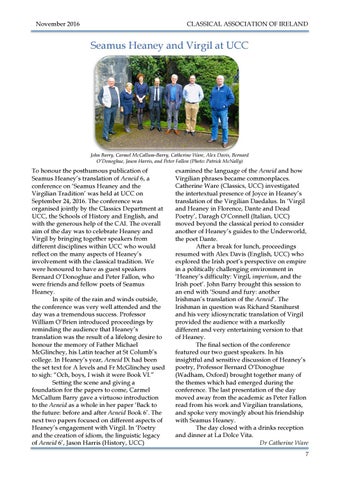
John Barry, Carmel McCallum-Barry, Catherine Ware, Alex Davis, Bernard O’Donoghue, Jason Harris, and Peter Fallon (Photo: Patrick McNally)
To honour the posthumous publication of Seamus Heaney’s translation of Aeneid 6, a conference on ‘Seamus Heaney and the Virgilian Tradition’ was held at UCC on September 24, 2016. The conference was organised jointly by the Classics Department at UCC, the Schools of History and English, and with the generous help of the CAI. The overall aim of the day was to celebrate Heaney and Virgil by bringing together speakers from different disciplines within UCC who would reflect on the many aspects of Heaney’s involvement with the classical tradition. We were honoured to have as guest speakers Bernard O’Donoghue and Peter Fallon, who were friends and fellow poets of Seamus Heaney. In spite of the rain and winds outside, the conference was very well attended and the day was a tremendous success. Professor William O’Brien introduced proceedings by reminding the audience that Heaney’s translation was the result of a lifelong desire to honour the memory of Father Michael McGlinchey, his Latin teacher at St Columb’s college. In Heaney’s year, Aeneid IX had been the set text for A levels and Fr McGlinchey used to sigh: “Och, boys, I wish it were Book VI.” Setting the scene and giving a foundation for the papers to come, Carmel McCallum Barry gave a virtuoso introduction to the Aeneid as a whole in her paper ‘Back to the future: before and after Aeneid Book 6’. The next two papers focused on different aspects of Heaney’s engagement with Virgil. In ‘Poetry and the creation of idiom, the linguistic legacy of Aeneid 6’, Jason Harris (History, UCC)
examined the language of the Aeneid and how Virgilian phrases became commonplaces. Catherine Ware (Classics, UCC) investigated the intertextual presence of Joyce in Heaney’s translation of the Virgilian Daedalus. In ‘Virgil and Heaney in Florence, Dante and Dead Poetry’, Daragh O’Connell (Italian, UCC) moved beyond the classical period to consider another of Heaney’s guides to the Underworld, the poet Dante. After a break for lunch, proceedings resumed with Alex Davis (English, UCC) who explored the Irish poet’s perspective on empire in a politically challenging environment in ‘Heaney’s difficulty: Virgil, imperium, and the Irish poet’. John Barry brought this session to an end with ‘Sound and fury: another Irishman’s translation of the Aeneid’. The Irishman in question was Richard Stanihurst and his very idiosyncratic translation of Virgil provided the audience with a markedly different and very entertaining version to that of Heaney. The final section of the conference featured our two guest speakers. In his insightful and sensitive discussion of Heaney’s poetry, Professor Bernard O’Donoghue (Wadham, Oxford) brought together many of the themes which had emerged during the conference. The last presentation of the day moved away from the academic as Peter Fallon read from his work and Virgilian translations, and spoke very movingly about his friendship with Seamus Heaney. The day closed with a drinks reception and dinner at La Dolce Vita. Dr Catherine Ware 7
CLASSICAL ASSOCIATION OF IRELAND
November 2016
CAI BRANCH & UNIVERSITY NEWS CAI CORK The Cork Branch at their recent stand in September at the Adult Education Exhibition in the City Hall were thrilled to be awarded the Best Overall Display Stand Award. As there were almost fifty stands, some from universities and institutes of technology, it was a great honour to come out on top. Many thanks to all the Branch members who ‘manned’ the stand over the two days.
Our first lecture of the season was in October and for this we had Dr Jason Harris from the History Department of UCC. The title of the illustrated talk was ‘Getting down and dirty with the Romans: How to be crude in Renaissance Latin’. The title was intriguing and we were assured that plenty examples of bad language would be used! They were. Some of the questions addressed were: what can be mentioned in polite company? and, for that matter, what makes language impolite in company? According to Plinio Veronese, “No elegant woman is chaste” and it would seem that Catullus, Martial, Horace, Ovid, Juvenal and Cicero were given to frequent bouts of less than elegant expression. November saw us welcome Dr Catherine Ware from the Department of Classics, UCC. Dr Ware is the latest addition to the staff there and has made a big impact since arriving. In September she organised a day seminar relating to Seamus Heaney’s translation of Virgil’s Aeneid VI. It was a superb day in spite of the shocking weather and all 8
who attended (and there were many) were treated to a diverse series of talks which helped to bring Book VI to life even more, if that is possible. Catherine spoke to the branch on ‘Condemned to the arena: a literary theme’. This was also an illustrated talk and helped trace the link between the physical arena and mentions of it in literature. Wherever the Romans conquered and settled, they built an arena. The last gladiatorial games were held in Rome in 404 AD, which is a long time from the oldest surviving amphitheatre in Pompeii dating to about 70 BC. That time span would amount to a huge number of animals and people killed. We learned quite a few interesting facts: gladiators did not fight animals, animals fought Christians. A day at the arena was just that, a day! Beast shows took place in the morning, executions at lunchtime, and gladiatorial contests brought the evening to a close. What more would one want for a day’s entertainment! In literature, Caesar and Pompey were described as gladiators. The theme is first referenced in the Aeneid, Book XII, and it is also seen in Lucian. In the Imperial Panegyrics, the theme of the amphitheatre is very popular. The arena, like the emperor, was the focus; one was the centre for the entertainment, the other was the centre of everything. In December we will welcome Dr Michael Hanaghan, again from the Department of Classics in UCC. A full report on Michael’s talk on ‘The epistolary narratives of Sidonius Apollinaris’ will appear in the next newsletter. The programme for the Spring term will be available shortly, but a preview of the speakers includes Dr Jo Day (UCD), Dr Damien Bracken (UCC), Dr Alexandra Guglielimi (UCD), and in May a number of members’ papers from the Branch.
November 2016
CLASSICAL ASSOCIATION OF IRELAND
If you get the newsletter and you are a Cork Branch member, or any Branch member in the vicinity for that matter, please do attend our lectures. Attendances have been excellent for the past year, but many who come are following a particular speaker (and we are delighted to see you) but to keep a Branch going, members need to be active. Several Branches over the years have become dormant and those which remain, do so because of the hard work of a few individuals on the various committees. Faces, likes ideas, need to circulate and input needs to be continuous. It’s only one Monday a month in our case – that’s not too much to ask! The annual Classical Association of Ireland Summer School will be held in 2017 in Cork from August 18 to 20, so don’t say you have not been warned! Put the date in your diary, book the holidays, and come to Cork for what will be a great series of talks. Alas, we cannot guarantee any amphitheatres but there is plenty of civilised entertainment waiting for your delectation. Season’s Greetings to all and every best wish for 2017. Jennifer O’Donoghue
CAI DUBLIN The Autumn session began with a committee meeting in the home of Dominique Geary on Friday, September 23. At this meeting the membership of a new committee was discussed, as was the series of Autumn meetings. Those present also sampled delicious home cooking! There followed a Latin reading on Wednesday, October 19, in which Alan Tuffery discussed Ovid’s Heroides VII. On Tuesday, November 1, the Branch AGM was held. This resulted in the following committee being approved: President: Isabella Bolger Vice-president: Patrick Sammon Secretary: Dominique Geary Treasurer: Liam Bairéad Other committee members: Pat Waldron, Andrew Smith, Brian O’Connell, Joan Wright, Alexander Thein, and Deirdre Doyle. A statement of accounts was distributed and approved. Both the past and future Presidents made closing statements.
There followed an illuminating address by Professor Andrew Smith on ‘Ancient Thrace and the Borders of Civilisation’. Here he described a visit to Bulgaria by members of the Classical Association. The lecture concentrated on Roman remains and influence in the area. On Tuesday, November 15, Dr Amanda Kelly from the UCD School of Archaeology gave us a fascinating lecture on ‘Extra–urban villae in Crete: rustic rituals or strategically placed administrative hubs?’. The following day, there occurred a Latin reading group meeting. Notable future meetings include Tuesday, December 5, when Michael Ann Bevivino from the UCD School of Art History and Cultural Policy will give a lecture entitled ‘Apollo in 3D? From plaster casts to digital models’. In addition, the Latin reading group will meet on Thursday, December 8; as well as extracts from Cicero’s De Republica and De Legibus, the Mediaeval Latin lyrics of the ‘Carmina Burana’ will be explored. Altogether an interesting Autumn! Brian O’Connell
CAI LIMERICK We were delighted to welcome Prof. George Huxley on October 20. Effervescent as ever, he began the programme with a very interesting lecture, ‘Stesichorus as an Epic Poet’. He was followed on November 9 by Ms Paula Keane, a member of the Branch, who treated us to an intriguing talk entitled ‘An Introduction to Dogs in Ancient Greece and Rome’. Our next speaker, on November 30, was Dr Catherine Ware, from UCC. She spoke on ‘Spectacular Justice: Rufinus in the Arena’. The programme of Autumn Term lectures will conclude on December 7, with a talk from our honorary Chairman, Mr Patrick Ryan, on ‘Christianity and Classical Culture in the 4th Century A.D.’. The Latin and Greek Adult Language classes will resume on Monday, January 9, 2017, under the tutelage of the aforementioned Patrick Ryan. Ms Paula Keane has volunteered to represent the Branch on the CAI Central Council from January 2017. Tom Seaver Branch Secretary 9
CLASSICAL ASSOCIATION OF IRELAND
CLASSICAL ASSOCIATION IN NORTHERN IRELAND The second half of 2016 has seen the Classical Association in Northern Ireland and its members making connections and presenting talks with other institutions and societies. On October 13 the Metropolitan Arts Centre, Belfast, hosted a screening of the marvellous Monty Python’s Life of Brian for the second CANI Film Night, before which Dr Peter Crawford highlighted how the reception of the film has gone from blasphemy and bans to academic praise for its depiction of Roman Judaea. On November 3, CANI founder Dr John Curran (pictured below) had the opportunity to present the Sir Samuel Dill Memorial Lecture on behalf of the esteemed Professor Dame Averil Cameron on ‘Samuel Dill, the end of the Roman empire, and learning from history’.
November 2016 Before the year is out though, CANI will return to hosting its own events. On December 8, a day-long public reading of Homer’s Iliad will take place on the grounds of the McClay Library at Queens University, where members of the public will be invited to take part. 2016 will then be closed out on December 15 with a talk by Professor Theresa Urbainczyk of UCD on ‘Some Byzantine Women and their Husbands’. Early 2017 will see CANI venture out into schools to provide help on the historical background to Classical Civilisation courses, and host talks on the March of the 10,000, Greek Percussion, and Constantius II, before the return of the Belfast Summer School in Classics. The CANI website continues to provide not only information, reviews and galleries of its events but also a blog on a variety of ancient subjects – Roman coins in Japan, Far Eastern remains in Roman London, falling down the numismatic rabbit hole, Trojan War playing cards and paper dolls, the classical allusions of the Battle of Cannae and burning princesses in Game of Thrones, and a new subsection on ‘My Favourite Picture of Ancient History’, which has so far covered a 3,300-year-old Egyptian door seal and a 100-year-old picture of a Marchioness of Londonderry as Circe. Find the blog at: https://classicalassociationni. wordpress.com/category/blog/
CLICK TO READ the full text of The Sir Samuel Dill Memorial Lecture 2016 by Dame Averil Cameron: http://www.qub.ac.uk/schools/IrishStudiesGateway/ NewsandEvents/ValueofMedievalStudiesandHumanities/
On November 15, Dr Peter Crawford was invited to Coleraine Town Hall by the Coleraine Historical Society (www.colerainehistoricalsociety.co.uk) to present a talk on the Coleraine Hoard – a collection of Roman silver coins, ingots and plate buried in the fifth century and uncovered in 1854, and what it might suggest about Romano-Irish relations (pictured, right). 10
We are willing to listen to ideas and are open to future contributions from our readers, so get in touch! Dr Peter Crawford
November 2016
MAYNOOTH UNIVERSITY Newly minted PhD Dr Kerry Phelan has recently been conferred with her PhD. A student in the Department of Ancient Classics at Maynooth, both as an undergraduate and as a graduate student, Kerry’s thesis entitled A Social and Historical Commentary on Demosthenes’ Against Euboulides, written under the direction of Dr Kieran McGroarty, has earned her a PhD. All her Maynooth friends are delighted to wish Kerry the very best in her academic career as a newly minted PhD. Bene vertat, quod agis.
Dr Kerry Phelan pictured with her supervisor, Dr Kieran McGroarty, at the conferring ceremony. (Photo: Stephen McCarthy)
Dr H. H. Stewart Prize in Latin 2016 Congratulations to Charlie Harding who won third prize for his results in First Arts Latin Examination. The award was presented at a special ceremony on Wednesday, November 9, 2016 in the Royal Hospital, Kilmainham, by the Chancellor of the University, Dr Maurice Manning (pictured below). This is an outstanding achievement for the recipient and for the Department of Ancient Classics, NUI Maynooth.
CLASSICAL ASSOCIATION OF IRELAND Department hosted seminars We have had a super calendar year of wonderful seminars starting February this year when Professor Douglas Cairns (University of Edinburgh) spoke on ‘Word and Deed: Brendan Kennelly’s Antigone’, especially auspicious in this year when the most beloved of our poets, Professor Brendan Kennelly, reached his eightieth birthday. The interaction between Ireland and the Classical tradition was again amply illustrated by Dr Elizabeth Boyle (Maynooth University, Department of Early Irish) in her contribution, ‘The Six Ages of the World and the Succession of World Empires: Conceptualising Greek and Roman History in Medieval Ireland’. Mathematical and political logic informed entertaining and erudite talks by Dr Ciarán Mac an Bhaird (Maynooth University, Department of Mathematics and Statistics), ‘Eudoxus of Cnidus: The Forgotten (?) Master of Classical Greek Mathematics’, and Dr Alexander Thein (University College Dublin), ‘The Logic of the Proscriptions of 82 and 43 B.C.’ Dr Clifford Robinson (Maynooth University), visiting Government of Ireland Scholarship Fellow from the USA, finished the academic year on ‘Gender Dynamics and the Power of Speech in the Classical Consolatory Tradition’. This academic year to date, one of our own, Dr Michael Williams, spoke about ‘Felix of Nola: The Unmaking of a Martyr in Late Antiquity’. Michael was awarded a Humboldt scholarship last year and has just returned from Germany to our Department. Professor George Huxley (Maynooth University/Trinity College Dublin) delivered a very special lecture, ‘Alcman and Sparta’, on October 19 to a packed audience. Undergraduates outnumbered us ‘oldies’ and they responded warmly to Professor Huxley’s unique mix of high scholarship and unassuming erudition. We were regaled by Professor Richard Rutherford (Christ Church, Oxford) about how we might interpret the famous shield of Achilles in Iliad 18 in ‘Viewing the shield of Achilles’, and we look forward to our Christmas celebration seminar, rounding off the year in perfect ring composition, with ‘Ancient Ideals and 1916’ by Dr Eoghan Moloney (The University of Winchester) on December 2, 2016, in Lecture Theatre 7, John Hume Building. All welcome. Dr Maeve O’Brien Department of Ancient Classics 11
CLASSICAL ASSOCIATION OF IRELAND
TRINITY COLLEGE DUBLIN
The past academic term and year in Trinity College Dublin have been particularly active and enjoyable. Our research seminar series hosted academic speakers from home and abroad, including Prof. Andrew Erskine (University of Edinburgh), Dr Yvona TrnkaAmrhein (Trinity College Dublin), Prof. Douglas Olson (University of Minnesota), and most recently Prof. Bernhard Palme (University of Vienna). The Student Classics Society has also been very active under the leadership of Zoe Boland. In addition to toga parties, film nights, and table quizzes, the society has hosted a number of high-profile guest lectures and will be embarking on an international trip early next year. Two new student-led journals have been founded in recent months: Minerva and Lines of Enquiry, which focus on literary translation and engagement with classical texts. Looking forward, there are a number of exciting events on the calendar for next year. Notably, between March 29-31 Dr Will Wootton of King’s College London will be delivering this year’s W.B. Stanford Memorial Lecture Series. The lectures will focus on Roman art and
Classical Association of Ireland Cumann Clasaiceach na hÉireann Central Council 2016-17 Hon. President 2016: Ms Justice Caroline Costello Chairperson: Isabella Bolger Vice-Chairperson: Catherine Ware Secretary: Patrick J. Ryan Treasurer: Martine Cuypers Membership Sec.: Andrew Smith Public Relations: vacant Elected Committee: Cosetta Cadau; Peter Crawford; Daniel O’Connor; Joan Wright Co-opted Members: Jo Day; Geraldine FitzGerald CAI-Teachers Rep.: Ian Maguire 12
November 2016 material culture. Victoria Rimell’s 2009 Stanford lectures have recently been published: The Closure of Space in Roman Poetics: Empire’s Inward Turn (CUP, 2015). Dr Shane Wallace
UNIVERSITY COLLEGE DUBLIN The UCD School of Classics is pleased to announce that Dr Jo Day has been appointed on a permanent basis as lecturer in Greek Archaeology and Curator of the UCD Classical Museum, and that Dr Cosetta Cadau has been appointed to teach Roman history and Latin for the current academic year. Dr Alan Ross (Marie-Curie post-doc) now has a teaching position as the Roman historian at Southampton, while Dr Daniele Miano (IRC post-doc) has been appointed to the Roman history post at Sheffield. Among our postgraduates we are pleased to announce that Edna Nash graduated with an MLitt, and that Jessica Doyle has completed her PhD. We are also pleased to welcome two new PhD students: Suzanne Lynch (BA and MA from UCD), and Mohan Deng (BA Minzu University of China, MA Beijing Normal University). Dr Alexander Thein
IIHSA Rep.: Andrew Smith Branch Representatives: Belfast (CANI) Raoul McLaughlin Cork Jennifer O’Donoghue Dublin Brian O’Connell Galway/Sth East vacant Limerick Paula Keane Sligo Kathleen Conlon University Representatives: Maynooth Maeve O’Brien NUI Galway Edward Herring QUB John Curran TCD Shane Wallace UCC Catherine Ware UCD Alexander Thein Student Rep Dainora Sukauskaite Publications: Andrew Smith Editors, Classics Ireland Brian Sheridan; Shane Wallace Editor, CAI Newsletter Selga Medenieks Editor, CAI Website Isabella Bolger