CLASSICAL ASSOCIATION OF IRELAND
NEWSLETTER Events: The UCD Classical Society Inaugural Mauris imperdiet. Duis nec purusto nonthe Lecture 2018; The Long March: Shannonside dui Ryan auctor consequat. Euphrates; The Eithne Lecture Maecenas in Classics 2018
ISSUE 1, MAY 2018 ISSUE 2, NOVEMBER 2013
faucibus. Ut quis velit ac mi lacinia euismod.
‘My Walk of Simichidas: remembering the seventh Idyll of Theocritus’ by Gerry Murtagh
2-3
The CAI Summer School programme: QUB, Belfast, 17-19 August, 2018
4 Mauris imperdiet. Duisthe nec CAI purus non Notices: dui auctor consequat. Maecenas 2018 AGM; the CAI faucibus. Ut quis velit ac mi lacinia euismod. Summer Language
News from the Classical
Mauris imperdiet. Association Duis nec inpurus Northern non dui auctorIreland consequat. Maecenas faucibus. Ut quis velit ac mi lacinia euismod. 7-8
Mauris imperdiet. Duis nec purus non dui auctor consequat. Maecenas Branch and faucibus. Ut quis velit ac mi lacinia University News euismod.
9-12
School
5
From the Editor
5-6
Dear CAI members, Another academic year may be drawing to a close but the CAI continues! In these pages you will find plenty of news about the activities of the Classical Association in Northern Ireland, hosts of this year’s CAI Summer School. Everyone is welcome to attend for a stimulating long weekend of Classics talks and social events! The Orchard Yard Players also extend a warm invitation to all, to Co. Tipperary for a reading of Terence’s Self-Tormentor (rt). As you may be aware, the biannual CAI tour abroad has been postponed; in place of a report on the trip, we will rely on Gerry Murtagh’s gentle reminiscences about a special day on Kos to whisk us away! Happy reading (in the sunshine, I hope!) Selga Medenieks
CLASSICAL ASSOCIATION OF IRELAND
May 2018
My Walk of Simichidas: Remembering the seventh Idyll of Theocritus Such nectar as you Nymphs mixed for us to drink that day by the altar of Demeter by the threshing floor. May I set once more the great winnowing fan on her corn heap, while the laughing goddess bears sheaves and poppies in either hand. (153-157) The day is already warm, the harvest sun well up (it must be), as I leave town. The road I’m on is scattered-suburban and traffic is relatively busy, coming towards me, on its way to Kos. Private houses stud the wayside, usually quite large and beautiful. There are some commercial buildings. Am I on the correct road? The parallel Ammoudia road, close to the sea and looking over towards Bodrum and modern-day Turkey, conceivably could be the one. But I clear my mind of doubts and carry on. It is a smooth, modern road, but I think of the words of the goatherd to Simichidas: “As you go, each pebble sings spinning from your shoes.” There are no pebbles here. There is just the rising August heat. Presently I reach a crossroads and am directed by a soldier towards the town of Zipari. With frank Greek curiosity he asks my age, and I tell him. On the left, but out of sight now, is the fresh-water spring Vourina, on the lower reaches of Mount Dikeo. It is a bone of contention among students of the Seventh Idyll. Is this the spring which in lines 6-9 of the Idyll is celebrated as caused by the foot of Chalcon, ancestor of the hosts of Simichidas, or is its name an archaeological revival of the nineteenth century? Is it not even possible that this Vourina lost its name in the slow passage of time, only to have had it restored in the eighteen hundreds? Or could it be that Vourina is to be identified with the scene of the harvest festival in the Haleis described in the closing lines of the poem, as argued by M. Puelma? I don’t think so. I belong to the school of Patton, Gow and Dover. Two springs feature in the Seventh Idyll. Vourina, now on my left, is employed in the poem to heroise the ancestor of Phrasidamus and Antigones. Given its relative height it is hardly such a practical place 2
as to be a centre for a harvest festival, with its fragrant reeds, four-year-old wine, beans, winnowing fans, Demeter and all. Meanwhile, its pure waters pour richly for the town of Kos, and for local farmers who siphon it off and, surprisingly, fill white bathtubs nearby, while more is conveyed downhill to the Asclepion a kilometre or so below. It is approaching midday. An Aldi (or a Lidl) appears on the left and I drink a welcome and well-chilled portokolada. The girl asks my age. Now, somewhere along here Simichidas meets Lycidas, a meeting “arranged by the Muses”. The smiling goatskin-clad Lycidas appears, carrying an olivewood herdsman’s crook and smelling strongly of rennet. “Are you going uninvited to a vineyard?” he jokes. Simichidas compliments Lycidas as “the best of pipers”. He and his friends are heading for the farm of friends who are holding a harvest festival in honour of the goddess Demeter. He invites Lycidas to “cowherdise”, though he half-modestly admits that compared to others he competes like a frog amongst cicadas. The laughing Lycidas accepts the friendly challenge. The Cowherdising The ‘meludrion’ of Lycidas is a love poem, a lover’s wish that Ageanax may arrive safely when he sails to Mytilene. When he does, the poet will celebrate with Ptelean wine and (well!) roasted beans, and music played by two pipers. It is a poem of grace and longing and deep emotion: The halcyons – and of all the birds whose living’s of the seas the sweet green Daughters of the Deep love none so well as these – 0 they shall still the Southwind and the tangletossing East, and lay for him wide Ocean and his waves along to rest. Ageanax late though he be for Mitylene bound heav’n bring him blest wi’ the season’s best to haven safe and sound. (57-62)
May 2018 Not to be outdone, and to honour Lycidas, as one who is loved by the Muses, Simichidas replies with his own song: his best, he thinks. To the lyricism of Lycidas he poses a playful, light-hearted, perhaps flippant offering. The Loves have sneezed on himself as on his friend Aratus. He himself loves Myrto “as goats love the spring”, while Aratus loves Philinus. Simichidas calls on the god Pan to help in his friend’s love affair. But if Pan fails to do so, “May your skin be bitten and scratched all over. May you sleep in nettles”. The song is a stinging, alliterative delight: But O if othergates thou go, may nettles make thy bed and set thee scratching tooth and nail, scratching from heel to head, and be thy winter-lodging nigh the Bear up Hebrus way i’ the hills of Thrace; when summer’s in, mid furthest Africa mayst feed thy flock by the Blemyan rock beyond Nile’s earliest spring. (109-114) It ends with some good advice, Theocritean good sense. If all fails, Aratus, no more waiting at doors. Let peaceableness (ἀσυχία) be our care. In other words, a philosophical outlook on life. And now Lycidas, laughing pleasantly as before, presents Lycidas with his lagobolon, his herdsman’s crook, a symbol of their friendship in the Muses. Then he takes the road on the left, to Pyxa, and travels on, and on. Simichidas turns towards the farm of Phrasidamus and his brother. Some two thousand years later I follow in his footsteps, to Linopoti. I would like to think that here, or somewhere nearby, close to the Haliki lake near the town of Tigaki, is where Theocritus sets the scene of Demeter’s harvest feast. A passage of Keatsian richness call up the scene: Poplars in plenty and elms stirred quietly overhead. Nearby the sacred water from the cave of the Nymphs murmured as it flowed. On the shady branches the sun-browned cicadas chattered busily, while a treefrog croaked from thorny brambles. Larks and finches sang. A turtle dove cooed, and humming bees flitted about the waters of the spring. Everything
CLASSICAL ASSOCIATION OF IRELAND savoured of the abundance of harvest-time. Pears at our feet, apples at our sides, sloe bushes hung down to the ground for us. (136-145) The wine is described no less richly. Wine fit for a Hercules, from wine jars four years old – such nectar as set Polyphemus dancing among his sheep, he who pelted ships with mountains. I find a pleasance for myself, and sit outside under some whispering pines, to do honour to Theocritus. My head full of the problems pored over by students of his poems, a glass of wine seems appropriate. It is red wine with the earthy character of cherries and plum, though hardly four years old. Simichidas – is he a real person? Is he Theocritus himself? A fictional character? And Lycidas – is he an actual goatherd or a freespirited poet got up in his goatskins? Or is he, too, a fictional character, or a figure borrowed from the Coan poet Philetas? Or… And the walk and the meeting and the harvest festival – did these actually happen and to what extent do they reflect an actual occurrence? Another glass is delicate and racy, with a lemony zest and freshness and vibrancy; I lose myself somewhat in a kind of reverie. A smell of rennet hangs in the air. I see, or think I see, two figures at a crossroads. One offers a lagobolon to the other. I want to call to him, “Who are you, Lycidas? Are you a real person or are you some symbol? That rancid smell – does it conceal some divine Olympian fragrance? Are you the god Apollo?” But Lycidas, smiling enigmatically, goes on down the road towards Pyxa, and on and on. I return to myself and take a sip to honour Demeter, and to thank snub-nosed Simaetha, and Gorgo, and Corydon, who led me to this place. Gerry Murtagh
Update on the CAI Tour 2018 Unfortunately, the cost of the lovely tour of Northern Italy planned for 2018 was prohibitive and we felt compelled to cancel. Instead, we hope to arrange a tour for May 2019. Our thoughts are turning towards Cyprus or southern France. Andrew Smith and Joan Wright.t 3
CLASSICAL ASSOCIATION OF IRELAND
May 2018
CAI Summer School QUB, BELFAST 17-19 August 2018 The Classical Association in Northern Ireland is delighted to host the annual Classical Association of Ireland Summer School from 1719 August 2018 at Queen’s University Belfast. Participants may register by emailing classicalassociationni@hotmail.com ensuring they provide all the information asked for on the registration form, which can be viewed on the CAI website: http://www.classicalassociation.ie/summerschool.php
PROGRAMME OF EVENTS FRIDAY, 17 AUGUST 17.30 Registration and Reception 19.00 CAI Annual General Meeting 19.50 Official Opening Dr JOHN CURRAN (QUB)
14.30 ‘Dungeons and Hydras: Board gaming in Ancient Greece’ BARRY TRAINOR (QUB) 15.15 Coffee/Tea break 15.30 ‘Who read the ancient novels?’ HELEN MCVEIGH (CANI) 19.00 Reception and CAI Dinner Canada Room, Lanyon Building, QUB SUNDAY, 19 AUGUST
12.30 Lunch
“MEDIEVAL AND MONASTIC IRELAND” Conducted by IRISH MONASTIC TOURS 10.00-17.00 We will visit: • Nendrum - The monastic settlement at Nendrum on Mahee Island in Strangford Lough was believed to have been established by St Mochaoi (better known as Coalán) in the 5th Century AD, with links to St Patrick. It is one of the best-preserved monastic cashel structures in Ireland • Inch Abbey, where the story of St Patrick and the snakes was recorded • Historic Downpatrick to uncover St Patrick’s legacy and see the High Cross in Down County Museum • Down Cathedral and the traditonal site of St Patrick’s Grave
13.30 ‘Why is tragedy entertaining?’ Dr CRESSIDA RYAN (OXFORD)
Lunch at Paddy’s Barn, Saul, Downpatrick, is included (www.paddysbarn.com)
20.00 Keynote Lecture: ‘Honour Among Thebes’ NATALIE HAYNES SATURDAY, 18 AUGUST 9.00 CAI Central Council meeting 10.00 Classics and modern culture: in conversation with NATALIE HAYNES 11.00 Coffee/Tea break 11.30 ‘Fun and Games in Ancient Epic’ Prof. HELEN LOVATT (NOTTINGHAM)
4
May 2018
Notice of Annual General Meeting The Annual General Meeting of the Classical Association of Ireland will take place at Queen’s University, Belfast, on Friday, 17 August 2018, at 7.00 p.m. The Secretary notifies members that nominations and motions will be received under the following provisions of the Association’s Rules. Article 12 – Nominations for CAI Council The officers and ordinary members of the Council are elected at the Annual General Meeting. The Council has made nominations under this Article as follows: Chair: Catherine Ware Vice-Chair: Helen McVeigh Secretary: Patrick J. Ryan Treasurer: Alexander Thein Members by Election: 1. Joan Wright 2. Cosetta Cadau 3. Geraldine FitzGerald 4. Peter Crawford
CAI Languages Summer School 2018 A fresh cohort of eager learners is warming up for the 2018 Summer School in ancient languages! The CAI offers intensive short courses in both Greek and Latin, taught by experienced language instructors. With two levels (Beginners and Intermediate) for each language, there is something to suit everyone, from the school pupil (over the age of 16) to the retired and keen Hellenophile! The courses take place in University College Dublin from 5-15 June and will consist of three meetings per day, with intervals for study between sessions (15 hours of class per week). There are still places available, and the price is €300 (students and pensioners €150), so spread the word and sign up soon!
CLASSICAL ASSOCIATION OF IRELAND Further nominations may be made by any Branch and should be sent to me, by post or email, before Friday, 3 August 2018. Every such nomination shall state the names of the persons nominated and shall be signed by their proposers and seconders and certified by the Branch Chairperson or Acting Chairperson. Article 14 – Special Motions Any member wishing to propose a Motion (including a proposal for amendment of the Constitution) at the Annual General Meeting should send a signed copy to me before 17 July 2018. Please note that Motions may be submitted by individual members, rather than by Branches. Patrick J. Ryan, Secretary Contacts by Post: The Orchard Yard, Newport, Co. Tipperary by E-mail: p.strepsiades@gmail.com
UCD Classical Society Inaugural Lecture with Prof. Paul Cartledge The UCD Classical Society’s 113th inaugural lecture took place on Thursday, 19 April 2018, in Theatre P of the Newman Building. This year we were delighted to welcome Paul Cartledge, A. G. Leventis Professor of Greek Culture emeritus from the University of Cambridge, to speak on ‘Gender and Sexuality in ancient Sparta: an Other View?’. The evening was one of the most successful inaugurals to date, with over 160 in attendance. Prof. Cartledge did not disappoint and presented the crowd with an informative, detailed, and entertaining paper, which examined the difficulties one encounters when viewing ancient Sparta, as well as perceptions of gender and sexuality in the past. The event was organised by Phoebe Nolan and Oscar McHale (pictured) with the assistance of the Senior Treasurer, Dr Martin Brady, and the Classical Society committee. Oscar McHale
For further information and registration forms, please contact: Dr Cosetta Cadau, School of Classics, University College Dublin, Dublin 4 Email: cosetta.cadau@ucd.ie 5
CLASSICAL ASSOCIATION OF IRELAND
The Long March: from Shannonside to the Euphrates The Limerick Post newspaper (28 Jan. 2006) reported under the heading “Limerickman traces steps of ancient Greek army” an interview with Shane Brennan, a native of Caherdavin in the city, on his epic journey on foot in the trail of Xenophon’s Anabasis of 401 BC. When the journey came to the attention of our classical languages group, local interest naturally demanded further investigation, particularly since by happy coincidence, we were, and still are, busily engaged in reading the very same Anabasis at Limerick Education Centre! Shane told the Post: “I didn’t reflect much on the hardships at the time, as I was so occupied on simply surviving and on where the next meal was coming from. People generally wouldn’t talk about Saddam Hussein and the regime (the journey was undertaken in 2000, before the fall of Saddam), but by their silence it was evident that they were too afraid to mention his name. I steered away from politics as far as possible, because I was there for my own project and didn’t want to draw attention to myself for all the wrong reasons”. His account of the project, entitled In the Tracks of the Ten Thousand, is published by Hale (London, 2005). Shane tells how his interest was sparked when his father, who had studied Classics at Multyfarnham College, occupied his time on a wet day during a family holiday by telling the story of the ten thousand Greeks who went up country with Cyrus the Younger. He writes: In walking the route I had little expectation of shedding light on the more obscure locations of the march. I wasn’t seeking to do this, but rather to discover what remains, and to try to see the world through the eyes of the soldiers. Quite early in the journey I noticed that I was developing an ability to read the landscape – a gradual shift from an aesthetic to a practical appreciation of natural features. Dr Shane Brennan is now Assistant Professor of World Cultures at the American University in Dubai and has just published an entry on the Anabasis in the Literary Encyclopaedia; also forthcoming is the Landmark Xenophon’s Anabasis (Pantheon Books, 2019) of which he is co-editor. We in Limerick are pleased to announce that Shane has accepted an invitation to lecture to our group when he comes home for the summer. 6
May 2018 We will inform the Branches and associate groups when arrangements are in place for this fascinating and unique opportunity to hear of his long march up country. Patrick J. Ryan
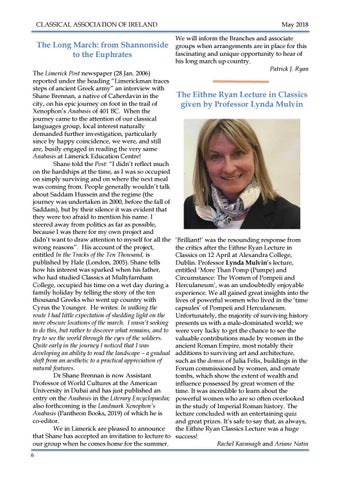
The Eithne Ryan Lecture in Classics given by Professor Lynda Mulvin
‘Brilliant!’ was the resounding response from the critics after the Eithne Ryan Lecture in Classics on 12 April at Alexandra College, Dublin. Professor Lynda Mulvin’s lecture, entitled ‘More Than Pomp (Pumpe) and Circumstance: The Women of Pompeii and Herculaneum’, was an undoubtedly enjoyable experience. We all gained great insights into the lives of powerful women who lived in the ‘time capsules’ of Pompeii and Herculaneum. Unfortunately, the majority of surviving history presents us with a male-dominated world; we were very lucky to get the chance to see the valuable contributions made by women in the ancient Roman Empire, most notably their additions to surviving art and architecture, such as the domus of Julia Felix, buildings in the Forum commissioned by women, and ornate tombs, which show the extent of wealth and influence possessed by great women of the time. It was incredible to learn about the powerful women who are so often overlooked in the study of Imperial Roman history. The lecture concluded with an entertaining quiz and great prizes. It’s safe to say that, as always, the Eithne Ryan Classics Lecture was a huge success! Rachel Kavanagh and Ariane Natin
May 2018
CLASSICAL ASSOCIATION OF IRELAND
CLASSICAL ASSOCIATION IN NORTHERN IRELAND Celebrating Classics Education: a Day for Schools An event organised by the Classical Association in Northern Ireland in partnership with Advocating Classics Education (ACE) was held on Friday, 9 February 2018, in the Ulster Museum, Belfast. ACE is an AHRC-funded project, managed at Kings College London by Prof. Edith Hall and Dr Arlene Holmes Henderson. The project seeks to promote the study of Classical Civilisation and Ancient History throughout the UK with the assistance of its partner organisations, which in Northern Ireland is Queen’s University Belfast. The event was aimed at primary and post-primary schools, and ACE brought writer, broadcaster and Classics advocate Natalie Haynes as our guest speaker. The day began early for Natalie and CANI board members Dr John Curran and Helen McVeigh. We were joined at the Ulster Museum by Eve Rosato from BBC Radio Ulster’s morning news programme and were interviewed on live radio, answering questions on the importance of studying Classics and what our event involved. The morning session was attended by P5 and P7 pupils from Belfast schools Our Lady’s Girls Primary School and Inchmarlo. Students from the QUB drama department performed excerpts from Colin Teevan’s Iphigenia in Aulis, causing much excitement among the children. During a short break, the girls and boys had the opportunity to handle ancient objects provided by University College Dublin and Queen’s University Belfast. They also met members of Legion Ireland, a society dedicated to portraying the Roman Army in the first century AD. Legion Ireland brought with them a large amount of equipment and spoke knowledgeably to the children and indeed the adults who passed by their tables during the day. Next, the children learned more about Greek drama and made their own masks, organised by a number of students from Stranmillis University College. The girls from Our Lady’s Girls School in Belfast kindly wrote letters of thanks to CANI and we were thrilled that they enjoyed their morning at the museum. After a quick sandwich, we welcomed 230 post-primary students, the majority
studying at GCSE and A level. These young people came from as far afield as Dublin to the south and Ballymoney to the north, and I am delighted to report that there was standing room only in the lecture theatre! The afternoon session began with some more drama: the QUB students performed excerpts from Sophocles’ Antigone and invited the audience to compare translations by Seamus Heaney, Tom Paulin and Owen McCafferty. Following a break during which the young people examined the ancient artefacts on the object-handling table and chatted with Legion Ireland, Dr John Curran delivered an interesting and informative lecture in which he answered the question “What is the Aeneid really about?” The day concluded with an address by Natalie Haynes, known for being a comedian, novelist, and from her Radio 4 programme 7
CLASSICAL ASSOCIATION OF IRELAND
May 2018
“Natalie Haynes Stands up for the Classics”, as well as appearances on Question Time and as a reviewer of the papers on the BBC News Channel. Natalie wowed the audience with her energy and enthusiasm for Classics and spoke about topics from her 2010 book The Ancient Guide to Modern Life. I am pleased to announce that Natalie will be returning to Belfast to be the keynote speaker at the CAI Summer School hosted in August by Queen’s University Belfast. Feedback from the young people who attended the day has been overwhelmingly positive and, as a result, CANI is considering making this an annual undertaking; a similar event is being planned for spring 2019. Of course, the day would not have been such a fantastic success without the help of a number of groups and individuals: the Ulster Museum; David Grant (QUB) and his drama students for their thought-provoking performances of Antigone and Iphigenia in Aulis; Dr Sharon Jones (Stranmillis University College) and her primary teaching students for providing the art activities; Legion Ireland for making the journey from Cork; Natalie, Arlene, Edith and Sam from Advocating Classics Education; and all the members of the CANI Board who gave their time. Most of all, CANI would like to thank the young people for their enthusiasm and their teachers for enabling them to participate. Helen McVeigh
now about the possibility of studying some element of classics at University...” On 5 March CANI members were very fortunate to attend William Crawley’s interview of Professor Mary Beard at BBC Blackstaff. Over the course of ninety minutes, Prof. Beard spoke on a variety of subjects linked to the new series ‘Civilisations’, its making, and its predecessor by Kenneth Clark. On 7 March CANI began its talks programme for the year with Dr Laura Pfuntner (QUB) speaking on ‘A Roman Holiday in Sicily’. Dr Pfuntner presented the multifaceted approach Rome had towards Sicily. It could be an imperial training ground, a haven for pirates and slave revolts, an Italian workshop, granary and warehouse, or a oncecultured place in need of saving by the mighty Cicero in order to found a thriving tourist industry by the end of the Republic.
CANI 2018
https://www.youtube.com/ watch?v=qnGVHKHU8ac
CANI’s 2018 programme kicked off with the aforementioned day-long event with Advocating Classics Education in the Ulster Museum. 23 February saw CANI4Schools return to Dalriada School, Ballymoney, to provide a series of curriculum-supporting talks for A-Level Classical Civilisation students. Dr Peter Crawford, returning to his old school, initiated proceedings with the talk ‘Defeating Goliath: The Persian Wars’. This was followed by talks from Dr John Curran on the Aeneid and Augustan Rome. We would like to thank Dalriada and Mr Bredin for inviting us to speak, as it is this kind of event with so many enthusiastic pupils for which CANI was originally formed, demonstrating that interest in the ancient world is thriving. Mr Bredin provided reassurance that the main brief of CANI4Schools was hit: “The students have commented how useful they found [the lectures] to their modules and several have been talking 8
CLICK TO WATCH
Laura Jenkinson on the mystery of Achilles
On 11 April, Laura Jenkinson of Greek Myth Comix presented ‘Teaching Classics via Comics’, tracing the history of sequential art from cave paintings (seeming to move in flickering light) to Roman imperial victory columns. She demonstrated how comics can not only bring more attention to the Classics but also how they can be superb learning and revision tools (as well as great fun!). On 12 May, CANI Film Night III saw the epic Jason and the Argonauts battle their way onto the big screen in the Ulster Museum, complete with an introduction from Dr Katerina Kolotourou. CANI’s 2017/18 events programme will finish on 30 May with a talk by Dr Pamela Zinn (Texas Tech University) on ‘Animals and Vegetarianism in Antiquity’. Peter Crawford
CLASSICAL ASSOCIATION OF IRELAND
May 2018
CAI BRANCH & UNIVERSITY NEWS CAI CORK 4 December 2017 saw Cork Branch welcome Mr John Ware, who spoke on ‘Hero and Hoplite: The Evolution of Warfare in the Greek World’. “War is a sweet thing to him who does not know it”: thus said Pindar many moons ago and never was a greater truism uttered. We learned that all ancient warfare was muscle-powered fighting and that heroes are not team players. After all, why would you want to share your glory and success with others! It is the champion who decides things, a sort of ‘rule by the best.’ On 5 February 2018 the Branch was host to Dr Joop van Waarden (University of Amsterdam), who spoke on ‘We are our brains: How Maretus invented the Rogations, or did he?’. This lecture was held in conjunction with the Dept of Classics in UCC. The talk sparked an enthusiastic discussion about the survival of religious customs in rural Ireland. On 5 March we were delighted to hear Ms Carmel McCallum-Barry reprise her 2017 CAI Presidential Address. Carmel and her husband John have had a long association with UCC and are great supporters of the Cork Branch. The evening’s topic was ‘Women in Classics: some landmark achievements from the Renaissance to the 20th century’. It might seem inconceivable to the female college-going population today that while women in the early days could attend lectures, they were not permitted to qualify with a degree. Thankfully, a lot has changed. Italy, England and America were the areas which Carmel focused on. Isotta Nogarola (Verona, 1418-1466) and Cassandra Fedele (Venice, 14701558) were two amazing women. They are known to us because of their letter writing. It was noted that Isotta was given the advice to “use your manliness of spirit to overcome your women’s nature”. Women who were scholarly were regarded as both immoral and unnatural! Cassandra was equally famous. She had been
taught Latin and Greek by her father. On her death in 1558, she was afforded a state funeral. Next up were the English women and, seemingly, they gained vice from reading Roman literature! In spite of this, Margaret Moore proved that females could be both good and literate. Even though religion had changed from Catholic to Protestant, the majority of works by and from women were either religious or translations. Other notable women discussed were Betty Radice, Margaret Heavey, Anne Cooke, Lucy Laney, and Anna Julia Cooper. It was a delightful exposition of the effect women had, especially when they were not as formidable a force in society as they are now! 9 April saw us welcome Dr Stephan Faust to the Branch and to Cork. Dr Faust has taken up a position in UCC in the Classics Department and we look forward to many enjoyable lectures in the future! His talk, entitled ‘Fun with Achilles: Late Roman perspectives on the life of a Greek hero’, centred on depictions of the young Achilles taken from the Kaiseraugst silver plate (circa 330 AD). This rather large decagon traces ten stages of the hero’s life from birth to the eleventh, central image when he is discovered on Skyros by Odysseus. The plate would have been the centrepiece of a Roman dining table. It was a thoroughly enjoyable, well-illustrated talk. May 14 saw us welcome Members’ Papers to the Branch. This very popular evening showcases a variety of topics from the people who attend so faithfully during the year. This time we had three papers: Nora Comerford spoke on ‘hedge’ schools, links with Classics, and how the Irish saved civilised literature! Hedge schools evolved as a result of the Penal Laws, the first of which was instituted in 1695 and forbade Catholic education. By 1740 jurors were urged to prosecute people who were involved or supported the education of the masses. A landlord’s attitude was: “Better to be hammering an anvil rather than learning bog Latin!” However, hedge schools thrived. 9
CLASSICAL ASSOCIATION OF IRELAND Teachers were paid a modest sum, usually in kind, and bramble and sorrel leaves were used as a rudimentary form of ink. Leather, paper and slate were the copybooks of the day. As a true Rebel, it pains me to admit that Kerry was the centre of Classical learning in Ireland at that time, particularly Faha, where Latin, Greek and Hebrew were taught. By 1782 the Penal Laws had relaxed and hedge schools moved indoors. Catherine Ware was up next with the very entertaining ‘“To sage debate are summoned all the Peers…” Eutropius’ War Council’. This was an interactive, audienceparticipation invective of 399AD! Claudian wrote the poem against the Eastern Roman Emperor Eutropius and it centred around a council of war disguised as a dinner party. We learned that the personification of bravery is gluttony, and cooks and pimps rise high. The audience participation bit was the enjoyable slinging of insults: “Grave robber, Gallows-meat, False swearer, Cheat, Pimp…”! Last up was Gerry McCarthy, who spoke about Dante Alighieri. This talk was inspired by a trip to Florence and a fortunate rest under a statue of the great man, born here in 1265AD. Dante met his muse and love Beatrice when he was only nine! As a forerunner to his famous Divine Comedy he wrote love poems about Beatrice for the Society of Love. Beatrice died aged twenty-three: perhaps that is fortunate, for we might have had a corpus of love literature equal to Shakespeare’s sonnets but no Divine Comedy. Dante had a disagreement with Pope Boniface VIII, who convicted him on false charges, and Dante left Florence, never to return. The Comedy, a satire on the world, begins in misery and ends in happiness, and incorporates real people, usually those whom Dante disliked. Virgil is his guide through regions of Hell. It always pays to know someone with an exit strategy in a place like that; he got Aeneas out before, so he had a mental map the second time around! Finally, Cork Branch would like to thank Ms Christine Shine for her stalwart service as Treasurer. Christine has been doing the job for more years than she would care to admit. She decided it was time to put away the ledger and calculator, and retires safe in the knowledge that the accounts will stand up to the closest scrutiny, such was her attention to detail. Thank you for the years of service, Christine, and enjoy not having to balance the books anymore! J. O’Donoghue 10
May 2018
CAI LIMERICK The gloomy weather of Spring was brightened by Branch activities, with language courses in Latin and Greek continuing even in early January, under the tutorship of Patrick Ryan. Numbers in the Greek class approached double figures, with smaller numbers taking Latin. Meanwhile, the lecture programme piled up to almost crisis point and, between changes and cancellations, three lectures had to be put back to the Summer term. Our speakers included Mr Gerald O’Carroll on ‘Ogham Stones and Greek Crosses: early Christian Ireland and the Mediterranean’, Dr Jason Harris (Dept of Classics, UCC) on ‘Language in Utopia: Greek Nonsense and Classical Standards’, and Mr Patrick Ryan on ‘“Homo sum, humani nihil a me alienum puto”. The Roman Playwright, Publius Terentius Afer’. After Easter we presented three further lectures: ‘Small Surprises and Detours: Ovid in 2018’ by Dr Maeve O’Brien (Dept of Classics, MU), ‘The Jewel in the Crown: the Royal Library of Alexandria’ by Prof. John Madden (formerly of the Dept of Classics, NUI Galway), and ‘Did Socrates have to die?’ by Dr Frank Flanagan (ex Dept of Education, M.I.C.E.). On the occasion of Prof. Madden’s visit, tributes were paid to his former colleague and close friend Professor Colm Luibhéid, recently deceased. Prof. Luibhéid delivered the inaugural lecture on the foundation of the Limerick Branch in February 1995.
The inaugural meeting of the CAI Limerick Branch in Mary Immaculate College of Education, 8 February, 1995. L-R: Tony Costello, Brendan Smith, Rosalie Moloney (Chairperson of the Council), Prof. Colm Luibhéid, Mary Walsh-Seaver, Tom Seaver.
CLASSICAL ASSOCIATION OF IRELAND
May 2018 New Year’s good wishes were sent to the Branch by Prof. George Huxley, whose presence was missed from this year’s programme, but who will, Deo volente, be with us again next year. The annual Branch dinner was held on May 17, in the Unicorn Restaurant, Dooradoyle. As usual, it was expertly organised by Patrick Ryan and proved a most enjoyable occasion for members. At the moment, the same Patrick is busy planning a summer production of Terence’s Self-Tormentor, to be given by the Orchard Yard Players in his premises in Newport, Co. Tipperary. All is set for the afternoon of Saturday, June 9, and all are welcome! Tom Seaver, Branch Secretary
CAI DUBLIN A very good way to enter into the minds of the Ancients is through hearing them speak for themselves, through their writings, in their own tongue. For these reasons CAI (Dublin) has encouraged and promoted the Latin Reading Group over many years. This academic year of 2017-18 has so far seen seven sessions, led by academics and non-academics. Prof. Emer. Andrew Smith, Dr Alexandra Eckert, Joan Wright, Geraldine FitzGerald, Gearóid Ó Broin, Alan Tuffery and myself, Liam Bairéad, chose texts for our group sessions from Horace, Valerius Maximus, Statius, Ovid, Terence, Tibullus and Vergil. Dr Cosetta Cadau leads the final session of the year on 30 May with an excerpt from the late-Roman poet Claudian. As Convenor of the Group, I wish on its behalf to thank all the session leaders of this academic year. I must also thank the School of Classics in UCD, which graciously provides a room for all our meetings. A new and very welcome development took place just before Christmas 2017, also under the auspices and with the full encouragement of CAI (Dublin): an Ancient Greek Reading Circle was set up. As Convenor of the Circle I must convey our thanks to the Department of Classics in TCD for providing a room for all our sessions. A very special thanks must be paid to Dr Martine Cuypers of the Department for her vital support to and continuing encouragement for the project. Again, I must thank the session leaders beginning with Gerry Murtagh, who
steered the very first session with some of Theocritus’s finest poetry. After Christmas four more sessions were held, led by Paddy Sammon (Plutarch), Prof. Emer. Andrew Smith (Sophocles), Dr Martine Cuypers (Homer), and Seán McCrum with an excerpt from a Byzantine-era Acritic Song (author unknown). Following the modus operandi of the Latin Reading Group, each Ancient Greek Reading Circle session is led by someone with a particular knowledge and interest in a given text. The leaders moderate and guide the sessions where participants read and translate the given text, ask questions and join in debate. The intention for 2018-19 is to provide seven or eight sessions for both of the groups, Latin and Ancient Greek. No one need be shy of coming along to participate: all are welcome even if their Latin or Greek is rusty, as no-one is obliged to attempt translating. Attendees can simply listen to the reading and translating of the text and join in the discussions and arguments! We are looking forward to rich, stimulating fare of language for soul and mind this Autumn. Be with us! Liam Bairéad
MAYNOOTH UNIVERSITY Greetings from Maynooth University as another academic year draws to a busy close. This semester, our Maynooth Classics Seminar series covered topics from the place of the supreme Roman poet Catullus in a complex of friendships political, philosophic and poetic in ‘“Out of the Forum”: Love, Friendship, and Philosophy in Catullus and his Contemporaries’ (2 February 2018), by Prof. Monica Gale (Trinity College Dublin), to two talks for the price of one at our final seminar of the year on 27 April 2018: ‘Some Problems with the Epicurean Soul’ by MU PhD postgraduate Stephen McCarthy, who gloried in the gory problem of whether a dismembered limb has a soul, and also ‘SelfFashioning in Augustine’s Retractationes’ by his colleague in MU postgraduate studies Colm Guerin, who demonstrated how St Augustine fashioned his writings into a unified corpus for posterity. We were delighted to welcome Dr Shelley Hales (University of Bristol) on 16 February 2018 and her erudite and entertaining ‘Novel Interiors: Resurrecting Pompeii in 11
CLASSICAL ASSOCIATION OF IRELAND Second Empire Paris’. Her lovely slides illustrated the contribution the ancient worlds of Greece and Rome played in opulent midnineteenth century Paris. The cultural reception of Classics received another outing, this time in Irish culture, with a super talk on ‘Galen and the Early Irish Gods’ (9 March 2018) by Dr Deborah Hayden (Maynooth University, Department of Early Irish). Deborah fascinated us all, reminding us of the importance of Irish language and learning in our common European heritage. Prof. Anna Chahoud (Trinity College Dublin) was in Maynooth to launch a volume coedited by our Prof. David Scourfield and TCD’s Monica Gale. We were pleased to see Monica again at the launch. Texts and Violence in the Roman World is the result of their labours. Published by Cambridge University Press (2018), the editors and ten other distinguished contributors provide a fascinating account of the ways violence is constructed and represented in Latin literature in a series of chapters on Latin prose and poetry from Plautus to Prudentius. Congratulations to all. Maeve O’Brien
UNIVERSITY COLLEGE CORK At UCC we have been fortunate to hear talks by visiting scholars. On 6 February the Director of the Sidonius Apollinaris project Dr Joop van Waarden (University of Amsterdam) spoke on ‘“You” and “I” in the letters of Sidonius Apollinaris: a case for pragmatic linguistics’. On 17 April we heard from Dr James CorkeWebster (KCL) on ‘Reassessing the persecution of the Christians: a bottom-up approach’. We are pleased to report that, after its great success last year, the second Schola Latina will take place from 6-12 June: a week of intensive spoken Latin run by Dr Jason Harris of the Neo-Latin Centre at UCC. For further information, please e-mail j.harris@ucc.ie. Catherine Ware 12
May 2018
UNIVERSITY COLLEGE DUBLIN The UCD Classical Museum hosted a number of exhibitions. Daily life in Ancient Rome, curated by Dr Joanna Day, is now open to visitors along with Assistant Curator Phoebe Nolan’s extension of our Ancient Egypt exhibition, which includes a bronze figurine, a ceramic scarab, and a section of mummy linen. ‘Fruit of the Loom: Five Loom Weights in the UCD Classical Museum’, an article by former Assistant Curator Kaylin Bednarz, was published in the journal Trowel. Kaylin also established and ran a highly successful Museum Seminar Series with eight speakers over the course of Semester 2. Its aim is to increase research within the museum and the UCD School of Classics with a series of presentations on topics that range from museum artefacts to cultural heritage. This year we were delighted to be joined by Professor John Richmond to present the Richmond Prize to James Hearn. The Richmond prize is awarded for the best all-round performance in second year modules in the School of Classics (in the subject areas of Greek, Latin, and Greek and Roman Civilisation). Denise Griffin won the Callaghan Scholarship for the highest performing student in Greek or Latin, and she also won first prize for Latin in the NUI Dr H H Stewart Literary Scholarship for 2017. The UCD Classical Society hosted a number of events throughout the year, including Halloween pumpkin carving, a Christmas symposium, and coffee mornings every Thursday. In April we welcomed our alumni, students, retired staff and other guests to the annual UCD Classical Society Inaugural Lecture. Professor Paul Cartledge delivered a lecture on ‘Gender & Sexuality in Ancient Sparta’ to an audience of one hundred and sixty-five attendees. In Semester 2 the School welcomed Dr Stephen O’Brien on a temporary contract as Museum Curator and Lecturer in Greek Archaeology. Dr Chris Farrell will start as Lecturer in Greek History and Culture in August 2018. Alexander Thein