May 2017
CLASSICAL ASSOCIATION OF IRELAND
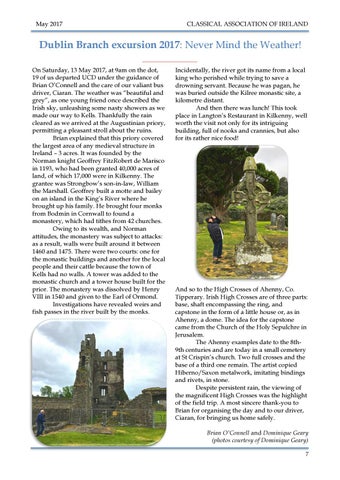
Dublin Branch excursion 2017: Never Mind the Weather! On Saturday, 13 May 2017, at 9am on the dot, 19 of us departed UCD under the guidance of Brian O’Connell and the care of our valiant bus driver, Ciaran. The weather was “beautiful and grey”, as one young friend once described the Irish sky, unleashing some nasty showers as we made our way to Kells. Thankfully the rain cleared as we arrived at the Augustinian priory, permitting a pleasant stroll about the ruins. Brian explained that this priory covered the largest area of any medieval structure in Ireland – 3 acres. It was founded by the Norman knight Geoffrey FitzRobert de Marisco in 1193, who had been granted 40,000 acres of land, of which 17,000 were in Kilkenny. The grantee was Strongbow’s son-in-law, William the Marshall. Geoffrey built a motte and bailey on an island in the King’s River where he brought up his family. He brought four monks from Bodmin in Cornwall to found a monastery, which had tithes from 42 churches. Owing to its wealth, and Norman attitudes, the monastery was subject to attacks: as a result, walls were built around it between 1460 and 1475. There were two courts: one for the monastic buildings and another for the local people and their cattle because the town of Kells had no walls. A tower was added to the monastic church and a tower house built for the prior. The monastery was dissolved by Henry VIII in 1540 and given to the Earl of Ormond. Investigations have revealed weirs and fish passes in the river built by the monks.
Incidentally, the river got its name from a local king who perished while trying to save a drowning servant. Because he was pagan, he was buried outside the Kilree monastic site, a kilometre distant. And then there was lunch! This took place in Langton’s Restaurant in Kilkenny, well worth the visit not only for its intriguing building, full of nooks and crannies, but also for its rather nice food!
And so to the High Crosses of Ahenny, Co. Tipperary. Irish High Crosses are of three parts: base, shaft encompassing the ring, and capstone in the form of a little house or, as in Ahenny, a dome. The idea for the capstone came from the Church of the Holy Sepulchre in Jerusalem. The Ahenny examples date to the 8th9th centuries and are today in a small cemetery at St Crispin’s church. Two full crosses and the base of a third one remain. The artist copied Hiberno/Saxon metalwork, imitating bindings and rivets, in stone. Despite persistent rain, the viewing of the magnificent High Crosses was the highlight of the field trip. A most sincere thank-you to Brian for organising the day and to our driver, Ciaran, for bringing us home safely. Brian O’Connell and Dominique Geary (photos courtesy of Dominique Geary)
7