CLASSICAL ASSOCIATION OF IRELAND
NEWSLETTER ISSUE MAY 2017 2013 ISSUE 2, 1, NOVEMBER
The Latin Reading Group
6 A public reading of Homer’s Iliad at Queen’s University Belfast
2-‐3 ‘Maritime Matters’: programme for the CAI Summer School, Cork; notice of the CAI AGM, Cork, 18 August
4-‐5
From the Editor Salvete, CAI members! The six months since the last Newsletter have flown by in a whirl of lectures and activities across Ireland relished not only by long-time Classics enthusiasts but also new audiences. You can read Helen McVeigh’s report about one such event, a public reading of the Iliad, on pp. 2-3; its success has led to the organising of another reading of Homer next month, this time the Odyssey at the Ulster Museum, and all are welcome to participate.
The Dublin Branch Excursion 2017: Kells, Kilkenny, Ahenny
7
Branch and University News; Summer Latin and Greek Language classes
8-‐12
The activities of the CAI and its members hardly wind down with the end of the academic year. Intensive language courses in ancient Greek and Latin will take place (p. 12) and the annual Summer School – a highly-anticipated weekend bringing together our members for informative lectures and enjoyable social events – will be hosted by Cork Branch on 18-20 August. The programme is outlined here (p. 4); further information can be found in the brochure accompanying this Newsletter. We look forward to seeing you in Cork! Dr Selga Medenieks
CLASSICAL ASSOCIATION OF IRELAND
May 2017
The Classical Association in Northern Ireland
Public reading of Homer’s Iliad McClay Library, Queen’s University Belfast, December 8, 2016 The public reading of Homer’s Iliad was an ambitious undertaking which was first discussed by the CANI steering group in July 2016. Within five months, on Thursday 8th December 2016, the event took place in the McClay Library at Queen’s University Belfast. Once the venue had been secured, it was time to attempt to fill the 50+ ten-minute reading slots which we anticipated we would need to complete Books 1-12. With the help of audio recordings of the Iliad and a stopwatch, we estimated how long it might take to read each book. A timetable was drawn up so that the readers who joined the rota might have an idea of what part of the poem they would be reading. #IliadLiveBelfast began with a welcome and introduction by the CANI convenor, Dr John Curran. Our first reader was Heather Parsons from Tasmania: she had provided a video-recording of herself reading the first 100 or so lines. We continued with a group of five students (and their teacher) from the Royal Belfast Academical Institution. The boys ranged in age from 14-18 and they read beautifully, CLICK TO WATCH CANI Convenor Dr John Curran read: https://www.google.ie/amp/s/classicalassociationni.w ordpress.com/2016/12/18/iliadlive-belfast-publicreading-review/amp/
2
showing their passion for both Classics in general and Homer in particular. As readers came and went, our audience grew. Some stayed for several hours, bringing with them their own copies of the Iliad in order to follow the reading. We were positioned beside the entrance to the Hope Cafe in a lounge with easy-chairs and coffee machines, an area of the library open to the public. Vase paintings of the Trojan War and photos from the site in Turkey illustrated the readings in a rolling slide-show presentation on a screen behind the readers’ lectern. Passers-by, students, staff, and members of the public stopped to listen with their lunch or a coffee. They learned about the work of CANI, and some were persuaded to join in with the reading. Participants came from as far afield as Dublin and Maynooth to the south and Ballymoney to the north, along with staff and students from Queen’s University Belfast, RBAI and Victoria College. Our youngest reader was 8 years old, and our most senior reader an octogenarian, proving that Homer’s story truly spans the generations.
May 2017
CLASSICAL ASSOCIATION OF IRELAND
The purpose of the reading was to raise the profile of the Association, and to fundraise for a worthy charity. It had been decided to invite donations for a homeless charity, the Simon Community Northern Ireland, and over £200 was raised. Dr John Curran, CANI Convenor, brought Book 12 to a close at approximately 6.30pm after more than nine hours of continuous reading. Feedback has been received from many sources, and it’s clear that CANI achieved its goal. In response to requests from our friends, members and supporters, the CANI Board is in the process of organising a second public reading: this time in the welcome
area of the Ulster Museum, Botanic Gardens, Belfast, on Saturday, June 17. We will read Homer’s Odyssey, commencing at 10am, and 10-minute reading slots are available for reservation. Readers who are unable to attend in person are invited to contact us about either providing a video which can be broadcast on the day or contributing via Skype. Donations will be accepted for Macmillan Cancer Support. Potential readers are invited to contact me as soon as possible to reserve their slot (helenmcveigh@gmail.com). Helen McVeigh
Photos courtesy of Helen McVeigh
3
CLASSICAL ASSOCIATION OF IRELAND
May 2017
The annual CAI Summer School will take place in CORK on 18-20 August, 2017 Register on www.classicalassociation.ie
‘Maritime Matters’ is the theme of the Conference, to be held at the Cork Education Support Centre, Western Road. Programme of Events Friday, 18 August 17.30
Registration and Reception
19.00
CAI Annual General Meeting
19.50 Official Opening PROF. WILLIAM O’BRIEN Head, School of the Human Environment (UCC) 20.00 Keynote Lecture: ‘Ostia and Portus: new light on the harbour cities of Imperial Rome.’ PROF. MARTIN MILLETT Laurence Professor of Classical Archaeology, Fellow of Fitzwilliam College (University of Cambridge)
15.15
15.30 ‘Ars artium est cura animarum: the care of souls in late medieval Ireland.’ BR COLMÁN Ó CLABAIGH, O.S.B. (GLENSTAL ABBEY) 19.30
Evening Reception
20.00
CAI Dinner at The River Lee Hotel. Sunday, 20 August
Saturday, 19 August 9.00
CAI Central Council meeting
10.00 ‘Remote Sensing and the Roman City.’ PROF. MARTIN MILLETT (CAMBRIDGE) 11.00
Coffee/Tea break
11.30 ‘Piracy in Classical Antiquity.’ DR PHILIP DE SOUZA (UCD) 12.30
Lunch
13.20 ‘Spinning a Yarn.’ MR JOHN BARRY (UCC) 14.15 ‘Seaboard of the Ancient Steppe: Greek and Roman Voyages in the Black Sea.’ DR RAOUL McLAUGHLIN 4
Coffee/Tea break
10.00 OUTING TO KILCREA FRIARY, near Macroom The Friary was founded for the Franciscan Order in 1465 by Cormac Laidir McCarthy, Lord of Muskerry. Interred within its walls is the penal martyr, Art O’Leary, captain of Hungarian Huzzars in the service of the Empress Marie Theresa. 11.45 Coffee/Tea break, Castle Hotel, Macroom 13.00 VISIT TO ST GOBNAIT’S WELL, Ballyvourney St Gobnait was a 6th century saint credited with saving the people of Ballyvourney from the plague. 14.30
Lunch, Abbey Gate Hotel, Ballyvourney
17.20
Approximate time of arrival in Cork
May 2017
CLASSICAL ASSOCIATION OF IRELAND
Notice of Annual General Meeting The Annual General Meeting of the Association will take place at Cork Education Support Centre on Friday, 18 August, 2017, at 7.00 p.m. The Secretary notifies members that nominations and motions will be received under the following provisions of the Association’s Rules. Article 12 – Nominations for CAI Council The officers and ordinary members of the Council are elected at the Annual General Meeting. The Council has made nominations under this Article as follows: Chair: Isabella Bolger Vice-Chair: Catherine Ware Secretary: Patrick J. Ryan Treasurer: Alexander Thein Members by Election: 1. Joan Wright 2. Daniel O’Connor 3. Geraldine FitzGerald 4. Cosetta Cadau Further nominations may be made by any Branch and should be sent to me, by post or email, before Friday, 4 August, 2017. Every such nomination shall state the names of the persons nominated, and shall be signed by their proposers and seconders and certified by the Branch Chairperson or Acting Chairperson. Article 14 – Special Motions
The Council shall establish a Publications Board, consisting of six members. The Treasurer of the Association shall be a member ex-officio, and five members shall be elected by the Council for a term of five years, and may be re-elected. Two at least shall be members of the Council at the time of their election. The Board shall appoint one of their number as Chair for the full term, and the said Chair shall be a member of the Council ex-officio. The Council shall fill any vacancy on the Board for the remaining part of the term. The Board may, after choosing a Chairperson, co-opt one other member. They may also, from time to time, invite non-voting advisers (who may be Editors) to participate in their meetings. The Board shall submit a report to each meeting of the Council, shall advise the Council on, and seek approval for, all publication enterprises, and shall be consulted by the Council on any publication proposal put before or by it. The Board will plan and be generally responsible for the execution of a publications programme, will advise the Council on the appointment of editors, and will be responsible for overall financial planning of all publication projects.
B. To add the following words to Article 16 (c) after “years”: , but the Council may, on the application of a Branch, waive this rule in circumstances which to it seem warranted.
C. To add the following words to Article 6: The Council may invite a representative of the Classical Youth Society of Ireland to participate in its meetings and discussions.
Any member wishing to propose a Motion (including a proposal for amendment of the Constitution) at the Annual General Meeting Amendments will be effective if approved by a should send a signed copy to me before 18 July, two-thirds majority of those present and voting 2017. Please note that Motions may be submitted at the AGM. by individual members, rather than by Branches. Patrick J. Ryan, Article 17 – Amendments to the Constitution Secretary The Council proposes three amendments to the Constitution of the Association: A. To strike out the existing Article 7 and replace with the following:
Contacts: Post: E-mail:
The Orchard Yard, Newport, Co. Tipperary. p.strepsiades@gmail.com 5
CLASSICAL ASSOCIATION OF IRELAND
May 2017
The Latin Reading Group
under the auspices of the Classical Association of Ireland
Perhaps some reader can recall when the Dublin branch of the Classical Association of Ireland first set up the Latin Reading Group: I regret to say that I can’t. When I began coming to its sessions in the mid-90s it was going strong and clearly had been around for some time already. Based in UCD as it was (and still is), I wonder: was it academics in UCD’s Classics Department that set it going? Certainly the Classics Department under Prof. Andrew Smith was very much engaged in supporting the Latin Reading Group, as is UCD’s School of Classics under Dr Alexander Thein in the present day. What drew me and others to it? A strong interest in and high admiration for Latin literature, a fascination with the Roman world and a desire to encounter it in as direct a way as possible, through reading its great works. It is spellbinding to listen to Cicero thundering against Catalina Quo usque tandem abutere, Catilina, patientia nostra? Reading Cicero’s In Catalinam is like standing there, outside the door into the gathering of the Senate: it’s just out of view but if you listen inwardly, you can hear Cicero’s voice remorselessly pounding Cataline 2,000 years on. That enthusiasm for the Roman world and for its literature is what motivates the Latin Reading Group today just as it did 20 years ago. I must add that we don’t restrict ourselves to literature of Classical Rome. Sometimes we stray into post-Classical times: after all, Latin literature did not end in 476AD. And sometimes we look at work from before Classical times. We have had much fun with passages from the plays of Plautus. I took on the job of Convenor of the Group in 2012/2013 and have helped plan each year’s crop of readings ever since. This academic year of 2016-2017 we met eight times to read, translate and discuss the poetry of Horace, Vergil (twice) and Ovid (twice), elements of Cicero’s writings on political philosophy, extracts from Lucretius and the biography of the Late Roman saint Paulinus of Nola. And by way of an outlier, we took a listen to bits of Carl Orff’s ‘Carmina Burana’ as part of our session just before Christmas 2016! This is how our sessions work: each session has a leader who chooses the passages 6
for consideration. The leader explains the literary and historical context of the passages, then asks each of those present to read and translate in turn a certain amount of the text. No-one is obliged to translate; some people come just to listen. Then the passages are discussed and commented on by all who wish to do so; lively - and often merry - discussion can ensue. More often than not, the leader is an academic in the field of Classics, but two of our eight sessions this year were led by nonspecialists. Non-specialists will probably not have the same deep knowledge of the subject one could expect from a specialist but amateurs who love their literature can communicate an enthusiasm which is wholly at one with the purpose of the Latin Reading Group. Before every session, as convenor of the Group I mail out the Latin passages and translations in English to all Branch members and certain others. Members are welcome to bring guests along. The only requirement is that they are interested in the literature under consideration. Just before we break for the summer we have one more session but not with a given text chosen by a leader: in this last session, each person presents their own deliciae Latinae, their own precious favourites from Latin literature, and explains why they chose them; then we read, translate and discuss it together. Can a Latin Reading Group on the Dublin model be set up elsewhere? Without a doubt, assuming that there are a) at least some people around who feel able and are willing to act as leaders of sessions and b) a sufficient number of others with enough Latin to be able to work their way through a passage (with the assistance of a translation, perhaps). Indeed, I understand that there is at least one other group in the country doing what we do in the Dublin Latin Reading Group. The most important thing required is that people have enough enthusiasm in their hearts that they would want to do it… and enough purpose in their minds that they get up and actually do it! Liam Bairéad, Convenor
May 2017
CLASSICAL ASSOCIATION OF IRELAND
Dublin Branch excursion 2017: Never Mind the Weather! On Saturday, 13 May 2017, at 9am on the dot, 19 of us departed UCD under the guidance of Brian O’Connell and the care of our valiant bus driver, Ciaran. The weather was “beautiful and grey”, as one young friend once described the Irish sky, unleashing some nasty showers as we made our way to Kells. Thankfully the rain cleared as we arrived at the Augustinian priory, permitting a pleasant stroll about the ruins. Brian explained that this priory covered the largest area of any medieval structure in Ireland – 3 acres. It was founded by the Norman knight Geoffrey FitzRobert de Marisco in 1193, who had been granted 40,000 acres of land, of which 17,000 were in Kilkenny. The grantee was Strongbow’s son-in-law, William the Marshall. Geoffrey built a motte and bailey on an island in the King’s River where he brought up his family. He brought four monks from Bodmin in Cornwall to found a monastery, which had tithes from 42 churches. Owing to its wealth, and Norman attitudes, the monastery was subject to attacks: as a result, walls were built around it between 1460 and 1475. There were two courts: one for the monastic buildings and another for the local people and their cattle because the town of Kells had no walls. A tower was added to the monastic church and a tower house built for the prior. The monastery was dissolved by Henry VIII in 1540 and given to the Earl of Ormond. Investigations have revealed weirs and fish passes in the river built by the monks.
Incidentally, the river got its name from a local king who perished while trying to save a drowning servant. Because he was pagan, he was buried outside the Kilree monastic site, a kilometre distant. And then there was lunch! This took place in Langton’s Restaurant in Kilkenny, well worth the visit not only for its intriguing building, full of nooks and crannies, but also for its rather nice food!
And so to the High Crosses of Ahenny, Co. Tipperary. Irish High Crosses are of three parts: base, shaft encompassing the ring, and capstone in the form of a little house or, as in Ahenny, a dome. The idea for the capstone came from the Church of the Holy Sepulchre in Jerusalem. The Ahenny examples date to the 8th9th centuries and are today in a small cemetery at St Crispin’s church. Two full crosses and the base of a third one remain. The artist copied Hiberno/Saxon metalwork, imitating bindings and rivets, in stone. Despite persistent rain, the viewing of the magnificent High Crosses was the highlight of the field trip. A most sincere thank-you to Brian for organising the day and to our driver, Ciaran, for bringing us home safely. Brian O’Connell and Dominique Geary (photos courtesy of Dominique Geary)
7
CLASSICAL ASSOCIATION OF IRELAND
May 2017
CAI BRANCH & UNIVERSITY NEWS CAI CORK The Cork Branch is pleased to report that it has had a varied series of lectures for its Spring term. First up in February was Dr Alexandra Guglielmi of the School of Archaeology at UCD. The title of the lecture was ‘In the shadow of the Empire, Ireland, Rome and Beyond’. In this wide-ranging lecture, Alexandra traced Ireland and what we know of it from the ancient sources: how migration and communication in the Roman period can assist our understanding. Julius Caesar, famous for many things, put Ireland on the Roman map. As a result, Ptolemy’s map of the second century AD has a better developed east coast side. This is supported by Tacitus, who states that trade existed between Ireland and Britain. Alexandra made reference to three finds/burials. The Stoneyford Burial in County Kilkenny was a typical, classic Roman cremation burial from between the first and second centuries AD. The Newgrange Finds from the first to fourth centuries AD yielded inscribed Bronze Age torcs, brooches and Roman coins (denarii and solidi). All of these were personal items and are similar to the kind of things found in Roman Britain, hence, links between Ireland and England. Finally, the Balline Hoard from the late fourth to fifth centuries AD comprised of hacked silver, perhaps booty from raids! LIARI, the Late Iron Age and ‘Roman’ Ireland Project, looked at the teeth of people who were buried, some in an Irish manner, others not. The result was that some people were not Irish, which proves the movement of people and animals in the early part of the Roman Empire. The conclusion drawn was that Ireland was a part of wider European Roman world. 8
Dr Damian Bracken of the School of History in UCC spoke to us in March. Damian is an expert on St Columbanus and his title on the night was: ‘Ireland’s place in the Roman world: Columbanus and the rhetoric of concordia’. Columbanus was a bit of a wanderer, according to his biographer, Jonus of Bobbio. Suffering a mid-life crisis, he ventured to the continent, to St Malo. After much travelling and being exiled by the Merovingian Queen, he ended up in 610 establishing a monastery in Bobbio, which was known as the Montecassino of the North. Columbanus’ monastery was seen as a blueprint for monasteries throughout Europe. Columbanus, coming from Ireland, had an orthodox attitude towards Christianity. Ireland had no snow and no snakes and thus was perfect. How far we have strayed from the ideal!! We found out that Columbanus was not very taken by the Gaulish bishops and they by him. His attitude to bishops in general was dim, though he was very inclined towards Pope Gregory the Great. Diversity of the natural world to promote unity was a big factor in Columbanus’ world and Pope Gregory agreed with this. One size does not fit all. Some places produce better wine, other places whiskey and others wheat. It is the same with the church and this leads onto the Roman ideas of Concord, harmony. The Church is a body and all parts must work together like all parts of the corporeal body must work together. The Romans valued peace: the Pax Romana emulated the Pax Concordia. Before Augustus there was war; Augustus brought peace. For Christians, war drives God away, while peace invites God in. Christian barbarians bucked the trend! What was a Christian now if, prior to this, only imperial people were Christians? Columbanus was a
May 2017 barbarian of the worst type, a Christian, outside of Rome’s influence. April saw us welcome Dr Jo Day of the UCD School of Classics. Jo’s topic was ‘Cilician Mists and Illyrian Oils: Crocus and Iris in Antiquity’. We learned that it takes 160,000 flowers to make one kilogramme of saffron and that it is a really labour-intensive task, hence the high price of the product. There are three main uses for saffron: culinary, medicinal and dying. Its origins in the ancient world seem fairly concrete. While there are no organic remains of the crocus bulbs to be found, there are plenty of references on Minoan artefacts and Mycenaean (Linear B) tablets. Pliny (N.H. 21:17) Strabo and Aristotle all wrote about where the best saffron came from and its uses. It seems in ancient times, the spectacle of food was more important than its taste, hence the vibrant use of saffron proclaimed one’s wealth, if not one’s chef’s ability! The second part of Jo’s lecture dealt with the iris and its scent. Again, a very expensive ingredient in contemporary perfumes. Theophrastus, Pliny and Ovid all discussed and agreed that the best irises came from Illyria, whereas now, the best plants come from Tuscany. It seems only the rhizomes produce the scent and, once gathered, they are stored for three years to allow for slow oxidation. Orris butter is the concentrated oil produced and fifteen hectares produce fifteen kilogrammes of rhizomes, which in turn produce one kilogramme of ‘butter’. This can be sold for anything between seventy-five thousand and one hundred thousand euros in today’s market. Again, there is no physical evidence for the oils, but archaeology provides the sources with perfume workshops in Delos and wall paintings of putti in Pompeii. Minoan Crete also provides lots of evidence of botanicals on early vases and vessels. So, the next time someone brings you a bag of saffron home from a trip to Turkey or somewhere equally exotic, be wary – it’s probably not the genuine article unless they spent a fortune on it, though best not to point that out at that moment. It is, after all, the thought which counts! May saw us welcome Members’ Papers and this year we had two offerings. First up was Dr Máire Geaney who spoke on ‘Watermills in the Roman World and early Medieval Ireland’. Grinding wheat using a
CLASSICAL ASSOCIATION OF IRELAND saddle quern or a rotary quern would only produce about eight kilogrammes of flour a day, whereas using a water powered mill would increase productivity, reduce labour and produce in excess of twenty-five kilogrammes a day. Horizontal and vertical watermills made of wood were used in Roman times. The Romans preferred the vertical mill, whereas the medieval Irish preferred the horizontal type. This short talk was fascinating in detail and only served to whet the appetite for more. There are one hundred and fifty horizontal mills in Ireland dating from between 612 AD to 1124 AD and seven vertical ones. Early Irish law conferred a lesser noble status on millwrights, such was their importance to the community. Little island in Cork has both a vertical and horizontal mill side by side, both of which date to 613 AD. The carpentry in the vertical one is identical to that found in Kent, England. The carpenters in Irish mills were using Roman joinery of mortise and tenon joints, so it looks as if foreign millwrights were coming to Ireland at a time when England and Germany were giving up on the Roman methods of construction. The second paper of the night was by Branch member Ms Christine Shine and this centred on the 2016 CAI trip to Bulgaria. Here we saw a delightful selection of slides highlighting a great trip. Amphitheatres, hypocausts, fountains, ancient Roman paving and mosaics were among some of the images on view and the slides were a testament to the great time had by all who ventured to travel! The Cork Branch have had a good season. As always, the Branch is very grateful for the support it receives from Dr David Woods of the Dept of Classics in UCC. We thank all who have faithfully attended on Monday nights. A branch is only as strong as its members and we encourage you to attend the lectures: paying the membership fee is great, but physical attendance is necessary too! We invite all Classical Association members to come to the annual Summer School which will be held in Cork this August (18th-20th). The theme of the conference is ‘Maritime Matters’, Cork being a sea-port. The details of the summer School can be found in this Newsletter, on the CAI website (www.classicalassociation.ie) and on the brochure enclosed. See you in August! Jennifer O’Donoghue 9
CLASSICAL ASSOCIATION OF IRELAND
CAI LIMERICK The Spring Term began with good news: the Branch secretary, Tom Seaver, was appointed Honorary President of the Association for 2018. However, this was followed by an unexpected shock, resulting from the 2016 Summer Conference: Mary Immaculate College sent their invoice belatedly in February and only then did we discover negative equity on our balance sheet. Thankfully, this situation has now been rectified. Meanwhile, an interesting programme of lectures was organised, all delivered by local academics. Dr Matthew Potter, the newly appointed curator of Limerick City Museum, led off on February 8 with ‘Byzantium’s greatest Ruling Family: the Macedonian Dynasty, 8671256 AD’. He was followed a fortnight later by Mr Gerald O’Carroll, author and historian, who spoke on ‘Bishop Charles Graves, of Limerick, Classical Scholar (18121899)’. The third lecture, on March 22, entitled ‘Iudaei nos Nazarenos appellant: the early Christian Church and its Jewish Heritage’, was given by our Chairman, Mr Patrick Ryan. Our final offering, ‘The Hunt in Ancient Greece’, was given on April 5, by Ms Paula Keane, formerly of Croom N.S., who is also our Branch Delegate to Council. Adult Greek and Latin classes, conducted by Patrick Ryan, resumed in early January and have continued throughout the term. Some 17 participants are taking Greek, with lesser numbers in the Latin classes.
10
May 2017 All lectures and classes are held in the Limerick Education Centre. The Branch committee are indebted to the director and staff there for making the excellent premises and back-up services available to us over the past year. The annual Branch dinner was held in the Unicorn Restaurant, Dooradoyle, on May 4. Numbers were up on last year and a very enjoyable evening was had by all. Finally, our Chairman wishes to announce that his Summer Soirée on Saturday, June 17, at 3pm, will include a reading of Shakespeare’s A Midsummer Night’s Dream. All are welcome to attend. Tom Seaver Branch Secretary
May 2017
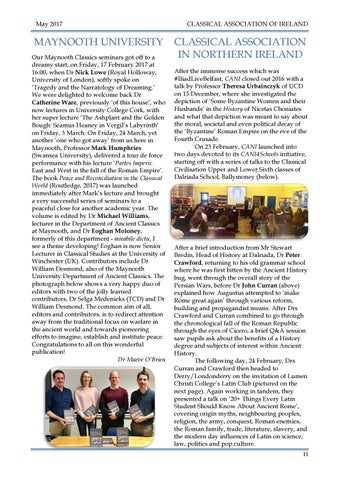
MAYNOOTH UNIVERSITY Our Maynooth Classics seminars got off to a dreamy start, on Friday, 17 February 2017 at 16:00, when Dr Nick Lowe (Royal Holloway, University of London), softly spoke on ‘Tragedy and the Narratology of Dreaming.’ We were delighted to welcome back Dr Catherine Ware, previously ‘of this house’, who now lectures in University College Cork, with her super lecture ‘The Ashplant and the Golden Bough: Seamus Heaney in Vergil’s Labyrinth’ on Friday, 3 March. On Friday, 24 March, yet another ‘one who got away’ from us here in Maynooth, Professor Mark Humphries (Swansea University), delivered a tour de force performance with his lecture ‘Partes Imperii: East and West in the fall of the Roman Empire’. The book Peace and Reconciliation in the Classical World (Routledge, 2017) was launched immediately after Mark’s lecture and brought a very successful series of seminars to a peaceful close for another academic year. The volume is edited by Dr Michael Williams, lecturer in the Department of Ancient Classics at Maynooth, and Dr Eoghan Moloney, formerly of this department - mirabile dictu, I see a theme developing! Eoghan is now Senior Lecturer in Classical Studies at the University of Winchester (UK). Contributors include Dr William Desmond, also of the Maynooth University Department of Ancient Classics. The photograph below shows a very happy duo of editors with two of the jolly learned contributors, Dr Selga Medenieks (TCD) and Dr William Desmond. The common aim of all, editors and contributors, is to redirect attention away from the traditional focus on warfare in the ancient world and towards pioneering efforts to imagine, establish and institute peace. Congratulations to all on this wonderful publication! Dr Maeve O’Brien
CLASSICAL ASSOCIATION OF IRELAND
CLASSICAL ASSOCIATION IN NORTHERN IRELAND After the immense success which was #IliadLiveBelfast, CANI closed out 2016 with a talk by Professor Theresa Urbainczyk of UCD on 15 December, where she investigated the depiction of ‘Some Byzantine Women and their Husbands’ in the History of Nicetas Choniates and what that depiction was meant to say about the moral, societal and even political decay of the ‘Byzantine’ Roman Empire on the eve of the Fourth Crusade. On 23 February, CANI launched into two days devoted to its CANI4Schools initiative, starting off with a series of talks to the Classical Civilisation Upper and Lower Sixth classes of Dalriada School, Ballymoney (below).
After a brief introduction from Mr Stewart Bredin, Head of History at Dalriada, Dr Peter Crawford, returning to his old grammar school where he was first bitten by the Ancient History bug, went through the overall story of the Persian Wars, before Dr John Curran (above) explained how Augustus attempted to ‘make Rome great again’ through various reform, building and propagandist means. After Drs Crawford and Curran combined to go through the chronological fall of the Roman Republic through the eyes of Cicero, a brief Q&A session saw pupils ask about the benefits of a History degree and subjects of interest within Ancient History. The following day, 24 February, Drs Curran and Crawford then headed to Derry/Londonderry on the invitation of Lumen Christi College’s Latin Club (pictured on the next page). Again working in tandem, they presented a talk on ‘20+ Things Every Latin Student Should Know About Ancient Rome’, covering origin myths, neighbouring peoples, religion, the army, conquest, Roman enemies, the Roman family, trade, literature, slavery, and the modern day influences of Latin on science, law, politics and pop culture. 11
CLASSICAL ASSOCIATION OF IRELAND
CANI would like to express our thanks to the staff and students of both Dalriada and Lumen Christi College. These are the kind of events for which CANI was originally formed, and with so many enthusiastic pupils attending and asking questions, it is clear that interest in the ancient world is alive and thriving in Northern Ireland. CANI kicked off its 2017 public programme on 16 March with ‘Narrative Experience in Xenophon’s Anabasis’ by Dr Rosie Harman of UCL. Dr Harman showed how Xenophon justified everything the Greeks did or proposed to do during the ‘March of the 10,000’ in terms of superiority over the alien inhabitants of the Persian Empire, all the while presenting the story in almost diametrically
May 2017 opposed terms – an ‘easy’ triumphal journey or a harrowing tale of survival against all odds. On 6 April, CANI hosted a talk on ‘Greek Percussion’ by Dr Katerina Kolotourou. A historian, linguist, field-archaeologist, and an accomplished pianist, Dr Kolotorou called upon literary sources and fragmentary sculptural evidence to demonstrate the sistrum, tympanon and kithara in the prominent roles required of them by the classical Greek musical ear. CANI’s 2016/17 programme will be completed with a talk by Dr Peter Crawford on ‘Who Was Constantius II?’ on 8 June at Queen’s University. Everyone is welcome, not just for the talk but for summer drinks afterwards! And then, due to popular demand, CANI will also be hosting not only a second public reading of the epic poetry of Homer, this time the Odyssey in the Ulster Museum on 17 June from 10am (complete with a range of activities provided by Greek Myth Comix), but also another Belfast Summer School in Latin and Classical Greek from 3-7 July. Please contact Helen McVeigh at belfastsummerschool@gmail.com for information about taking part in the latter and classicalassociationni@hotmail.com for all other inquiries about CANI events. Dr Peter Crawford
The Classical Association in Northern Ireland
Belfast summer school In latin and classical greek
Summer Language Courses with the Classical Association of Ireland
Monday 3rd – Friday 7th July 2017 at the Open University in Northern Ireland, 110 Victoria Street, Belfast
Classes for beginners and post-beginners in Latin and Classical Greek
Language courses in Ancient Greek and Latin (Beginners and Intermediate), organised by the Classical Association of Ireland, will take place in University College Dublin, 6-16 June, 2017. • 3 classes per day (15 hours of class per week). • The courses are open to all persons over 16 years of age. • Fees: €300.00 (full-time students and pensioners €150.00).
Open to over 18s — Non-residential summer school Optional sessions on Classical Roman and Greek culture PLACES ALLOCATED ON A FIRST-COME, FIRST-SERVED BASIS For an application form, email belfastsummerschool@gmail.com. The closing date for receipt of applications is Friday 2nd June 2017.
12
Registration forms can be obtained from the CAI website: classicalassociation.ie or from Dr Cosetta Cadau, School of Classics, University College Dublin, Dublin 4: cosetta.cadau@ucd.ie.