CLASSICAL ASSOCIATION OF IRELAND
NEWSLETTER ISSUE 1, JULY 2016 ISSUE 2, NOVEMBER 2013 Classics and Irish Politics 1916-2016; and Classical Influences in Irish Culture
CAI Branch Reports; Aristophanes’ Knights at the Orchard Yard; the Classical Association in Northern Ireland
7-‐10
2-‐4 The CAI Archaeological Tour of Bulgaria
5-‐6
Dublin Branch outing to Wicklow; The Ninth Celtic Conference in Classics, held at UCD
11-‐12
audiences: particularly special occasions were the Royal Irish Academy and Trinity College Dublin conference sponsored by the University of Notre Salvete, CAI members! Dame (pp. 2-4), and the Ninth Celtic Classics We have not been short of opportunities Conference held at University College Dublin, in 2016 to indulge our enthusiasm for Classics, attended by over 300 delegates (p. 12). whether we were in Bulgaria on the highly Things are by no means set to slow down anticipated CAI biennial trip (pp. 5-6), in in the second half of the year. Our Branches are Ravenna, like our fortunate colleagues at CANI busy programming lectures and events, and we (p. 10), or on tour more locally, in Wicklow look forward to meeting CAI members from all enjoying the Dublin Branch outing (pp. 11-12). around the country at our annual summer school. The first half of the year was replete with As always, up-to-date information can be found engaging conferences, seminars and lectures on our website: www.classicalassociation.ie. See demonstrating the breadth of our interests and you in Limerick! showcasing our scholarship also to international Dr Selga Medenieks
From the Editor
CLASSICAL ASSOCIATION OF IRELAND
July 2016
Classics and Irish Politics 1916-2016 and Classical Influences in Irish Culture
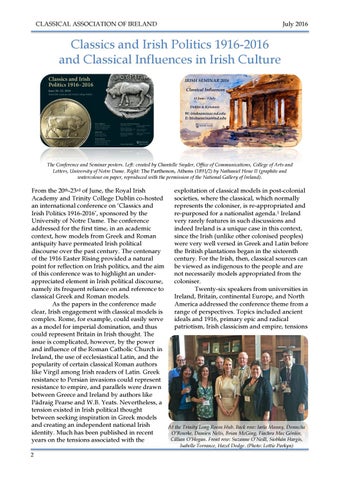
The Conference and Seminar posters. Left: created by Chantelle Snyder, Office of Communications, College of Arts and Letters, University of Notre Dame. Right: The Parthenon, Athens (1891/2) by Nathaniel Hone II (graphite and watercolour on paper, reproduced with the permission of the National Gallery of Ireland).
From the 20th-23rd of June, the Royal Irish exploitation of classical models in post-colonial Academy and Trinity College Dublin co-hosted societies, where the classical, which normally an international conference on ‘Classics and represents the coloniser, is re-appropriated and Irish Politics 1916-2016’, sponsored by the re-purposed for a nationalist agenda.1 Ireland University of Notre Dame. The conference very rarely features in such discussions and addressed for the first time, in an academic indeed Ireland is a unique case in this context, context, how models from Greek and Roman since the Irish (unlike other colonised peoples) antiquity have permeated Irish political were very well versed in Greek and Latin before discourse over the past century. The centenary the British plantations began in the sixteenth of the 1916 Easter Rising provided a natural century. For the Irish, then, classical sources can point for reflection on Irish politics, and the aim be viewed as indigenous to the people and are of this conference was to highlight an undernot necessarily models appropriated from the appreciated element in Irish political discourse, coloniser. namely its frequent reliance on and reference to Twenty-six speakers from universities in classical Greek and Roman models. Ireland, Britain, continental Europe, and North As the papers in the conference made America addressed the conference theme from a clear, Irish engagement with classical models is range of perspectives. Topics included ancient complex. Rome, for example, could easily serve ideals and 1916, primary epic and radical patriotism, Irish classicism and empire, tensions as a model for imperial domination, and thus could represent Britain in Irish thought. The issue is complicated, however, by the power and influence of the Roman Catholic Church in Ireland, the use of ecclesiastical Latin, and the popularity of certain classical Roman authors like Virgil among Irish readers of Latin. Greek resistance to Persian invasions could represent resistance to empire, and parallels were drawn between Greece and Ireland by authors like Pádraig Pearse and W.B. Yeats. Nevertheless, a tension existed in Irish political thought between seeking inspiration in Greek models and creating an independent national Irish At the Trinity Long Room Hub. Back row: Iarla Manny, Donncha identity. Much has been published in recent O’Rourke, Damien Nelis, Brian McGing, Fiachra Mac Góráin, Cillian O’Hogan. Front row: Suzanne O’Neill, Siobhán Hargis, years on the tensions associated with the Isabelle Torrance, Hazel Dodge. (Photo: Lottie Parkyn)
2
July 2016
CLASSICAL ASSOCIATION OF IRELAND
Robert Mitchell Henry and James Joyce’s Ulysses’. The closing keynote was delivered by RECENT PUBLICATIONS Terry Eagleton, Emeritus John Edward Taylor BY CAI MEMBERS Professor of Cultural Theory at the University of Manchester, on ‘Ancient Sacrifice, Modern Revolution’. Conference delegates enjoyed three different keynote and reception venues, first in the Royal Irish Academy, next in the Long Room Hub and Ideas Space at Trinity College Dublin, and finally the Emmett Theatre, followed by the closing reception in the Classics Department with its stunning views over Trinity College. This provided a wonderful setting for the concluding event. The conference was generously sponsored by the Henkels Lecture Fund, Institute for Scholarship in the Liberal Arts, College of Arts and Letters, University of Notre Dame; the Global Collaboration Initiative at Notre Dame International in partnership with Trinity College Dublin’s Department of Classics; the Keough-Naughton Institute for Irish Studies; the Nanovic Institute for European Studies; Notre Dame Research; and Notre Dame’s Department of Classics. Originally organised as an independent event, the conference became a part also of the University of Notre Dame’s annual three-week intensive postgraduate Irish Studies Summer Seminar, run by the Keough-Naughton Institute for Irish Studies on a different theme every Isabelle Torrance, keynote speaker Edith Hall, and Hazel Dodge. year. This year, for the first time, the Executive (Photo: Henry Stead) Director of the Irish Seminar was a Classicist, TCD alumna Isabelle Torrance, who was also Three keynote lectures were delivered. Declan the conference organiser. The theme for the Kiberd, Donald and Marilyn Keough Professor three-week seminar, which ran from the 13th of of Irish Studies, and Professor of English and June to the 1st of July, was ‘Classical Influences Irish Languages and Literatures at the in Irish Culture’. It was attended by University of Notre Dame, opened the approximately twenty students from conference with a lecture on ‘The Use and universities in Ireland, North America, and Abuse of Classics’. Edith Hall, Professor of Turkey. These students were among the Classics at King’s College London, delivered seventy-five registered delegates at the the second keynote, entitled ‘Ipsis Hibernis conference. Several colleagues who spoke at or Hiberniores: Sinn Féin according to Professor
between classical and Celtic models in Myles na gCopaleen’s Cruiskeen Lawn columns and in Michael Ireland’s Return of the Hero, classical oratory and Irish politics, the Juvenalian satire of Martin McDonagh, the politics of the Irish Odyssey, George Thomson and Irish history, Marina Carr’s Hecuba and Irish politics, Trojan Women and Irish sexual politics, Irish sexual politics and ancient Greece, memory and commemoration in Republican Rome and the Irish Republic, Dido and Carthage in the Irish political imagination, Roman history and Irish literature, Michael Longley’s political poetry and its Greek and Roman sources, Virgil, Heaney and the politics of the georgic tradition, Virgil in Irish and the politics of language, Austin Clarke and Greek myth, the legacy of Synge in Ireland’s reception of antiquity, classical influences on Irish coins, and the political use of classical architecture in Northern Ireland.
Kylemore Abbey, location of Notre Dame’s new education centre. (Photo: www.kylemoreabbey.com)
3
CLASSICAL ASSOCIATION OF IRELAND attended the conference also generously led seminar sessions for the Irish Seminar, both in the week preceding the conference at Notre Dame’s Dublin Centre, O’Connell House on Merrion Square, and in the week after the conference at Notre Dame’s new education centre at Kylemore Abbey in Connemara.2 Seminar sessions in O’Connell House included Virgil and Heaney, Ireland and Greek tragedy, an Irish-Canadian Odyssey, Bishop Berkeley the Crypto-Platonist, classical influences on Eavan Boland, Sophocles and Yeats, Ovid and exile in Irish poetry, Joyce and the Classics, and the history of teaching Classics in Irish schools. Topics addressed at the Kylemore Centre included the use of Latin in Irish Benedictine prayer, the Irish as mediators of Latin Classics in the early middle ages, the Classics and Renaissance women’s writing, Sappho and early modern women writers, classical influences in Irish heroic literature and their 18th- and 19th-century reception, Cicero and Cassian on friendship and the Irish anam cara, and the Persephone myth in Irish poetry.
Marina Carr. (Photo: Mary McGraw)
July 2016 Highlights of the week at Kylemore included a public lecture and seminar session with Marina Carr on classical influences in her work, a screening of Gerry Gregg’s film George Thomson: Eighty Years A-Growing introduced by the filmmaker, a guided tour of Inis Mór led by archaeologist Michael Gibbons, and a poetry reading by Mary Madec in the Kylemore Gothic Chapel. Isabelle Torrance e.g. M. Bradley (2010) (ed.) Classics and Imperialism in the British Empire (Oxford), B. Goff (2005) (ed.) Classics and Colonialism (London), L. Hardwick and C. Gillespie (2007) (eds) Classics in Post-Colonial Worlds (Oxford), E. Hall and P. Vasunia (2010) (eds) India, Greece and Rome 1757-2007 (London), S. Stephens and P. Vasunia (2010) (eds) Classics and National Cultures (Oxford), P. Vasunia (2013) The Classics and Colonial India (2013). 2 This stunning new facility, within the St. Joseph wing of Kylemore House, is an ideal location for a small conference, seminar or retreat, and can be reserved for academic activities through the Director of Notre Dame at Kylemore, Lisa Caulfield lcaulfield@nd.edu. 1
Mary Madec in the Gothic Chapel, Kylemore Abbey. (Photo: Claire Brown)
Some of the seminar group members exploring the West country. (Photo: Beth Kiberd)
4
July 2016
CLASSICAL ASSOCIATION OF IRELAND
CAI Archaeological Tour of Bulgaria 1-14 May, 2016
One of the highlights of van Dommelen. He, Joan the programme of the and Andrew had put Classical Association of together a programme Ireland is the biennial that included some of the tour of a country of most interesting sites and classical interest under museums but also gave the inspired (and us great insights into inspiring) leadership of contemporary Bulgarian Joan Wright and Andrew society. Julien was a mine Smith. of information and his This year’s tour theories about Thracian was to one of the less culture sparked some familiar parts of the lively discussion! In Greco-Roman world. We addition to this, he was know it as Bulgaria but to unfailingly kind and The group at Plovdiv. (Photos on these pages the ancients it had a helpful. When we recall courtesy of our tour guide, Julien van Dommelen.) variety of names: Thrace, that we stayed in nine Moesia, Mesembria. It was the land of Orpheus different hotels over the fortnight and, for and was associated with some of the great names various reasons, used four different buses, it was of antiquity: Philip of Macedon, his son a very challenging assignment. Alexander the Great, the Roman poet Ovid, the Sophia (Roman Serdica) has one metro emperors Trajan, Hadrian, Diocletian. It was line in operation and another is planned (Dublin: occupied by a succession of invaders: Celts, please note!). The excavations revealed extensive Thracians, Macedonians, Romans, Byzantines, remains from the Roman period, very well Bulgars and, for many centuries, the Ottomans. preserved and displayed. Sophia also boasts the All of these peoples have left their mark on the most amazing collection of Thracian gold in its country. archaeological museum. Our trip began and ended in Sophia and Plovdiv is Bulgaria’s second city and took in quite a large slice of the country. What quite different to Sophia. It gets its name from we experienced was a beautiful country with Alexander’s father Philip but it is the Romans stunning scenery, a wonderful variety of who have left extensive remains. We were archaeological sites, and a friendly and entertained that evening by local singers and dancers. welcoming people. Our local guide was Julien
Above: David and Maire Lohan and Christine Shine. Below: joining in the folk dancing.
5
CLASSICAL ASSOCIATION OF IRELAND On our way to Ivaylograd, we had a tough climb up Perperikon, a strange jumble of massive boulders. It is claimed that Alexander came here seeking to know what the future held for him. We were now working our way towards the Black Sea. On the way, we stopped at the wonderful Roman Villa Armira where we were lucky to have an outstanding guide. On then to Nesebar, beautifully situated on a promontory on the Black Sea and once called Mesembria. Nesebar has many fine Orthodox churches. Over the next few days, we encountered some fascinating examples of Thracian burial mounds. The one at Pomerie is quite extraordinary and gave rise to lively discussion. Later, we met other tombs at Kazanluk and Shipka.
July 2016 Although not often available in Ireland, Bulgaria produces lots of wine, some of it very good and very reasonably priced. We had a number of visits to wine producers, large and small, built into the programme. On then to Varna with its museum and Roman baths. Not far from Varna, we had a very pleasant meal on the shore of the Black Sea; two of our party even took the plunge! Our route now took us westward towards Velik Tarnovo but on the way we stopped for a picnic below the Madara horseman, a stone carving high up on the rock face. In the same area were the lovely mosaics at Devnya from Martianopolis, the complex Trajan built for his sister. On then to Nikopolis ad Istrum and a steep climb up the imposing Tsarevets fortress. Later in the evening we enjoyed a sound and light show.
Top, from left: Liam O Broin at a Thracian tomb; Ann Monaghan, Sylvia Baker and Isabella Bolger wine-tasting at Katarzyna Estate; Damhlaic mag Shamhráin at Nicopolis ad Istrum. Centre: Brian Farley Left: Stara Zagora Right: Nicopolis ad Istrum
The end of our tour was not far off but there were still some treats in store. First was Stara Zagora with its museum, Roman theatre and mosaic. Another surprise was the importance of rosewater to the Bulgarian economy. Bulgaria is the largest producer of rosewater in the world. We had seen on our travels acres and acres of roses and were given an interesting tour of a rosewater distillery in Karlovo. This was followed by our last hotel in Hisaria (a town built by the emperor 6
Diocletian) and our last meal all together, enlivened by local musicians playing traditional instruments. We have been fortunate enough to have experienced Bulgaria, past and present. It is a fascinating country with a wealth of treasures, many of them waiting to be discovered. It remains to record our thanks to Joan and Andrew for all they did both before and during the tour to make it so memorable. Brian Farley
July 2016
CLASSICAL ASSOCIATION OF IRELAND
CAI BRANCH NEWS CAI CORK The Cork Branch resumed lectures after its Christmas break in February! Like the Dáil, we take longer holidays than the norm. We are pleased to say that we had a very successful Spring term with really good attendances. First up for the February lecture was Dr Maeve O’Brien from NUI Maynooth. Maeve’s topic was ‘Women in Ancient Rome, Matrons and Rebels’. We learned about Junia Tertia, Lucretia, Tarpeia and Cornelia, mother of the Gracchi, amongst others. All seemed rather formidable dames who, though they were presented as ideal women, were well able to take care of themselves. While it was a man’s world, these ladies were eloquent and by 100BC were being commemorated in eulogies usually by their husbands. March saw the Presidential Address coming to Cork. It is nice for this to occur because it is not always possible for members who live outside of Dublin to attend this special event. This year it was held in November, but we were delighted that Prof. John Madden, Emeritus Professor of Classics, NUI Galway, came to deliver his lecture, entitled ‘The Jewel in the Crown: The Royal Library of Alexandria’. We learned that it was built in the third century BC and it was the greatest library known before printing. Alas, today there is nothing really left of this wonder, just a few fragments. Demetrius, a peripatetic philosopher, instigated a state funded library. Books were collected, classified and identified. The library was reputed to contain every book ever written in Greek. At its height, the library contained in excess of seven hundred thousand papyrus scrolls. Over time the library declined: papyri were hard to use and their condition deteriorated. Politics, religion and technology finally put and end to it. As Christianity became more popular, Christians recorded the sayings of Jesus in a Codex and, as
Christianity became more established, papyri became neglected like the religions they supported. Prof. Madden’s lecture was a wonderful walk through the ages of this truly fascinating library and we are extremely grateful he and his wife Ann were able to come to Cork and share the Presidential Address with those beyond the Pale! April saw a change from the advertised schedule. Dr David Woods, Head of Classics at UCC, spoke on ‘The Christianisation of the Roman Coinage, 303-625AD’. Alas, the coins in our pockets today do not tell as interesting a story as those hundreds of years ago. As this was well into the Christian era, pagan gods were disappearing from the coins. There were three exceptions though: Victory, Roma and Constantinopolis. Over time the images were undergoing change. The Labarum replaced the Aquila. This was followed by the Cross replacing the Trophy, then the Globe with the Cross replaced the Globe with Victory and, at this stage, Christian slogans were gradually being introduced. In another thousand years, when scholars come to examine our currency, one wonders what they will make of its uniform appearance and what story it will be able to tell! Finally, our May lecture is the time when members have their say. This year we had three topics. Sheila O’Sullivan gave a wonderful visual talk on the ‘Ara Pacis’ in Rome. This singular building has been fully restored and the function, sculpting and story were explained. If your travels take you to Rome this summer, a visit to see this magnificent building will not disappoint. Mary Kelleher, another Cork member, spoke about ‘Philosophy’ and how we could benefit by reflecting as the ancient Greeks did. A number of questions were posed: what it is to be human, how can we be the best we can be, and what is it all about. Thought evolves and we evolved listening about Anaxagoras, Socrates and Aristotle. The final speaker on the 7
CLASSICAL ASSOCIATION OF IRELAND night was yours truly and my subject was ‘The Ships of the People, Triremes’. These were the workhorses of war for the Greeks and accounted for much of their success. Alas, no remains have been found but a few bronze rams have survived. There are plenty of depictions though, found on vase paintings and frescoes in Pompeii and the Palace of Sennacherib, Nineveh. The Cork branch is now gearing up for taking its annual stand at the Cork Adult Learning Exhibition, this year on August 31 and September 1 in the City Hall. We are also working on putting the Autumn programme in place and we are looking forward to a Classics Seminar taking place on Saturday, 24 September in UCC (more details can be found on the website). Thank you to all members and friends who supported us so faithfully during the year and to Dr David Woods of UCC for unfailing assistance. See you all back in October and please diarise Summer 2017 next to come to Cork, as we will be hosting the Summer School then. Start saving..! Jennifer O’Donoghue
Remembering Tanya and Ann During 2015, the Classical Association of Ireland lost two stalwart members and great friends with the deaths of Ann Buchanan in April and Tanya Blyth in December – Requiescant in Pace. They both trained as nurses in St. Bartholomew’s Hospital, London, and when they returned to Dublin they worked as midwives in the Rotunda Hospital. Ann’s family name was Shackleton and I remember her telling me about going on a Russian cruise ship to visit Tierra del Fuego, as this was as close as she could get to Antarctica, where her relative Ernest Shackleton went on exploration. She dropped a bouquet of flowers into the sea there. Accompanied by her niece, Tanya’s first CAI tour was in 1983 to Provence. She wore crisp white gloves and I remember thinking I wasn’t properly dressed at all! Ann came on the 1989 tour to Crete in springtime, where she loved the profusion of wild flowers - little blue irises, orchids, marguerites and pink and white rock roses, similar to those in The Burren. Ann and Tanya’s medical skills were called upon during the CAI tour to Syria when 8
July 2016
Ave atque vale We would like to express our sympathies to the husband and family of Dr Jennifer O’Reilly on her sudden passing away. Dr O’Reilly, from the History of Art Dept, UCC, spoke at the Cork Branch meeting in October. She also spoke at the last Summer School held in Cork in 2013. She was a world-renowned, highly published expert in the literature of conversion and pilgrimage, patristic and Insular biblical exegesis, the Book of Kells and the art of the Insular Gospel Books. She was all of the above and she was a wonderful speaker. Anyone who listened to her speak came away inspired and informed. Her departure is a great loss to her family and to academia at large. We are grateful that we knew her. Ar dheis Dé go raibh a anam. (J. O’D) Spring Term opened with the sad news of the passing of one of Limerick Branch’s most distinguished members, former Chairman Cecil D’Arcy. Cecil, who was a very private person, seldom spoke about his past. He was a Classics graduate of UCD and once taught in Belvedere College. His widow, Rose, who is a member of our branch, is under continuing care in St Camillus’ Hospital, Limerick. This year’s CAI Summer School, to be held in Limerick, is named for our departed friend in memoriam. (TS)
a member of our party fell and broke her leg. They both came on the Millennium year tour to Jordan. When we would sit down for a break on a site, you might hear Ann call: “Tanya, ciggie!” and they would sit on a low wall nearby for a cigarette. On the second tour to Turkey, Tanya was my roommate and showed me a quick way to blow dry socks using the nozzle of a hairdryer! So many lovely memories of two very special people. God be good to them. Christine Shine
July 2016
CLASSICAL ASSOCIATION OF IRELAND
CAI LIMERICK While our Summer Conference sub-committee held frequent meetings, and the Latin and Greek classes continued under the tutelage of Patrick Ryan, we devised a programme of four lectures for Branch members. These took place in the Limerick Education Centre, Marshall House, Dooradoyle, courtesy of the Director and management, to whom we owe a deep debt of gratitude. Ms Paula Keane gave two of these, under the title ‘The Hollandiae Comitum Historia et Icones of Adrianus Barlandus, 1585’ (Barlandus’s History of the Counts of Holland). Dr Frank Flanagan, ex-Dept of Education, M.I.C., spoke on ‘Socrates, Confucius, and the Majesty of the Law’, while Dr Shane Wallace’s subject was ‘Afterlives: Alexander the Great in the Hellenistic and Roman Empires’. We really
appreciated Shane’s dash to Limerick, by bus, straight from delivering his afternoon lectures in TCD! Our annual Branch Dinner was held on May 5, in the Unicorn Restaurant, Dooradoyle, and turned out to be an enjoyable social occasion. The term’s activities ended with a soirée hosted by our chairman, Patrick Ryan, in the very elegant surroundings of his home in Newport. A feature of the pleasant, rain-free afternoon was a play-reading of Aristophanes’ The Knights by members of the Orchard Yard Dramatic Group, the character Cleon being played/read by the host himself! Finally, Limerick Branch will host the Summer Conference in Mary Immaculate College, August 19-21, and we look forward to welcoming an enthusiastic gathering of members from all the other CAI branches there. Tom Seaver (Branch Hon. Secretary)
Aristophanes’ Hippeis (The Knights) at the Orchard Yard On June 11 the Greek flag was hoisted to the mast for the eighth production of the Orchard Yard Players while the company implored the Olympians to hold off their threats of rain, at least until after 6pm. Zeus obliged, no doubt in deference to the appearance of our guest of honour Meg The Goat, mascot of the Milk Wood Theatre, and the smiling faces of political candidates around the set. The wizardry of Orla Coffey’s sounds illustrated the proceedings; the Knights of Attica came in to the strains of Der Koniggratzer Marsch,
and from there on Aristophanes’ story of political shenanigans in 424 BC was accompanied by sounds as diverse as Status Quo, Fr Jack Hackett, the Soggy Bottom Boys, and Dylan Thomas. We saw Cleon reduced from overweening potentate to selling sausages outside the city gates, while Demos was boiled in a pot and rejuvenated before our eyes. Proceedings adjourned for tea, and slán mar a ninstear é, just after 6 o’clock, down came the rain! Patrick J. Ryan
(Photos by Jennifer O’Donoghue and Waltraud Goslowsky)
9
CLASSICAL ASSOCIATION OF IRELAND
CANI Classical Association in Northern Ireland On March 19, CANI members Dr Martijn Icks and Dr John Curran led a group of QUB History and Archaeology postgraduates in a joint trip with Radboud University Nijmegen to Ravenna, the site of some of the most famous Christian churches of late antiquity.
Byzantine mosaics in the Basilica di San Vitale, Ravenna.
CANI’s first event of 2016 came on March 30 with ‘Re-voicing Classics: An Evening of Poetry,’ which saw a panel of some of Northern Ireland’s leading poets convened by Dr Erin Halliday. Ross Thompson, Manuela Moser, Stephen Sexton and Dr Halliday herself presented selections of classically-inspired works of their own and others. Through them, the likes of Ovid, Sappho and the Classical tradition were brought to the halls of QUB once more. CANI were also proud to collaborate with the Open University for a dual event on April 1516, where two prominent scholars of Greek Tragedy and Epic, Dr Laura Swift and Dr William Allan, presented papers on ‘Sophocles, Heaney and the Manipulation of Myth’ and ‘The Homeric Hero’ respectively. Demonstrating the commitment of both the OU and CANI to promoting the Classics amongst schools and the public as a whole, these talks were presented as consecutive days first on April 15 to a gathering of pupils of from various Belfast schools at QUB and then the following day to a public gathering at Stranmillis College. CLICK TO WATCH clips from Dr Laura Swift and Dr William Allan’s QUB papers: https://classicalassociationni.wordpress.com/ category/gallery/ 10
July 2016 A slight change of pace was introduced for CANI’s Film Night on May 18 with a presentation of Ridley Scott’s Gladiator in the Black Box, Belfast. It may not be the most historically accurate representation of second century Rome but, as Dr Martijn Icks asked in his short introduction, does that really matter? It is meant as entertainment and went a long way to rejuvenating the historical epic as a mainstream genre in film and bolstering interest in the Classics. The final event of CANI’s 2015/16 programme came on June 9, where in the Old Staff Common Room of QUB Dr John Curran stepped forward to read from a prepared statement on ‘Was Judaea Rome’s Northern Ireland?’ Choosing the language of familiarity rather than similarity, Dr Curran demonstrated how these two ‘provinces’ and their political and social circumstances caused ‘Troubles’ for the Romans and the British. Also in the last couple of months, the CANI website has played host to a blog, which has so far presented pieces on the accidental suicide of a Byzantine emperor, the QUB/Radboud trip to Ravenna, a poem from Ross Thompson on the divine personification of the moon called Selene, and a subsection on the classical allusions/inspirations of various aspects of HBO’s smash hit Game of Thrones. We are also willing to listen to ideas for future contributions from our readers, so get in touch! https://classicalassociationni.wordpress.com/ category/blog/ Peter Crawford
Above: secondary school students gather for the Greek Tragedy and Epic for Schools event at QUB. Below: students consult Dr Laura Swift.
July 2016
CLASSICAL ASSOCIATION OF IRELAND
CAI DUBLIN Outing to south Wicklow On a bright Saturday morning, May 28, an excited group of prospective antiquarians left Belfield at 9am for the delights of Wicklow, armed with maps and brochures giving details of towns and villages along the route. At 11.30 we arrived at Coollattin (also spelled Coolattin, the name means ‘secluded place of the gorse’), where we were treated to coffee and scones at the golf club restaurant. We then proceeded to Coollattin House down an avenue of flaming rhododendrons – purple, pink and white. There we were entertained by Gerry Cassidy, who not only showed us the house but gave us a lively account of the Fitzwilliam family. Lord Fitzwilliam owned one-fifth of County Wicklow in the nineteenth century. His ancestor, Wentworth (known as ‘thorough’) had come from England to get money for his master and was granted land in Wicklow and Kildare. He was executed some years before his master suffered the same fate. However, the family survived, making judicious marriages and having sons – whether legitimate or not is hard to say! The Fitzwilliams were very good to their 20,000 tenants. During the Great Famine of the 1840s the then Lord Fitzwilliam called a meeting. He asked those who wanted to go to Canada to put up their hands and then provided them with good boats and money. Gerry told us that the less well-off tenants were excused their rent – including his own family. They were very considerate employers: this was shown by the beautiful village of Shillelagh owned by the family, where they built substantial stone houses for their employees and laid out the village on an English model. The house itself is enormous. It was built in the early nineteenth century, replacing a Georgian house which was burnt down during the 1798 rebellion. It was only used occasionally by the family who lived most of the time on their English estates. However, the whole area was noted for its oak forests which were used for the roofs of many fine English buildings. There is a grove of primeval oak trees on the estate. When that was sold to a developer, he decided to cut down the trees. The locals protested, to no avail: the trees were marked for
Inside Coollattin House. (Photos by Isabella Bolger)
cutting. During the night, the marks disappeared. The developer gave up. The land now belongs to the Coollattin Golf Club, which is preserving the forests. Having surveyed the house, we went back to the golf club for a delicious lunch and then travelled on to Aghowle, a beautiful church. The name comes from the Irish Achadh Abhaill, ‘Apple field’, indicating the fertility of the land. The church is near Kilkenna, off the main Shillelagh to Tullow road. It was originally a monastery, founded by Saint Finian of Clonard in the sixth century. The Annals of the Four Masters mentions two tenth-century abbots and the Yellow Book of Lecan gives an account of its foundation. The church on the site is early twelfth century and is built of Wicklow granite which glitters in the sunlight. There are cut stone windows and a Romanesque doorway on the inside. Part of the building was cut off to provide a mausoleum for a local landlord named Nixon. John O’Donovan wrote about the church in the notes provided with the first Ordnance Survey in 1838: “I have spent eight years looking for this church!” Nearby is an undecorated 2.8metre high Celtic Cross of the tenth century and beside it a baptismal font: the locals say that the water from this cures headaches (photo on the front page of this Newsletter). We then went across the road to an ancient fortress called Rathgall (‘the bright fort’, from the quartz crystals in the granite of the innermost wall). The enclosure is surrounded by four walls: three of stone covered by earth dating from the sixth century, and the 11
CLASSICAL ASSOCIATION OF IRELAND innermost of cut granite blocks of the eleventh century. This was an important fortress of the rulers of south Leinster. It has been excavated. Several cremated burials and a mold for making weapons were found. This seen, the now-sated travellers went home through Tullow, Baltinglass and Blessington to the starting point at Belfield. The sun shone all day and one was left with the impression of a beautiful countryside punctuated by visions of the past… Brian O’Connell
Celtic Classics at UCD More than three hundred scholars from around the world came to Dublin at the end of June when the UCD School of Classics hosted the Ninth Celtic Conference in Classics from June 22 to 25, 2016. The conference is held every two years in Ireland, Wales, Scotland, and France, and since its inaugural meeting, at Maynooth in 2000, it has grown in size and reputation and evolved into a major international conference which attracts scholars from around the globe, above all the UK, EU, and North America. It has been held twice before in Ireland, with four panels at the first meeting at Maynooth in 2000 and eight panels at Cork in 2008. This year’s conference at UCD was the largest to date, with more than 300 registered delegates and a total of 21 panels on a broad range of topics, from Indian Ocean trade and the origins of the Olympic Games to genre in Cicero and court culture in Late Antiquity. Eight panels were organised by scholars with a Dublin connection: Cosetta Cadau, Trinity (Late Antique literature); Aideen Carty, Freie Universität Berlin, formerly UCD (Persia); Daniele Miano, UCD (Historiography of Early Rome); Lynda Mulvin, UCD (Late Antique Palaces); David Newell, UCD (Alcibiades); Alan Ross, UCD and Southampton (Imperial Panegyric from Diocletian to Theodosius); Philip de Souza, UCD (Ancient Greek Warfare); and Alexander Thein, UCD (Sulla). In addition to the panels there were four plenary lectures on topics of general interest. Arnaud Suspène (Orléans-CNRS) delivered a paper in French on coinage in the period of the Roman Revolution, Rosaria Vignolo Munson (Swarthmore College) spoke on narrative and legal time in Athenian forensic oratory, 12
July 2016
‘Homeward Trek’, a week of events promoting the history of Coollattin Estate and encouraging descendants of Canadian emigrants to seek out their family history, will be hosted by the Coollattin Canadian Connection from August 20-26. Details at: http://www.coollattincanadianconnection.com
Victoria Wohl (University of Toronto) addressed the topic of freedom and culture in Herodotus, and Philip de Souza (UCD) offered a new approach to Greek naval warfare. The first and last plenary lectures were sponsored by grants from the Classical Association of Ireland and the UCD College of Arts and Humanities. The UCD School of Classics wishes to thank both institutions for their support. It also wishes to express its gratitude for financial support received from Fáilte Ireland. The conference was a big event, but the organisation ran smoothly due to the efficiency and professionalism of the UCD Conference Office, which booked every available classroom in the Newman Building for the duration of events, and the UCD Restaurant, which ensured that teas, coffees, and pastries were ready and waiting for when all 300 delegates descended en masse at break times. A team of ten students led by Martin Brady manned the registration desks and remained on hand to lend at helping hand. The conference was a great success, and for three days there was a real energy in the Newman Building as scholars from around the world discussed their research and enjoyed a few days of warmth and sunshine. It was, as Professor Andrew Deeks, UCD President, noted in his welcome address, a testament to the global perspective and continuing vitality of the Classics. The conference was organised by Alexander Thein, Alan Ross, and Michelle McDonnell (UCD School of Classics), Douglas Cairns (University of Edinburgh) and Anton Powell (Classical Press of Wales). Alexander Thein Dr A. Thein; Assoc. Prof. P. de Souza; Prof. D. Cairns; & Prof. A. Deeks