CLASSICAL ASSOCIATION OF IRELAND
NEWSLETTER Classical Association Tour 2014: the Peloponnese
ISSUE FEBRUARY2013 2015 ISSUE 2, 1, NOVEMBER
6 The CAI Presidential Address 2014: Peter Fallon
2
The Amphipolis Tomb: When? Where? Who? by Damhlaic mag Shamhráin
3–5
CAI Summer School 2014, Queen’s University, Belfast; the re-launch of the Classical Association of Northern Ireland; advance information about the CAI Summer School 2015; & CAI-Teachers news
7–9 Branch news and Spring 2015 event programmes
10–12
From the Editor New Year greetings to all CAI members! This edition of the Newsletter reflects our Association’s many and diverse activities all around the country. From lectures, plays, and outings, to much anticipated annual events such as the CAI Tour (this year to the Peloponnese), the Summer School, and the Presidential Address, your participation made possible a wide variety of memorable occasions in 2014. The Branch committees have already planned interesting and wide-ranging activities for the coming year, and we look forward to
your involvement. A personal highlight was the address given by our Honorary President for 2014, the poet and translator Peter Fallon, which was as learned and thoughtful as it was captivating. No doubt his successor will prove equally enthralling! The 2015 Presidential Address is scheduled for 16 October. Please note that this and future editions of the Newsletter are also available digitally on our website (www.classicalassociation.ie) and can now be read on mobile devices such as tablets and smartphones. Dr Selga Medenieks
CLASSICAL ASSOCIATION OF IRELAND
February 2015
CAI Presidential Address 2014 Dr Peter Fallon On Friday, 3 October 2014, Peter Fallon addressed CAI members in the Assembly Hall of Belvedere College, Dublin. His intriguing subject: “The Arts of Translation.” Few people in that field could claim to be his equal. Publisher, poet and life-long practitioner of the craft of translation, Dr Fallon entranced his audience that stormy autumn evening. As the elements raged outside, inside the audience enjoyed a discussion of the purposes and possible achievements of translation. (One thought inevitably of another stormy night in October 1816 when Charles Cowden Clarke sat with John Keats and they read through Chapman’s translation of Homer until daybreak, “Keats sometimes shouting aloud with delight as some passage of special energy struck his imagination”.1 At breakfast, Cowden Clark found Keats’ poem “On First Looking into Chapman’s Homer” on his desk.) Dr Fallon’s own work on the Georgics has been recognized throughout the Englishspeaking world. His The Georgics of Virgil (Gallery Books, 2004) was a Poetry Book Society Recommended Translation, and has recently been republished by Oxford University Press. His love of Virgil brought him to a discussion of how the famous first lines of The Aeneid might
best be rendered in English. (Recent practitioners to assay this include Robert Fagles, Frederick Ahl, Sarah Ruden and Stanley Lombardo, to mention only Americans). In Fagles’ translation for Penguin, for example, the poet recites “Wars and a man I sing,” for “arma virumque cano”,2 an opening similar in many ways to the “Arms and the man I sing” of Edward Fairfax Taylor’s translation of 1907, and yet crucially different. Each and every beautifully crafted sentence in Dr Fallon’s address had charm and provoked thought simultaneously. We were witness to the truth of what Seamus Heaney had written of Fallon’s approach in June 2010, namely that “the seriousness of [his] caretaking [of words] has developed over the years to a point where the artistic and the moral have converged”.3 Fallon’s originals have been translated into French, German, Irish, Japanese, Romanian and Hungarian. He merits the encomium of Tennyson in the ode “To Virgil”: “lord of language.” We left that storm-tossed Assembly Hall uplifted and enthused, and ready to look into the deep “arts of translation” anew. Damhlaic mag Shamhráin Chairman, CAI 1 Robert
Chambers (ed.), The Book of Days, vol. 2 (London: W. & R. Chambers, 1832) 511. 2 For an interesting comparative discussion of the translations by Fagle, Ahl and Ruden, see the article by A.N. Wilson in The Telegraph (2008): http://www.telegraph.co.uk/comment/personalview/3560281/Virgil-through-modern-eyes.html (last accessed 6 January 2015). 3 Address at Villanova University, 20 April, 2010.
2
February 2015
CLASSICAL ASSOCIATION OF IRELAND
Caryatids (2.27m high) guarding the second chamber of the Amphipolis tomb (Photo: Greek Culture Ministry)
The Amphipolis Tomb: When? Where? Who? by Damhlaic mag Shamhráin On 20 January 2015 we were promised answers to the oft-asked question “who is buried in the magnificent Amphipolis burial complex?” For over a year, archaeologists have busied themselves in the excavation of the Mound at Kasta in Greek Macedonia, located near the site of ancient Amphipolis, between Thessaloniki and Kávalla.1 The first indication of a man-made tumulus or other series of constructions was the discovery of a nearly 500-metre-long wall of marble surrounding the Mound. So far, 80 metres of that circular wall have been fully uncovered, all in pristine condition. Because of the design of the wall, the work has been attributed to Dinocrates of Rhodes, architect and engineer to Alexander the Great, who famously rejected his proposal to cut Mount
Atos into the shape of a man holding a city in one hand and a reservoir in the other. Originally, the famous Lion of Amphipolis is thought to have stood atop the enormous Mound. It was reconstructed from fragments in the early part of the last century, and is located some five kilometres away from the tomb – but it is still, fortunately, in the general area despite an attempt by English
Head of the Lion of Amphipolis prior to its reconstruction.2
3
CLASSICAL ASSOCIATION OF IRELAND
February 2015
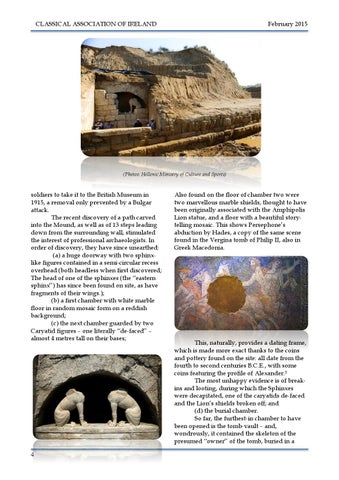
(Photos: Hellenic Ministry of Culture and Sports)
soldiers to take it to the British Museum in 1915, a removal only prevented by a Bulgar attack. The recent discovery of a path carved into the Mound, as well as of 13 steps leading down from the surrounding wall, stimulated the interest of professional archaeologists. In order of discovery, they have since unearthed: (a) a huge doorway with two sphinxlike figures contained in a semi-circular recess overhead (both headless when first discovered; The head of one of the sphinxes (the “eastern sphinx”) has since been found on site, as have fragments of their wings.); (b) a first chamber with white marble floor in random mosaic form on a reddish background; (c) the next chamber guarded by two Caryatid figures – one literally “de-faced” – almost 4 metres tall on their bases;
4
Also found on the floor of chamber two were two marvellous marble shields, thought to have been originally associated with the Amphipolis Lion statue, and a floor with a beautiful storytelling mosaic. This shows Persephone’s abduction by Hades, a copy of the same scene found in the Vergina tomb of Philip II, also in Greek Macedonia.
This, naturally, provides a dating frame, which is made more exact thanks to the coins and pottery found on the site: all date from the fourth to second centuries B.C.E., with some coins featuring the profile of Alexander.3 The most unhappy evidence is of breakins and looting, during which the Sphinxes were decapitated, one of the caryatids de-faced and the Lion’s shields broken off; and (d) the burial chamber. So far, the furthest-in chamber to have been opened is the tomb-vault – and, wondrously, it contained the skeleton of the presumed “owner” of the tomb, buried in a
February 2015 limestone coffin set into the floor. This brings us to the real mystery of Amphipolis, which may well be solved in the course of 2015 – who is the high-ranking occupant of the coffin? No inscription that might reveal the person’s identity has so far been discovered and looting may have deprived us of other potentially identifying evidence. Adding to the mystery, there are centuries-old references to Kasta Mound as the “Tomb of the Queen”. If so, which queen might be a possible candidate? Initially it was hoped that it might be the (a?) wife of Alexander, or perhaps even Alexander’s mother, Olympias. (Wonder of wonders – it was even hoped originally that the coffin might contain the remains of the world-conqueror himself!) On 20 January it was revealed that the skeletal remains belonged to a woman of approximately sixty years of age, sparking immediate speculation that Olympias rested here. But a bigger surprise was the announcement that there were at least four other people also present in the tomb: bones from two males and an infant, and a cremation were discovered. The bones of the younger male show a number of deep knife marks which betray the vicious manner in which he met his death.
CLASSICAL ASSOCIATION OF IRELAND significant travellers passed through, little or no mention is made of the Mound. Saul of Tarsus (Paul of the New Testament) makes only very scant mention of the whole area: Acts 17:1 refers to “Paul and Silas… pass[ing] through Amphipolis and Apollonia on the way to Thessaloniki.” But they clearly paid no attention to the Mound and did not refer to the tumulus, nor do they seem to have bothered preaching there. Pausanias some two centuries later is of no use on the subject of Kasta Mound either. So much for the past – what of the coming years? We can certainly expect exciting developments in Greek Macedonia. Drs Andrew Smith and Joan Wright led a group from the Classical Association of Ireland to the area some years ago – a most exciting and enjoyable tour focussing on Vergina; and we look forward to the prospect of further CAI exploration there. Notes It is 100 km N.E. of Thessaloniki. See Oscar Broneer, The Lion Monument at Amphipolis (Cambridge, MA: Harvard University Press, 1941), Figs 28 and 29. Available at: http://babel.hathitrust.org/cgi/pt?id=wu.89095909818;vi ew=1up;seq=1 3 Somewhat controversially, some coins of this kind from the region were to be auctioned in Germany in October 2014, coinciding with some of the most exciting moments of the excavation, with allegations that they were possibly loot from the Amphipolis site. See, for instance: http://www.grreporter.info/en/coins_amphipolis_be_au ctioned_germany/11773 (last accessed 22 January 2015). 1 2
Sources Ongoing information on the excavations at Amphipolis can be found readily on the internet, including at:
To date, only about one tenth of the Mound site has been excavated or even surveyed, and geophysical scans suggest that there may well be further tombs underneath the Mound. The Greek government departments involved have great expectations for the area in terms of tourist potential: land plots in the region are already being snapped up by speculators – mostly Germans – while the site itself is currently under military protection.
http://greece.greekreporter.com/?s=Amphipolis http://www.theamphipolistomb.com/
Historical Knowledge of the Mound Despite the reference to the site as the “Tomb of the Queen”, for centuries apparently the Mound was regarded as nothing more than a natural feature of the local landscape. Although
TAKE A VIRTUAL TOUR of the Amphipolis Tomb: https://www.youtube.com/watch?v=Kgm9yxJQDTw
5
CLASSICAL ASSOCIATION OF IRELAND
February 2015
Classical Association of Ireland Tour 2014: the Peloponnese In a break with tradition, this
Epidauros was a centre of healing tour took place slightly later than using water from local springs in heretofore to coincide with the the sanctuary of Asclepius. We start of the airline summer also visited Messene, Sparta and schedules. So on May 1st we Monemvasia. The Museum of the assembled at Dublin Airport for Olive and Greek Olive Oil aims to the Aer Lingus flight direct to preserve the technology of times Athens. Members from Dublin, past and acknowledge the Cork, Sligo and Limerick importance of the olive in Greek Branches made a group of 31. life. Our tour leader, for the 17th The well-prepared among time, was Professor Andrew us brought along the book by Smith of UCD, ably assisted by travel writer Patrick Leigh Dr Joan Wright, Sotiris, our bus Fermor entitled Mani: Travels in driver and a local guide. My the Southern Peloponnese. The Above: Andrew Smith within the first CAI tour was to Greece in cyclopaean walls of Mycenaean Tiryns. peninsula of that name is the 1981 and this time we revisited middle one in the southern Below: Robin Simmons at Epidauros. (Photos: Isabella Bolger) many of the same sites, evoking Peloponnese. We drove zigzag memories of good times and the people who style through its forested mountains of pine and shared them with us. We remembered the olive groves. Many Athenian families escape to botanical knowledge of Ann Buchanan and their holiday homes here in summer when Tanya Blyth, who identified the Mediterranean temperatures soar in the capital. The visit to the flora for us – we missed ye this time, ladies. Vlychada caves was memorable. The rise in sea We stayed overnight in Athens and next level after the ice age flooded them, so a halfday headed north to the Isthmus of Corinth. The hour tour in a canoe-size boat brought us up Corinth Canal was constructed here in the time close to the calcite dripstone formations that are of Nero, using the slave labour of thousands of still evolving today. Jewish prisoners after the Judean revolt. Today Back in Athens, we had time to walk up the road bridge over the canal is a very busy one, to the Acropolis. The Parthenon (Temple of as is the shipping route below, in the canal itself. Athena) looked majestic with its Pentelic marble We went on to visit the Environment Museum of gleaming in the May sunlight. The new Stymphalia, overlooking the lake that gives it its Museum of the Acropolis was visited too. name. Modern technology is used at its best in To conclude, it is only fitting that we pay this museum setting and the views over the lake tribute to the late Alan Benson of Sadlier Travel and its bird life were special. who died suddenly and unexpectedly in On day 3 we walked uphill and through January. He organised our tours over the years; the Lion Gate to the citadel of Mycenae. Its his colleagues did so this time. Thanks to position controlled access to the interior and everyone who helped make this tour the success there was a clear view over the Palace of it was. It was enjoyable and, unlike visitors in Agamemnon to the sea. The so-called Treasury ancient times, we didn’t encounter the bed-bugs of Atreus is the largest and best preserved of of Argos or the tholos tombs. the thistles Pylos was the second most important of Tiryns! centre in the Mycenaean world after Mycenae itself. It was unfortified. The Palace of Nestor Christine was destroyed by fire but some fragments of Shine, the wall paintings are in the Museum at Cork Chora. The sanctuary at Olympia flourished Branch from the 10th century BC until the emperor Theodosius closed all the ancient sanctuaries. 6
February 2015
CLASSICAL ASSOCIATION OF IRELAND
Hosted this year in Queen’s University Belfast’s Canada Room, the CAI Summer School took as its theme ‘Voyages and Journeys in the Ancient World’. And with such a subject, who better to start things off than the man behind the Barrington Atlas? Professor Richard Talbert (UNC Chapel Hill) looked at two items that might have helped a Roman get to where he was going. On Friday evening he examined the portable sundial in the Roman empire. Useful timepiece or a rich man’s trinket? The following morning Prof. Talbert shifted his attention to the great Tabula Peutingeriana, revealed as a remarkable testament to mapping in the ancient world. As an accompaniment, a copy of the great map was unearthed from the QUB Library and put on display (below).
Professor Talbert on portable sundials (Photos in this report: Peter T. Crawford)
CAI Annual Summer School: Queen’s University Belfast 15th-17th August, 2014
From traversing land and sea to the actual and metaphorical journeys of the classical philosopher with Professor Andrew Smith (UCD). Perhaps the most eye-catching of those journeys was where classical philosophy met Romanticism, with the revealing of that “steep and rugged ascent” in William Blake’s The Sea of Time and Space. In investigating how the passing of emperors changed depending on their reputations, Oliver O’Sullivan (NUI Maynooth) demonstrated not just an in-depth knowledge of Suetonius but also how in giving early career academics a platform to present their research the CAI fosters the next generation of Irish scholars on Classical antiquity. In addition to Oliver, generous bursaries funded by the CA (UK) also helped five early career academics to attend. With Dr Raoul McLaughlin (QUB), we turned to a specific and extremely lucrative
voyage of the ancient world – the shipping lanes of the Red Sea through the Gulf of Aden to the African, Arabian and Indian coasts sailed by the Ptolemies and Romans. Seeing ancient western traders and soldiers stationed in such far-flung places never ceases to amaze. Building on his recent work on Roman waterways, Professor Brian Campbell (QUB) spoke on the multiple, even contradictory visions of rivers – bringers of life or destruction, arteries of transport, imperial boundaries, artistic inspiration, or divine entities in themselves: all sprung from the inspiration of a Spanish bleach advertisement! At the close of proceedings school-goers participated in a lively exchange of ideas at a local establishment, a reception in the cloisters of the Lanyon Building and a wonderful meal in the Great Hall, provided by QUB (below). These festivities did not mark the end of the weekend’s activities, however, and the
7
CLASSICAL ASSOCIATION OF IRELAND
February 2015
following day, Dr Thérèse Cullen led a tour of many of the Christian sites of the County Down, taking in Strangford Lough, Down’s famous drumlins, and lunch at Ballyduggan Mill. CAI and QUB would like to thank those in attendance and in return I am sure all involved would extend their thanks to the speakers, QUB staff, Dr Thérèse Cullen and especially Dr John Curran for being the manager, organiser and point man in the run up to and during a weekend enjoyed by all. Dr Peter T. Crawford, QUB As the culmination of the CAI Summer School 2014, the Classical Association of Northern Ireland was formally re-launched. Its aim is to provide the Classics and schools communities with stimulating and up-todate knowledge on the ancient world.
The Summer School Sunday outing. Above: Inch Abbey; Below: Sheltering from a rain shower
A programme of events is being put together and a website is under construction. The success of the Summer School in Belfast was a powerful affirmation of the enthusiasm and generosity of Classics scholars on both islands (and beyond) and the Classical Association of Northern Ireland looks forward to fulfilling its missio!
CAI Summer School 2015
Right: Downpatrick Cathedral; Below: Ballyduggan Mill (Photos: Joan Wright)
8
This year’s Summer School will be held in Maynooth and is dedicated to ancient drama. The keynote speaker will be Fiona Macintosh, who will deliver the opening lecture on 14 August at 8.00pm, as well as the first morning lecture on Saturday. Fiona is Professor of Classical Reception and Fellow of St Hilda’s College, University of Oxford. Her publications include: Dying Acts: Death in Ancient Greek and Modern Irish Tragic Drama (Cork, 1994; New York, 1995), Greek Tragedy and the British Theatre, 1660-1914 (Oxford University Press, 2005, coauthored with Edith Hall), Sophocles’ Oedipus Tyrannus (Cambridge University Press, 2009). Other speakers include Michael Lloyd, Eoghan Moloney and Hugh Denard. Prof. Michael Lloyd (UCD) has written extensively on Euripides and Greek drama in general. He is also interested in Irish adaptations of Greek tragedy. On this occasion he will talk about ‘Characterization in Sophocles’. Sophocles has
February 2015 been famous since antiquity for his character portrayal; this lecture will examine the nature of character in Sophocles, and the techniques which he uses to represent it. Special attention will be given to Oedipus the King. Dr Eoghan Moloney (NUIM) lectured on Ancient History at the University of Adelaide before coming back to Ireland. His research and publications focus on the history and culture of the Classical period, with special emphasis on the fourth century BC and ancient Macedon. His lecture is entitled ‘Courts, kings, and all theatrical things’. In it he will look beyond theatre’s stage to examine the place of drama in the larger political and social world of the ancient Greeks. He will begin with a consideration of theatre’s crucial importance in Classical Athens, before tracing the dissemination of drama outside of that democratic city. In particular, this presentation will highlight the unlikely part antiquity’s ‘greatest’ kings played in transforming Greek drama into an international phenomenon. Dr Hugh Denard lectures on digital humanities in TCD. He is presently on leave from King’s College London where he is lecturer in Digital Humanities. As a theatre historian his classical research interests span ancient drama, the theatricality of life and art in Greece and Rome, and modern performances and adaptations of ancient drama. He is also currently investigating the ‘lost’ theatres of early twentieth-century Dublin. His theme for the Summer School is ‘Lost and forgotten playing spaces of Greece and Rome’ in which he will explain how the archaeological remains of theatres in the Roman empire give us invaluable information about ancient theatrical practice. But they are only part of the story. Today, digital technologies are bringing to light hidden spaces and lost traditions of theatrical performance which textbooks often overlook. In this session, Dr Denard will present the results of several years of detailed, multidisciplinary research, and reflect on the ways in which digital visualisation tools are adjusting our understanding and narratives of ancient theatre. The Saturday session will end with a conference dinner in the Glenroyal Hotel in Maynooth and on Sunday there will be an outing to visit Belvedere House, which was built in the eighteenth century as a hunting lodge and is set in 160 acres of garden and parkland on the shores of Lough Ennal.
CLASSICAL ASSOCIATION OF IRELAND Further details of the 2015 Summer School programme and registration forms can be obtained on the Classical Association website www.classicalassociation.ie or from Liam Bairéad: 3 Garrán Pháirc na Gráinsí Ráth Eanaigh Baile Átha Cliath 5
3 Grange Park Grove Raheny Dublin 5
Prof. Andrew Smith
CAI-TEACHERS The CAI-T Annual Conference 2014 was held in the Glenroyal Hotel, Maynooth, in October. The conference opened with an address to the members from the Chairman, highlighting the need for a full review of the Leaving Certificate Syllabus for Classical Studies. The most obvious problem with the current syllabus is that the prescribed texts for four out of the ten topics are now out of print. On Saturday, in addition to the business of the AGM, there were three speakers. Dr Jo Day (UCD, pictured below with Ian Maguire) spoke about food and cooking in the Roman world, with a focus on exotic foods, where they were sourced, and the lucrative trade routes used. Dr Hugh Denard (TCD) gave a highly visual presentation on aspects of both Greek and Roman theatre performance, including his work on the digital reconstruction of theatre buildings. The final speaker was Greg Daly, author of Cannae: The Experience of Battle in the Second Punic War. He delivered a very interesting talk on the battle and its significance in the wider context of the Second Punic War. All present agreed that the three speakers were excellent and that this year’s conference was a great event. Ian Maguire was elected the new Chairman of the Association and he promised to pursue reform of the Leaving Certificate syllabus as his number one priority. Ian Maguire (CAI-T Chairman) 9
CLASSICAL ASSOCIATION OF IRELAND
February 2015
CAI BRANCH NEWS CAI CORK The Cork branch activities started in October, the season of mellow fruitfulness, with ‘The Roman Empire: a model for Gerald of Wales on the Medieval English conquest of Ireland’. Dr Diarmuid Scully, a lecturer in the department of medieval History in UCC, is both an excellent speaker and a great friend to the Cork branch. Both Gerald of Wales and Tacitus were Diarmuid’s primary sources and one would not want to be sensitive in the Middle Ages, as the common term for the Irish a la both of these characters was ‘Barbarian’. However, the British people are descended from the Britains who came from Troy!! Even then, it was all about location, location. The lecture was quite varied and we learned that the Romans surpassed Alexander the Great’s escapades because they managed to cross Ocean. We also found out that Pope Adrian IV granted Ireland to Henry II under the Papal decree Landobiliter, no 13 and this led to an interesting development: the lawless Barbarian versus the Christians. However, Virgil in Aeneid VI summed it all up – the Romans, he said, have to lead all nations! One wonders about the new political party to be formed to ‘ReBoot Ireland’, if there will be claims of Roman or Trojan ancestry! November saw us entertain Tony O’Sullivan of the Limerick Branch. Tony took us on a journey with ‘Travels in Roman Istria from the Golden Fleece to the Amber Road and beyond’. At the time of writing (January 2015), travels in Roman Istria sound very appealing, as the rain pounds down and the wind howls around Cork City! The main literary sources for the lecture were Strabo, Livy, Pliny the Elder, Martial and Cassiodorus. At its peak, Istria was a highly developed Roman area, quite a small area about the size of County Limerick – Tony’s words, not mine! Despite its size, it was an area of vast 10
importance. Cassiodorus called it the granary of Ravenna and Julius Caesar made Pula a regional capital. However, its fame was short lived. It sided with Brutus and Cassius after the death of Caesar and the Triumvirate of Anthony, Lepidus and Octavius destroyed it. The area was rebuilt by Octavius/Augustus and renamed Pola Pietas Julia. As always, the exploration of lesser known areas of the Roman Empire opens a window to discovery and future holiday prospects. The first of December saw another Limerick branch member make a foray into Cork. This time we were pleased to welcome the Secretary of the Classical Association of Ireland, Patrick Ryan, on: ‘“erant qui metu mortis mortem precarentur”. The collection from Pompeii and Herculaneum in the National Archaeology museum of Naples’. This lecture had its origins in a trip to Naples and the museum which was founded by Charles of Bourbon, King of Naples and Sicily (17341759). Archaeological excavations began in Herculaneum in 1738 and one of the most important sites to be discovered was the Villa of the Papyri. In 1806, the French invaded Herculaneum and took away the majority of the 1800 scrolls discovered. To date, some 580 have been opened and read.
WATCH footage of the eruption of Vesuvius in 1944 and a video illustrating a new technique for reading Herculaneum’s carbonised scrolls without opening them: https://www.youtube.com/watch?v=JlWJ68DJGM0
February 2015 Cork branch activities resume in February 2015 and we are looking forward to an exciting Spring programme, details of which can be found on the right. We are always looking for new members and all up to date notices can be found on the Classical Association website (www.classicalassociation.ie) and the Facebook page. Jennifer O’Donoghue
CLASSICAL ASSOCIATION OF IRELAND
Spring 2015: Cork *Tuesday, 3 March, 7.30pm, Room 2.02 in the O’Rahilly Building, UCC Colmán Ó Clabaigh OSB (Glenstal Abbey) ‘Monks and their books in late medieval Ireland: with reference to a recently re-discovered 14th century copy of Aristotle’s On the Nature of Animals and other texts from St Mary’s Cistercian Abbey, Dublin.’ *PLEASE NOTE CHANGE OF VENUE AND DAY
CAI DUBLIN The Dublin Branch programme for the academic year 2014-15 started in September with the branch AGM and the annual keynote lecture, entitled ‘Viewing Ireland through Rome-tinted Spectacles in Renaissance Italy’ by Dr Eric Haywood from the UCD School of Languages and Literatures. It was a fascinating talk which highlighted Ireland’s ‘Otherness’ for Renaissance Italians schooled in the prejudices of classical authors. Members who could not attend the lecture can read up on the topic in Dr Haywood’s new book, Fabulous Ireland - Ibernia Fabulosa: Imagining Ireland in Renaissance Italy (Peter Lang, 2014). In October, the branch hosted the Presidential Address of Peter Fallon, CAI President for 2014, who used his lecture, ‘Inscribing Ages: On the Arts of Translation’, to discuss his work as a poet, publisher, and translator, in particular his translation of Virgil’s Georgics for the Oxford World’s Classics series (Oxford 2009). In November, there was a branch lecture by Dr Eoghan Moloney from the Department of Ancient Classics at Maynooth on ‘Heroes and History: Homer, Heracles, and Alexander the Great’, an excellent exposition of the scholarly myths which surround the early history of Macedonia. In December, there was a branch lecture by Dr Rob Sands from the UCD School of Archaeology on ‘The Wooden Small Finds from Vindolanda’, a meticulous survey and analysis of various wooden items, from wheel spokes to barrel fragments, found at the wellknown site on Hadrian’s Wall.
Monday, 13 April, 7.30pm, Cork Educational Support Centre (opposite the main gates of UCC) Dr Máire Geaney ‘Things we did not know about carpentry in Roman Britain and Ireland.’ Monday, 11 May, 7.30pm, Cork Educational Support Centre (opposite the main gates of UCC) Members’ Papers: a diverse range of ten-minute papers given by five branch members on topics of their choice.
Branch lectures have been well attended, and for one talk we had the enviable problem of having too many people for the chairs in the room. But at present we do not have a full Branch committee, and we really do need help from one or two more people. In particular, we are looking for a Minutes Secretary, a Public Relations Officer, and an Education Officer to liaise with CAI-T. If you would like to join the committee to contribute to the smooth running of the branch, please make contact with our President Brian O’Connell (01-848 0957), Vice-President Isabella Bolger (isabella.bolger@gmail.com), or the Treasurer Liam Bairéad (liambairead@gmail.com). Dr Alexander Thein
IIHSA
11
CLASSICAL ASSOCIATION OF IRELAND
Spring 2015: Dublin All meetings take place in Room K217, Newman Building, University College Dublin, at 7.30pm. Tuesday, 17 February Latin Reading Group Joan Wright ‘The Venerable Bede’s account of King Edwin of Northumbria’s conversion to Christianity’ Thursday, 19 March Latin Reading Group Louise Maguire ‘Livy’s account of the Rape of the Sabine Women’
Thursday, 26 March Branch Lecture Gordon Campbell (NUI Maynooth) ‘Humans and Animals in Ancient Thought: Are we Different?’ Thursday, 23 April Latin Reading Group Alexander Thein ‘Tacitus on Civil War and the Capitoline Fire of A.D. 69’ Thursday, 30 April Branch Lecture Andrew Smith (UCD) ‘The birth of enquiry: the first Greek philosophers’ Saturday, 16 May Day Trip To Co. Meath, including Trim Castle
The 6th annual play-reading at The Orchard Yard took place on Saturday, 7 June. We chose the oldest surviving Greek tragedy, Aeschylus’ The Persians, first staged in 472 BC. Our attempts to recreate the open-air Greek theatre proved quite successful, despite persistent threats from Zeus to inundate us with thundershowers! Patrick J. Ryan (Photos: Orla Coffey and Jennifer O’Donoghue)
Spring 2015: Galway The Classical Association Ireland Galway Branch will hold its relaunch on Tuesday, 24 March. Dr Pádraic Moran of NUIG will deliver his paper ‘The Survival of Greek Learning in Early Medieval Ireland’. The paper will be given in the Hardiman Research Building on the Arts Concourse of NUIG at 6.30pm (venue TBC).
12
February 2015 Latin and Greek Languages Summer School The 2015 CAI Languages Summer School will take place 15-26th of June at Trinity College, Dublin. Courses will be for Beginner and Intermediate levels. For further information please contact Dr Cosetta Cadau: cadauc@tcd.ie
CAI LIMERICK The Limerick Branch continues to project itself as one of the organisations that keep the torch of culture very much aflame in the South-West. We celebrated Limerick as 2014 City of Culture with a special series of lectures given, in all cases but one, by local lecturers. The adult Greek and Latin were well attended and are set to continue in the Limerick Education Centre, under the excellent tutelage of Patrick Ryan. We have a mixture of lectures on offer for the current term. Apart from Mr Patrick Ryan in early February and Dr Matthew Potter, our local speakers, it will be our privilege to welcome Professor George Huxley once more. We are also delighted to have Dr Rachel Finnegan coming and Dr John Curran, of QUB, on his first visit to speak to the branch. The full programme is set out below. Details of the branch Annual Dinner and other fringe events will be available later. Tom Seaver (Hon Sec.)
Spring 2015: Limerick All lectures take place on Wednesdays (except Friday, 24 April), at the Limerick Education Centre, Marshall House, Dooradoyle, Tel. 061 585060, at 8pm. 4 March Dr Matthew Potter (Limerick Museum and Archives) ‘The Ptolemies: 305-30 B.C.’
25 March Dr Rachel Finnegan (Literary Editor and Proofreader) ‘The eastern and ‘curious’ collections of Richard Pococke (1704-1765)’ 15 April Prof. George Huxley (TCD) ‘War and Exile in the Poetry of Alcaeus’ Friday, 24 April Dr John Curran (Queen’s University, Belfast) ‘ius vitae necisque (the right of life and death) and the politics of killing children’