By Jim Keogh ALUMNI NEWS
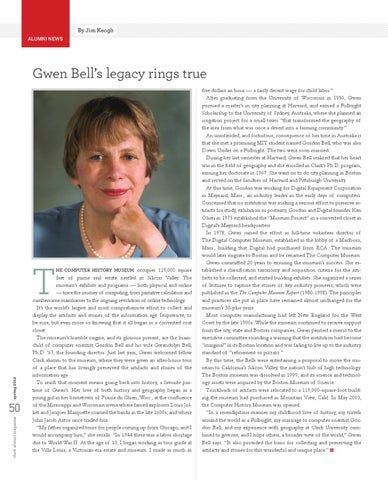
Gwen Bell’s legacy rings true
T spring 2012
HE COMPUTER HISTORY MUSEUM occupies 119,000 square
clark alumni magazine
50
feet of prime real estate nestled in Silicon Valley. The museum’s exhibits and programs — both physical and online — trace the journey of computing, from primitive calculators and cumbersome mainframes to the ongoing revolution of online technology. It’s the world’s largest and most comprehensive effort to collect and display the artifacts and stories of the information age. Impressive, to be sure, but even more so knowing that it all began in a converted coat closet. The museum’s humble origins, and its glorious present, are the brainchild of computer scientist Gordon Bell and his wife Gwendolyn Bell, Ph.D. ’67, the founding director. Just last year, Gwen welcomed fellow Clark alumni to the museum, where they were given an after-hours tour of a place that has lovingly preserved the artifacts and stories of the information age. To reach that moment means going back into history, a favorite pastime of Gwen’s. Her love of both history and geography began as a young girl in her hometown of Prairie du Chien, Wisc., at the confluence of the Mississippi and Wisconsin rivers where famed explorers Louis Jolliet and Jacques Marquette roamed the banks in the late 1600s, and where John Jacob Astor once traded furs. “My father organized tours for people coming up from Chicago, and I would accompany him,” she recalls. “In 1944 there was a labor shortage due to World War II. At the age of 10, I began working as tour guide at the Villa Louis, a Victorian-era estate and museum. I made as much as
five dollars an hour — a fairly decent wage for child labor.” After graduating from the University of Wisconsin in 1956, Gwen pursued a master’s in city planning at Harvard, and earned a Fulbright Scholarship to the University of Sydney, Australia, where she planned an irrigation project for a small town “that transformed the geography of the area from what was once a desert into a farming community.” An unintended, and fortuitous, consequence of her time in Australia is that she met a promising MIT student named Gordon Bell, who was also Down Under on a Fulbright. The two were soon married. During her last semester at Harvard, Gwen Bell realized that her heart was in the field of geography and she enrolled in Clark’s Ph.D. program, earning her doctorate in 1967. She went on to do city planning in Boston and served on the faculties of Harvard and Pittsburgh University. At this time, Gordon was working for Digital Equipment Corporation in Maynard, Mass., an industry leader in the early days of computers. Concerned that no institution was making a serious effort to preserve artifacts for study, exhibition or posterity, Gordon and Digital founder Ken Olsen in 1975 established the “Museum Project” in a converted closet in Digital’s Maynard headquarters. In 1978, Gwen joined the effort as full-time volunteer director of The Digital Computer Museum, established in the lobby of a Marlboro, Mass., building that Digital had purchased from RCA. The museum would later migrate to Boston and be renamed The Computer Museum. Gwen committed 20 years to ensuring the museum’s success. She established a classification taxonomy and acquisition criteria for the artifacts to be collected, and started building exhibits. She organized a series of lectures to capture the stories of key industry pioneers, which were published in the The Computer Museum Report (1980-1998). The principles and practices she put in place have remained almost unchanged for the museum’s 30-plus years. Most computer manufacturing had left New England for the West Coast by the late 1990s. While the museum continued to receive support from the city, state and Boston companies, Gwen penned a memo to the executive committee sounding a warning that the institution had become “marginal” in its Boston location and was failing to live up to the industry standard of “refinement or pizzazz.” By this time, the Bells were entertaining a proposal to move the museum to California’s Silicon Valley, the nation’s hub of high technology. The Boston museum was dissolved in 1999, and its science and technology assets were acquired by the Boston Museum of Science. Truckloads of artifacts were relocated to a 119,000-square-foot building the museum had purchased in Mountain View, Calif. In May 2003, the Computer History Museum was opened. “In a serendipitous manner my childhood love of history, my travels around the world as a Fulbright, my marriage to computer scientist Gordon Bell, and my experience with geography at Clark University combined to give me, and I hope others, a broader view of the world,” Gwen Bell says. “It also provided the basis for collecting and preserving the artifacts and stories for this wonderful and unique place.”