GardentoTable
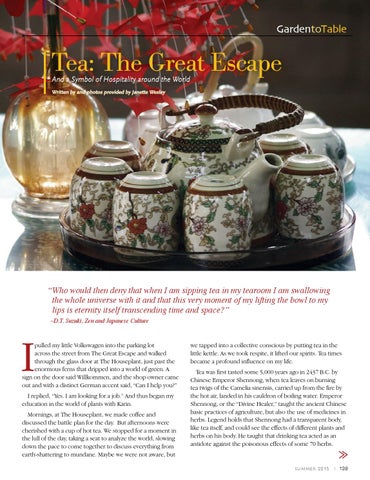
Tea: The Great Escape And a Symbol of Hospitality around the World Written by and photos provided by Janette Wesley
“ Who would then deny that when I am sipping tea in my tearoom I am swallowing the whole universe with it and that this very moment of my lifting the bowl to my lips is eternity itself transcending time and space?” –D.T. Suzuki, Zen and Japanese Culture
I
pulled my little Volkswagen into the parking lot across the street from The Great Escape and walked through the glass door at The Houseplant, just past the enormous ferns that dripped into a world of green. A sign on the door said Willkommen, and the shop owner came out and with a distinct German accent said, “Can I help you?” I replied, “Yes. I am looking for a job.” And thus began my education in the world of plants with Karin. Mornings, at The Houseplant, we made coffee and discussed the battle plan for the day. But afternoons were cherished with a cup of hot tea. We stopped for a moment in the lull of the day, taking a seat to analyze the world, slowing down the pace to come together to discuss everything from earth-shattering to mundane. Maybe we were not aware, but
we tapped into a collective conscious by putting tea in the little kettle. As we took respite, it lifted our spirits. Tea times became a profound influence on my life. Tea was first tasted some 5,000 years ago in 2437 B.C. by Chinese Emperor Shennong, when tea leaves on burning tea twigs of the Camelia sinensis, carried up from the fire by the hot air, landed in his cauldron of boiling water. Emperor Shennong, or the “Divine Healer,” taught the ancient Chinese basic practices of agriculture, but also the use of medicines in herbs. Legend holds that Shennong had a transparent body, like tea itself, and could see the effects of different plants and herbs on his body. He taught that drinking tea acted as an antidote against the poisonous effects of some 70 herbs.
SUMMER 2015
| 139