THE TAKEAWAY |
NOTES FROM THE BEST TALKS YOU MISSED
Culture Counts Arts and culture play a valuable role in the Upstate’s economic and community vibrancy By DEAN HYBL executive director, Ten at the Top
What: Ten at the Top Culture Counts Regional Forum
When/Where: Jan. 24 at the Chapman Cultural Center, Spartanburg
Who was there: 130+ business and
community leaders and residents interested in arts and culture in the Upstate Richmond Federal Reserve Bank
According to the new Upstate Arts and Cultural Assets Interactive Map unveiled during Ten at the Top’s Jan. 24 Culture Counts Regional Forum at Spartanburg’s Chapman Cultural Center, the 10-county Upstate region is home to more than 1,300 arts and culture organizations, venues, and programs. Yet, much of the discussion during the forum was that perhaps we don’t do enough to tell the story and leverage the economic and community value of that significant regional investment. According to Anthony Radich, the event’s keynote speaker and executive director of the Western States Arts Federation, “Many have ignored the creative economy in the past because for many years the interaction was typically through writing a check, and therefore they didn’t see it as something that can generate revenue within the economy.” However, Radich added, that has changed in recent years, as “a lot of focus has been put on the creative economy as something that helps power the overall economy in a state or region.” Radich credits the growing number of economic impact studies on arts and culture with helping to change the dynamic. He referenced two specific things that economic impact studies highlight that help illustrate that arts and culture are an important part of local economies. 1 Arts organizations and venues employ people who then purchase goods and services and support the economy. 2 The studies identify how arts and culture are related to tourism. Sometimes a specific event can bring people to your community, but the studies show that cultural availability as a whole is critical in attracting visitors. 24
UBJ | 2.9.2018
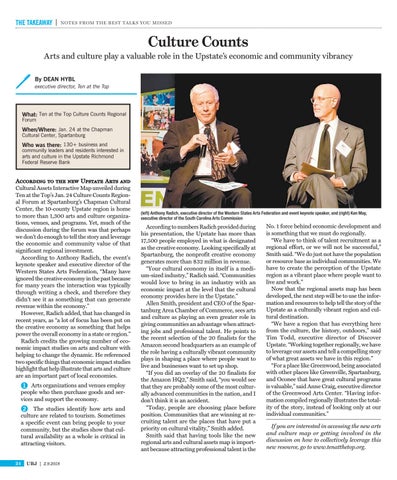
(left) Anthony Radich, executive director of the Western States Arts Federation and event keynote speaker, and (right) Ken May, executive director of the South Carolina Arts Commission
According to numbers Radich provided during his presentation, the Upstate has more than 17,500 people employed in what is designated as the creative economy. Looking specifically at Spartanburg, the nonprofit creative economy generates more than $32 million in revenue. “Your cultural economy in itself is a medium-sized industry,” Radich said. “Communities would love to bring in an industry with an economic impact at the level that the cultural economy provides here in the Upstate.” Allen Smith, president and CEO of the Spartanburg Area Chamber of Commerce, sees arts and culture as playing an even greater role in giving communities an advantage when attracting jobs and professional talent. He points to the recent selection of the 20 finalists for the Amazon second headquarters as an example of the role having a culturally vibrant community plays in shaping a place where people want to live and businesses want to set up shop. “If you did an overlay of the 20 finalists for the Amazon HQ2,” Smith said, “you would see that they are probably some of the most culturally advanced communities in the nation, and I don’t think it is an accident. “Today, people are choosing place before position. Communities that are winning at recruiting talent are the places that have put a priority on cultural vitality,” Smith added. Smith said that having tools like the new regional arts and cultural assets map is important because attracting professional talent is the
No. 1 force behind economic development and is something that we must do regionally. “We have to think of talent recruitment as a regional effort, or we will not be successful,” Smith said. “We do just not have the population or resource base as individual communities. We have to create the perception of the Upstate region as a vibrant place where people want to live and work.” Now that the regional assets map has been developed, the next step will be to use the information and resources to help tell the story of the Upstate as a culturally vibrant region and cultural destination. “We have a region that has everything here from the culture, the history, outdoors,” said Tim Todd, executive director of Discover Upstate. “Working together regionally, we have to leverage our assets and tell a compelling story of what great assets we have in this region.” “For a place like Greenwood, being associated with other places like Greenville, Spartanburg, and Oconee that have great cultural programs is valuable,” said Anne Craig, executive director of the Greenwood Arts Center. “Having information compiled regionally illustrates the totality of the story, instead of looking only at our individual communities.” If you are interested in accessing the new arts and culture map or getting involved in the discussion on how to collectively leverage this new resource, go to www.tenatthetop.org.