In practice
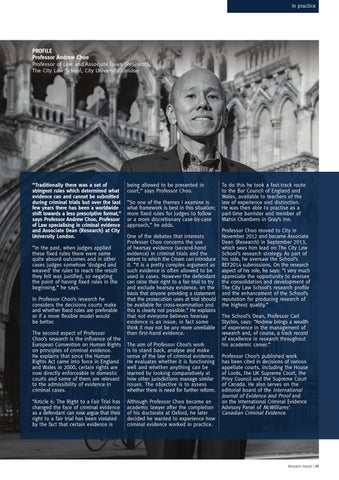
PROFILE Professor Andrew Choo Professor of Law and Associate Dean (Research), The City Law School, City University London
“Traditionally there was a set of stringent rules which determined what evidence can and cannot be submitted during criminal trials but over the last few years there has been a worldwide shift towards a less prescriptive format,” says Professor Andrew Choo, Professor of Law specialising in criminal evidence and Associate Dean (Research) at City University London. “In the past, when judges applied these fixed rules there were some quite absurd outcomes and in other cases judges somehow ‘dodged and weaved’ the rules to reach the result they felt was justified, so negating the point of having fixed rules in the beginning,” he says. In Professor Choo’s research he considers the decisions courts make and whether fixed rules are preferable or if a more flexible model would be better. The second aspect of Professor Choo’s research is the influence of the European Convention on Human Rights on principles of criminal evidence. He explains that since the Human Rights Act came into force in England and Wales in 2000, certain rights are now directly enforceable in domestic courts and some of them are relevant to the admissibility of evidence in criminal cases. “Article 6: The Right to a Fair Trial has changed the face of criminal evidence as a defendant can now argue that their right to a fair trial has been violated by the fact that certain evidence is
being allowed to be presented in court,” says Professor Choo. “So one of the themes I examine is what framework is best in this situation; more fixed rules for judges to follow or a more discretionary case-by-case approach,” he adds. One of the debates that interests Professor Choo concerns the use of hearsay evidence (second-hand evidence) in criminal trials and the extent to which the Crown can introduce it. “It is a pretty complex argument as such evidence is often allowed to be used in cases. However the defendant can raise their right to a fair trial to try and exclude hearsay evidence, on the basis that anyone providing a statement that the prosecution uses at trial should be available for cross-examination and this is clearly not possible.” He explains that not everyone believes hearsay evidence is an issue; in fact some think it may not be any more unreliable than first-hand evidence. The aim of Professor Choo’s work is to stand back, analyse and make sense of the law of criminal evidence. He evaluates whether it is functioning well and whether anything can be learned by looking comparatively at how other jurisdictions manage similar issues. The objective is to assess whether there is need for further reform. Although Professor Choo became an academic lawyer after the completion of his doctorate at Oxford, he later decided he wanted to experience how criminal evidence worked in practice.
To do this he took a fast-track route to the Bar Council of England and Wales, available to teachers of the law of experience and distinction. He was then able to practise as a part-time barrister and member of Matrix Chambers in Gray’s Inn. Professor Choo moved to City in November 2012 and became Associate Dean (Research) in September 2013, which sees him lead on The City Law School’s research strategy. As part of his role, he oversaw the School’s REF2014 submissions. On the research aspect of his role, he says: “I very much appreciate the opportunity to oversee the consolidation and development of The City Law School’s research profile and the enhancement of the School’s reputation for producing research of the highest quality.” The School’s Dean, Professor Carl Stychin, says: “Andrew brings a wealth of experience in the management of research and, of course, a track record of excellence in research throughout his academic career.” Professor Choo’s published work has been cited in decisions of various appellate courts, including the House of Lords, the UK Supreme Court, the Privy Council and the Supreme Court of Canada. He also serves on the editorial board of the International Journal of Evidence and Proof and on the International Criminal Evidence Advisory Panel of McWilliams’ Canadian Criminal Evidence.
Research Impact | 35