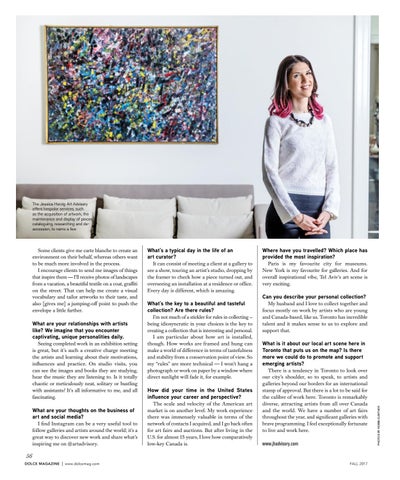
The Jessica Herzig Art Advisory offers bespoke services, such as the acquisition of artwork, the maintenance and display of pieces, cataloguing, researching and deaccession, to name a few
What are your relationships with artists like? We imagine that you encounter captivating, unique personalities daily. Seeing completed work in an exhibition setting is great, but it’s such a creative charge meeting the artists and learning about their motivations, influences and practice. On studio visits, you can see the images and books they are studying, hear the music they are listening to. Is it totally chaotic or meticulously neat, solitary or bustling with assistants? It’s all informative to me, and all fascinating.
What are your thoughts on the business of art and social media? I find Instagram can be a very useful tool to follow galleries and artists around the world; it’s a great way to discover new work and share what’s inspiring me on @artadvisory.
What’s a typical day in the life of an art curator?
Where have you travelled? Which place has provided the most inspiration?
It can consist of meeting a client at a gallery to see a show, touring an artist’s studio, dropping by the framer to check how a piece turned out, and overseeing an installation at a residence or office. Every day is different, which is amazing.
Paris is my favourite city for museums. New York is my favourite for galleries. And for overall inspirational vibe, Tel Aviv’s art scene is very exciting.
What’s the key to a beautiful and tasteful collection? Are there rules?
My husband and I love to collect together and focus mostly on work by artists who are young and Canada-based, like us. Toronto has incredible talent and it makes sense to us to explore and support that.
I’m not much of a stickler for rules in collecting — being idiosyncratic in your choices is the key to creating a collection that is interesting and personal. I am particular about how art is installed, though. How works are framed and hung can make a world of difference in terms of tastefulness and stability from a conservation point of view. So my “rules” are more technical — I won’t hang a photograph or work on paper by a window where direct sunlight will fade it, for example.
How did your time in the United States influence your career and perspective? The scale and velocity of the American art market is on another level. My work experience there was immensely valuable in terms of the network of contacts I acquired, and I go back often for art fairs and auctions. But after living in the U.S. for almost 15 years, I love how comparatively low-key Canada is.
Can you describe your personal collection?
What is it about our local art scene here in Toronto that puts us on the map? Is there more we could do to promote and support emerging artists? There is a tendency in Toronto to look over our city’s shoulder, so to speak, to artists and galleries beyond our borders for an international stamp of approval. But there is a lot to be said for the calibre of work here. Toronto is remarkably diverse, attracting artists from all over Canada and the world. We have a number of art fairs throughout the year, and significant galleries with brave programming. I feel exceptionally fortunate to live and work here.
www.jhadvisory.com
56 DOLCE MAGAZINE
|
www.dolcemag.com
fall 2017
phOtOs by rObin gArtner
Some clients give me carte blanche to create an environment on their behalf, whereas others want to be much more involved in the process. I encourage clients to send me images of things that inspire them — I’ll receive photos of landscapes from a vacation, a beautiful textile on a coat, graffiti on the street. That can help me create a visual vocabulary and tailor artworks to their taste, and also [gives me] a jumping-off point to push the envelope a little further.