THE POWER OF DIVERSITY LATINO
100
RITCHIE TORRES WON’T FOLLOW YOUR SCRIPT
HOW TO BRING NYC BACK
HOW A YOUNG, GAY, AFRO-LATINO MAN MADE HIS OWN WAY FROM NYCHA TO CAPITOL HILL
CIT YANDSTATENY.COM
@CIT YANDSTATENY
August 24, 2020
August 24, 2020
City & State New York
3
EDITOR’S NOTE
JON LENTZ Editor-in-chief
EVER SINCE HIS RUN for New York City Council in 2013, Ritchie Torres has frequently been billed as the next big thing in New York politics. Midway through his first term in office, the Observer featured him under the headline, “Could This 27-Year-Old Councilman Be the Mayor of New York One Day?” Not long afterward, he was the subject of a glowing profile in The New Yorker, which described him as a “rising star” who was “fighting for the poor under Trump.” Not surprisingly, his own official City Council profile describes him as “a rising star in City politics.” City & State was early in identifying Torres as a promising political talent, highlighting him in our 2013 New York City 40 Under 40 Rising Stars list. At the time, on the heels of a victory in a competitive City Council primary, we credited “Torres’ message that resonated in the district, undoubtedly helped by his compelling personal narrative, including his being raised in public housing.” Seven years later, Torres has just secured an even more impressive victory in another crowded primary, this time for a seat in the U.S. House of Representatives. In this week’s magazine, City & State contributor A. G. Sims looks at how Torres beat several other Democratic heavyweights in the contest – and how there’s more to his personal narrative than meets the eye.
CONTENTS NOT DEAD YET … 8
How New York City can get better
POWER OF DIVERSITY … 12
New York’s 100 most politically powerful Latinos
RITCHIE TORRES … 14
CELESTE SLOMAN; EMILY GERAGHTY/SHUTTERSTOCK
He overcame the odds. Now he’s headed to Congress.
THE CENSUS … 32 Upper Manhattan stands up to be counted Conventional wisdom says Latinos don’t answer the census. Washington Heights begs to differ.
WINNERS & LOSERS … 50
Who was up and who was down last week
CityAndStateNY.com
NEW YORK CITY TEACHERS THREATEN A STRIKE
In the ongoing battle over school reopening, the New York City teachers union is holding strong in its demands that the city delay in-person learning until the Department of Education provides more details about how it plans to keep students and teachers safe. Michael Mulgrew, the president
August 24, 2020
of the United Federation of Teachers, said that his teachers are prepared to strike if the union believes reopening wouldn’t be safe or if the city does not delay in-person classes. The union released an extensive health and safety checklist for school reopening that it will use to evaluate the preparedness of individual schools and urged all parents to opt for remote learning until schools have been
approved. Mulgrew also said that every student should receive an antibody or diagnostic coronavirus test before they are allowed into school buildings. The union’s plan was supported by a variety of health professionals, city and state lawmakers, business leaders and community organizations. However, New York City Mayor Bill de Blasio still seemed undeterred, taking a thinly veiled jab at teachers who don’t feel safe going back when he said “public servants show up,” citing transit workers and grocery store employees. He also released a “Back to School Pledge” that contained a series of promises about health and safety, although it didn’t actually provide any new guidance or information.
“If I can regularly roast Trump sycophants in 280 characters or less, I can speak to progressive values in 60 secs.” – Rep. Alexandria OcasioCortez, in a tweet, about her short allotted time to speak at the Democratic National Convention, via the Daily News
OTHER SCHOOLS GO REMOTE
As the school reopening debate rages on in New York City, other major school districts throughout
VICTORY LAP The first draft of history may be written by journalists, but now Gov. Andrew Cuomo wants a crack at it, having written a new book on his experience fighting COVID-19. Denying the notion that the book is a history of the pandemic – which is far from over – Cuomo likened it to a halftime speech. Because what we all need at halftime in the fight of our lives is to curl up with a good, self-promotional book.
“In many ways, COVID is just a metaphor.” – Gov. Andrew Cuomo, during his DNC speech, describing a disease that has killed tens of thousands of people in New York as a metaphor for the nation’s political dysfunction, via the New York Post
the state have made the decision to go with remote learning, at least to start off the year. Buffalo Public Schools will begin this fall with online classes, but the district plans to reevaluate the prospect of sending students back to classrooms after four to six weeks. Yonkers Public Schools followed soon after with an announcement that the district will also begin the year with remote classes. Staff will teach from school buildings, but students will attend class online.
JIM MALATRAS NAMED SUNY CHANCELLOR
Jim Malatras, a former top aide to Gov. Andrew Cuomo and a frequent presence at the governor’s nationally televised daily coronavirus briefings earlier this year, was appointed to lead the State University of New York system on Friday. The decision to install the SUNY Empire State College president as the leader of the statewide public university system drew scrutiny, given that there was no traditional nationwide search for a candidate to fill the role, although some SUNY board members said the expedited process was due to the public health crisis that has upended the fall semester. Malatras replaces Kristina Johnson, who stepped down to take the top job at Ohio State.
RON ADAR, GROSSINGER/SHUTTERSTOCK; KEVIN P. COUGHLIN/OFFICE OF THE GOVERNOR
4
August 24, 2020
PREPPING FOR A PANDEMIC ELECTION
Gov. Andrew Cuomo signed into law three bills meant to make it safer for New Yorkers to vote in November. The cornerstone of the package will allow anyone to use the pandemic as a reason to apply for an absentee ballot. Another will allow voters to begin applying for an absentee ballot immediately. The third bill will validate ballots that lack a postmark but were received the day after the election. Earlier in the week, state Sen. Alessandra Biaggi, congressional candidate Mondaire Jones and several others sued the Trump administration to stop its attempts to hinder the U.S. Postal Service’s ability to process mail. Soon after, Postmaster General Louis DeJoy said he would halt all of the controversial cost-saving measures until after the election, although it was unclear whether he would reverse the actions that were already taken.
THE
WEEK AHEAD
City & State New York
Schumer, AOC hit the same notes
NEW YORKERS TAKE THE VIRTUAL DNC STAGE
Democrats officially nominated Joe Biden for president and U.S. Sen. Kamala Harris for vice president, making history as Harris became the first Black and first South Asian woman to be on a major party ticket. The Democratic National Committee invited a host of speakers for its first virtual convention. Cuomo spoke during a primetime slot on the first night of the convention, giving a fiveminute address that focused largely on his management of the coronavirus pandemic in New York, while heavily criticizing the response of President Donald Trump. U.S. Sen. Charles Schumer and Rep. Alexandria OcasioCortez both spoke on the second night. OcasioCortez, who only spoke for one minute and 40 seconds, used her speech to second the nomination of U.S. Sen. Bernie Sanders, which was a procedural point rather than a snub of Biden.
TUESDAY 8/25 The state Senate and Assembly committees that oversee the MTA hold a virtual joint legislative hearing starting at 10 a.m. on the coronavirus’s impact on public transportation.
5
Ever the New Yorker, U.S. Senate Minority Leader Charles Schumer delivered a speech at the Democratic National Convention on Tuesday night with the Statue of Liberty behind him, calling the monument a “symbol of freedom and a beacon of hope” but one that President Donald Trump has “demeaned.” The Brooklynite started the three-minute speech by noting that he can see Lady Liberty from his Park Slope apartment – but his eyes seemed focused on winning control of the Senate. It’s a goal that seems increasingly achievable for Democrats in November, and one that would likely make Schumer majority leader, increasing his already substantial power in Washington, D.C. Schumer listed some of the party’s goals should Democratic nominee Joe Biden win the White House and Democrats control Congress, including making health care “affordable for all,” undoing “the vicious inequality of income and wealth that has plagued America for far too long” and – with a nod to the Statue of Liberty behind him – reforming the immigration system “so that immigrants, yearning to breathe free, will at last become American citizens.” The goals weren’t wildly different from those shared by Rep. Alexandria Ocasio-Cortez in her speech later in the night. Ocasio-Cortez, who
THURSDAY 8/27 The New York City Council slows down in the summer, but the Legislature is having its one full meeting of the month, held virtually at 1:30 p.m., and may pass some minor bills to help small businesses.
represents Queens and the Bronx, was one of two delegates chosen to deliver a nominating speech for U.S. Sen. Bernie Sanders. It was essentially a procedural point before the roll call vote that would officially designate Biden as the party’s nominee, but Ocasio-Cortez used her one minute and 40 seconds to speak to the progressive movement that helped elect her to Congress in 2018 and continues to hold her up as a champion. She thanked the “mass people’s movement working to establish 21st century social, economic, and human rights, including guaranteed health care, higher education, living wages and labor rights to all people in the United States.” Like Schumer, she used her brief time on air to highlight economic inequality, saying that the progressive movement realizes “the unsustainable brutality of an economy that rewards explosive inequalities of wealth for the few at the expense of longterm stability for the many.” While Ocasio-Cortez was there to nominate Sanders, her appearance was a sign of party unity going into the November election. She has repeatedly said she will vote for Biden in November. But her support for Schumer isn’t as clear cut – rumors have swirled that she may be considering challenging him when he’s up for reelection in 2022. – Jeff Coltin
THURSDAY 8/27 The Republican National Convention will take place from Monday to Thursday, and, like the DNC, is expected to be done mostly over video. President Donald Trump is expected to be officially nominated Thursday.
INSIDE DOPE
Trump will be the center of attention, but New York’s Republican congressional candidates, like Assembly Member Nicole Malliotakis, will be angling for time in the spotlight.
BY THE TIME YOU READ THIS... 6
CityAndStateNY.com
NYC RENTS ARE SKYROCKETING, AS RICH PEOPLE GET INCREASINGLY BORED IN THE SUBURBS AND WANT TO MOVE BACK
August 24, 2020
AN UNTESTED CORONAVIRUS VACCINE TOUTED BY PRESIDENT DONALD TRUMP IS GIVING PEOPLE MEASLES
A
MID WIDESPREAD ACCUSATIONS that the White House was attempting to influence the November election, Postmaster General Louis DeJoy announced that he would wait until after Election Day to implement his plans to scale back operations at the Post Office. But some of his cutbacks – like eliminating sorting machines – have already been set in motion, and he hasn’t announced plans to reverse them.
THE FIRST SENTIENT E-BIKE IS RUNNING FOR CITY COUNCIL IN WILLIAMSBURG “SCUBA DINING” IS THE HOT NEW TREND ATTRACTING TOURISTS AT THE SOUTH STREET UNDERSEAPORT
Announcement or not, mail delivery has already slowed to a crawl. Here’s what we expect the latest headlines will be by the time you receive this magazine.
THE DE BLASIO ADMINISTRATION NOW CONSISTS OF ONE DEPUTY MAYOR, TWO STAFFERS AND BILLY IDOL GOV. ANDREW CUOMO’S NEW BOOK IS A HIT, WITH CNN BOOK REVIEWER CHRIS CUOMO GIVING IT FIVE STARS
Po G e s tmas D e J n e ra l t e r a c c o y w L o u is sl o us e d as he l wing o f p T ma ru m i l to p.
THE LAGUARDIA AIR TRAIN IS THE ONLY MODE OF PUBLIC TRANSPORTATION PROVIDING OVERNIGHT SERVICE
PEOPLE ARE STILL SPECULATING WHETHER JUMAANE WILLIAMS WILL RUN FOR MAYOR
August 24, 2020
City & State New York
A Q&A with state Sen.
There really are now people asking, “Does Manhattan have a future?” The answer has to be, “Yes.”
BRAD HOYLMAN
You’re running for Manhattan borough president, but you’re the chair of the state Senate Judiciary Committee and you have sponsored so many major bills in Albany. Why are you trying to leave the state Legislature? What we want in a borough president is someone who can identify a problem and a solution, build a coalition to address it, and make change. And I think that’s exactly what I’ve done as a legislator, and what I would want to do continuing my public service as borough president. I also think that this is such an important time in
our city’s history. There really are now people asking, “Does Manhattan have a future?” The answer has to be, “Yes.” And I feel a call to arms at the level of public service to help navigate this extremely difficult path when we emerge from COVID-19. You just won the Democratic primary in your state Senate district, and you’ll win the general election in November. Were you open with constituents about the fact that you were planning on running for another seat? Well, I didn’t announce until (August 17). And part
of it was strategic because I had bills in the Senate. But also, I hadn’t fully decided. It is a matter of personal process. To be clear, even though I hadn’t made a decision until I announced today, when people asked, I never denied. I think you probably heard the rumors too. This is not uncommon for elected officials like me to have an office and seek another. You live with your husband and two daughters in Greenwich Village. Has there ever been an openly gay borough
president – in any borough? No! I would be the first. And I’m proud and honored to be the only openly LGBTQ person in the Senate at the moment. And the second candidate who’s run as an openly gay candidate, (Assembly Member) Deborah Glick being the first. You were general counsel at the Partnership for New York City, the voice of big business. Do you plan to be a business-friendly borough president? I think my credentials in office suggest I have a healthy degree of skepticism towards issues like deregulation
SUBSCRIBE TODAY SUBSCRIPTIONS INCLUDE 48 ISSUES CONVENIENTLY MAILED TO YOUR HOME OR OFFICE. CITY & STATE MAGAZINE is a premier weekly publication that dedicates its coverage to everything politics in New York. SHUTTERSTOCK/NY SENATE MEDIA SERVICES
7
Profiles of leading political figures In-depth updates on campaigns and elections Analysis of policy and legislation Special sections on key industries and sectors
*Free subscriptions are offered to New York City and New York State government employees, staff of nonprofit organizations, and staff, faculty and students of academic institutions. $99 per year for all other subscribers.
and attempts to combat unions and curb worker protections. But like any borough president, relationships matter. What’s your philosophy on residential land use? That without a planning process that takes into a wider lens of issues and significant community involvement, the end result is often unfortunate. And we end up selling parcels without concern for the wider public good. I think we can do better. The borough president has to be a cheerleader. What’s your favorite spot in Manhattan? I have to say Hudson River Park.
8
CityAndStateNY.com
August 24, 2020
COMMENTARY
HOW TO BRING NEW YORK CITY BACK New York isn’t dying – it just needs leadership and creative policymaking. by Tom Allon
N
EW YORK CITY is dying – or, at least, so I’ve read in the newspapers. The New York Post claims that families are fleeing the Upper West Side because of hotels turned into homeless shelters, The New York Times reports that national retail chains are shuttering their Manhattan locations and Gov. Andrew Cuomo is fearful that Billionaire’s Row has permanently moved from West 57th Street to East Hampton – and along with it a large chunk of New York City’s tax base. Like every longtime New Yorker, I’ve seen such claims of its imminent demise before. They weren’t proven out then, and they won’t be this time. The question is not whether New York will ever come back, but when and how. The COVID-19 crisis can be shortened if the city and the state stay the course and adopt the right package of measures to effectively combat the virus through the fall and winter, get schools up and running and bring back residents and businesses sooner rather than later.
CKY123/SHUTTERSTOCK; FOLLOWING PAGE: FELIX LIPOV/SHUTTERSTOCK
“Fall down seven times. Get up eight times.” —japanese proverb
City & State New York
It’s suddenly hard to avoid all the self-indulgent op-eds describing why their authors are leaving New York. But there have been predictions of the city’s demise before.
Like the mythical Phoenix that rises from the ashes, New York City will make a powerful comeback in the coming years and will once again prove to the naysayers that, to paraphrase Mark Twain, reports of our death are greatly exaggerated. In just my lifetime, since the early 1960s, I have witnessed multiple crises that have challenged our great city: in 1968 the assassination of both New York Sen. Robert Kennedy and Martin Luther King Jr. in the same year that student protestors at Columbia University shocked the country by taking over school buildings; the fiscal crisis and rampant crime of the 1970s, epitomized by famous movies such as “Death Wish;” the crack epidemic and racist violence in Howard Beach in the 1980s; the first World Trade Center bombing and the Crown Heights riot in the 1990s; 9/11 and the Great Recession in the aughts; Hurricane Sandy, widening inequality and the tragic ascendancy of New York’s least favorite billionaire to the White House in
the teens. Through it all, New York City has persevered. Abandonment, arson and blight have been supplanted by waves of new immigrants and the innovation and rebuilding that was needed to get New York back on track. And in the first year of this new decade, New York is now very slowly emerging from our greatest challenges ever: a twin health and economic crisis with an overlay of frequent clashes between protesters and police over criminal justice reforms and the widening inequality that the COVID19 crisis has exposed in an even harsher light. These past six months have felt like a collective nightmare that we cannot just shrug off and move on from — this multiple cascading of crises has brought our city to its proverbial knees: Almost half a million New Yorkers have fled the city, the unemployment rate hovers at a mind-boggling 20%, small businesses and retailers are shuttering for good, the crime rate is
9
shooting up for the first time in two decades and hundreds of thousands of our neighbors are facing eviction and food shortages that were unimaginable just a year ago. This is an extremely deep hole to climb out of, so where do we start? Who will rise up, as the New York Times lamented, to be the ultimate civic cheerleader like former Mayor Ed Koch and the shrewd uniter of labor and business like former Gov. Hugh Carey in another crisis-ridden era? We must think strategically in the shortterm and medium-term to douse these multiple bonfires. (As famous economist John Maynard Keynes famously said about focusing long-term: “In the long run, we’re all dead.”) First and foremost, we must continue to tamp down the COVID-19 crisis in our city through the scientific mitigation measures that are working: mandatory mask wearing, extreme social distancing, limiting of crowds in indoor spaces, widespread testing and tracing and vigilant hand-washing and hygiene. If these containment measures prolong our economic challenges for the next few months, it is the steep price we have to pay to right the ship of state for the next decade. As the governor reminds us each day, we can’t let our guard down – lest we become Florida or Texas or other hotspots in this country that reopened way too quickly. Also in the short term, we must prove that public education can be executed well, despite the challenges we face this fall and winter. Right now, City Hall has divergent views from the teachers and principals unions. This will not lead to the smooth, synchronous rollout of the new school year that will be essential. I’m a big believer that outdoor learning, at least for middle school and high school students, will be a necessary ingredient to ensure that we have a relatively safe fall semester while we patiently await a vaccine in early 2021. Colleges must also be creative and erect outdoor tents and use their campuses to facilitate outdoor learning. We also must avert the looming housing crisis – the city should work with residential landlords to devise a program that allows for forbearance in rent payments for those adversely impacted by large-scale unemployment. At the same time, the city and the state need to help landlords get through this period with a combination of tax breaks and bridge loans so that they can work out longer term repayment schedules with their economically challenged tenants. The city must also figure out how to reverse the retail apocalypse in New York, particularly in Manhattan. Large chains and big restaurants are fleeing, much like the flight of well-heeled New Yorkers to
10
CityAndStateNY.com
less-crowded suburbs or tax-advantageous states such as Florida. Perhaps this is an opportunity for the city to finally institute commercial rent regulations in return for federal and city subsidies to incentivize new small businesses to open in the emptying retail districts. Can we actually bring back, through targeted subsidies, “mom and pop” shops that the banks and drugstores and other large chains have chased out of our neighborhoods? Can we convert the overabundance of Class B and C commercial real estate to affordable housing
August 24, 2020
revenue-starved environment. But like the 1970s, there needs to be shared sacrifice. City government must do more with less; perhaps eliminating overtime in the NYPD and FDNY and other city agencies could avert mass layoffs. A freeze on both hiring and wage increases for government employees for at least one year may be necessary to stem the looming cuts to city employee headcount, which the mayor estimates to be 22,000 in October, almost 7% of the municipal workforce. Labor unions will have to get in a room
I suspect even our “progressive” mayor and his NYPD Commissioner would be forced to attack this problem more urgently than they have done in the past two months. Policing needs to be redefined and the scope of responsibilities shrunk to crime prevention and reacting to and solving violent crimes; for matters like penalizing traffic infractions or dealing with domestic abuse and mentally ill homeless people, we’d be better served by civilian employees who are specialists who will not walk around with a gun. This will start to deWith big chains fleeing the city, this could be an opportunity to bring back the “mom and pop” shops that have been driven out of neighborhoods by banks and drug stores that could afford astronomical rents.
and solve two problems at once? Gov. Andrew Cuomo joked that he’s inviting rich New Yorkers over for homecooked meals to persuade them not to abandon the city, and he more seriously argued that any tax increase would harm those efforts. But the budget gap must be solved, so there is no doubt that increased taxes on the wealthy are necessary. Perhaps, though, they can be enacted by the Legislature for three years and then sunset, to get us through the coming challenging period. If they are not permanent, then these wealthy New Yorkers will have less reason to flee. We can appeal to the civic pride of wealthy New Yorkers to hang in and do their fair share to get our weakened City back on its feet. And a “pied-à-terre” tax on those that don’t live in New York full time but benefit from its abundant services is a no-brainer in this
with business and real estate leaders like Kathy Wylde of the Partnership for NYC and Jim Whelan from REBNY, and devise ways to work together to get New York to the other side of this fiscal cliff. In the absence of leadership from City Hall, labor and business and real estate need to fill the vacuum like Victor Gotbaum, Felix Rohatyn and Lew Rudin did in the 1970s. There’s a playbook from that era that our current crop of mayoral candidates should be studying now. To combat the soaring crime rate, there are a number of fixes that need to be implemented in the coming months. The NYPD should use Compstat to flood the zone with undercover police in illegal gun hotspots and implement an aggressive gun buyback program to get guns off the streets. Much of the increase in crime is in poorer areas of the city; if shootings and violent crime were skyrocketing on the Upper East Side,
fuse the tensions that bubbled over this summer throughout the country – and led to protests and some looting in the city – because many New Yorkers are understandably frustrated with continued inaction on meaningful police reform. The NYPD needs more focused job descriptions, so that police are set up to succeed rather than to fail; we need to decriminalize many nonviolent crimes like drug possession, prostitution and petty larceny that have contributed to our shameful mass incarceration crisis. There are so many flames burning in our city right now that it’s easy to throw up your hands and say that the fire will consume us. In the city’s low point in the 1970s, the iconic slogan for New York was “the Bronx is burning.” Well, the Bronx made an impressive comeback the last two decades and our city will do the same in the next two to three years. To accomplish this, we need enlightened politicians who are driven less by ideology and performative leadership, but rather by pragmatism and the ability to creatively turn around failing policies and institutions. If New York is indeed one large corporation, then we need a turnaround artist who can roll up their sleeves to do the hard work of preaching shared sacrifice and can unite all interest groups in the city in a coordinated way to rebuild New York better, more equal and more just than it has ever been.
■
Tom Allon is the president and publisher of City & State.
We celebrate and appreciate everything you are, and all that you do. Spectrum is proud to support City & State’s Power of Diversity: Latino 100
Congratulations to our colleagues, NY1 Noticias' Juan Manuel Benitez and Gerson Borrero and all the honorees for their achievements.
LATINO 12
CityAndStateNY.com
August 24, 2020
THE POWER OF DIVERSITY
100 FROM THE MAJOR influx of Puerto Ri-
cans to New York City in the 1940s to the more recent migration of Central Americans to the five boroughs, Latinos have steadily broken barriers across all sectors of city life, including politics. In New York City, Rep. José E. Serrano bids farewell to Congress after 30 years serving the South Bronx as the longest-serving Puerto Rican legislator,
while on the other side of the Bronx (and Queens), Rep. Alexandria Ocasio-Cortez has taken the progressive baton, amplifying the concerns of a demographic whose poverty rate – currently at 29% in New York City – ranks the highest of any ethnic group in the five boroughs. Latinos are also being disproportionately affected by the COVID-19 outbreak in New York City – a statistic
that has been linked to poverty – further evidence that while gains have been made, the work for equity continues. Within these pages, we spotlight the leaders helping to carve a path for greater visibility and a seat at the table, the many men and women who wield power in telling the story of Latinos while demonstrating the impressive strides made.
O
August 24, 2020
1
RACHAEL WARRINER/SHUTTERSTOCK; U.S. HOUSE; CELESTE SLOMAN
ALEXANDRIA OCASIO-CORTEZ
Congress Member Rep. Alexandria Ocasio-Cortez is considered one of the most powerful foils to President Donald Trump and the GOP writ large, countering their tweets with her own, which are then frequently magnified by the media. A social media influencer and member of the Squad – four progressive firstterm members of Congress who swept into the House in 2018 – Ocasio-Cortez has increasingly brought progressivism into the national political conversation, much to the chagrin of moderate Democrats. But Ocasio-Cortez isn’t omniscient. She hasn’t done well when handicapping local
City & State New York
deeply segregated school system have been met with both praise and rancor, but it’s his choice to close schools for more than a month during the coronavirus outbreak that tested his decision-making skills. The move was both an inconvenience and relief to millions of parents. As the new school year draws closer, Carranza will again be under intense scrutiny.
AOC has established herself as the most potent foil to the president.
and national races, including endorsing U.S. Sen. Bernie Sanders in the Democratic presidential primary. OcasioCortez has now entered her second term, fending off two challengers, all while building a progressive wing of the party that can force the establishment to pause.
2 RICHARD CARRANZA
Chancellor New York City Department of Edu c ation Schools chancellor Richard Carranza commands one of the most complex school systems in the country – and he doesn’t appear to break a sweat over it. His actions aimed at integrating the
Nydia Veláz qu ez stays relevant by advoc ating for the voic eless.
3 NYDIA VELÁZQUEZ
Congress Member The first Puerto Rican woman elected to Congress, Rep. Nydia Velázquez stays relevant by doing what she does best: advocating for the voiceless. The 14-term Brooklyn legislator has also become something of a stateswoman, advising fellow colleague Rep. Alexandria Ocasio-Cortez to stand down in targeting her own party. Unlike other veteran Congress members running for reelection, Velázquez didn’t face any serious challengers.
4 ROBERT MUJICA
State Budget Director With a multibillion-dollar budget hole in need of filling, the tough decisions will be Gov. Andrew Cuomo’s to make, but state budget director Robert Mujica’s to recommend. Mujica, a member of the governor’s inner circle who has served in the Cuomo administration since 2016, is serving on the
13
MTA board despite failing to comply with a residency requirement that was waived by the state Senate last year.
5 FÉLIX V. MATOS RODRÍGUEZ
Chancellor City University of New York As the first Latino chancellor for the City University of New York system, Félix V. Matos Rodríguez reflects the dominant demographics of the system’s student body. Presiding over a network comprising 25 campuses and enrollment of more than 275,000 students, Rodríguez has bolstered the economic impact that CUNY schools, particularly Queens College and City College, can generate.
6 RAFAEL SALAMANCA JR.
New York City Council Member As the chair of the powerful New York City Council Land Use Committee, Rafael Salamanca Jr. has pumped the brakes on rezoning projects across New York City, including the Southern Boulevard rezoning project in the South Bronx, much to the chagrin of Mayor Bill de Blasio. The former Bronx Community Board 2 district manager has impressed colleagues enough that he’s being considered for council speaker; he would be the first Bronxite to hold the post.
THE RISEN STAR 14
CityAndStateNY.com
August 24, 2020
By A. G. Sims Portraits by Guerin Blask
How Ritchie Torres – a young, gay, AfroLatino man from the projects – took charge of his political destiny
I
N JANUARY 2014, the same week a new class of New York City Council members were sworn into office, a snowstorm blew through the city. The blizzard created a problem for former public school teacher Mark Treyger, who was then chair of the council’s brand-new Recovery and Resiliency Committee, which focused on recovery in communities affected by Superstorm Sandy and on long-term efforts to make the city more resilient to climate change. Public housing residents in Treyger’s Brooklyn district were experiencing heating outages in Coney Island. Projects in the Rockaways, Red Hook and other waterfront areas that had been hard hit by Superstorm Sandy just a year before were also affected. Their boilers were destroyed by flooding from Sandy, and now, during the coldest days of the year, in several New York City Housing Authority developments, the temporary boilers that the city had installed were failing. After inspecting the boilers himself late one night, Treyger went to NYCHA headquarters the next morning to get help. In the hallway, he ran into Ritchie Torres, then a 25-year-old council member, whom he had met at freshman orientation. Torres had been tapped to chair the public housing committee. His district in the South Bronx wasn’t experiencing the outages as badly, but helping Treyger and his constituents became one of Torres’ highest priorities.
“Ritchie barely knew who I was, and he stopped everything that he was doing. He listened to everything that I had to say, and his first response to me was, ‘Mark, how can I help?’” Treyger recalled recently. What happened next has become part of the lore of Torres, a rising star in the Democratic Party, who just prevailed in a 12-way Democratic primary to replace retiring Rep. José E. Serrano in the South Bronx. Treyger and Torres approached then-Council Speaker Melissa Mark-Viverito with a plan to go directly to the people. For the first time in City Council history, that February a public hearing was held in a NYCHA complex, at 2315 Surf Ave. in Brooklyn. The two freshmen lawmakers organized hundreds of residents from Coney Island, Red Hook, the Rockaways and elsewhere to testify about inadequate heat and hot water in their homes. A week later, New York City Mayor Bill de Blasio and U.S. Sen. Charles Schumer announced a $3 billion investment in NYCHA from the federal government, the largest disaster relief grant in FEMA history. “I can tell you that when you hold government agencies accountable the way Ritchie does, you don’t make many friends in government,” Treyger said. “But he’s not in it to make friends in government. He is here to deliver to people. I saw it firsthand.” Before he was elected to City Council, Treyger went to school to
August 24, 2020
City & State New York
15
16
CityAndStateNY.com
August 24, 2020
August 24, 2020
be a principal, and there was an expression in his leadership program that he thinks Torres – who Treyger admits has ruffled many feathers in government – exemplifies. “If you want to make everyone happy,” said Treyger, “don’t be a leader – sell ice cream.”
T
ORRES, 32, is all but guaranteed to succeed Serrano in the House of Representatives, since the South Bronx congressional district is overwhelmingly Democratic. That would make Torres the first openly gay Latino member of Congress. Because he is Afro-Latino, he will also join Mondaire Jones, the Democratic nominee to replace Rep. Nita Lowey in Westchester and Rockland County, to be the first openly gay Black members of Congress. The achievement was especially significant because Torres overcame the Bronx’s socially conservative streak to beat Rubén Díaz Sr., a Penetecostal minister with a history of homophobic remarks. In a field stacked with fellow ambitious progressives such as Mark-Viverito and Assembly Member Michael Blake, some on the left feared that Díaz could have won. When I met Torres on Zoom in August to discuss how he pulled it off, he seemed reluctant to talk. When not out in the field, his days are usually filled with an endless array of Zoom meetings, and this day was no different. “My condolences to you,” he said wryly, upon turning on his Zoom camera. He wore a coral polo with white stripes and an open collar, and sat in a gray, upholstered chair positioned in a nondescript corner of the living room in his Belmont apartment. Asked if he was offering condolences because he anticipated a bad interview, he replied, smiling, “We’ll see, I guess.” This is how Torres jokes, when he does joke. Cautiously friendly, he has a muted, mildly sardonic conversational manner. He disagrees that he’s soft-spoken – “You should see me at a City Council hearing, and then ask yourself if I’m soft-spoken” – but he accepts the characterization of being contemplative. “But I never want to be Hamlet: contemplation to the exclusion of action,” he said. “In politics, it’s important to be decisive, to take a stand, which is what I do.” In a field as crowded as the Democratic primary in New York’s 15th Congressional District this year, having a distinctive narrative is how a candidate stands out from the pack. Torres’ narrative is that of a progressive pioneer. He was raised by a single mother in the Throggs Neck Houses, a NYCHA development in the East Bronx. He overcame poverty, homophobia and racism to become the youngest member of the City Council and the first openly gay man elected to public office in the Bronx. While Díaz’s conservatism never seemed to stand in his way when running for City Council or, previously, serving in the state
City & State New York
Senate, Torres was able to use it against him in the House race. But during his campaign, Torres spent a lot less time highlighting Díaz’s controversial remarks about the LGBTQ community than he did tying Díaz to President Donald Trump. Flyers portraying Díaz and Trump as one in the same appeared in mailboxes across the South Bronx, with pictures of Trump and his MAGA hat next to Díaz and his trademark cowboy hat. (Torres for Congress did not send these mailers.) A notice for absentee voters on Torres’ campaign website underscored these links, stating: “Democratic primary voters in New York’s 15th Congressional District need to see that Councilman Ruben Diaz, Sr. is not the same person as his son, the Bronx Borough President Ruben Diaz, Jr. They need to see that Ruben Diaz,
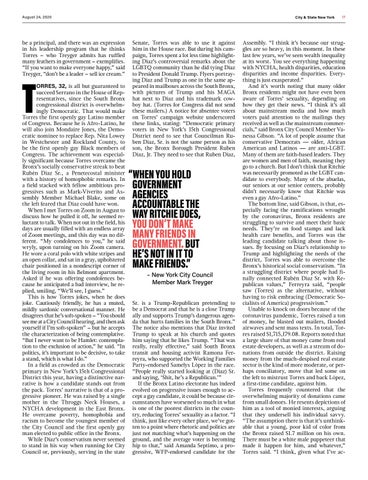
“WHEN YOU HOLD GOVERNMENT AGENCIES ACCOUNTABLE THE WAY RITCHIE DOES, YOU DON’T MAKE MANY FRIENDS IN GOVERNMENT. BUT HE’S NOT IN IT TO MAKE FRIENDS.”
– New York City Council Member Mark Treyger
Sr. is a Trump-Republican pretending to be a Democrat and that he is a close Trump ally and supports Trump’s dangerous agenda that hurts families in the South Bronx.” The notice also mentions that Díaz invited Trump to speak at his church and quotes him saying that he likes Trump. “That was really, really effective,” said South Bronx transit and housing activist Ramona Ferreyra, who supported the Working Families Party-endorsed Samelys López in the race. “People really started looking at (Díaz) Sr. and saying, ‘Shit, he’s a Republican.’” If the Bronx Latino electorate has indeed evolved on progressive issues enough to accept a gay candidate, it could be because circumstances have worsened so much in what is one of the poorest districts in the country, reducing Torres’ sexuality as a factor. “I think, just like every other place, we’ve gotten to a point where rhetoric and politics are just not matching what’s happening on the ground, and the average voter is becoming hip to that,” said Amanda Septimo, a progressive, WFP-endorsed candidate for the
17
Assembly. “I think it’s because our struggles are so heavy, in this moment. In these last few years, we’ve seen wealth inequality at its worst. You see everything happening with NYCHA, health disparities, education disparities and income disparities. Everything is just exasperated.” And it’s worth noting that many older Bronx residents might not have even been aware of Torres’ sexuality, depending on how they get their news. “I think it’s all about mainstream media and how much voters paid attention to the mailings they received as well as the mainstream commercials,” said Bronx City Council Member Vanessa Gibson. “A lot of people assume that conservative Democrats — older, African American and Latinos — are anti-LGBT. Many of them are faith-based leaders. They are women and men of faith, meaning they go to a church. But I don’t think that Ritchie was necessarily promoted as the LGBT candidate to everybody. Many of the abuelas, our seniors at our senior centers, probably didn’t necessarily know that Ritchie was even a gay Afro-Latino.” The bottom line, said Gibson, is that, especially facing the ramifications wrought by the coronavirus, Bronx residents are struggling to survive and meet their basic needs. They’re on food stamps and lack health care benefits, and Torres was the leading candidate talking about those issues. By focusing on Díaz’s relationship to Trump and highlighting the needs of the district, Torres was able to overcome the Bronx’s historical social conservatism. “In a struggling district where people had finally connected Rubén Díaz Sr. with Republican values,” Ferreyra said, “people saw (Torres) as the alternative, without having to risk embracing (Democratic Socialists of America) progressivism.” Unable to knock on doors because of the coronavirus pandemic, Torres raised a ton of money, he blasted out mailers, flooded airwaves and sent mass texts. In total, Torres raised $1,715,179.08. Reports noted that a large share of that money came from real estate developers, as well as a stream of donations from outside the district. Raising money from the much-despised real estate sector is the kind of more moderate, or perhaps conciliatory, move that led some on the left to mistrust Torres and back López, a first-time candidate, against him. Torres frequently countered that the overwhelming majority of donations came from small donors. He resents depictions of him as a tool of monied interests, arguing that they undersell his individual savvy. “The assumption there is that it’s unthinkable that a young, poor kid of color from the Bronx raised $1.7 million on his own. There must be a white male puppeteer that made it happen for him, and whatever,” Torres said. “I think, given what I’ve ac-
18
CityAndStateNY.com
complished in public office, and given my talents as an elected official, it’s entirely reasonable to think that I would be effective at fundraising, and effective at running a campaign, because I’m a competent person who knows how to build a competent team and run a competent operation.” A cohort of Torres’ supporters, including The New York Times editorial board, considered him the logical antidote to a populist demagogue. And where some left-wing Democrats saw Torres’ friendly relationship with elements such as the real estate community as a flaw, to many mainstream Democrats it was a feature. To them, his candidacy is a course correction – an opportunity to balance the scales of a rapidly shifting New York congressional delegation. “He has a very centrist point of view – he was not (Rep. Alexandria Ocasio-Cortez),” explained George Arzt, a political consultant who once served as then-New York City Mayor Ed Koch’s press secretary. Arzt doesn’t use “centrist” as a slur. He means that Torres is pragmatic. “People were becoming fearful of where the city, and state, and Congress was going in the wake of AOC’s victory, and they felt that he was a person who would have his feet on the ground and get more accomplished than the others in the race.” Arzt and Torres have been friends for as long as Torres has been in the City Council. “Ritchie is unbelievably articulate, charismatic and a very welcoming human being,” said Arzt. “I think all of this comes out on the campaign trail, where people like to touch the candidate – even in these COVID times.” For his part, Torres rejects overly complex narratives about how he won. “Voters are intuitively more intelligent than most people in politics. You cannot fool them,” he said. “You have no choice but to be who you are and to run on the strength of your personal story and your personal narrative, which is exactly what I did. I forged a human connection with the electorate in the South Bronx. The median voter is a Latino or African American woman at or above the age of 55. Those voters came to see me as their son and their grandson, who represents the next generation of leadership.”
I
T IS IMPOSSIBLE not to notice the way that Torres speaks, which is formal and deliberate, and also self-conscious. Torres resents being called articulate, because of its racist connotations. However, his manner of speaking is frequently characterized as such by his white, Black and Latino friends and colleagues alike. The way that he talks is always mentioned in passing when he is described by those close to him, as well as anyone who’s watched him stump. It’s worth noting that unlike many other famously well-spoken politicians such as former President Barack
August 24, 2020
Obama or U.S. Sen. Cory Booker, Torres is not a graduate of Harvard Law. In fact, Torres didn’t graduate from college at all. He briefly attended New York University before withdrawing due to his lifelong struggle with depression. (Before running for the City Council, Torres worked in the office of Council Member Jimmy Vacca as housing director.) Torres contributes op-eds to leading publications, including a recent piece for The Washington Post about why he wants to break with precedent and join both the Congressional Hispanic Caucus and Congressional Black Caucus, and his prose style is equally as sophisticated as his speech. “I think part of it is raw talent,” Torres said. “I feel like I have something of a gift for both written and verbal communication.” Like many millennials, Torres has an astute and studied grasp of the ways in which he experiences his identity in the world and borrows from the language of critical race theory to explain how being both Black and Latino has defined him throughout his life. In his Washington Post article, Torres describes race as “chosen and given.” He believes that, though he’s chosen to identify as a Black man and as a Latino, identity is equally the world’s perception of you. When Torres first entered the City Council, there was a meeting among the Black members of the Black, Latino, and Asian Caucus, about the lack of representation of Black people in the leadership of the City Council. While initially invited
to participate in the call, minutes before the meeting, Torres received a call from one of his colleagues saying, “There are people who object to your participation in the call.” When Torres asked why, his colleague responded, “Well, because you’re Latino.” Torres pointed out that he’s both Latino and Black because, like many Puerto Ricans, he has mixed racial ancestry. That wasn’t good enough for his colleague. “You have to choose,” his colleague said. There have been times in his life where Torres has felt racially homeless, as he puts it, and this was one of them. However, he has also had to contend with the phenomenon of colorism within the Latino community. Raised by his mother’s side of the family, which is largely light-skinned, Torres felt like an outlier. “There were moments when I was made to feel less authentically Latino and Puerto Rican than the rest of my family,” recalled Torres. This, despite the many famous Afro-Puertorriquenos, he notes, like Arturo Alfonso Schomburg, a leading intellectual figure during the Harlem Renaissance. Growing up in the Bronx, the schools Torres attended were mostly Latino and African American. (The Bronx is 56% Hispanic or Latino and 44% Black, according to census data. The 15th Congressional District is 65% Hispanic and 28% Black.) In middle school he was assigned to a gifted program, a separate track of coursework for qualifying students. The students in those classes were mostly white. “I remember experiencing
August 24, 2020
what we would now call microaggressions. Comments like, ‘You’re smarter than I would expect,’ or, ‘You’re so articulate. You’re so well-spoken for a Black person,’ or, ‘What is it like to have nappy hair?’” Those microaggressions continued through high school and in college as well. “People were shocked that I had a functioning cerebral cortex, or that I could piece together a sentence,” Torres recalled. “I would respond sarcastically whenever anyone said that I spoke white. I would simply point out, ‘I speak better than most white people.’” Torres attended Herbert H. Lehman High School, which at the time was a school of about 5,000 students in a building designed for no more than 2,000. “It was one of the largest high schools in New York City, and I was the intellectual equivalent of the captain of the football team,” Torres said. “I was the captain of the law team, something of a celebrity within the boundaries of the school.” Torres participated in moot court, in which students argue a case before a panel of judges in the face of rigorous questioning. He credits it for his ability to think critically, and on his feet. “The purpose of a trial court, mock trial, is fact finding,” he explained. “But moot court is about legal interpretation, which is much more abstract, much heavier in critical thinking, so I felt that was helpful.” Though he wasn’t ideological, and he was never a member of the student government, Torres’ peers thought the internship he accepted at the deputy mayor’s office was a good fit. He said he was viewed by his classmates as a person destined for political leadership, but that he had no thoughts about running for City Council or Congress. But, Torres explained, “I had an inchoate sense of myself as a political animal.” One day, while Torres was browsing the internet, he stumbled across the MySpace profile of a teacher who identified as gay. It was the first time in his life that he had encountered an openly LGBTQ person. Torres had never considered the possibility of coming out before. He overheard insidious expressions of homophobia in his community growing up – casual use of the anti-gay slur that starts with F, for example – and saw no LGBTQ visible presence. People hardly suspected his own homosexuality – “I might qualify as a straight-acting gay,” he said – but Torres never spoke about girls. Torres spontaneously came out to this teacher, who became a mentor to him, taking him to his first Pride parade in 2005 and to the LGBT Center in Manhattan. The sense of acceptance was new to him, but coming out is a process for many queer people. When he was a junior in high school, Torres came out publicly, in a debate about the definition of marriage. It was a seesaw of returning to the closet and coming out for many years, until he ran for the City Council in 2013. “That was
City & State New York
the definitive moment of coming out for me,” he remembered. “I came to conclude that if you are deceitful about your personal life, then you’re likely to be deceitful about your professional life.” Torres said that he never considered how he would approach his sexuality on the campaign trail. There was no special strategy, nor any intentional obfuscation. He believes that the distinction often drawn between the personal and the professional is a false compartmentalization. “Your character, your integrity, your authenticity, cuts across those artificial categories,” Torres said. “I felt I owed it to myself, and I owed it to the people that I was going to represent to be honest and open about who I am.”
“THE ASSUMPTION THERE IS THAT IT’S UNTHINKABLE THAT A YOUNG, POOR KID OF COLOR FROM THE BRONX RAISED $1.7 MILLION ON HIS OWN.”
– Ritchie Torres
R
“
ITCHIE’S REALLY a cool guy,” said Gibson, who is friends with Torres. “For those that have the chance to hang out with him, going out to dinner and being in social settings, they see that Ritchie’s very laid back. He’s not loud. He’s very quiet. You wouldn’t think that he talks a lot.” Gibson confesses that because of his age and stature – he is slender and stands 5 feet 10 inches tall – she tends to regard Torres as a little brother. Last summer, at community parties in the Bronx, they danced with residents. “We’re all people of color, so I assumed that Ritchie could dance,” she recalls, laughing. “So I was like, ‘Come on, Ritchie, come on let’s dance to bachata, hip hop.” At first Torres was a little bit awkward, she recalled affectionately, before he eventually got the hang of it. “I said, ‘Ritchie, come on, now, you’re a Black man, you have to have rhythm!’” Because she chaired the public safety committee, Gibson was involved in what Torres characterizes as his most challenging legislative battle to date. Her committee heard the original Right to Know Act – the law that set new measures for police interactions with civilians – which was two bills, one authored by Torres and one by Council Member Antonio Reynoso.
19
Not unlike today, it was a tumultuous time in New York City. Eric Garner had been killed by NYPD officers on Staten Island, and his family and many enraged New Yorkers were asking for accountability and transparency in the police department. “The Mothers in the Movement and many other advocates, (Communities United for Police Reform) and the Justice League, and civil rights organizations were demanding that we try to put legislation into law that would really change the behavior of cops,” Gibson said. The advocates wanted all traffic stops included in the bill, and the de Blasio administration was adamantly against that, wanting increased rules for police identification to only apply in limited circumstances. “We got to an impasse, where Ritchie, as the prime sponsor, had to make a decision,” Gibson said. “Do I conform to what the administration wants, which is a watered-down version of the bill, and pass that, or do I hold off and stand with the advocates and the Mothers in the Movement, knowing the opposition?” Without consulting the advocates, Torres moved forward with the revised bill. “I made a decision to broker a compromise, not with the police unions, which is a lie that’s often told, but with the administration, the mayor and the speaker’s office,” Torres said. “I felt, if the speaker is against you, and the mayor is against you, and the NYPD is against you, then there’s a limit to what you can accomplish, right? There’s only so much you can accomplish in the face of overwhelming obstructionism and opposition from the three most powerful forces in city government.” Torres said he still thinks about this often. He believes, with the momentum of the current political moment, they could have gone farther. Gibson agrees. “Was it the right decision to broker the compromise over the objections of the advocates?” Torres asked himself aloud. “Was it the right decision to even take, agree to the bill?” Torres argued that he is most effective when he’s free to operate independently, but with progressive values, rather than as a movement progressive like the rising tide of elected officials who belong to the Democratic Socialists of America. “There are some elected officials who can operate effectively as an agent of a coalition, and enact the will of the coalition,” Torres said. “I am admittedly not one of those. I operate best when I’m operating independently. So am I an effective legislator? Yes. Am I the ideal movement progressive? Admittedly, no.” For the Bronx, Torres didn’t need to be a movement progressive. In the end, being who he is was enough to make history.
■
A. G. Sims is a writer and editor living in Brooklyn.
20 CityAndStateNY.com
BETTY ROSA
Interim Commissioner State Edu c ation Department As chancellor of the state Board of Regents, Betty Rosa was in the thick of the backand-forth over the education funding formula during budget
negotiations, legislation to ease school discipline policies and the possibility of banning vape use by teens. Now, as New York grapples with how to start the fall semester during the coronavirus pandemic, the former principal and administrator has taken on a new role as interim state education commissioner.
initiatives well before then. In 2014, Gonzalez rolled out the Conviction Review Unit that has so far exonerated 28 incarcerated men and women while also easing up on marijuana convictions. Gonzalez now worries bail reform could make Brooklyn more susceptible to crime.
ERIC GONZALEZ
9 ADRIANO ESPAILLAT
Congress Member Adriano Espaillat was among the first members of Congress to call for drafting articles of impeachment against President Donald Trump, reflecting the majority of constituents in his Manhattan and Bronx district. The first Dominican American member of Congress, Espaillat has spread his wings more forcefully with the creation of the Northwest Bronx Democrats for Change, which looks to give Dominicans an even more dominant presence in the Bronx.
10 RAUL PEREA-HENZE
State Sen. Jessica Ramos is an aggressive advocate for progressives.
11 HENRY GARRIDO
Executive Director Distric t Cou nc il 37
8 Brooklyn District Attorney Eric Gonzalez rose through the ranks of the Brooklyn district attorney’s office to become the first Latino district attorney elected in the state in 2017, but he began implementing
the challenge, marshaling his experience at the federal level to get much-needed resources in the fight against the virus.
New York City Deputy Mayor for Health and Human Services Dr. Raul Perea-Henze had been deputy mayor for health and human services for less than six months when COVID-19 stormed New York City. But the Obama administration veteran, who’s credited with coordinating early efforts in the fight against the HIV/ AIDS epidemic, has risen to
Henry Garrido’s tenure as executive director of the city’s largest municipal employees union has been marked by pay raises for its employees and a merger with DC 1707. Politicians constantly seek out Garrido’s endorsement, which recently went to Rep. Carolyn Maloney in her reelection bid for Congress, Assembly Member Michael Blake in his run for the 15th Congressional District seat, and Sandy Nurse in her run for New York City Council.
12 RITCHIE TORRES
New York City Council Member Supporters of New York City Council Member Ritchie Torres have always stressed the 32-year-old legislator is destined for great things, and those predictions came true after Torres secured the Democratic nomination for the 15th Congressional District seat in a race that pitted him against fellow progressives and the socially conservative Democrat and Council Member Rubén Díaz Sr. With his nomination virtually assuring him a victory in November, the presumptive winner is headed for the national stage.
13 JESSICA RAMOS
State Senator State Sen. Jessica Ramos may have been in the chamber
STATE EDUCATION DEPARTMENT; SEAN PRESSLEY; LEV RADIN/SHUTTERSTOCK
7
August 24, 2020
AS WE CONGRATULATE MR. PAREDES FOR HIS ACHIEVEMENT, WE KNOW THERE IS A LONG ROAD AHEAD. WE ENCOURAGE YOU TO LOOK AT OUR STATE OF LATINO HEALTH REPORT AT
SOMOSNYHEALTH.ORG
T H E
“I share this honor with all essential workers on the frontline of this pandemic with gratitude for their continued dedication to increasing access to healthcare for the underserved of New York. This recognition comes at a pivotal moment in which Latino leaders are working tirelessly to safeguard the health and economic futures of our neighborhoods across New York and beyond.” — Mario J. Paredes, C.E.O.
833.SOMOSNY | SOMOSNYHEALTH.ORG
S TAT E
O F
L AT I N O
H E A LT H
I N
N E W
Y O R K
C I T Y
22 CityAndStateNY.com
14 VINCENT ALVAREZ
President New York City Central Labor Cou nc il The spine of the city’s labor force – comprised of teachers, truckers, electricians, firefighters – has a fighter in Vincent Alvarez, who’s rolled up his sleeves as executive director of the New York City Central Labor Council. In times of crisis – be it last year’s possible strike by MTA employees or this year’s
coronavirus impacting millions – Alvarez has been on hand to lend his voice to 1.3 million members in the umbrella group.
Sepú lveda’s Green Light Bill c leared a path for u ndoc u mented immigrants to obtain driver’s lic enses. believing Rikers can be saved through renovations and the “No New Jails” activists. Next on her list: realizing Mayor Bill de Blasio’s expanded plan for more affordable housing.
15 MARISA LAGO
Chair New York City Planning Commission As chair of the City Planning Commission, Marisa Lago has a front row seat to the changing New York City skyline and the uptick in resentment that goes with it. Among the notable decisions she’s had to preside over was the approval of the closing of Rikers Island in favor of smaller jails. It was with plenty of resistance from both sides of the argument—those
Carlina Rivera is already a front-runner for council speaker.
only since 2017, but she’s already a front-runner to replace Corey Johnson as the next council speaker. Introducing a bill that required Airbnb to disclose host data in New York City and cochairing the Women’s Caucus have raised her profile. Should 2021 prove prosperous for the hospitals committee chair, it could propel her to the speaker post.
18 16 LUIS SEPÚLVEDA
State Senator State Sen. Luis Sepúlveda secured one of his biggest victories last year with the passage of the Green Light Bill, clearing a path for undocumented immigrants to obtain state-issued driver’s licenses. The measure was opposed by the U.S. Department of Homeland Security, which suspended the Trusted Traveler Program at New York airports once the law went into effect. The Bronx lawmaker in the past mulled a run for district attorney.
17 CARLINA RIVERA
New York City Council Member New York City Council Member Carlina Rivera may have been in the chamber
ANTONIO REYNOSO
New York City Council Member Antonio Reynoso has led successful reforms to New York City’s commercial waste industry as chair of the Sanitation Committee, introducing legislation that established greater city control over an unregulated and often unsafe industry. The Brooklyn lawmaker has been ramping up for a run for borough president – he’s got plans for his home borough and will likely give other candidates a run for their money.
19 ANTONIO DELGADO
Congress Member Harvard Law School-educated freshman Congressman Antonio Delgado managed to flip the 19th Congressional District seat from red to blue in 2018, helping Democrats regain the majority in the House of Representatives.
NYC DEPARTMENT OF CITY PLANNING; NEW YORK CITY COUNCIL; STATE SENATE; A KATZ, LEV RADIN/SHUTTERSTOCK
for just two years, but she’s already proven an aggressive advocate for state Senate Democrats’ most urgent progressive causes, including legalizing sex work and holding the line on bail reform. And she isn’t afraid to stand up to her old boss, Mayor Bill de Blasio, publicly disagreeing over a bill to increase the number of vendor permits following the controversial arrest of the “Churro Lady.” Ramos is up for reelection, and her increasing clout can serve as a guarantee for another term.
August 24, 2020
August 24, 2020
City & State New York
For years, Ru ben Diaz Jr. was seen as the best shot to bec ome the first Latino mayor of New York City. Delgado hopes to repeat his victory in November by focusing on quality-oflife issues like the removal of PFAS contaminants in drinking water and greater broadband access to Otsego and Delaware Counties, which he represents.
Julia Salazar has had little trouble getting items on her legislative wish list addressed and even enacted, including an aggressive revamp on state rent laws. The Democratic Socialist representing Brooklyn may have notched a few victories, but she’ll be the first to tell you the work isn’t over on hot-button issues like tenant protection measures.
22 CARLOS MENCHACA
20 GUSTAVO RIVERA
State Senator You won’t find a stronger advocate for single-payer health care than state Sen. Gustavo Rivera – and he’s got the pulpit to amplify the fight. As chair of the state Senate health committee and main sponsor of the New York Health Act introduced in 2017, the staunch Democrat has prioritized overhauling the system. With COVID-19 wreaking havoc across the nation, Rivera has found his strongest argument yet for such an overhaul.
21 JULIA SALAZAR
State Senator She may be a freshman legislator, but state Sen.
New York City Council Member Carlos Menchaca, the first Mexican-American elected to the New York City Council, has focused on immigration
during his six years in office, authoring the IDNYC program and introducing bills limiting immigration agents from infiltrating the courts as well as a resolution mandating that they identify themselves. Yet lately the biggest headlines have come from his controversial decision to side with local activists in blocking the Industry City rezoning.
23 LORRAINE CORTÉS-VÁZQUEZ
Commissioner New York City Department for the Aging With more older denizens calling New York City home, it’s clear Lorraine Cortés-Vázquez’s role as commissioner for the New York City Department for the Aging – which seeks to make the five boroughs more age friendly – will be even more relevant in the years ahead. Another sign of her growing importance: Mayor Bill de Blasio appointed her to the MTA board this year, pending Gov. Andrew Cuomo’s approval.
Nicole Malliotakis is one of NYC’s few elected Republicans.
23
24 NICOLE MALLIOTAKIS
Assembly Member The New York Times called Assembly Member Nicole Malliotakis a lawmaker with “guts” during her 2017 Republican New York City mayoral run, a campaign in which she highlighted her Cuban heritage. The only GOP woman representing a portion of the five boroughs – sections of Staten Island and Brooklyn – is now challenging Rep. Max Rose, and has proven to be relentless, attacking her rival like a prizefighter.
25 RUBEN DIAZ JR.
Bronx Borough President For years, Ruben Diaz Jr. was seen as the best shot to become the first Latino mayor of New York City, thanks to his political talents, his experience in elected office and such influential allies as Gov. Andrew Cuomo and Assembly Speaker Carl Heastie. But earlier this year, the Bronx borough president surprised New York’s political world with his decision to drop out of the 2021 race.
26 JAVIER H. VALDÉS
Co-executive Director Make the Road New York Whether it’s blasting U.S. Immigration and Customs Enforcement for its aggressive
24 CityAndStateNY.com
August 24, 2020
29 SONIA OSSORIO
President National O rganiz ation for Women New York City
Ydanis Rodriguez chairs the City Council transportation committee.
arrests of undocumented immigrants or calling out Gov. Andrew Cuomo for not acknowledging the 13-year nonprofit advocacy group, Javier Valdés will make sure you know his opinion. At Make the Road New York, Valdés works to ensure undocumented immigrants have a path carved out for them as they seek out the American dream.
conference since 2018, corralling lawmakers for policy brainstorming and schmoozing. Davila also hasn’t forgotten about her gentrifying district, calling out shady landlords in Brooklyn and addressing the issue of domestic violence.
Since 2005, Sonia Ossorio has been at the helm of NOW New York, amplifying the concerns of women across the state while boosting the fortunes of female politicians who went on to win public office. With a membership base of 20,000 behind her, Ossorio has led campaigns that blasted the NYPD for inadequately revamping the Special Victims Unit, and that took aim at the MTA for a controversial ad campaign that appeared to promote a sex work pop-up exhibit.
30 HAVIDÁN RODRÍGUEZ
President University at Albany
28 27 MARITZA DAVILA
Assembly Member Prioritizing issues that impact New York’s Latino community as a way of hammering out policy positions has been crucial for the Brooklyn Assembly member Maritza Davila, who has doubled as the chair of the everpopular Somos El Futuro
FERNANDO CABRERA
New York City Council Member New York City Council Member Fernando Cabrera is among the longest-serving council members in the Bronx and is part of a group of socially conservative Democrats in council chambers. During his decade in the council, Cabrera has risen to the post of majority whip, seeing more than 30 of his bills passed. The ordained pastor is jumping into what
With a record of expanding higher learning institutions, Havidán Rodríguez’s tenure as president of the University at Albany has included some lofty plans, including a new $180 million academic center that will be the home of the College of Emergency Preparedness, Homeland Security and Cybersecurity, and the Department of Atmospheric
and Environmental Sciences. Rodríguez was previously the founding provost and executive vice president for academic affairs at the University of Texas Rio Grande Valley.
31 ANA OLIVEIRA
President and CEO New York Women’s Fou ndation Advancing women and taking on their challenges has been Ana Oliveira’s life’s work. As president of the New York Women’s Foundation, the native of Brazil leads a group that has seen its membership jump elevenfold since she began leading it in 2006. Her insight into helping the disadvantaged has earned her a spot on the New York City Commission on Human Rights as a commissioner, and seats on the Independent Commission to Study Criminal Justice Reform in New York City and the board of Philanthropy New York.
32 YDANIS RODRIGUEZ
New York City Council Member New York City Council Member Ydanis Rodriguez might have been a long shot in his unsuccessful bid to win the 15th Congressional District Democratic primary, but he’s been making strides in the City Council, building his resume
Cabrera is ju mping into what shou ld be a hotly c ontested borou gh president rac e in the Bronx.
JUAN VEGA CRUZ; ASSEMBLY; EMIL COHEN/NEW YORK CITY COUNCIL
should be a hotly contested borough president race in the Bronx.
Congratulations
Tonio Burgos CEO On being named to the
Power of Diversity: Lati tin no 100
And congratulations from the TBA Team to all of this year’s honorees!
Government Relati tio ons and Public Aff ffa airs New York | Albany | Trenton | Washington www.tonioburgos.com
26 CityAndStateNY.com
The Bronx of 19 9 0 is c ertainly not the same as the Bronx of 2 02 0 thanks to Serrano’s fight to repair dormant sec tions of the borou gh.
35 33 DIANA AYALA
New York City Council Member Diana Ayala made the toughest choice of her career, compounded by blowback she received from some Bronx City Council colleagues, when she voted to close Rikers Island. But the former chief of staff to her predecessor, Melissa Mark-Viverito, carried out a promise from her former boss in seeing it through. The Bronx and Manhattan lawmaker has been a prolific legislator, drafting 18 bills, with seven of them passing.
34 FRANCISCO MOYA
New York City Council Member New York City Council Member Francisco Moya has taken a bite out of food delivery service app goliaths that have gouged New York City’s restaurant industry through a bill introduced earlier this year. The ambitious Queens lawmaker with a propensity for helping the downtrodden now has his sights set on helping airline workers who are facing layoffs as a result of the coronavirus outbreak.
“the Walter Cronkite of Latin America.”
JORGE RAMOS
36
Whether he’s documenting a ravaged Puerto Rico following natural disasters, confronting President Donald Trump, or being detained for asking Venezuelan dictator Nicolás Maduro tough questions on conditions in the country, there’s nothing that keeps Jorge Ramos from reporting what’s happening to millions of Latinos. The eight-time Emmy-winning anchor has been a journalist for 40 years, and has been called
ANTHONY ROMERO
Anchor “Notic iero Univision”
spying program, the Obama administration’s drone strike program and the Trump administration’s insistence on keeping prisoners detained during the pandemic.
37
Executive Director Americ an Civil Liberties Union One of the most consistent thorns in President Trump’s side has been Anthony Romero, executive director of the American Civil Liberties Union. At the helm of the national nonprofit for nearly 20 years, Romero has waged legal battles against the Bush administration’s
Francisco Moya is known for helping the downtrodden.
JOSÉ E. SERRANO
Congress Member Rep. José Serrano’s career, which has spanned five presidencies, 9/11, the Great Recession, and a changing political atmosphere, ends this year in the same district he’s represented for nearly a generation. The South Bronx legislator – the most senior Hispanic elected official and longest-serving Puerto Rican congressman – caps more than 45 years as an elected official, beginning with a 15year run in the Assembly. The Bronx of 1990 is certainly not the same as the Bronx of 2020 thanks to Serrano’s fight to secure federal dollars to clean up the Bronx River, create more affordable housing and repair dormant sections of the Bronx.
38 LUIS MIRANDA & ROBERTO RAMÍREZ Founders MirRam Grou p
The political consulting duo remains a fixture in New York City politics, with Roberto Ramírez once serving as Bronx Democratic Party boss and Luis Miranda serving on the campaigns of Charles Schumer, Kirsten Gillibrand, and Hillary Clinton in their
JOHN MCCARTEN, JEFF REED/NEW YORK CITY COUNCIL; LEV RADIN/SHUTTERSTOCK
as chair of the transportation committee. He has backed a proposal to bail out cashstrapped cabbies, a bill to strip reckless drivers of their vehicles and moved to authorize greater oversight of the multibilliondollar LaGuardia Airport AirTrain expansion project.
August 24, 2020
Your future can’t wait Our tech-infused, virtual, and in-person degrees offer a safe and affordable alternative for students who don’t want to delay their college careers.
90+ PROGRAMS
BACHELOR’S MASTER’S DOCTORATE
Financial Aid, Scholarships, and Rolling Admissions for undergraduate, graduate, and transfer students.
LEARN MORE AT:
NYIT.EDU/STATE
Power of Diversity
Latino 100
Paloma Izquierdo-Hernandez The Associates, Patients and Board of Directors of Urban Health Plan congratulate our President and CEO Paloma Izquierdo-Hernandez, MPH, MS on being selected one of City and State’s Latino Power 100. As a leader, advocate, role model and visionary, thank you for your ongoing commitment to the Latinx community and for transforming the lives of underserved populations.
Urban Health Plan (UHP) is a system of federally qualified community health centers, throughout the Bronx, Corona, Queens, and Central Harlem delivering high-quality, holistic and affordable healthcare, while offering community programs to address the social determinants of health.
August 24, 2020
City & State New York
29
Life after pu blic offic e has worked ou t well for two-time mayoral c andidate Freddy Ferrer.
41 MONICA MARTINEZ
Monica Martinez often sides with Republicans.
respective runs for U.S. Senate. On top of creating another consulting firm, the Hamilton Campaign Network, the pair has also created the Manhattan Times and Bronx Free Press.
39 FRANKIE MIRANDA
STATE SENATE; EPA
President and CEO Hispanic Federation Frankie Miranda rose to president and CEO of the Hispanic Federation after proving his mettle in various capacities within the organization, including senior vice president and executive vice president. He helped expand the Hispanic Federation’s footprint by opening field offices in Florida
State Senator She may be pegged as a progressive Democrat, but state Sen. Monica Martinez has become quite the swing voter, thanks to her affiliation with the “Long Island Six,” a moderate group inspired by the bygone Independent Democratic Conference. The Brentwood, Long Island, native has sided with Republicans on bills ranging from allowing undocumented immigrants to obtain state-issued driver’s licenses to rent reform. Facing reelection this year, Martinez has introduced a bill that amends bail reform.
and Puerto Rico, throwing the weight of the 30-yearold nonprofit behind recent recovery efforts there.
40 ROSSANA ROSADO
New York Secretary of State Confirmed as Secretary to the New York State Department of State in 2016, Rosanna Rosado has overseen major initiatives, including the legalization of professional mixed martial arts and greater services to the immigrant population. Born and raised in the Bronx, Rosado also served as publisher and editor of the influential El Diario La Prensa publication, and is a winner of Peabody and Emmy awards.
the U.S. Virgin Islands and several tribal regions. That includes mandating a massive cleanup job of the Hudson River by General Electric, and announcing an action plan to address the handling of PFAS contaminants found in drinking water.
43 TONIO BURGOS
Founder and CEO Tonio Bu rgos & Assoc iates Tonio Burgos has navigated the lobbying world thanks in no small part to his knowledge of Albany politics that began when he was a top aide to Gov. Mario Cuomo. His relationship with the Cuomos has continued; he donated $85,000 to Gov. Andrew Cuomo’s campaign. Cuomo later appointed Burgos to the Hurricane Maria Memorial Commission, which unveiled a memorial for victims of the catastrophic natural disaster.
42
44
PETER LOPEZ
FERNANDO FERRER
Peter Lopez is juggling a number of environmental hazards of critical importance as regional administrator to the U.S. Environmental Protection Agency’s Region 2, which covers New York, New Jersey, Puerto Rico,
Life after public office has worked out well for Fernando “Freddy” Ferrer, co-chair of Mercury, the global public strategy firm with past clients that include WeWork, Charter Communications, and American Transit Company. In addition to his position at
Regional Administrator Environmental Protec tion Agenc y Region 2
Co-chair Merc u ry
30 CityAndStateNY.com
August 24, 2020
48 VICTOR PICHARDO
Catalina Cruz advocates for undocumented immigrants.
Mercury, the former Bronx Borough President and twotime mayoral candidate serves on the MTA board, even once filling in as acting chair, and is recognized as a leader in revamping cities.
45 CATALINA CRUZ
Assembly Member When Assembly Member Catalina Cruz makes her way to a microphone, people listen – and the results can be viral. The first Dreamer elected to the Legislature, Cruz advocates for undocumented immigrants on issues like the Green Light Law, which allows undocumented immigrants to obtain driver’s licenses. Cruz now has her sights on fulfilling a promise by Queens borough president candidate Donovan Richards to create an immigrant welcome center in her home borough.
46 NICK SIFUENTES
Executive Director Tri-State Transportation Campaign The vision of an equitable and fairer transportation network drives Nick Sifuentes,
executive director of Tri-State Transportation Campaign. Since taking the helm, Sifuentes has highlighted the need to roll out the Fair Fares initiative, advocated for e-bike laws, and called for the MTA board to have its vacant spot occupied by a member with a physical disability. Sifuentes is continuing the work he began at Riders Alliance, where he served as deputy director.
47 KARINES REYES
Assembly Member Karines Reyes spends half the year in the Assembly chambers and the other half at Montefiore Einstein Hospital in the Bronx as a registered nurse. It’s the perfect mix for Reyes, who has advocated for better nurse-to-patient ratios and single-payer health care, both in the Assembly and as a member of the New York State Nurses Association. There’s now talk that Reyes could replace Assembly Member
Assembly Member This could be the year for the four-term Assembly member: a growing Dominican population in the Bronx could help him become the borough’s first Dominican Democratic Party boss. But even if he doesn’t secure the spot, Victor Pichardo will still be a busy man, reigniting the debate on legalizing recreational marijuana while defending bail reform, two pieces of legislation that have a direct impact in the 86th Assembly District.
49 CESAR PERALES
Vice Chair SUNY Board of Tru stees With a career that spans four decades, including a stint as assistant secretary for health, education and welfare under President Jimmy Carter, Cesar Perales brings a wealth of experience from all levels of government to his role as a trustee to the SUNY board, where he has helped shepherd a task force aimed at creating a more inclusive campus experience across the network’s 64 higher learning institutions and campuses. Perales’ resume also includes stints as New York state commissioner of social services under Gov. Mario
Cuomo and a member of the board of directors of Empire State Development, New York state’s economic development agency.
50 ISRAEL ROCHA JR.
CEO NYC Health + Hospitals/ Elmhu rst As CEO of NYC Health + Hospitals/Elmhurst, the public hospital at the epicenter of the coronavirus pandemic, Israel Rocha Jr. has increased patient revenue by $50 million per year, secured funds to build a new emergency room, a neurosciences center, and an ambulatory surgical center, and has renovated various departments at the hospital. He previously worked for the U.S. House of Representatives in Texas’ 15th Congressional District.
51 FAUSTO PICHARDO Chief of Patrol NYPD
The highest-ranking Hispanic member of the NYPD, Fausto Pichardo became the first Dominican-born chief of patrol this year. Pichardo sustains the morale of the city’s 23,000 patrol officers while serving as a go-between for the NYPD and minority neighborhoods that have long felt slighted by the department – a fraught role during the recent civil unrest in the city.
Reyes spends half the year in the Assembly and the other half as a registered nu rse.
JASON FALCHOOK; ASSEMBLY; ALMA MEDIA; EMILY HLAVAC GREEN PHOTOGRAPHY
Marcos Crespo as Bronx Democratic Party boss.
August 24, 2020
City & State New York
52
57
ARLENE GONZÁLEZSÁNCHEZ
MIGUEL FUENTES
President and CEO BronxCare Health System
Commissioner State O ffic e of Addic tion Servic es and Su pports Arlene González-Sánchez may not be one of the most high-profile commissioners in the Cuomo administration, but she is among the most experienced and wellqualified. That has helped González-Sánchez stay on since Gov. Andrew Cuomo appointed her at the start of his first term. Her work is increasingly critical in the midst of the coronavirus pandemic and the economic recession. She is also part of ongoing efforts to curb opioid abuse.
53 EDWIN QUEZADA
Superintendent Yonkers Pu blic Sc hools The state’s fourth-largest school district has experienced a renaissance under Edwin Quezada, superintendent of Yonkers Public Schools. Overseeing 3,500 staff members in a system with a student body of 27,000, Quezada has improved graduation rates, lowered the dropout rate and boosted state test scores. His latest challenge is how to navigate the coronavirus pandemic, and he’s moving his district forward with a hybrid plan the combines remote and in-person learning for most students.
54 MELISSA MARK-VIVERITO
Former New York City Council Speaker Even without any legislative power, former New York City
31
Council Speaker Melissa Mark-Viverito continues to fight for just causes, including those central to the betterment of her native Puerto Rico. In New York City, Mark-Viverito is credited for turning her vision for the closure of Rikers Island into a reality. However, after failed bids for New York City public advocate and for Congress, it’s unclear what’s next for MMV.
55 CAMILLE RIVERA
Partner New Deal Strategies Camille Rivera brings a wealth of knowledge on New York City government and politics to New Deal Strategies, a political consulting firm specializing in strategy, speechwriting and even joke-writing. Working for candidates solely on their progressive merits, Rivera, who was previously with the
BronxCare Health System, the rebranded Bronx-Lebanon Hospital, is being led by a familiar face in Miguel Fuentes. Fuentes has devoted 40 years to the notArlene Gonzáfor-profit hospital in lez-Sánchez various capacities. leads efforts With the Bronx still against opioids. ranked as the state’s unhealthiest county, don’t be surprised New York City Department of to see Fuentes harness the Homeless Services, is fearless power of the community in her desire to see more hospital to reverse that as women and people of color quickly as possible. run for public office – and win.
56
58
ALICIA GUEVARA
RAFAEL ESPINAL
CEO Big Brothers Big Sisters of New York City The first woman to lead the 116-year-old nonprofit, Alicia Guevara’s mission looks to ensure that the city’s underserved have a fighting chance at a bright future, matching young ones (the “littles”) with responsible adults (the “bigs”) to make that happen. The resident of the Riverdale section of the Bronx, who once ran the social services nonprofit Part of the Solution in Fordham, now works to increase the mentorship figures in her home borough.
Executive Director Freelanc ers Union Rafael Espinal stunned New York City’s political world this year when he announced he would be leaving the New York City Council to run the Freelancers Union. Espinal’s victories included seeing his bill on legalizing basement apartments turn into a pilot program and the repeal of an outdated cabaret law. As head of the Freelancers Union, Espinal’s representation of some 490,000 members will be increasingly relevant as the gig economy continues to expand.
Espinal stu nned the politic al world when he annou nc ed he wou ld be leaving the City Cou nc il.
UPTOWN S 32 CityAndStateNY.com
August 24, 2020
Census experts call Latino communities ‘hard to count.’ But Washington Heights and Inwood have some of the best response rates in the city.
By Kay Dervishi
that Latino communities, particularly Latino immigrants, are considered “hard to count” in the census. Strong mobilization has capitalized on the civic nature of the region’s Dominican community, according to census outreach workers in the area. And previous outreach efforts made it easier to convince residents to fill out the census in 2020, although most in-person initiatives
were suspended due to the pandemic. “That push really led people to understand what the census is,” said Juan Rosa, Northeast director at the NALEO Educational Fund, which promotes civic engagement among Latinos. “And when we went out now, it’s a lot about doing outreach and equipping people with the ‘how to’ and the ‘when’, rather than edu-
EMILY GERAGHTY/ SHUTTERSTOCK
T
HE CORONAVIRUS PANDEMIC has derailed efforts to get New York City residents counted in this year’s census. The city’s census response rate has lagged 8 percentage points behind the national average and several neighborhoods have seen fewer than half of residents respond. But Washington Heights and Inwood, which have historically performed well in responding to the census, have outpaced the city as a whole. Certain parts of the area have reached response rates as high as 75% – far surpassing the national rate – and in most census tracts, more than 60% of residents have filled out their census forms. Much of the area’s success can be attributed to its history of effective census outreach. Relying on a network of religious institutions, schools, local nonprofits, elected officials and doctors to spread the word, the largely Dominican community in the area has consistently been able to make the decennial count a priority. The Upper Manhattan neighborhoods had higher average response rates than the city in both 2000 and 2010 censuses, earning it the honor of having one of the highest participation rates nationally during the 2010 census. “The neighborhood has developed a strategy and culture for responding to the census,” said Rep. Adriano Espaillat, who was also actively engaged in census outreach during 2010 as a state legislator. Success in Washington Heights and Inwood has also defied conventional wisdom
STANDS UP August 24, 2020
cating on the ‘why’ and what it is.” New York City officials have tried to replicate this strategy citywide by funneling $19 million into local nonprofits targeting hard-to-count communities, which includes immigrants, renters and low-income people. They may be difficult to reach for myriad reasons, such as linguistic barriers or mistrust in government. By us-
City & State New York
ing community organizations, city officials hoped that residents may be more amenable to calls to fill out their census forms. Juan Tapia-Mendoza, a pediatrician with the Somos Community Care network of physicians, said that because community providers like Somos promote social connection with patients, it can be easier to encourage them to fill out the census. A
33
conversation about how the pandemic has affected them and their families can help doctors explain why the census will determine how much federal funding goes to their community. But much of the city’s efforts to do outreach at block parties and other in-person locations have been stymied since March. Washington Heights and Inwood have also seen overall declines in their response rates compared with 2010 likely for similar reasons. But the region was still well-positioned to keep up a comparatively higher response rate because of their history in census outreach and strong partnerships among nonprofits. “A lot of the community organizations have consistently worked together,” said Maria Guzman-Colon, who has led census initiatives for the Northern Manhattan Improvement Corp., a nonprofit that offers legal and social services. “So throwing the census into things, it wasn’t like reinventing the wheel.” But Aldrin Rafael Bonilla, Manhattan deputy borough president, cautioned that the response rate in Upper Manhattan may give a misleading impression of how successful the count has been there. He said in highly populated communities like Washington Heights and Inwood, approximately 40% of people still haven’t been counted, which represents a larger swath of New York’s population than certain other neighborhoods that may have lower response rates, such as the Financial District. “We cannot celebrate,” he said. “We cannot think this is great because that percentage number is misleading.” Boosting participation in the census count has only been further complicated by the Trump administration. The U.S. Census Bureau’s outreach phase, in which workers knock on people’s doors to follow-up with nonrespondents, will end a month earlier than initially planned, which has inflamed fears of an undercount. And what legal experts believe to be an unconstitutional effort to exclude undocumented immigrants from the population count has reignited concerns that undocumented immigrants may be fearful of filling out their census forms.
■
34 CityAndStateNY.com
MICHAEL NIEVES
President and CEO Hispanic Information and Telec ommu nic ations Network Keeping the Hispanic community across the U.S. informed remains the core mission of the Hispanic Information and Telecommunications Network, where Michael Nieves has served as president and CEO for the past five years. The network, a Spanishlanguage version of the Public Broadcasting Service, delivers educational and entertainment content to 44 million homes across the country. Before HITN, Nieves held senior posts in the New York City Council.
and aggressive. She’s certainly delivered, convincing Mayor Bill de Blasio and the New York City Council to boost the wages of members who work as partners in de Blasio’s 3K program. With the union’s merger with DC 37, expect Medina to be even more forceful in fighting for her members.
Lourdes Zapata is guiding South Bronx economic development.
62 RALPH DA COSTA NUNEZ
60
President and CEO Institu te for Children, Poverty and Homelessness
ELISA VILLANUEVA BEARD
As the homelessness crisis in New York City continues unabated, Ralph da Costa Nunez remains on the front lines, underscoring its root causes and providing shelter services. The president and CEO of the Institute for Children, Poverty, and Homelessness, and its sister nonprofit, Homes for the Homeless, he offers both policy proposals and practicality to the battle against homelessness, notwithstanding an unsuccessful takeover attempt of a senior home in Manhattan.
CEO Teac h for Americ a
Elisa Villanueva Beard rose through the ranks at Teach for America, bringing her experience as a corps member to her role as CEO. Beard also held posts as chief operating officer and executive director of the nonprofit’s Rio Grande region, bringing a wealth of on-the-ground knowledge and expertise to roles that have helped expand the group’s regions from 22 to 51, with 62,000 leaders.
61 KIM MEDINA
Executive Director Distric t Cou nc il 1707 When Kim Medina became executive director of DC 1707, she promised the early childhood educators union that she would be progressive
63 RAFAEL CESTERO
President and CEO Commu nity Preservation Corp. Rafael Cestero’s expertise in the affordable housing market couldn’t come at a more
critical time for New York City. As president and CEO of Community Preservation Corp., Cestero approved $840 million in capital spending across New York state through an array of products, including construction lending, agency lending and equity investing platforms. With housing affordability more important than ever, Cestero remains integral in bringing relief.
development before serving as Gov. Andrew Cuomo’s chief diversity officer, where she worked to build a more multiethnic state workforce. With her deep well of knowledge about SoBRO, the Bronx native is in the right place at the right time.
64
Non-executive Board Chair Popu lar Inc .
LOURDES ZAPATA
President and CEO Sou th Bronx O verall Ec onomic Development Corp. Things have come full circle for Lourdes Zapata, the first Latina and woman to lead the decades-old community development organization where it all began. Zapata began at SoBRO as director of community
65 RICHARD CARRIÓN
Richard Carrión has his finger on the pulse of the financial market in Puerto Rico and New York through Popular Inc. – whose well-known subsidiary, Popular Bank, remains dominant in Spanishspeaking neighborhoods. Outside of banking, Carrión is a member of the International Olympic Committee, where he’s been tapped to lead the 2023 International Basketball Federation (FIBA) World Cup.
As the homelessness c risis c ontinu es u nabated, Nu nez is on the front lines.
ICPH; OFFICE OF THE GOVERNOR
59
August 24, 2020
Taking Hispanic causes to heart
hispanicfederation.org 1 844 HF AYUDA
36 CityAndStateNY.com
August 24, 2020
66
needed testing centers in communities of color.
MARTA TELLADO
President Consu mer Reports The Ivy League-educated leader of Consumer Reports has been at the top post since 2014, bringing her penchant for innovation to the forefront of the consumer advocacy publication. Tellado, whose previous work experience includes the Aspen Institute, where she was executive director of the Domestic Policy Group, and the Partnership for Public Service, also worked for former U.S. Sen. Bill Bradley.
ROGER JUAN MALDONADO Partner Smith, Gambrell & Ru ssell LLP
From imploring Congress to investigate U.S. Attorney General William Barr to meting out criminal justice reform with victims in mind, and even calling out U.S. Sen. Charles Schumer for controversial comments made against U.S. Supreme Court Chief Justice John Roberts, Roger Juan Maldonado has long been at the forefront of calls for justice. He is a former president of the 24,000-member New York City Bar Association.
68 MIGUEL GAMIÑO JR.
Executive Vice President of Enterprise Partnerships Masterc ard Miguel A. Gamiño Jr. serves as Mastercard’s executive vice president of enterprise partnerships and head of global cities. He powers the company’s reach through its City Possible initiative, which involves participation in the
Marta Tellado is president of Consumer Reports.
MTA’s new OMNY tap-to-ride system. The initiative seeks to integrate new technology with existing infrastructure around the globe and function as a thought leader at the intersection of technology and inclusivity.
appeared to undercut the hotel trade’s bottom line, and placing a moratorium on condominium conversions.
69
MARIO J. PAREDES
JASON ORTIZ
On top of leading the nonprofit SOMOS Community Care, which provides health care to more than 700,000 Medicaid beneficiaries across the five boroughs, Mario J. Paredes has served as director of operations at the United States Catholic Conference of Bishops, founded the Northeast Hispanic Catholic Center, and serves on various editorial boards, including El Diario La Prensa and Catholic New York. Paredes stayed busy during the COVID-19 crisis, establishing much-
Founder and CEO Blu e Su it Strategies Since he launched his own consulting firm in 2019, Jason Ortiz has notched several legislative victories for a client list that includes unions and advocacy groups. Previously the political director for the New York Hotel and Motel Trades Council, Ortiz oversaw a number of successes at the union, including curbing Airbnb’s business practices in New York City, which
70 CEO SO MO S Commu nity Care
The exec u tive editor of El Diario has pou nded the dru m against Tru mp’s polic ies.
DIANNE MORALES
New York City Mayoral Candidate Dianne Morales outlasted Bronx Borough President Ruben Diaz Jr. in the race for New York City mayor, and is now the only Latina woman running for Gracie Mansion. The former executive director and CEO of the Bronx nonprofit Phipps Neighborhoods has focused on understanding the needs of underserved New Yorkers. She’s also kept one foot in city government, serving on the Human Services Council and Mayor Bill de Blasio’s Nonprofit Resiliency Committee.
72 CARMEN VILLAVICENCIO Executive Editor El Diario La Prensa
The executive editor of New York City’s oldest and largest Spanish-language daily newspaper has pounded the drum against President Donald Trump’s controversial immigration policies, easing the minds of the city’s immigrant population with practical information and reminding readers that journalists are not the enemy of the people. And when it comes to partnerships with daily newspapers trying to break through in the Latino community, Villavicencio’s door is always open.
MELANIE DUNEA; HALLIE EASLEY/COMMIT
67
71
"Los hispanos y latinoamericanos somos un hermoso mosaico de diferentes colores de piel y ojos, música y comida." Celebrating the strength, diversity and power of the Diaspora
- CONGRATULATIONS -
To all the recipients of the Latin Power edition of City & State. Thank you, City & State for selecting our president, Lupe Todd-Medina.
A boutique public affairs, communications and strategy firm here to help you or your company if you ever find yourself in some kind of trouble. effectivemediastrategies.com
Start hiring now on New York’s highest-quality job site! City & State Jobs helps hundreds of job seekers and employers find the right fit every day.
Consumer Reports is Committed to Diversity, Equity & Inclusion as Key Components of a Fair and Just Marketplace.
We Salute the Recipients of City & State’s Latin Power 100
38 CityAndStateNY.com
August 24, 2020
73
expert marketer, Maldonado is a frequent speaker at the city’s higher learning institutions.
GERSON BORRERO
Political Commentator NY1
74 RUBÉN DÍAZ SR.
New York City Council Member New York City Council Member Rubén Díaz Sr. has been labeled as an outspoken homophobe and a relic of a bygone era. He is also considered formidable, and the Bronx politician was not underestimated during his ultimately unsuccessful run for the Democratic nomination in the 15th Congressional District primary, as he exploited his popularity in the South Bronx while fending off attacks from progressive candidates.
75 JUAN MANUEL BENÍTEZ Journalist NY1/ NY1 Notic ias
Whether chronicling the fallout of Puerto Rico’s corrupt government or highlighting policy proposals that could impact New York City’s Spanish-speaking community, Juan Manuel Benítez reports with the reliability and trust needed in a time when journalists’ credibility is
78 JENNY RIVERA
Juan Manuel Benítez brings his bilingual skills to NY1.
consistently under scrutiny. Benítez brings his bilingual skills to both departments on NY1 and its sister station, NY1 Noticias, where he anchors “Pura Política.” Benítez has been with the station since 2003.
76 NICK LUGO & CINDY ESTRADA
President and CEO; Executive Director New York City Hispanic Chamber of Commerc e As president and CEO of the New York City Hispanic Chamber of Commerce, which promotes the economic growth and vitality of the city’s Hispanic businesses, Nick Lugo has been a pioneer for Hispanic businesses across the city, including
Associate Judge State Cou rt of Appeals
the expansion of the 116th Street Festival into the largest Hispanic food festival in the world. Cindy Estrada, an entrepreneur in her own right, has driven the chamber’s growth since its 2006 launch.
77 LOUIS MALDONADO
Board Chair National Pu erto Ric an Day Parade The head of the largest parade honoring Boricua pride and accomplishments has been balancing the spirited culture with Puerto Rico’s recovery from back-to-back disasters over the years. For Maldonado, setting a theme for a cultural staple in New York City could carry throughout the next 12 months for Puerto Ricans. An
Crespo’s retirement left a leadership vac u u m, bu t this won’t be the last we hear of him.
Associate Judge Jenny Rivera is the second Latina named to the state Court of Appeals following an appointment by Gov. Andrew Cuomo in 2013, despite questions over a lack of judicial experience for the state’s highest court. Nevertheless, her resume prior to being nominated to the bench included serving as a clerk for then-Southern District of New York Judge Sonia Sotomayor and working for the Puerto Rican Legal Defense and Education Fund.
79 MARCOS CRESPO
Senior Vice President, Community Affairs Montefiore Medic al Center The former Bronx Democratic Party boss and 85th Assembly District legislator’s retirement announcement threw a wrench into his path to the borough presidency and left a leadership vacuum to be filled. The socially conservative Democrat helped install the borough’s first female district attorney, but also faced criticism for perpetuating an “old boys club.” This won’t be the last we hear of Crespo: He’s now at Montefiore Health
SPECTRUM; NYS COURT OF APPEALS
Gerson Borrero is one of the veterans of the New York City political press corps, and he’s as well sourced as anyone in the business. Borrero, who previously served as editor-in-chief of El Diario and an editor-at-large at City & State, was known for his must-read gossip columns. He now remains in the public eye as a commentator at NY1, where he offers insightful and entertaining takes on the latest political news.
August 24, 2020
System handling community and government affairs.
City & State New York
Tiffany Cabán is now an organizer at the WFP.
communities in Queens, the epicenter during the early days of the pandemic, Alfonso Quiroz’s post as president of the Hispanic Chamber of Commerce of Queens is all the more integral to New York City’s ongoing effort to rebuild and reopen, in part via growing partnerships with Hispanic businesses.
80 TIFFANY CABÁN
National Political Organizer Working Families Party Tiffany Cabán may have lost by a handful of votes in her run for Queens district attorney last year, but the tight race and its aftermath highlighted the defense attorney’s penchant for hardcore progressivism – she opposed building any new jails after Rikers Island closes. A perfect fit for the Working Families Party, Cabán is now recruiting and training criminal justice reformers for the party.
85 MIGUEL CENTENO
Vice President of Community Engagement Healthfirst
18-year-old nonprofit, Abreu has offered training to more than 10,000 people and helped entrepreneurs access $15 million in funding and another $30 million in procurement contracts.
82 81
ABE MENDEZ
QUENIA ABREU
Abe Mendez seeks to diversify the tech industry’s largely homogenous workforce through his work as managing director of Per Scholas, a national nonprofit that provides free IT job training to members of overlooked communities. Mendez held several posts before arriving at the national nonprofit, with roles at Barclays in New York and London and JPMorgan Chase.
President New York Women’s Chamber of Commerc e While New York City consistently earns a D grade from city Comptroller Scott Stringer for its failure to support women-owned businesses, Quenia Abreu is striving to turn that mark into an A. As president of the
39
Managing Director, New York Per Sc holas
Qu iroz and the Hispanic Chamber of Commerc e of Qu eens are integral to the effort to rebu ild.
83 LILLIAM PEREZ
Vice President, Community and Government Relations Montefiore Health System Behind the gargantuan Montefiore Health System lies the Office of Community & Government Relations headed by Lilliam Perez. With ties to the political world on the city and state level, Perez schmoozes the movers and shakers that bring the Bronx hospital network the funds needed to keep that medical center operational. Perez is unafraid of going to bat for the hospital beyond its Bronx borders, justifying their decision-making to the community writ large.
84 ALFONSO QUIROZ
President Hispanic Chamber of Commerc e of Qu eens With COVID-19 continuing to wreak financial pain and devastation on Hispanic
Miguel Centeno is charged with shaping messaging for Healthfirst, which provides coverage to 1.2 million members, making it one of the largest insurance companies in New York City. The Bronx-bred vice president of community engagement worked at the Brooklyn borough president’s office, the U.S. Small Business Administration and Aetna before taking on his current role.
86 LUPE TODD-MEDINA President Effec tive Media Strategies
Lupe Todd-Medina has notably brought her brand of lived experience to successful political and issues campaigns on behalf of New York City Council members, Bill de Blasio’s run for public advocate, the former Brooklyn district attorney Kenneth Thompson and Melinda Katz’s run for borough president. Before going out on her own as president of Effective Media Strategies, Medina served as communications director for then-Newark Mayor Cory Booker.
40 CityAndStateNY.com
August 24, 2020
Teresa Gonzalez and Keyla Espinal Antigua know how to get results in City Hall and Albany.
90 JORGE PEREZ
Senior Associate The Parkside Grou p
Raul Russi is president and CEO of Acacia Network.
87 RAUL RUSSI
President and CEO Ac ac ia Network The president of Acacia Network, Raul Russi commands the largest Puerto Rican-founded organization in the country, serving 150,000 people yearly in a variety of areas, including education and housing, in New York. Russi was a member of the Buffalo Police Department, superintendent of the Erie County New York Correctional Facility, chair of the New York State Parole Board and CEO of the Division of Parole.
88 DAISY COCCO DE FILIPPIS Interim President Hostos Commu nity College
The first Dominican woman to lead Hostos Community College since its inception more than 50 years ago, Daisy Cocco de Filippis is carrying out the institution’s mission inspired by legendary 19th-century educator
Eugenio María de Hostos. After decades as part of the CUNY system, De Filippis was appointed to the interim post as the Bronx school introduced a culinary apprenticeship initiative.
Jorge Perez is building his career as something of a political brain trust, starting out at The Parkside Group by updating voter databases and programming digital maps to overlay with voter information. With more than 20 professional certifications in digital advertising, Perez has been promoted to senior associate, where he is taking part in crucial political campaigns for marquee clients like FreshDirect and AT&T.
89 TERESA GONZALEZ & KEYLA ESPINAL ANTIGUA Partner; Vice President of Government Affairs Bolton-St. Johns
This duo’s deep understanding of New York City government and its politics have made them indispensable assets to Bolton-St. Johns. Whether it’s leveraging their experience navigating the public review process on land use on behalf of their clients, or lobbying for earmarks to early childhood and education programs,
by Michael DenDekker. The former executive director of the National Latina Institute for Reproductive Health has built a brand for progressive activism, taking part in a number of Black Lives Matter protests, advocating for canceling rent during the pandemic, and pressing forward with a so-called Green New Northern Deal. It’s safe to say, GonzálezRojas has plans.
92 MARCELA MITAYNES
Democratic Assembly Candidate 51st Assembly Distric t Marcela Mitaynes is among the bevy of Democratic Socialists enjoying a banner year unseating incumbents. In Mitaynes’ case, she defeated Assistant Assembly Speaker Félix Ortiz, a longtime Assembly member, in the June 23 primary by several hundred votes. Mitaynes is now poised to represent the Brooklyn district, bringing a grassroots perspective to Albany that could shake things up.
91
93
JESSICA GONZÁLEZ-ROJAS
AMANDA SEPTIMO
Jessica González-Rojas won the June Democratic primary for the Queens 34th Assembly District seat held
Persistence paid off for Amanda Septimo, the official Democratic nominee for the 84th Assembly District, following a campaign flub by her rival, Assembly Member Carmen Arroyo. Septimo squared off against Arroyo in 2018, ultimately losing that race. But the district director for Rep. José E. Serrano won this year’s primary, virtually guaranteeing her a win in November – and the chance to bring her firsthand knowledge of the struggle for Bronxites to Albany.
Democratic Assembly Candidate 34 th Assembly Distric t
Mitaynes defeated Assistant Assembly Speaker Félix O rtiz by several hu ndred votes.
Democratic Assembly Candidate 8 4 th Assembly Distric t
August 24, 2020
City & State New York
94
Hernandez also helped found a charter school focused on health care training.
SAMELYS LÓPEZ
99
Former Congressional Candidate The quietly influential activist who co-founded the Bronx Progressives, a grassroots group aligned with Bernie Sanders’ presidential campaigns, Samelys López stepped into the spotlight with a 2020 congressional campaign to succeed Rep. José E. Serrano. The Puerto Ricanborn, South Bronx-raised López beat out her more established opponents for the support of the progressive left, including the Working Families Party and the Democratic Socialists of America. She finished in a distant fourth place, but her next move will be closely watched.
95 NANCY GENOVA
President 100 Hispanic Women Since 2015, Nancy Genova has been amplifying the voices of Latina women around New York City as president of 100 Hispanic Women – a nonprofit devoted to the empowerment of Hispanic women. Among her other responsibilities, she is charged with increasing membership enrollment and establishing a membership program for young Latinas. Genova is also a playwright, having scripted the play, “The Death of a Dream.”
96 ROMINA HENDLIN
PATRICK CHARPENEL
Executive Director El Mu seo del Barrio After a series of executive directors who left before they truly settled in, El Museo
41
SHEILA GARCIA
Director Commu nity Ac tion for Safe Apartments
Paloma Izquierdo-Hernandez leads Urban Health Plan.
del Barrio has found more stability in Patrick Charpenel. Since 2017, the curator has been attempting to improve the Manhattan museum by prioritizing the appointment of more Latinos to its board while striving to open the door for more Latino artists to display their works in the art capital of the world – although some activists are still pushing for deeper institutional changes.
97 EDUARDO VILARO
Artistic Director and CEO Ballet Hispánic o The chronicle of Hispanic diaspora and the diversity of Latin culture can only be told through dance, at least in the eyes of Eduardo Vilaro, CEO and artistic director of Ballet Hispánico. An accomplished dancer and choreographer, Vilaro worked under the 50-yearold group’s founder and CEO, Tina Ramirez, before ascending to the post and opening the door of
the dance world wider to communities of color.
98 PALOMA IZQUIERDOHERNANDEZ
President and CEO Urban Health Plan Paloma Izquierdo-Hernandez has built Urban Health Plan into a leading community health care organization spanning parts of the Bronx, Manhattan and Queens. A major employer, the network has also helped drive economic development in its coverage area. Along with father, Dr. Richard “Doc” Izquierdo, who founded UHP decades ago and recently died, Izquierdo-
No one will fight for tenants’ rights like Sheila Garcia, executive director of the Bronx-based Community Action for Safe Apartments, or Casa. As a member of the New York City Rent Guidelines Board, which passed a historic partial rent freeze this year, Garcia insisted on a COVID-19based reprieve for the poorest New York City residents. Her advocacy has helped bring even greater rights for renters, including right to counsel, another tool aimed at staving off eviction.
100 JUAN CARLOS “J.C.” POLANCO
Political Consultant If a journalist wants a memorable quote from a political analyst, they know they can turn to J.C. Polanco, an adjunct professor at the Borough of Manhattan Community College. Polanco also runs his own law firm, is the New York City regional director for Assembly Republicans, and founded the Polanco Organization, which specializes in management and marketing. Polanco is a regular guest on “Inside City Hall.”
Ramirez opened the door of the danc e world wider to c ommu nities of c olor.
42
CityAndStateNY.com / PUBLIC and LEGAL NOTICES
August 24, 2020 For more info. 212-268-0442 Ext.2039
legalnotices@cityandstateny.com
Notice of Formation of Aj’s Happy Feet Daycare LLC , LLC filed with SSNY on May 29, 2020. Office: NY County. SSNY designated agent of Ajs Happy Feet Daycare LLC upon whom process against it may be served. SSNY shall mail copy of process to AJ’s Happy Feet Daycare LLC: 1669 university ave, Bronx, NY 10453. Purpose: any lawful act or activity. Notice of Qual. of KIMMERIDGE ACTIVE ENGAGEMENT, LLC. Auth. filed with SSNY on 07/14/20. Office location: New York. LP formed in DE on 03/19/20. SSNY desg. as agent of LP upon whom process against it may be served. SSNY mail process to: 600 Mamaroneck Avenue #400, Harrison, New York, 10528. Arts. of Org. filed with DE SOS. Townsend Bldg. Dover, DE 19901. Any lawful purpose. Notice of Qual. of 111 WALL FEE HOLDINGS LLC. Auth. filed with SSNY on 07/06/20. Office location: New York. LLC formed in DE on 07/01/20. SSNY desg. as agent of LLC upon whom process against it may be served. SSNY mail process to: 733 Third Avenue, 12th Floor New York, New York, 10017. Arts. of Org. filed with DE SOS. Townsend Bldg. Dover, DE 19901. Any lawful purpose.
Notice of formation of UPLIFT DENTAL, PLLC. Arts of Org filed with Secy. of State of NY (SSNY) on 4/30/20. Office location: NY County. SSNY designated agent upon whom process may be served and shall mail copy of process against PLLC to 77 W. 24th St., Apt 22B, New York, NY 10010. Purpose: any lawful act. Notice of formation of UPLIFT DENTAL, PLLC. Arts of Org filed with Secy. of State of NY (SSNY) on 4/30/20. Office location: NY County. SSNY designated agent upon whom process may be served and shall mail copy of process against PLLC to 77 W. 24th St., Apt 22B, New York, NY 10010. Purpose: any lawful act. Notice of Qual. of KRE BKLYNER 10 LEXINGTON LLC. Auth. filed with SSNY on 07/08/20. Office location: New York. LLC formed in DE on 06/25/20. SSNY desg. as agent of LLC upon whom process against it may be served. SSNY mail process to: 4001 Kennett Pike, Suite 302 Wilmington, Delaware, 19807. Arts. of Org. filed with DE SOS. Townsend Bldg. Dover, DE 19901. Any lawful purpose.
LEGALNOTICES@ CITYANDSTATENY.COM
Notice of Formation of New Brooks Media, LLC filed with SSNY on July 1, 2020. Office: NY County. SSNY designated agent of LLC upon whom process against it may be served. SSNY shall mail copy of process to LLC: 387 Park Ave South, 5th floor, NY, NY 10016. Purpose: any lawful act or activity. GD OFFICES, LLC, Arts. of Org. filed with the SSNY on 06/16/2020. Office loc: NY County. SSNY has been designated as agent upon whom process against the LLC may be served. SSNY shall mail process to: The LLC, 300 Fort Washington Avenue, NY, NY 10032. Purpose: Any Lawful Purpose. Notice of Qualification of LEARNING SPECIALIST BULLETIN, LLC Appl. for Auth. filed with Secy. of State of NY (SSNY) on 07/07/20. Office location: Westchester County. LLC formed in Massachusetts (MA) on 07/16/18. SSNY designated as agent of LLC upon whom process against it may be served. SSNY shall mail process to c/o Corporation Service Co. (CSC), 80 State St., Albany, NY 12207-2543. MA addr. of LLC: 333 Lexington St., Auburndale, MA 02466. Cert. of Form. filed with Secy. of the Commonwealth of MA, Corporations Div., 1 Ashburton Pl., 17th fl., Boston, MA 02108-1512. Purpose: Any lawful activity. Notice of Formation of Gemstone Consulting Services, LLC filed with SSNY on June 18, 2020. Office: NY County. SSNY designated agent of LLC upon whom process against it may be served. SSNY shall mail copy of process to LLC: P.O. Box 141048, Staten Island, NY 10314. Purpose: any lawful act or activity. Notice of Formation of HANCO & WENDY LLC. Arts. Of Org. filed with SSNY on 07/01/20. Office location: Kings SSNY desg. As agent of LLC upon whom process against it may be served SSNY mail process to 255 Bay 20th Street, Brooklyn, New York, 11214. Any lawful purpose.
August 24, 2020
Notice of Qual. of KRE BKLYNER 1-11 LEXINGTON LLC. Auth. f i l e d with SSNY on 07/08/20. Office location: New York. LLC formed in DE on 06/25/20. SSNY desg. as agent of LLC upon whom process against it may be served. SSNY mail process to: 4001 Kennett Pike Suite 302 Wilmington, Delaware, 19807. Arts. of Org. filed with DE SOS. Townsend Bldg. Dover, DE 19901. Any lawful purpose. Notice of Formation of GKED Holding Company, LLC. Arts. of Org. filed with Secy. of State of NY (SSNY) on 01/21/20. Office location: NY County. SSNY designated as agent of LLC upon whom process against it may be served. SSNY shall mail process to: 1114 Avenue of the Americas, NY, NY 10110. Purpose: any lawful activities. NOTICE OF FORMATION OF PROFESSIONAL LIMITED LIABILITY COMPANY Dawood Rouben Architecture, PLLC filed Art. of Org. with the NY Dept. of State on July 10, 2020. Location: New York County. Sec’y of State is agent for service of process. Copy of any process shall be mailed to Delaney Corporate Services, Ltd. 99 Washington Ave., Suite 805A, Albany, NY 12210. The profession to be practiced is architecture. Notice of Formation of JKLM Advisors, LLC. Arts. of Org. filed with Secy. of State of NY (SSNY) on 06/22/20. Office location: NY County. SSNY designated as agent of LLC upon whom process against it may be served. SSNY shall mail process to: c/o Marc Schneider, 215 West 88th St., Unit 2D, NY, NY 10024. Purpose: any lawful activities.
LEGALNOTICES@ CITYANDSTATENY.COM
Notice of Qual. of KRE BKLYNER 75 RALPH LLC. Auth. filed with SSNY on 07/08/20. Office location: New York. LLC formed in DE on 06/25/20. SSNY desg. as agent of LLC upon whom process against it may be served. SSNY mail process to: 4001 Kennett Pike, Suite 302 Wilmington, Delaware, 19807. Arts. of Org. filed with DE SOS. Townsend Bldg. Dover, DE 19901. Any lawful purpose. Notice of Qual. of KRE BKLYNER 412 EVERGREEN LLC. Auth. filed with SSNY on 07/08/20. Office location: New York. LLC formed in DE on 06/25/20. SSNY desg. as agent of LLC upon whom process against it may be served. SSNY mail process to: 4001 Kennett Pike, Suite 302, Wilmington, Delaware, 19807. Arts. of Org. filed with DE SOS. Townsend Bldg. Dover, DE 19901. Any lawful purpose. Notice of Qual. of KRE BKLYNER 1875 ATLANTIC LLC. Auth. filed with SSNY on 07/08/20. Office location: New York. LLC formed in DE on 06/25/20. SSNY desg. as agent of LLC upon whom process against it may be served. SSNY mail process to: 4001 Kennett Pike, Suite 302, Wilmington, Delaware, 19807. Arts. of Org. filed with DE SOS. Townsend Bldg. Dover, DE 19901. Any lawful purpose. LEGALNOTICES@ CITYANDSTATENY.COM Notice of Formation of The Law Firm of Rasica Selvarajah, PLLC filed with SSNY on 5/15/2020. Office: Richmond County. SSNY designated agent of LLC upon whom process against it may be served. SSNY shall mail copy of process to PLLC: 397 Gower St., Staten Island, NY 10314. Purpose: any lawful act or activity. BFS NA LLC filed w/ SSNY 6/15/20. Off. in NY Co. SSNY desig. as agt. of LLC whom process may be served & shall mail process to the LLC, 50 Broad St, Ste. 1904, NY, NY 10004. Any lawful purpose.
Notice of Form. of 143147 Madison St LLC. Arts. of Org. filed with SSNY on 3/27/20. Office location:Cortland. SSNY desg. as agent of LLC upon whom process against it may be served. SSNY mail process to 36 Monroe St. Apt E3, New York, New York, 10002. Any lawful purpose. Notice of Formation of EMPYREUS LLC.Arts. of Org. filed with SSNY on 07/02/20.Office location:New York SSNY desg. as agent of LLC upon whom process against it may be served. SSNY mail process to 950 El Campo Drive, Pasadena, California, 91107. Any lawful purpose. Notice of Formation of H & H BRONX LLC. Arts .Of Org. filed with SSNY on 05/23/18. Office location: Bronx SSNY desg. As agent of LLC upon whom process against it may be served. SSNY mail process to 2438 Fuller Street, Bronx, New York, 10461. Any lawful purpose. Notice of Formation of SUSSEX YORK LLC. Arts. of Org. filed with SSNY on 07/08/20.Office location:New York SSNY desg. as agent of LLC upon whom process against it may be served. SSNY mail process to 387 Park Avenue South, 5th Fl, New York, New York, 10016.Any lawful purpose. Notice of Formation of AV-ZG WEST 80 LLC. Arts. Of Org. filed with SSNY on 06/30/20. Office location: Kings SSNY desg. As agent of LLC upon whom process against it may be served SSNY mail process to 444 Madison Avenue, 6th Floor, New York, New York, 10022. Any lawful purpose. Notice of Formation of 203 WEST 80 STREET OWNER LLC. Arts. Of Org. filed with SSNY on 06/30/20.Office location: Kings SSNY desg. As agent of LLC upon whom process against it may be served SSNY mail process to 444 Madison Avenue, 6th Floor, New York, New York, 10022. Any lawful purpose.
PUBLIC and LEGAL NOTICES / CityAndStateNY.com
August 24, 2020
Notice of Formation of ET FILS, LLC. Arts. Of Org. filed with SSNY on 06/24/20.Office location: Kings SSNY desg. As agent of LLC upon whom process against it may be served SSNY mail process to 193 Midwood Street, Brooklyn, New York, 11225. Any lawful purpose.
Notice of Formation of EMA RUGBY LLC. Arts. Of Org. filed with SSNY on 07/13/20.Office location: Kings SSNY desg. As agent of LLC upon whom process against it may be served SSNY mail process to 400 Rugby Road Apt 3a, Brooklyn, New York, 11226. Any lawful purpose.
Notice of Formation of HIGHER PICTURES GENERATION LLC. Arts. Of Org. filed with SSNY on 07/07/20.Office location: Kings SSNY desg. As agent of LLC upon whom process against it may be served SSNY mail process to 16 Main Street, Brooklyn, New York, 11201. Any lawful purpose.
Notice of Formation of JAR FAMILY LIMITED PARTNERSHIP. Arts. of Org. filed with SSNY on 06/22/20.Office location:New York SSNY desg. as agent of LP upon whom process against it may be served. SSNY mail process to 420 Lexington Ave Ste 1708-09, New York, New York, 10170.Any lawful purpose.
Notice of Formation of CELERI TREASURY LLC.Arts. of Org. filed with SSNY on 01/21/20. Office location:New York SSNY desg. as agent of LLC upon whom process against it may be served. SSNY mail process to 387 Park Avenue South, 5th Fl, New York, New York, 10016.Any lawful purpose. Notice of Formation of EWQ CAPITAL LLC. Arts. of Org. filed with SSNY on 07/03/20.Office location:New York SSNY desg. as agent of LLC upon whom process against it may be served. SSNY mail process to 1760 Wilson Avenue, Arcadia, California, 91006. Any lawful purpose. Notice of Formation of GARAGE D’OR, LLC. Arts. Of Org. filed with SSNY on 06/24/20. Office location: Kings SSNY desg. As agent of LLC upon whom process against it may be served SSNY mail process to 193 Midwood Street, Brooklyn, New York, 11225. Any lawful purpose. Notice of Formation of A UNICORN LIVES HERE LLC. Arts. Of Org. filed with SSNY on 07/06/20. Office location: Richmond SSNY desg. as agent of LLC upon whom process against it may be served. SSNY mail process to 105 Boulder Street, Staten Island, New York, 10312. Any lawful purpose.
Notice of Formation of GBZL LLC. Arts. Of Org. filed with SSNY on 03/02/20.Office location: Kings SSNY desg. As agent of LLC upon whom process against it may be served SSNY mail process to 5401 4th Ave.,Brooklyn, New York, 11220. Any lawful purpose. Notice of Formation of SKYRX LLC. Arts. Of Org. filed with SSNY on 07/02/20.Office location: Kings SSNY desg. As agent of LLC upon whom process against it may be served SSNY mail process to 500 Wythe Avenue, Brooklyn, New York, 11249. Any lawful purpose. Notice of Formation of KAYA MANAGEMENT GROUP TWO LLC. Arts. Of Org. filed with SSNY on 06/24/20.Office location: Kings SSNY desg. As agent of LLC upon whom process against it may be served SSNY mail process to 1674 72nd Street, Brooklyn, New York, 11204. Any lawful purpose.
LEGALNOTICES@ CITYANDSTATENY.COM
Notice of Formation of COELO OASIS LLC Arts .Of Org. filed with SSNY on 06/10/20. Office location: Bronx SSNY desg. As agent of LLC upon whom process against it may be served. SSNY mail process to 120 Erskine Place #11c, Bronx, New York, 10475-5702. Any lawful purpose. Notice of Formation of FIRST ENY LLC. Arts. Of Org. filed with SSNY on 07/07/20.Office location: Kings SSNY desg. As agent of LLC upon whom process against it may be served SSNY mail process to 1562 Pacific St, F l1, Brooklyn, New York, 11213. Any lawful purpose. Notice of Formation of MM3 LLC. Arts. Of Org. filed with SSNY on 06/18/20.Office location: Kings SSNY desg. As agent of LLC upon whom process against it may be served SSNY mail process to 2 Park Avenue, 20th Floor, New York, New York, 10016. Any lawful purpose. Notice of Formation of ADVERTIBLES LLC. Arts. Of Org. filed with SSNY on 02/26/19.Office location: Kings SSNY desg. As agent of LLC upon whom process against it may be served SSNY mail process to 1129 E 23rd Street, Brooklyn, New York, 11210. Any lawful purpose. Notice of Formation of DAMES I, LLC.Arts. of Org. filed with SSNY on 06/04/45.Office location:New York SSNY desg. as agent of LLC upon whom process against it may be served. SSNY mail process to 477 Madison Avenue, 20th Floor, New York, New York, 10022.Any lawful purpose. Notice of Formation of MULTIPLE PROPERTIES LLC. Arts. Of Org. filed with SSNY on 06/30/20.Office location: Kings SSNY desg. As agent of LLC upon whom process against it may be served SSNY mail process to 1763 74th Street, Brooklyn, New York, 11204. Any lawful purpose.
FEEL GOOD VIBES NYC, LLC Notice of formation of limited liability company. Name: FEEL GOOD VIBES NYC LLC. Articles of Organization filed with Secretary of State of New York (SSNY) on 4/13/2020. NY office location: Bronx County. SSNY has been designated as agent of the LLC upon whom process against it may be served. The post office address to which the SSNY shall mail a copy of any process against the LLC served upon him/her is FEEL GOOD VIBES NYC, LLC, 729 Bryant Avenue, Bronx, NY 10474. Purpose/character of LLC: Any lawful purpose. Notice of Formation of Gross Investigation Bureau, LLC filed with SSNY on April 27, 2020. Office: 244 5th Ave, Ste V201, NY County, NY 10001. SSNY designated agent of LLC upon whom process against it may be served. SSNY shall mail copy of process to LLC: 213 Bennett Ave, Apt. 3B, NY, NY 10040 Purpose: any lawful act or activity. Notice of Qual. of KIMMERIDGE ENGAGEMENT MANAGEMENT, LP, LLC. Auth. filed with SSNY on 07/14/20. Office location: New York. LP formed in DE on 03/19/20. SSNY desg. as agent of LP upon whom process against it may be served. SSNY mail process to: 600 Mamaroneck Avenue #400, Harrison, New York, 10528. Arts. of Org. filed with DE SOS. Townsend Bldg. Dover, DE 19901. Any lawful purpose. Notice of Formation of Blocc Music Entertainment LLC filed with SSNY on May 7, 2020. Office: NY County. SSNY designated agent of LLC upon whom process against it may be served. SSNY shall mail copy of process to LLC: P.O Box 381 NY, NY 10039. Purpose: any lawful act or activity.
LEGALNOTICES@ CITYANDSTATENY.COM
Notice of Formation of Courtney In Real Life, LLC filed with SSNY on March 2, 2020. Office: NY County. SSNY designated agent of LLC upon whom process against it may be served. SSNY shall mail copy of process to LLC: 405 East 54th Street, 5G, NY, NY 10022. Purpose: any lawful act or activity. NOTICE OF FORMATION of IVY MARIE LLC. Articles of Organization filed with the Secretary of State of New York (SSNY) on July 17, 2020. Office: Westchester County. United States Corporation Agents, Inc. designated as agent of the LLC upon whom process against it may be served. SSNY shall mail a copy of process to: United States Corporation Agents, Inc. C/O IVY MARIE LLC, 7014 13th Avenue, Suite 202, Brooklyn, NY 11228. Purpose: Any Lawful Purpose. Angels of Mayhem LLC. Arts. of Org. filed with the SSNY on 04/27/2020. Office: Richmond County. UNITED STATES CORPORATION AGENTS, INC. designated as agent of the LLC upon whom process against it may be served. SSNY shall mail copy of process to UNITED STATES CORPORATION AGENTS, INC. at 7014 13TH AVENUE SUITE 202 BROOKLYN, NEW YORK, 11228. Purpose: Any lawful purpose. Notice of Formation of Little Hunt’s, LLC filed with SSNY on May 27, 2020. Office: NY County. SSNY designated agent of LLC upon whom process against it may be served. SSNY shall mail copy of process to LLC: 2522 university ave apt 4h, Bronx, NY10468. Purpose : any lawful act of activity. Notice of Formation of 711-717 GRAND LLC. Arts. Of Org. filed with SSNY on 3/4/20.Office location: Kings SSNY desg. As agent of LLC upon whom process against it may be served SSNY mail process to 1917 East 1st Street, Brooklyn, New York, 11223. Any lawful purpose.
43
UCHECHUKWUKA OSADEBE M.D., PLLC, a Prof. LLC. Arts. of Org. filed with the SSNY on 07/16/2020. Office loc: NY County. SSNY has been designated as agent upon whom process against it may be served. SSNY shall mail process to: The LLC, 115 Broadway, Ste 1800, NY, NY 10006. Purpose: To Practice The Profession Of Medicine. Notice of Formation of GHN497 MANAGEMENT LLC Arts. of Org. filed with Secy. of State of NY (SSNY) on 07/21/20. Office location: NY County. Princ. office of LLC: 375 Park Ave., 24th Fl., NY, NY 10152. SSNY designated as agent of LLC upon whom process against it may be served. SSNY shall mail process to Corporation Service Co., 80 State St., Albany, NY 12207. Purpose: Any lawful activity. Notice of Formation of ANNEJEANNETTE MERRIEWOLD LLC. Arts. of Org. filed with SSNY on 7/22/20.Office location: New York SSNY desg. as agent of LLC upon whom process against it may be served. SSNY mail process to C/O Peter Slater, Bessemer Trust, 630 Fifth Avenue, New York, New York, 10111-0333.Any lawful purpose. Notice of Formation of CULTURAL ANALYTICS LLC Arts. of Org. filed with Secy. of State of NY (SSNY) on 07/15/20. Office location: NY County. Princ. office of LLC: 277 Park Ave., Ste. 3800, NY, NY 10172. SSNY designated as agent of LLC upon whom process against it may be served. SSNY shall mail process to Marc J. Lane, Marc J. Lane, the Law Offices of Marc J. Lane, P.C., 70 W. Madison St., Ste. 2050, Chicago, IL 60602-4256. Purpose: Any lawful purpose.
LEGALNOTICES@ CITYANDSTATENY.COM
44
CityAndStateNY.com / PUBLIC and LEGAL NOTICES
Notice of Formation of HANCO & WENDY LLC. Arts. Of Org. filed with SSNY on 07/01/20. Office location: Kings SSNY desg. As agent of LLC upon whom process against it may be served SSNY mail process to 255 Bay 20th Street, Brooklyn, New York, 11214. Any lawful purpose. P&C Brothers LLC Notice of formation of limited liability company (LLC). Name: P&C Brothers LLC. Articles of Organization filed with Secretary of State of New York (SSNY) on 3/18/2020. NY office location: Richmond County. SSNY has been designated as agent of the LLC upon whom process against it may be served. The post office address to which the SSNY shall mail a copy of any process against the LLC served upon him/her is Esmeralda G Betancourth, 172 Kirshon Avenue, Staten Island, NY 10314. Purpose/character of LLC: Any Lawful Purpose. Notice of Qualification of Cheat Sheet, LLC. Authority filed with Secy. of State of NY (SSNY) on 07/14/20. Office location: Kings County. LLC formed in Delaware (DE) on 07/13/20. SSNY designated as agent of LLC upon whom process against it may be served. SSNY shall mail process to: c/o eResidentAgent, Inc., 99 Washington Ave., Ste. 805A, Albany, NY 12210, also the registered agent upon whom process may be served. Address to be maintained in DE: 1013 Centre Rd., Ste. 403S, Wilmington, DE 19805. Arts of Org. filed with the Secy. of State, 401 Federal St. - Ste. 4, Dover, DE 19901. Purpose: any lawful activities. Notice of Formation of BKLYN PIZZA COMPANY OF BUSHWICK LLC. Arts. Of Org. filed with SSNY on 07/27/20. Office location: Kings SSNY desg. As agent of LLC upon whom process against it may be served SSNY mail process to 7212 Juniper Valley Rd, Middle Village, New York, 11379. Any lawful purpose.
LEGAL NOTICE Notice of Formation of InnissEnt, LLC. Art. Of Org. filed with SSNY on 7/21/2020. Office Location: New York County. SSNY designated as agent of the LLC upon whom process against it may be served. SSNY shall mail process to: Chistopher Inniss, 2286 7th ave apt.2, NY, NY, 10030. Purpose: any lawful purpose. Notice of Qual. of SAVCON CONSTRUCTION, LLC. Auth. filed with SSNY on 07/22/20. Office location: New York. LLC formed in DE on 06/16/20. SSNY desg. as agent of LLC upon whom process against it may be served. SSNY mail process to: 15 North Mill Street, Nyack, New York, 10960. Arts. of Org. filed with DE SOS. Townsend Bldg. Dover, DE 19901. Any lawful purpose. Mott Haven Productions, LLC. Art. of Org. filed with the SSNY on 07/22/2020. Office: Bronx County. SSNY designated as agent of the LLC upon whom process against it may be served. SSNY shall mail copy of process to the LLC, 406 East 142nd St., #1, Bronx, NY 10454. Purpose: Any lawful purpose. Notice of Formation of Made with Love, DUH! LLC filed with SSNY on July 13, 2020. Office: Kings. SSNY designated agent of LLC upon whom process against it may be served. SSNY shall mail copy of process to LLC: 80 Clarkson Ave Apt 5H, Brooklyn, NY 11226. Purpose: any lawful purpose. Notice of Formation of Mad Focused Consulting LLC. Arts. of Org. filed with the SSNY on 07/09/2020. Office: Kings County. SSNY designated as agent of the LLC upon whom process against it may be served. SSNY shall mail copy of process to the LLC, 163 Milton Street, Apt 3e, Brooklyn, NY 11222. Purpose: Any lawful purpose.
LEGALNOTICES@ CITYANDSTATENY.COM
NOTICE OF FORMATION of Taghkanic Lookout LLC. Articles of Organization were filed with the Secretary of State of New York on 7/28/2020. Office location: 13 Van Hoesen Road Craryville NY 12521 Columbia County. SSNY has been designated as agent of the LLC upon whom process against it may be served. SSNY shall mail a copy of process to the LLC, c/o Taimur Hyat 185 East 85th Street Apt 33D New York NY 10028. Purpose: Any lawful activities. Notice of Formation of COHEN FASHION OPTICAL STORE NO. 842, LLC Arts. of Org. filed with Secy. of State of NY (SSNY) on 07/24/20. Office location: NY County. Princ. office of LLC: 400 W. 42nd St., NY, NY 10036. SSNY designated as agent of LLC upon whom process against it may be served. SSNY shall mail process to Richard Winter, Chief Financial Officer, Cohen Fashion Optical, LLC, 100 Quentin Roosevelt Blvd., Ste. 400, Garden City, NY 11530. Purpose: Any lawful activity. Notice of Formation of FRIENDSHIP SC PRESERVATION CLASS B, LLC Arts. of Org. filed with Secy. of State of NY (SSNY) on 07/31/20. Office location: NY County. Princ. office of LLC: 60 Columbus Circle, 19th Fl., NY, NY 10023. SSNY designated as agent of LLC upon whom process against it may be served. SSNY shall mail process to Corporation Service Co., 80 State St., Albany, NY 12207. Purpose: Any lawful activity. Notice of Formation of 3023 EOS LLC. Articles of Org. filed with Secretary of State of NY (SSNY) on 7/23/2020. Office location: New York County. SSNY is designated agent for service of process (SOP). SSNY shall mail copy of any process served against the LLC: 3023 EOS LLC, 340 East 93 Street, Suite 7C, NYC, NY, 10128. The Company is formed for any lawful business purpose.
August 24, 2020
Notice of Formation of FRIENDSHIP SC DEVELOPER, LLC Arts. of Org. filed with Secy. of State of NY (SSNY) on 07/31/20. Office location: NY County. Princ. office of LLC: 60 Columbus Circle, 19th Fl., NY, NY 10023. SSNY designated as agent of LLC upon whom process against it may be served. SSNY shall mail process to Corporation Service Co., 80 State St., Albany, NY 12207. Purpose: Any lawful activity. BLUE HERON HOLDINGS LLC Art. Of Org. Filed Sec. of State of NY 8/4/2020. Off. Loc.: Richmond Co. SSNY designated as agent upon whom process against it may be served. SSNY to mail copy of process to The LLC, 22 Blue Heron Drive Staten Island, NY 10312. Purpose: Any lawful act or activity Notice of Qualification of GROUPE CHANTELOUP L.P. Appl. for Auth. filed with Secy. of State of NY (SSNY) on 07/09/20. Office location: NY County. LP formed in Delaware (DE) on 07/07/20. Duration of LP is Perpetual. SSNY designated as agent of LP upon whom process against it may be served. SSNY shall mail process to Corporation Service Co. (CSC), 80 State St., Albany, NY 12207-2543. Name and addr. of each general partner are available from SSNY. DE addr. of LP: CSC, 251 Little Falls Dr., Wilmington, DE 19808. Cert. of LP filed with Secy. of State of the State of DE, Div. of Corps., P.O. Box 898, Dover, DE 19903. Purpose: Any lawful activity. Notice of Formation of CAN MAN PRODUCTIONS LLC. Arts. of Org. filed with SSNY on 08/04/20. Office location: Greene SSNY desg. as agent of PLLC upon whom process against it may be served. SSNY mail process to 77 Water Street, 8th Floor, New York, New York, 10005. Any lawful purpose.
Notice of Formation of DIANA FILMCO LIMITED LIABILITY COMPANY Arts. of Org. filed with Secy. of State of NY (SSNY) on 07/30/20. Office location: NY County. Princ. office of LLC: 630 Ninth Ave., Ste. 610, NY, NY 10036. SSNY designated as agent of LLC upon whom process against it may be served. SSNY shall mail process to c/o Grove Entertainment Limited Liability Company at the princ. office of the LLC. Purpose: Any lawful activity. Notice of Formation of ASTAK LLC. Arts. of Org. filed with SSNY on 7/21/20. Office location: Warren SSNY desg. as agent of LLC upon whom process against it may be served. SSNY mail process to 80 State St., Albany, New York, 12207. Any lawful purpose. Notice of Formation of BARBIE TM, LLC. Arts. Of Org. filed with SSNY on 07/22/20.Office location: Kings SSNY desg. As agent of LLC upon whom process against it may be served SSNY mail process to 1041 Remsen Avenue, Brooklyn, New York, 11236. Any lawful purpose. Notice of Formation of FATHER & 4 SONS LLC. Arts. Of Org. filed with SSNY on 07/20/20. Office location: Kings SSNY desg. As agent of LLC upon whom process against it may be served SSNY mail process to 758 New Lots Avenue, Apt. 1, Brooklyn, New York, 11207. Any lawful purpose. Notice of Form. of L M TREE SERVICE LLC. Arts. of Org. filed with SSNY on 07/14/20. Office location: Montgomery SSNY desg. as agent of LLC upon whom process against it may be served. SSNY mail process to 2399 Hickory Hill Road, Fonda, New York, 12068. Any lawful purpose.
LEGALNOTICES@ CITYANDSTATENY.COM
Notice of Formation of LAMINA PROJECT LLC. Arts. of Org. filed with SSNY on 04/21/20. Office location:New York SSNY desg. as agent of LLC upon whom process against it may be served. SSNY mail process to 116 Pinehurst Avenue D34, New York, New York, 10033.Any lawful purpose. Notice of Formation of LAS MEDIA NY, LLC. Arts. Of Org. filed with SSNY on 07/10/20.Office location: Kings SSNY desg. As agent of LLC upon whom process against it may be served SSNY mail process to 368 Stratford Road, Brooklyn, New York, 11218. Any lawful purpose. Notice of Formation of NY 21 MANAGEMENT LLC. Arts. Of Org. filed with SSNY on 03/18/20. Office location: Kings SSNY desg. As agent of LLC upon whom process against it may be served SSNY mail process to 930 60th Street. Brooklyn, New York, 11219. Any lawful purpose. Notice of Formation of PANORAMA BK, LLC. Arts. Of Org. filed with SSNY on 07/22/20. Office location: Kings SSNY desg. As agent of LLC upon whom process against it may be served SSNY mail process to 8725 16th Avenue, Brooklyn, New York, 11214. Any lawful purpose. Notice of Formation of RTSM GROUP LLC. Arts. Of Org. filed with SSNY on 07/20/20.Office location: Kings SSNY desg. As agent of LLC upon whom process against it may be served SSNY mail process to 9110 Flatlands Ave, Brooklyn, New York, 11236. Any lawful purpose. Notice of Formation of THE HATCH-CHICKEN & WRAPS LLC. Arts. Of Org. filed with SSNY on 06/25/20.Office location: Kings SSNY desg. As agent of LLC upon whom process against it may be served SSNY mail process to 630 Flushing Ave, Brooklyn, New York, 11206. Any lawful purpose.
44
CityAndStateNY.com / PUBLIC and LEGAL NOTICES
Notice of Formation of HANCO & WENDY LLC. Arts. Of Org. filed with SSNY on 07/01/20. Office location: Kings SSNY desg. As agent of LLC upon whom process against it may be served SSNY mail process to 255 Bay 20th Street, Brooklyn, New York, 11214. Any lawful purpose. P&C Brothers LLC Notice of formation of limited liability company (LLC). Name: P&C Brothers LLC. Articles of Organization filed with Secretary of State of New York (SSNY) on 3/18/2020. NY office location: Richmond County. SSNY has been designated as agent of the LLC upon whom process against it may be served. The post office address to which the SSNY shall mail a copy of any process against the LLC served upon him/her is Esmeralda G Betancourth, 172 Kirshon Avenue, Staten Island, NY 10314. Purpose/character of LLC: Any Lawful Purpose. Notice of Qualification of Cheat Sheet, LLC. Authority filed with Secy. of State of NY (SSNY) on 07/14/20. Office location: Kings County. LLC formed in Delaware (DE) on 07/13/20. SSNY designated as agent of LLC upon whom process against it may be served. SSNY shall mail process to: c/o eResidentAgent, Inc., 99 Washington Ave., Ste. 805A, Albany, NY 12210, also the registered agent upon whom process may be served. Address to be maintained in DE: 1013 Centre Rd., Ste. 403S, Wilmington, DE 19805. Arts of Org. filed with the Secy. of State, 401 Federal St. - Ste. 4, Dover, DE 19901. Purpose: any lawful activities. Notice of Formation of BKLYN PIZZA COMPANY OF BUSHWICK LLC. Arts. Of Org. filed with SSNY on 07/27/20. Office location: Kings SSNY desg. As agent of LLC upon whom process against it may be served SSNY mail process to 7212 Juniper Valley Rd, Middle Village, New York, 11379. Any lawful purpose.
LEGAL NOTICE Notice of Formation of InnissEnt, LLC. Art. Of Org. filed with SSNY on 7/21/2020. Office Location: New York County. SSNY designated as agent of the LLC upon whom process against it may be served. SSNY shall mail process to: Chistopher Inniss, 2286 7th ave apt.2, NY, NY, 10030. Purpose: any lawful purpose. Notice of Qual. of SAVCON CONSTRUCTION, LLC. Auth. filed with SSNY on 07/22/20. Office location: New York. LLC formed in DE on 06/16/20. SSNY desg. as agent of LLC upon whom process against it may be served. SSNY mail process to: 15 North Mill Street, Nyack, New York, 10960. Arts. of Org. filed with DE SOS. Townsend Bldg. Dover, DE 19901. Any lawful purpose. Mott Haven Productions, LLC. Art. of Org. filed with the SSNY on 07/22/2020. Office: Bronx County. SSNY designated as agent of the LLC upon whom process against it may be served. SSNY shall mail copy of process to the LLC, 406 East 142nd St., #1, Bronx, NY 10454. Purpose: Any lawful purpose. Notice of Formation of Made with Love, DUH! LLC filed with SSNY on July 13, 2020. Office: Kings. SSNY designated agent of LLC upon whom process against it may be served. SSNY shall mail copy of process to LLC: 80 Clarkson Ave Apt 5H, Brooklyn, NY 11226. Purpose: any lawful purpose. Notice of Formation of Mad Focused Consulting LLC. Arts. of Org. filed with the SSNY on 07/09/2020. Office: Kings County. SSNY designated as agent of the LLC upon whom process against it may be served. SSNY shall mail copy of process to the LLC, 163 Milton Street, Apt 3e, Brooklyn, NY 11222. Purpose: Any lawful purpose.
LEGALNOTICES@ CITYANDSTATENY.COM
NOTICE OF FORMATION of Taghkanic Lookout LLC. Articles of Organization were filed with the Secretary of State of New York on 7/28/2020. Office location: 13 Van Hoesen Road Craryville NY 12521 Columbia County. SSNY has been designated as agent of the LLC upon whom process against it may be served. SSNY shall mail a copy of process to the LLC, c/o Taimur Hyat 185 East 85th Street Apt 33D New York NY 10028. Purpose: Any lawful activities. Notice of Formation of COHEN FASHION OPTICAL STORE NO. 842, LLC Arts. of Org. filed with Secy. of State of NY (SSNY) on 07/24/20. Office location: NY County. Princ. office of LLC: 400 W. 42nd St., NY, NY 10036. SSNY designated as agent of LLC upon whom process against it may be served. SSNY shall mail process to Richard Winter, Chief Financial Officer, Cohen Fashion Optical, LLC, 100 Quentin Roosevelt Blvd., Ste. 400, Garden City, NY 11530. Purpose: Any lawful activity. Notice of Formation of FRIENDSHIP SC PRESERVATION CLASS B, LLC Arts. of Org. filed with Secy. of State of NY (SSNY) on 07/31/20. Office location: NY County. Princ. office of LLC: 60 Columbus Circle, 19th Fl., NY, NY 10023. SSNY designated as agent of LLC upon whom process against it may be served. SSNY shall mail process to Corporation Service Co., 80 State St., Albany, NY 12207. Purpose: Any lawful activity. Notice of Formation of 3023 EOS LLC. Articles of Org. filed with Secretary of State of NY (SSNY) on 7/23/2020. Office location: New York County. SSNY is designated agent for service of process (SOP). SSNY shall mail copy of any process served against the LLC: 3023 EOS LLC, 340 East 93 Street, Suite 7C, NYC, NY, 10128. The Company is formed for any lawful business purpose.
August 24, 2020
Notice of Formation of FRIENDSHIP SC DEVELOPER, LLC Arts. of Org. filed with Secy. of State of NY (SSNY) on 07/31/20. Office location: NY County. Princ. office of LLC: 60 Columbus Circle, 19th Fl., NY, NY 10023. SSNY designated as agent of LLC upon whom process against it may be served. SSNY shall mail process to Corporation Service Co., 80 State St., Albany, NY 12207. Purpose: Any lawful activity. BLUE HERON HOLDINGS LLC Art. Of Org. Filed Sec. of State of NY 8/4/2020. Off. Loc.: Richmond Co. SSNY designated as agent upon whom process against it may be served. SSNY to mail copy of process to The LLC, 22 Blue Heron Drive Staten Island, NY 10312. Purpose: Any lawful act or activity Notice of Qualification of GROUPE CHANTELOUP L.P. Appl. for Auth. filed with Secy. of State of NY (SSNY) on 07/09/20. Office location: NY County. LP formed in Delaware (DE) on 07/07/20. Duration of LP is Perpetual. SSNY designated as agent of LP upon whom process against it may be served. SSNY shall mail process to Corporation Service Co. (CSC), 80 State St., Albany, NY 12207-2543. Name and addr. of each general partner are available from SSNY. DE addr. of LP: CSC, 251 Little Falls Dr., Wilmington, DE 19808. Cert. of LP filed with Secy. of State of the State of DE, Div. of Corps., P.O. Box 898, Dover, DE 19903. Purpose: Any lawful activity. Notice of Formation of CAN MAN PRODUCTIONS LLC. Arts. of Org. filed with SSNY on 08/04/20. Office location: Greene SSNY desg. as agent of PLLC upon whom process against it may be served. SSNY mail process to 77 Water Street, 8th Floor, New York, New York, 10005. Any lawful purpose.
Notice of Formation of DIANA FILMCO LIMITED LIABILITY COMPANY Arts. of Org. filed with Secy. of State of NY (SSNY) on 07/30/20. Office location: NY County. Princ. office of LLC: 630 Ninth Ave., Ste. 610, NY, NY 10036. SSNY designated as agent of LLC upon whom process against it may be served. SSNY shall mail process to c/o Grove Entertainment Limited Liability Company at the princ. office of the LLC. Purpose: Any lawful activity. Notice of Formation of ASTAK LLC. Arts. of Org. filed with SSNY on 7/21/20. Office location: Warren SSNY desg. as agent of LLC upon whom process against it may be served. SSNY mail process to 80 State St., Albany, New York, 12207. Any lawful purpose. Notice of Formation of BARBIE TM, LLC. Arts. Of Org. filed with SSNY on 07/22/20.Office location: Kings SSNY desg. As agent of LLC upon whom process against it may be served SSNY mail process to 1041 Remsen Avenue, Brooklyn, New York, 11236. Any lawful purpose. Notice of Formation of FATHER & 4 SONS LLC. Arts. Of Org. filed with SSNY on 07/20/20. Office location: Kings SSNY desg. As agent of LLC upon whom process against it may be served SSNY mail process to 758 New Lots Avenue, Apt. 1, Brooklyn, New York, 11207. Any lawful purpose. Notice of Form. of L M TREE SERVICE LLC. Arts. of Org. filed with SSNY on 07/14/20. Office location: Montgomery SSNY desg. as agent of LLC upon whom process against it may be served. SSNY mail process to 2399 Hickory Hill Road, Fonda, New York, 12068. Any lawful purpose.
LEGALNOTICES@ CITYANDSTATENY.COM
Notice of Formation of LAMINA PROJECT LLC. Arts. of Org. filed with SSNY on 04/21/20. Office location:New York SSNY desg. as agent of LLC upon whom process against it may be served. SSNY mail process to 116 Pinehurst Avenue D34, New York, New York, 10033.Any lawful purpose. Notice of Formation of LAS MEDIA NY, LLC. Arts. Of Org. filed with SSNY on 07/10/20.Office location: Kings SSNY desg. As agent of LLC upon whom process against it may be served SSNY mail process to 368 Stratford Road, Brooklyn, New York, 11218. Any lawful purpose. Notice of Formation of NY 21 MANAGEMENT LLC. Arts. Of Org. filed with SSNY on 03/18/20. Office location: Kings SSNY desg. As agent of LLC upon whom process against it may be served SSNY mail process to 930 60th Street. Brooklyn, New York, 11219. Any lawful purpose. Notice of Formation of PANORAMA BK, LLC. Arts. Of Org. filed with SSNY on 07/22/20. Office location: Kings SSNY desg. As agent of LLC upon whom process against it may be served SSNY mail process to 8725 16th Avenue, Brooklyn, New York, 11214. Any lawful purpose. Notice of Formation of RTSM GROUP LLC. Arts. Of Org. filed with SSNY on 07/20/20.Office location: Kings SSNY desg. As agent of LLC upon whom process against it may be served SSNY mail process to 9110 Flatlands Ave, Brooklyn, New York, 11236. Any lawful purpose. Notice of Formation of THE HATCH-CHICKEN & WRAPS LLC. Arts. Of Org. filed with SSNY on 06/25/20.Office location: Kings SSNY desg. As agent of LLC upon whom process against it may be served SSNY mail process to 630 Flushing Ave, Brooklyn, New York, 11206. Any lawful purpose.
46
CityAndStateNY.com / PUBLIC and LEGAL NOTICES
NOTICE OF NAMES OF PERSONS APPEARING AS OWNERS OF CERTAIN UNCLAIMED PROPERTY HELD BY CHARLES SCHWAB BANK (888) 403-9000 The following persons appear from our records to be entitled to unclaimed property consisting of cash amounts of fifty dollars or more: EVELYN R ABBEY 7309 220 ST OAKLAND GARDENS, NY 11364-3037 QUEENS ITAI AFEK 99 RIVINGTON ST NEW YORK, NY 10002-2201 NEW YORK STUART AGTSTERIBBE 333 E102ND ST. #833 NEW YORK, NY 10029 NEW YORK SHAUL YOSEF ALFASSI 13737 70TH RD FLUSHING, NY 11367-1929 QUEENS DIANA ANDRIOTIS 4318 39TH PLACE31 SUNNYSIDE, NY 111044308 QUEENS DAVID ARINUS 1012 LYNN DRIVE VALLEY STREAM, NY 11580-1224 NASSAU BRINDA AYER 206 ASHLAND PL APT 1F BROOKLYN, NY 11217-1100 KINGS ARLEN BADEN 9805 74TH AVE FOREST HILLS, NY 113756803 QUEENS AUGUSTUS BALDINI 1682 HAWLEYTON RD BINGHAMTON, NY 139035533 BROOME JELANI BARRO 8714 101ST AVE APT 3F OZONE PARK, NY 114162137 QUEENS JAMES B BAYDAR 1 HOLLOW LANE STE 107 NEW HYDE PARK, NY 11042-1215 NASSAU SIMO BELFKI 41 DUSTY LANE PINE PLAINS, NY 125674835 DUTCHESS SIMON BERG 261 BROADWAY APT 5F NEW YORK, NY 10007-2314 NEW YORK ROBERT S BERKO 3184 GRAND CONCOURSEAPT 3A BRONX, NY 10458 BRONX ERIC T BERNSTEIN 260 E 72ND ST APT 5F NEW YORK, NY 10021-4535 NEW YORK MANU BHAT 229 CHRYSTIE ST APT 714 NEW YORK, NY 10002-1172 NEW YORK PARMANAND SHARMA BHEEKIE 88-37 179TH PLACE JAMAICA NEWYORK, NY 11432-4735 QUEENS
LE’TED BLACKSTONE 746 ST NICHOLAS AVE # 63 NEW YORK, NY 10031-4018 NEW YORK JEFFREY RAYMOND BLAGDON 211 W 146 ST2K NEW YORK, NY 10039-3725 NEW YORK MONIQUE LASHAY BLAKE 114-82 226TH STREET CAMBRIA HEIGHTS, NY 11411-1319 QUEENS LEE BROOKS 262 ARGYLE ROAD BROOKLYN, NY 11218-4302 KINGS LAURA KATHRYN BROWNING 162 EAST 80TH STREET, APT 8B NEW YORK, NY 10075 NEW YORK JONATHAN MICHAEL BUKSBAUM 5 W 86TH ST APT # 15A NEW YORK, NY 10024-3665 NEW YORK DANIELLE THERESA CACCIATORE 4 VINEYARD CT SAINT JAMES, NY 117802161 SUFFOLK LEE HOWARD CARLIN 39 SCHOOL LN LLOYD HARBOR, NY 117431039 SUFFOLK MEAGAN ELIZABETH CARROLL 90 OLD POST RD. S CROTON ON HUDSON, NY 10520-2402 WESTCHESTER REA CASTELLOTTI 34 KNOX PLACE STATEN ISLAND, NY 10314 RICHMOND STEPHANIE CAVE 16 WILAFRA PL NORTHPORT, NY 117682113 SUFFOLK KATHERINE A CHAN 144-30 JEWEL AVE FLUSHING, NY 11367-1733 QUEENS JANE CHEN 317 E 85TH ST APT 4D NEW YORK, NY 10028-4526 NEW YORK ALAN CHEN 214 W 82ND ST APT 1A NEW YORK, NY 10024-5435 NEW YORK YUTAO CHENG 10420 68TH DR APT A63 FOREST HILLS, NY 113753470 QUEENS LUCAS LEONARDO CHILCZUK 42 WADSWORTH TER APT 3B NEW YORK, NY 10040-3089 NEW YORK
JEANNY CHIU 8274 160TH STREET JAMAICA, NY 11432-1110 QUEENS ATAUL HAKIM CHOWDHURY 9703 191ST ST APT 2 HOLLIS, NY 11423-2818 QUEENS RUDOLPH W CHUNG 21110 73RD AVE APT 1D OAKLAND GARDENS, NY 11364-2837 QUEENS ZACHARY STEPHEN CILIOTTA-YOUNG 660 BERGEN ST 1C BROOKLYN, NY 112383580 KINGS CLAUDIUS MICHAEL COLOMBO 150 WEST END AVE 18B NEW YORK, NY 100235730 NEW YORK ROBERT W CONNELLY 516 RIVERSIDE PL SCOTIA, NY 12302-1628 SCHENECTADY LUCY F COOLIDGE 275 W 96TH ST APT 5J NEW YORK, NY 10025 NEW YORK MILES ZUHAYR COOPER 444 CENTRAL PARK WEST APT 2B NEW YORK, NY 100254356 NEW YORK FREDERICK F CRONIN 73 BOGERT AVE PEARL RIVER, NY 109651823 ROCKLAND ALICIA CRUZ 3057 SEDGWICK AVEAPT 1 BRONX, NY 10468-2002 BRONX SCOTT DANAHY 363 2ND STREET FL. 3 BROOKLYN, NY 11215 KINGS PRABU DAVAMANIRAJAN 215 E 96TH STREET AP 15Q NEW YORK, NY 10128 NEW YORK DEIRDRE N DAVEY 203A WINDSOR PL BROOKLYN, NY 112155919 KINGS ALEXANDRA IRENE DEATON 224 NORTH NASSAU AVENUE NORTH MASSAPEQUA, NY 11758-3326 NASSAU KATHARINE DEMPSEY 515 W 59TH ST APT 8M NEW YORK, NY 100191038 NEW YORK YING DENG 112-31 75TH AVE2A FOREST HILLS, NY 11375 QUEENS DANIEL DESJARDINS 24 SIDNEY LN WAPPINGERS FALLS, NY 12590-6030 DUTCHESS
August 24, 2020
ROBERTO DI BERNARDINI 300 ALBANY STREET APT. 3H NEW YORK, NY 102801405 NEW YORK PETER J DICTENBERG 49 W 38TH ST FL 11 NEW YORK, NY 100181933 NEW YORK KAITLIN RAE DIRRIG 121 MADISON AVE APT 1B NEW YORK, NY 100167043 NEW YORK NORIKO DOHERTY-KATO 746 SAINT NICHOLAS AVENUEAPT 74A NEW YORK, NY 100310804 NEW YORK SAMUEL THAN DOLINER 333 EAST 45 STREET10B NEW YORK, NY 100173417 NEW YORK MANUEL FIDEL R DOMINGO 115-42 115TH ST SOUTH OZONE PARK, NY 11420-2304 QUEENS VIVIAN DONG 15015 72ND RDAPT 3L KEW GARDENS, NY 11367-2129 QUEENS ALBERT J D’ONOFRIO 91 STONEGATE DR STATEN ISLAND, NY 10304-4454 RICHMOND BENJAMIN DOSCHER 76 NASSAU DRIVE GREAT NECK, NY 110211441 NASSAU BENJAMIN DOSCHER 76 NASSAU DRIVE GREAT NECK, NY 110211441 NASSAU MONICA L DREITCER 550 W 157TH ST APT 54 NEW YORK, NY 100327620 NEW YORK GEORGE P DUKELIS 2678 STATE HIGHWAY 23 WEST LAURENS, NY 13796 OTSEGO LOUIS O EBER JR 4109 METAURO DR LIVERPOOL, NY 130906822 ONONDAGA MICHAEL EMMERT 2 CRISTIN COURT STONY POINT, NY 109803018 ROCKLAND HALEY LIA ENSLEY 214 E 24TH ST APT 3B NEW YORK, NY 100103910 NEW YORK MICHAEL FREDERICH ERNEMANN 6 ALESSANDRO DR ITHACA, NY 14850-9776 TOMPKINS MICHAEL JAY FELD 325 1ST ST APT B7 BROOKLYN, NY 112151912 KINGS
BRIAN KEITH FENDING PO BOX 153 HAMBURG, NY 14075-0153 ERIE ALEX FERRER-ALEQUIN 1679 LAWRENCE RD MOHEGAN LAKE, NY 10547-1673 WESTCHESTER PETER LEE FESSENDEN 126 WEST 81ST STREET #1 NEW YORK, NY 100245945 NEW YORK FRANK A FORNARIO 96 HOOVER ST BLAUVELT, NY 10913-1513 ROCKLAND CHRISTOPHER FORSYTHE 290 CLINTON AVE APT 2C BROOKLYN, NY 112053620 KINGS LATEEF FOWLER 1012 NAMEOKE ST # 5A FAR ROCKAWAY, NY 11691-4907 QUEENS NORMA GABRIEL 576 EASTERN PKWY APT 6B BROOKLYN, NY 112251615 KINGS ADAM PATRICK GARRIGA 1161 YORK AVE APT 10K NEW YORK, NY 100650231 NEW YORK FRANCINE GIAMBONA 12 WENWOOD DR MASSAPEQUA PARK, NY 11762-3928 NASSAU MICHAEL S GOODMAN 31 WILMONT TURN CORAM, NY 11727-1037 SUFFOLK DAVID GOODMAN 230 W 107TH ST APT 5C NEW YORK, NY 100253047 NEW YORK SHAN DULANJANA GOONATILAKA 1528 MC DONALD STREET BRONX, NY 10461-2208 BRONX IRVING GREENBERG 257 BEACH 132ND STREET BELLE HARBOR, NY 11694 QUEENS SARAH ELLEN DAVIS GROVER 225 EAST 73RD STREET APT 1B NEW YORK, NY 10021 NEW YORK KATHERINE F HAGGANS 142 HENRY STREET #7 NEW YORK, NY 11201 NEW YORK NANCY HAITCH 4-74 48TH AVE APT 11J LONG ISLAND CITY, NY 11109-5611 QUEENS WILLIAM JOSEPH HALLORAN JR PO BOX 954 FLORAL PARK, NY 110020954 NASSAU
JAMES BRIAN HARVEY 15 AGNOLA ST YONKERS, NY 10707-1001 WESTCHESTER STEPHEN C HEIDORN 82 TOMPION LN SARATOGA SPRINGS, NY 12866-9260 SARATOGA ROBERT H HENDEL 20 ROLLING ST LYNBROOK, NY 115631834 NASSAU KEVIN HERMANN 238 MONMOUTH WAY CLIFTON PARK, NY 120658509 SARATOGA STEWART HERNANDEZ 2312 38TH ST ASTORIA, NY 11105 QUEENS JOHN HINRICHSEN 128 AMITY ST # 3 BROOKLYN, NY 11201 KINGS MARCY HOENIG 139 E 33RD ST APT 7G NEW YORK, NY 100165318 NEW YORK JOEL M HUBERT 675 WEST END AVE APT 2D NEW YORK, NY 10025 NEW YORK HSIN-I HUNG 301 E 64TH ST APT 12H NEW YORK, NY 100656777 NEW YORK WAN CHUN HUNG 13256 60TH AVEAPT 2R FLUSHING, NY 11355-5265 QUEENS KYLE MCHENRY HUNTER 189 SOUTH 9TH STREETAPT 31 BROOKLYN, NY 112116195 KINGS RONG-NAN HWANG 138-15 FRANKLIN AVE APT 303 FLUSHING, NY 11355-3336 QUEENS DAN ILANY 59 SARLES ST ARMONK, NY 10504-1230 WESTCHESTER DAN K ILKAY 6717 BURNS ST FOREST HILLS, NY 113753536 QUEENS HAROON MOHAMMAD IQBAL 6612 AVENUE M BROOKLYN, NY 112345702 KINGS TOMOHIRO ISHIZUKA 3135 CRESCENT ST APT 2D ASTORIA, NY 11106-3763 QUEENS MARVIN JACOBS 347 WINTHROP STREET BROOKLYN, NY 112223813 KINGS VISHWANATHA JANASWAMY 330 E 39TH STREETAPT PHH NEWYORK, NY 10016 QUEENS
PUBLIC and LEGAL NOTICES / CityAndStateNY.com
August 24, 2020
JISOOK JEON 6323 HARING ST REGO PARK, NY 113742820 QUEENS CHARLES JOHNSTONE 39 E 75TH ST APT 6E NEW YORK, NY 10021-2752 NEW YORK MBABAZI KASARA 539 W 112TH ST APT 4D NEW YORK, NY 10025-1681 NEW YORK CATHERINE M KAWALEK 342 E DEVONIA AVE MOUNT VERNON, NY 10552-1206 WESTCHESTER RAYMOND JOSEPH KECKEISEN P.O. BOX 327 MASONVILLE, NY 138040327 DELAWARE CHRISTOPHER KEIR C/O CHRISTOPHER KEIR MD NEW YORK, NY 10036 NEW YORK MARY KELLY 9817 31ST AVEFLOOR 1 EAST ELMHURST, NY 11369 QUEENS KYLE JUSTIN KILNESS 836 BERGEN ST APT 411 BROOKLYN, NY 11238-7459 KINGS JINSOO H KIM 225 E 57TH ST APT 10C NEW YORK, NY 10022-2826 NEW YORK MELISSA ALEXANDRA KITSON 56-13 CLEARVIEW EXPRESSWAY OAKLAND GARDENS, NY 11364-1711 QUEENS CATHERINE KLINEDINST 105 W 29TH ST APT 42B NEW YORK, NY 10001 NEW YORK WILLIAM KONG 5923A XENIA ST CORONA, NY 11368-3925 QUEENS ARTHUR HARRIS KREITMAN 392 CPW APT 5U NEW YORK, NY 10025 NEW YORK ARTHUR HARRIS KREITMAN 392 CPW APT 5U NEW YORK, NY 10025 NEW YORK KRISTIN SUZANNE KREMERS 309 AVENUE C APT 2A NEW YORK CITY, NY 100091603 QUEENS ALVIN NATANAEL KUMARGA 3515 LEVERICH ST APT 303 JACKSON HEIGHTS, NY 11372-3903 QUEENS CHARLOTTE B KUX 7 WASHINGTON SQ N APT 32A NEW YORK, NY 10003 NEW YORK CHENG KEE LAI 2 5TH ST NEW HYDE PARK, NY 11040-4106 NASSAU
MARTHA LARSON 680 METROPOLITAN AVEAPT 2R BROOKLYN, NY 11211 KINGS KWOK H LEE 289 16TH ST BROOKLYN, NY 11215-5504 KINGS ANA LIAO 1812 AVE Y BROOKLYN, NY 11235-3512 KINGS ANDREA LISHER 134 E 93RD ST APT 9B NEW YORK, NY 10128-1675 NEW YORK ANNE LOWENTHAL 340 RIVERSIDE DRIVE NEW YORK, NY 10025 NEW YORK SCOTT T MACPHEE 171 MONROE ST, APT 2 BROOKLYN, NY 11216 KINGS JENNIFER MAGEE 200 WATER STREET APT 2708 NEW YORK, NY 10038-3648 NEW YORK MARTHA JO MALINS 200 W 60TH ST APT 26C NEW YORK, NY 10023-8509 NEW YORK ANNA VELIA MANCUSI 224 ECKFORD ST APT 2 BROOKLYN, NY 11222-2904 KINGS ALEXANDER I MANDELSHTAM 2133 E 35TH ST 1FL BROOKLYN, NY 11234 KINGS DI MAO 1025 ESPLANADE AVE. APT 6F BRONX, NY 10461 BRONX SOFIA MARTINEZ 300 ASHLAND PL APT 15F BROOKLYN, NY 11217-4077 KINGS PIA MICHELLE MARTINY 1643 ELLIS HOLLOW RD APT 1 ITHACA, NY 14850-9689 TOMPKINS GRACE E MCCURRY 16 COUNTRY CLUB ESTATES CATSKILL, NY 12414-2126 GREENE MAXWELL MCDONNELL 22 RENWICK ST. #8A NEW YORK, NY 10013-1481 NEW YORK MARYANNE COLEMAN MENDELSOHN 119 W 77TH ST APT 3 NEW YORK, NY 10024-6927 NEW YORK KAITLIN ANNE MEYERS 806 NOSTRAND AVEAPT 2 BROOKLYN, NY 11216 KINGS LAURA VALLISH MEYERS 1-50 50TH AVE #914 LONG ISLAND CITY, NY 11101-6072 QUEENS MICHELLE D SMITH 2011 DECLARATION OF TRU 450 N END AVE APT 9F NEW YORK, NY 10282-1107 NEW YORK
CHRISTOPHER MICHAEL MILETO 204 COURT NORTH DR MELVILLE, NY 11747-8149 SUFFOLK KASSANDRA AURORA MILLER 1623 3RD AVE APT 42B NEW YORK, NY 101283689 NEW YORK NAFTALI HERTZ MINKOWITZ 483 BROOKLYN AVE BROOKLYN, NY 112254402 KINGS BROOKE RACHEL MITTLEBERG 3072 CLUBHOUSE ROAD MERRICK, NY 11566-4843 NASSAU MELANIE ADRIENNE MORRIS 111 FULTON ST PH 204PH204 NEW YORK, NY 100382780 NEW YORK ASHLEY MORRIS ESQ 27-03 42ND RD 5B LONG ISLAND CITY, NY 11101-4134 QUEENS VALERIYA MURATOVA 8610 109TH ST APT FF2 RICHMOND HILL, NY 11418-1623 QUEENS EMILY MYDOSH 7271 RAWSON ROAD VICTOR, NY 14564-9101 ONTAIO MICHAEL STEVEN NASON 210 VARET STAPT 304 BROOKLYN, NY 112063759 KINGS ANA SOFIA NECEL 150 E 57TH ST APT 21E NEW YORK, NY 100222797 NEW YORK ANTHONY MICHAEL NICASIB 23 RIVER CHASE RENSSELAER, NY 121448415 RENSSELAER BRIAN E O’DONOGHUE 49 UPPER DOCK RD KINGS PARK, NY 117541107 SUFFOLK KEVIN S ORAM 212 5TH AVE 10-A NEW YORK, NY 100102179 NEW YORK SARAH B ORBAN 18 CHANNEL DR KINGS POINT, NY 110241212 NASSAU CASEY OTO 23-22 30TH ROAD 5E ASTORIA, NY 11102-3262 QUEENS NANCY PARISH 214 RIVERSIDE DR APT 1B NEW YORK, NY 100256805 NEW YORK PARDIS PARTOW 1085 HANCOCK ST BROOKLYN, NY 112215116 KINGS
LEEANA PEDRON PO BOX 20050 NEW YORK, NY 100210060 NEW YORK DAVID PEREIRA 38 GLEN AVE MOUNT VERNON, NY 10550-2304 WESTCHESTER DUC PHAM 2052 32ND STFLOOR 2 ASTORIA, NY 11105 QUEENS VIRGILIO PINTO 4 BRUCE HILL RD. SPENCER, NY 14883-9626 TIOGA ELIEZER POSNER 1468 PRESIDENT ST BROOKLYN, NY 112134435 KINGS ALEXANDRA LEAH PRICE 1 COLUMBUS PLACEN30G NEW YORK, NY 100198231 NEW YORK REYNALDO JACINTO PUNZALAN JR 811 WALTON AVENUEE20 BRONX, NY 10451-2319 BRONX SPENCER TODD RAFAJAC 2 STONEHOUSE ROAD SCARSDALE, NY 105832914 WESTCHESTER RICHARD B RAFAL 240 E 82ND ST APT 12A NEW YORK, NY 100282735 NEW YORK VENKAT RAMANI 12 LARKSPUR DR LATHAM, NY 12110-4942 ALBANY MELISSA RAWLINS 170-44 130TH AVE APT 7E QUEENS, NY 11434-6112 QUEENS GERARD JOHN READ 27 JENSEN DR ROCHESTER, NY 146243930 MONROE STEPHEN JAMES REARDON 219 MOTT STREETAPT. 4FN NEW YORK, NY 100120207 NEW YORK ARIELLA J REICHMAN 15 PUPS PATH FORT SALONGA, NY 11768-2649 SUFFOLK ALENE EMERE RETA 1787 MADISON AVE APT 605 NEW YORK, NY 100354541 NEW YORK JAHANARA REZA 2 BROOKSIDE DRIVE WEST HARRIMAN, NY 109263018 ORANGE YEVGENIY RIKHTERMAN 41-42 24TH STAPT 107 LONG ISLAND CITY, NY 11101-3963 QUEENS
AMANDA RIVERA 2517 PAULDING AVENUE BRONX, NY 10469-4303 BRONX LEONARD RODMAN 496 MADISON AVE APT 2 ALBANY, NY 12208-4606 ALBANY BRIANNA MARIE ROONEY 1871 GLORIA DR FAIRPORT, NY 14450-9136 MONROE ALICIA ROTBARD 124 W 60TH ST APT 16G NEW YORK, NY 100237465 NEW YORK AARON GRANT R RUBIN 210 PACIFIC ST APT 3W BROOKLYN, NY 112017058 KINGS EDDIE SANCHEZ 115 W 172ND ST FL 2 BRONX, NY 10452 BRONX MELISSA SAUNDERS 67 MULLOCK RD MIDDLETOWN, NY 10940 ORANGE DENA SCARSO 62 HUNTON STREET STATEN ISLAND, NY 10304-3102 RICHMOND EVELYN SCHAFER 115 EAST 9TH STREET NEW YORK, NY 10003 NEW YORK JEREMY RYAN SCHAFFER 238 TROUTMAN ST APT 2L BROOKLYN, NY 112372134 KINGS THOMAS SCHARF PO BOX 182 IRVINGTON, NY 105330182 WESTCHESTER TIMOTHY J SCHUCK 43 LAKE ROAD VALLEY COTTAGE, NY 10989-2355 ROCKLAND NATHANIEL ALEXANDER SCRANTON 303 CARLTON RD SYRACUSE, NY 132071530 ONONDAGA KRISTAL YEE SEALES 235 E 40TH ST APT 31A NEW YORK, NY 100161754 NEW YORK PETER ANDREW SERAFIN 18 MONROE ST APT. K-A-PH NEW YORK, NY 10002 NEW YORK TIMOTHY MICHAEL SESTITO 11 BEECHWOOD LANE RYE, NY 10580-3501 WESTCHESTER YOUSRA SHAHAB 8768 254TH ST BELLEROSE, NY 114262328 QUEENS ROBERT W SHEPPARD 431 BRITTON AVE STATEN ISLAND, NY 10304 RICHMOND
PEARL SHUM 65-10 183RD ST FRESH MEADOWS, NY 11365-2129 QUEENS DANIEL JOSHUA SIEBER 10 LENOX RD APT 3G ROCKVILLE CENTRE, NY 11570-5273 NASSAU SUZANNE SITELMAN 20-57 33RD STREETAPT. 1 ASTORIA, NY 11105 QUEENS GABRIEL SMILEY 260 EAST 26TH STREET BROOKLYN, NY 112266213 KINGS PHYLLIS F SMITH 2835 WEBB AVE APT 4E BRONX, NY 10468-2123 BRONX WILLIAM JOSEPH SMOLINSKI ESQ 31-72 31ST STREETAPT 3L ASTORIA, NY 11106-2597 QUEENS RICHARD BOSWELL SNYDER 75 FURMAN CRES ROCHESTER, NY 146202801 MONROE HERMAN STEINFELD 2401 AVE L BROOKLYN, NY 112104530 KINGS HERMAN STEINFELD 2401 AVE L BROOKLYN, NY 112104530 KINGS TYSON J STRAUSER 155 FRANKLIN STREET APT 2 SOUTH NEW YORK, NY 10013 NEW YORK MENACHEM SUDAK 750 EASTERN PARKWAY BROOKLYN, NY 112133409 KINGS PATRICK J SULLIVAN 105 EAST 4 STREET BROOKLYN, NY 11218 KINGS JACLYN A SZELUGA 6986 HIDDEN OAK DRIVE PENDLETON, NY 14094 NIAGARA BRADLEY B TAFT 3307 REGENCY PARK APTS N QUEENSBURY, NY 128045838 WARREN GARY TAM 176 DAHILL ROAD BROOKLYN, NY 11218 KINGS BENJAMIN WEN HAO TAN 5837 207 ST BAYSIDE, NY 11364-1730 QUEENS LEWIS W TEEL 250 W 89TH ST APT 5D NEW YORK, NY 100241744 NEW YORK THE VICTOR WEINBERG 2007 IRREVOCABLE TRU 105 CEDAR DR W PLAINVIEW, NY 118032823 NASSAU
47
48
CityAndStateNY.com / PUBLIC and LEGAL NOTICES
August 24, 2020
Notic of Auction JOOST FREDERIK THESSELING 1150 FITH AVENUE APT. 6E NEW YORK, NY 10128 NEW YORK PETER THOMLEY 184 KENT AV A514 BROOKLYN, NY 11211-3180 KINGS COURTNEY THORPE 94 N. HENRY STREET BROOKLYN, NY 11222 KINGS SAI KUMAR THUMULURU 118 EAST 91ST STREETAPT 3D NEW YORK, NY 10128-1696 NEW YORK KEVIN TRUONG 2460 GRAND AVE APT 5C BRONX, NY 10468-5116 BRONX NANCY TSAI 598 HENRY ST.APT 2 BROOKLYN, NY 11231 KINGS CHINYERE UBA 1591 FULTON AVE APT 1B BRONX, NY 10457-8235 BRONX SAFI ULLAH 89-17 168 STREET JAMAICA, NY 11432-4333 QUEENS ADRIENNE VERRILLI 4545 CENTER BLVD APT 3606 LONG ISLAND CITY, NY 11109-5977 QUEENS JOSELITO NEMESIO F VINLUAN 95 BRADLEY AVE WHITE PLAINS, NY 106072503 WESTCHESTER AMANDA ROSE WALSH 36 W 90TH ST APT B NEW YORK, NY 10024-1535 NEW YORK YAN YAN WANG 4630 CENTER BLVD APT 1703 LONG ISLAND CITY, NY 11109-5735 QUEENS JESSIE WANG 99 JOHN ST APT 324 NEW YORK, NY 10038-2906 NEW YORK MICHAEL WAXMAN 600 WASHINGTON ST APT 716 NEW YORK, NY 10014-3384 NEW YORK
Notice of Qual. of INQUISITIONIS HOLDINGS LLC. Auth. filed with SSNY on 08/18/20. Office location: New York. LLC formed in DE on 08/07/20. SSNY desg. as agent of LLC upon whom process against it may be served. SSNY mail process to: 100 Avenue Of The Americas, 16th Floor, New York, New York, 10013. Arts. of Org. filed with DE SOS. Townsend Bldg. Dover, DE 19901. Any lawful purpose.
ELINA WEINBERG 3864 HYLAN BLVD STATEN ISLAND, NY 103083415 RICHMOND JOANNA MARGARET WEISS 301 E 12TH ST APT 4A NEW YORK, NY 10003-7265 NEW YORK THELMA WESLEY 1725 PURDY ST APT 3A BRONX, NY 10462-6349 BRONX TIM WINKLER 2322 30TH ROADAPT 5C ASTORIA, NY 11102 QUEENS ERIC WOLFF 59 W 71ST STREET APT 5B NEW YORK, NY 10023-2016 NEW YORK JEREMY PAUL WOOD 77 CHURCH AVE BALLSTON SPA, NY 120201904 SARATOGA ELIZABETH N KRUSE 343 E 74TH ST APT 10C NEW YORK, NY 10021-3760 NEW YORK OI Y WU 77-07 101 AVE OZONE PARK, NY 114161915 QUEENS WEI XUE 54 PLEASANT ST STATEN ISLAND, NY 103082713 RICHMOND NICHOLAS YAGER 592 E SCHENCK ST NORTH TONAWANDA, NY 14120 NIAGARA MARCEL MENG-HSUEH YANG 159 MADISON AVE APT 6J NEW YORK, NY 10016-5435 NEW YORK JOONSU YANG 81 SAINT MARKS PLACEAPT 1E NEW YORK, NY 10003-7904 NEW YORK SHEENA YEE 150 EAST 39TH STREETAPARTMENT PHA NEW YORK CITY, NY 10016 QUEENS DIMITRI ZAVOS 82 82ND STREET BROOKLYN, NY 11209-4202 KINGS LINDA ZHANG 86 AVENUE S BROOKLYN, NY 11223-2537 KINGS
MICHAEL ZHANG 67 MANHATTAN AVE#14R BROOKLYN, NY 112063112 KINGS MINGMING ZHOU 3 WASHINGTON SQUARE VLG APT 15L NEW YORK, NY 100121809 NEW YORK MICHAEL I ZINDER 334 W 86TH ST APT 5A NEW YORK, NY 100243157 NEW YORK ANNA ZUZEK 455 W. 37TH STREETAPT. 601 NEW YORK, NY 10018 NEW YORK
Notice of Formation of SIG OLIVE TREES IMPORT & EXPORT LLC filed with SSNY on July 10, 2020. Office: Kings County. SSNY designated agent of LLC upon whom process against it may be served. SSNY shall mail copy of process to LLC: 15 Mackay Place # 6K, Brooklyn, NY 11209. Purpose: any lawful act or activity.
NOTICE IS HEREBY GIVEN THAT A LICENSE, SERIAL # 1330299 FOR LIQUOR, WINE, & BEER HAS BEEN APPLIED FOR BY THE UNDERSIGNED TO SELL LIQUOR, WINE, & BEER AT RETAIL UNDER THE ALCOHOLIC BEVERAGE CONTROL LAW AT 212 FRONT ST NEW YORK, NY 10038. NEW YORK COUNTY, FOR ON PREMISE CONSUMPTION.
LEGALNOTICES@ CITYANDSTATENY.COM
A REPORT OF UNCLAIMED PROPERTY WILL BE MADE TO THE COMPTROLLER OF THE STATE OF NEW YORK, PURSUANT TO ARTICLE III OF THE ABANDONED PROPERTY LAW. A LIST OF THE NAMES CONTAINED IN SUCH NOTICE IS ON FILE AND OPEN TO PUBLIC INSPECTION AT THE PRINCIPAL OFFICE OF THE BANK, LOCATED AT 2360 CORPORATE CIRCLE, HENDERSON, NV 89074, WHERE SUCH ABANDONED PROPERTY IS PAYABLE. SUCH ABANDONED PROPERTY WILL BE PAID ON OR BEFORE OCTOBER 30, 2020 TO PERSONS ESTABLISHING TO ITS SATISFACTION THEIR RIGHT TO RECEIVE THE SAME. IN THE SUCCEEDING NOVEMBER, AND ON OR BEFORE THE TENTH DAY THEREOF, SUCH UNCLAIMED PROPERTY WILL BE PAID TO THE COMPTROLLER OF THE STATE OF NEW YORK, AND SHALL THEREUPON CEASE TO BE LIABLE THEREFORE. TO CLAIM YOUR FUNDS DIRECTLY FROM CHARLES SCHWAB BANK, PLEASE CONTACT (888) 403-9000 BEFORE SEPTEMBER 30, 2020. CHARLES SCHWAB BANK, P.O. BOX 982605, EL PASO, TX 79998-2605
OSTERIA DEL PORTO INC.
Modern Moving Inc. will sell at Public Auction at 3735 Merritt Avenue, Bronx, NY 10466 At 6:00 P.M. on SEPTEMBER 08TH, 2020 for due and unpaid charges by virtue of lien in accordance with the provisions of the law and with due notice given all parties claiming an interest there in, the time specified In each notice for payment of said charges having expired household furniture & effects, pianos, trunks, cases, TV’s, radios, hifi’s, refrigerators, sewing machines, washers, air conditioners, household furniture Of all descriptions and the contents thereof, stored under the following names:
-FERNANDEZ, SAM/ INOA, AMARIS -FOREST, CHARLES -GONZALEZ, ERICA -GUMENYUK, ILONA -HAYES, AUDREY -HOLIDAY, GINA -HOWARD, WANDALINE/BLAH, TERESIA -ASHLEY, HOWELL -JAIME, OLGA
WEEKEND ALL THE TIME, LLC, Arts. of Org. filed with the SSNY on 08/05/2020. Office loc: NY County. SSNY has been designated as agent upon whom process against the LLC may be served. SSNY shall mail process to: The LLC, 200 Ave A, Apt 4A, NY, NY 10009. Reg Agent: Nusrat S El-Waylly, 200 Ave A, Apt 4A, NY, NY 10009. Purpose: Any Lawful Purpose. Notice of Formation of FRIENDSHIP SC PRESERVATION, L.P. Cert. of LP filed with Secy. of State of NY (SSNY) on 08/03/20. Office location: NY County. Princ. office of LP: 60 Columbus Circle, 19th Fl., NY, NY 10023. Latest date on which the LP may dissolve is 12/31/2119. SSNY designated as agent of LP upon whom process against it may be served. SSNY shall mail process to Corporation Service Co., 80 State St., Albany, NY 12207. Name and addr. of each general partner are available from SSNY. Purpose: Any lawful activity.
LEGALNOTICES@ CITYANDSTATENY.COM
-LOPEZ, VICTOR -LINDVOR, FREDDIE -MYERS, DARNELL -MOULTRIE, SARAH/ NIXON, JOHN -POWELL, CLARENCE -SCARBOROUGH, LULA -TURNER, NAQUAN -WEBB, SHAMEIK/ MACK, ROSEANNE -WILSON, STEVEN -MARTINEZ, JOSEFINA Notice of Qualification of TYPT LLC Appl. for Auth. filed with Secy. of State of NY (SSNY) on 08/03/20. Office location: NY County. LLC formed in Delaware (DE) on 07/30/20. SSNY designated as agent of LLC upon whom process against it may be served. SSNY shall mail process to c/o Tao Li, 650 Fifth Ave., Ste. 3301, NY, NY 10019. DE addr. of LLC: c/o Corporation Service Co., 251 Little Falls Dr., Wilmington, DE 19808. Cert. of Form. filed with Secy. of State of DE, Dept. of State, Div. of Corps., John Townsend Bldg., Dover, DE 19901. Purpose: Any lawful activity. Notice of Formation of Leading Factor, LLC filed with SSNY on 8/6/2020. Office: NY County. SSNY designated agent of LLC upon whom process against it may be served. SSNY shall mail copy of process to LLC: 450 37 Street, Brooklyn, NY 11232. Purpose: any lawful act or activity. Notice of Formation of Signaturedfox, LLC filed with SSNY on July ,9, 2020 . Office: NY County. SSNY designated agent of LLC upon whom process against it may be served. SSNY shall mail copy of process to LLC: 170-32 130th Ave 13E Jamaica , Ny, 11434. Purpose: Clothing company
Notice of Formation of Faye’s Couture Hair LLC filed with SSNY on June 8, 2020. Office: Richmond County. SSNY designated agent of LLC upon whom process against it may be served. SSNY shall mail copy of process to LLC: 1075 Castleton Avenue apt 6E Staten Island, NY 10310. Purpose: any lawful act or activity. Notice of Formation of HFP OG LLC Arts. of Org. filed with Secy. of State of NY (SSNY) on 08/04/20. Office location: NY County. SSNY designated as agent of LLC upon whom process against it may be served. SSNY shall mail process to c/o Cohen & Cohen, LLP, 767 Third Ave., 31st Fl., NY, NY 10017. Purpose: Any lawful activity.
Notice of Qualification of GA APF GenPar, L.P. Authority filed with NY Dept. of State on 7/8/20. Office location: NY County. LP formed in DE on 5/5/20. NY Sec. of State designated agent of LP upon whom process against it may be served and shall mail process to: c/o General Atlantic Service Company, L.P., 55 E. 52nd St., 33rd Fl., NY, NY 10055, principal business address. DE address of LP: Corporate Creations Network Inc., 3411 Silverside Rd., Tatnall Bldg. #104, Wilmington, DE 19810. Name/address of genl. ptr. available from NY Sec. of State. Cert. of LP filed with DE Sec. of State, 401 Federal St., Dover, DE 19901. Purpose: all lawful purposes. Notice of formation of MountSophia LLC. Arts of Org filed with Secy of State of NY (SSNY) on 7/27/20. Office location: NY County. SSNY designated as agent upon whom process may be served and shall mail copy of process against LLC to: 49 Bayview Dr., Huntington, NY 11743. Purpose: any lawful act.
LEGALNOTICES@ CITYANDSTATENY.COM
PUBLIC and LEGAL NOTICES / CityAndStateNY.com
August 24, 2020
49
ACCOUNTING PROCEEDING FILE NO. 2019-333/A CITATION THE PEOPLE OF THE STATE OF NEW YORK
TO:
Unknown Distributees Attorney General of the State of New York The RSP Companies NYC Human Resources Administration/DSS and to the heirs at law, next of kin and distributees of John Davis, a/k/a John B. Davis, a/k/a John Benjamin Davis, the decedent herein, if living and if any of them be dead, to their heirs at law, next of kin, distributees, legatees, executors, administrators, assignees and successors in interest whose names and places of residence are unknown and cannot, after diligent inquiry, be ascertained by the petitioner herein; being the persons interested as creditors, legatees, devisees, beneficiaries, distributees, or otherwise in the estate of John Davis, a/k/a John B. Davis, a/k/a John Benjamin Davis, deceased, who at the time of his death was a resident of 301 W 53rd St., New York, NY 10019; A petition having been duly filed by the Public Administrator of the County of New York, who maintains an office at 31 Chambers Street, Room 311, New York, New York 10007. YOU ARE HEREBY CITED TO SHOW CAUSE before the New York County Surrogate’s Court at 31 Chambers Street, New York, New York, on September 30, 2020, at 9:30 A.M., why the following relief stated in the account of proceedings, a copy of the summary statement thereof being attached hereto, of the Public Administrator of the County of New York as administrator of goods, chattel and credits of said deceased, should not be granted; (i) that her account be judicially settled; (ii) that a hearing be held to determine the identity of decedent’s distributees at which time proof pursuant to SCPA §2225 may be presented, or in the alternative, that the balance of the funds in this estate be deposited with the Commissioner of Finance of the City of New York for the benefit of the decedent’s unknown distributees; (iii) that the Surrogate approve the reasonable amount of compensation as reported in Schedules C and C-1 of the account of proceedings to the attorney for the petitioner for legal services rendered to the petitioner herein; (iv) that the claim of The RSP Companies for unpaid apartment rental expenses for the period covering May 2018 through August 2018 in the amount of $5,681.49 and reimbursement for payment of apartment cleanout in the amount of $2,500.00 be allowed and paid; (v) that the claim of NYC Human Resources Administration/DSS for medical assistance rendered in the form of Medicaid in the amount of $5,099.97 be allowed and paid; (vi) that the persons above mentioned and all necessary and proper persons be cited to show cause why such relief should not be granted; (vii) that an order be granted pursuant to SCPA §307 where required or directed; and (viii) for such other and further relief as the Court may deem just and proper. • To Persons serving this Citation: The citation is to be served in accordance with the court’s order directing alternative service of process. • To all Parties: No in-person appearances shall be made at the return date. If you wish to object to this matter, you may do so in writing in accordance with the annexed New York County Surrogate’s Court Notice to Cited Parties. Dated, Attested and Sealed. August 17, 2020 (Seal) Hon. Rita Mella, Surrogate. Diana Sanabria, Chief Clerk. Schram Graber & Opell P.C. Counsel to the Public Administrator, New York County 11 Park Place, Suite 1008 New York, New York 10007 (212) 896-3310 Note: This citation is served upon you as required by law. You are not required to appear. If you fail to appear it will be assumed that you do not object to the relief requested. You have the right to have an attorney-at-law appear for you and you or your attorney may request a copy of the full account from the petitioner or petitioner’s attorney. SURROGATE’S COURT OF THE COUNTY OF NEW YORK 31 CHAMBERS STREET NEW YORK, NY 10007 (646) 386-5800 NOTICE TO CITED PARTIES You have been served with a citation for a matter that is scheduled to be heard at a New York County Surrogate’s Court calendar. Please be advised that pursuant to Governor Andrew Cuomo’s Executive Orders and Chief Administrative Judge Lawrence Marks’ Administrative Orders now in effect in response to the COVID-19 pandemic, this court is serving the public and court users primarily through virtual or electronic appearances; in-person appearances are limited at this time. The citation that you have received contains a return date. Please do not appear in the courthouse on that date. The following choices are available to you: If you do not object to the relief requested, you do not need to contact the court or do anything else. If you do object to the relief sought on the citation, you or your lawyer must send a document to the court signed by you or your lawyer indicating that: 1. You object to the relief or you are requesting discovery; OR 2. You are requesting the opportunity to appear in person or by using Skype for Business or by telephone conference; OR 3. You are requesting an adjournment to consult with or retain counsel. Your written response must be received by the court three (3) business days before the return date and must include either an email address or telephone number, or both, where you or your lawyer can be reached during business hours. Your communication to the court may be sent by email to: Accounting_General@nycourts.gov or by mail addressed to the Accounting Department of this court at the address listed above. The attorney for the petitioner must be copied in your communication. If your written communication to the court indicates that you would like to proceed as described in choice number 1 above, your case may be referred to a court attorney-referee for a conference. The case will be adjourned to a future date, if you request the opportunity to appear in person or by electronic means or to consult or retain counsel (choices number 2 and 3). If you do not contact the court by the date on the citation, the record will reflect that you do not object to the relief requested. If an attorney plans to appear on your behalf, he or she must file a Notice of Appearance. This Notice may be filed by mail addressed to the Accounting Department of this court at the address listed above or through the e-filing system (NYSCEF), at www.nycourts.gov/efile. If you have questions about responding to the citation, you may contact the Accounting Department at Accounting_General@nycourts.gov. Please note that court staff are prohibited from giving legal advice but they are available to answer any question about procedure. The Accounting Department of the New York County Surrogate’s Court NOTICE IS HEREBY GIV-
Notice of Formation of ES ACUPUNCTURE PLLC. Arts. Of Org. filed with SSNY on 8/7/20.Office location: Kings SSNY desg. As agent of PLLC upon whom process against it may be served SSNY mail process to C/O Elham Salehin,2152 Ralph Ave, Suite 637 Brooklyn, NY, 11234. Any lawful purpose.
Notice of Formation of SwaineTrain LLC filed with SSNY on April 10, 2020. Office: NY County. SSNY designated agent of LLC upon whom process against it may be served. SSNY shall mail copy of process to LLC: 7014 13th Avenue Suite 202 Brooklyn, NY 11228 Purpose: any lawful act or activity.
The Dress Maven LLC. Arts of Org. filed with NY Secy of State (SSNY) on 7/6/2020. Cty: Richmond. SSNY designated as agent of LLC upon whom process against it may be served and shall mail copy of process to the LLC: 4 Allen Court, Staten Isl., NY 10310. Purpose: Any lawful activity.
Notice of formation of JERRY LOPEZ NEW YORK LLC. Arts. of Org. filed with Secy. of State of NY (SSNY) on 06/04/20. Location: NY County. SSNY designated as agent for service of process on LLC. SSNY shall mail a copy of process to: 147W 40th Street, 2 floor New York, NY 10018 R/A: US Corp Agents, INC. 7014 13th Ave, #202, BK, NY 11228. Purpose: Any lawful act.
LEGALNOTICES@ CITYANDSTATENY.COM
7864 Arkabutla Road Owner LLC. Arts.of Org. filed with the SSNY on 7/24/20. Office: New York County. The LLC is designated as agent upon whom process against it may be served. SSNY shall mail copy of process to the LLC, 280 West 12th Street, 3E, NY, NY 10014. Purpose: Any lawful purpose.
EN THAT A LICENSE, SERIAL # 1324179 FOR LIQUOR, WINE, & BEER HAS BEEN APPLIED FOR BY THE UNDERSIGNED TO SELL LIQUOR, WINE, & BEER AT RETAIL UNDER THE ALCOHOLIC BEVERAGE CONTROL LAW AT 38-12 BROADWAY. ASTORIA, NY 11103. QUEENS COUNTY, FOR ON PREMISE CONSUMPTION. 38-12 CORP.
50 CityAndStateNY.com
August 24, 2020
CITY & STATE NEW YORK MANAGEMENT & PUBLISHING CEO Steve Farbman, President & Publisher Tom Allon tallon@cityandstateny.com, Comptroller David Pirozzi, Business & Operations Manager Patrea Patterson, Administrative Assistant Lauren Mauro
Who was up and who was down last week
CREATIVE Art Director Andrew Horton, Senior Graphic Designer Alex Law, Graphic Designer Aaron Aniton
LOSERS
DIGITAL Project Manager Michael Filippi, Digital Content Manager Amanda Luz Henning Santiago, Digital Marketing Strategist Caitlin Dorman, Web/Email Strategist Isabel Beebe
STEVE BANNON Yo ho! Yo ho! It’s a pirate’s life for Steve Bannon! President Donald Trump’s former adviser was arrested at sea – well, off the coast of Connecticut – in a 150-foot yacht on Thursday for allegedly defrauding thousands of donors. While working for Trump in 2016, Bannon redirected funds from the “We Build the Wall” campaign into his own bank account, prosecutors say, siphoning about $1 million to pay his own personal expenses. It’s looking like Scallywag Steve may soon walk the plank.
THE BEST OF THE REST
THE REST OF THE WORST
JIM MALATRAS
CHIRLANE MCCRAY
Jim Malatras, president of SUNY Empire State, has been a member of Cuomo’s cabinet of pandemic-fighting insiders, but he’s been named the next chancellor of the whole State University of New York system. Who needs a nationwide search when you’ve got a rotating array of Cuomo allies right here in Albany?
TOM PEREZ
This year’s Democratic National Convention was … different. But New York is still on top, with the Buffalo-born DNC chair Tom Perez getting high marks for projecting a picture of party unity.
As many as 22,000 city workers could be laid off thanks to the city’s budget gap. But if there’s one thing the city’s budget apparently has room for, it’s expanding payroll for New York City’s first lady.
ANDREW RIGIE
Packs of sweaty people, breathing heavily while sharing communal equipment? A-OK, according to Gov. Andrew Cuomo, who announced that gyms can reopen. Indoor dining? Nope, despite New York City Hospitality Alliance’s Andrew Rigie begging for the same privilege.
WINNERS & LOSERS is published every Friday morning in City & State’s First Read email. Sign up for the email, cast your vote and see who won at cityandstateny.com.
ADVERTISING Vice President of Advertising Jim Katocin jkatocin@ cityandstateny.com, Account/Business Development Executive Scott Augustine saugustine@cityandstateny.com, Vice President, Advertising and Client Relations Danielle Koza dkoza@cityandstateny.com, Sales Associate Cydney McQuillan-Grace cydney@cityandstateny.com, Legal Advertising Executive Shakirah Gittens legalnotices@ cityandstateny.com, Sales Assistant Zimam Alemenew EVENTS events@cityandstateny.com Sales Director Lissa Blake, Events Manager Alexis Arsenault, Event Coordinator Amanda Cortez
Vol. 9 Issue 32 August 24, 2020 THE POWER OF DIVERSITY LATINO
100
RITCHIE TORRES WON’T FOLLOW YOUR SCRIPT
HOW TO BRING NYC BACK
HOW A YOUNG, GAY, AFRO-LATINO MAN MADE HIS OWN WAY FROM NYCHA TO CAPITOL HILL
CIT YANDSTATENY.COM
@CIT YANDSTATENY
August 24, 2020
Cover photo Guerin Blask
CITY & STATE NEW YORK (ISSN 2474-4107) is published weekly, 48 times a year except for the four weeks containing New Year’s Day, July 4th, Thanksgiving and Christmas by City & State NY, LLC, 61 Broadway, Suite 1315, New York, NY 10006-2763. Periodicals postage paid at New York, NY and at additional mailing offices. POSTMASTER: Send address changes to City & State New York, 61 Broadway, Suite 1315, New York, NY 10006-2763. General: (212) 268-0442, subscribe@cityandstateny.com Copyright ©2020, City & State NY, LLC
MARK REINSTEIN/SHUTTERSTOCK; ELEKES ANDOR
ANDREW CUOMO The governor suffered a lot of mockery when his 2014 memoir flopped, but he might get the last laugh now that his COVID-inspired treatise is shooting up the bestseller list weeks before its release. Plus, a primetime spot at the Democratic National Convention shows that his national stature is only rising. Haters gonna hate, but that’s not likely to keep the governor from making some serious bank as he enjoys the renewed buzz about a possible presidential run.
OUR PICK
OUR PICK
WINNERS
While students wait to see how exactly the new school year will play out in New York, there are plenty of lessons that they can learn just from reading the latest political news. For example, what’s the best way to make a quick buck: Write a bestselling book about the coronavirus crisis – or defraud donors who want to build a wall on the Mexican border? Carefully read this week’s Winners & Losers, then fill in the correct answers.
EDITORIAL editor@cityandstateny.com Editor-in-Chief Jon Lentz jlentz@cityandstateny.com, Managing Editor Ryan Somers, Senior Editor Ben Adler badler@cityandstateny.com, Special Projects Editor Alice Popovici, Deputy Editor Eric Holmberg, Senior Reporter Jeff Coltin jcoltin@cityandstateny.com, Staff Reporter Zach Williams zwilliams@cityandstateny.com, Staff Reporter Rebecca C. Lewis rlewis@cityandstateny.com, Tech & Policy Reporter Annie McDonough amcdonough@ cityandstateny.com, Staff Reporter Kay Dervishi, Copy Editor Holly Pretsky
PONCE BANK CONGRATULATES
NICK LUGO
Ponce Bank Board Member
ON HIS LATIN 100
RECOGNITION Ponce Bank was born in The Bronx in 1960, when most banks had abandoned what many perceived to be a community in decline but in which our founders saw nothing but the potential of proud neighborhoods anchored by a strong immigrant work ethic and entrepreneurial spirit. They dreamed all that was needed was a financial fuel, and in the 60 years since, we’ve provided that fuel for this engine of creativity and resilience as we helped develop pockets of this spirit throughout The Bronx, Brooklyn, Queens, Manhattan and New Jersey. This spirit is shared by our board member Nick Lugo, investor, entrepreneur and founder of the New York City Hispanic Chamber of Commerce. Today, we celebrate Nick’s recognition as a member of City and State’s Latin 100 and we affirm our commitment to the diverse communities we were founded to serve 60 years ago.
We all face an unprecedented challenge in the COVID-19 pandemic but our communities have especially suffered at the hands of this vicious virus. Our hearts open to those suffering, including the small-business owners, the property owners whose rental income helps pay the bills, our heroic first responders and all the workers and immigrants who’ve fueled the rise of our neighborhoods in recent decades. We share our Ponce Love to the many legacy customers upon whose vision and hard work these thriving communities were built and want you to know that Ponce Bank remains here to help through these difficult times and those that lie ahead. Ponce Bank was here in 1960 and thanks to visionary partners like Nick Lugo, we are here today. Congratulations Nick and thank you for your leadership!
Ponce Bank. Dreamers Welcome.