www.cityandstateny.com
May 21, 2012
UNDER
Vol. 1, No. 12
RISING STARS N ALBANY’S NEXT GENERATIO 7 OF POLITICAL LEADERS PAGE
Insurance Spotlight: Expert roundtable on no-fault legislation Page 28 Do healthcare exchanges have a future? Page 30
UPFRONT
THE BRIGHT LIGHTS OF ALBANY My earliest memory of New York State politics, so far back now that it is more of an impression than a genuine recollection, is then Gov. Mario Cuomo hoisting me onto his shoulders Morgan Pehme as he presided over EDITOR a press conference at the Park Avenue Armory in Manhattan. Though I must have been no more than 5 or 6 at the time, what has always remained in my mind’s eye was the strobe of flashbulbs before us and a dizzying, almost acrophobic, sensation of towering over the capacity crowd. I may not have been old enough to grasp what a governor was, but I understood quite clearly at that moment that I was atop a summit. Never again have I reached such a height in politics. Like so many who toil in the field as staffers, campaign hands, operatives, advocates, kibitzers and, yes, journalists, my general view of the highest rungs of elected office has been from the perspective of looking up—and more often than not,
day, modestly devoting their lives to the being looked down betterment of our state. upon. Recognition The 40 Of course, no list such as this is in this arena, for all young men ever complete. Indeed, it is the wealth but the few in the and women of worthy candidates that keeps us limelight, is rare, coming back to this feature every year. and the countless featured Nor is an honor roll confined to hours so many of in the those under 40 adequate to recogus spend plying our nize the legions of unsung notables in passion tend to go following Albany. Perhaps a “100 Under 100” list unnoticed, except pages are would be more just. I will take up the by those who miss just the sort idea with our publisher. us in our absence. Lastly, to return to my reminiscence, It is for this of sparkling I would be unappreciative were I not reason that I am talents that to acknowledge that it was my father, particularly gratiKalev Pehme, who brought me to the fied to be able to deserve press conference that longbegin my tenure recognition, governor’s ago day. An unrelenting muckraker of a as editor of City & and yet mold that belongs more to lore than real State by presenting life at this point, my father would often our third annual so rarely take me in tow in pursuit of a story, as Rising Stars: Albany receive it. part of his work as editor of Our Town, issue. The 40 young the Upper East Side community newsmen and women featured in the following pages are just the paper now owned by Manhattan Media, sort of sparkling talents that deserve recog- parent company of City & State. It was from my father, who passed away nition, and yet so rarely receive it. Reading through these profiles, I am struck by how last year, that I inherited my love of polimany truly exceptional individuals circu- tics—a love that I am privileged to share late through the halls of the Capitol each with you.
AROUND NEW YORK The best items from The Notebook, City & State’s political blog City & State’s political blog, The Notebook, is your key source for political and campaign developments in New York. Stay on top of the news with items like these at www.cityandstateny.com/thenotebook.
1. OTISVILLE
Most of the defendants in the Carl Kruger bribery scandal want to serve their prison sentences at Otisville, a mediumsecurity federal correctional facility in Orange County, N.Y. Kruger was sentenced to seven years in prison, Michael Turano to two years, former MediSys CEO David Rosen to three years, and Parkway 2
Hospital executive Robert Aquino to four months. Kruger, Turano and Rosen all specifically requested Otisville. The facility, a so-called “haven” for white-collar criminals, was listed in Forbes as one of the “12 Best Places to Go to Prison.” The biggest perk? “Jewish prisoners can enjoy one of the biggest and most active religious programs at Otisville,” Forbes noted. “My guess is that it’s a relatively easy place to do time,” said Robert Gangi,
MAY 21, 2012 | www.cityandstateny.com
the former executive director of the Correctional Association of New York. The other thing Otisville has is really great seders, which could appeal to Jewish inmates like Kruger. In 2008 New York magazine wrote a piece on Otisville and its Jewish traditions, which stated, “Otisville is one of only a handful of federal institutions to have
a full-time Jewish chaplain. It also boasts a kosher kitchen and weekly Shabbat services.” 2. ALBANY
Now that Fran Barrett, wife of legendary Village Voice muckraker Wayne Barrett, is taking a job with the Cuomo administration, we wondered
1
what effect the new hire could have on her husband’s reporting on Andrew Cuomo. Asked if he thinks Cuomo co-opts potential critics, 2 Barrett said he hasn’t covered the governor in a long time, since Barrett’s been writing national copy for Newsweek– The Daily Beast. “Do I think that he regarded me as a media threat to him? Absolutely,” Barrett said. “Do I think he does now? Absolutely not.… I know many people regard him as a national figure and a
EDITORIAL Editor: Morgan Pehme mpehme@manhattanmedia.com Reporters: Chris Bragg cbragg@cityandstateny.com Laura Nahmias lnahmias@cityandstateny.com Jon Lentz jlentz@cityandstateny.com Copy Editor: Helen Eisenbach Photography Editor: Andrew Schwartz Intern: Michael Mandelkern ADVERTISING Associate Publishers: Jim Katocin, Seth Miller Advertising Manager: Marty Strongin Senior Account Executives: Ceil Ainsworth, Monica Conde Director of Events & Special Projects: Andrew A. Holt Digital Sales Director: Gary P. Bronson Executive Assistant of Sales: Jennie Valenti PRODUCTION Art Director: Christie Wright Production Manager: Ed Johnson Ad Designer: Quarn Corley MANHATTAN MEDIA President/CEO: Tom Allon CFO/COO: Joanne Harras Director of Interactive Marketing and Digital Strategy: Vinny DiDonato Editorial (212) 894-5417 Advertising (212) 284-9712 advertising@cityandstateny.com General (212) 268-8600 City & State is published twice monthly. Copyright © 2012, Manhattan Media, LLC
presidential candidate, but I think most of the copy about that has been ridiculous.” And is the governor
transparent enough? “I kicked his butt on his media strategy. But you know, look, this is just my feeling about it. He is more secretive than some governors I’ve covered. He’s not any more secretive than Pataki was.… I think his point of view is, he’s got 75 percent favorables; it’s a strategy that he developed while he was [attorney general], and until his numbers start going down I don’t see him changing it.”
CITY&STATE
UPFRONT
THE FOOTNOTE: A real press release, annotated Sent 10:58 a.m. on Wednesday, May 16 from Gov. Andrew Cuomo’s press office Cuomo has identified the legislation as a top priority with five weeks remaining this session. “Have I heard any good reason not to do this? No,” the governor said.
GOVERNOR CUOMO PRESENTS NEW LEGISLATION TO PROTECT VULNERABLE NEW YORKERS IN SYRACUSE Proposes New Justice Center to Prevent, Investigate and Prosecute Abuse and Neglect of New Yorkers with Special Needs
The new investigating agency would have about 400 employees.
Cuomo said the changes will be “cost-neutral” since they only “reconfigure” the current system.
Last year a state official said about 40 percent of the allegations of physical abuse of disabled people living in group homes were not reported to law enforcement, an improvement over previous years. The state last year received 10,000 complaints involving abuse or neglect of people with special needs. Assembly Democrats have said they will pass the bill with some changes. The State Senate passed the bill unanimously last week. Michael Carey, an advocate for the developmentally disabled, has accused Sundram of doing little to correct abuses for years. Other groups and advocates defended Sundram.
Last month the governor’s office asked the Senate to remove a state employee who has been critical of the state’s handling of abuse allegations from a panel on disabled people. After word got out, the employee was allowed to testify.
4
MAY 21, 2012 | www.cityandstateny.com
Governor Andrew M. Cuomo today presented his new legislation at Syracuse University in Onondaga County that would establish the strongest standards and practices in the nation for protecting people with special needs and disabilities. Governor Cuomo’s bill will create a new Justice Center for the Protection of People with Special Needs, an initiative that will transform how the state protects over one million New Yorkers in State operated, certified or licensed facilities and programs. The Justice Center will have a Special Prosecutor and Inspector General for the Protection of People with Special Needs who will investigate reports of abuse and neglect and prosecute allegations that rise to the level of criminal offenses. It will also include a 24/7 hotline run by trained professionals, a comprehensive statewide database that will track all reports of abuse and neglect and a statewide register of workers who have committed serious acts of abuse who will be prohibited from ever working with people with disabilities or special needs. “The Justice Center will dramatically improve the way we protect and care for people with special needs and disabilities, and this bill is vital to ensuring that these reforms are implemented,” said Governor Cuomo. “Patients, families, and friends deserve this new agency and the reforms it brings. The Senate and Assembly need to pass this bill so we can apply these reforms as soon as possible.” Clarence Sundram, the Governor’s Special Advisor on Vulnerable Persons, said, “The Governor’s proposed legislation is the strongest and most comprehensive plan in the country for both preventing abuse and neglect before it happens and responding to reported incidents. The legislation covers five of the state’s health and human services agencies, as well as the State Education Department, and sets forth a clear and consistent set of standards to guide the behavior of employees in all systems. It provides a simple system for reporting allegations, where trained investigators can administer consistent responses to all reports. Governor Cuomo is demonstrating visionary leadership by improving our government’s performance in one of its most important obligations --protecting vulnerable New Yorkers. The Governor’s proposed legislation will affect over one million New Yorkers and their families. The legislature should take swift action to enact this bill into law.” Deputy Secretary for Health Jim Introne said, “The Governor has shown leadership in pledging to give New Yorkers with special needs the best possible care. His proposed legislation will make New York the national standard bearer in protecting our vulnerable population. I commend Governor Cuomo for his
The governor’s office has a penchant for describing its initiatives as “historic,” but this time Cuomo relied on other adjectives.
Some advocates and former whistleblowers said the proposal, which maintains state oversight, would have little impact on an entrenched culture of not reporting abuse. Some said that administrative staff would need to be replaced.
A New York Times investigative series revealed that workers abused disabled people in the state’s care but still kept their jobs.
Powerful publicemployee unions, seen as the most likely opponents, may stall the legislation.
Sundram was appointed by Cuomo to help reform a system that has long been rife with allegations of abuse.
Do you have a press release to submit for The Footnote? Email editor@cityandstateny.com with “Footnote” in the subject line. CITY&STATE
AME RICA’S BEVERAGE COMPANIES ARE DELI V ER I NG . From sodas, fruit juices and iced teas to sports drinks and waters, we offer
MORE CHOICES for everyone. We’ve
added clear calorie labels to the front of our packaging, created
SMALLER PORTIONS , and replaced full-calorie soft drinks in schools with lower-calorie choices. Offering such a wide range of low- and no-calorie options means on average there are now 23%
FEWER CALORIES per serving. America’s beverage
companies are dedicated to helping you choose what’s right for you. To learn more, visit DeliveringChoices.org
IT’S ALL IN
S
tay plugged into New York politics all day long with The Notebook, the new political blog from City & State. Led by political writer Chris Bragg with contributions from the entire City & State staff, The Notebook is City & State’s new online home for breaking news and sharp analysis of the shifting sands of campaigns and elections in New York.
www.cityandstateny.com/thenotebook MAY 2012 | www.cityandstateny.com CITY &21, STATE
6
www.cityandstateny.com
JANUARY 23, 2012 21 CITY &STATE
UNDER
R I S I N G STA R S
RISING STARS ALBANY’S NEXT GENERATION OF POLITICAL LEADERS
Profiles by ANDREW J. HAWKINS, JON LENTZ, ELIZA RONALDS-HANNON, LAURA NAHMIAS, NICK POWELL AND MORGAN PEHME Photos by ANDREW SCHWARTZ, DANIEL S. BURNSTEIN, PATRICK DODSON AND DYLAN FORSBERG
Thomas Giordano managing director
CITY&STATE
andrew Cuomo 2014 P.o. Box 4105 new York, nY 10163 P (212) 551-9441 F (646) 597-6195 E tom@andrewcuomo.com
www.cityandstateny.com | MAY 21, 2012
7
r i s i n g sta r s movement in progress,” Soufer says, “where the focus has been on moving ideas and moving legislation forward.” How did your past jobs get you to where you are now? “To my benefit, I’ve always worked for principals who demanded the absolute best of their staffs. That continues today. Two things I learned: Stay true to your principal’s core but always find a way to get him what he wants.” Eric soufEr
age: 27 Communications Director and Policy Counsel, Independent Democratic Conference
M
ost people wouldn’t view a move from the White House to Albany as a step in the right direction, but Eric Soufer isn’t most people. Soufer got his first job in politics at age 17, writing speeches for then attorney-general candidate Charlie King. After a stint working for John Edwards, then Barack Obama’s presidential campaign, the Connecticut native took a job working for
Adolfo Carrión in the Bronx, then at the White House when Carrión was promoted to director of Urban Affairs. A job with the IDC, headed by Bronx Sen. Jeff Klein, seemed the logical next step. And when Rich Azzopardi left to take a position in the Cuomo administration, the task of managing the conference’s political message fell to Soufer. He says he most appreciates the diversity of opinions, as well as the competitiveness among the four breakaway Democratic senators. “It’s about being part of a
If you were not working in politics, what would you be doing? “I’d be practicing at a law firm in New York City.” Five years from now, what will it say on your business card? “ ‘Communications Director to Governor Klein.’ ” If you had could have a superpower, what would it be, and why? “The ability to read minds: This job would be so much easier.”
carlos BEato
age: 32 Senior Government Relations Specialist, Pitta Bishop Del Giorno & Giblin
a
s a child Carlos Beato got his exposure to labor politics by taking out the trash. That was one of the tasks he was charged with when he spent afternoons at the offices of Local 237 with his father, who was a porter for the building. By the age of 9, his favorite subject was current events, and he stayed up late to watch 20/20 by himself on
Friday nights. The dissolution of the Soviet Union was the news of the day, and he didn’t want to miss a single development. Beato realized he wanted to go to law school while working at Temple University’s law library as an undergraduate, but first he put his double major in sociology and psychology to work as a case manager for Safe Horizon, a not-for-profit service agency for victims of domestic violence. Throughout most of his tenure at Safe Horizon, Beato spent his evenings earning a J.D. at St. John’s School of Law. During those busy days he learned the discipline that guides his schedule today, which includes waking up every day at 5:00 a.m. to work out and catch up on reading before heading in to work. How did your past jobs get you to where you are now? “My job at Safe Horizon
Verizon congratulates Patrick A. Lespinasse Verizon’s Director of Government and External Affairs on being named one of City & State NY’s “40 Under 40” for 2012 We commend Patrick on his recognition as one of the next generation of New York State’s leaders. As Director of Government and External Affairs, Patrick combines his communications and networking skills and applies them to Verizon’s advocacy efforts. He understands that we need to invest in education and the innovation industries that are expanding opportunity throughout the state, in the small businesses that are the backbone of our economy and our communities, and in the network infrastructure that connects it all. We thank Patrick for his efforts on behalf of Verizon to make New York State a better place to live, work, raise a family and grow a business.
8
May 21, 2012 | www.cityandstateny.com
CITY&STATE
r i s i n g sta r s taught me how to work in high-stress environments, manage expectations, and work with difficult personalities.” If you were not working in politics, what would you be doing? “Either union organizing or the military.” Five years from now, what will it say on your business card? “Hopefully it will say that I’m at the same firm, opening up a D.C. office.” If you could have a superpower, what would it be, and why? “Telepathy. I was a huge X-Men fan as a kid, and I would want to be like Professor Xavier. It would make my job a lot easier if I knew what people were thinking. At that point I can gauge what I have to say to persuade them.”
CITY&STATE
sEan gaVin
age: 29 Campaign Manager, Kirsten Gillibrand for Senate
s
ean gavin first met Kirsten Gillibrand, then a largely unknown candidate for Congress, at a picnic in his native Columbia
County back in August of 2005. “I instantly knew she was someone special and someone I wanted to work for,” he recalls. Soon after, Gavin was hired as a jack-of-all-trades on the campaign: body person, scheduler, driver, advance man— whatever he could do to help
Gillibrand win. His utility on the campaign earned Gavin the nickname “chief of stuff.” Since Gillibrand successfully ascended to Congress a few months later, Gavin has not ceased to be valuable to her, and he has stayed by her side as she has made her meteoric rise to New York’s junior senator. Over the years Gavin has worked in a variety of key positions in the senator’s legislative offices and campaigns, most recently receiving a promotion to campaign manager for her 2012 reelection bid. Gavin, a graduate of SUNY Geneseo, credits his own ascent to emulating the work ethic of the indefatigable senator. Speaking of Gillibrand’s 2008 House victory, Gavin recalls, “We always said you can be outspent, but you can’t be outworked. Putting everything into the task at hand is the model for success.” Gavin, who is getting married next month, says that he would be honored to continue to serve in the senator’s administration if she is
again victorious this November. As to whether he might ever want to follow in the senator’s footsteps as a candidate for elected office, Gavin responds, “I never say ‘never,’ but at this point I’m very happy to be working at the staff level.” How did your past jobs get you to where you are now? “Having worked for the senator for a while now, it’s taught me the value of hard work, dedication, and the importance of being on a great team.” If you were not working in politics, what would you be doing? “Sportswriter for ESPN.” Five years from now, what will it say on your business card? “I think I’ll still be in the same business. Government and politics have always been my main interest.” If you could have a superpower, what would it be, and why? “The ability to hit 60 home runs in a year for the Yankees.”
www.cityandstateny.com | May 21, 2012
9
r i s i n g sta r s
Dan QUart
age: 39 Assemblyman, Manhattan
a
little over six months into his first term as an Assemblyman, Dan Quart can say with confidence that his experience as an elected official has met the high expectations he held for the job.
“On a personal level it’s been very satisfying and rewarding to try and pass legislation that brings needed services back to the district, but also keeps the line so spending doesn’t get out of control,” reflects Quart, who represents Manhattan’s Upper East Side. “I am enjoying being a part of it.” Running for office was a
natural extension of Quart’s work in the community. A graduate of St. John’s School of Law, he dedicated himself to pro bono advocacy, particularly on behalf of low-income tenants facing eviction. In 2003 then New York State Chief Judge Judith Kaye honored him as one of the city’s top pro bono attorneys. Growing up in northern Manhattan with a social worker mother and a father who was a New York City public school teacher and guidance counselor, Quart knew he wanted his profession to revolve around helping people. So far he views his time in the Assembly positively, with helping secure funds to continue construction of the Second Avenue Subway, increasing education and Medicaid by 4 percent, and boosting school construction among his proudest accomplishments. Quart, who fell short in his first bid for elected office back in 2005, attributes his ultimate success to pure hard work and determination.
For Quart, a quote by Maya Angelou sums it up: “Nothing works, unless you do.” How did your past jobs get you to where you are now? “I’ve been in private practice for 13 years, and it instilled a lot of discipline in me. The practice of law is a good training ground for being an elected official.” If you were not working in politics, what would you be doing? “I’d be an attorney in private practice, assuming my baseball skills can’t get me onto the Yankees—and that’s fairly certain.” Five years from now, what will it say on your business card? “Hopefully it will say ‘Dan Quart, member of the state Assembly.’ ” If you could have a superpower, what would it be, and why? “Teleportation, because it would save me on travel time on the freeway getting to and from Albany.”
DEanna BitEtti
age: 28 Chief of Staff, Assemblyman David Weprin
D
eanna Bitetti’s commitment to public service is personal. “Growing up in a lowincome household and having to deal with government services on a regular basis made me really want to get into government to affect change from within,” explains Bitetti, who was reared in a hardscrabble section of Sheepshead Bay, Brooklyn. “It’s always been my goal to make services more
NYSUT congratulates Jacob Crawford of its Research and Educational Services department. We’re proud of you, Jake! Richard C. Iannuzzi, President Andrew Pallotta, Executive Vice President Maria Neira, Vice President Kathleen M. Donahue, Vice President Lee Cutler, Secretary-Treasurer
Representing more than 600,000 professionals in education and health care. www.nysut.org 800 Troy-Schenectady Road, Latham, N.Y. 12110 • 518-213-6000 • 800-342-9810 • Affiliated with AFT / NEA / AFL-CIO 10
May 21, 2012 | www.cityandstateny.com
CITY&STATE
r i s i n g sta r s accessible to low-income individuals, and to ensure that government didn’t just work for some people and not others.” Bitetti’s passion for social justice and equality led her to study political science, get an MPA from Columbia University and then return to Brooklyn to take a job as a district representative for Rep. Yvette Clarke. After three years in Clarke’s office, Bitetti became associate director of Common Cause New York, where she focused on campaign-finance issues and the tracking of donations from the naturalgas industry. In January she became chief of staff to Assemblyman David Weprin, which allows her to return to her love of helping constituents get the benefits they need
to survive and thrive, benefits like the ones her own family once depended upon. Bitetti attributes her success to her lifelong hero. “My mother was a single parent who put herself through college while raising two children,” she says. “She instilled in me the importance of being a strong woman, having integrity, and learning to stand on your own two feet.” How did your past jobs get you to where you are now? “In all my former positions I’ve always been actively engaged in politics in some shape or form, either working for an elected official or as a government watchdog. Both of those positions really informed my desire to be engaged in public service.”
If you were not working politics, what would you be doing? “Definitely international development work.” Five years from now, what will it say on your business card? “ ‘Helping Women Get Elected Since …’ My past two employers, Congresswoman Yvette Clarke and Susan Lerner, were such great inspirations for women to get involved in politics. I really want to follow in their footsteps.” If you could have a superpower, what would it be, and why? “Teleportation, because I love to travel—and besides, because being in NYC it would be a helluva lot easier to get around to meetings.”
working in both public and private sector healthcare positions. So coming to work for the Cuomo administration at the Department of Health just seemed like a natural transition for me.”
ELiZaBEtH Misa
age: 37 Deputy Director, State Office of Health Insurance Programs
g
ov. andrew Cuomo has touted his Medicaid Redesign Team’s saving the state $2.3 billion last year. But there’s plenty more to do for Elizabeth Misa, who was hired last month to help Medicaid Director Jason Helgerson wring billions more in savings from the state’s massive Medicaid program. “The Cuomo administration has really focused on Medicaid and Medicaid reform,” Misa says. “One of my main jobs will be...really implementing everything
CITY&STATE
the Medicaid Redesign Team has set out to do.” A former healthbudget analyst for the Assembly Ways and Means Committee who later worked at 1199 SEIU and at a law firm representing healthcare clients, Misa is well prepared for the effort, which could save over $17 billion in 5 years. “It’s a very interesting time to be working on Medicare and Medicaid reform,” she says, “because I think what New York is doing is the first in the nation.” How did your past jobs get you to where you are now? “I’ve spent many years
If you were not working in politics, what would you be doing? “I would probably be doing something artistic, either an art teacher or a photographer.” What will your business card say in five years? “I’m hoping it will still say ‘Deputy Director at the Office of Health Insurance Programs.’ I think we have quite a lot of work to do, and it’s a very exciting place to be.” If you could have a superpower, what would it be, and why? “It would be superspeed. I just started this position last month, and I’ve noticed there’s a lot going on and it’s very highenergy. So that would help me keep up day to day.”
Our Perspective Raising Minimum Wage Will Move Us Ahead By Stuart Appelbaum, President, Retail, Wholesale and Department Store Union, RWDSU, UFCW
O
n May 15, the New York State Assembly passed a bill that would raise New York’s minimum wage. The bill — introduced and championed by Assembly Speaker Shelly Silver — would raise New York’s minimum wage to $8.50 per hour from the current $7.25, and most importantly, would include indexing, which increases the minimum wage each year to keep pace with inflation. Indexing would help an increase in the minimum wage maintain its’ value, which is key in a state that has seen the minimum wage’s purchasing power drop 48 percent since 1970. The bill represents a sensible and important effort to improve Raising the minimum the lives of working people in wage would increase New York. New York has the highest cost of living in the the spending power of country, yet pays only the federal New York’s low wage minimum wage, and full-time workers, energize our minimum wage earners in the economy and create state bring home only $15,000 a year annually, far below the upwards of 25,000 jobs. poverty line for a family of three. Raising the minimum wage would increase the spending power of New York’s low wage workers, energize our economy and create upwards of 25,000 jobs in the state, while reducing low wage earners’ dependence on public benefits. That’s why New York Senate Majority Leader Dean Skelos and his Republican colleagues should support an increase in the minimum wage. It will help countless working New Yorkers, and makes fiscal sense in a state that needs an economic boost. A new Siena College poll shows that New York’s voters overwhelmingly support increasing the minimum wage. The poll showed an astounding 78 percent of voters want to see the minimum wage rise, compared to only 17 percent who are opposed, with 58 percent of Republican voters supporting the State Assembly proposal that passed earlier this month. Voters across New York want a higher minimum wage. On this issue, New York’s Republican elected officials would be well served to consider joining with their Democratic counterparts across the aisle.
Visit us on the web at
www.rwdsu.org www.cityandstateny.com | May 21, 2012
11
Stop Trucking Around With Workers’ Rights
r i s i n g sta r s education will surely continue to prove useful as Giordano supports the governor, who has made a point of championing New York’s economic engines, trumpeting that the state is “open for business.”
By George Miranda President, Teamsters Joint Council 16 Every morning hard working men and women across New York report to work as truck drivers to log long, strenuous hours shipping the freight that we depend on daily. And nearly 30,000 of them are denied basic protections and benefits that every employee in the state is provided. This is because under antiquated state laws the truck drivers are not technically classified as “employees” of the companies for which they draw a paycheck. Instead, they are misclassified as contracted workers, robbing them of fair salaries, benefits and government protections; and robbing the State of tax revenue, Workers Compensation taxes and Unemployment Insurance. A recent report by the Drum Major Institute identified the misclassification of drivers as a “serious issue” that “deprives New York State of millions.” The report reveals that recent audits of the truck transportation industry found that nearly 10 million dollars of Unemployment Insurance tax is not paid every year- couple that with the potential unpaid income, social security and workers’ compensation taxes and the number would be staggering. Another study conducted by Cornell University’s School of Industrial and Labor Relations between 2002 and 2005 produced similarly shocking results, finding more than 700,000 workers misclassified as independent contractors. The difference between the workers in question and actual independent contractors is that these workers are reliant on the company that has hired them but are not granted any of the entitlements of employment, like social security, minimum wage protection and the right to a safe workplace.
And, perhaps the most financially damaging aspect is the fact that these drivers are solely responsible for keeping in compliance with government mandates and EPA regulations-something employers in other industries are required to do. On a salary averaging $29,000 per year, it’s nearly impossible for some drivers to make ends meet even without the burden of purchasing a new, more efficient vehicle. Realizing the implications of this issue on workers, tax payers and the State, Senator Martin Golden (R-Brooklyn) and Assemblyman Keith Wright (D-Harlem) introduced legislation, The Commercial Goods Transportation Industry Fair Play Act (A8997/S6267), to end the unfair practices by unscrupulous employers. Opponents argue that reorganizing the driver classification laws would drive up costs for consumers for all goods shipped via trucks and that it would cause a decline in the workforce because of costs, but these arguments just don’t hold water. In a similar situation in 2009, the State Department of Labor addressed the issue inside the building trades. Legislation was passed making the workers “employees” and the industry did not come to a crashing end, proving it can easily be done in this situation. More than 80 percent of businesses do the right thing and classify their drivers as employees, and some of those that misclassify do it unintentionally because the laws are not clearly written. But we must take steps to crack down on those that continually try to save a buck by exploiting drivers. Senator Golden, Assemblyman Wright and the 40 other legislators that cosponsored the Act have the right plan to make the industry fair for employers and employees alike.
It is our hope that Governor Cuomo and the Legislature will agree and support the Fair Play Act.
12
May 21, 2012 | www.cityandstateny.com
toM giorDano
age: 30 Managing Director, Andrew Cuomo 2014
F
or as long as he can remember, Tom Giordano’s goal has been to work at the intersection of business and politics. “Very few people understand them both,” says Giordano. “Few CEOs know who their congresspeople are, and too few politicians understand who their local business leaders are, or how the Dow did yesterday.” Fortunately Giordano is well situated to operate in both worlds. As an undergraduate at Providence College, he majored in politics and minored
in business. These days he spends his evenings working toward an M.B.A. at NYU’s Stern School of Business. “There’s a niche to be found in there,” Giordano says. “That’s really what I’m pushing for.” Though he admits juggling classes with a fulltime job has been tough at times, Giordano said he considers returning to school “the best decision I ever made.” Lessons on corporate strategy and company growth have proven relevant to managing a campaign, especially since much of Giordano’s workday involves fundraising and donor outreach. And his business
How did your past jobs get you to where you are now? “I started out in D.C., working for the political fundraising consulting firm Berger Strategies, and Andrew Cuomo was a client of theirs that I was focused on. I jumped over to work on the Cuomo team full-time in the summer of 2009, and I’ve been with the team ever since, although it’s gone from Cuomo 2010 to Cuomo 2014.” If you were not working in politics, what would you be doing? “Working in the Office of the Commissioner of Major League Baseball.” Five years from now, what will it say on your business card? “Senior vice president of business development at a private firm.” If you could have a superpower, what would it be, and why? “Never needing to sleep.”
Matthew wing
age: 28 Deputy Communications Director for New York City, Executive Chamber of the State of New York
F
or a Democrat, Matthew Wing’s entry into New York politics was somewhat unconventional: After graduating college, he won a Senate fellowship that landed him a job working for the Republicans under Joe Bruno. This was during Eliot Spitzer’s first few months as governor,
CITY&STATE
r i s i n g sta r s
Lashaun LesLey
age: 37 Legislative Coordinator, SEIU Local 32BJ
L
ong before becoming a rising star in the New York political scene, LaShaun Lesley hoped to dance her way to the top. A trained dancer in a wide variety of forms, from ballet to jazz,
Lesley took a leap of faith moving from her native Oklahoma to the big city to pursue her passion. “Dance in New York is very competitive, so sometimes I got a gig and sometimes I didn’t—so sometimes I could eat and other times I was starving,” explains Lesley. This uncertainty led Lesley to begin taking
when tension between the Legislature and the Executive Chamber—and between Democrats and Republicans— was at an all-time high. “It was an eye-opening and invaluable experience to work with people I didn’t match up with,” he says, “to know where we were different and where we were the same.” From there Wing took a job with then Attorney General Andrew Cuomo, his once and future boss. He got to see Cuomo in action uncovering fraud and corruption in the student-loan business, and was inspired. After a stint on the Obama
CITY&STATE
evening classes at John Jay College, while also working for New York political bigwigs Mel Miller and Norman Adler performing administrative duties. It was Miller who first nudged Lesley toward a career in government. “When I finished school, Mel said to me almost verbatim, ‘Hey, kid, you ought to come over and do some work for city government,’ and that’s how I started in politics,” recalls Lesley. Lesley took a job working alongside Miller and Adler at the political consulting firm BoltonSt. Johns. Her eight years at the company gave her the necessary experience and exposure to take on her current position as legislative coordinator for SEIU Local 32BJ. Seven months into the job Lesley, the first African-American woman to hold that position in the union, is finding her footing navigating the complicated landscape of organized labor and using her experience working on both sides of the aisle to her advantage. She is currently driving two prevailing-wage bills, one for utility workers
and the other for school employees, which she hopes will gain traction this legislative season. How did your past jobs get you to where you are now? “It’s been a progression of moving through politics to figure out exactly where I fit in and where I should be. I think I landed in a good place, fighting and working for the underserved. I am greatly appreciative to all of my mentors—Mel Miller, Norman Adler, Alfonse D’Amato—for all that was taught to me and for the exposure that I gained working under them.” If you were not working in politics, what would you be doing? “In some capacity, I feel like I would be in the arts. Probably a dance instructor.” Five years from now, what will it say on your business card? “Still fighting for the people and liking it.” If you could have a superpower, what would it be, and why? “The power to create peace and harmony on earth to make all things equal.”
campaign, Wing was invited to lunch by then Councilman Bill de Blasio, who was considering jumping into the race for public advocate. De Blasio convinced Wing to join his “motley crew” on the campaign, a decision Wing says helped prepare him for the job he has today. “Now I’m in month seven,” he said. “It was a tough decision.... I love it. Everything we do, we do it big, and we push all the way.”
people in this work. Each new opportunity always stems from those two things.”
How did your past jobs get you to where you are now? “Every job I have had has taught me something new and introduced me to incredible, smart
If you could have a superpower, what would it be, and why? “Superspeed. I want to be able to run back and forth to Albany really fast.”
Learning from our Past, Planning for our Future By Richard Thomas
On August 14, 2003, on the day of my 21st birthday, I experienced my first electricity blackout. Having lived through 9/11 at the New York University dorms near the World Trade Center, I wanted to believe that this was a prank, but I soon learned that it was a real emergency. Since that day, I stopped taking this vital, life-sustaining resource for granted. My generation is destined to inherit a complex set of issues that are further complicated by a slow economic recovery and partisan politics. No matter who is in charge, we can all agree that $5 per gallon gasoline is bad for the economy and clean air quality is good for our health. In looking toward our future, we must learn from our past. We now know that in order to reduce our carbon footprint, we must end our reliance on dirty fossil fuels and instead turn to clean energy sources like wind, solar, and hydro. History has also taught us that as our energy needs continue to grow, an increased reliance on foreign-generated power is bad economic policy. Luckily, New York has an abundance of resources to supply its energy needs now and in the future: from renewables like wind and hydroelectric power, to readily available natural gas reserves, and our single largest, clean, and reliable power source, Indian Point. New York’s energy policy must line up with its economic policy, in order to continue to foster growth and prosperity. Energy and economic development go hand in hand and we cannot afford to pursue policies that prioritize one above the other. Our governor understands this relationship between energy and economic development and has put forward a plan to address New York’s greatest barrier to becoming self-sustainable in meeting its energy needs – a deficient transmission system. The governor’s proposal to create an energy highway that would effectively and efficiently transport excess power generated in the Western and Upstate regions, could transform New York from a net importer to a net exporter of energy. Any energy plan for New York’s future must include both existing and new power generation. Most importantly, any energy plan we pursue must recognize Indian Point’s essential role in meeting our electricity needs, from both a generation and reliability standpoint. The state’s most prominent energy authorities, including NYISO and NYSERDA, acknowledge that Indian Point not only provides up to 30 percent of New York City’s power on a given day, it is also vital to ensuring reliability and a continuous flow of power throughout the grid. Over the next several months, we will all have the opportunity to engage in the process of deciding the best approach for our state’s energy future. Through proper planning, transmission development, and the continued operation of Indian Point, we can secure a more affordable and reliable future for New York and the next generation. Richard Thomas is the Director of the New York Affordable Reliable Electricity Alliance.
S P E C I A L
S P O N S O R E D
S E C T I O N
If you were not working in politics, what would you be doing? “I would want to work for NPR. I love NPR. I listen to it all the time.” Five years from now, what will it say on your business card? “ ‘Third member of Hall and Oates and Wing.’ ”
The New York Affordable Reliable Electricity Alliance (New York AREA) is a diverse group of business, labor, environmental, and community leaders working together for clean, low-cost and reliable electricity solutions that foster prosperity and jobs for the Empire State. W W W. A R E A - A L L I A N C E . O R G www.cityandstateny.com | May 21, 2012
13
r i s i n g sta r s
J JiLL C. anDErsOn age: 31 Chief of Staff to the President and CEO, New York Power Authority
LaUra KaVanagH age: 29 Vice President of Campaigns and Elections, The Advance Group
a
fter discovering that she had a gift for fundraising and politics while canvassing for nonprofits in her native California, then-23-year-old Laura Kavanagh decided she was ready for the big time. Kavanagh bought a one-way ticket to the East Coast, determined to land in the thick of campaign season somewhere in New York or Washington, D.C. Her audacity paid off when she was hired by the Advance Group, where she has worked ever since, rising over the years to the top ranks of the strategic consulting firm. Since scoring a victory for her very first client, Manhattan Civil Court Judge David Cohen, Kavanagh has successfully spearheaded campaigns for a host of elected officials including Rep. Yvette Clarke, Bronx Borough President Rubén Díaz Jr., State Sen. Diane Savino and several Assembly members, including fellow 2012 City & State Rising Star Dan Quart. She credits the Advance Group’s management approach as critical to culti-
14
ill anderson always had a knack for science, though she also served as the editor of her high school newspaper and competed on the speech and debate teams. In her role now as chief of staff to NYPA’s president, she still uses both her scientific side and her writing and communication skills. In college she had narrowed her focus to engineering, viewing it as a way to build and improve things and make the world a better place. “And in a way, that’s what drew me to public service after my time in the private sector,” she says. At NYPA, she monitors and
vating her talents. “They give me a lot of independence, so I can say, ‘How about we do this?’ or ‘How about we pitch this person?’ and they respect that,” explains Kavanagh. “They’re also like a family. They’ve been very supportive of the California girl adjusting to New York City.” She still savors the opportunity to escape outdoors for backpacking expeditions when she has the chance, but Kavanagh loves spending the lion’s share of her time in the trenches of heated political battles. “I think the reason I particularly enjoy campaigns is that I like taking chaos and organizing it into something,” Kavanagh reflects. “It’s kind of like a start-up business that you’re organizing from scratch.” How did your past jobs get you to where you are now? “I think that I’ve done every role on a campaign over the years, so there’s not much that throws me anymore.” If you were not working in politics, what would you be doing? “I’d like to be the owner of the San Francisco 49ers.” Five years from now, what will it say on your business card? “Hopefully, finance director for a presidential campaign.” If you could have a superpower, what would it be, and why? “I would freeze time, so that 1) I could get all my work done, and 2) so I could relax and enjoy myself.”
May 21, 2012 | www.cityandstateny.com
prioritizes key issues that come across the CEO’s desk, as well as working on state energy efficiency, solar-power initiatives and the New York Energy Highway. “It’s very fast-paced, and I’m constantly being challenged,” she says of her job. “You never really master the chief-of-staff role.” How did your past jobs get you to where you are now? “I worked in the private sector in electric utilities and in oil and gas, and I spent time working on the smart-grid program at Con Edison, and doing some work looking at international
utilities. That really prepared me to do the job I have now, because I have the perspective of businesses and how businesses are impacted by policy and by government.” If you were not working in politics, what would you be doing? “I would see myself writing cookbooks, or maybe doing a cooking show. I really enjoy baking and cooking, and I’m always bringing in treats for the office here.” What will your business card say in five years? “I’d like it to say ‘Vice President.’
I’m a director right now, so that would be the next promotion for me. What’s important is that I’m still in a position where I can be doing something that is contributing to the organization. I also want to round myself out and do something in the finance or strategy area, but still in the energy industry.” If you could have a superpower, what would it be, and why? “I would really like, especially in this job, to be able to freeze time or fix problems just by wiggling my nose, kind of like Samantha on Bewitched.”
challenged in life.” Fueled by an unabashed affection for wonky policy matters, Delgado, who has a master’s degree in public administration from Pace University, thrives on helping to shape issues and projects behind the scenes. Though politics is unquestionably her passion, Delgado admits that her friends outside of the arena, most of whom work in finance, often have a hard time understanding what it is about government and campaigns that appeals so much to her. Delgado, who clearly never shirks from sticking to her own path, explains to her friends: “It’s something I feel, that either you love it or you hate it. And I absolutely love it.” KatHErinE DELgaDO
age: 27 Deputy Chief of Staff, Westchester County Executive Robert Astorino
W
hen Katherine Delgado was a student at SUNY Cortland, one of her professors told her flat out that she was too nice for the “mudslinging” world of politics, and suggested she would be better off pursuing a more delicate line of work. Rather than being deterred by her professor’s dismissal, Delgado vowed to prove him wrong. And boy, has she ever. Barely 27 years old, Delgado was recently promoted to deputy chief of staff for Westchester County Executive Robert Astorino. Prior to joining Astorino’s team, Delgado spent over three years working as a staffer for the
“i learned i didn’t want to be in the minority. i wanted to play with the big boys.” county Legislature, serving under Minority Whip Gordon Burrows, former Minority Leader George Oros and current Minority Leader James Maisano. Delgado hasn’t had to morph into a Machiavellian to succeed. “Politics is definitely cutthroat; I agree with that,” says Delgado, “but it’s nothing I can’t handle. It’s a challenge, and that’s what I love: being
How did your past jobs get you to where you are now? “I learned I didn’t want to be in the minority. I wanted to play with the big boys. Working in the county executive’s office, I’m challenged every day.” If you were not working in politics, what would you be doing? “I’d be an engineer. I love dealing with capital projects.” Five years from now, what will it say on your business card? “ ‘Senior Policy Advisor’ or ‘Chief of Staff.’ ” If you could have a superpower, what would it be, and why? “I’d like to be able to foresee the future, so I could know how to move my chess pieces.”
CITY&STATE
r i s i n g sta r s
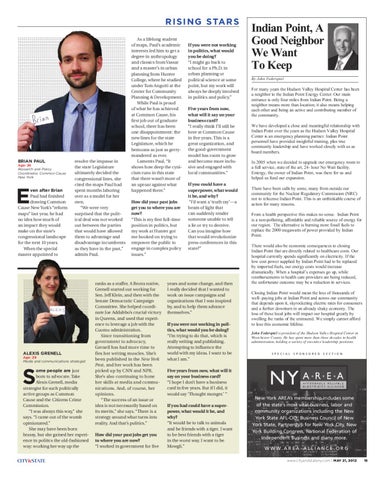
Brian PaUL
age: 26 Research and Policy Coordinator, Common Cause New York
E
ven after Brian Paul had finished drawing Common Cause New York’s “reform maps” last year, he had no idea how much of an impact they would make on the state’s congressional landscape for the next 10 years. When the special master appointed to
resolve the impasse in the state Legislature ultimately decided the congressional lines, she cited the maps Paul had spent months laboring over as a model for her own. “We were very surprised that the political deal was not worked out between the parties that would have allowed them to advantage and disadvantage incumbents as they have in the past,” admits Paul.
aLExis grEnELL
age: 29 Media and communications strategist
s
ome people are just born to advocate. Take Alexis Grenell, media strategist for such politically active groups as Common Cause and the Citizens Crime Commission. “I was always this way,” she says. “I came out of the womb opinionated.” She may have been born brassy, but she gained her experience in politics the old-fashioned way: working her way up the
CITY&STATE
As a lifelong student of maps, Paul’s academic interests led him to get a degree in anthropology and classics from Vassar and a master’s in urban planning from Hunter College, where he studied under Tom Angotti at the Center for Community Planning & Development. While Paul is proud of what he has achieved at Common Cause, his first job out of graduate school, there has been one disappointment: the new lines for the state Legislature, which he bemoans as just as gerrymandered as ever. Laments Paul, “It shows how deep the cynicism runs in this state that there wasn’t more of an uproar against what happened there.” How did your past jobs get you to where you are now? “This is my first full-time position in politics, but my work at Hunter got me hooked on trying to empower the public to engage in complex policy issues.”
ranks as a staffer. A Bronx native, Grenell started out working for Sen. Jeff Klein, and then with the Senate Democratic Campaign Committee. She helped coordinate Joe Addabbo’s crucial victory in Queens, and used that experience to leverage a job with the Cuomo administration. Since transitioning from government to advocacy, Grenell has had more time to flex her writing muscles. She’s been published in the New York Post, and her work has been picked up by CNN and NPR. She’s also continuing to hone her skills at media and communications. And, of course, her opinions. “The success of an issue or idea is not necessarily based on its merits,” she says. “There is a strategy around what turns into reality. And that’s politics.” How did your past jobs get you to where you are now? “I worked in government for five
If you were not working in politics, what would you be doing? “I might go back to school for a Ph.D. in urban planning or political science at some point, but my work will always be deeply involved in politics and policy.” Five years from now, what will it say on your business card? “I really think I’ll still be here at Common Cause in five years. This is a great organization, and the good-government model has room to grow and become more inclusive and engaged with local communities.” If you could have a superpower, what would it be, and why? “I’d want a ‘truth ray’—a beam of light that can suddenly render someone unable to tell a lie or try to deceive. Can you imagine how that would revolutionize press conferences in this state?”
years and some change, and then I really decided that I wanted to work on issue campaigns and organizations that I was inspired by, and to help them advance themselves.” If you were not working in politics, what would you be doing? “I’m trying to do that, which is really writing and publishing. Attempting to influence the world with my ideas. I want to be what I am.” Five years from now, what will it say on your business card? “I hope I don’t have a business card in five years. But if I did, it would say ‘Thought monger.’ ” If you had could have a superpower, what would it be, and why? “It would be to talk to animals and be friends with a tiger. I want to be best friends with a tiger in the worst way. I want to be Mowgli.”
Indian Point, A Good Neighbor We Want To Keep By John Federspiel
For many years the Hudson Valley Hospital Center has been a neighbor to the Indian Point Energy Center. Our main entrance is only four miles from Indian Point. Being a neighbor means more than location; it also means helping each other and being an active and contributing member of the community. We have developed a close and meaningful relationship with Indian Point over the years as the Hudson Valley Hospital Center is an emergency planning partner. Indian Point personnel have provided insightful training, plus true community leadership and have worked closely with us as board members. In 2005 when we decided to upgrade our emergency room to a full service, state of the art, 24- hour No Wait facility. Entergy, the owner of Indian Point, was there for us and helped us fund our expansion. There have been calls by some, many from outside our community for the Nuclear Regulatory Commission (NRC) not to relicense Indian Point. This is an unthinkable course of action for many reasons. From a health perspective this makes no sense. Indian Point is a non-polluting, affordable and reliable source of energy for our region. The alternative is burning more fossil fuels to replace the 2000 megawatts of power provided by Indian Point. There would also be economic consequences to closing Indian Point that are directly related to healthcare costs. Our hospital currently spends significantly on electricity. If the low cost power supplied by Indian Point had to be replaced by imported fuels, our energy costs would increase dramatically. When a hospital’s expenses go up, while reimbursements to health care providers are being reduced, the unfortunate outcome may be a reduction in services. Closing Indian Point would mean the loss of thousands of well- paying jobs at Indian Point and across our community that depends upon it, skyrocketing electric rates for consumers and a further downturn in an already shaky economy. The loss of these local jobs will impact our hospital greatly by swelling the ranks of the uninsured. We simply cannot afford to lose this economic lifeline. John Federspiel is president of the Hudson Valley Hospital Center in Westchester County. He has spent more than three decades in health administration, holding a variety of executive leadership positions. S P E C I A L
S P O N S O R E D
S E C T I O N
New York AREA’s membership includes some of the state’s most vital business, labor and community organizations including the New York State AFL-CIO, Business Council of New York State, Partnership for New York City, New York Building Congress, National Federation of Independent Business and many more. W W W. A R E A - A L L I A N C E . O R G www.cityandstateny.com | May 21, 2012
15
r i s i n g sta r s
EilEEn MillEr
age: 33 Director of Media Services, New York State Senate
O
nce upon a time Eileen Miller wanted to be the one asking the tough questions. Instead she ended up helping politicians answer them. A communications major with a concentration in journalism at Marist College in Poughkeepsie, Miller originally had her sights set on becoming a reporter, starting her career as a Web editor for an entertainment company composing product descriptions. “I realized I did not enjoy the content at all,” says Miller. “But
it didn’t matter what you were writing about, as long as you were writing.” Frustrated with journalism, Miller made her first foray into New York politics via the State Senate press office, where she worked for eight years. When the Republicans took control of the Senate in January 2011, Miller was promoted to director of media services, a change she undertook with slight trepidation. “It was nerve-racking to make the jump from something that I had been doing for eight years,” explains Miller. “Going into a new realm...it’s been the most trying and the most rewarding moment of the past year.” Miller enjoys being in the thick of things in her current position, where she helps coordinate and oversee the various offices within Media Services, including press, photography and graphics. It’s safe to say she has no regrets about ditching her initial career choice. “I think I’ve been very
fortunate. The timing’s always been right with the steps that I’ve made. It’s just been, overall, a very positive experience that I would not trade for anything.” How did your past jobs get you to where you are now? “Working closely with a lot of different offices during my years in the press office gave me an appreciation of what they were doing and trying to accomplish, and allowed me to make the transition.” If you were not working in politics, what would you be doing? “I would definitely be writing in some way, shape or form.” Five years from now, what will it say on your business card? “Hopefully still ‘Director of Senate Media Services.’ ” If you could have a superpower, what would it be, and why? “Reading people’s minds, because people often think that you can already.”
well as a political explanation in navigating the process.” Oppenheimer interned in high school and college for then Assemblyman Mark Weprin, whose district office happened to be a few blocks from Cardozo. Oppenheimer was “really bit by the bug” to get into politics thanks to the family atmosphere of Weprin’s office. Oppenheimer went on to Albany Law School, where he took a special interest in campaign finance. A job with the Board of Elections’ Campaign Finance Enforcement Unit was instrumental in getting him to where he is today. “There’s constant talk about campaign-finance reform, and way too often the public has this image that lobbyists are inextricably intertwined with campaign contributions and activity,” he says. “If you’re doing your job well, it has nothing to do with the campaign side of the business. Lobbying is about advocating for your clients’ interests the most substantive way you can.”
JOshua OppEnhEiMEr
age: 30 Associate, Greenberg Traurig LLP
E
ven back when he was a student at Benjamin N. Cardozo High School in Bayside, Queens, Joshua Oppenheimer knew he wanted to go into politics. After years learning the ropes in and around government, he established himself as an associate with the international law and lobbying firm Greenberg Traurig. “In our Albany office we have a small-firm feel with huge-firm resources,” says Oppenheimer. “We’re lawyers, not just lobbyists, so we’re able to give solid legal analysis as
The New York State AFL-CIO is proud to congratulate Ryan Delgado and his fellow “40 Under 40 Rising Stars.” The future is looking bright.
CONGRATULATES For being recognized as one of the ‘40 Under 40 Rising Stars’
Mario Cilento President
16
•
1042 38th Street
May 21, 2012 | www.cityandstateny.com
•
Brooklyn, NY 11219
40
AFL-CIO
DAVID LOBL
718.854.2747
under
New York State
OUR OwN
Human Care Services provides a full range of customized services to individuals with special needs.
40
Rev. Terrence L. Melvin Secretary-Treasurer
Helping working families achieve a better life. 50 Broadway, 35th Floor, New York, NY 10004 - 212.777.6040 100 South Swan Street, Albany, NY 12210 - 518.436.8516
www.nysaflcio.org CITY&STATE
r i s i n g sta r s How did your past jobs get you to where you are now? “Working in government gives you a great education and insight into how the legislative process works.” If you were not working in politics, what would you be doing? “Very few people know this, but my other thought when considering careers was to become a stage manager.” Five years from now, what will it say on your business card? “I’m not sure, but I hope they spell my name right.” If you could have a superpower, what would it be, and why? “The Zack Morris (Saved by the Bell) time freeze. We could always use a couple more minutes in the day, and sometimes we’d like to change the way people are standing.”
ryan DelgaDo
age: 34 Public Policy Director, New York State AFL-CIO
Ryan Delgado’s relative youth belies his already accomplished career in the world of New York labor. “I’ve worked in the labor
movement in both the public sector and the private sector, and now for a central lobby, and also upstate and downstate, so I’ve been able to see the labor movement from different perspectives,” says Delgado. A New Yorker through and through, Delgado was raised
in Woodside, Queens, and completed his undergraduate studies at Hofstra University. Right out of college Delgado found a job with the State Assembly, but soon after, he moved on to the New York City Central Labor Council, where he first got his feet wet in labor. After working as political director for Local 1102 RWDSU and spending a four-year stint as a lobbyist and political organizer for the Public Employees Federation, Delgado received the opportunity to work for the New York AFL-CIO, where he has helped lead some contentious legislative battles over the past year, including the battle over Tier 6 pension reform. “Oddly enough, what might be my biggest accomplishment was something we actually may have lost in terms of legislation: our fight against Tier 6,” says Delgado, reflecting on his current position. “The labor movement really put on an aggressive campaign, and all of labor really stuck together in the fight. We had good coordination, a lot of grassroots
activity, and the solidarity that the whole union showed was something that I think all of us at labor can really be proud of.” How did your past jobs get you to where you are now? “I think over the years I’ve had the opportunity to work with very talented people in the legislature, in the press, and in the labor movement, and I’ve tried to take something from each one of those people.” If you were not working in politics, what would you be doing? “I guess I’d be home with the kids, and I’d have a lot more gray hair.” Five years from now, what will it say on your business card? “As long as it says ‘The New York State AFL-CIO’ at the top, the rest of it is kind of irrelevant.” If you could have a superpower, what would it be, and why? “I guess it would be the ability to eat and not gain weight. That’s one of my loves.”
A Capitol Star
Wilson Elser congratulates Tania Dissanayake on being selected as a “2012 Albany Rising Star” by City & State. Congratulations to all the 2012 honorees.
Congratulations to our friend and colleague, Joshua Oppenheimer for being selected as one of City & State’s 40 Under 40 Albany Rising Stars
Wilson Elser
Greenberg Traurig, LLP 54 State Street | 6th Floor Albany, NY 12207
Wilson Elser Moskowitz Edelman & Dicker LLP 1800 ATTORNEYS | 35 LOCATIONS° | WWW.GTLAW.COM Government Affairs • Health Care Law • Civil Defense Litigation • Commercial Litigation Government Investigations • Lobby Law Compliance • Liquor Licensing • Insurance Regulatory Albany, NY • NYC • Offices Nationwide • 518.449.8893 www.wilsonelser.com
CITY&STATE
Greenberg Traurig is a service mark and trade name of Greenberg Traurig, LLP and Greenberg Traurig, P.A. ©2012 Greenberg Traurig, LLP. Attorneys at Law. All rights reserved. Contact: Harold Iselin in Albany at 518.689.1400. 14523
www.cityandstateny.com | May 21, 2012
17
r i s i n g sta r s
daVid LobL age: 27 Director of Public and Government Affairs, Human Resource Services
rebecca Wood age: 27 Assistant Floor Counsel, Senate Majority
b
ack in 2005 when she was a sophomore in college, Rebecca Wood had to predict the candidates for the 2008 presidential election. It was just for a mock convention, in a class called “The Presidency,” but that exercise helped shape Wood’s decision to enter the world of politics. For her the experience stood out not because of her aptitude for the work but because she was so wrong. “When the election rolled around, only one or two of our guesses actually ran,” recalls Wood. “I remember thinking that in politics nothing is certain—anything can change at any given moment.” And that’s part of what she loves about it. “It’s certainly never dull,” says Wood. “I like the idea that I can help figure out what’s going to happen.” Throughout her academic career Wood worked in government, first for the Republican State Committee and Senator Michael Nozzolio while she was in college, and then again for the Senate
18
New York’s Orthodox Jews are on the rise, flexing their political muscles and providing the margin of victory for a number of candidates in recent elections. David Lobl is often at the center of that activity, helping craft messages and coordinate resources for his community. But Lobl is no local boy. He grew up on the South Side of Chicago, where he cut his teeth working for Rep. Judy Biggert, whom he still considers his “political godmother.” After getting married, Lobl moved to Brooklyn, where he began working for the Friedlander Group, a Jewish lobbying
firm. Seeking other ways to contribute, he was intrigued by a client, Human Care Services, a nonprofit that helps care for the disabled. “You always have that one client you really, really believe in,” he says. “You really think you’re doing God’s work.” For Lobl, helping Orthodox Jews find their political voice is also doing God’s work—whether supporting Simcha Felder in a potentially historic Senate race, or coordinating the Jewish vote in other local races. “They’re finally realizing their own ability to stand up for issues that they believe,” he
says, “rather than let politicians take them for granted.”
difference, is at the end of the day what gets me going.”
How did your past jobs get you to where you are now? “I started on the Hill; then I was involved in local campaigns in Chicago. Then I got married and moved out here. I took an opportunity with Ezra [Friedlander] and I got to meet a lot of people.”
Five years from now, what will it say on your business card? “I was born in Israel, so I can’t be president. I guess ‘Chief of Staff to the President of the United States of America.’ ”
If you were not working in politics, what would you be doing? “If I wasn’t in politics, I would be in psychology. The idea of being able to make people’s lives better, to make a tangible
while she obtained a joint M.B.A./J.D. from Albany Law School. The first year of her job as assistant floor counsel for the majority hasn’t exactly been an easy one—Wood was diagnosed with breast cancer in October of 2011—but the obstacles haven’t slowed her down a whole lot. She worked throughout her chemotherapy, taking every Friday off to make the trip from Albany to Memorial SloanKettering and back. How did your past jobs get you to where you are now? “My internship in college got me started in the political end of things, and then after there was a change in the state party, there was a lot of staff turnover, and I got to intern for Senator Nozzolio in the Senate.” If you were not working in politics, what would you be doing? “Playing cards in Vegas. My game of choice is No-limit Hold’em.” Five years from now, what will it say on your business card? “The same thing it says now, except ‘Assistant Counsel to the Majority’ will mean something else, because our majority will be much bigger.” If you could have a superpower, what would it be, and why? “The ability to make the hair I lost during chemo grow back faster.”
May 21, 2012 | www.cityandstateny.com
If you could have a superpower, what would it be, and why? “To go back in time. To be able to talk to and learn from previous world leaders how they were able to make such a positive difference with the little that they had, and translate that into our generation.”
How did your past jobs get you to where you are now? “I started doing campaign work, as opposed to having an internship on the inside or coming out of law school. Then I worked for a client of Malkin & Ross, but wanted to get into politics, so I called one of the lobbyists, and they were, by coincidence, hiring. So within a week we came to an agreement on me coming here.” If you weren’t working in politics, what would you be doing? “Maybe I’d be the backup tambourinist for the Rolling Stones, or the radio announcer for the New York Yankees.”
Jessica schafroth age: 38 Lobbyist, Malkin & Ross
i
t’s all rep. Paul Tonko’s fault that Jessica Schafroth got into politics. When Tonko was a firstterm congressman, he gave a speech to a group of Girl Scouts in Schafroth’s hometown. “He gave a speech about the need to have more women in politics,” says Schafroth, who was 9 at the time. “I don’t know that I knew too many really strong women, so that resonated with me.” “So I blame Paul Tonko,” she adds with a laugh. Today Schafroth is a lobbyist at Malkin & Ross. Her accomplishments since starting there
“i’d be the backup tambourinist for the rolling stones, or the radio announcer for the new York Yankees.” in 2004 include passing the Family Health Care Decisions Act, which had been stalled for years, and the Wage Theft Protection Act, which sped through the Legislature in a mere eight months. “I think a lot of people think that lobbyists are evil or bad or whatever, but I think a lot of good can be done from being involved in the process,” says Schafroth.
What will your business card say in five years? “I don’t see leaving here. I really love my job. I have pretty much unlimited growth potential. This firm lets us work on the issues we want to work on. We have great clients, and it’s a great group of people.” If you could have a superpower, what would it be, and why? “My superpower would be to get people to always tell the truth. Why? I think a lot of what we do in Albany is to try to counter stuff that’s not true. I’d like to have a superpower that people would be required to tell the truth. There’s always a way to come to a rational conclusion if you know what the truth is. You spin your wheels otherwise.”
CITY&STATE
r i s i n g sta r s
tania Dissanayake
age: 22 Legislative Director, Wilson Elser
t
ania Dissanayake’s family came to the U.S. in 1989 to escape civil war in Sri Lanka, so when her mother encourages her to pursue her dreams, the advice carries some weight.
“My brother and I were raised in Westchester, proudly by a single mom, and she instilled in me a lot of big dreams and promise and trying to have a big future,” Dissanayake says. Dissanayake, who saw government as a way to protect against suffering, started out as an intern for State Senator Jeff Klein, who had just formed the Independent Democratic Conference. “They announced the breakaway on January 5 and I started on January 6, so as you can imagine I started amid quite a flurry of movement and excitement,” Dissanayake says. “I felt very encouraged to see a group of people who put governance ahead of everything else.” Dissanayake now tracks legislation at one of the state’s top lobbying firms. “I really kind of viewed it as the starting point of getting to see what the political realities are, and how I can insert myself and hopefully make a differ-
political action. And without both I would never have made it to Wilson Elser, where I’m able to see the reverberations of all those political actions.”
“My brother and i were raised in Westchester, proudly by a single mom, and she instilled in me a lot of big dreams.”
If you weren’t in politics, what would you be doing? “I certainly struggled with trying to decide whether I was going to do creative writing or something like that. I used to in college, but I put in on the back burner because this is my passion.”
ence someday,” she says.
What will your business card say in five years? “ ‘Attorney at Law,’ hopefully.”
How did your past jobs get you to where you are now? “Without campaigning I never would have learned what the structure of constituent relations was and what organizations for constituents are. Without the Senate IDC I would not have known how to use those constituent voices to translate that into meaningful
If you could have a superpower, what would it be, and why? “I would love the ability to teleport, because that would then give me the ability to see all the places I’ve always wanted to see in my life. I would love that. To be able to be in Italy one second and Greece the next would be kind of fantastic.”
Congratulations DAVID LOBL Director of Government Relations for Human Care Services
TINA LEVIN
seth lamont
City and State’S newest rising star.
As CNA Director of Government Relations, your hard work and dedication is an inspiration to us all. www.cna.com. CNA is a registered trademark of CNA Financial Corporation. Copyright © 2012 CNA. All rights reserved.
CITY&STATE
www.cityandstateny.com | May 21, 2012
19
r i s i n g sta r s
a Conor BamBriCK age: 34 Legislative Director, Assemblyman Kevin Cahill
matthew nelson age: 33 President, Office of Community Renewal
w
hen matthew nelson enrolled in his first AmeriCorps volunteer program in the summer of 1998, he didn’t know the experience would mark the beginning of a lifelong commitment to community service. Almost 15 years later Nelson has held positions in several local and national administrations, including those of Hillary Clinton and John Edwards, but now he has gone back to basics in his position at the Office of Community Renewal. “Politics has been my profession, but I’ve never lost focus on why I got into politics in the first place, which is community service,” explains Nelson. At OCR Nelson oversees community development grant programs at the state and local level, such as the Community Development Block Grant program, which
s the assembly’s go-to staffer on energy, Conor Bambrick is a key player during a critical transition period in New York. “It’s a huge opportunity right now,” says Bambrick, who has worked on issues like Article X, energy planning and solar power. “We need to act now and take extraordinary steps, like New York did more than a half century ago with the hydroelectric dams, to modernize our grid, make our existing transmission system more efficient, and to embrace solar power.” For Bambrick much of the work is about protecting the
environment and underserved communities. “The way energy impacts all aspects of our lives—and, really, how little the average person understands how the energy markets work—we feel it’s really our role to stand up for the average New York resident and small business and make sure we put policies in place that protect them and protect the environment,” Bambrick says. How did your past jobs get you to where you are now? “When I got involved with NYPIRG in college, I started really paying attention to state
government at that point. So I moved up to Albany, and I transferred to SUNY Albany to finish out my degree, but the main reason was to intern in the NYPIRG legislative office, where I got to work under Blair Horner. I stuck around until they started paying me. Blair used to call me a jack-of-all-trades but a master of none. It really prepared me well for my current position.” If you were not working in politics, what would you be doing? “My dream job would be understudy for Rita Houston, music director at WFUV. It’s the best station out there. They play a lot of stuff that becomes hits, but
he says combines economic development, community development, business development and job creation. “I’ve always been interested in the plight of the working class—and that, as I’ve come to know it, is the definition of the CDBG,” says Nelson. In his first six months on this job it’s been refreshing for Nelson to “sink his teeth” into the specific programs and services under his purview. “My jobs before were much more operational and behind-the-scenes,” says Nelson. “This is a great shift for me, and something I’ve sought for a long time.” How did your past jobs get you to where you are now? “I got my start working for AmeriCorps, which obviously deals with helping the lower rungs of our communities all across the country. That’s very relevant to what I do today.” If you were not working in politics, what would you be doing? “Baking.” (One specialty is his pumpkin cheesecake.) Five years from now, what will it say on your business card? “Other than ‘Retired’? I don’t know.” [Laughs] “If you could have a superpower, what would it be, and why?” “I would love to be able to control time.”
20 May 21, 2012 | www.cityandstateny.com
they’ve been playing six, seven months beforehand.” What will your business card say in five years? “If I am not working in the Legislature or government, I can see myself returning back to where I started. If that is the case, I would like my card to read: ‘Advocate for the Public Interest.’ ” If you could have a superpower, what would it be, and why? “It would be the ability to see through the eyes of others, in the realm of mind reading, but more for the purposes of how they perceive and understand issues.”
keep his promise to be a “lobbyist” for students in Albany. “It was an excellent opportunity—and to see this governor, who has so much credibility, want to take on the system, and do it from the simplest point of view [was an experience I didn’t want to miss],” she said.
Katie Campos
age: 26 Assistant Secretary for Education, Executive Chamber of the State of New York
K
atie Campos knew she was an idealist at age 21. And as a staffer for Democrats for Education Reform, she saw how parents and communities were frustrated by the education system, and vowed to balance her idealism with real-world actions. She asked Joe Williams, the executive director at DFER, about implementing some of the Obama administration’s Race to the Top goals in her native Buffalo. He gave her his blessing—and more importantly, his Rolodex.
“It was a quick learning curve on what was possible, and how to actually do it,” she says. Her success in organizing parents, charter-school supporters and educationreform advocates in the Queen City caught the attention of the right people. “I got an email, pretty late at night, and I think it said ‘Governor Cuomo—Education Agenda,’ ” Campos said. “I thought it was spam.” Now, as assistant secretary for education to Cuomo, Campos is on the front lines of implementing the governor’s education policy goals, including revamping the state’s teacher-evaluation process and helping Cuomo
How did your past jobs get you to where you are now? “I played soccer, and I attribute a lot of it to that. Just understanding how much passion and dedication to have, and trying to harness it. In going into Democrats for Education Reform… there was not a lot expected of me, but I was curious and interested, so I was able to get involved in the more high-profile meetings with reformers from across the state.” If you were not working in politics, what would you be doing? “It would be great to start a school, or work on turning around a low-performing school.” Five years from now, what will it say on your business card? “It would probably say ‘Teacher’ or ‘School Leader,’ or something like that.” If you could have a superpower, what would it be, and why? “I would say to fly, but that’s probably what everyone says. I’ll take flying. It would make the commute so much easier.”
CITY&STATE
r i s i n g sta r s
Zack Fink
age: 38 NY1 Reporter, Albany Bureau
Z
ack Fink, who joined NY1 last year, is a recent edition to the state Capitol’s Legislative Correspondents’ Association, but he’s no journalism neophyte. A television
correspondent who’s been reporting on camera and for the radio since before he graduated from Skidmore College, Fink has found ways to practice the craft of political reportage even when the government tried to shut him down while he was a reporter at New Jersey News. Literally. “NJN wound up getting shut down by Governor Christie. Sensing that we were heading for the iceberg, I jumped ship a few months before we actually crashed.” He landed as a freelancer at NY1, where he logged so many hours he was told he might be breaking federal labor laws. Last year he finally signed a contract. Fink, a Bronx native, always wanted to be a journalist. “I grew up in a very politically savvy household, I guess you could say,” Fink said. “The discussions around the dinner table were about
current events. And I went to a very socially conscious high school, which was Fieldston. It was a very progressive ethos of secular humanism that they exercised.” How did your past jobs get you to where you are today? “I did a weekly news show on the TV station at Skidmore, which no one watched. I got to the city and I started volunteering at WBAI radio, where I did the morning news. And then I started freelancing at WFUV. Anybody who would give me hours, I’d go work for them. I was basically working, like, 10 jobs, and then NJN had an opening, and I was able to get in there on a grant. For 13 years I was a reporter at the PBS station in New Jersey. And for the last three years, I guess late 2008 to 2011, I was the statehouse correspondent for NJN News in Trenton.” If you were not working in politics, what would you be doing?
“I think I would still be in journalism, just maybe not covering politics. And assuming I weren’t doing journalism at all? I would, um, try to figure out how to make some money?” Five years from now, what will it say on your business card? “Hopefully it will still say ‘Reporter.’ I’m under contract with NY1 for three years, and this is my first year.” If you had a superpower, what would it be, and why? “I would say an ability to do even more things at the same time than I’m capable of doing now at the same time. Or I would like to be able to communicate with the deceased. That would be my superpower, because people who are no longer here probably have as much to tell us as the people who are. But I bet just as many of them are probably full of sh-t also.”
CONGRATULATIONS and BEST WISHES to OUR FRIEND AND COLLEAGUE
CARLOS E. BEATO One of the Recipients of the “Rising Stars” Award
PITTA BISHOP DEL GIORNO & GIBLIN LLC LOBBYING * CONSULTING * GOVERNMENT RELATIONS * CAMPAIGN FINANCE COMPLIANCE
PITTA & GIBLIN LLP LABOR * EMPLOYMENT * EMPLOYEE BENEFITS * REGULATORY COMPLIANCE
C
111 Washington Avenue, Suite 401, Albany, New York 12210 Telephone (518) 449-3320 • Facsimile (518) 449-5812 120 Broadway, 28th Floor, New York, New York 10271 Telephone (212) 652-3890 • Facsimile (212) 652-3891
CITY&STATE
ongratulations to
Katherine Nadeau and all of the 2012 Rising Stars! Environmental Advocates of New York is proud of Katherine’s star-quality work shaping the environmental debate in the state capital.
353 Hamilton Street • Albany, NY 12210 • (518) 462-5526 • www.eany.org
EANY Nadeau.indd 1
5/16/2012 3:18:17 PM
www.cityandstateny.com | May 21, 2012
21
r i s i n g sta r s
i adam richardson age: 39 Senior Counsel, New York State Senate Majority
cassandra anderson
age: 32 Director of Communications, New York Insurance Association
B
y her own admission, Cassandra Anderson is something of an “association junkie.” Before Anderson became director of communications for the New York Insurance Association in January 2008, she spent the earlier part of her career working for the Empire State Society of Association Executives, which she describes as the “association for associations.” Anderson never imagined that her life would be so closely entwined with associations, but she is now as ardent a believer in their mission as anyone. “I think the association industry, unfortunately, is often known as specialinterests groups, but as a whole lobbying is a small part of what associations do,” Anderson says, pointing out that they also educate, establish best practices and encourage collaboration. Anderson’s aim is to reframe what she perceives as
22
f adam richardson pens an autobiography, at least one chapter will be devoted to his experience on the front lines of the 2009 Senate coup. “That had to be one of the most interesting times I’ve seen,” says Richardson, the Senate Republicans’ floor counsel. “Albany being a town of open secrets sometimes, the ability for the Republican minority at the time to keep it under wraps and within a tight community up until the time it happened was certainly amazing.” He’s also been making his mark as a tireless asset for his
some common misconceptions about the insurance industry. “It’s a little sad to me that all of the positive things that property- and casualtyinsurance companies do don’t get noticed,” explains Anderson. “I find it a privilege to tell their stories. Our members provide a financial backbone for communities at their greatest times of need.” When she is not serving as an advocate for her association, Anderson, who recently became a mother, dedicates herself to her family. She believes that remembering to appreciate life is essential to her happiness. As she says, “If you take a moment to enjoy where you’re at, and not always focus on where you’re going to be, that’s very important to me.” How did your past jobs get you to where you are now? “Definitely it made me believe in the power of associations, and I learned a lot about a variety of different industries.” If you were not working in politics, what would you be doing? “I think I would really enjoy being a guidance counselor or a career counselor.” Five years from now, what will it say on your business card? “The word association is certain to be somewhere on the card.” If you could have a superpower, what would it be, and why? “I would love to be able to make everybody happy.”
May 21, 2012 | www.cityandstateny.com
caucus, handling labor issues, the budget—anything that needs to get done. Richardson, who grew up a Reagan Republican, started out professionally in the tech world. After the sector crashed in the early 2000s he enrolled in law school in his hometown of Albany, then joined the Senate majority counsel’s office in 2007, where he’s been moving up ever since. “I really enjoy the work,” he says. “It’s not coming in and doing the same thing every day.” How did your past jobs get you to where you are now?
“I worked in technology and sales, which prepared me somewhat for the political environment. To a certain extent this job is about sales. You’re trying to sell your ideas, your policies and your position... With sales there’s a lot of negotiating that goes back and forth, and a lot of negotiating happens here.”
procedure. I envision staying in politics, whether inside...or outside the building, for a good portion of the rest of my career.”
If you were not working in politics, what would you be doing? “Probably a winemaker—not that I know much about it. Otherwise, a more realistic goal is some day teaching in a professorial rule, maybe politics or parliamentary
If you could have a superpower, what would it be, and why? “I would love to make time stop. That way I could get everything done that needs to be done, and then be able go out and spend time with my wife wife and kids.”
What will your business card say in five years? “It could still say ‘Senior Counsel.’ Maybe it will say ‘Senior Senior Counsel to the Senate Majority.’ ”
pretty much all the same goal, so it’s connecting these groups through social media and making their views heard to the elected officials, members of the Legislature and policymakers in Albany.” How did your past jobs get you to where you are now? “As a college intern in Senator Schumer’s office, I assembled news articles from all the papers around the state. It was a pretty entry-level job, but that really got me started in the governmental world and the media world. Then after college I worked in government affairs, and I worked for a time for then Attorney General Andrew Cuomo in the press office. Then I came here about three years ago.” tina Levin
age: 28 New Media Coordinator, PLA Communications
a
s Facebook and Twitter transform the digital world, Tina Levin is harnessing the social media sites’ growing reach to connect her clients with a broader, Web-savvy audience. Her public advocacy campaigns, which also involve crafting and producing websites, have been paying off for her clients at PLA Communications, the communications arm of the powerful lobbying firm Patricia Lynch Associates. “I just want to make an impact,” Levin says. “We worked on marriage equality, and that was very important to me, just to make an impact and bring change to society in a beneficial way.”
“We worked on marriage equality, and that was very important to me, just to make an impact and bring change to society in a beneficial way.” Levin is currently working with patient advocacy groups to ensure patients are not shortchanged as federal healthcare reform and the state’s Medicaid redesign transform medical care. “All these groups—there’s lung, kidney, heart, Alzheimer’s—they all focus on a specific disease,” says Levin. “But it’s
If you were not working in politics, what would you be doing? “I always enjoyed working with the elderly. So something like events coordinator at an assisted-living facility, something along those lines.” What will your business card say in five years? “I think it will say ‘Manager of PLA Communications.’ We’re doing some great stuff now, but we’re also growing, and I want to have a leadership role as we expand.” If you could have a superpower, what would it be, and why? “The thing I would want to do is be able to teleport, just so I could be at many different places fast and efficiently, so it’s just instant access to any place in the world.”
CITY&STATE
r i s i n g sta r s
t Jacob craWford
age: 25 Assistant, Research and Educational Services for Higher Education, Education Finance and Federal Programs, NYSUT
he budget crisis in New York’s public university system has been an ironic boon to Jacob Crawford’s career. As student president for the entire SUNY system, Crawford testified before the Senate Committee on Higher Education about the drastic budget cuts in 2009. His testimony got him noticed by State Senator Toby Ann Stavisky—to the tune of an immediate job offer. He worked as a policy analyst for the committee, which meant he had to resign from his SUNY position, but it paved the way for
his career in public policy. When the Democrats lost the majority, Crawford found a job at New York State United Teachers (NYSUT), where he’s putting to use his master’s in public administration from the University of Albany. At NYSUT Crawford does budget and policy analysis for higher education on the state level, and also tracks federal education policy that comes down from the Department of Education. Twenty-five may seem young to have achieved so much, but for Crawford it’s all happening
right on schedule. “I wanted to be in state politics ever since I was a teenager,” says Crawford. “For some reason, it was always enticing to me.” How did your past jobs get you to where you are now? “Before I was a student trustee I was also an intern for the New York State AFL-CIO with Suzy Ballantyne. That was the reason I decided I wanted to be in labor. Working for her was such a wonderful experience.” If you were not working in
Jonathan Lang
age: 29 Director of Governmental Projects and Community Development, Empire State Pride Agenda
W
hile Many new Yorkers rejoiced last June when Gov. Andrew Cuomo signed the Marriage Equality Act legalizing same-sex marriage in New York, for Jonathan Lang, that milestone was merely a small victory in the grand scheme of leveling the playing field for gay, lesbian and transgender individuals. “We had a lobbying team that worked in close conjunction with the governor’s office, but my job is to make sure everything else is going on besides gay marriage,” explains Lang. Since graduating from Denison University in 2004,
CITY&STATE
Lang, a Buffalo native, has been instrumental in pushing LGBT issues to the forefront of the state’s political and moral consciousness, working for advocacy networks all over New York. Lang joined the Empire State Pride Agenda in 2006, where he has served in a number of different roles before ascending to his current position as ESPA’s point man for overseeing advocacy activities within state government, including the Executive Chamber, and public funding for LGBT issues. With the fight for equality far from over, Lang is currently focusing his energy on a number of high- and low-profile advocacy efforts, including working on a Medicaid redesign team to
If you were not working in politics, what would you be doing? “My family believes strongly in public service, so I think I would still be doing that.” Five years from now, what will it say on your business card? “That’s tough. Five years ago, I wouldn’t have thought I’d be doing this job. Executive director somewhere.” If you could have a superpower, what would it be, and why? “X-ray vision, so you could see through what folks are presenting to you and get to the truth of the matter.”
Five years from now, what will it say on your business card? “As long as it says ‘NYSUT’ on it, I’ll be happy.” If you could have a superpower, what would it be, and why? “Knowing what people are thinking. You would always have the edge on everyone. Information is always key.”
Today Lamont is back to his legal roots, practicing insurance and energy law in his role at CNA. He says the position has given him more respect for the private sector. “One of the things that transitioning showed me is that despite the rhetoric we see everywhere, people on both sides are trying to do the right thing,” Lamont said. “I see as much or more integrity on the private side as I did working in public affairs.”
expand health coverage to LGBT individuals in the Medicaid system. He is also helping to oversee the implementation of last year’s antibullying bill in the state education system. As Lang puts it, “We are committed to making sure our young people are protected in school so they can get the education they deserve.” How did your past jobs get you to where you are now? “I had a very winding road. In college I was premed, but then decided I didn’t want to be a doctor at all, much to my parents’ chagrin. I ended up back in Buffalo working for a local project. Then I ended up in Rochester, working for a coalition of about 16 companies around the state. Finally I came to the Pride Agenda, and the rest is history.”
politics, what would you be doing? “I’d like to be a commentator on the evening news.”
seth r. LaMont age: 37 Director, Government Relations, CNA Insurance
s
eth Lamont’s work history spans all three branches of New York State government, with a focus on insurance law. Yet one of his favorite professional achievements is developing the Consumer Protection Board’s “Do Not Call” program. “It sort of found me,” he says of the project. Though Lamont went to the Consumer Protection Board in 2001 as an energy lawyer, he stepped into a peculiar vacuum in leadership surrounding the “Do Not Call” legislation; by the time the law passed, almost all the people responsible for getting it passed had left the agency. Lamont loved the opportunity to build something from scratch. “It was a chance to get a program off the ground from soup to nuts. Nothing was in place,” explains Lamont. “To build out a new operation is the kind of thing I’ve always liked to do.”
How did your past jobs get you to where you are now? “During my time in the private sector, I worked closely with the marketing department, and my observations from that time are useful today. One of the things I try to do in my role is get our business leads in front of associations that can help us place our product. That sort of quasi-sales activity is something I enjoy having in my portfolio.” If you were not working in politics, what would you be doing? “Marketing insurance in the private sector.” Five years from now, what will it say on your business card? “ ‘Chief Transformation Officer at CNA.’ ” If you could have a superpower, what would it be, and why? “Mind reading. When you’ve been in this environment long enough, you can usually tell whether somebody’s being forthright with you or not, but that would certainly take all the guesswork out of it.”
www.cityandstateny.com | May 21, 2012
23
r i s i n g sta r s
c christoPher Duryea age: 39 Government Affairs Consultant, Marsh, Wassermann & McHugh
JenniFer FreeMan age: 38 Director of Communications, State Comptroller’s Office
t
hough she is one of the state government’s most skilled and experienced communication directors, Jennifer Freeman is hesitant to talk up her own accomplishments. The chief spokeswoman for State Comptroller Thomas DiNapoli prefers to highlight the “focus” and “integrity” of her boss and the staggering magnitude of the work her office performs: the 300,000 financial transactions it processes daily, the billions of dollars in contracts it approves on a given day, its 700 to 800 annual audits. Keep pressing Freeman to toot her own horn and she quickly pivots to praising the professionalism of her co-workers. “I think every director of communications that is effective has a solid team behind them,” Freeman beams. A Minnesota native, Freeman started her professional life in the Minnesota Attorney General’s office under Hubert Humphrey III, then moved to New York, where she worked as a senior
24
hristopher Duryea got the politics bug in 1992, when he heard Bill Clinton give a rousing campaign speech. “I was a machinist on a submarine in the military at the time, so you’d think I’d be sort of this right-wing type,” Duryea says. “But Bill Clinton, his campaign message in ’92, it just grasped me. I was like, ‘This guy gets it.’ ” A decorated military veteran, Duryea got his start in Albany in 2000 working for then Assemblyman Richard Brodsky. “I showed up as this green graduate intern who knew nothing
about Albany politics,” Duryea says. “And about 60 days later, his legislative director up and quit. And he’s like, ‘Here’s your shot.’ And Richard was carrying at the time, I don’t know, something to the tune of 325 bills. So it was trial by fire.” Now an Albany veteran, with stints at Crane Consulting and the Cable Telecommunications Association under his belt, Duryea is a key player at Marsh, where he represents clients on everything from manufacturing to healthcare. How did your past jobs get you to where you are now?
“I started out in the Navy in the submarine service, so I had a view on a public-sector career from day one. I cut my teeth in politics in Syracuse working on Democratic campaigns.” If you were not working in politics, what would you be doing? “I grew up on Skaneateles Lake. I spent a number of years in the Navy. I have this nautical thing. I’m also a tinkerer, a fix-it guy, so I always thought that a nice thing for me would be to own and operate a marina on an upstate New York lake.”
account executive at Media Logic and a legislative assistant for the state Assembly. From 2004 to 2010 Freeman served as deputy press secretary in the state comptroller’s office. In between her two stints in that office, Freeman was the assistant vice president for external communications at the Albany Medical Center. While Freeman is reluctant to discuss herself, she instantly brightens when describing the discipline, balance and healthful living habits she believes aspiring communications pros must develop to succeed in the field. Freeman advises, “You need to network like crazy, intern, and really learn the business from the bottom up.” How did your past jobs get you to where you are now? “First and foremost, relationships. I was seen as someone who really understood this office and the comptroller.” If you were not working in politics, what would you be doing? “I love what I do. I’m in my dream job right now.” Five years from now, what will it say on your business card? “I hope five years from now it says that I am the director of communications for Tom DiNapoli.” If you could have a superpower what would it be, and why? “I would fly, because you could go so many places and see so many things so quickly.”
May 21, 2012 | www.cityandstateny.com
What will your business card say in five years? “I hope it says the same thing, frankly. If it says the same thing, it will reflect growth in our business. At some point in my career I’d like to get back to public service, or at least some sort of community service.” If you could have a superpower, what would it be, and why? “Well, I am a new dad, so now I’m striving to be Superdad. Maybe that would be the power to never sleep and function.
which would protect telecommunications companies offering Internet phone service from regulation. Says Lespinasse, “The world is changing. Verizon is creating new markets and opportunities to drive growth and prosperity in New York and around the world.” How did your past jobs get you to where you are now? “My father and I decided one day that I would run for vice president of the student council at North Middle School in Brentwood. He crafted my campaign slogan: ‘If you know where it’s at, vote for Pat.’ We won that race. It was that first ‘job,’ if you will, that set the stage for every opportunity I’ve had since.” Patrick a. LesPinasse age: 33 Director of Government Affairs, Verizon
a
t the tender age of 33, Patrick A. Lespinasse can rattle off impressive accomplishments: lawyer, St. John’s University adjunct professor, York College trustee, and former staffer to then Assemblyman Thomas DiNapoli. But Lespinasse says that to really understand him, it is necessary to understand his family. Growing up, initially in Laurelton, Queens and later in Brentwood, Long Island, in a structured and religious household with an extensive library of reading material at his disposal, Lespinasse had the infrastructure he needed to live up to his family’s proud reputation as “strivers.” It was this determina-
tion that expedited Lespinasse’s steady ascent to his current post as Verizon’s director of government affairs. “Professionally I consider myself a student of government,” he explains. “I am into big ideas, but I also believe in action. In the classroom as an adjunct professor, it’s about the big ideas and the founding principles. At Verizon and in my work in the community, it’s about building teams and taking small steps every day to work the needle forward on the big goals.” At Verizon Lespinasse is responsible for strategic advocacy on a broad range of public policy, legislative and regulatory issues that impact corporations on the local, municipal and state levels. This past year he has played a key role in Verizon’s support for VoIP legislation,
If you were not working in politics, what would you be doing? “If I’m reaching, I’d love to work in journalism reading tons of books, writing reviews and interviewing authors. If I’m dreaming, I’d enjoy teaching social studies at a local school in my neighborhood in Queens.” Five years from now, what will it say on your business card? “Charlie ‘Tremendous’ Jones, the motivational speaker, once said: ‘You will be the same person in five years as you are today except for the people you meet and the books you read.’ I read a lot and I try to meet a new person everyday. So who knows?” If you could have a superpower, what would it be, and why? “The ability to hit a golf ball exactly the way I intend every time.”
CITY&STATE
r i s i n g sta r s so I started getting interested in that sector.” If you were not working in politics, what would you be doing? “Definitely something fitnessrelated. I work out a lot. I do Pilates three days a week. I’m an avid runner. I used to teach a spin class. I just started training in certain martial arts.”
Jessica reinhardt age: 30 Manager, State Government Relations, Con Edison
U
nderstanding energy policy can be like learning a foreign language, but it’s one in which Jessica Reinhardt is getting fluent. First exposed to energy policy in the Assembly minority counsel’s office, Reinhardt stuck with it during a stint at Wilson Elser, then landed at Con Ed in October.
CITY&STATE
“I work for a company full of brilliant engineers, and they talk in a bunch of acronyms,” she says. “I’m trying to translate what they say and then convey that to a legislator or someone like me.” How did your past jobs get you to where you are now? “In law school I was an intern for the Assembly minority counsel’s office, and they offered me a position when I graduated. I had a couple energy-related committees,
What will your business card say in five years? “I’d like to say that I’d be some sort of director. I would like to be doing some sort of government relations, maybe overseeing a portfolio that’s not just state but maybe state, city and federal.” If you could have a superpower, what would it be, and why? “Maybe flying or transporting or something that can get me from point A to point B fast. Just trying to get up an elevator to the 6th floor [in the Capitol building] with all those big groups, not having to fight the traffic, both cars and people, would be a nice superpower.”
Brad Fischer
age: 32 Director of Operations, Albany County
W
hen daniel Mccoy was elected Albany County executive at the end of 2011, he turned to Brad Fischer to lead his transition team. A native of the county’s hamlet of Slingerlands and a proud resident of downtown Albany, Fischer was a fitting choice for the job. “I’m very good at curating relationships, making connections between people,” says Fischer. While Fischer describes the purpose of his job as “executing the county executive’s vision as to how to bring Albany into the 21st century,” he says that on a more quotidian basis his position entails dealing with the “sundry mix of fires that need to be put out throughout the day, with peripheral consideration given to longterm planning, depending upon
how much time the day allows.” Prior to joining McCoy’s team, Fischer spent five years working in the State Senate. Initially selected as a Senate Fellow, Fischer became a legislative aide to former Sen. John Sabini before moving on to then Sen. Efrain Gonzalez’s staff. Most recently he was counsel to State Sen. Eric Adams, while also serving as a counsel to both the Racing, Gaming and Wagering Committee and the Veterans, Homeland Security and Military Affairs Committee. Despite his impressive résumé, Fischer says, “I don’t take myself too seriously.” How did your past jobs get you to where you are now? “Working with a variety of personalities, you see what is effective and what to emulate.” If you were not working in politics, what would you be doing? “If I were smarter, I would be a dentist like my father.” Five years from now, what will it say on your business card? “ ‘Macher.’ ” If you could have a superpower, what would it be, and why? “The ability to make you believe what I’m saying.”
www.cityandstateny.com | May 21, 2012
25
r i s i n g sta r s
t EDWarD FriEDLanD age: 38 District Court Executive, United States District Court for the Southern District of New York
he man behind the curtain in Manhattan’s largest federal court is Edward Friedland. He’s the person making sure the security systems work and the clocks tick, the man who recently oversaw a $365 million renovation of the Marshall Courthouse. Now he’s trying to secure a new security pavilion for the federal court building. Everything people take for granted when they arrive in one of the court buildings downtown is Friedland’s purview. Even in law school he was drawn to the operations side of the criminal justice system: “I like the
management side a little better. I like the nuts and bolts of how the system operates: the budgeting, the facilities, the political liaisons. All the operational stuff, to me, was much more intriguing, and also turned out to be something that I was very good at.” A Long Island native, Friedland attended Hofstra and Touro Law before becoming an administrator at the Suffolk County Department of Civil Service. He went on to become executive deputy commissioner at the New York State Division of Human Rights during former Gov. George Pataki’s administration, and part
of former Gov. Eliot Spitzer’s administration, too. He left the system briefly to become court executive officer and assistant court administrator for Las Vegas’ Clark County Courts. Vegas’ court system was a happening place, but Friedland missed New York. “There’s no good pizza,” he says. “Once a New Yorker, always a New Yorker.”
past the stage of going back and doing chemistry, biology, physics and calculus.”
If you were not working in politics, what would you be doing? “My undergraduate major in college was premed. Veterinary medicine, actually. I certainly love animals. But I think I’m
If you could have a superpower, what would it be, and why? “To see the future. If you’re working in government, it’s always good to know what the future holds.”
some cases, doesn’t go far enough.”
KatHErinE naDEaU age: 32 Water & Natural Resources Program Director, Environmental Advocates of New York
K
atherine nadeau is a leading advocate in the fight against hydraulic fracturing, the natural-gas drilling procedure under review in New York. But while she’s leading the fight, what inspires her is how many regular New Yorkers are fighting too. “Fracking has brought people together in a way that I don’t think any other issue really has in recent history,” Nadeau says. “People are just getting together at their kitchen tables all across the state working on how to best protect what matters most.” The issue has kept Nadeau busy for months as she coordinates with environmental groups, publicizes hydrofracking research and lobbies lawmakers on issues like having stricter controls on drilling wastewater. “Our existing framework doesn’t go nearly far enough to protect our water or our communities from the documented dangers of fracking,” she says. “What the state is proposing, while better in
26
working in the State Senate. Currently, he serves as counsel to Bonacic and to both the Judiciary and Racing, Gaming and Wagering committees. As part of the senator’s son’s firm, Bonacic, Krahulik, Cuddeback, McMahon & Brady, Chapman is counsel to the Ulster County Legislature, and acts in various legal capacities for six municipalities and towns across Delaware, Sullivan, and Orange Counties. Playing a vital role in politics is just as appealing to Chapman now as it was when he started back in college. Says Chapman: “The opportunity to deal with the diversity of issues and effect positive change is outstanding.”
How did your past jobs get you to where you are now? “I started off in college working with the New York Public Interest Research Group as a volunteer on my college campus. I really got interested and excited about doing advocacy work in the public interest, so I kept taking jobs that would allow me to keep working on issues I care about. That led to my Environmental Advocates work on water issues, which these days have morphed into all fracking all the time.” If you were not working in politics, what would you be doing? “I think I’d be a paramedic or maybe a physician’s assistant. I was a volunteer EMT for a little while with the town of Colonie and loved it. In another life I would have loved to pursue that.” What will your business card say in five years? “It will say something strikingly similar, I’m sure. I love working on water issues. So I’d love to keep working in this field.” If you could have a superpower, what would it be, and why? “Teleportation. I love traveling all over. I have a lot of friends all over the state, from Buffalo to New York, and it’s just really timeconsuming and sometimes annoying to get out to see them all. So I’d love to be able to just zap myself there.”
May 21, 2012 | www.cityandstateny.com
Five years from now, what will it say on your business card? “Whatever the person printing it decides to put on it. I always manage for today, and the opportunities seem to find their way over.”
LangDOn CHaPMan age: 39 Counsel, Sen. John Bonacic
L
angdon Chapman discovered firsthand the importance of political engagement when he was in college. Chapman was working at a day camp that could not accommodate all of the kids who wanted to attend, so he went to their local board in the town of Hunter to ask for more resources. When the board turned down the request, Chapman quickly came to a realization: “It became obvious to me, if you want to be able to make decisions, you have to be in the room where decisions are being made.” So Chapman became politically active, and less than two
years later he was appointed to fill a vacancy on the town board. Though the status of being a councilman while still a college senior might sound lofty, Chapman says it was not as flashy as it might seem. “My first job was landfill coordinator for the town board. It’s not too heady an experience when you’re dealing with garbage all day.” It was not just in his hometown that Chapman’s star was on the rise. After volunteering for the late State Sen. Charles Cook in a tough primary campaign, Chapman became an intern and then legislative assistant in the senator’s office. When Cook retired, his successor, Sen. John Bonacic, hired Chapman as his counsel. This year marks Chapman’s 20th legislative session
How did your past jobs get you to where you are now? “I started in the Senate when I was 20 and worked with a lot of people of great talent, and that’s what prepared me to move on to different roles.” If you were not working in politics, what would you be doing? “Continuing to be an attorney in private practice.” Five years from now, what will it say on your business card? “‘Attorney and Counselor at Law.’ ” If you could have a superpower, what would it be, and why? “Turning back time to give me more hours in the day.”
CITY&STATE
R I S I N G STA R S
PHILLIP GOLDFEDER Age: 31 Assemblyman, Queens
W
hen Phillip Goldfeder was a boy, his parents instilled in him the importance
of giving back to the community. But he was too queasy to follow in the footsteps of his father, a volunteer emergency medical technician. “I could never stand the
sight of blood, so I chose public service as my calling and my opportunity to give back to a community that really raised me,” Goldfeder says. The assemblyman took office last fall after winning a special election, and he has kept the focus on his district in southeast Queens, including legislation to remove a toll on the Cross Bay Bridge and another bill to preserve wetlands in Jamaica Bay. “There’s nothing better than being able to attend a community board meeting and hear directly from community leaders and community advocates about some of the issues that are facing the community, and then being able to work in government to resolve some of those problems,” Goldfeder says. “What makes this job really great is the interaction I get to have with people on a daily basis, whether it’s children in schools or seniors at
“I could never stand the sight of blood, so I chose public service as my calling and my opportunity to give back to a community that really raised me.” senior centers or community activists at civic meetings.” How did your past jobs get you to where you are now? “Most recently I had the opportunity to work for Senator Chuck Schumer. There is no harder working, more focused elected official in the entire state, and I’d venture to say in the entire country, someone who has dedicated his life to working on behalf
of every person he represents, and someone who truly epitomizes the idea that you never forget where you come from.” If you were not in politics, what would you be doing? “I would probably be teaching. I love history. I love global studies. As a matter of fact, in my spare time I tutor for an organization for kids who can’t afford tutors. I really love speaking to young people, and doing the best I can to pass on what I’ve learned. It’s something I’ve always done, and I love it.” What will your business card say in five years? “ ‘Representing the people of the state of New York in some capacity.’ Wink, wink.” If you could have a superpower, what would it be, and why? “If there was a way to stretch the hours in the day, I’d do that.”
2 0 1 1 Writer of the Year:
BETTER NEWSPAPER CONTEST EXCELLENCE AWARDS
Chris Bragg In-Depth Reporting:
Third Place Coverage of Education:
Third Place
CITY&STATE
Writer of the Year Runner-up:
Laura Nahmias Coverage of Elections and Politics:
Third Place Coverage of Local Elections:
Third Place
Best News/Feature Series:
Laura Nahmias, First Place News Story:
Laura Nahmias, Second Place
www.cityandstateny.com | MAY 21, 2012
27
S P OT L I G H T : i n s u r a n c e
ExpErt roundtablE those dirty medical providers out of the system, the rest of the fraud—which involves receptionists and runners and all the other arms of this—they all can’t really do the fraud if they don’t have a doctor or another medical provider at the top doing the billing. So we decided we were going to focus our efforts, at least initially, on getting rid of those dirty doctors. Ben LawSky, Superintendent, Department of Financial Services
Q: How big a problem is nofault insurance fraud right now? Ben Lawsky: It’s a huge problem; the estimates are it’s about $385 million a year in fraud that all gets passed on to consumers through higher rates. It’s a huge priority. We’re focused on it here in the department. I can tell you the governor’s focused on it as well. It’s a problem not just downstate, where it is bad, but also upstate, especially in urban areas. They have a problem in Buffalo; they have a problem in Syracuse, for example, where rates are just going up each year and there’s a lot of fraud. So we’ve issued a number of regulations. The first thing was, there was a 2005 law that had gone into effect that allowed us to issue a regulation to kick dirty doctors, who were involved in these no-fault schemes, out of the no-fault system. That regulation, for whatever reason, had never been issued, so when we looked at this when we first got to the department, there was no real consequence if a doctor was involved in this unless they were convicted of a crime. So we issued that regulation. The governor announced it in early March, and that regulation allows us now, working with the education department and the department of health—if we find doctors we can throw them right out of the system, and they can’t bill them anymore. We looked very closely at the problem, and the way to address that problem is—we wanted to try a new strategy, which is: If you cut the head off, the medical mill can’t really exist, without the medical provider billing for the services. If you get 28
Q: Does law enforcement need to be more involved in no-fault reform, as some of the bills introduced by Senate Republicans suggest? BL: I think the jury’s out on that. I think everything should be on the table and be considered. It’s that big of a problem. It’s potentially the tip of the iceberg. The issue is, What can we get done? Everyone agrees that the bad doctors and the fraud should come out of the system. The flip side is we don’t want to cut with such a broad swath that you take out legitimate claims by people who are actually injured, and then undermine the whole reason you have a no-fault system. What happens in the legislative area is, each time there’s a bill, it’s well-intended, but it can sometimes devolve into a debate over tort reform. And the moment it becomes a tort-reform debate, nothing gets done. So our strategy when we got here, our direction from the governor was, “Let’s get something done.”… The Cuomo model of government is, government is not supposed to be a waste of time. You’re supposed to get things done. That’s how he lives, and that’s how we at the agency try to live. And we looked at this and said, “There are good reasons for a lot of those bills, but there’s a big legislative fight over them because if they cut too broadly you’re going to undermine the good purposes of the no-fault system: to protect consumers who are injured in car accidents. So what can we do?” Well, there are regulations, there is low-hanging fruit, at least, where we can start to do something focused: Take the doctors out of the system. But the jury’s out. We’ll have to wait
May 21, 2012 | www.cityandstateny.com
and see whether getting the doctors out of the system will help cut back on the fraud significantly. If it does, I think we’ll feel pretty good about it, and we’ll keep working. If it doesn’t, if the fraud is not coming down, then we’ll reassess. Q: Do you have concerns about the speed with which you’re going to have to put the healthinsurance exchange together? BL: We don’t have concerns. We realize that it is a very ambitious, significant, important, tough undertaking, and time is limited. My guess is HHS [U.S. Department of Health and Human Services] will be flexible, given all the backing and forthing. They will be flexible in terms of certain deadlines, but we are working furiously. It’s not just DFS [Department of Financial Services]: The exchange is housed at DOH [Department of Health]. And there is a whole group of people working at a nonprofit within DOH who are charged with really setting it up day to day, and they’re working very hard. We’re having conference calls. We’re very focused on it. It’s a real challenge to get it all done and do it effectively, and it’s new, so we’re going to do everything we can to get it done on time, do it the right way and do it well. Obviously we still have to see what happens with the Supreme Court case that will come down in late June, and we’ll take that as it comes. It’s something you can’t control. It is what it is.
STaTe Sen. JameS Seward Senate Insurance Committee Chairman
Q: Are the State Department of Financial Services’ no-fault
insurance reforms enough to fix no-fault fraud? James Seward: I think this is a positive step. It does help give the insurers some additional time and tools to, first, identify fraud and then to combat it by not making payments on fraudulent claims. It’s not the total answer, but it’s a big step in the right direction, and I appreciate Superintendent Lawsky and the department’s cooperation in what is certainly my overall goal of being much more aggressive when it comes to no-fault and all insurance fraud, for that matter. Q: Can reform be accomplished through more policy, or is there a need for increased law enforcement? JS: Certainly the department action is a positive step. We do need to give prosecutors and law enforcement some additional tools. As a matter of fact, you know, the Senate has already passed three bills this session on insurance fraud. My bill would make staging an auto accident with the intent to commit insurance fraud a felony in New York. Do you know about this scam where people deliberately cause a collision and they load up the car with passengers and everyone goes through these medical mills and collects up to $50,000 in no-fault medical claims? We’ve actually seen organized-crime rings getting involved in this. This is what we call Alice’s Law, and it’s named after a 71-yearold grandmother who was actually killed as the result of a staged accident. They rammed into the back of her car and she ran off the road and hit a tree and was killed. This goes beyond no-fault fraud. The other is Senator Skelos’ bill, which we call the “Runners Bill,” which would make the use of runners illegal in New York City. It’s a class-E felony in this case. Runners are very key to insurance fraud schemes. They go out and obtain these so-called clients to participate in insurance fraud. Runners then run them through medical mills. By making that a specific crime in New York State, that would enable our law enforcement to
attack no-fault fraud at the most basic level, arresting those who are involved in steering these individuals to the medical mills. The third bill is Senator Marty Golden’s, that permits an insurer to retroactively cancel an autoinsurance policy within the first sixty days if the initial premium payment was rejected due to a fraudulent check or unauthorized or stolen credit card. Q: Do you think New York’s health-insurance exchange will survive even if the Supreme Court strikes down part of the health-reform law? JS: Even though the Senate did not move forward with legislation, we are not challenging the governor’s right or ability to issue this executive order. We’re not challenging that. I think, obviously, with the executive order the governor can continue to move forward toward an exchange, but it strikes me that at some point down the road there is going to be a need for some sort of statutory authorization of certain aspects of an exchange, and at this point I don’t see it as being a 2012 issue; I think this is 2013 at the earliest. At that point we will know the Supreme Court decision, the presidential election and the national elections will be behind us, and at that point we will have a much better handle on exactly where this issue will be going. Then we can react based on where we are in 2013.
aSSemBLyman JOSePH mOreLLe Assembly Insurance Committee Chairman
Q: Are the State Department of Financial Services’ no-fault insurance reforms enough to ContInueD on pAge 30
CITY&STATE
What Life Insurance Means for New York
Total annual payments in New York equivalent to 461,000 jobs paying $52,000 per year. (New York’s per capita income was about $48,000 in 2010.)
105,000 jobs – 21 percent of all finance and insurance sector employment in New York.
Eight million individual life insurance policies securing the future for New Yorkers and their families.
$2 trillion in life insurance coverage in New York alone. (By contrast, at the end of 2010, the assets of all 401(k) retirement plans in the entire United States totaled $3.1 trillion.)
Every business day the life insurance industry in New York pays an average of $90 million to state residents who have wisely chosen to buy life insurer products to protect themselves and their families from life’s uncertainties. They recognize that this solid, stable financial industry— which weathered the recent economic crisis without faltering—will be there for them when needed. New York’s life insurance industry is a major investor in the state as well, putting $375 billion into the economy to fund business growth, jobs and innovation.
LICONY 551 Fifth Avenue New York, NY 10176 111 Washington Avenue Albany, NY 12210
We’re proud of the work we do to support New York and its residents, and grateful they put their trust in us to see them through life’s journey. LIFE INSURANCE COUNCIL OF NEW YORK
S P OT L I G H T : i n s u r a n c e continued from page 28
fix no-fault fraud? Joseph Morelle: There are some factors outside of fraud that account for high costs for insurance premiums. But to the degree that fraud contributes to the high costs, then I think we should do everything we can to address those concerns and root out the fraud rings.
Benjamin Lawsky of the state’s Department of Financial Services, shown earlier this year launching a mortgage foreclosure initiative. (Source: Department of Financial Services)
No-Fault Lines Will Further Regulations on No-Fault Insurance Cure the Problem? By Laura Nahmias Just weeks after New York’s Superintendent of Financial Services, Ben Lawsky, announced a spate of new regulations designed to address no-fault insurance fraud, Allstate Insurance filed a $29.9 million civil suit against a fraud ring of doctors, acupuncturists and runners accused of staging car accidents to take advantage of the state’s no-fault insurance laws. The suit seemed to focus attention on a problem that lawmakers said has been growing for years, despite attempts to address it through legislation at the state level—and lawmakers on both sides of the aisle are wondering what they can do to stem the tide of fraud estimated to cost consumers in downstate areas hundreds of dollars a month more in car insurance premiums. A 2011 study by the Insurance Research Council estimated that between $385 and $512 million in excess auto-insurance premium payments annually are directly related to no-fault fraud, said State Sen. Jim Seward, the chair of the Senate Insurance Committee.
“In other words, this is not a can better police the no-fault victimless crime,” said Seward. system without making changes “Anyone who purchases auto to the criminal code. insurance in New York State is a And only one of the bills, which victim of this fraud.” would enable insurers to retroacSeward and the Senate Repubtively cancel insurance plans set up lican majority for fraudulent see no-fault purposes or with “Anyone who fraud as false or stolen purchases auto enough of credit card infora problem mation, seems insurance in New that they’re remotely likely to York State is a pushing for pass the Assembly. victim of this the passage of Assembly a spate of bills Insurance fraud.” that would Committee criminalize Chair Joseph the fraud rings, a more severe Morelle is working on a bill with step than the series of regulations Assemblymen Carl Heastie and Joe recently promulgated by SuperinLentol that would enable retroactendent Lawsky, allowing the state tive policy cancellation, but it’s a to remove doctors who’ve practiced delicate subject, Morelle said. fraud from the no-fault system, “We are trying to work on some even without criminal conviction. language that would make people In the eyes of Senate Repubcertain that we wouldn’t cut off licans, law-enforcement agents someone who didn’t intend to and prosecutors need more tools defraud but who just gave a check to go after fraud rings, particuthat happened to bounce because larly the so-called “runners” they didn’t know how much who bring doctors, pharmacists money was in their checking and the people who stage acciaccount,” he said. dents together into the schemes. “That’s why this stuff gets so “These bills,” Seward said, “are difficult to do. It is separating out no-brainers, in my estimation.” people who simply make mistakes But the Cuomo Administrafrom people who are trying to tion’s approach so far, through defraud insurance companies and Lawsky’s department, seems the public.” heavily based on utilizing existing law to promote regulations that lnahmias@cityandstateny.com
30 May 21, 2012 | www.cityandstateny.com
Q: Do you agree with some Senate Republicans who believe that more needs to be done to curb fraud and abuse on the side of law enforcement rather than just through policy? JM: Some of those issues are very important, and we’re always talking to law enforcement about ways we can help cut down on fraudulent behavior. One of the things the superintendent did recently is to decertify docs, or at least to ask questions of doctors who have excessively high billing under no-fault, to determine whether or not there’s some fraudulent practice. There’s a lot we can do with data mining to identify people who are unusually high users in terms of providers and facilities. There has been some reluctance among some Assembly members to create, you know, different crimes of staging an accident, for instance. I think there’s a difference of philosophy in how to assess those. I think there are rules of evidence that need to be developed. It’s a pretty high bar to prove it. It goes to intent and, frankly, I think you could capture some of these people under existing law, as well. So I think there is some reluctance to add crimes when there are what some people think are sufficient body of work in a statute that law enforcement could use. Unfortunately what happens is, you pass one set of laws to deal with
one fact pattern, and you find that either through use of technology or other scenarios, people who want to perpetrate these crimes just innovate or adapt and figure out new ways to do it. Q: Do you have concerns about the viability of New York’s health-insurance exchange, given the uncertainty of the Affordable Care Act at the federal level? JM: I think we are well behind in the development of the exchange. We are behind where we should be. Last year the Senate and governor and Assembly all agreed on the creation of the exchange and how it should be done, and the Senate essentially reneged on their commitment. They came up with a number of reasons why they reneged on their commitment, but they made a commitment and they didn’t honor it. And so New York remains, in my view, in danger of not being able to meet the federal guidelines, and ending up in a non–New York exchange. Should the Supreme Court uphold the Affordable Care Act, then New York is going to be way behind, and I would hope at that point that some of the work done through the executive order can be salvaged and used for a legislativedesigned authority that would house the exchange. Hopefully we’ll take a hand off. I think it’s very important for the healthcare exchange to be created in state law. I applaud the governor for doing what he can with what tools he has, but I think he would agree that this is not the optimal way to create the exchange, and I’m very disappointed that the Senate has not fulfilled their obligations and responsibilities. lnahmias@cityandstateny. com
CITY&STATE
Insurance provides New Yorkers with financial security and enables people to live life to the fullest. Own a home
S P OT L I G H T : i n s u r a n c e
ready, set, exchaNge! Real Work Just Beginning for New York Health Exchange By Laura Nahmias
Drive a car Start a business The insurance industry is also a major contributor to the NY economy. Employs 183,000 people Insures 9 million cars and 3 million homes—paying $27 billion in claims Invests $25 billion in municipal bonds Pays $2 billion in taxes, assessments and fees Policymakers need to do their part and make NY a better place to do business.
A month ago, in what seemed like an end to a long standoff, Gov. Andrew Cuomo finally issued the executive order necessary for the state to begin setting up a health exchange, an online marketplace where individuals and small businesses will be able to buy health insurance, as mandated by President Barack Obama’s Affordable Care Act. But with a year and a half left until the exchange is required to become fully operational, health professionals say the work to make the exchange functional is just beginning. “They don’t really have enough time to build even the simplest exchange,” said Mark Kessler, Director of Strategic Initiatives for HealthPass, arguably the country’s most successful small-business health-exchange program. New York’s exchange, which Cuomo’s executive order set up to be run out of the state’s Department of Health, is currently working on the physical plant of the exchange, hiring staff, from a chief executive officer to administrative support personnel. And these personnel are going to set to work designing software and a website that New Yorkers can use to purchase their health insurance, Kessler said. “I expect that it will be somewhere between an Amazon.com and KAYAK,” Kessler said of the website. But the big haul will actually be what comes after, said Hudson TG consultant Ben Geyerhahn, who has been specializing in the health-reform law. “The infrastructure for the individual exchange is monumentally difficult,” he said—in part because it requires the federal and state government to synchronize information across a vast array of agencies, and make that information instantly accessible. “The exchange has to be able to instantly qualify you for Medicaid, SCHIP, and tax credits. That is a really difficult thing, because it means that every state agency which holds data necessary for those forms has to digitize them and make them accessible to the exchange,” he said. When it becomes functional, though, the exchange is supposed to provide massive relief to small-business owners, who will be able to do things like write one check for health insurance to the state that would then be parceled out to the different providers employees were able to select from, using the exchange’s
By THe NumBerS: New yOrk STaTe aNd THe affOrdaBLe Care aCT a look at how healthcare spending and insurance coverage for the state’s nonelderly population will change with—or without—the federal healthcare reform law in place.
14.2
miLLioN Population covered without reform (84 percent)
15.3
miLLioN Population covered under reform (90 percent)
$17.8 BiLLioN
Federal spending under reform
$21.9 BiLLioN
Federal spending without reform
continued on page 34 32
May 21, 2012 | www.cityandstateny.com
CITY&STATE
S P OT L I G H T : i n s u r a n c e
successful businesses rely on the expertise of cnA.
continued from page 32
broad array of options, Kessler noted. That would lower administrative costs for businesses used to filing paperwork for individual employees, he said. The biggest cloud hanging over the exchange presently is the threat the federal health reforms face from the U.S. Supreme Court, which is expected to rule on the mandate at the end of June, and the uncertainty created by the upcoming presidential election. Presumed Republican nominee Mitt Romney has said he would repeal the Affordable Care Act, which would potentially dismantle the exchange. But either way, that means that a lot of legitimate action on the exchange will be postponed until those two decisions are final, Geyerhahn said. “I think there is an assumption in political and policy circles that once this election shakes out and the Supreme Court rules, that the people will begin to accept that the law is going to continue to exist or not,” he said.
“I expect that it will be somewhere between an Amazon.com and KAyAK.” In New York, exchange proponents are hopeful that even a short timetable will still enable them to produce a functional exchange. “The devil’s always in the details,” Kessler said of how well the product might turn out. The state will have to wait until January 1, 2014 to know if the system works. What seemed like a done deal a year ago when the Legislature and governor’s office agreed on the fundamentals of an exchange fell apart rapidly because of political concerns when the Senate Republicans wouldn’t pass a bill setting it up. “A year ago in June, we had champagne on ice,” Kessler said. “That champagne is still in a fridge somewhere.”
By THe NumBerS: (cONTINued)
$17.3 billion
state spending under reform
$15.0 billion
state spending without reform:
+11
percent change in total government spending under reform
-7
percent change in employer spending under reform
Source: The urban InSTITuTe healTh PolIcy cenTer
lnahmias@cityandstateny.com Business Services • Construction Financial Institutions • Healthcare Manufacturing • Professional Services Real Estate • Retail • Technology Wholesale Distribution
With more than 100 years of experience, local industry expertise, and a complete portfolio of products and risk control services, when it comes to finding a business insurance company dedicated to success in the Empire State … we can show you more.® To learn how CNA helps protect some of New York’s most influential businesses, contact your local independent agent or visit www.cna.com today.
CNA is a registered trademark of CNA Financial Corporation. Copyright © 2012 CNA. All rights reserved.
Professional insurance agents of new ew York state inc. Professional Insurance Agents of New York State Inc. represents insurance agents throughout New York state; in every city, every town and every village, we are your neighbors providing valuable property/casualty insurance coverage to the homes, businesses and automobiles of the citizens of the Empire State. PIANY members employ more than 20,000 insurance professionals, providing insurance for more than 2,000,000 households and 750,000 businesses, governmental units and other organizations.
Phone: (800) 424-4244 • Fax: (888) 225-6935 • www.Pia.org 34
May 21, 2012 | www.cityandstateny.com
CITY&STATE
PRESENTS
STARS Presented By
PLEASE JOIN US IN HONORING THE CITY & STATE 2012 ALBANY RISING STARS. 74 State Hotel Albany, New York Tuesday, June 5th 5:30 PM – 7:30 PM. Please visit http://www.cityandstateny.com/rising-stars-albany/ or email jfreeman@cityandstateny.com for more information and to register for the reception.
“My daddy’s working up there.” Construction workers—and their families—are counting on our state leaders to help them stay safe on the job by protecting New York’s Scaffold Law. According to the most recent federal data available, onthe-job accidents took the lives of 37 New York State construction workers. Compounding the tragedy: devastating accidents like this can be prevented, but too often prevention takes a back seat to corporate profits. When irresponsible contractors cut corners on safety because they know they can get away with it, it’s not just their employees who pay the price. We need to work to make sure New Yorkers are kept safer from construction accidents.
New York State’s Scaffold Law was designed to protect construction workers—and their families—and to keep the public safe. It holds contractors and owners accountable for enforcing work site safety rules and regulations. Unfortunately, some builders, contractors, insurers and other special interests are trying to dodge their responsibilities by pressuring the State Legislature to erode the Scaffold Law. For all of our sakes, state leaders must continue to protect workers and all New Yorkers by keeping the Scaffold Law strong.
Protect worker safety Support the Scaffold Law
New York State trial l awYerS aSSociatioN Protecting New Yorkers Since 1953