CANADIAN INSTITUTE OF TRANSPORTATION ENGINEERS MEMBER NEWSLETTER
VOLUME 39, NUMBER 2 | JULY 2017
CREDIT: DLLU/WIKIMEDIA COMMONS
Lessons from the Past IN THIS EDITION FEATURES Lessons from the Past: Proactive Planning for Automated Vehicles ������������������������� 1, 12 Research Highlight: Machine Learning, AVs & Social Equity ��������������������������������������16 excite Youth Summit ��������������������������������������18 My Favourite: Transportation Promise of the Future ��������������������������������������������������������22 TAC Tidbits ��������������������������������������������������������24 Member Highlight: Ryan Martinson ��������30 CITE NEWS President's Ponderings ���������������������������������� 2 2017 CITE Election Results ���������������������������� 6 2016 Financial Statements & 2018 Budget ���������������������������������������������������� 8 Training Committee Seeks Members ������34 Welcome New Members ������������������������������38 Section News ����������������������������������������������������40 Student Chapter News ����������������������������������47 UPDATES FROM ITE INTERNATIONAL DIstrict Director's Message ���������������������������� 4 Joint ITE/CITE 2017 Annual Meeting and Exhibit �������������������������������������������������������� 7
Proactive Planning for Automated Vehicles BY: ERIN TOOP & HONG YUN (EVA) SHI
There is no doubt that driverless vehicles will be the next big shift in transportation technology and the next disruptive technology to society. While some cities are actively participating in research and development of the technology, others have banned automation technology from their streets. Nevertheless, full automation technology is already on its way. Today, Level 4 light-duty shuttles are being piloted and deployed in North America and around the world, and auto manufacturers are racing to develop Level 5 fully-automated vehicles. Modern technology has already impacted the way people travel in cities. Ridesourcing and carsharing, for example, are relatively new modes of transportation that are enabled by handheld connected devices and customer-friendly applications. Demand for these modes has quickly increased to the extent that auto manufacturers are seeing the convergence of automated vehicles and shared fleets as a significant business opportunity. Continued on page 12...
Advertising Directory ������������������������������������53 CITE Contacts ��������������������������������������������������54 SUMMER 2017 | TRANSPORTATION TALK
1
president's p on d e r ing s
Dear members,
JEN MALZER, P.Eng.
Canadian District President president@cite7.org
I find myself feeling bittersweet writing my last address as CITE president. This experience has surpassed any hopes I might have had and I am in constant awe of the energy and passion that our members bring to our Sections, Chapters, and home cities. That said, I will be delighted to pass the torch to our incoming president, Edward Soldo, at our Toronto conference. Edward is thoughtful and forward-looking and will no doubt be a great next leader for our organization. I also encourage anyone contemplating getting more involved with ITE to run or apply for a position within ITE. It will be rewarding - I personally guarantee it!
Speaking of energy, just a few weeks ago we hosted CITE’s first youth summit in Calgary. It was an opportunity to bring together student chapter and excite members from across Canada. You will find more details on the events and bold conversations that took place all related to the future of our cities in this edition of TT. I especially would like to thank all of the many volunteers who helped organize including: Chun Man (Urban Systems), Ryan Martinson (Stantec), Garrett Donaher (City of St. John’s), Lynn Machacek (Bunt), Heather Goodman (Paradigm), Khulud Sheeraz (WSP|MMM), Zheng Luo (WSP|MMM), Kaitlynn Livingstone (City of Calgary), and Charlene Wilcock (Parsons). The theme of the youth summit was Cities of Tomorrow. Tamika Butler, our keynote speaker, charged the group to use our positions of influence and privilege. To not ignore social injustice but to actively work to correct imbalances in transportation, gentrification, and access to services. In the spirit of being bold, I will share only three impressions I’ve made over these couple years as president. (Though come chat with me in Toronto; debate is far more interesting than me simply stating my case!) Design speed: We pay such a high toll to realise high design speeds on our roads. Outside of our key highway network, we’re learning that higher speeds really don’t translate to time savings given all of the network impacts. With our new emphasis on vision zero, planning for autonomous vehicles, and complete streets, it’s a great time to revisit our need for speed. Safety: Safety should not be a red card or excuse to avoid trying something new or to justify a roadway expansion. I too often hear professionals state that they think an idea is unsafe, sometimes regarding a mode they may have little experience serving. We need to speak up and become more disciplined applying a systems level view of safety and roadway attribute data when considering propensity for harm in addition to segment or intersection safety.
2
TRANSPORTATION TALK | SUMMER 2017
p re s id e nt ' s p o n d er ings
Jen with fellow members of the CITE Executive and support staff in Kelowna for the 2016 conference.
It is a great time to be a transportation professional: The possibilities to be creative, empower new partners, and think about maximizing a whole host of benefits from health to economic vibrancy abound. Complicated problems are great problems to work on, especially paired with some new tools that are appearing around the country like protected intersections and tactical urbanism, to name just a couple. I’d like to end with a few thank yous: to our Board who is always keen to try something new, the CITE Executive for its incredible dedication, and to our local Sections, including the Atlantic Section for welcoming me back in May. (What a great meeting in Halifax with a day-long program scheduled on-time to the minute!) My last thank you will be to my family and all of our collective kids, partners, and friends who free up weekend and evening windows for the advancement of CITE and the professional networks that deliver transportation solutions in Canada. So, I wish you a happy summer and I look forward to welcoming you to a great conference in Toronto!
JEN MALZER Canadian District President
SUMMER 2017 | TRANSPORTATION TALK
3
di s tric t d i re c tor ' s m e s s a g e
July is a great time to be a Canadian. Canada celebrated its 150th birthday on July 1 amidst great fanfare and jubilation from coast to coast to coast. Our dollar is trending up. (The loonie is the best performing G10 currency this month!) Tim Horton's is celebrating Canada's sesquicentennial with a special version of its annual promotional event. (Nothing says Canada quite like "roll up the rim to win"!) And the Canadian District gets to co-host the Joint ITE/CITE 2017 Annual Meeting and Exhibit in Toronto at the end of the month. What could be better?
GENE CHARTIER, We are only three short weeks away from kick-off of the Annual Meeting and M.A.Sc., P.Eng., FITE Exhibit. The venues are booked, presenters are confirmed, meals are ordered, Canadian District Director tours are arranged, and sessions are scheduled. With only a few details director@cite7.org remaining, we’re ready to welcome over 1,000 of our closest friends from across North America and around the world to Canada and Toronto! ITE HQ staff, the Toronto Local Arrangements Committee, and our volunteers have assembled an outstanding program that showcases the very best transportation has to offer. We have recently surpassed the 1,000-delegate milestone, meaning the meeting is poised for great success. But we still have room if you haven’t registered yet! Go to ite.org/annualmeeting to add your name to the list. It’s going to be an exceptional event you won’t want to miss! Since I’m going to see most of you in a few weeks, I will focus the remainder of my address on some of the noteworthy initiatives currently happening at ITE: • The Professional Development Committee is working on delivering several new webinars for this fall, including Creating Great Communities, Connected Vehicles, Professional Skills, Self-Enforcing Roadways, Trip Generation, Transportation and Health, and Vision Zero. • ITE Talks Transportation Podcasts will continue this summer and fall, with new episodes planned on Smart Communities. • The 10th Edition of the Trip Generation Manual, featuring new data from more than 1,700 sites (including a significant new source of urban data, both vehicle- and people-based), will be announced at the ITE Annual Meeting and Exhibit and officially released in September 2017 (yet another great reason to come to Toronto!). ITE is exploring new and innovative ways to disseminate this useful information to practitioners in formats that best suit their needs and preferences. • The 3rd Edition of the Trip Generation Handbook is now approved as an ITE Recommended Practice and will be published as part of the release of the 10th Edition of the Trip Generation Manual.
4
TRANSPORTATION TALK | SUMMER 2017
d i s tr ic t d ire c to r ' s m e ssage
• The initial version of the Vision Zero Toolbox, officially branded as the Safety Resources Toolbox (due to its inclusion of resources beyond Vision Zero), was formally launched at the Texas District meeting in April. A complementary website, hosted through ITE, was launched at the same time to support the Toolbox and the overall Vision Zero Task Force. • Guidelines for Determining Traffic Signal Change and Clearance Intervals Recommended Practice will provide guidance on signal timing parameters for the yellow (amber!) and red intervals at signalized intersections. • The Transit and Traffic Impact Studies Informational Report presents the current state of the practice in how transit service is considered in traffic impacts studies. Material from this document will be incorporated into the next edition of the Traffic Impact Assessment for Site Development Recommended Practice. • The Pedestrian and Bicycle Safety in Parking Facilities Informational Report, which presents techniques and design applications to improve the safety of pedestrians and bicyclists in surface parking lots, has been published and is available as an e-publication in the ITE Marketplace. • The Preemption of Traffic Signals Near Railroad Crossings Recommended Practice is being updated. • The Protected Bikeways Practitioners Guide is approved for publication and expected to be released by the Annual Meeting and Exhibit. • ITE has joined the Smart Cities Council as an Advisor. The Smart Communities Task Force continues its work to establish ITE’s role. Before closing, I wanted to express my gratitude and congratulations to excite and the local committee who organized the Cities of Tomorrow Conference in Calgary from June 18 to 20, 2017. The first Youth Summit hosted by CITE was well-attended and showcased the energy, enthusiasm, and sheer brilliance of our emerging members. If this event was any indication, our profession is in good hands! Kudos to excite Chair Garrett Donaher and his team for a job well done and to CITE President Jen Malzer for having the foresight and determination to make the event happen. Feel free to drop me an email at director@cite7.org if there is anything you want to discuss or share about ITE. See you in Toronto!
GENE CHARTIER Canadian District Director
SUMMER 2017 | TRANSPORTATION TALK
5
CITE elec ti on s
CITE Election Results
PRESIDENT
Edward Soldo City of London Acclaimed
VICE PRESIDENT
Julia Salvini Salvini Consulting Acclaimed
SECRETARY-TREASURER
Ryan Vanderputten City of Calgary
Following the Call for Nominations for the 2017-2019 Canadian Institute of Transportation Engineers (CITE) District Executive Committee, there were two acclaimed positions – President and Vice President – and an election was held for the position of Secretary-Treasurer. Over the month that voting was open, from April 10 to May 10, a total of 500 ballots were cast out of 1,149 eligible voters, which represents an excellent and representative turnout. Thank you to the many members who took the time to participate in the election. Pursuant to Section 4.4d of the CITE Bylaws, a Tellers Committee of three ITE members in good standing from across the county – Mike Skene (Victoria), Garreth Rempel (Winnipeg), and Roddy MacIntyre (Halifax) – was appointed to review and confirm the election results. With the concurrence of the Tellers Committee, I am pleased to advise that Ryan Vanderputten has been ELECTED as the CITE Secretary-Treasurer for the 2017-2019 term. Congratulations Ryan! Ryan and the acclaimed members of the CITE Executive Committee – President Edward Soldo and Vice President Julia Salvini – with Past President Jen Malzer will be sworn into their respective offices at the CITE Annual General Meeting to be held on Wednesday, August 2 from 8:00 to 10:00 AM during the Joint ITE/CITE 2017 Annual Meeting and Exhibit in Toronto. Please join me in thanking Nabil Ghariani and Pedram Izadpanah for standing for office. CITE and its members were fortunate to have such an excellent slate of candidates for this election. GENE CHARTIER, M.A.SC., P.ENG. Nominating and Elections Committee Chair Email: director@cite7.org
6
TRANSPORTATION TALK | SUMMER 2017
CREDIT: FLICKR - WYLIEPOON
CREDIT: THE CITY OF TORONTO
#ITEToronto2017 | ite.org/annualmeeting
THERE'S STILL TIME! With just over two weeks remaining until the Joint ITE/CITE Annual Meeting and Exhibit, it’s not too late to register! We have planned an exciting program for you. This conference offers professional development and career growth through interactive sessions designed to help you stay current on the latest advances in your field as well as furthering your communication and leadership skills. Plus there are a number of conference elements Canadian members have come to expect, such as the annual Student Mixer and the Street Hockey Challenge. In short, there is no better opportunity to take advantage of everything ITE has to offer – learning from peers, seeing innovations in the exhibit hall, touring local projects, and enjoying the comradery within ITE’s community of transportation professionals. We look forward to welcoming you in Toronto! We would like to thank the following sponsors for helping make this conference possible through their generous contributions: AECOM, Bunt & Associates, CBB Transportation Engineering, Econolite, Iteris, Kimley-Horn and Associates, LEA Consulting, Morrison Hershfield, MTJ Roundabout Engineering, Neel Schaffer, Paradigm Transportation Solutions Ltd, PTV Group, Sanderson Stewart, SIDRA Solutions, Stantec, VHB, and WSP as well as the Association for Pedestrian and Bicycle Professionals, ITE Toronto, and YPT Toronto for their assistance in promoting this event. Tremendous recognition also goes to the members of the Local Arrangement Committee, the CITE Executive Committee, the Technical Program Committee, and the Family Program Subcommittee for their hard work and effort in putting together a stellar program. Don’t let another moment go without registering for this conference. You will be glad you did.
JEFFREY F. PANIATI, P.E. (F) Executive Director and Chief Executive Officer, ITE
GENE CHARTIER, M.A.Sc., P.Eng. (F) Chair, Local Arrangements Commitee
Register for the Joint ITE/CITE 2017 Annual Meeting and Exhibit and see a full program at:
ite.org/annualmeeting SUMMER 2017 | of TRANSPORTATION TALK Watch this video to hear first hand from fellow ITE members about the value attending!
7
CITE 201 6 f i n a n c ia l s t ate m e nt
Dear CITE Members, I am pleased to share with you both our 2016 financial statement and our 2018 budget. Both documents have been reviewed by the CITE Executive Committee and the CITE Board before bringing them to you, our membership, for discussion and voting at our Annual General Meeting (AGM) in Toronto in August. Typically, we have an accountant review our financial statements in accordance with the recommendations of our Financial Review Committee (cite7.org/wpdm-package/cite-financial-review-committee-report-2011/). This year, with the support of our CITE Board, we took the additional step of having our financial statements audited by Wilkinson Rogers LLP in preparation for the incorporation of our organization. The report from the auditors is published on our website (cite7.org/wpdm-package/2016-year-end-financials-audited/) for your information. The opinion of the auditor is that “the financial statements present fairly, in all material respects, the financial position of the Canadian Institute of Transportation Engineers as at December 31, 2016 in accordance with Canadian Accounting Standards For Not-for-Profit Organizations.� One of the changes that has come from the audit process is related to the Dr. Michel Van Aerde Memorial Transportation Scholarship. A review of the original documentation for the scholarship confirms that, although we choose the winner, the scholarship itself belongs to the University of Waterloo and should not be shown in our books. You will see in both the 2016 financial statements and the 2018 budget that we have removed the scholarship from our revenues and expenses along with our investments for 2016. The John Vardon Scholarship has not disappeared from our investments; rather, the term of the GIC ended and the money sits in cash at the end of 2016. Our financial position at the end of 2016 is positive. We continue to see growth in our organization and in the revenue generated from our advertising services. The annual conference in Kelowna was a financial success largely thanks to the efforts of the Local Arrangements Committee and the support of our many corporate sponsors. Looking ahead to 2018, we anticipate another healthy year, financially. The budget allows for a small transfer from reserves in order to support the expenses we anticipate, which include money for our newly formed Training Committee to come together and begin to generate ideas of what training through CITE will look like in the future. We have added a line item for section dues distribution. ITE International has begun sending section dues to CITE for distribution and we anticipate that this will continue into the future. It has been a pleasure serving as the District Secretary Treasurer these last two years and working with so many dedicated volunteers in our organization across the country. If you have any questions about the 2016 financial statement or the 2018 budget, please feel free to contact me. Sincerely,
JULIA SALVINI, P.ENG. Secretary Treasurer, Canadian Institute of Transportation Engineers treasurer@cite7.org
8
TRANSPORTATION TALK | SUMMER 2017
C I T E 2 0 16 f ina n c ia l s t atement INCOME STATEMENT
2014 ACTUAL
2015 ACTUAL
2016 BUDGET
2016 ACTUAL
92,950.00
75,650.00
83,000.00
92,625.00
Annual Conference
215,395.60
151,809.30
148,000.00
232,247.13
Currency Exchange
4,441.12
12,384.12
5,000.00
22,801.66
Education/Training
22,152.21
-
15,000.00
-
Interest Income
2,635.16
6,520.86
3,000.00
1,989.70
John Vardon Scholarship
1,777.00
1,940.00
2,000.00
236.83
Membership Dues (District and Section)
61,256.80
50,882.62
70,000.00
72,050.90
Award/Scholarship Donations
16,000.00
4,500.00
2,500.00
5,500.00
$416,607.89
$303,686.90
$328,500.00
$427,451.22
-
9,512.47
18,000.00
16,498.58
Awards - Awards/Scholarships
4,860.12
5,064.15
4,000.00
6,128.63
Awards - Travel
4,612.41
5,999.04
5,000.00
6,306.01
INCOME Advertisements
TOTAL INCOME EXPENSES Administrator
Bad Debt
9.00
-
-
Bank Charges
3,692.16
3,484.86
4,000.00
3,533.15
Bookkeeping
2,035.00
2,018.50
2,500.00
2,320.74
CITE Appointee Travel
4,576.36
4,033.34
7,000.00
4,104.49
CITE Elections
-
-
-
6,319.50
10,000.00
3,539.78
162,668.84
118,890.43
135,000.00
206,032.77
Director Expenses
8,468.42
12,421.34
14,000.00
12,007.40
Executive Expenses
17,469.93
18,036.84
24,000.00
14,594.34
5,151.00
5,157.24
5,400.00
5,157.24
Conference Expenses
Insurance International Initiatives
-
639.78
11,776.80
Communications and Marketing
-
-
-
4,141.64
5,092.86
3,471.37
7,500.00
7,812.52
Miscellaneous
455.87
7.34
500.00
Postage, Mailing Service
579.46
517.13
600.00
724.66
Section/Chapter Rebates
3,750.00
3,750.00
7,000.00
5,000.00
Student Presentation Comp.
2,000.00
3,200.00
4,000.00
1,600.00
859.53
1,360.28
1,000.00
1,094.02 5,071.15
Membership Support Programs
Telephone, Telecommunications TLC - Administration
-
5,100.88
5,616.98
9,000.00
TLC - Tech Project Dev.
15,057.65
1,274.45
10,000.00
-
TLC Project - TAC Sponsorship
10,000.00
-
10,000.00
10,000.00
-
17,500.00
5,000.00
-
TLC Project - Traffic Calming TLC Active Transportation CLASP Traffic Bowl Transportation Talk Vardon/Van Aerde Scholarship Website Revenue Canada Penalties and Interest
732.04
6,000.00
10,000.00
-
5,309.74
6,275.50
6,000.00
7,859.65
13,561.16
6,651.00
10,000.00
6,062.50
2,000.00
4,000.00
4,000.00
3,000.00
13,448.18
12,686.15
$15,000.00
5,396.44
-
1,763.94
TOTAL EXPENSES
$301,539.35
$265,760.61
NET INCOME (LOSS)
$115,068.54
$37,926.29
-
$328,500.00 -
101.53
$338,087.24 $89,363.98
SUMMER 2017 | TRANSPORTATION TALK
9
CITE 201 6 f i n a n c ia l s t ate m e nt BALANCE SHEET December 31 2014
December 31 2015
December 31 2016
Scotiabank Chequing
69,505.42
70,392.89
123,219.47
Scotiabank Conference
49,285.61
79,853.20
112,199.56
-
-
ASSETS CURRENT ASSETS Chequing/Savings/Cash
Cash Total Chequing/Savings/Cash
-
118,791.03
150,246.09
235,419.03
480.25
2,000.00
3,432.21
$119,271.28
$152,246.09
$238,851.24
John Vardon Scholarship
56,137.26
56,941.53
Scotia GIC
91,947.80
103,084.17
Michel Van Aerde Scholarship
59,865.09
62,460.07
Total Accounts Receivable
TOTAL CURRENT ASSETS INVESTMENTS
Cash Holdings
124,258.59 -
30,023.37
20,008.61
57,765.42
TOTAL INVESTMENTS
$237,973.52
$242,494.38
$182,024.01
TOTAL ASSETS
$357,244.80
$394,740.47
$420,875.25
LIABILITES CURRENT LIABILITIES Accounts Payable Total Acounts Payable
1,357.49
-
157.74
1,357.49
-
157.74
OTHER CURRENT LIABILITIES GST/HST Payable Total Other Current Liabilities
TOTAL LIABILITIES
-
926.87
-
-
926.87
-
$1,357.49
$926.87
$157.74
-
-
EQUITY Capital Gain (loss)
215.22
Retained Earnings
240,603.55
355,887.31
393,813.60
Net Income
115,068.54
37,926.29
90,423.83
TOTAL EQUITY
$355,887.31
$393,813.60
$484,237.43
TOTAL LIABILITIES & EQUITY
$357,244.80
$394,740.47
$484,395.17
GST REBATE/OWED
10
TRANSPORTATION TALK | SUMMER 2017
-
-$926.87
-
CIT E 2018 b udget 2016 ACTUAL
2017 BUDGET
2018 BUDGET
92,625.00
83,000.00
83,000.00
INCOME Advertisements Annual Conference
232,247.13
-
200,000.00
Currency Exchange
22,801.66
5,000.00
10,000.00
Education/Training Interest Income John Vardon Scholarship Membership Dues (District and Section) Award/Scholarship Donations
-
-
-
1,989.70
6,000.00
3,000.00
236.83
2,000.00
3,000.00
72,050.90
75,000.00
82,000.00
5,500.00
5,500.00
5,500.00
-
26,050.00
12,100.00
$427,451.22
$202,550.00
$398,600.00
16,498.58
20,000.00
20,000.00
6,128.63
4,500.00
6,000.00
Awards - Travel
6,306.01
7,000.00
7,000.00
Bank Charges
3,533.15
4,000.00
4,000.00
Bookkeeping
2,320.74
2,500.00
2,500.00
CITE Appointee Travel
4,104.49
7,000.00
7,000.00
Transfer from Reserves
TOTAL INCOME EXPENSES Administrator Awards - Awards/Scholarships
CITE Elections Communications and Marketing Conference Expenses Director Expenses excite Expenses
-
700.00
100.00
10,000.00
10,000.00
206,032.77
-
185,000.00
12,007.40
12,000.00
16,000.00
3,539.78
-
-
10,000.00
14,594.34
22,000.00
24,000.00
Insurance
5,157.24
5,500.00
5,500.00
International Initiatives
4,141.64
4,000.00
4,000.00
Membership Support Programs
7,812.52
3,500.00
3,500.00
250.00
250.00
Executive Expenses
Miscellaneous
-
Postage, Mailing Service
724.66
600.00
750.00
Section/Chapter Rebates
5,000.00
4,000.00
4,000.00
Student Presentation Comp.
1,600.00
3,500.00
3,500.00
-
-
12,000.00
Telephone, Telecommunications
1,094.02
2,000.00
2,000.00
TLC - Administration
5,071.15
9,000.00
10,000.00
Section Dues Distribution
TLC - Tech Project Dev.
-
10,000.00
20,000.00
10,000.00
5,000.00
10,000.00
TLC - Turn Lane Warrants
-
20,000.00
-
TLC - Trip Generation
-
5,000.00
-
-
1,000.00
-
7,859.65
8,500.00
10,000.00
TLC Project - TAC Sponsorship
TLC - Accessibility Guidelines Traffic Bowl Training Committee Expenses
-
-
6,000.00
Transportation Talk
6,062.50
10,000.00
6,500.00
Vardon Scholarship
3,000.00
6,000.00
3,000.00
Website
5,396.44
15,000.00
6,000.00
-
-
Revenue Canada Penalties and Interest
TOTAL EXPENSES NET INCOME (LOSS)
101.53
$338,087.24 $89,363.98
$202,550.00 -
$398,600.00 -
feature ...continued from page 1 When they do finally develop fully automated vehicles, we will likely see a shift in auto manufacturers’ focus from selling vehicles as a product to selling rides in their automated fleets as a service. This new paradigm involves a major shift in the way transportation professionals think about travel demand, and modelling efforts are only beginning to scratch the surface of understanding what the impacts on cities and communities could be. Even with highly sophisticated travel and land use models, uncertainties about the technology and people’s response to it remain vast. Fortunately, as we are preparing and planning for a future with automated vehicles, we can look to lessons learned from the adoption of the automobile to inform how we think about this new disruptive technology.
LESSONS FROM THE AUTOMOBILE
Although the car provided unprecedented personal mobility and played a key role in shaping popular culture, it also brought along many of the environmental, social, and health costs that we face today. Some of these environmental costs include noise, light, air, and water pollution, the urban heat island effect, and removal of trees and green space. We have also seen health costs such as injuries and deaths due to collisions, respiratory issues relating to air pollution, obesity caused by reduced physical activity, and stress from time spent behind the wheel. While best practice of past decades was focused on supporting the automobile as a mobility tool, current best practice has shifted to reinvigorating walking, cycling, and transit. Now, in 2017, we understand that we cannot build our way out of congestion and that the healthiest urban areas are places where people can conveniently access all of their daily needs without a personal automobile.
CREDIT: TRANSDEV
When motorized transport emerged, it was originally used for public transportation and goods movement. Quickly following, the private automobile was developed for consumers. As it moved away from being a toy for the rich and into a tool for the everyday person, public perceptions, policies, regulations, and the built
environment all began to change. Over the last century, marketing has played an enormous role in the widespread adoption of the automobile; public policy has reacted to not only accommodate but support the integration of automobiles into the fabric of our cities.
The EZ10 automated driverless shuttle was showcased at the UITP global public transport summit in Montreal in May 2017. 12
TRANSPORTATION TALK | SUMMER 2017
pla n n i n g fo r a u to m ate d ve h icles In response to the unintended consequences of the automobile, many of today’s transportation plans set out utopic goals for the future which are not so different than the pre-automobile era: compact, walkable, bikeable, and transit-served communities. With the introduction of automated vehicles, we need not change our goals. Current practices and initiatives like complete streets, robust transit systems, transit oriented development, mixed-use neighbourhoods, and car- and bike- sharing will all remain key to achieving livable communities. Introducing automation into the transportation system should be viewed as an opportunity to make community goals a reality. The transit system could be automated to improve efficiency and reduce operating costs. Fleets of automated vehicles that are electric and shared would make more efficient use of existing roadway and parking capacity while also reducing emissions produced by the transportation system. Vision Zero goals could be realized through reducing human error. On-demand mobility could improve quality of life for people who do not have access to private automobiles or the ability to drive a vehicle.
But history and lessons learned from the automobile tell us that private corporations are powerful and that community livability needs to be supported by strong policies and regulations. In our roles as transportation professionals and community-builders, it is important to reflect on this lesson from the past and proactively plan for automated vehicles. We are accountable to ensure the technology is deployed responsibly for society, the environment, and the economy.
PLANNING AND PREPARING FOR AUTOMATED VEHICLES There are a number of cities in Canada that are currently planning and preparing for automated vehicles. Many are taking the approach that we need to continue to plan for the communities set out in our vision statements and leverage new technology to help deliver on our visions. In summer 2016, the City of Calgary established a Canadawide working group with members from Vancouver, Toronto, and Edmonton. Each municipality had a similar request from their Council to study and report back on the potential impacts of automated vehicle technology. Continued on page 14...
The City of San Francisco offers a compelling example of how strong public policy can capitalize on automated vehicles to support community liveability. They are embarking on an ambitious vision to "phase out its reliance on single occupant vehicles by adopting a path toward Shared, Electric, Connected and Automated Vehicles (SECAV) deployment through the Smart City Challenge."1 They have chosen to follow a shared model path as the most effective way to meet multiple city goals. Key outcomes from their plan include: • increased customer experience • vision zero and active transportation • affordability • sustainability
"Our vision is less about the technology (which we care about deeply) and more about people, community and culture change. Technology enables. But it is our belief that values shape technology – not the other way around."
Potential Transportation Paths OWNED AUTOMATED
SHARED AUTOMATED Meets city goals SECAV
TODAY Does not meet city goals OWNED CONVENTIONAL Ownership Model Path 1. Internal Combustion Engine/ Pedal Power 2. Electric Vehicles 3. Electric Driverless Vehicles
SHARED COVENTIONAL Shared Model Path 1. Shared Vehicles 2. Shared Electric Vehicles 3. Shared, Electric, Connected Automated Vehicles
Francisco Municipal Transportation Agency, 2016, San Francisco: Meeting the Smart City Challenge, page 3
RECREATED FROM SAN FRANCISCO MUNICIPAL TRANSPORTATION AGENCY, 2016, SAN FRANCISCO: MEETING THE SMART CITY CHALLENGE, FIGURE 2
INSPIRATION FROM SAN FRANCISCO
1San
SUMMER 2017 | TRANSPORTATION TALK
13
SINGLE OCCUPANCY VEHICLE
feature TAXI
ON-DEMAND SINGLE OCCUPANCY ON-DEMAND HIGH OCCUPANCY PUBLIC TRANSIT COMMERCIAL
SHARED & CONNECTED INSPIRATION FROM SAN FRANCISCO (continued)
SAN FRANCISCO: MEETING THEMunicipal SMARTTransportation CITY CHALLENGE This graphic, extracted from the San Francisco Agency 2016 report San Francisco: Meeting the Smart City Challenge, depicts a phased transition toward SF's goal of a Shared, Electric, Connected Automated Vehicles (SECAV) model which supports a vibrant public realm and realizes their community vision of green, affordable, and efficient transportation.
P
CONVERT
Shared On-Demand
All modes operate independently. OWNERSHIP/ Congestion, pollution, collisions, waste, CURRENT MODEL for noise. Public space dominated parking and roads. Lack of funding to All modes operate maintain system. Lack of supply means independently with little long wait times and high prices for prioritization. Congestion, on-demand. Lack of social equity.
Supply greatly increased for on-demand ON-DEMAND services but still out of reach for most. SERVICES Sharing becomes viable. Car/ bike and pool services emerge reducing costs. Supply greatly increased Shared Delivery services emerge reducfor on-demand services. ing costs for suppliers and receivers.
Most vehicles are now shared vehicles, SHAREDtrips costs are modes are integrated, ON-DEMAND low enough for most users to participate. Supply is closer to being satiated Most vehicles are now with shared services and parking shared vehicles, modes demand peaks. TaaS is preferred way are integrated, trips of navigating city.
P
P
Sharing becomes viable. Car, bicycle and pool services emerge. Shared delivery services emerge reducing costs for suppliers and receivers. Late night service layer with micro-transit emerges.
P
P
P
P
P
P
P
P
P
P
P
P
P
P
LOW
On-Demand Services
pollution, collisions, waste, noise. Public space sacrificed for parking and roads. Lack of funding to maintain system. Lack of supply means long wait times and high prices for on-demand services.
P
P
P
P
P
P
FULL
Ownership Model
VERT
P
CONVERT
P
P
P
FULL
P
P
P
LOW
P
P
P
P
P
P
FULL
costs are low enough for all users to participate. SINGLE VEHICLE SupplyOCCUPANCY is satiated with shared services and TAXI parking demand peaks. ON-DEMAND SINGLE OCCUPANCY TaaS is preferred way of navigating city. ON-DEMAND HIGH OCCUPANCY
S CO
Connec optimizes Collis techn optimiz reductio and stre reduces t space to Build out
PUBLIC TRANSIT COMMERCIAL P
P
P
P
Shared & Connected Connected technology optimizes SHARED & shared services. Collision avoidance CONNECTED technology and speed reduction reachingConnected Vision Zero.technology Parking and street optimizes use demand reduces enough to shared services. re-purposeCollision some space to temporary avoidance uses. Moretechnology, equitable transport. signal Built out bikeoptimization network. and speed
AFFORDABLE HOUSING
SECAV Model SECAV services are fully optimized. SHARED ELECTRIC CONNECTED Fatalities eliminated Vision Zero goal met. AUTOMATED MODEL Pollution, noise, costs, impacts minimized. SocialShared equity and access significantly Electric Connected improved. Parking structures repurposed and Autonomous services for affordable housing, streets become are fully optimized. shared spaces for all. Fatalities eliminated Vision
The city will explore different types of partnerships at each phase to guide outcomes and help drive costs down so that all users can FULL participate. P
P
P
P
Zero goal met with faster Figure 3. Phases of Conversion Pollution, noise reduction[jcg2] . Parking Concept: Shifting from Owner to travel. Experience Plan to SECAV Model minimized. Parking and street use demand repurposed for providers. Once we see their services to repurpose • reduces Test out the TaaPsome policy platform structures with the shared mobility TRANSPORTATION TALK | SUMMER 2017 affordable housing,users streetsof priority rights of way. space temporary uses. meettoour goals we will qualify them to be eligible become shared spaces. Build out bicycle network.
P
CONVERT
P
P
P
now odes rips gh for pate. with and eaks. way of 14 y.
SHARED & CONNECTED
pla n n i n g fo r a u to m ate d ve h icles Since then, the working group has expanded to include Montreal, Ottawa, and Winnipeg, as well as Metrolinx and TransLink, which are regional authorities in the Greater Toronto and Hamilton Area and Metro Vancouver, respectively. Transportation professionals in these cities are acknowledging the importance of collaborating on planning and preparing for automated vehicle technology to avoid redundancies and build on each other’s investments in understanding the technology. To date, the City of Toronto has invested the most effort and dedicated staff resources to preparing and planning for automated vehicles. They have developed a 3-year work plan and are actively conducting research in partnership with universities to reflect on lessons learned from the automobile and understand citizens’ perceptions of the technology. Recently, in June 2017, Edmonton City Council supported a cross-departmental work plan around automated vehicles and additional staff resources that would be required to carry out the plan. The work plan includes looking at key inputs to the next Transportation Master Plan: big data and data collection, scenario planning and modelling, policy development, envisioning the future transit system, and a program for pilot projects. It also includes an economic development plan and a communications and engagement plan.
Snapshot of Municipalities in Canada Preparing for AVs TransLink Vancouver
Edmonton
Calgary Toronto Metrolinx
Report – The Future of Driving: Policy Directions for Automated Vehicles and New Mobility Services in Metro Vancouver (2016) Council Presentation – Automated + Connected Vehicles: Implications for Vancouver & Next Steps Report – Planning for Automated Vehicles in Edmonton (2016) Council Report – Cross-Departmental Planning for Autonomous and Connected Vehicle Technology (2017) Report – The Future of Transportation in Calgary (2016) Discussion Paper – Driving Changes: Automated Vehicles in Toronto (2017) Background Paper – New Mobility (2016)
CHALLENGES FOR OUR COMMUNITY OF TRANSPORTATION PROFESSIONALS Preparing for an uncertain future is no small task. We, as transportation planners, are well-experienced with using data and evidence from the past to extrapolate into the future. But this practice has always been flawed. We need to learn from the past without extrapolating the past. History and data help us better understand the impacts of our past investments and can help us evaluate scenarios, but our vision for the future should be the guide for planning decisions. The impending arrival of automated vehicle technology is a clear signal that we need to adapt our planning toolkit. When we are estimating future travel demand and considering adding capacity to the transportation system, we need to ask ourselves where that capacity should go. In our healthy and livable communities of the future, walking and cycling will always be the modes of choice for those who are able, and transit and shared fleets will serve longer-distance trips. Allocating capacity to these modes should be the priority. The need for additional automobile capacity is perhaps the largest question, and investments in infrastructure to serve privately owned vehicles should not be made lightly. But what if fully automated vehicles never emerge or if people resist the technology? No problem. We will have prioritized walking, cycling, and shared transportation, and made our community goals a reality.
Erin Toop is the CITE appointee to the TAC Connected and Automated Vehicles Working Group and, since 2015, has been leading the new mobility preparation and planning efforts at the City of Edmonton. She currently supervises the Urban Places Unit in Edmonton’s City Planning Branch. Erin is a Leadership ITE alumni and Past President of the Northern Alberta ITE Section. Hong Yun (Eva) Shi recently received her Honours Bachelors of Arts with distinction from the University of Toronto with a double major in Urban Studies and Criminology & Sociolegal Studies as well as a minor in Human Geography. In September, she will be starting her Masters in Urban and Regional Planning at Ryerson University.
SUMMER 2017 | TRANSPORTATION TALK
15
no r th of th e 4 9 t h In this feature, we highlight research from across Canada that asks relevant questions and offers insight and solutions to pressing transportation issues. For this edition, we consider social inclusion and automated vehicles.
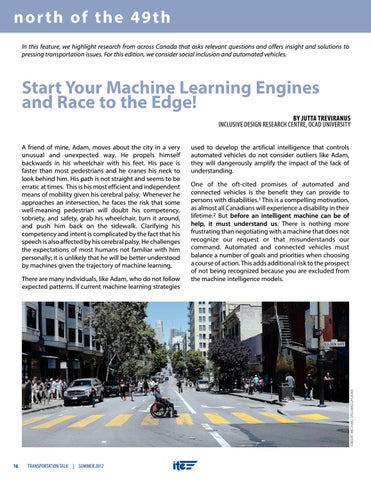
Start Your Machine Learning Engines and Race to the Edge! BY JUTTA TREVIRANUS INCLUSIVE DESIGN RESEARCH CENTRE, OCAD UNIVERSITY A friend of mine, Adam, moves about the city in a very unusual and unexpected way. He propels himself backwards in his wheelchair with his feet. His pace is faster than most pedestrians and he cranes his neck to look behind him. His path is not straight and seems to be erratic at times. This is his most efficient and independent means of mobility given his cerebral palsy. Whenever he approaches an intersection, he faces the risk that some well-meaning pedestrian will doubt his competency, sobriety, and safety, grab his wheelchair, turn it around, and push him back on the sidewalk. Clarifying his competency and intent is complicated by the fact that his speech is also affected by his cerebral palsy. He challenges the expectations of most humans not familiar with him personally; it is unlikely that he will be better understood by machines given the trajectory of machine learning.
One of the oft-cited promises of automated and connected vehicles is the benefit they can provide to persons with disabilities.1 This is a compelling motivation, as almost all Canadians will experience a disability in their lifetime.2 But before an intelligent machine can be of help, it must understand us. There is nothing more frustrating than negotiating with a machine that does not recognize our request or that misunderstands our command. Automated and connected vehicles must balance a number of goals and priorities when choosing a course of action. This adds additional risk to the prospect of not being recognized because you are excluded from the machine intelligence models.
CREDIT: MICHAEL STILLWELL/FLICKR
There are many individuals, like Adam, who do not follow expected patterns. If current machine learning strategies
used to develop the artificial intelligence that controls automated vehicles do not consider outliers like Adam, they will dangerously amplify the impact of the lack of understanding.
16
TRANSPORTATION TALK | SUMMER 2017
t ra ns p o r t at io n 1 0 1 Machine intelligence is formed by machine learning engines using training data. A variety of learning processes (whether supervised or unsupervised by humans) are employed to use data to create models from which the intelligent machines recognize patterns, formulate inferences, and make decisions. Accuracy is honed through feedback processes that identify and correct mistakes. The emergence of “Big Data” and connected sensors and monitors (e.g., smart phones, health and fitness monitors, security cameras, bio-sensors, connected vehicles, etc.) feed this machine learning, creating intelligence that is more comprehensive and detailed than ever before. “Big Data” inherits methods from quantitative, statisticsbased research. Data is “cleaned” or normed and thereby reduced to find dominant patterns and generalizable findings. This implies eliminating “noise” or outlying data that is assumed to be an anomaly that could muddy the conclusions. For automated vehicles, this data is used to recognize elements in the path and decide the best course of action. It is also used to recognize human commands. However, people with disabilities are, by definition, different from the norm. This difference, especially extreme difference, is predominantly treated as outlying data to be eliminated in the process of efficiently finding dominant patterns from which to make inferences.3 The effect of this data handling in machine decisions can already be felt in the failure to recognize impaired speech, process unusual requests, diagnose complicated illnesses,
REFERENCES & RESOURCES 1. Kelly, H. (2012). Self-driving cars now legal in California. CNN, updated Oct, 30. 2. Canadian Survey on Disability, 2012. A New Survey Measure of Disability: the Disability Screening Questions (DSQ) http://www.statcan.gc.ca/pub/89-654-x/89-654x2016003-eng.htm 3. O'Neil, C. (2016). Weapons of math destruction: How big data increases inequality and threatens democracy. Crown Books. 4. Treviranus, J. (2014). Leveraging the web as a platform for economic inclusion. Behavioral sciences & the law, 32(1), 94-103. 5. BIG IDeA in Action: Design Challenges - http://bigidea. one/2017/04/04/design-challenges/
accept unusual applications, or give security access through unexpected biometrics. As machine intelligence permeates our daily lives, this effect will drive a larger wedge of disparity between those that are served and those that are not understood, recognized, or served. The most pessimistic scenario is an exponentially amplified vicious cycle of exclusion for individuals already at the margins.3 There is a hopeful thread in this entangled and complex inevitability. As with all wisdom gained and substantiated by supporting precarious values such as accessibility and inclusion, we find that considering the edge benefits everyone. While it is more expedient to move quickly to dominant patterns, if we learn from edge scenarios and develop our intelligence by exposure and understanding of diversity and difference, we gain in the long run. Intelligence that understands diversity and stretches to encompass the outliers is more noise tolerant, better at predicting risk and opportunity, more capable of processing the unexpected, more adaptable, and more dynamically resilient.4 The Inclusive Design Research Centre has challenged machine learning innovators and developers to participate in a “race to the edge.”5 Participating universities and colleges will be creating a series of secret tests to see which machine learning engine can effectively and efficiently address scenarios and requests that are not typical or average. The most popular machine learning developers have expressed interest in taking up the challenge. The race will begin this October with the release of the secret tests and the results will be publicly available through the BIG IDeA website. It is hoped that this event will be one of many to enable more diversity supportive artificial intelligence. As we delegate more and more tasks and decisions to machines, it is important that we attend to what we teach machines. Do our machines understand and serve individuals that are different, or do they fail to recognize and thus ignore anyone that does not conform to the model of an average human?
Jutta Treviranus is a professor and the director of the Inclusive Design Research Centre (IDRC) (idrc.ocadu.ca) and the Inclusive Design Institute (inclusivedesign.ca) at OCAD University. She founded the IDRC in 1993 to proactively ensure that all emerging socio-technical practices are inclusive of the full range of human diversity. SUMMER 2017 | TRANSPORTATION TALK
17
exc ite you th su m m it
CREDIT: LAMBERT RELLOSA/FLICKR
CITIES OF TOMORROW CONFERENCE June 18-20, 2017 Calgary, Alberta
After months of preparation and planning, excite held the Cities of Tomorrow Conference this past June in Calgary, Alberta. The summit-style conference brought together excite members, executive members from Student Chapters, and early career professionals from across Canada to connect, discuss, and learn about the key elements required for building a future city. The organization of the conference sessions carried delegates through the design process – from the initial need to the final concept.
BY HEATHER GOODMAN PARADIGM TRANSPORTATION SOLUTIONS LTD.
emerging members in CITE
excite is a new initiative formed to help you get involved in CITE and develop in your profession. excite is for emerging members: whether you are a student or recent grad, early in your career, or just getting involved in CITE, this is the place for you to LEARN, CONNECT, CONTRIBUTE and GROW.
SPARK! The Welcome/Kickoff event focused on engaging delegates and sparking discussion around the problems of today and the challenges of tomorrow in the field of transportation. A Pecha Kucha session featured five presenters answering the question “What is a City of Tomorrow?” by highlighting emerging and innovative transportation trends in Calgary and beyond. Their 7 minute presentations included 20 slides shown for 20 seconds on topics ranging from autonomous vehicles in cities to designing not only for diversity but inclusivity.
WHY? In an ever-changing social and technological environment, new professionals need to be able to anticipate changes and adapt to new challenges to stay competitive and effectively serve the public. We need to “Unlock Our City” and provide solutions that meet the needs of the people who live in it, solutions that protect the environment and support economic vitality all while making it easier to involve the community. Speakers presented projects demonstrating innovative ways to involve the public and blend with the environment.
18
DESIGN… Traditionally, design follows a rigid process that doesn’t necessarily meet the needs of the user. As new professionals are confronted with more and more projects that don’t fit the box, they need alternative methods to develop a solution. The presenters in this session introduced innovative ways of approaching design: as a process, as a way of thinking, for the user, with nature, and for sustainability. Recognizing design is a fluid process, one can approach a project with these elements in mind to create an innovative solution to fit the needs of today and tomorrow.
OBSERVE With technology at our fingertips, it’s easy to quickly snap a few pictures, pull up a map on the internet, or drive by via Google street View. But how often do we take time to reconnect with the environment and simply observe the surroundings? During this session, delegates had the opportunity to walk through the East Village in Calgary and observe – walk for 100 steps and then look around and record for three minutes, and repeat 15 times.
TRANSPORTATION TALK | SUMMER 2017 ICONS MADE BY FREEPIK AND VECTORS MARKET FROM WWW.FLATICON.COM
c it ie s o f to m or row Participating Student Chapters • University of British Columbia • • UBC Okanagan • • University of Calgary • • University of Alberta • • University of Manitoba • • Lakehead University • • McMaster University
Mohawk College Ryerson University University of Toronto Carleton University Quebec ITE Student Chapter University of New Brunswick
Picture this: You’re walking down the recently constructed pedestrian and cyclist friendly River Walk on the shore of the Bow River, right next to the up and coming East Village. There are multiple bridges crossing the river – for vehicles, the C-Train, and pedestrians. Construction of new condo buildings and downtown is behind you in the distance. The area is swarming with activity. You take a few photos and leave. But what if you stayed just a little while longer? You notice pedestrians like to cut through the landscaping because it provides a quicker path to the water. Cyclists take the long route to cross the river because there are no bike lanes on the bridge with vehicle traffic. Cars park on the street because it’s closer to their destination than the parking lot. Some observations are difficult to make with only a snapshot in time and it may be hard to realize the scale of the area. The users of the area are there daily, weekly, monthly, while you only pass by for a few minutes. The extra time for observation can make the difference between a good design and a great design.
DO IT! Now the delegates had the opportunity to combine these ideas in the culminating event of the conference – a design project! Delegates were provided information about the community of Bridgeland, including demographics, problem locations, and community improvement requests. As the community was located close by on the north side of the Bow River, just outside downtown Calgary, delegates were given an hour to visit the site, select an area to redesign, and observe. Afterwards, two hours was all the time they had to develop a design and create a pitch for their project, with an added roadblock given halfway through. Although most groups focused
on the same area of Bridgeland, the designs varied greatly with innovative ways to bring the community together and tie into the natural environment such as community gardens, tobogganing events, and an outdoor stage. The designs strived to incorporate all road users; for example, bump-outs and raised crosswalks were proposed in the seniors' area of the community to assist with crossing the wide road. In the end, the judges – including a Bridgeland community activist – had the final say on the winning design. See photos from the event, including the winning team and judges, following this article. In addition to the speaker sessions and idea competition, the summit participants also attended the divers(city) public talk with a compelling panel discussion from Tamika Butler (LA County Bike Coalition), Paul Meunier (Federation of Calgary Communities), Roda Siad (Documentary Filmmaker and Researcher), Teresa Byrne (The City of Calgary, Festivals and Events), and Jordan Hamilton (Calgary Drop In & Rehab Centre Society). The panel discussion centred around the question “How does built form support diversity and inclusivity in Calgary?”, with speakers revealing past projects and initiatives that brought communities together, as well as barriers we still need to overcome. To CITE, thank you for providing the resources for excite to plan and host the Cities of Tomorrow Conference, a unique and exciting way for young professionals to become involved in all CITE has to offer. To the speakers and judges, thank you for your time and valuable input. Finally, to the organizing committee, thank you for all your time and effort to plan such a great event! Already looking forward to the next conference! Interested in joining CITE's emerging members group? Visit us at cite7.org/excite. By joining excite, you connect to a central resource to help find your place within CITE and the transportation profession!
Heather Goodman is a Transportation Consultant at Paradigm Transportation Solutions Limited and is currently pursuing her Master Of Engineering at the University of Toronto. She has a passion for traffic operations and transportation demand management (TDM), working towards the collective effort to reduce congestion and improve our cities. An excite member since its inception, Heather strives to engage students and young professionals to become involved in excite.
SUMMER 2017 | TRANSPORTATION TALK
19
exc ite you th su m m it
20
TRANSPORTATION TALK | SUMMER 2017
c it ie s o f to m or row
The judges and winning team of the DO IT! Idea Competition (L-R): Edward Soldo, CITE Vice-President (Judge); Ali McMillan, Bridgeland Riverside Community Association (Judge); Derek Napoli, Mohawk College; Erika Valecillos, Carleton University; Kelsey Waugh, LEA Consulting Ltd.; Heather Goodman, Paradigm Transportation Solutions Limited; Ryan Vanderputten, The City of Calgary (Judge); Brandon Bradt, Associated Engineering; Kris Kelly-Frère, The City of Calgary (Judge)
SUMMER 2017 | TRANSPORTATION TALK
21
my favo u r i te. . . In this feature, fellow CITE members share favourite transportation tidbits from across Canada. For this special edition, participants from the recent excite Cities of Tomorrow conference share their favourite...
...transportation promise of the future Kelsey Waugh, B.A.Sc.
Transportation Analyst, LEA Consulting Ltd. | Toronto, ON
Active Transportation and Complete Streets I am most excited about the promise of cities and towns building more complete streets and active transportation facilities into the future. I first learned about Complete Streets while at the City of Burlington and was immediately fascinated with this approach of designing streets – not merely as a conduit to pass by high speeds, but as a place for people to gather and enjoy. This approach is even more critical as we’re seeing more and more people who either can’t or don’t want to drive, making it incumbent on us to consider these, the most vulnerable, users first. I’ve seen first hand the social, economic, and health benefits that a Complete Street can have, and look forward to seeing more streets have transportation for all.
Anthony Kwok, B. Eng., EIT
Graduate Student, Carleton University & Transportation Designer, Morrison Hershfield | Ottawa, ON Whenever I think about the future of transportation, there are so many ideas that spring to mind, be it the development of autonomous and connected vehicles, designing complete streets, or promoting active transportation solutions to name a few. Although I do believe each idea will, in their own right, make a positive impact on our transportation needs for the present and in the future, I was inspired by my recent experiences at the inaugural excite conference to promise that all modes of transportation shall remain an accessible service for all regardless of their personal circumstances as we explore the future of transportation. My belief is providing mobility as an accessible service to all will contribute to promoting the liveliness and health of our communities.
Padma Priya Prabha Haridas, EIT, B.Tech
Student, Transportation Engineering Technology, Mohawk College | Hamilton, ON Transportation of the future must be multi-beneficial while utilizing the same resources. Such a major revolution in the field of transportation engineering is the Hyperloop. Hyperloop is a mode of high-speed transportation of freight and passengers in "pods" that are propelled through metal tubes at low pressure with a speed of 970 km/h. If Hyperloop becomes a reality, people will be able to travel longer distances in one-tenth of the time taken by current modes of transportation. This will reduce the use of cars and truck traffic and make roads much safer, thereby providing solutions to current traffic congestions and collisions. Researchers are also trying to produce electricity from the high speed that can be put back into the grid. Even though the initial costs for the project is very high, I see Hyperloop as the answer to many of our current transportation needs – an innovation leading to a sustainable earth.
22
TRANSPORTATION TALK | SUMMER 2017
my f avo u r ite. . .
Brandon Bradt, B. Eng. Mgt., EIT
Transportation Designer, Associated Engineering (Ont.) Ltd. | St. Catharines, ON My favourite transportation promise of the future is Vision Zero. Beginning in the progressive country of Sweden 20 years ago, it has been adopted by nearly every major city since then. I think the reason for the universal adoption is that almost everyone has been affected by a death or serious injury involving the transportation system. These deaths happen suddenly and unexpectedly, leaving friends and family trying to make sense of a situation where there is no sense to be found. If we as a profession remain conscious of the Vision Zero philosophy in our everyday work and we continue to leverage new technology then we can succeed in preventing the 1.25 million deaths and the millions of broken hearts that our roadways cause each year.
Jeff Pascua, B.Eng
M.Sc Student, Civil Engineering & Lakehead University Student Chapter President | Thunder Bay, ON My favourite transportation promise of the future has to be the increase of community awareness and inclusivity in transportation infrastructure and policy development. One notable example of this would be Thunder Bay’s new Active Transportation Plan, which details the establishment of additional safe shared-use trails within the city, among other changes. Community feedback was obtained using a variety of methods, ranging from the traditional open house to specialized events such as the 2017 Thunder Bay Bike Summit. What I observed and enjoyed the most was the innovation and effort that organizers and staff had to accommodate participants of every age - ranging from children who are riding for their first time to older adults who are looking for a new way to enjoy their city. Plans such as these, in my opinion, have really shown me that it is never too late to make a difference in your community, and that city growth genuinely comes from the people who participate within it.
Karen Reimann, EIT
Transportation EIT, Urban Systems Ltd. | Calgary, AB I see the future of transportation as one that encompasses sustainable design approaches, such as Complete Streets and Active Transportation, while integrating local context into a design. Having an inclusive mindset is the key for success in future transportation developments. For example, providing wheelchair ramps to a pathway near a senior community or controlling noise pollution from a highway near a new park are designs that are not only following sustainable transportation models but are also accommodating to the existing background. Either planning for new developments or rehabilitating existing neighborhoods, my expectation of the future is to focus on avoiding the isolation of different design elements and provide an inclusive attitude overall.
Have a topic idea? Want to be featured in a future edition? Contact us at communications@cite7.org! SUMMER 2017 | TRANSPORTATION TALK
23
TAC tidb i ts CITE has a strong partnership with the Transportation Association of Canada (TAC). One of our key contributions to TAC's technical projects is participation on a number of TAC councils and committees through CITE appointees. In TAC Tidbits, our appointees share updates about their committees from the spring TAC meetings.
Chief Engineers Council JOHN MCGILL
PAST CITE PRESIDENT The two day long Chief Engineers Council (CEC) meetings are the last of all technical meetings at TAC’s mid-year meetings and AGM. Day one is typically filled with interesting presentations that are reviews of events that have occurred, or perspectives on the future of transportation. For example, in the past few years we have heard about how many Cities, such as Winnipeg, dealt with the significant snowfalls that have occurred thanks to climate change, and how the Nipigon River Bridge in northern Ontario failed and how it could be repaired. We have been challenged to think about Big Data, the future impacts that might occur when autonomous and connected vehicles arrive, and to imagine a day when infrastructure is designed and constructed with little human interface. On the second day of meetings, we receive updates and approve the activities of all TAC's standing committees including the Asset Management Task Force, the Joint Active Transportation Subcommittee, and the following standing committees: Geometric Design, Maintenance and Construction, Pavements, Road Safety, Soils and Materials, Structures, Traffic Operations and Maintenance. Where else would one get such a complete overview of where all the transportation services within Canada are presented? The CITE/TAC relationship is a strong one and being provided a seat at the CEC is both a unique and rewarding opportunity!
Education and Human Resources Development Council MAUREEN VAN RAVENS
Manager of Transportation and Development Engineering, Town of Halton Hills, Ontario The EHRDC spring meeting focused on succession planning, skills needed by transportation professionals, and mental health issues in the workplace. There were three different presentations focusing on the overall skill sets of high school students, using video gaming to provide skills in transportation and mental health issues in the workplace. As part of the Spring meeting, EHRDC along with the TAC Foundation sponsored a TRAC Workshop for high school students. The program included the students breaking into groups and using a computer program to assist in designing a bridge. This was a highly successful workshop. EHRDC activities for the 2017 Fall conference will focus on the following: 1. High School Event. The organizing committee will invite 30 or so high school students to learn about the transportation field in Canada. 2. Three different technical sessions/panel sessions which include a TAC Transportation Theatre “Off-Broadway” discussion: ŰŰ “Understanding and Appreciating Different Stakeholder Views in Transportation” ŰŰ Mentoring – “Pave a Path for Canadian and Foreign Engineers for Advancement and Success” ŰŰ Technical Expert to Manager – “Tips on Successfully Navigating the Transition” 24
TRANSPORTATION TALK | SUMMER 2017
TAC t i d bit s Geometric Design Standing Committee MARCIA ENG
Senior Transportation Engineer, Urban Systems Ltd. The Geometric Design Standing Committee (GDSC) is one of seven technical standing committees of the Chief Engineers Council (CEC). The GDSC focuses on geometric design facilities for all modes of road transportation and its influence on capacity, operation, maintenance, safety, aesthetics, and environmental and social-economic impacts. Current projects, initiatives, and key discussion topics include: • 2017 Edition of Geometric Design Guide sub-committee is going through final comments for revisions and additions. Also exploring establishing reserve funding model for future updates to the MUTCD and the GDG. • Special Roads chapter (Low Volume) update – circulation to Revisions and Additions committee in June and targeting for Fall approvals • Road Safety professional designation – TAC representative will work with ITE to move forward with implementing a future professional designation program • Round table discussion on: ŰŰ Market conditions and key projects in different regions. Transit projects were consistent in most major regions representing the bulk of the funded projects. Other project themes included active transportation and cycling projects, road and infrastructure maintenance, safety and roundabouts. ŰŰ Emerging topics included in depth discussion of the impact of Climate Change: adaptations and resilient design and application of PIEVC (Public Infrastructure Engineering Vulnerability Committee), and a briefing of Connected Autonomous vehicles (CAV) and future impacts to design, regulations and the profession – currently a new working group established under TOMS.
Joint Active Transportation Subcommittee MARIAN MITHANI
Client Consultant, EcoCounter The Joint Active Transportation Subcommittee (JATSC) is a relatively new TAC entity. Its mandate is to share information about the work related to active transportation that is being pursued across TAC’s councils and committees. It membership is made up of representatives of other standing committees and councils. While it does not lead projects, it can inform the work of other councils and committees, to understand how their projects can influence and be affected by trends in active transportation. Current projects and initiatives on the JATSC radar are: • • • •
Strategic Opportunities for Integrating Health and Transportation Volunteer project to review regulatory practices that affect bikeway design An inventory of TAC AT resources Outreach to the TAC membership to raise awareness of JATSC and its mandate
JATSC is another forum for CITE to leverage work done by TAC to progress active transportation. Focal topics are active modes, complete streets, multimodal level of service, and automated and connected vehicles and vulnerable users.
SUMMER 2017 | TRANSPORTATION TALK
25
TAC tidb i ts Joint CV/AV Working Group ERIN TOOP
Senior Engineer, City of Edmonton The Joint CV/AV Working Group is under the Traffic Operations and Management Sub Committee (TOMSC) and is a relatively new group. Discussions are ongoing about whether the scope of the working group could expand to more broadly consider higher-level issues related to connected and automated vehicles (CAVs) like policy, planning, and design. Currently, the group focuses exclusively on operational issues. The Working Group has three sub-groups: • Conference Planning is developing sessions for the TAC Annual Conference. • Technical Activities is working to curate technical content for the working group and disseminate the information. • Project Idea Development and Initiation is identifying a project creation and submission process and soliciting project ideas. The Working Group heard presentations on updating the National ITS Architecture for Canada, an overview of spectrum related activities for CAVs (reserving radio frequency for V2I communication), and Transport Canada’s technical testing and evaluation priorities.
Road Safety Standing Committee PEDRAM IZADPANAH
Partner, CIMA+
The Road Safety Standing Committee (RSSC) had a lively meeting during the TAC Spring Meetings in Ottawa. The RSSC meetings generally include: • A review of the RSSC strategic plan; • Updates on the activities of subcommittees which are tasked to deliver various activities on behalf of the RSSC (e.g. Paper sessions, workshops and panel discussions, ideas for projects); • Guest speakers; and • Brainstorming breakout sessions to utilize the brainpower of all attendees during the meeting to move the agenda of the committee forward. The key highlights of the spring meeting are: • The RSSC is organizing a workshop on work zone safety during the Monday of the Fall Conference in St. John’s. The workshop will include a tour of work zones; • A panel discussion will be held on the applications of Unmanned Aerial Vehicles (UAV) on the Tuesday of the Fall conference; • The RSSC has sponsored a few paper sessions and there was a very healthy number of papers submitted; • The RSSC has sponsored a pool fund project entitled safety effects on cycling facilities. The project is seeking funding. It is anticipated that original research will be done in this project which rarely takes place in our industry; and • Road Safety Professional Designation has morphed into a North American concept and Transportation Certification Board in Washington DC is taking the lead with the support from ITE.
26
TRANSPORTATION TALK | SUMMER 2017
TAC t i d bit s Sustainable Transportation Standing Committee JUSTIN BAK
Project Lead, City of Toronto The Sustainable Transportation Standing Committee (STSC) is a standing committee under the Urban Transportation Council (UTC). The primary objectives of the STSC are to promote research, analysis, development, and application of sustainable transportation strategies, policies, tools, and practices for urban areas. Current projects include: • Strategic Opportunities for Integrating Health and Transportation jointly with the Transportation Planning & Research Standing Committee (TPRSC). The primary objectives of this project are to explore how health can be integrated into transportation planning, design, and decision making; explore how health is impacted by different modes of transportation; and suggest measures to strengthen the integration between health and transportation. The project has secured full funding and will be proceeding shortly. • Volunteer project on innovative practices in public participation in sustainable transportation. The primary objectives of this project are to identify challenges and opportunities for effective and efficient delivery of public and stakeholder engagement in planning, implementing, and operating sustainable transportation projects. • Volunteer project on legal and regulatory barriers to enabling bikeway geometric design and traffic control. The primary objectives of this project are to identify legal and regulatory barriers faced by jurisdictions in implementing on-road cycling facilities and identify how jurisdictions have changed law and regulations in order to implement modern bicycling facilities.
Urban Transportation Council JEN MALZER
CITE President & City of Calgary Urban Transportation Council (UTC) oversees several committees and is a good venue for its members to compare the trends and priorities in cities across Canada. Several themes certainly emerged, including customer service, LRT and complete streets construction, and vision zero. Montreal is demolishing aging freeways in favour of complete streets, and many cities are adding bike networks, lowering speed limits, and investigating new funding sources. Calgary, Vancouver, and Halifax are also reviewing their freight and goods movement strategies. Several presentations were made to UTC including project updates and one by Kornel Musci (City of Ottawa) on the evolution of complete streets. In his presentation, he described how, as a general rule, legislation lags our practices and designs. He noted several ways we are currently designing to be inclusive but that we may be asking users, like cyclists, to disobey rules and our city staff to stop enforcing them. As my last meeting representing CITE on UTC, I gave a presentation on Calgary's pedestrian strategy and how we piloted a temporary street configuration adding bike and pedestrian facilities as a possible form of public engagement. The street lab was received positively and is hoped that this approach may lead to better conversations and faster project delivery. UTC is also reviewing opportunities to better include autonomous vehicles (CV/AV Working Group) in a planning sense and asking how they can be leveraged to deliver complete streets. TAC is currently developing a strategic plan and has unveiled its new vision which is: transportation that makes Canada safe, healthy, and prosperous. They are reviewing their priority areas and have indicated that among them will be greater emphasis on engaging with young professionals. Certainly, there is support and opportunity on both the TAC and CITE sides for collaboration on technical projects.
SUMMER 2017 | TRANSPORTATION TALK
27
TAC tidb i ts Traffic Operations and Management Standing Committee (TOMSC)
JAMES DONNELLY
TOM BAUMGARTNER
JIM MALLETT
Transportation Engineer / Principal, Urban Systems
Transportation Engineer, Watt Consulting Group
President, Paradigm Transportation Solutions Limited
JEANNETTE MONTUFAR
GREG O'BRIEN
KELLY SCHMID
Founding Partner & CEO, MORR Transportation Consulting
Atlantic Practice Manager, Traffic Engineering and Transportation Planning, WSP Canada Inc.
Head, Northwestern Region Traffic Section, Ontario Ministry of Transportation
TOMSC had a dynamic and exciting meeting, covering a wide variety of issues. The Traffic Calming Guide Second Edition final report was presented to the TOMSC. A motion passed to present and forward the report for review by Chief Engineers Council (CEC). A presentation will be made to the CITE Technical Liaison Committee at the CITE conference in July 2017 followed by CEC and CITE Board to review final deliverable by letter ballot. Final report and deliverables to TAC August 2017. In addition, a number of other final reports were presented to the TOMSC inlcuding the “Update Canadian Model Rules of the Road”, “Speed Reader Display Guidelines”, the “Handbook of Recommended Information Signs and Symbols” and the “ITS Architecture Phase 1 Final Report”. All were recommended to be presented to the Chief Engineers Council. Other hot topics in transportation were discussed: • • • • •
City of Vancouver undertaking completion of Evergreen Line (11 km) resulting in 80 km Skytrain system. City of Vancouver planning $200 M viaduct replacement program. City of Calgary implementing $80 M diverging diamond interchange at McLeod Trail and 162nd Avenue. Winnipeg implementing its first Traffic Management Control Centre. Toronto has implemented Phase 2 of its Congestion Management Strategy and it involves the use of paid duty police officers for traffic control. • Montreal is experiencing political pressure to implement “No RTOR” policy. Investing $650 M in transit improvements. Also experimenting with paid parking app. • New Brunswick implementing EV charging stations along Trans Canada Highway. • Nova Scotia is twinning Highway 104 because of high collision experience.
28
TRANSPORTATION TALK | SUMMER 2017
TAC t i d bit s
One of the presentations, given by Dr. Garreth Rempel, was about TRAINFO. This is a live railway crossing blockage information system that provides immediate notifications when a crossing is blocked and predicts when it will clear. The system uses proprietary, trackside sensors that are installed off rail property to determine when a crossing is blocked. Patented, machine-learning algorithms confirm blockages and predict when the crossing will clear. The information is delivered to smartphones, roadside VMS, traffic management centers, emergency dispatchers, and others. According to Dr. Rempel, TRAINFO can help reduce congestion, improve safety, and save money by assisting issues such as: prioritizing infrastructure investments, managing traffic, selecting railway crossing improvements, and reducing collision risk. The system is currently operational in Winnipeg and Vancouver, and new installations are already planned for other major Canadian and U.S. cities Finally, progress reports for a number of ongoing projets were provided: • 310 - Investigation of Potential Benefits and Applicability of Wider Pavement Markings (test sites selected) • 317 - Update to “Guide for the Design of Roadway Lighting” • 342 - Training Program on Traffic Signal Modelling (model training session undertaken at Ryerson, further training development and exploration of partnerships underway) • 344 - Guidelines for the Use of Retro-Reflective Sign Post Enhancement • 347 - Update ITS Architecture - Phase 1 (consultant selected, project underway) • 255 - Transit Priority Signal Sign (now undergoing comprehension testing) • 330 - Standardization of Agricultural Vehicle Warning Signs (now undergoing comprehension testing) • 339 - Use of Fluorescent Yellow-Green Crosswalk Signs as a Standard Device • 345 - U-Turn Signal Indication • 346 - Modernization of Tent Camping Sign Symbol (now undergoing comprehension testing) In addition to participation in the TAC meetings, your CITE appointees are also involved in a variety of TOMSC projects: TOMSC Project 243 - Redesign of Graphics of WC-8, WC-12, WC-17 276 - Review Transport Canada Report on Passing Sight Distance 321 - Best Practice Guide for Street Name Signing 326 - Warrant for Traffic Signals at Intersections in Close Proximity to RR Grade Crossings 336 - Red Arrow Signal 339 - Adopt the Use of Fluorescent Yellow-Green Pedestrian Crosswalk Signs as a Standard Device in the MUTCDC 346 - Modernization of the Tent Camping Sign 348 - Anti-Whistling Sign for Railway Crossings with a Whistling Cessation
Project Lead G. Cuthbertson Alan Aitken Greg O’Brien Alf Guebert
349 - Enhanced RB11S2 Supplementary Tab Sign
D. Beaulieu
CITE Appointees Greg O’Brien Tom Baumgartner Greg O’Brien Jeannette Montufar
W. Chou Greg O’Brien T. Koutroulakis Greg O’Brien R. Hird Heide Shlegl
Kelly Schmid Jim Mallett Greg O’Brien James Donnelly
SUMMER 2017 | TRANSPORTATION TALK
29
me mb er h i g h l i ght
RYAN MARTINSON
P.ENG.
Current employment Stantec, Associate – Sustainable Transportation Education • University of Calgary, 2014, M.Eng. • University of Calgary, 2005, B.Sc. First job in transportation engineering Transportation Data Collection and Analysis Current city of residence Calgary, Alberta Family Wife: Jen, Abby (7) and Noah (5)
How long have you been involved with ITE? Since 2005 I've been a regular conference attendee, but my involvement increased notably after I presented for the first time at a CITE conference (Halifax 2011) and met Jim Gough. He got me involved with the Sustainability Standing Committee of ITE.
CITE INVOLVEMENT When did you first attend a CITE event? One of my first CITE memories is when I presented my fourth year project at the Student Paper Competition luncheon in Calgary. The reason this was such a memorable moment was because I met my future boss (Glen Pardoe) there and struck up a conversation about my presentation on Aggressive Driving. Shortly after that, I was helping with data collection at his firm and then offered my first engineering job a few months after. What is your CITE involvement (past and present)? I have been actively involved with the ITE for a number of years (since 2011). I have been able to contribute to the Canadian District through conference organization committees (Calgary 2013) and recently with the emerging members group (excite) and, through that position, sitting on the Technical Liaison Committee.
30
TRANSPORTATION TALK | SUMMER 2017
Personal hobbies Reading, drawing, making comics and movies with the kids, camping, playing music, volunteering! What positions have you taken on as a member of ITE? excite Innovation Chair and member of the Technical Liaison Committee; Executive Member of the ITE Complete Streets Council; and Chair of the ITE Sustainability Standing Committee
My ITE involvement has me currently helping out with the ITE Complete Streets Council, co-developing, with my colleague Tyler Golly, a practitioner guide on protected bikeway design. I am also chairing the Sustainability Standing Committee where we are discussing ideas like Mobility Hubs, Resilience, Equity, and the State of the Practice with regards to Sustainable Transportation. What do you value most about your CITE membership? The opportunities to contribute to the advancement of our profession and the amazing people I meet at the yearly conferences. PROFESSIONAL EXPERIENCE/ACHIEVEMENTS How would you describe your job to someone you just met at a party? I’m a transportation engineer who works on projects that are focused on walking and biking… usually that’s
m e m b e r hig h light
where it ends, but if they ask one more question, then they get an earful! I get to work on projects that improve the equity of transportation options to people of all social, economic, and mobility needs; I work on changing the world to make sure it’s awesome for my kids, and their kids to come, by thinking about optimizing our transportation system which usually means making walking, biking, and transit options fantastic; I love to think about transportation as a really messy system (watch out, I might get started on systems thinking) where we will be able to find better answers to problems if we engage community members and look for collaborative solutions; and NO, I can’t change that traffic signal timing that really drives you bonkers. What is one aspect of your work that you particularly enjoy? Talking to people. Usually this includes working with the public or colleagues to tease out values or issues that we can do a better job of addressing in our designs. I also love giving lectures at the University of Calgary for third and fourth year students as well as some graduate student courses. The mixing of theory and practice is so fascinating and I love to be able to teach or coach people who are as inquisitive as I am about the world. What are one or two projects that you're most proud to have worked on? I’ve been lucky enough to work on projects that have provided new design guidance for engineers to use when designing walking and biking infrastructure (e.g.,
“
Changing the rules we use to design our cities and the way we define success are great ways to help make change occur
"
Complete Street Design Guidelines) for a few municipalities and regions. I was also a co-author in the International Walking Data Standard with some amazing people in the Walk21 network. Changing the rules we use to design our cities and the way we define success are great ways to help make change occur. Implementing projects that change people’s lives for the better is also extremely rewarding and I got to experience that recently with two projects that involved implementing a brand new separated bike network in the downtown areas of Calgary and Edmonton. During your career to date, have you pursued any professional designations through ITE (such as PTOE)? Not through ITE, but I have completed training for public engagement through the International Association of Public Participation. Please describe what attracted you to the transportation profession? I love the idea of physical infrastructure that is designed and built which respects human behavior and experiences. That was my first realization that this was cool stuff; it was more dynamic than concrete or steel design (I was originally planning on being a structural engineer… designing bridges, of course!). If asked to speak to a class of engineering or planning students, how would you recommend it as a profession? I have a lecture on this, actually. I relate it to the Lego Movie and the idea that we should be striving to be Master Builders and not be bound to instruction booklets. In that class, we focus on the human aspects of why we do what we do and what goes on in our heads, hearts, together with the motivations, needs, and wants that we have. Projecting yourself into the future, from an end-ofcareer perspective, what will you hope to have accomplished? Ideally, I’ll be out of a job in the next ten years; at least, a job that is needing to push Complete Streets design and principles like Vision Zero so regularly and strongly. I’d love to continue to work with communities and organizations that are keen on making the world a better place now and into the future. Continued on page 32... SUMMER 2017 | TRANSPORTATION TALK
31
me mb er h i g h l i ght What is the single greatest satisfaction you take from your job as a transportation professional? I love talking with people. It could be talking about: a project that is being planned in their neighbourhood; a project that a client is working through; a student just getting interested in transportation; a colleague wanting to talk about ‘big’ issues like equity, gendered transportation systems, or morality issues with technological fixes… There is so much to learn from everyone else’s experience and perspective, which is wonderful when you are a very curious person like me. What is the first thing people most commonly ask or say when they find out you are a transportation professional? “Really, you’re an engineer?!” GETTING TO KNOW YOU If you did not pursue engineering as a career choice, did you have another career in mind? Not really… since Grade 5 I wanted to be Civil Engineer.
What is the last book that you read or are currently reading? I haven’t finished a book in a while. I have a massive stack on the go, covering topics like Indigenous Leadership, Systems Thinking, Game Theory, Sustainability, Ethics, Morality, Design Thinking/User Experience, Critical Thinking, Comic Book Drawings… so pretty light reading! INTERESTS & PERSPECTIVES Who has had the greatest influence on your life and career? Everyone! My teachers in school all played really interesting roles that I reflect on now. My parents obviously helped guide me. I’ve had great mentors and colleagues who are always available to bounce ideas around with. And, last but not least, my wife and kids have had an amazing effect on me and the way that I see the world. If you could change one thing about the practice of transportation engineering, what would it be? I don’t think it would be fair to tell someone to ‘change’, but I do think our profession could spend more time making observations of how people use and interact on a street, from the quantitative to the qualitative, and devote more time to talking with the public, our major stakeholder, about their desires and values. Through this process, I believe we will have a larger capacity for empathy of all users of the transportation system and be able to think about the biases that we bring to the design or decision making. Ultimately, this may lead to a more inclusive society. What is the greatest opportunity you see for the field? Our society, I feel, is really starting to reflect on where we are in the world and the nature of our polarizing social discourse. I think this might move us to some really heavy dialogues around topics like equity, inclusion, power, control, and gender that don’t usually make it into the day-to-day discussion of engineers. The role that transportation professionals play in planning, prioritizing, designing, and implementing transportation infrastructure could (and some will strongly argue "should") take these really heavy issues to heart and have them more explicitly incorporated into the work that we do on a daily basis.
32
TRANSPORTATION TALK | SUMMER 2017
Next Generation Integrated Mobility: Driving Smart Cities Opportunity exists on transportation’s cutting edge. Tap into
the potential by attending ITS World Congress 2017, where the newest information—on connectivity, infrastructure, Smart Cities, security, systems integration, business models and more—will provide the advantage needed to anticipate change, respond to demand and navigate effectively in the rapidly moving marketplace. Gain insights, exchange ideas, work through solutions and acquire strategies for deploying technology at dynamic education sessions, presented by the industry’s best thought leaders, transportation experts and technology pioneers.
REGISTER TODAY AND SAVE UP TO 20%:
www.itsworldcongress2017.org |
#THISisITS
t ra ining com m i t te e u p d ate
Opportunities Available with CITE's New Training Committee The new CITE Training committee will be meeting at the Joint ITE/CITE Annual meeting in Toronto. This committee was been formed to increase the awareness and availability of training opportunities for Canadian transportation professionals by overseeing the development and delivery of training initiatives. The Training Committee is comprised of Canadian Institute of Transportation Engineers (CITE) members who are responsible for prioritizing, selecting and organizing training opportunities for transportation professionals across Canada. We are looking for some additional committee members (1-2 people) from different regions of Canada. We have representatives from Ontario and Alberta at this point. If you are interested in joining our committee, please send a letter of interest, a resume, and a letter indicating support from your employer to training_committee@cite7.org.
Current members of the committee are: Chair - Vanessa Skelton is a professional engineer with 20 years’ of experience, specializing in traffic operations, transportation planning, environmental assessment and design. She is currently working for AECOM in Ottawa and has worked in consulting in Montreal and Toronto. As a senior transportation engineer, she is responsible for project management, traffic and transportation engineering and environmental planning for assigned projects. She is also involved in business development for the transportation planning group and is bilingual. She has led traffic engineering and transportation planning studies for municipalities across Ontario as well as in Quebec and Nova Scotia. She has performed traffic operations analysis for many municipalities ranging from rural communities to large cities with suburban and urban environments where she has been involved in large scale traffic assessments. Her experience includes the analysis of networks with traffic signals, stop controlled intersections and roundabouts. She regularly contributes to preliminary and detailed design assignments. She has performed operational analyses and prepared functional design plans for mini-roundabouts, single lane roundabouts and two-lane roundabouts. Outside of engineering, Vanessa is active in leadership roles in community organizations including 33 years in Girl Guides, 16 years as a competitive soccer coach and as a basketball club manager. She has been involved in the organizational level for the Girl Guides as the District membership director, public relations director and annual conference organizer. She has acted as the referee coordinator for the Soccer Club for several years and was a member of the municipal Library Board that helped to consolidate the ageing and inefficient library branches through the construction of a new central municipal library.
34
TRANSPORTATION TALK | SUMMER 2017
tra i ning co m m it te e u p d ate Vice-Chair - Mehemed Delibasic is a Professional Engineer with 18 years of extensive engineering experience in the transportation sector. Mehemed holds a Bachelor and Master of Science degree in Traffic/ Transportation Engineering and currently is the Manager of Transportation Planning at WSP Canada Inc. Mehemed has shown ongoing initiative, leadership and dedication to the engineering profession as he has made a measurable impact over the past 15 years as a volunteer for transportation engineering and passionate advocate for engineering profession, new engineering graduates, and internationally trained engineers. Mehemed is a member of various engineering organizations, having served as the Past President of the Institute of Transportation Engineers (ITE), Toronto Section. In addition to the Training Committee (Vice Chair) of the Canadian Institute of Transportation Engineers (CITE), Mehemed serves as member of the Transportation Planning Committee of the Ontario Traffic Council (OTC) and participates in the Urban Transportation Council of the Transportation Planning and Research Standing Committee of the Transportation Association of Canada (TAC). As a professional engineer, Mehemed has been a dedicated volunteer for Ontario Society of Professional Engineers (OSPE), having served with the Political Action Network (PAN), Professional Development and Career Centre Services (PD / CS) Committee, and the Ministry of Citizenship and Immigration Employers’ Advisory Committee. Currently, Mehemed is also serving as the Chair of OSPE’s Infrastructure Task Force. Member - Maryam Tabeshian is a Transportation Planning engineer with over 4 years of experience in the field of transportation planning, traffic engineering and operations, active transportation, traffic modelling and traffic simulation. Throughout her carrier Maryam has been involved in developing transportation master plans and transportation policies for area structure plans and outline plans as well as performing network analysis and intersection capacity analysis during subdivision planning processes. She is also experienced in using traffic analysis software including Synchro/ SimTraffic, Sidra, HCS as well as traffic modelling and simulation software such as Visum and Vissim. Maryam has also been involved in various studies including
transportation impact assessments, parking studies, functional design, traffic modelling and traffic simulation. The Training Committee is the liaison between the CITE membership, the CITE Executive and Board of Directors, the CITE Technical Liaison Committee, and partner organizations for training. Since the Training Committee is primarily a coordinating body tasked with providing opportunities for training to CITE members, it typically does not get involved with the development of specific training materials or delivery of the actual training sessions. Individual members of the Training Committee can be involved in the preparation of materials and delivery of the training sessions as appropriate. We just started at the end of 2016 and are looking forward to serving the needs of the CITE community. More information, including the Committee's terms of reference, is available at cite7.org/research-training/ training.
TNICO is proud to introduce TAPCA The world’s best, digital Traffic and Pedestrian Counting Application to replace the current process of pen, paper and hand clicker counter.
Your Traffic COUNTS.
TAPCA is a professional,
proven, advanced traffic data collector designed for use by: • All levels of Government • Engineering Consultants • Developers • Census takers • Educational facilities • Anyone requiring traffic data collection
For more information on how to make “Your Traffic Counts”, visit our website at www.tapca.ca or email us, info@tapca.ca.
SUMMER 2017 | TRANSPORTATION TALK
35
Building Better Communities
Associated Engineering specializes in:
A Carbon Neutral Company
•
Transportation & Urban Planning
•
Intelligent Transportation Systems
•
Infrastructure Design
•
Asset Management
•
Transit Management Systems
Associated Engineering provides consulting services in planning, engineering, landscape architecture, environmental science, project management, and asset management. We specialize in the transportation, infrastructure, water, environmental, energy, and building sectors. Our holistic approach considers climate change impacts to create sustainable and resilient solutions.
www.ae.ca
ARE YOU THE FUTURE OF TRANSPORTATION? Are you ready to accelerate your career and be a strong leader in this dynamic environment? LeadershipITE is an international program to identify, engage, and develop the next generation of transportation leadership. Participants hone their skills through interactive workshops, active problem solving and engagement with association and national leaders. Graduates leave with a broadened leadership perspective and the skills to engage in their communities and shape the future of their transportation careers, organization, and profession. Join this diverse group of transportation professionals to: Enhance your leadership skills Collaborate in team building exercises
Mike Bittner, PE, PTOE, PTP Traffic Engineer / Transportation Planner KLJ
“Networking was what I enjoyed most about my LITE experience. LITE allowed me to create a network of friends, who are also colleagues, from around the country and industry. Other great aspects of LITE are educational benefits, ability to help make strategic changes to ITE and having my employer fly me to exciting destinations for each meeting!”
Andy Kaplan
Assistant Manager, Agency Operations Center Port Authority of New York and New Jersey “The LeadershipITE program provided me an incredible opportunity to learn from and network with professionals throughout the United States and Canada. This experience helped me to identify best practices and emerging trends, allowing me to bring them back to my community to better serve their transportation needs.”
Engage in transportation policy issues Build professional relationships LeadershipITE is seeking transportation professionals who demonstrate a capacity for leadership, and engagement, as well as concern about the future of the transportation profession. To stay up-to-date on the latest LeadershipITE activities send a note to leadership@ite.org. For more information and to apply to LeadershipITE, visit www.ite.org/Leadership.
Application deadline for the class of 2018 is September 15, 2017.
Eric Claussen, PE, PTOE, PTP City Traffic Engineer City of Springfield, Missouri
“LeadershipITE is a comprehensive program that taught me essential leadership characteristics that I can directly attribute to advancement in my career. Through the program, I was able to build life-long friendships and a network of other professionals that I can go to for suggestions, solutions, or just encouragement. In that regard, the program has a significant benefit to my employer, as well. Rather than just one perspective, the City is receiving the expertise of professionals across the US and Canada.”
Carrie Falkenrath, PE, PTOE, PTP Transportation Engineer & Planner, Owner T2 Traffic & Transportation
“One of the best facets of LeadershipITE for me was (and is) the exchange that happens between the program participants and the individuals leading the ITE organization: the staff at ITE Headquarters, the International Board of Direction, and Council and Committee Chairs. It is a fantastic opportunity for both groups to learn from the other why decisions are made and what impact they have on our members throughout the organization worldwide. New ideas are hatched and current initiatives are made stronger by input from the grass-roots levels.”
cong ratul ati on s & we l co m e CITE extends a warm welcome to all new Canadian District ITE members who recently joined us! Rabiya Abdulkadir, E.I.T., Saskatchewan Ministry of Highways and Infrastructure, Regina, SK Scott Anderson, City of Mississauga, Mississauga, ON Maksim Apelfeld, J.L. Richards & Associates Limited, Ottawa, ON Michelle Berquist, City of Mississauga, Mississauga, ON Yuwei Bie, University of Alberta, Edmonton, AB Susan Boot, P.Eng., Ministry of Transportation of Ontario, St. Catharines, ON Ian Borsuk, Dillon Consulting, Ottawa, ON Christina Bouchard, IBI Group, Toronto, ON Charlotte Brockman, P.Eng, PMP, Saskatchewan Ministry of Highways and Infrastructure, Saskatoon, SK Rob Bushman, P.Eng., Saskatchewan Ministry of Highways and Infrastructure, Saskatoon, SK Peter Kelvin Chen, University of Waterloo, Waterloo, ON Paulina Chiacchia, University of Calgary, Calgary, AB David Copp, University of New Brunswick, Welsford, NB Lucas Demysh, Metallurgical Sensors Inc., Milton, ON Navreet Dhaliwal, Burnaby, BC Bojana Eberts, P.Eng., Saskatchewan Ministry of Highways and Infrastructure, Regina, SK Olaitan Edu, University of Ottawa, Hamilton, ON Hamed Esmaeeli, Concordia University, Montreal, QC Zarahnaaz Feroz, University of British Columbia, Kelowna, BC Max Gill, City of Mississauga, Mississauga, ON Michael Goorovich, Regional Municipality of York, Sharon, ON Mahmoud Halfawy, P.Eng., Saskatchewan Ministry of Highways and Infrastructure, Regina, SK Evan Hammer, University of British Columbia, Vancouver, BC
38
TRANSPORTATION TALK | SUMMER 2017
Cole Hendrigan, City of Red Deer, Red Deer, AB Benedict Ho, University of Waterloo, Waterloo, ON Jennifer Hostland, Steer Davies Gleave, Vancouver, BC Alexandra Hoy, University of Manitoba, West St. Paul, MB Syed Imran, P.Eng., Saskatchewan Ministry of Highways and Infrastructure, Regina, SK Garry Johnston, P.Eng., Strathcona County, Sherwood Park, AB Ahmed Kabir, Ryerson University, Toronto, ON Stacy Kaufmann, P.Eng., Saskatchewan Ministry of Highways and Infrastructure, Regina, SK Bill Kenny, P.Eng., Alberta Transportation, Edmonton, AB Josh Kerr, E.I.T., Saskatchewan Ministry of Highways and Infrastructure, Regina, SK Javed Khan, City of Mississauga, Mississauga, ON Karalee Klassen-Townsend, University of Manitoba, Winnipeg, MB Zvjezdan Lazic, P.Eng., Saskatchewan Ministry of Highways and Infrastructure, Saskatoon, SK Alex Lee, McGill University, Markham, ON Ian Lindley, Ryerson University, Brampton, ON Andrew Liu, Saskatchewan Ministry of Highways and Infrastructure, Regina, SK Ben Liu, P.Eng., Saskatchewan Ministry of Highways and Infrastructure, Regina, SK Doug Macyshon, Saskatchewan Ministry of Highways and Infrastructure, Regina, SK Fadi Madi, Toronto, ON Mark Magnus, EIT, Saskatoon, SK Erin Medforth, Stantec Consulting Ltd., Saskatoon, SK Larissa Moreira Costa, University of Calgary, Calgary, AB Maddison Murch, University of Waterloo, Kitchener, ON Jason Neudorf, WSP, Toronto, ON Reza Omrani, CIMA Canada Inc, Burlington, ON
con g rat u l at io ns & we l co me Graeme Patrick, University of Saskatchewan, Saskatoon, SK Colin Patterson, City of Mississauga, Mississauga, ON Mike Pearsall, P.Eng., Ministry of Transportation of Ontario, St. Catharines, ON Julian Petras, E.I.T., Saskatchewan Ministry of Highways and Infrastructure, Saskatoon, SK Mohammad Rahman, Carleton University, Ottawa, ON Keyvan Rangin Kaman, University of Waterloo, Toronto, ON Jack Ready, Mohawk College, Hamilton, ON Harold Retzlaff, P.Eng., FCSCE, Saskatchewan Ministry of Highways and Infrastructure, Regina, SK Ajhay Sathiyanarayanan, Concordia University, Montreal, QC Brendan Schlamp, E.I.T., City of Lloydminster, Lloydminster, AB Rehan Shakeel, Mohawk College, Hamilton, ON Shiva Shrestha, P.Eng., Saskatchewan Ministry of Highways and Infrastructure, Regina, SK Yusuf Soliman, University of Alberta, Edmonton, AB Tamara Soltykevych, P.Eng., Alberta Transportation, Edmonton, AB Areta Switucka, E.I.T., Saskatchewan Ministry of Highways and Infrastructure, Regina, SK Susan Tanabe, City of Mississauga, Mississauga, ON
Mahinsasa Tennakoon, P. Eng., Saskatchewan Ministry of Highways and Infrastructure, Regina, SK Sahar Tolami, BA Group, Toronto, ON Ana Maria Torres, Bunt & Associates Ltd., Calgary, AB Sandro Torresan, City of Mississauga, Mississauga, ON Bryan Tran, University of Alberta, Edmonton, AB Ron Turcotte, P.Eng., Ministry of Transportation of Ontario, St. Catharines, ON Mark Vandersluis, City of Mississauga, Mississauga, ON George Vayali, P.Eng., City of Calgary, Calgary, AB Pamela Visaya, University of British Columbia, Kelowna, BC Blair Wagar, Saskatchewan Ministry of Highways and Infrastructure, Regina, SK Keera Wang, University of Manitoba, Winnipeg, MB Erica Warsh, City of Mississauga, Mississauga, ON Steven Werner, University of British Columbia Okanagan, Kelowna, BC Justin White, P.Eng., Ministry of Transportation of Ontario, St. Catharines, ON Melvin Wong, Ryerson University, Toronto, ON Tyler Xuereb, City of Mississauga, Mississauga, ON
Connect with CITE and your fellow members! twitter.com/itecanada linkedin.com facebook.com/itecanada
Find news and events from across the country on our website:
cite7.org
SUMMER 2017 | TRANSPORTATION TALK
39
se c tio n n ews GREATER VANCOUVER SECTION The Greater Vancouver Section of ITE has had an eventful spring of 2017 with four events happening. The first event of this quarter was a breakfast meeting with Paul Lee, who’s the Acting Project Director of Surrey LRT and shared his experience and perspective on the project with an update on the planning and design of the region's first at-grade, urban-styled rapid transit initiative. The second event of this quarter was held in April. It was a lunch meeting which marked the 1-year anniversary of when TransLink first started to close its faregates and adopt the Compass card for use by the general public. During this time, nearly 2 million Compass cards have been issued, and Compass is used to pay for over 95% of all fares. Most people interact with Compass by loading their cards at vending machines or online, and tap the various Compass devices around the region, but how does it all work? Tom and William, systems engineers from TransLink who worked on the Compass project, delivered a presentation that answered some of these questions. The presentation was based on questions received
from the GVITE community, and covered topics including fare calculations, business rules, and data collection. The third event of this quarter was a lunch meeting with Clark Lim who expanded on some of the themes presented in his Internet of Transport Things (IoT2) talk from last year. Throughout history, man's innovations resulted in key technologies that represent a marker for each human era. The constant evolution of technologies combined with fundamental needs creates industries with a cycle of birth, peak and death. "Disruptive" innovations are the "engines" of these cycles and the discipline of engineering is the source of many of these "disruptive" innovations. However, the rate of innovation and change is approaching unprecedented levels. Innovations, such as autonomous vehicles, big data, and artificial intelligence, have the potential to significantly change the transportation engineering industry. Clark’s presentation led the discussion on “Will our industry become a victim of disruption, or be able to change and adapt to the future? If so, what can we do to transform our industry and our profession?”
Left: Paul Lee on the Surrey LRT Bottom left: Tom and William (TransLink) on the Compass card Bottom centre: Clark Lim on the Internet of Transport Things Bottom right: The YVR 2037 Master Plan discussed at a breakfast meeting
40
TRANSPORTATION TALK | SUMMER 2017
The last event of this quarter was a breakfast meeting discussing the YVR 2037 Master Plan. It is the Vancouver Airport Authority's 20-year plan for guiding the development of the Vancouver International Airport. This presentation discussed all aspects of the Master Plan, including the consultation process, terminal plans, airside and airspace, ground access, the natural environment, community amenities and land use planning.
s e c t io n news BC INTERIOR CHAPTER Imagine Harvey Avenue Community Event On May 29th, the BC Interior Chapter of ITE held a community conversation to discuss possibilities for how Harvey Avenue (Highway 97) through downtown Kelowna could be re-imagined from the perspective of sustainable design. The event was held in collaboration with the Imagine Kelowna team from the City of Kelowna, and with the University of British Columbia’s Okanagan Campus. The event featured two guest speakers, Peter Van Rijn and Marc Verheijen from Rotterdam, Netherlands, who spoke about their research and experience in how sustainable design is being applied to the highway ring roads in their home city. Their knowledge and passion helped to inspire a discussion of ideas of what could be done differently in Kelowna to make Harvey Avenue a more vibrant, sustainable and attractive place to come to. The Imagine Harvey Avenue event was catered to a broader audience than typical CITE events in which the public was invited to attend and participate. The event was published in the local news, shared through social media, and an interview held with our guest speakers on CBC Daybreak Radio to draw a more public audience. Key interest groups including the City of Kelowna and the Ministry of Transportation and Infrastructure attended and were interested to hear the ideas and conversations of community participants. Overall, the event attracted 95 participants and was effectively sold out (tickets were free with donations to the Okanagan Rail Trail Initiative). The planning committee was instrumental in making Imagine Harvey a success and it is important to recognize those who helped. These individuals include Gordon Lovegrove, Rafael Villarreal, Ellen Morrison, Peter Truch, Ian Roth, Karen Reimann, and our many other volunteers on the day of the event. The BC Interior Chapter looks forward to planning its next mini-conference event in the Fall of 2017 and hopes to organize similar community conversation events in the future.
SUMMER 2017 | TRANSPORTATION TALK
41
se c tio n n ews LETHBRIDGE CHAPTER During Spring 2017, the ITE Lethbridge Chapter has continued their monthly luncheon series on transportation topics and has enjoyed sustained interest from local transportation professionals in both the public and private sectors. On Tuesday, March 21, the City of Lethbridge invited members of the ITE Lethbridge Chapter to join them in participating in the Transportation Research Board (TRB) webinar, Mini-Roundabouts: Is the U.S. Ready to Take Advantage of Their Benefits?, which featured presenters who applied mini-roundabouts to relieve congestion or address safety problems. The webinar was held at the City of Lethbridge Stafford Building and was well attended. The chapter’s April 24th luncheon featured the topic, Geotechnical Challenges of the Scenic Drive North Construction, which was presented by Trevor Curtis, P.Eng., a geotechnical engineer with Tetra Tech. The presentation highlighted a local arterial road extension
that crossed two coulee ravines with deep fills of up to 35 m thick. Trevor discussed how the project team overcame the significant geotechnical challenges of the project, which included addressing deep fill settlements, slope stability issues, and optimizing the embankment design to minimize construction costs. Finally, prior to breaking for summer, the chapter met on Wednesday, May 24, to watch the recorded webinar, BIKETORIA: How the City of Victoria Aims to Be One of the Best Small Cities in the World for Cycling, from Simon Fraser University’s Next-Generation Transportation Webinar Series. The webinar discussed how the City of Victoria recently made an unprecedented commitment to building a world-class cycling network that is comfortable for people of all ages and abilities. As the City of Lethbridge has recently been taking steps to develop a Cycling Master Plan, the webinar was of particular interest to attendees and was followed-up by a group discussion on cycling in the context of Lethbridge.
NORTHERN ALBERTA SECTION Luncheons The Northern Alberta chapter of CITE concluded another successful luncheon season. In April, we co-hosted a luncheon with APPI that included a presentation by Rokib Sa and Jun Yang, both of Alberta Transportation, on the social and economic impacts of investment in Alberta’s highway network. In May, Dr. Ali Hadayeghi, Ph.D., P.Eng., of Cima+, visited us from Toronto and presented on a high occupancy toll lanes which included a case study of Highway 427 in Toronto. We wrapped up our season in June with a presentation by Corry Broks, P. Eng., Al-Terra Engineering, on modern roundabouts. Traffic Bowl Tune-Up In May, NACITE partnered with the U of A Student Chapter and hosted a Traffic Bowl Tune-Up at Devanay’s on Campus. The event was attended by about 20 students and professionals, including members of the U of A’s 2017 Traffic Bowl Team. Participants were grouped into five teams with each team
42
TRANSPORTATION TALK | SUMMER 2017
s e c t io n news
Northern Alberta Section technical bike tour
having at least one student with two or three professionals. The teams were challenged with skilltesting questions related to transportation planning and engineering and ITE. There were some right answers, more wrong answers than we’d like to admit, and lots of laughs.
islengineering.com Connect with us
®
First Ever Technical Bike Tour To celebrate the completion of Edmonton’s Downtown bike network, NACITE hosted its first ever technical bike tour in early June. About 20 cyclists ranging from commuter cyclists to casual riders from various backgrounds (public and private sector transportation professionals, community league members, and passionate cyclists) gathered downtown to embark on a trek across the City. The tour started in the Quarters area of downtown and moved through the newly constructed downtown bike grid, the Legislature grounds, across the High Level Bridge, Whyte Avenue, the 83 Avenue bike corridor, and back towards downtown through Mill Creek Ravine. The tour included scheduled stops along the way to hear City staff and industry professionals give a little insight and background information on some of the bike facilities in Edmonton. We capped off the evening with welldeserved food and drinks at Craft Beer Market.
ISL Engineering and Land Services is proud to announce the following appointment: Cameron Matwie, MBA, M.Sc., P.Eng. Transportation Planning Manager With 19+ years of public service experience in Calgary and Edmonton, Cameron is tuned into Alberta municipalities and is a proven leader in the transportation field. As former Manager of Networking Planning with The City of Calgary, Cameron brings his experience managing complex, multi-year transportation planning studies to ISL to help shape transportation in the province of Alberta. Adopting a collaborative approach to stakeholder engagement, he will assist communities in identifying, evaluating and planning potential transportation infrastructure optimization projects and will play a key role in helping municipalities and regions make strategic decisions about their future development. ISL Engineering and Land Services is an award-winning, full-service engineering and land services consulting firm that is committed to inspiring sustainable thinking in transportation, land and water projects for the public and private sectors.
SUMMER 2017 | TRANSPORTATION TALK
43
se c tio n n ews MANITOBA SECTION The Manitoba Section thawed out after the winter season with luncheons in April and May. April’s luncheon featured a presentation by Scott Suderman of the City of Winnipeg. Scott spoke about an active transportation project the City is working on to upgrade the existing bike lanes on the Fort Street/Garry Street couplet in downtown Winnipeg to fully protected bike lanes (see figure). The public engagement process as well as solutions to overcoming the technical challenges was discussed in this presentation. In May, ITE Manitoba was pleased to present Caleb Olfert with the annual Kean Lew Memorial Student Paper and Presentation Competition prize. Caleb is a graduate student at the University of Manitoba studying transportation engineering. During the May luncheon, he shared his research on pedestrian monitoring in downtown Winnipeg, including coverage and continuous count approaches, as well as methods to deal with the large and sporadic effects of large events hosted in Winnipeg’s downtown arena. Below: Proposed Garry Street Bike Lane
44
TRANSPORTATION TALK | SUMMER 2017
During this time period, we also had to say goodbye to our brand new Treasurer, Nini Nytepchuk, who recently left Manitoba to pursue an exciting new opportunity in British Columbia. We were sorry to see her go, but welcome Steven Florko of Stantec to our Executive Committee and thank him for stepping into this new role so effortlessly! We are looking forward to hosting our final luncheon of the season on June 29 prior to taking a break for the summer months.
s e c t io n news TORONTO SECTION Since the last issue of Transportation Talk, the ITE Toronto Section has been extremely busy with local events in this pinnacle year for ITE in Toronto. Our second issue of The Junction provides a great overview of what we’ve been up to, and will soon be available for download to ITE members beyond the boundaries of the Toronto Section on our website. Here’s a brief summary.
present to provide national updates, including news on the forthcoming ITE Annual Meeting in Toronto. With over 65 attendees, it is anticipated that this was our highest-attended Spring Luncheon in the section’s history. Our four event sponsors of CIMA+, IBI Group, LEA Consulting Ltd., Stantec were instrumental in this attendance, as their sponsorships allowed local students to attend the event at a reduced rate.
On Wednesday, March 29th, 2017, Vi Bui of the Regional Municipality presented on York Region’s new Transportation Mobility Plan Guidelines for Development Applications at a Breakfast Session co-hosted by the ITE Toronto Section and BA Group. The Guidelines are an update to Region’s Transportation Impact Study Guidelines for Development Applications (2007). A Transportation Mobility Plan is simply a combination of a multimodal mobility plan along with the traditional transportation impact study analyses, and will focus more on transit, active transportation, and measures that will reduce travel demand and minimize single-occupant vehicles trips.
We look forward to sharing news of our future events in the next issue of Transportation Talk. In particular, we draw attention to the upcoming GTAA Group Operations and Airside Tour on Tuesday, August 15th. Details regarding registering for this event will be circulated to members via email closer to the date.
On Wednesday, April 5th, ITE Toronto Section featured Barbara Gray, General Manager of Transportation Services at the City of Toronto, at its annual Spring Luncheon. She shared her experiences of working with the City of Seattle for 17 years working on projects related to complete streets implementation, regulatory code development, design standards, and pedestrian and bicycling planning and design. She also discussed her new role at the City of Toronto and how her unique experiences will lead Transportation division priorities such as the Vision Zero Road Safety Plan, Congestion Management Plan, and Ten Year Cycling Network. CITE District Director Gene Chartier was also Top: Vi Bui presenting on York Region’s new Transportation Mobility Plan Guidelines for Development Applications Bottom: Barbara Gray, General Manager of Transportation Services at the City of Toronto, presenting at the 2017 ITE Toronto Section Spring Luncheon.
SUMMER 2017 | TRANSPORTATION TALK
45
st udent se c tio n ncews h a p te r n ews ATLANTIC PROVINCES SECTION The Atlantic Provinces Section held our annual spring technical session on May 25th in Halifax. There were over 70 attendees, including 22 students from both Dalhousie and UNB, making this one of our most successful sessions ever. We were also very pleased to have Canadian District President Jen Malzer join us to take part in the session. This years’ program was very diverse and covered topics including road safety, pedestrians, transit, integrated modes and connected vehicles. Our students were also very involved in the program, presenting two research projects and hosting a poster session including over half a dozen of their projects. New this year, we held a pub night the evening before the session. Sponsored by exp., the aim was to get members together in an informal setting to chat, share a pint, and make some connections that are sometimes difficult given the geographical separation among our membership. The event was very well received and we had about 30 members attend. Keep an eye out for similar events during future sessions! The entire event was a big success and we couldn’t have done it without the support of our sponsors: exp., Harbourside Transportation Consultants, Crandall Engineering Consultants, CBCL, WSP, Nova Scotia Transportation & Infrastructure Renewal and Halifax Regional Municipality.
Top: A packed room for the technical session Middle: Atlantic Section members gather at pub night Bottom: Members of the Atlantic Provinces Section Executive with CITE President Jen Malzer. L-R: Mike Connors (Section Vice President), Jen Malzer, Roddy MacIntyre (Section President), Tanya Davis (Section Secretary/Treasurer)
46
TRANSPORTATION TALK | SUMMER 2017
s t u d e nt c h a p te r news UNIVERSITY OF ALBERTA The Spring for the ITE University of Alberta was an active term with two major events, the first one was the mentorship program and second, the mock traffic bowl competition. Our Spring-term mentorship program ran through March 2017 – June 2017, with 13 student mentees and 11 industry mentors. Mentor and mentee pairs met at the start of the program to set goals and make plans specific to each pair, and then they met on a monthly basis to get updates. The mentorship program provided students a better understanding of the daily work of traffic engineers, and got a chance to consult their career development issues with professionals. A satisfaction survey will be carried out soon among mentors and mentees to see how the program has helped them and what improvements should be made for future programs.
Top: Traffic Bowl Trivia Night organized with the Northern Alberta Section. Bottom: Participants of the University of Alberta chapter mentorship program gather
In addition, our student chapter supported the Northern Alberta section of ITE in organizing the Traffic Bowl Trivia Night. The purpose of this Trivia Night was helping our Traffic bowl student team to warm up for the competition at the CITE/ITE joint conference in Toronto. Several groups of students and professionals competed with each other for the mock Traffic Bowl quiz. During this event, the students also had a chance to socialize with industry, and test their knowledge in the transportation field. In general, both mentorship program and the traffic bowl tune up helped the students of University of Alberta in building relations and gaining deeper insight in the field of transportation engineering.
UNIVERSITY OF MANITOBA Over the past few months, the Student Chapter hosted a variety of events, and we hope to continue some events throughout the summer. In the months of March and April, our Student Chapter organized three unique technical events. At the end of March, city councillor and active transportation
advocate Janice Lukes visited our Student Chapter to discuss transportation from a more political perspective, and give students insight into potential upcoming projects. In mid-April, our Student Chapter hosted a half-day workshop featuring Bjorn Radstrom of Winnipeg Transit and Bob Hastings of TriMet in Portland, OR. Bjorn discussed current developments at
SUMMER 2017 | TRANSPORTATION TALK
47
st udent c h a p te r n ews Winnipeg Transit as well as where they are headed in the future. Bob then took the floor to teach about the importance of public engagement in transportation projects and the design of the Milwaukee Park & Ride. The workshop was attended and enjoyed by both students and professionals. The next day, the Student Chapter visited the City of Winnipeg’s new Transportation Management Centre, where they received a tour from supervisor Ryan Patrick. The students learned about the new signal management system, the video system, and how the city collects real-time traffic data. The chapter even got a peek at where signs and signals are stored. In early April, six student chapter members visit junior high students at Grant Park School to teach them about transportation engineering as part of the Middle School Education program we started in 2016. The day consisted of four-1 hour presentations, covering a variety of topics including safety, bike rules and maintenance, and railways. These presentations also featured various demonstrations to emphasize key ideas and concepts. In total, the six student chapter members presented to roughly 100 students throughout the day. April was a busy month for the chapter, as it also hosted a perogy sale fundraiser! Student chapter members pulled out their aprons to sell perogies in the University of Manitoba Engineering Atrium and raise funds for the group, some of which will go toward helping send students to the annual conference in July. Top: Bob Hastings speaking at the student chapter workshop Middle: Student Chapter members with Councillor Janice Lukes Bottom: Student Chapter members with Ryan Patrick at the Transportation Management Centre
48
TRANSPORTATION TALK | SUMMER 2017
Our social chairs planned a new event for the summer in the form of a group bike ride, which they hope will continue as a monthly activity. The first bike ride took place on May 20th. The approximately 9km trek started at Assiniboine Park and utilized cycling infrastructure in the area before returning to the park. Over the past few months, the Student Chapter has provided many unique and exciting opportunities to its members, and as always we look forward to future events, including meeting other students and professionals at the conference in Toronto.
s t u d e nt c h a p te r news LAKEHEAD UNIVERSITY After several years of hiatus, Dr. Juan Pernia (advisor) and I am pleased to announce the revival of the Lakehead University Student Chapter, effective July 2017. As President, I am joined by Vice President Swaraj Ahluwalia – another Masters Student at Lakehead University. Although our initial membership numbers are relatively low, the potential for chapter growth is at a maximum with the new academic year on the horizon.
Active Transportation Plan, the Transit Master Plan, the Multi-Year Accessibility Plan, to name a few. There have been several events around the city to advertise the TMP project. For example, the 2017 Bike Summit at Confederation College offered citizens a chance to provide valuable feedback directly to project members. Swaraj and I hope to build a larger student chapter presence before the final Public Open House, occurring in the fall of 2017.
The revival effort began to take form on June 18th, 2017, as Swaraj and I attended the inaugural edition of the excite Youth Summit hosted in Calgary, AB as delegates. For both of us, participating in this event was a truly enlightening experience. We acquired experience in site observation by performing case studies around Northeast Calgary’s Bridgeland community. Within this community, several critical locations were identified to require improvements. It was up to us to survey the scene and offer our own recommendations with our pairs of fresh eyes. The lessons learned in Alberta will not be forgotten easily, as we are eager to bring these ideas back to Northern Ontario.
While we are not as established as other student chapters within the nation, we are also eager and poised to make an impact in the field of transportation, especially in the context of sparse rural communities who desire safe, reliable year-round active transportation. We are planning to build additional relationships between the public service realm and the education sector to provide students with valuable connections in industry. We know that we have a lot of challenges ahead of us, but we believe that given time, Thunder Bay can blossom into a major active transportation hub for many years to follow.
The revival of the Student Chapter could not have been done at a more opportune time for the City of Thunder Bay. Currently, city engineers and planners are working to create a new Transportation Master Plan (TMP) to supplant the most recent issue made in 1989. The TMP will draw inspiration from existing policies such as the
Jeff Pascua Lakehead University Student Chapter President
Left: Lakehead University Student Chapter President Jeff Pascua explores Calgary's 8th Ave. SW as a pedestrian. Right: Vice-President Swaraj Ahluwalia enjoying the views on St. Patrick's Bridge along Calgary's Bow River.
SUMMER 2017 | TRANSPORTATION TALK
49
st udent c h a p te r n ews UNIVERSITY OF TORONTO UofT ITE Student-Industry Mixer 2017 The UofT ITE Student Chapter hosted its annual Student-Industry Mixer this past April. The event was a huge success with over 100 students from the University of Toronto and Ryerson University Civil Engineering and Planning departments in attendance. Professionals from various engineering firms and government
organizations in the GTA attended and sponsored the event, making it a great networking opportunity for graduate and undergraduate students. These organizations included ARUP, IBI Group, Metrolinx, Parsons, BA Group, HDR, ITE Toronto, LEA Consulting, WSP, Trapeze Group, YPT Toronto and the City of Mississauga. Thank you to everyone who attended and sponsored the event! UofT ITE 2017/2018 Executive Council Election In May the UofT ITE Student Chapter held its annual general meeting with a summary of the events and progress made by 2016/2017 council was presented. Also, the new 2017/2018 Executive Council was elected. UofT ITE would like to thank the outgoing council members and directors including: • • • • •
President: Sami Hasnine Vice President: Gregory Lue Financial Executive: Bo Wen Administrative Executive: Yishu (Roy) Pu Directors: Nancy Hui, Siyu Lin, and Paula Nguyen
Congratulations to the new 2017/2018 council: • • • • •
President: Sami Hasnine Vice President: Chris Stogios Financial Executive: Paul Deng Administrative Executive: Kenan Al Rejleh Directors: Ran Tu, Brittany Chung, Catalina Parada, and Luna Xi
Collegiate Traffic Bowl Trivia Night On July 6, the UofT ITE Student Chapter 2017/2018 council hosted its first event: Traffic Bowl Trivia Night. Attendees of the event included the prospective traffic bowl teams from the University of Toronto, Ryerson University and Mohawk College. It was a fun event with pizza and great practice for the upcoming CITE Collegiate Traffic Bowl at the CITE Annual Meeting coming up in Toronto. Good Luck to all the teams participating this year! Top & Middle: Student Industry Mixer Bottom: Outgoing 2016/2017 Executive Council
50
TRANSPORTATION TALK | SUMMER 2017
s t u d e nt c h a p te r news MOHAWK COLLEGE On Monday, May 29th, the Mohawk College ITE Student Chapter hosted Chris Hawley of the City of Buffalo, who gave a presentation on the recently adapted Green Code (the local version of a zoning by-law). The key feature of this presentation was the city-wide elimination of minimum parking requirements on new developments, with Buffalo being the first city in the United States to experiment with this type of zoning regulation. In an effort to raise money for the Mohawk College CITE Collegiate Traffic Bowl team, this session was opened up to members of the local industry at a fee of $10 each. With nine attendees, the student chapter managed to raise $90 from this event. Special thanks to Chris Hawley for sacrificing his Memorial Day holiday to deliver this exciting lecture.
Dekaneas and Andrew Brown. On Thursday, July 6th, the team will have a chance to practice for the competition by attending the Traffic Bowl Trivia Night hosted by the University of Toronto ITE Student Chapter (UT-ITE).
Thanks to subsidies from excite, Mohawk College students Shajin Jahan, Derek Napoli and Priya Haridaswere afforded the opportunity to attend excite’s first ever Youth Summit in Calgary from Sunday, June 18th to Tuesday, June 20th. Mohawk College was also represented by recent graduate and current excite member, Khulud Sheeraz, who was on the Youth Summit’s planning committee. This summer, we look forward to preparing for the 2017 CITE Collegiate Traffic Bowl. Mohawk College will be represented by Gregory De Tina (Team Captain), Eleni
Top: Chris Hawley of the City of Buffalo presenting the new Buffalo Green Code. Photo credit: Craig Sherwood Middle: On the right, Mohawk College students Priya Haridas and Derek Napoli among other delegates at the Cities of Tomorrow excite Youth Summit. Photo credit: Shajin Jahan Bottom: On the left, Mohawk College students Derek Napoli, Priya Haridas and Shajin Jahan among other delegates at the at the Cities of Tomorrow excite Youth Summit. Photo credit: Shajin Jahan
SUMMER 2017 | TRANSPORTATION TALK
51
a dve st udent r ti s icnhga pdte i rer cnto ews ry QUÉBEC STUDENT CHAPTER Visit to Montreal-Integrated Management Center (ITMC)
Traffic
In February, a group of members of Québec ITE student chapter visited the Montreal-Integrated Traffic Management Center (ITMC). The students got familiar with traffic monitoring and maintenance mechanism of tunnel Ville-Marie through some presentations provided by Miss Christine Pelletier (Direction adjointe de l’exploitation du reseau). Visit to Centre de Gestion de la mobilité urbaine Québec ITE student chapter held a tour to visit the Centre de Gestion de la mobilité urbaine located in Vieux-Montréal in early May. This was a great opportunity for enthusiasts to check out how this center monitors and controls the traffic (signals, coordination, centralization of control, etc.) at the city level. excite Cities of Tomorrow Conference Finally, in June, three members of the executive committee of the Chapter participated a threeday excite Cities of Tomorrow Conference at Calgary on behalf of the Chapter. They attended the technical sessions regarding design of future cities and discussed with transportation professionals to create new partnerships.
Top & Middle: Quebec student chapter members visit the Montreal-Integrated Traffic Management Center (ITMC) Bottom: The Quebec student chapter tours la Centre de Gestion de la mobilité urbaine in Montreal
52
TRANSPORTATION TALK | SUMMER 2017
a d ve r t is in g d ire c to r y We help our partners implement transportation solutions that leave our world better than we found it.
Our focus is transportation planning & engineering. Our reputation is everything.
• Transportation Planning • Traffic Engineering • Parking Planning • Active Transportation & TDM
Collaborative Transformational Principled www.ptsl.com
Engineers and Environmental Consultants
Barrie Collingwood Guelph
Calgary Edmonton Vancouver Victoria
Mississauga Newmarket Orangeville
bunteng.com
Pickering Stratford Wingham
1 (800) 265-9662
CIMA provides the full range of transportation services for bridges, highways, airports and railways. + Traffic Engineering + Environmental Assessments + Intelligent Transportation Systems + Public Engagement
www.rjburnside.com
Winnipeg Calgary
Design with community in mind
+ Transportation Planning + Transportation Safety + Functional Design + Detailed Design
Burlington | Calgary | Edmonton | Kitchener-Waterloo | Laval Montreal | Ottawa-Gatineau | Regina | Saskatoon | Toronto
cima.ca
84a moody street port moody, bc canada v3h 2p5
Traffic engineering Transportation surveys Transportation Planning Impact Assessments Traffic & Parking Operations
www.cts-bc.com
Info@cts-bc.com 604.936.6190 604.936.6175
www.stantec.com/transportation
REACH CANADA'S LARGEST COMMUNITY OF TRANSPORTATION PROFESSIONALS THROUGH CITE Visit cite7.org/advertise for more information
SUMMER 2017 | TRANSPORTATION TALK
53
CITE conta c ts CITE EXECUTIVE President . . . . . . . . . . . . . . Jen Malzer, P.Eng., MITE
Past President . . . . . . . . . . Peter Truch, P.Eng., PTOE, FITE
Vice President . . . . . . . . . . Edward Soldo, P.Eng., FITE
District Director . . . . . . . . Gene Chartier, M.A.Sc., P.Eng., FITE
president@cite7.org
vicepresident@cite7.org
pastpresident@cite7.org director@cite7.org
Secretary/Treasurer . . . . Julia Salvini, P.Eng.
secretary@cite7.org
TECHNICAL LIAISON COMMITTEE
tlc@cite7.org
Chair . . . . . . . . . . . . . . . . . . Dwayne Cross, P.Eng.
Committee . . . . . . . . . . . . Mariya Otten-Andrew, P. Eng., PTOE
Vice Chair . . . . . . . . . . . . . . Kerra Mruss, M.Sc., P.Eng.
Committee . . . . . . . . . . . . Paula Sawiki, P.Eng.
Committee . . . . . . . . . . . . Manoj Dilwaria, B.Eng., M.Pl., FITE
Committee . . . . . . . . . . . . Mike Skene, Eng.L.
Committee . . . . . . . . . . . . Ekke Kok, M.Eng., P.Eng.
Committee (excite) . . . . . Ryan Martinson, M.Eng., P.Eng.
Dwayne.Cross@novascotia.ca
MrussK@mmm.ca
MDilwaria@Thorold.com ekke.kok@calgary.ca
Mariya.Otten-Andrew@wspgroup.com PSawicki@regionofwaterloo.ca MSkene@wattconsultinggroup.com ryan.martinson@stantec.com
Committee . . . . . . . . . . . . Reza Noroozi, P.Eng.
Reza.Noroozi@aecom.com
excite – EMERGING MEMBERS IN CITE
excite@cite7.org
Co-Chair . . . . . . . . . . . . . . . Irini Akhnoukh, M.Eng., P.Eng.
Outreach . . . . . . . . . . . . . . William Hui, P.Eng.
Co-Chair . . . . . . . . . . . . . . . Garrett Donaher, M.A.Sc., P.Eng.
Innovation . . . . . . . . . . . . . Ryan Martinson, M.Eng., P.Eng.
Development . . . . . . . . . . Jordan Hart-Bishop
Programming . . . . . . . . . . Idi Cheung, M.Eng., P.Eng., PTP
iakhnoukh@mcelhanney.com gdonaher@gmail.com
jhartbishop@gmail.com
William.Hui@translink.ca ryan.martinson@stantec.com idi.cheung@calgary.ca
Engagement . . . . . . . . . . . Heather Goodman, B.Eng., EIT
hgoodman@ptsl.com
SECTION CONTACTS Vancouver Island . . . . . . . Nadine King, P.Eng., PTOE
Manitoba . . . . . . . . . . . . . . David Wiebe, P.Eng. PTOE
Greater Vancouver . . . . . Brendan Stevenson, P.Eng. PTOE
Southwestern Ontario . . Doug MacRae, P.Eng.
BC Interior . . . . . . . . . . . . . Ian Roth, EIT
Hamilton . . . . . . . . . . . . . . Manoj Dilwaria, B.Eng., M.Pl., FITE
Northern Alberta . . . . . . Dallas Karhut, P. Eng.
Toronto . . . . . . . . . . . . . . . . Sean Nix, M.Eng., RPP
Southern Alberta . . . . . . Irini Akhnoukh, M.Eng., P.Eng.
National Capital . . . . . . . . Andrew Harte, P.Eng.
Lethbridge . . . . . . . . . . . . . Steven Dudley, P.Eng.
Québec . . . . . . . . . . . . . . . . Paul Bourque, IAITE
Saskatchewan . . . . . . . . . Rosemarie Draskovic, P.Eng., PTOE
Atlantic . . . . . . . . . . . . . . . . Roddy MacIntyre, P.Eng.
NKing@wattconsultinggroup.com president@citevancouver.org
cite.bcinteriorchapter@gmail.com
dkarhut@bunteng.com
iakhnoukh@mcelhanney.com sdudley@mpe.ca
president.saskite@gmail.com
54
TRANSPORTATION TALK | SUMMER 2017
president@manitoba.cite7.org
dmacrae@london.ca
MDilwaria@Thorold.com
sean.nix@mohawkcollege.ca cite.ncs.pres@gmail.com paul@pabeco.com macintr@halifax.ca
CIT E co nt ac t s STUDENT CHAPTERS
Advisors
Presidents
Carleton University . . . . . . . . . . . . . . . . . . . . . . . . . . . . . . Ata Khan
Anthony Kwok
Lakehead University . . . . . . . . . . . . . . . . . . . . . . . . . . . . Dr. Juan Pernia
Jeff Pascua
McMaster University . . . . . . . . . . . . . . . . . . . . . . . . . . . . Antonio Páez
Allister Aresta and Kyle Doucette
Mohawk College . . . . . . . . . . . . . . . . . . . . . . . . . . . . . . . . Sean Nix
Gregory DeTina
Montréal-Québec Étudiant . . . . . . . . . . . . . . . . . . . . . . Ciprian Alecsandru
Amir Khatami
Ryerson University . . . . . . . . . . . . . . . . . . . . . . . . . . . . . . Bilal Farooq
-
University of Alberta . . . . . . . . . . . . . . . . . . . . . . . . . . . . Tony Z. Qiu
Naomi Li
University of British Columbia . . . . . . . . . . . . . . . . . . . Tarek Sayed
Ian Mckenna and Alex Liaw
University of British Columbia - Okanagan . . . . . . . Gordon Lovegrove
Karen Reimann
University of Calgary . . . . . . . . . . . . . . . . . . . . . . . . . . . . Lina Kattan
Heba Al-Junaidi
University of Manitoba . . . . . . . . . . . . . . . . . . . . . . . . . . Jeannette Montufar
Auja Ominski
University of New Brunswick . . . . . . . . . . . . . . . . . . . . Eric Hildebrand
Andrew Northmore
University of Saskatchewan . . . . . . . . . . . . . . . . . . . . . -
-
University of Toronto . . . . . . . . . . . . . . . . . . . . . . . . . . . . Marianne Hatzopoulou
Md. Sami Hasnine
University of Waterloo . . . . . . . . . . . . . . . . . . . . . . . . . . Bruce Hellinga
Jacob Terry
ata_khan@carleton.ca
jpernia@lakeheadu.ca
paezha@mcmaster.ca
sean.nix@mohawkcollege.ca
ciprian.alecsandru@concordia.ca
bilal.farooq@ryerson.ca
zhijunqiu@ualberta.ca
tsayed@civil.ubc.ca
gord.lovegrove@ubc.ca
lkattan@ucalgary.ca
jeannette.montufar@morrconsulting.com
edh@unb.ca
hatzopoulou@utoronto.ca
bhellinga@uwaterloo.ca
cite.carleton@gmail.com
jpascua@lakeheadu.ca
arestaag@mcmaster.ca
gregory.de-tina@mohawkcollege.ca
info@sitem.ca
li18@ualberta.ca
president@ubcite.org
ubcocite@gmail.com
uofc@gmail.com
president@iteumanitoba.ca
anorthmo@unb.ca
ite@utoronto.ca
uw.ite.sc@gmail.com
CITE TEAM District Administrator . . Steven Garner, M.Sc.
cite_administrator@cite7.org
Communications . . . . . . . Evonne Donaher, MAES communications@cite7.org
PO Box 25118 • 1221 Weber Street East • Kitchener, ON N2A 4A5 © 2007-2017 Canadian Institute of Transportation Engineers
SUMMER 2017 | TRANSPORTATION TALK
55