JMU: The Journal of Conventional Weapons Destruction
Building Confidence in Central Asia
Understanding the Context
Although the scale and threat of explosives hazards vary in
Developing regional projects demands an in-depth un-
Central Asia, the governments, military forces and humani-
derstanding of the context in which the project was initially
tarian demining organizations face similar challenges—from
developed and subsequently implemented. This was explic-
the illicit use of abandoned or uncontrolled explosives, unsafe
itly underlined in the external mid-term evaluation of the
storage and transportation of munitions, to inadequate in-
project. 2
vestment in the life management of serviceable ammunition.
A number of factors affected the initial ICExH project:
A series of unplanned explosions at munitions sites in
• An absence of commonly accepted international norms
Central Asia during the 2000s— and particularly in Abadan,
and agreements related to conventional weapons de-
Turkmenistan, on 7 July 2011—demonstrated that the region-
struction and humanitarian mine action.
al explosive hazards problem was a broader threat than those
• An absence of regional political consensus combined
covered by the traditional framework of mine action, and in-
with a lack of enthusiasm to cooperate on regional se-
cluded the illicit use of abandoned and uncontrolled explo-
curity issues, as well as the perceived threat that cross-
sives and the unsafe storage and transportation of munitions.
border and/or regional cooperation, even on a technical
Thus in early 2012, the OSCE OiT’s emphasis changed from
level, may have significant political implications.
a top-down regional coordination of mine action in Central
• Discrepancies between the expressed political will of
Asia to a bottom-up approach via EOD, risk education and
countries in the region and poor implementation of
management trainings, conventional ammunition destruc-
stated intentions on the ground. This fact is also re-
tion, stockpile security, stockpile management, and the en-
flected on a country level where a hierarchical and for-
couragement of regional technical dialogues during exchange
malized decision-making and decision-implementing
visits. This important change in emphasis helped shape the
system is practiced.
design of the activities, outputs and intended outcomes of the ICExH project.
• Discrepancies in understanding mine action (including its components), since not all of the countries have
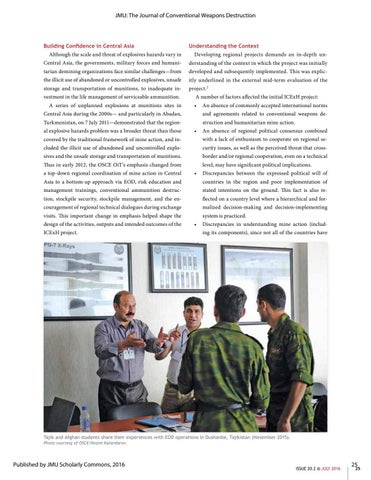
Tajik and Afghan students share their experiences with EOD operations in Dushanbe, Tajikistan (November 2015). Photo courtesy of OSCE/Nozim Kalandarov.
Published by JMU Scholarly Commons, 2016
ISSUE 20.2 @ JULY 2016
25
25