BRITISH COLUMBIA • PRAIRIES AND NORTHWEST TERRITORIES • ONTARIO • QUÉBEC • MARITIMES • NEWFOUNDLAND AND LABRADOR
Le Journal de l’Institut canadien des économistes en construction
WINTER 2021
PM 40065075
CONSTRUCTION ECONOMIST
The Journal of the Canadian Institute of Quantity Surveyors
ciqs.org
Canada’s Leading Journal in Construction Economics
Realize your potential
OUTSTANDING OPPORTUNITIES TO JOIN AN ESTABLISHED, EXPANDING PRACTICE IN VANCOUVER & VICTORIA. BDC has been providing the highest standard of services, to industry leading clients for over 30 years. We offer superior benefits and salary packages commensurate with expertise, qualifications, skills and potential for growth.
SENIOR QUANTITY SURVEYOR
ESTIMATOR
A great opportunity for an ambitious individual with partnership aspirations.
Self starter with ambitions to grow an estimating team.
You are a seasoned professional with a broad skill set in all aspects of Quantity Surveying. Experienced in Estimating, Monitoring and Contract Administration. Technical abilities include report production on a variety of software systems. A self starter with engaging leadership, teamwork and communication skills. Comfortable liaising directly with clients. Strong communication skills. RICS/ CIQS membership.
Experience in estimating in both Trade and Elemental formats, using a variety of software applications an asset.
INTERMEDIATE QUANTITY SURVEYOR An opportunity for a qualified individual to move up to a more senior role. Experience in the field of Mortgage Monitoring an asset.
Please enquire, with confidentiality, to ian@bdconsultants.com.
www.bdconsultants.com
The mission of CIQS is to promote and advance professional quantity surveying and construction estimating; to establish and maintain national standards; to recruit, educate and support our members.
Canadian Institute of Quantity Surveyors 90 Nolan Court, Unit 19, Markham, ON L3R 4L9 t. 905/477.0008 f. 905/477.6774 toll free. +1 866/345.1168 e.info@ciqs.org www.ciqs.org
Chief Executive Officer Sheila Lennon, CAE .................... . . . . . . . . . . ceo@ciqs.org Managing Editor Arif Ghaff ur, PQS(F) Assistants to Editor Ajibola Soboyejo, PQS Shane McKernan, PQS Send Change of Address to: Canadian Institute of Quantity Surveyors 90 Nolan Court, Unit 19, Markham, Ontario L3R 4L9
CIQS Board Chair: Erin Brownlow, PQS Vice-Chair: Arif Ghaff ur, PQS(F) Past Chair: David Dooks, PQS(F) Education Director: Adam Ding, PQS Director: Tammy Stockley, PQS
CONSTRUCTION ECONOMIST WINTER 2021
The Journal of the Canadian Institute of Quantity Surveyors Le Journal de l’Institut canadien des économistes en construction
Features
Leadership interview – Wissam Ayoub . . . . . . . . . . . . . . . . 20 The fundamentals of Decarbonization . . . . . . . . . . . . . . . .22 Independence. . . . . . . . . . . . . . . . . . . . . . . . . . . . . . . .24 Progressive design-build – target price and emerging norms . . . . . . . . . . . . . . . . . . 26 Canadian construction – Indicators of growth, composition, and changes . . . . . . . 29 New association management system creates personalized member experience . . . . . . . . . . 32 A new Parliament and a new phase of advocacy for CIQS . . . . . . . . . . . . . . .33
Director: Hiran Dassoruth, PQS Director: Jack Chen, PQS Director: Antoine Aurelis, PQS Director: Dominic Leadsom, PQS Advisor: Roy Lewis, PQS(F)
31
Statements of fact and opinion contained within this journal are those of the authors, including subject matter experts. CIQS assumes no responsibility or liability for the content of such fact and opinion, nor do they represent the official policy of CIQS.
Corners
Messages
Legal Corner . . . . . . . . . . . . . . . . 12
Chair’s Message . . . . . . . . . . . . . .
Published four times a year on behalf of the Canadian Institute of Quantity Surveyors by
Young Quantity Surveyor Corner… . 14 Education Corner . . . . . . . . . . . . . 17
4 CEO’s Message . . . . . . . . . . . . . . . 6 Managing Editor’s Message . . . . . . 10
Events Corner . . . . . . . . . . . . . . . 19 Third Floor - 2020 Portage Avenue Winnipeg, Manitoba R3J 0K4 Tel: 866-985-9780 Fax: 866-985-9799 info@kelman.ca www.kelman.ca Managing Editor ..................... Chris Kelman and Katie Woychyshyn Art Design/Production ............. ............... . . . . . Dani Goulet Advertising Coordinator..... Stefanie Hagidiakow Marketing Manager .................. . . . . . . . . . Jeff Kutny jeff@kelman.ca 866-985-9789 Publication Mails Agreement #40065075 Send undeliverable addresses to: lauren@kelman.ca
OUR CONCERN FOR THE ENVIRONMENT IS MORE THAN JUST TALK This document is printed on paper certified to the standards of the Forest Stewardship Council® (FSC®).
Winter 2021 | www.ciqs.org | CONSTRUCTION ECONOMIST | 3
Chair’s Message
Professional Quantity Surveyor or Construction Estimator Certified?
Erin Brownlow, PQS
T
here once was a time when most Professional Quantity Surveyors were considered cost consultants, and most Construction Estimator Certified designated professionals were contractors’ estimators. This is no longer the case, yet a long misunderstanding about this is still apparent. These are completely different roles which need to be better understood. As the construction industry has changed, so has contract delivery. Many more contractors’ estimators are becoming involved in design, contract management, and analysis. When working on projects in preconstruction, construction management contracts, or design/build, there are many tasks the estimator takes on now, which make this role very different from what it once was. Some estimators choose to shift their roles into more in-depth project cost analysis and advisory as a PQS; others enjoy the passion of a fantastic closing day, would rarely give that up, and prefer to have CEC as their professional designation. Both roles are very important in the contractor world. Equally, there are CECs working in the cost consulting world who enjoy the measuring and calculating of costs, gathering cost data, loan monitoring, and reviewing the “biddability” of contract documents. These are very valuable services provided directly to an owner’s project team, design team, or to supplement a contractor. PQSs and CECs complement each other in their roles. We often speak about these differences. While the above is only a small example of the individual roles, services provided, and the industries in which they work, it is important that we
recognize and accord equal value to each of our designations. I urge our CECs to inform us of what specific event or education opportunities they would like the CIQS to offer. It is very important that we ensure we are providing equal professional learning opportunities for both designations. Why the CIQS? What value does the CIQS offer, why join the CIQS, what is the purpose? As a refresher, the CIQS mission statement is: “CIQS is a self-regulatory, professional body and the gatekeeper of the ethics and standards for construction and infrastructure economics in Canada. Designated Professional Quantity Surveyors (PQS) and Construction Estimator Certified (CEC) professionals counsel building owners, developers, government bodies, designers, and contractors at every stage of the design, procurement and construction process to help ensure a return on investment is delivered.” Not only is there a standard of professionalism in our work, but there is also a standard for the more human side of what we do. Our Code of Ethics and Professional Conduct and Competency are key to
4 | CONSTRUCTION ECONOMIST | www.ciqs.org | Winter 2021
ensuring our members can deliver on this statement. Members of the CIQS must comply with these requirements to ensure that all members, associates, employers, clients, the public, and the CIQS are treated with fairness and loyalty. Each year, when we send out the renewal agreements, a service agreement is attached. As part of this agreement, there is an acknowledgement that the Code of Ethics and Professional Conduct and Competency has been reviewed and accepted. It is important that each of us reviews these documents as a reminder of the value of the work that we bring to each other, and to all other parties. This is a good way to recentre your professional goals with the CIQS, at the start of each year. If there are any questions or concerns about these documents, never hesitate to contact myself or the CEO. We are always pleased to hear from the membership. Thank you. Stay happy, healthy, and safe! Erin Brownlow, PQS CIQS Chair To return to Table of Contents CLICK HERE
Message du Président du Conseil
Erin Brownlow, PQS
Économiste en construction agréé ou estimateur en construction certifié?
I
l fut un temps où la plupart des économistes en construction agréés étaient considérés comme des consultants en coûts, et où la plupart des professionnels ayant le titre d’estimateur en construction certifié étaient des estimateurs d’entrepreneurs. Ce n’est plus le cas, mais un long malentendu subsiste à ce sujet. Ce sont des rôles complètement différents qui doivent être mieux compris. Le secteur de la construction a évolué, tout comme l’exécution des contrats. De plus en plus d’estimateurs d’entrepreneurs s’impliquent dans la conception, la gestion des contrats et l’analyse. Lorsqu’il travaille sur des projets de préparation des travaux, de contrats de gestion de la construction ou de conception/construction, l’estimateur assume désormais de nombreuses tâches qui rendent ce rôle très différent de ce qu’il était auparavant. Certains estimateurs choisissent d’évoluer vers une analyse plus approfondie des coûts du projet et vers le conseil en tant qu’ÉCA, tandis que d’autres aiment toute l’émotion d’une journée de clôture réussie, souhaiteraient rarement y renoncer et préfèrent avoir comme titre professionnel ECC. Ces deux rôles sont très importants dans le monde des entrepreneurs. De même, il y a des ECC qui travaillent dans le monde du conseil en coûts et qui aiment mesurer et calculer les coûts, recueillir des données sur les coûts, surveiller les prêts et examiner la qualité de soumission des documents contractuels. Il s’agit de services très précieux fournis directement à l’équipe de projet d’un propriétaire ou à l’équipe de conception ou qui viennent en complément du travail d’un entrepreneur. Les rôles d’ÉCA et d’ECC se complètent.
CLICK HERE to return to Table of Contents
C’est un bon moyen de recentrer vos objectifs professionnels avec l’ICÉC, au début de chaque année. Nous parlons souvent de ces différences. Bien que ce qui précède ne soit qu’un petit exemple des rôles individuels, des services fournis et des industries dans lesquelles ils travaillent, il est important de reconnaître et d’accorder une valeur égale à chacun de nos titres professionnels. J’encourage nos ECC à nous informer des événements spécifiques ou des possibilités de formation qu’ils aimeraient voir offerts par l’ICÉC. Il est très important de nous assurer d’offrir des opportunités de formation professionnelle égales pour les deux titres. Pourquoi l’ICÉC? Quelle valeur offre l’ICÉC, pourquoi adhérer à l’ICÉC, quel en est l’objectif? À titre de rappel, l’énoncé de mission de l’ICÉC est le suivant : « L’ICÉC est un organisme professionnel d’autoréglementation et le gardien de l’éthique et des normes pour l’économie de la construction et des infrastructures au Canada. Les économistes en construction agréés (ÉCA) et les économistes en construction agréés (ECC) conseillent les propriétaires de bâtiments, les promoteurs, les organismes gouvernementaux, les concepteurs et les entrepreneurs à chaque étape du processus de conception, d’approvisionnement et de construction afin de garantir un retour sur investissement. » Notre travail répond non seulement à des normes de professionnalisme, mais
aussi à des normes concernant le côté plus humain de ce que nous faisons. Notre code de déontologie, de conduite professionnelle et de compétence est essentiel pour nous assurer que nos membres respectent cette déclaration. Les membres de l’ICÉC doivent se conformer à ces exigences afin de garantir que tous les membres, associés, employeurs, clients, le public et l’ICÉC sont traités avec équité et loyauté. Chaque année, lorsque nous envoyons les accords de renouvellement, un accord de service est joint. Dans le cadre de cet accord, il est reconnu que le code de déontologie et de conduite professionnelle et de compétence a été examiné et accepté. Il est important que chacun d’entre nous examine ces documents afin de se rappeler la valeur du travail que nous accomplissons les uns pour les autres, et pour toutes les autres parties. C’est un bon moyen de recentrer vos objectifs professionnels avec l’ICÉC, au début de chaque année. Si vous avez des questions ou des préoccupations concernant ces documents, n’hésitez pas à me contacter ou à contacter la directrice générale. Nous sommes toujours heureux d’avoir des nouvelles de nos membres. Merci. Restez heureux, en bonne santé et en sécurité! Erin Brownlow, économiste en construction agréé Présidente, Institut canadien des économistes en construction
Winter 2021 | www.ciqs.org | CONSTRUCTION ECONOMIST | 5
CEO’s Message
2021 was a victory for CIQS
A
s we are in the home stretch of the strategic plan that began with a two-day planning session in Toronto in May of 2019, I reflect on everything that we have accomplished, despite a pandemic and a major learning curve in the use of various meeting platforms and other technologies. Our current three-year strategic plan was an ambitious one and I am proud to say that we are on track to complete most of the tasks that were outlined under each of the four strategic plan pillars. Some projects will be on-going for years to come, whereas others were implemented with the expectation of a definitive end-date. A complete overview of the strategic plan accomplishments is included in the 2020-2021 CIQS annual report, now available in the pressroom on www.ciqs.org. Thanks to a significant increase in the categories of Professional Quantity Surveyor (PQS), Construction Estimator Certified (CEC), and Associate, the 2020 CIQS membership year has been one of the most successful in a decade! The Institute now has a membership of over 2,000, of which more than 1,000 are PQS’s and over 200 are international members (Members at Large). With close to a nine per cent increase in new applications over the 2019 membership year, quantity surveyors are in high demand, continuing to prove that this is a profession that can weather any storm. Our team of staff, volunteers, and consultants has worked tirelessly over the past year to improve our current programs and implement new ones, such as: 1. The external relations committee, spearheaded by Tammy Stockley, PQS, has made tremendous strides
Sheila Lennon, CAE
A complete overview of the strategic plan accomplishments is included in the 2020-2021 CIQS annual report, now available in the pressroom on www.ciqs.org. this year. scheduling meetings with federal government officials and industry organizations. They launched a Push Politics campaign in time for the federal election (www.count-on-us.org) and secured a seat for CIQS at the Construction Industry Roundtable. 2. This year we hosted our first virtual Congress, which was a tremendous success! It comprised three half-days of presentations by an impressive lineup of speakers, daily networking cafes, and even a virtual trivia game night. Our virtual AGM, held in September, had an impressive attendance of close to 150, most of whom stayed on for the Year in Review presentation. Members who missed the presentation can access the video from the member portal on www.ciqs.org. 3. The education committee has established a process to review accredited programs that was used to review the architectural syllabi as well as to develop four elective courses. They also renewed the reciprocity agreement between CIQS and the Canadian Construction Association’s Gold Seal Certification program. This recommitment enables CEC and PQS designates to be automatically accepted into the Gold Seal Certification program. Additional
6 | CONSTRUCTION ECONOMIST | www.ciqs.org | Winter 2021
details are available under the Education tab on www.ciqs.org. 4. For the first time in some time, CIQS has published a brand new textbook entitled Construction Project Development, which is now on sale in the CIQS online bookstore at www.ciqs. org. This 900+ page textbook walks the learner through the construction project development process in a practical, easy-to-understand format, and can serve as an invaluable resource for construction professionals as well as a teaching resource for construction programs at the college and university levels. 5. Last, but certainly not least, on November 10, 2021, we officially launched our new integrated, cloudbased association management system which offers an interactive member portal to create a more personalized customer experience. You can learn more about this program later in this issue. The past year has been an exciting time to be part of the Canadian Institute of Quantity Surveyors and I can’t wait to see what 2022 has in store for the Institute, its members, and our stakeholders. May you and your loved ones have a wonderful holiday season! Sincerely, Sheila Lennon, CAE Chief Executive Officer To return to Table of Contents CLICK HERE
CEO’s Message
New Staff Kelsey Wright, CIQS Member Services Coordinator The CIQS is pleased to welcome Kelsey Wright as our new member services coordinator. Kelsey brings nine years of customer service experience to the Institute. She gained her experience in the retail sector, working with one of Canada’s top, high-end, sporting goods companies where she led a team of over 30 people. In her role as customer experience manager, she focused on delivering exceptional service to clients, vendors, and co-workers.
She also worked as a training coordinator, where she focused on the development, sourcing, management, and scheduling of in-house product knowledge sessions, and developing onboarding training manuals. Kelsey has been working towards her Business degree at Seneca College through part-time evening and weekend studies, with an expected completion in early 2022. Her role and responsibilities as member services coordinator include: • Membership inquiries • Membership Renewals, reinstatements, and new applications • Coordination of the CIQS exam program • TPE exam coordination and scheduling
• Bookstore • Administrative support to the membership manager “I look forward to my role as the member services coordinator, where I can enable the Canadian Institute of Quantity Surveyors to successfully serve the interests of applicants, members, students, and volunteers through the provision of well-executed customer service policies and procedures, strong leadership, and pursuit of excellence,” said Kelsey, when asked about her new role at the CIQS. For membership inquiries, please contact memberservices@ciqs.org.
CIQS CONGRESS 2022 Westin Ottawa Hotel | June 16-18, 2022
Call for Presenters The Canadian Institute of Quantity Surveyors (CIQS) are seeking dynamic, engaging, and knowledgeable presenters for the 2022 CIQS Congress in Ottawa, ON. Presentation dates are Friday, June 17, 2022 or Saturday, June 18, 2022. Proposals are solicited for 45-minute or 60-minute individual presentations or 90-minute panel presentation, that are creative, dynamic, and feature best practices. The presentation timeframe will include introductions, presentation material, and question and answer session. Attendees should leave with specific knowledge and skills about various aspects of the topic and how it relates to their future development. Presentations should provide attendees with educational value and refrain from promoting a specific business, product, or service. The theme for CIQS Congress 2022 is Assemble-Advocate-Lead. CIQS is interested in but not limited to the following areas of focus: • Risk Based Estimating and Forecasting Project Outcomes • Off Site Construction (Pre-Fabricated and Modular Construction) • Cost Accuracy & Predictability • Virtual Design & Construction and Building Information Modeling • Clean Energy Creation and Sustainable Power
• • • • • • •
Collaborative Contracting and Integrated Project Delivery Prompt Payment and Construction Adjudication Alternative Finance and P3 Project Delivery Progressing Quantity Surveying as a Sustainable Profession Reserve Fund Studies Insurance Value Analysis
For more information and the Call for Presentations application form, please visit www.ciqs.org and click on the Events tab.
CLICK HERE to return to Table of Contents
Winter 2021 | www.ciqs.org | CONSTRUCTION ECONOMIST | 7
Message du Directrice Générale
L’année 2021 était une victoire pour le ICEC
A
lors que nous sommes dans la dernière ligne droite du plan stratégique lancé par la séance de planification de deux jours à Toronto en mai 2019, je réfléchis à tout ce que nous avons accompli, malgré la pandémie et tout ce qu’il nous a fallu apprendre concernant l’utilisation de diverses plateformes de réunion et d’autres technologies. Notre plan stratégique triennal actuel était ambitieux, et je suis fière d’annoncer que nous sommes en bonne voie pour réaliser la plupart des tâches décrites dans chacun des quatre piliers du plan stratégique. Certains projets se poursuivront pendant des années, tandis que d’autres ont été mis en œuvre avec une date de fin définitive prévue. Un aperçu complet des réalisations du plan stratégique est inclus dans le rapport annuel 2020-2021 de l’ICÉC, maintenant disponible dans la salle de presse sur www.ciqs.org. Grâce à un apport important de membres dans les catégories d’économiste en construction agréé (ÉCA), d’estimateur en construction certifié (ECC) et d’associé, 2020 a été une des années les plus populaires depuis une décennie en termes d’adhésion à l’ICÉC! L’Institut compte désormais plus de 2 000 membres, dont plus de 1 000 sont des ÉCA et plus de 200 sont des membres internationaux (membres à titre particulier). Avec près de neuf pour cent d’augmentation des nouvelles demandes sur l’année d’adhésion 2019, les économistes en construction sont très demandés et nous continuons ainsi de démontrer que notre profession peut essuyer toutes les tempêtes. Notre équipe d’employés, de bénévoles et de consultants a travaillé sans
relâche au cours de l’année écoulée pour améliorer nos programmes actuels et mettre en place de nouveaux programmes, comme : 1. Le comité des relations extérieures, dirigé par Tammy Stockley, ÉCA, s’est énormément développé cette année et a organisé des réunions avec des représentants du gouvernement fédéral et des organisations de l’industrie. Ils ont lancé une campagne Push Politics au moment des élections fédérales (www.count-on-us.org) et ont obtenu un siège pour l’ICÉC à la Table ronde sur l’industrie de la construction. 2. Cette année, nous avons organisé notre premier congrès virtuel, qui a remporté un énorme succès! Il s’agissait de trois demi-journées de présentations par une impressionnante brochette d’orateurs, de cafés de réseautage quotidiens et même d’une soirée de jeu de questions-réponses virtuel. Notre AGA virtuelle, qui s’est tenue en septembre, a connu une participation impressionnante de près de 150 personnes, dont la plupart sont restées pour la présentation du bilan de l’année. Les membres qui ont manqué la présentation peuvent accéder à la vidéo à partir du portail des membres sur www.ciqs.org. 3. Le comité d’éducation a mis en place une procédure d’examen des programmes accrédités qui a servi pour examiner les plans de cours d’architecture ainsi que pour élaborer quatre cours à option. Ils ont également renouvelé l’accord de réciprocité entre l’ICÉC et le programme de certification Sceau d’or de l’Association canadienne de la construction. Ce réengagement permet aux désignations d’ECC et d’ÉCA d’être automatiquement
8 | CONSTRUCTION ECONOMIST | www.ciqs.org | Winter 2021
Sheila Lennon, CAE
acceptées par le programme de certification Sceau d’or. Vous pouvez trouver plus de détails sous l’onglet « Éducation » sur www.ciqs.org. 4. Pour la première fois depuis quelque temps, l’ICÉC a publié un tout nouveau manuel intitulé « Construction Project Development » (Développement de projets de construction, disponible en anglais) qui est maintenant en vente dans la librairie en ligne de l’ICÉC à l’adresse suivante www.ciqs.org. Ce manuel de plus de 900 pages guide l’apprenant à travers le processus de développement de projets de construction dans un format pratique et facile à comprendre, et peut servir de ressource inestimable pour les professionnels de la construction ainsi que de ressource d’enseignement pour les programmes de construction aux niveaux collégial et universitaire. 5. Dernier point, mais certainement non des moindres, le 10 novembre 2021, nous avons officiellement lancé notre nouveau système de gestion d’association intégré dans le nuage qui offre un portail interactif pour les membres afin de créer une expérience client plus personnalisée. Vous en saurez plus sur ce programme dans la suite de ce numéro. L’année qui vient de s’écouler a été une période passionnante pour l’Institut canadien des économistes en construction, et j’ai hâte de voir ce que 2022 réserve à l’Institut, à ses membres et à nos parties prenantes. Je vous souhaite, à vous et à vos proches, de passer de merveilleuses fêtes de fin d’année! Sincères salutations, Sheila Lennon, CAE Dectrice Générale To return to Table of Contents CLICK HERE
ASSOCIATE LEVEL OPPORTUNITY Pelican Woodcliff is looking for a Senior Consultant to take a leading role in our Project Monitoring department. This is an Associate Level position reporting directly to our company principals. Candidates must have a minimum of ten (10) years of experience in the Canadian project monitoring field and possess an appropriate professional accreditation. The successful candidate will be offered a compensation package reflective of your professional experience, unique skill sets and a leadership role in our organization. To pursue this opportunity please forward your resume in strictest confidence to: E-mail: Donny@pelicanwoodcliff.com Donny Afonso, Principal of Pelican Woodcliff
100 York Blvd., Suite 608, Richmond Hill, ON L4B 1J8 Tel 905.889.9996 www.pelicanwoodcliff.com
CLICK HERE to return to Table of Contents
Winter 2021 | www.ciqs.org | CONSTRUCTION ECONOMIST | 9
Managing Editor’s Message
Canadian construction: here comes 2022
Arif Ghaffur, PQS(F)
Reality check & opportunity for a paradigm shift
I
t has been interesting to track the many success stories in Canadian construction in 2021 and the many instances of project failures and disappointments. The above, in addition to the issues brought up in my editorials in the summeri and fallii editions, paint a picture of a defining moment for the Canadian construction industry. The current situation is that the latest quarterly Canada Construction Monitor Reportiii indicates that growth in workloads continues to accelerate and identifies key insights that: • The Construction Activity Index has improved for a seventh consecutive quarter. • All sectors are continuing to display a firmly positive outlook for the next twelve months. • There remain concerns around the cost and availability of materials. 2022 will also bring many challenges for the construction industry. The scale and magnitude of such issues will only become evident after the fact. However, there are indications that certain issues will continue to cause uncertainty, some of which could include the following concerns that come to mind: 1. GETTING PAID: Prompt Payment reforms across individual jurisdictions across Canada will continue, albeit at a significantly slower pace than necessary. 2. PROJECT OUTTURN: Major projects will increasingly be impacted by cost escalation and schedule delays due to supply chain and resource challenges. 3. COST VOLATILITY: The difference between project budget and actual tender prices will deviate to a record extent as cost volatility bites the construction industry even harder.
Tammy Stockley, PQS, CIQS Director All stakeholders need to continue the dialogue and engagement that will lead to there being a strong and sustainable Canadian construction industry.
Antoine Aurelis, PQS, CIQS Director Irrespective of project size or complexity, issues are increasing, and approaches are being sought to resolve matters using innovative techniques.
Adam Ding, PQS, CIQS Director CIQS is positioning its education programs to respond to ongoing education programs that respond to a substantial pipeline of construction projects.
Christopher Court, PQS(F), incoming Editor, Construction Economist The construction industry has done tremendously well in the face of adversity – the time is now right to pivot to new forward thinking initiatives
4. PROJECT DELIVERY: Multiple projects coming on stream concurrently will significantly challenge the capacity and capability of the construction supply chain to deliver projects. 5. ISSUE PROLIFERATION: There will be a proliferation of construction conflicts and disputes as projects are beset with an accumulation of unresolved issues.
10 | CONSTRUCTION ECONOMIST | www.ciqs.org | Winter 2021
6. DIMINISHING PATIENCE: Canada will increasingly become more litigious with less tolerance for negotiation and issues will enter the legal arena quicker than ever. 7. BUSINESS VIABILITY: Construction companies will risk exhausting their bonding capacities and the financial viability of some companies will become a topic of concern. 8. PERSONNEL TRANSITION: The construction supply chain will see To return to Table of Contents CLICK HERE
Managing Editor’s Message
a greater transition of personnel as employee retention becomes harder due to a more transient market. 9. DELAYED INNOVATION: Digitization will continue to move along in a slow manner with the construction industry evidencing a broader reluctance to accept innovation. 10. COMMERCIAL ALIGNMENT: The lack of alignment between construction market realities and contractual agreements will create mistrust, uncertainty, and confusion. The solutions to the above and many more important issues of equivalence, such as diversity and net zero, require bold approaches and incisive decision making. Any such approaches first require a recognition of the issues, followed by a thoroughly thought-out plan to arrive at solutions that are sensible, achievable, and measurable. Such visionary approaches require those who represent the construction industry to be part of the solution, and the government needs to be the catalyst to bring all stakeholders together to arrive at a set of objectives, and a plan to deliver these.
Below is a bold, but perhaps realistic, summary of what such a plan may contain relative to the items identified above: 1. GETTING PAID: "Federal prompt payment reforms legislated and now underway." 2. PROJECT OUTTURN: “Independent review underway on status of 10 major projects.” 3. COST VOLATILITY: “National initiative launched to centralise construction cost data.” 4. PROJECT DELIVERY: “Construction trades training programs receive major funding boost.” 5. ISSUE PROLIFERATION: “Major rethink on risk transfer aimed at reducing project issues.” 6. DIMINISHING PATIENCE: “Streamlined method resolves disputes quicker and cheaper.” 7. BUSINESS VIABILITY: “New instruments introduced to provide performance security.” 8. PERSONNEL TRANSITION: “Employers launch incentives for employee retention.” 9. DELAYED INNOVATION: “BIM mandated on major projects and incentives offered to users.”
10. COMMERCIAL ALIGNMENT: “Standard contract forms introduce cost fluctuation provisions.” The above provides an indication of some of the challenges that are likely to be faced by the Canadian construction industry in 2022 and beyond. This transitional phase will provide an opportunity for a reality check and perhaps for a paradigm shift towards improvements that result by pivoting towards best-in-class initiatives. Thank you for your support and contributions to the Construction Economist. I wish you and your families a wonderful Christmas, a safe holiday season and all the best for 2022. If you have feedback, suggestions, and of course, any articles that you would like to be considered for publication, please email editor@ciqs.org or ceo@ciqs.org. Arif Ghaffur, PQS(F) Managing Editor Footnote i Resource cost fluctuations continue to cause havoc, Construction Economist, Summer 2021 ii Increasing market volatility and cost fluctuations (collaborative sharing of risks), Construction Economist, Fall 2021 iii A publication of the RICS and CIQS
Appointment of Editor The Canadian Institute of Quantity Surveyors (CIQS) is pleased to announce that it has appointed Christopher Court PQS(F) as Editor of Construction Economist. Chris has 18 years of experience in the construction and development industry working for cost consultants, developer/owners, and construction managers. Chris has worked on projects such as Pan Am Athletes Village, Pearson Airport Terminal 3 Expansion, and the Corus Building (Toronto). Chris possesses the Professional Quantity Surveyor (PQS) designation accredited through the CIQS, and was awarded his Fellowship with the CIQS after dedicating over 10 years of volunteer work between 2006 and 2016. Chris is employed with TMG Builders Inc. and has been their Chief Estimator since January 2016. His previous employment includes Pelican Woodcliff, Altus Group and Tridel/Deltera. Chris graduated from George Brown College with a Diploma in Construction Engineering Technology (Management) in 2003. Upon his appointment, Christopher said, “I am delighted to take on this key role for a journal that has elevated itself as best in class in the knowledge share of construction economics”. Arif Ghaffur, Vice Chair of the CIQS and Managing Editor of Construction Economist said, “Christopher is an excellent addition to lead the CIQS team that works so hard to deliver this quarterly publication. Chris will be assisted by the Assistants to the Editor and work closely with our CEO Sheila Lennon and her team.” Chris will write his first editorial in the Spring 2022 edition and, in the interim, will transition into his new role.
CLICK HERE to return to Table of Contents
Winter 2021 | www.ciqs.org | CONSTRUCTION ECONOMIST | 11
Legal Corner
Smart building technologies – thinking about data
I
ncreasingly, contractors and other parties in the construction industry are tapping into opportunities presented by information technology to improve building construction as well as operation and maintenance service offerings. The expanded use of information technology promises more efficient and cost-effective services as waste is eliminated and resources are allocated more productively. This trend impacts every stage of planning, construction and operation. These technological innovations often depend upon the collection and use of vast quantities of data. As quantity surveyors know, one powerful technology is building information modelling (BIM). BIM permits various parties in the construction project, including engineers, architects, consultants, designers, and trades, to input data into a centralized three-dimensional model automated to identify clash points (i.e., incompatible designs from different parties) and efficiency opportunities that could be created by selective redesign. BIM data can also be aggregated and analyzed to create valuable statistical models across multiple projects, demonstrating the most efficient and useful designs generally in a variety of climactic, geotechnical, or other conditions. Thus, BIM illustrates the multi-tiered nature of data value. In the first instance, value is created for execution of the individual project employing BIM. In the second tier, data collected and aggregated from BIM models of multiple projects across different applications and enterprises creates a valuable data set with higher predictive value than individual project data alone. This iterative process is driven by and depends upon the collection, aggregation, and analysis of accurate data. Buildings enhanced by the collection and use of data are often referred to as “smart buildings.” Some of the data collected by smart buildings includes project inputs, trade and sub-trade performance, number of users, utility and other resource consumption, temperature and other building conditions, waste management, and traffic management. The legal factors that owners, contractors, consultants, suppliers, and others should consider when implementing BIM and collecting the associated data include: • Assessing the value of data to prepare for contractual negotiations • Ensuring adequate rights to data and preserving value in such data by contractually controlling use rights • Protecting these assets from illicit third party access by use of appropriate data security safeguards • Managing regulatory risk
12 | CONSTRUCTION ECONOMIST | www.ciqs.org | Winter 2021
Simon Hodgett
Andrew Wong
Ben Bouwman
The value of data To properly assess the value of its data, an organization needs to spend time carefully mapping out the data it has and the data that it plans to collect, whether from its own sources or via acquisition from another party. How valuable is each source of data on its own? How valuable is the data when combined with data from other sources? The value of data is often multiplied by combining it with other data. Organizations often obtain more data by adding to their native data set or by contributing data to a larger “pool” in return for access to aggregated data from that pool (e.g., industry-wide data analytics or AI applications). Organizations may also add data from technology providers or other vendors. Such data is usually subject to contractual and other obligations that need to be taken into account when deciding how the data will be used. Once aggregation has occurred in compliance with all contractual, security, and regulatory requirements, larger data sets offer significant competitive advantages and drive efficiencies and cost savings for current and future projects. With an accurate assessment of the value of data both on its own and when pooled, an organization can make strategic decisions to grant use rights for its data set or to exploit such data in its own projects and activities. Current and future data security measures In parallel with an accurate valuation of their data, owners and contractors should carefully analyze current data security measures in place in their organization, as well as added measures that need to be included for future data and its anticipated uses. Organizations should determine where data resides on their systems and should ensure that the security controls in place are commensurate with the value and sensitivity of the data. Organizations should also consider requiring any proposed contractual party or service provider with whom the organization will share information to make the same investigations and disclose the results as part of contractual negotiations. One risk area for particular scrutiny is the control systems that vendors have in place when such vendors are engaged to work with and extend the capabilities of the organization’s internal systems. As protection from certain of these risks, contracts should set out both a clear review process to ensure ongoing performance of security obligations, and a comprehensive system of remedies that will effectively protect the organization’s interests in the event of a breach. To return to Table of Contents CLICK HERE
Legal Corner
Osler’s professionals are experienced in advising clients concerning data collection in various industries and are available to assist construction industry participants in strategic uses of advanced building technology and data. A note on “ownership” of data References to data “ownership” are very common. However, the concept of ownership has some legal limits. A wide variety of data types is relevant to BIM and similar technologies, including input data, output data, and insights derived from output data. Input data includes “project data” that is inputted by engineers, architects, designers, and other tradespeople. This data may be subject to ownership claims by the various contributing parties pursuant to their service contracts. The output data produced by the software technology has significant value over and above the value of isolated input data, and this value may be eroded by a successful claim of “ownership” by an input provider. It is important to note, however, that data in the form of raw numeric figures is not intellectual property, and that therefore parties should carefully contract to protect their data rights. Clear contractual language should set out the use rights (and restrictions on use) that apply to the data. Agreements create no “free standing” intellectual property rights with respect to third parties; so any data distributions to third parties should be subject to contractual restrictions on use. Effective confidentiality provisions are especially important. Regulatory considerations Many applications such as BIM may collect little or no information about identifiable individuals. However, if the technology collects, stores or processes data containing personally identifiable information, there are important regulatory issues to consider. Recording movements of individuals through a building or their use of building systems, if connected with an identifiable individual, would constitute collection of personal information. Careful consideration should be given to, and specialized advice sought regarding, both internal and public facing data and privacy policies. Such policies and practices also will need to comply with applicable legislation on the collection and use of personal information. Conclusion Widespread adoption of information technology systems and massive data collection is relatively new in the construction industry, but other industries have been engaged with these issues for some time. Osler’s professionals are experienced in advising clients concerning data collection in various industries and are available to assist construction industry participants in strategic uses of advanced building technology and data. CLICK HERE to return to Table of Contents
About the authors Simon Hodgett is a Partner in the Technology Group at Osler, Hoskin & Harcourt LLP, whose practice concentrates on outsourcing, other complex services arrangements, and procurement. Andrew Wong is a Partner in the Commercial Group at Osler, Hoskin & Harcourt LLP and a civil engineering graduate, whose practice includes work in international and Canadian construction and infrastructure matters. Ben Bouwman is an Associate in the Construction, Infrastructure, and Energy Group at Osler, Hoskin & Harcourt LLP, and has a specific focus on Canada’s construction, energy, and infrastructure industries.
Stimulus + Compliance = Building for Success As money starts to flow into shovel-worthy projects, Osler’s Chambers Band 1 Construction Group has the industry expertise and legal insight to help you identify opportunities and manage risks — so you can be sure you’re always on solid ground. Contact Richard Wong at rwong@osler.com Visit our blog osler.com/constructionblog Osler, Hoskin & Harcourt llp osler.com
Winter 2021 | www.ciqs.org | CONSTRUCTION ECONOMIST | 13
YQS Corner
Sustainable resource spotlight – mass timber
T
he CIQS has hosted several events over the last few years on mass timber construction across Canada. While this method of construction is not new to many of us, it is becoming an increasingly popular way to build, despite the massive lumber price hikes as of late, and scrutiny over old-growth logging practices. Progressive building codes, new mass timber products, innovative building systems, a growing number of designers and builders with expertise, increasingly affordable products and systems, interest in green building materials, and sustainable designs are all contributing to the growth of mass timber construction in Canada and the rest of North America. Below are some interesting mass timber projects planned across Canada and the US (with Canadian timber), as well as some interesting statistics from the Government of Canada. With a national focus on our carbon footprint and energy efficiency, sustainable and renewable resources in construction will soon become the norm when considering methods of construction for certain projects.
University of Toronto: 14-storey Academic Building “The proposed Academic Tower will be an iconic, precedent-setting building at a unique site on the University of Toronto’s St. George campus. Situated between the Munk School of Global Affairs at 315 Bloor Street, and the Goldring Centre for High Performance Sport at 100 Devonshire Place, the tower will be (one of) the first tall wood structure(s) in Ontario. It is intended that the tower become a prototype for the use of mass timber/tall wood both nationally and worldwide. Given the prominent sustainable effort driving the project, the design approach will both reveal this unique timber structure to the street, while also responsibly designing the building envelope to respond to its four unique solar conditions via a passive design strategy. The intent is one that responds specifically to its context, while also delivering the highest energy performance and thermal comfort solution.” (www.updc. utoronto.ca/project/academic-tower) 8th & Pine: Tallest Wood (Mixed-Use) Building in the World at 40-storeys “If plans are hammered into reality,
QS Online Cost Consultants Inc. Halifax, Nova Scotia p. 902 405-1504 halifax@qsonlinecostconsultants.com www.qsonlinecostconsultants.com
14 | CONSTRUCTION ECONOMIST | www.ciqs.org | Winter 2021
Shane McKernan, PQS
Vancouver’s Broadway corridor will see the world’s tallest wood residential tower and the largest Passive House project in the world ascend on West 8th Avenue over the next two to three years. The tower is designed for approximately 136 condominium apartments and 34 purpose-built rentals. It will also include four to six storeys of offices and street-level retail that would total about 130,000 square feet of commercial space. The tower would use B.C. manufactured and processed mass timber, as well as engineered wood such as cross-laminated, glue-laminated, and dowel-laminated timber. It would be designed for maximum fire and structural safety, architects say, while lowering greenhouse gas emissions.” (www.urbanyvr.com/tallest-mass-timberbuilding-vancouver) Prototype: 21-storey Vancouver Tall Wood Market Rental Building “As one of the first tall wood market rental housing buildings of its kind in Canada, this 21-storey mass timber design aims to be a model for more affordable eco-friendly housing solutions. • A sustainable, cost-effective mass timber 216-unit residential rental building. • The design team is exploring two possible mass timber hybrid systems: a post and platform system and a post, beam, and panel system. • Targeting low carbon, zero-emission standards for the project’s materials, construction, and operation. This residential building, named Prototype, demonstrates how lowcarbon tall wood construction is a viable option for purpose-built rental housing. Located in Vancouver’s vibrant Mount Pleasant neighbourhood, To return to Table of Contents CLICK HERE
YQS Corner
the project aims to deliver a mix of units affordable to moderate-income residents. As its name suggests, Prototype sets out to be a model for future tall wood housing projects that are sustainable, cost-effective, and replicable. This includes optimizing wood usage, minimizing the number of elements required for each floor, and connection designs to reduce crane time, and quicken construction.” (www. naturallywood.com/project/prototype) The Government of Canada has set-up a great tool on its website, the “State of Mass Timber in Canada,” portal. This portal shows all completed and under construction mass timber projects in Canada (631 active from 2007- 2021), which can be filtered for region and occupancy/use. British Columbia is leading the way in mass
timber projects with 281, followed by Quebec (170), Ontario (108) and Alberta (52). There is a total of 20 projects in the remaining provinces and territories. Institutional projects lead the way with 260 buildings, followed by commercial (158), recreational (86), residential (48) industrial (38), bridges (28) and other (13). An interesting statistic is that, of these 631 projects, 532 of them are between one to four storeys, with only eight projects across Canada being 13 or more storeys. With changes to provincial building codes now allowing for taller wood structures, mass timber projects have a chance to become a regular feature of the development landscape.
About Stay safe the and author healthy. Shane McKernan, PQS, GSC, B.Tech, is a Project Manager & Estimator for Landa Global Properties, based out of Vancouver, BC. With over 14 years of experience in the construction sector, Shane’s experience includes estimating, cost consulting, project loan monitoring, and project & construction management. Shane is the Past Chair of the CIQS – BC Chapter, where he joined as the board’s first ever student member in 2013. Shane previously sat on the CIQS Board as the 2020+2021 YQS Observer and is an Assistant to the Editor of Construction Economist.
QUANTITY SURVEYORS, ESTIMATORS, PLANNERS A leading Cost Consulting and Project Management firm requires the following candidates for its Montreal and Ottawa offices: Junior, intermediate and senior level Q.S.’s, Estimators and Planners with experience on: • Commercial and institutional projects • Industrial projects (oil/gas, refineries, mining, metallurgical). We offer competitive salaries, benefits, training and potential for growth. Relocation assistance will be provided. We sincerely thank all applicants, but only those candidates which meet our requirements will be contacted.
Please send resume in strictest confidence to: LCO - Construction and Management Consultants Inc. Fax: 514-846-8913 | Phone: 514-846-8914 | E-Mail: MONTREAL@LCOGROUP.COM
CLICK HERE to return to Table of Contents
Winter 2021 | www.ciqs.org | CONSTRUCTION ECONOMIST | 15
ACCÉC CACQS Association Canadienne des Consultants en Économie de Construction
The Canadian Association of Consulting Quantity Surveyors
The voice of the Consulting Quantity Surveyor in Canada The Mission of the CACQS/ACCEC is to “advance the consulting Quantity Surveyor industry in Canada”. The CACQS/ACCEC accomplishes this by: 1. Raising the profile of Consulting Quantity Surveying firms within the construction industry in Canada. Example: In 2018 we launched the first Lender's Certificate in Construction Loan Monitoring for Commercial Real Estate lenders. Since then, 80 lenders have taken the course. 3. Maintaining healthy and productive relationships with public and private sector groups, on behalf of the member firms. Example: In 2014 the CACQS/ACCEC became a member of PSPC's Federal Industry Real Property Advisory Council (FIRPAC) and from 2017 to 2019, our Executive Director acted as FIRPAC's construction industry cochair. 5. Identifying and developing new markets for the Consulting Quantity Surveying industry in Canada. Example: In 2017 two of our Board members presented “A v o i d i n g C o m m o n P i t f a l l s i n C a p i t a l C o s t Management” at the Ontario Association of School Board Officials.
2. Enhancing communication and information sharing with member firms and industry partners. Examples: Since 2015 we have been meeting with key provincial ministries to promote the use of consulting QS firms (Infrastructure Ontario, Alberta Infrastructure, Partnerships BC). In 2015 we published the CACQS Best Practices Guide in Construction Cost Management. It has been revised once since then, and is in the process of a third revision.
4. Monitoring and intervening in trends and threats to the industry, particularly regarding regulations and procurement policies. Example: In both 2017 and 2019 we conducted RFP audits to review public sector policies regarding procurement of construction cost estimating services. Since then, we have engaged in conversations with PSPC, Ontario's Ministry of Infrastructure and Quebec's Treasury Board Secretariat to lobby for independent QS consulting on every government infrastructure project.
ADVANTAGES IN BEING A MEMBER
• Recognition and visibility with government decision-makers
• Access to trends and best practices in the consulting QS industry • Add your voice to our national voice on behalf of the consulting QS industry
• Meet regularly with other consulting QS firms to discuss issues affecting our industry • Participate in the development of the on-going initiatives of the CACQS/ACCEC BECOME A MEMBER To become a member, fill out and submit the application form on the Membership page on our website www.cacqs.ca FOR MORE INFORMATION CONTACT:
ACCÉC CACQS Association Canadienne des Consultants en Économie de Construction
The Canadian Association of Consulting Quantity Surveyors
Canadian Association of Consulting Quantity Surveyors 9450 County Rd 9, Creemore, Ontario L0M 1G0 Phone: 1(519)766-5828 • info@cacqs.ca • www.cacqs.ca
Education Corner
Adam Ding, PQS
Labour shortage or skill shortage?
W
ith our economy on the road of recovery, the impact of the pandemic is now increasingly felt by everyone in construction industry. We could trace the cost escalations and schedule delays back to a variety of factors: disruption of supply chain, fluctuating material price, additional health regulation orders… and alas, the ever-present labour shortage! I can certainly understand the doubt some might have: do we really have a labour shortage? Or is it just due to people’s unwillingness/inability to return to work? Even without the pandemic, didn’t the economic cycle always cause boom and bust? Well, in construction, the type of scarcity we experience is almost always “skilled” labour shortage. The new normal brought by this pandemic is, although often restricted physically, we now have the freedom to learn whatever we want, whenever we want, and wherever we want. There are online platforms that provide free or low-cost learning resources. Colleges and universities have expanded their online course offerings. Employers are acknowledging online credentials. It is a reality many students are completing their degrees, diplomas and certificates online, while working on jobsites, in offices, and at home. Think about this: a traditional physical classroom might accommodate only 30 or 40 students with specified time table, while now an online virtual course would allow hundreds (if not thousands) of learners to study at their own pace. The pandemic might end one day, but this new flexible work-study model is very likely to stay, which is critical to maintain a qualified and skilled labour force for the future of our construction industry. Specifically, I would like to encourage: • Individuals to join the CIQS and discover the PQS and CEC certification opportunities we offer. For instance, how many subject exams do you need to pass? What is TPE? What is the required experience hours you should achieve? Did you know many of our members were able to maintain full-time employment while pursuing and achieving their PQS or CEC? • Businesses to check out the value of the PQS and CEC credentials our members possess. Of course, we are more than cost estimators or quantity measurement technicians! If you are looking for motivated and capable candidates who truly understand construction, design, engineering, business, management and technology – look no further, hire a PQS or CEC! • Colleges and universities to explore the accreditation opportunities we have, whether your programs are traditional
CLICK HERE to return to Table of Contents
degree/diploma based or online continuing/distance education courses. We have recently formalized our accreditation process and will have the full-blown architectural, mechanical, electrical, and civil tracks in place soon, to meet increasing industry needs. One lesson we discovered in the past two years is that some industries will never shut down, whatever the situation is. These includes hospitals, grocery stores, police stations– and yes, of course, construction jobsites! Actually, recent reports show significant increases in construction volumes across the country, despite material and labour woes. While any early predictions could prove to be immature, opportunities are always reserved for those who are prepared. Therefore, let’s train for present and future!
Winter 2021 | www.ciqs.org | CONSTRUCTION ECONOMIST | 17
Winter 2021 Events
T
he CIQS successfully has hosted over 50 virtual events since the start of the pandemic, ranging from industry-specific topics, leadership development, and dedicated chapter networking sessions. This past fall, we partnered with several colleges across the country to provide students with educational, virtual lunch-and-learns. Our CIQS ambassadors performed an amazing job keeping the students engaged and enthusiastically promoted the profession, as well as the association. Upcoming virtual events • NFLD Chapter Webinar: “Benchmarking Methodology and Process” featuring Alexander Ings, PQS. January 12, 2022, 12:001:00 pm (EDT). • Congress Event in Ottawa: June 15, 16, and 17, 2022. REGISTRATION OPENS ON JANUARY 27, 2022. ** For more information on our events, please visit our events page on www.ciqs.org ** Fall/Winter 2021 virtual events • Maritimes Chapter Chat: September 16, 12 :00-1:00 pm (ADT) • Ontario ACM and Chapter Chat: September 23, 12:30-1:30 pm (EDT) • YQS Coffee Talk: October 7, 1:002:00 pm (EDT) • Prairies & NWT Chapter Chat: October 5, 12:00-1:00 pm (MDT) • YQS Webinar Series #4: “Difficult Conversations” featuring Craig Woodall and Gwyon Nelson: October 14, 12:00-1:00 pm (EDT) • Ontario webinar: “Life Cycle Costing Analysis featuring Glenn Hultzer, PQS. October 20, 1:00-2:00 pm (EDT) • Fanshawe Lunch-and-Learn featuring Kelly Parker, PQS: October 27, 11:00 am-2:00 pm • Fanshawe Open House featuring Pat Cantin, PQS: November 6, 11:00 am12:00 pm
CLICK HERE to return to Table of Contents
• SAIT Lunch-and-Learn featuring Steven McIver, PQS: November 17, 11:00 am-12:00 pm (MST) • BC Chapter Chat: November 17, 12:00-1:00 pm (PST) • George Brown Lunch-and-Learn featuring Charles Ogodo, PQS: November 18, 11:00 am-12:00 pm (EST) • NFLD Chapter Chat: November 19, 11:00 am-12:00 pm (EST) • Prairies & NWT Chapter webinar: “How to plan a construction project post pandemic” featuring Niamh Ni Chronin,
Associate Director, HKA Global: November 25, 12:00-1:00 pm (PST) • Red River College Lunch-and-Learn with CIQS: December 1, featuring Jonathan Weigand, PQS, 2:003:00 pm (CST) YQS Webinar Sponsors • Advicas Group Consultants, Inc. • A.W Hooker Quantity Surveyors For more information on our virtual events, please contact Sharon Lui at events@ciqs.org.
Fall 2021 Events by Sharon Lui, EA/Events Specialist
ARE YOU READY TO TAKE THE NEXT STEP IN YOUR CAREER?
JOIN OUR TEAM www.conecon.ca
Winter 2021 | www.ciqs.org | CONSTRUCTION ECONOMIST | 19
LEADERSHIP INTERVIEW
Wissam Ayoub,
MBA, P.Eng. Senior Vice President, Middle East and North Africa (MENA)
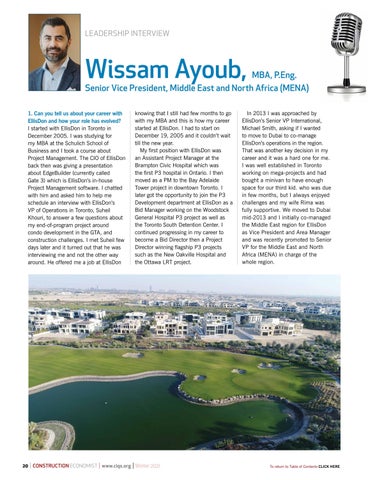
1. Can you tell us about your career with EllisDon and how your role has evolved? I started with EllisDon in Toronto in December 2005. I was studying for my MBA at the Schulich School of Business and I took a course about Project Management. The CIO of EllisDon back then was giving a presentation about EdgeBuilder (currently called Gate 3) which is EllisDon’s in-house Project Management software. I chatted with him and asked him to help me schedule an interview with EllisDon’s VP of Operations in Toronto, Suheil Khouri, to answer a few questions about my end-of-program project around condo development in the GTA, and construction challenges. I met Suheil few days later and it turned out that he was interviewing me and not the other way around. He offered me a job at EllisDon
knowing that I still had few months to go with my MBA and this is how my career started at EllisDon. I had to start on December 19, 2005 and it couldn’t wait till the new year. My first position with EllisDon was an Assistant Project Manager at the Brampton Civic Hospital which was the first P3 hospital in Ontario. I then moved as a PM to the Bay Adelaide Tower project in downtown Toronto. I later got the opportunity to join the P3 Development department at EllisDon as a Bid Manager working on the Woodstock General Hospital P3 project as well as the Toronto South Detention Center. I continued progressing in my career to become a Bid Director then a Project Director winning flagship P3 projects such as the New Oakville Hospital and the Ottawa LRT project.
20 | CONSTRUCTION ECONOMIST | www.ciqs.org | Winter 2021
In 2013 I was approached by EllisDon’s Senior VP International, Michael Smith, asking if I wanted to move to Dubai to co-manage EllisDon’s operations in the region. That was another key decision in my career and it was a hard one for me. I was well established in Toronto working on mega-projects and had bought a minivan to have enough space for our third kid. who was due in few months, but I always enjoyed challenges and my wife Rima was fully supportive. We moved to Dubai mid-2013 and I initially co-managed the Middle East region for EllisDon as Vice President and Area Manager and was recently promoted to Senior VP for the Middle East and North Africa (MENA) in charge of the whole region.
To return to Table of Contents CLICK HERE
2. What is the scope of your responsibilities and what excites you most about your current role? I lead EllisDon’s business in the MENA region accountable for the P&L. EllisDon currently operates in four different countries in the MENA area with more than 16 projects in UAE, KSA, Qatar, and Egypt. Our focus is on Project Management Consultancy, Virtual Design and Construction, FM Consultancy, and Energy and Digital Services. My role is to manage all these countries and services with key leaders supporting me in different sectoral and geographic areas. The most exciting part of my job is the thrill of opening new doors and meeting new people. The thrill of having to constantly push to win new work and deliver on our current commitments keeps that spark alive in me and gives me that adrenaline rush that I enjoy. 3. What is the most memorable construction project that you have worked on? I think the project that I enjoyed working on most was the Bay Adelaide tower in downtown Toronto. It was the first high rise project that I had worked on with interesting components such as a hybrid structure with steel columns and beams and a concrete core, a heritage façade that needed to be repurposed and reinstalled on one area, and some high-end finishes. My background as a structural engineer also made me more interested in this project as I learned more about differential axial shortening in high rise buildings with hybrid structure and how to overcome that in construction. 4. What do you foresee as emerging opportunities in MENA over the next few years? The opportunities in the MENA region are huge. The scale and complexity of the projects are second to none and they keep getting more exciting. In the UAE there is a big push for cultural and entertainment projects especially in Abu Dhabi. In Saudi Arabia, the Vision 2030 is extremely ambitious and the projects are massive in all sectors including leisure, cultural, hospitality, and residential. In Qatar, the final push for FIFA 2022 World Cup still keeps the market busy, while the Egypt CLICK HERE to return to Table of Contents
Change is the only constant, and with that come opportunities – especially in construction.
economy is growing exponentially, and with that comes a massive increase in development projects. 5. What are some of the main differences of working in construction in the Canada vs MENA? The main differences between Canada and the MENA region for working in construction are mostly around the labour force, productivity, material used, and weather considerations. While projects in MENA are in general much larger in scale, the labour force used is less skilled which creates less productivity than in Canada where labour is more skilled and trained, especially on unionized projects. In the MENA region you see a heavy reliance on concrete as well as block-work for partitions, while in Canada, steel, timber, and drywall are commonly used. The use of different material and the means and methods also must take into consideration the weather. For example, in Canada projects must allow for heating during the fall and winter during construction, whereas in the MENA region there are considerations for wild air upon the start of finishes in the spring and summer seasons. 6. What do you see as the main challenges in project management and what are your thoughts on mitigating these? Few of the key areas in project management that are often not given enough thought and consideration are leadership, communication, and stakeholder engagement. I often see very technically strong people who are challenged with successfully delivering projects; many times it boils down to the
project managers not developing a level of engagement and relationship with the client and the different stakeholders, including their own teams. For me, it is very important to have the right positive attitude for project leaders – equally if not more important than the right technical skills. 7. What is your advice to aspiring professionals who would like to achieve a leadership position? I think there are two very important criteria to grow professionally. The first advice is to be empathetic, listen, learn, and develop yourself accordingly. The second advice is to embrace change, be flexible, and challenge yourself. Change is the only constant, and with that come opportunities – especially in construction. 8. What do you enjoy doing in your spare time and how often do you get to return to Canada? I enjoy spending time with my wife and three kids, especially on the weekends, which gives me the energy to deal with all the day-to-day challenges. I also enjoy running which is my stress reliever and my time for zoning out while listening to a podcast that has nothing to do with construction. I usually go back to Canada two or three times a year, but it has now been almost two years due to COVID-19.
Interview conducted by Arif Ghaffur, PQS(F), Managing Editor of Construction Economist.
Winter 2021 | www.ciqs.org | CONSTRUCTION ECONOMIST | 21
I
n 2020, the pandemic slowed our usual hustle and bustle in incredible ways. What followed, as the pandemic raged and social justice issues arose, was the awareness of significant reductions in carbon dioxide and other greenhouse gases emitted from human activities. Forced reductions in land, sea, and air transportations, unoccupied commercial buildings, etc., lowered the amounts of fossil fuel we burned and the associated gases emitted to the atmosphere. Then, last August, the Intergovernmental Panel on Climate Change (IPCC), released its Assessment Report #6 or AR6, which showed unequivocally that human activities resulting in greenhouse gas emissions are causing the planet to warm up at accelerated rates. AR6 also reinforced the need to limit the rising global average temperature relative to preindustrial times to within 1.5°C. The 1.5°C target was initially given back in Paris in 2015 and, since then, the global average temperature has already risen from 1.1°C in 2015 to 1.2°C. The UN Secretary General called the report, “a code red for humanity”, and with only eight years to halve global emissions and curtail the temperature rise, we need changes on a massive scale. Effectively, the world is on a Race to Zero, to decarbonize human activities. But, what do these all mean? In this inaugural piece on Decarbonization, we’ll examine the meanings and fundamentals of the climate issues, why they are important to everyone, and our role as Canada’s construction professionals. Let’s start with Carbon dioxide, or CO2. THE FUSS ABOUT CARBON DIOXIDE We know from basic biology that humans and animals breathe out carbon dioxide, and plants absorb it as part of an ecobalance. It is less known that CO2 is a heat-trapping gas. Its ability to stretch and bend the bond between its carbon and oxygen molecules, allows it to absorb photons of light. CO2 in the atmosphere absorbs the sun’s energy reflected outward from the earth’s surface; then its molecules vibrate and it reemits the infrared energy in all directions, including sending some back to earth, rather than letting them all escape out to space. This keeps inward the heat that would otherwise exit earth and is one of the reasons that earth can maintain a warm temperature to sustain life – otherwise the planet would freeze up as a giant ice rock. If carbon dioxide is such a good thing, then why all the fuss? It turns out that “you can have too much of a good thing” as
22 | CONSTRUCTION ECONOMIST | www.ciqs.org | Winter 2021
Katharine Hayhoe, Chief Scientist at The Nature Conservancy puts it. She explains that it’s like when you have an extra blanket over your body at night, and you wake up sweating. We are putting extra carbon dioxide into the atmosphere, causing earth to heat up faster. Carbon dioxide is just one of known heattrapping gases, collectively known as greenhouse gases, but it is the most abundant one increasing rapidly under human influence. THE GOAL FOR DECARBONIZATION Since the industrial era dawned in the 1700s, humans have been extracting and transforming energy on a scale never seen in known history. We create technologies to build bigger and taller, heat and operate our buildings, manufacture, drive our vehicles, etc. These activities release tons of carbon dioxide equivalent (CO2e) of GHGs into the atmosphere, mostly through the burning of fossil fuels. We are currently headed to a total of 50 billion tons CO2e in annual global emissions, and current atmospheric CO2 concentration is over 400ppm – a record in human history. A reconstruction of the historical CO2 levels from ice cores shows rapid jump since 1950, as human energy use intensified in the current technological era (Figure 1). Previous CO2 levels, about 800 years prior, never went past 300ppm. The extra CO2 is upsetting the eco-balance that the planet has known for thousands of years. A similar reconstruction of 11,000 history of the planet’s average temperature indicates the accelerating rise in global average temperatures in modern times (Figure 2). These and much other scientific evidence are why the latest AR6 report earlier mentioned stated that “It is unequivocal that human influence has warmed the atmosphere, ocean and land.” The goal for Decarbonization is therefore, to reduce the current carbon dioxide equivalent greenhouse gas levels to net zero by mid-century (2050). Direct removal of emissions from the atmosphere is unfortunately an endeavor that is yet unproven to be feasible, at the scale required, within the time available. WHAT IF THE PLANET CONTINUES TO HEAT UP? What if the levels of CO2 and other GHGs continue to rise, and the planet continues to heat up? The impact of climate change is already affecting every region on the planet with increasing heat waves, longer warm seasons, shorter cold seasons, droughts, etc. Wind patterns too will continue to change, as extreme wind events become more frequent. There is also risk of biodiversity loss as regions and local habitats can no longer support the life they To return to Table of Contents CLICK HERE
once did. The polar ice caps are melting faster than they did. According to NASA, the September Arctic sea ice has been declining more rapidly each year since satellite observations began in 1979. Melting ice leads to rising ocean levels, which in turn, leads to flooding and other water disasters. Avoiding these disastrous consequences will require all hands on deck, to bring the levels of emissions to net zero. Net-Zero implies that we are taking as much emission out of the atmosphere as we put in. If we take out more than we put in, we’d be carbon-negative, which is highly desirable, at this point
Figure 1: Historic CO2 levels prior to current technology era showed no more than 280 PPM until 1950 (Source: NASA, NOAA)
WHAT SHOULD WE DO? As construction professionals, we should continually educate ourselves on the science and understand how our work influences the Decarbonization efforts. Buildings, transportation, and energy comprise some of the largest carbon intensive sectors that Canada and other industrialized nations must decarbonize to meet emission targets. Canada currently releases about 750 MT CO2e emissions annually, and has pledged to bring this level down by 40-45% by 2030, and net zero by 2050, through electrification and other strategies. The efforts require collaboration among industry professionals. In follow up articles, we will discuss how PQSs and CECs, as counsellors through cost planning, risk management, life cycle costing, etc., are uniquely positioned to help accelerate the Decarbonization of the construction sectors. About the author Ayo Daniel Abiola, P.Eng, PQS is the Engineering Manager for the Energy and Sustainability Services (ESS) at Black and McDonald Limited. He has experience delivering mechanical services and sustainability solutions for buildings and infrastructure development. He has also contributed to the development of resilient renewable energy infrastructure for the Canadian climate and environment. Ayo is a professional engineer, licensed in Ontario, and Certified Energy Manager. He has provided services for construction projects and developments located across Canada, the US, and the Middle East.
Figure 2: 2013 reconstruction of the global average temperature over the past 11,300 years by Marcott, et. al. The extreme right shows a galloping rise in the difference from average temperatures.
CLICK HERE to return to Table of Contents
Winter 2021 | www.ciqs.org | CONSTRUCTION ECONOMIST | 23
INDEPENDENCE A “Best Practice" for Public Procurement of Construction Cost Estimating and Cost Management Services
T
he problem of cost predictability was introduced by Public Works and Government Services Canada (PWGSC) at the joint Government of Canada/Canadian Construction Association (CCA) meeting in April 2003, where the department identified a need to improve the accuracy of its pre-tender construction estimates (Class A estimate) which were increasingly resulting in variances of greater than 30% from the bids received.1 The Joint Federal Government/Industry Cost Predictability Taskforce (November 2012) stated: “It is highly problematic for any one individual or agency, no matter how qualified or “in tune” with local conditions and market influences, to arrive at a consistent and accurate prebid estimate for construction services.”1 A recent study of 258 major roads, tunnels, bridges, urban transit, and interurban rail projects in 20 countries on five continents concluded that 90% of megaprojects experienced a cost overrun with an average cost increase of 28%.2
A 2006 study of cost overruns on Canadian transportation projects conducted by Joseph Berechman and Qing Wu examined 163 routine highway, bridge, and tunnel projects on Vancouver Island, and found that eight out of ten had cost overruns. The average cost overrun was 5.5 percent, while a considerable share of the projects had far larger cost increases.3 Given the financial risks associated with capital projects, many government procurement agencies engage with cost consulting firms to provide them with Project Cost Estimates. Typically, these firms will be consulting Quantity Surveying firms, with professional staff carrying the designation Professional Quantity Surveyor.4 The Canadian Association of Consulting Quantity Surveyors (CACQS/ ACCEC)5 conducted an RFP Audit in 2017, and again in 2019, looking at RFPs (asking for project cost estimates) from the Government of Canada, the provinces, municipalities, as well as college, hospital, and school boards. The audits specifically looked at to
24 | CONSTRUCTION ECONOMIST | www.ciqs.org | Winter 2021
whom who the cost consultant would be reporting: the owner (government ministry, agency or Board of Directors) or the design consultant (typically architects or engineers). In 2017, the audit (of 110 randomly selected RFPs) revealed that 18% of the RFPs asked the cost consultant to report directly to the owner, whereas the other 82% of RFPs had the cost consultant reporting to the architect or engineer (as part of their team). In 2019, our second audit of 130 RFPs revealed that 35% of the RFPs asked the cost consultant to report directly to the owner, and 65% of the RFPs asked the cost consultant to report to the design consultant. A further breakdown of the 2019 RFP audit results showed that one agency, Infrastructure Ontario, had the cost consultant reporting directly to the owner in 88% of their RFPs, whereas for all of the other agencies, only 31% of their RFPs asked the cost consultant to report directly to the owner.
To return to Table of Contents CLICK HERE
Infrastructure Ontario’s 2018 Track Record Report states that, of 62 P3 projects reaching substantial completion as of December 31, 2018, 95% were completed on budget.6 Typically, Infrastructure Ontario contracts directly with an independent cost consulting firm to provide first, an Order of Magnitude Estimate (Class D) prepared at a Functional Program/Concept Stage, and second, Pre-tender Estimates (Class B or C estimates, depending on the Project Delivery Model). Independence is considered to be one of the most sought after and important commitments that Professional Consultants can offer to their Clients. In its Guide to Canadian Independence Standard, the Chartered Professional Accountants (Canada) states: “It is a fundamental principle of the practice of Chartered Professional Accountancy that a member who provides assurance services shall do so with unimpaired professional judgment and objectivity, and shall be seen to be doing so by a reasonable observer. This principle is the foundation for public confidence in the reports of assurance providers. The confidence that professional judgment has been exercised depends on the unbiased and objective state of mind of the reporting accountant, both in fact and appearance. Independence is the condition of mind and circumstance that would reasonably be expected to result in the application by a member of unbiased judgment and objective consideration in arriving at opinions or decisions in support of the member’s report.”7 Similarly, independence is the foundation for client confidence in the reports of a consulting quantity surveyor. In 2017, in order to reflect the importance of independence (in the provision of cost estimating and cost management services8 to the clients of its member firms) the Canadian Association of Consulting Quantity Surveyors (CACQS/ ACCEC) changed its By-laws. The following addition was made to Article 1 (Definitions): Independent Consulting refers to consulting engagements not affected CLICK HERE to return to Table of Contents
by influences that may compromise professional judgement. In support of this requirement, any or all of the firm’s work performed in the nature of quantity surveying shall be devoid of the influence or input of others including but not limited to designers, constructors (general contractors or construction managers) and equity investors. Although this does not preclude a firm from such engagements, the firm shall have conflict of interest policies and mechanisms in place to identify and segregate Independent work. These shall be underpinned by objectivity, integrity, and professional skepticism such that the clients’ interest and that of the public is preserved and the firm would pre-agree these mechanisms with clients. The following addition was made to Article 3 (Membership Requirements): The firm shall be engaged in the provision of independent advice directly to clients, free from bias, conflict of interest, or the undue influence of others whether real or perceived. The firm shall pre-agree conflict of interest mechanisms with clients when these arise. Further, at its March 2021 Board meeting, the CACQS/ACCEC Board of Directors passed a motion requiring that, starting in January 2022, all member firms must sign a Declaration certifying that they are in compliance with the CACQS By-laws on independence. In its “Recommendations for Improved Cost Predictability,” the Guide to Cost Predictability in Construction has as its first recommendation: “Utilize qualified estimating personnel throughout the life of the project – budget preparation, design, tendering, post-tender review and construction phases.”1 The CACQS/ACCEC proposes that only independent cost consulting firms are truly “qualified” and in addition, we speculate that true independence only comes when the consulting firm reports directly to the owner. (Note that the fees charged by the cost consulting firm are unchanged, whether the consultant reports directly to the owner, or to the design consultant.) We recognize that it takes time and effort to create and manage a separate RFP process and resultant contract for
cost consulting services; however, we think that this time and effort pays real dividends in ensuring that the owner of the project receives independent (unbiased and objective) cost estimating and cost management services. In doing so, the owner improves their odds for bringing construction projects to conclusion “on budget.” REFERENCES 1 www.cca-acc.com/wpcontent/uploads/2016/07/ guidecostpredictability.pdf 2 www.researchgate.net/ publication/263746967_ underestimating_costs_in_public_ works_projects_error_or_lie 3 Berechman, J., and Wu, Q. 2006. Cost Overruns Risk Analysis in Transport Infrastructure Investments. Working Paper 2006-05. University of British Columbia, Phelps Centre for the Study of Government and Business. 4 www.ciqs.org/english/designationsdefined-professional-quantity-surveyor 5 www.cacqs.ca 6 2018 Track Record Report (PDF). Hanscomb (July 2019) 7 www.media.cpaontario.ca/stewardshipof-the-profession/pdfs/guide-tocanadian-independence-standards.pdf 8 CACQS/ACCEC Cost Management Best Practices Guide About the authors Glenn Hultzer, B.Sc. (QS), MRICS, PQS, has more than 31 years of international experience as a professional quantity surveyor. He is a CACQS Ontario board representative and has deep experience in all aspects of quantity surveying and advisory work on a range of project types. Susan Neil, PQS(F), MRICS, is President of the CACQS/ACCEC and Executive Vice President at Hanscomb with 32 years of experience working on many of the country’s most significant infrastructure projects. Susan is a proud fellow of CIQS and a Member of RICS.
Winter 2021 | www.ciqs.org | CONSTRUCTION ECONOMIST | 25
PROGRESSIVE DESIGN-BUILD target price and emerging norms About the author Daniel Josiah, PGDip, PQS, MRICS, MCIArb, is Director, Contracts & Commercial with Lakeland Consulting Inc., where he provides services to a wide range of clients in the private and public sectors on pre-contract, delivery, and contract closeouts. Daniel has a particular expertise in issues around scope, schedule, and cost, and has prepared expert reports for the purposes of negotiation, alternative dispute resolution, and litigation. In 2020, Daniel was selected by On-Site Magazine and SitePartners in the inaugural edition of the 40 Under 40 in Canadian Construction.
I
n the last 18 months, we have seen knock on effects of the pandemic that have impacted supply chains globally including those in the construction industry. Uncertainty factors including commodity price fluctuations, labour shortages, and prolonged lead times continue to contradict project stakeholder commitments by adversely impacting the agreed scope, price, and schedule. With this ongoing uncertainty, the risk profile of projects has become unpredictable, and owners on large and complex infrastructure/institutional projects are increasingly engaging in
collaborative delivery models that provide owners with more control over the design, costs schedule, and risk through innovation on an iterative basis. In parallel, specific provisions addressing the rights and responsibilities related to relative unknowns such as the pandemic are being introduced into contracts. Progressive Design-Build (PDB) is an emerging delivery model which is being introduced in large scale infrastructure projects. This article provides an overview of the PDB delivery model which is seeing an increased uptake by owners seeking collaborative approaches to reduce procurement and construction timelines,
Figure 1 – Summary of Progressive Design-Build Phases 26 | CONSTRUCTION ECONOMIST | www.ciqs.org | Winter 2021
To return to Table of Contents CLICK HERE
apportion and proactively mitigate and risks, and attain cost certainty on an iterative basis. SEQUENCE The PDB delivery model can be categorised into four phases (as summarised in Figure 1). A. Phase 1: Request for Qualifications (RFQ) The RFQ stage is the initial stage of a two stage procurement initiated by the owner. The RFQ identifies the summary key terms and commercial/financial considerations for the project. Entities responding to the RFQ are assessed, shortlisted, and qualified based on relevant project experience. B. Phase 2: Request for Proposals (RFP) The RFP stage is the second stage of the two stage procurement. Entities responding to the RFP are typically assessed on technical and financial aspects. It is important to note the distinction with PDB, unlike other design-build RFP models, there is no design development required at this stage and as a result, the bidders do not offer a price to execute the project. Instead, bidders are required to provide rates for overhead and profit upon which emphasis is placed by the owner’s evaluation team. It is noted that this may be considered by some to be a risky approach, as there is no competition on pricing of overall project cost.
CLICK HERE to return to Table of Contents
Recognizing the collaborative nature of the PDB model, consideration is given for collaborative behaviours, with one responding entity being selected to proceed to the Development Phase as the development partner with a trust relationship being fostered between the parties. C. Phase 3: Development The Development Phase commences after the execution of a development agreement between the owner and a development partner. The development agreement which includes terms that allow the owner and the development partner to enter into a collaborative period in which the parties jointly work on an iterative basis to progress the design and establish key commercial and legal terms including: a. Design: The design commences and is progressed to at least 60% to meet Class 2 estimate classification, sufficient to establish a Target Price for review and potential adjustment through design development. Emphasis is placed on early work packages (e.g., enabling works) for early owner review. b. Price: The owner and development partner establish a Target Price for the next phase (Implementation Phase) on an iterative basis through open-book cost estimates prepared by the development partner, which may be reviewed by an independent cost consultant.
Winter 2021 | www.ciqs.org | CONSTRUCTION ECONOMIST | 27
PROGRESSIVE DESIGN-BUILD – target price and emerging norms At the end of the Development Phase, the estimates are converted into a final Target Price for the purposes of the Implementation Phase. c. Schedule: Based on the design progress and associated risks known or foreseen, the owner and development partner set the project schedule. To realise schedule benefits and de-risk the project, early work packages can be advanced. d. Risk: The owner and development partner mutually agree on a strategy for the identification, tracking, and mitigation of risk. During this process, contingencies are established for inclusion in the Target Price. D. Phase 4: Implementation Following the Development Phase, the owner and development partner enter into a Design-Build Agreement to finalize the design and facilitate the construction work. The Design-Build Agreement confirms the agreed scope, Target Price, schedule parameters, and other items including the arrangement for any increases (“pain”) and decreases (“gain”) to the Target Price, sometimes referred to as painshare/gainshare. The Implementation Phase continues the collaborative theme with the owner supporting the design-builder (previously the development partner) in risk management such that the project achieves its cost (Target Price) and schedule objectives.
QSM
MECHANICAL AND ELECTRICAL COST CONSULTING
Dennis M. Smith PQS dennis@qsmconstructors.ca www.qsmconstructors.ca
416-949-8540 OFFICE 905-649-8540 CELL
Let QSM bring its experience to your next project!
28 | CONSTRUCTION ECONOMIST | www.ciqs.org | Winter 2021
THEMES There are a number of themes that apply to the PDB delivery model, including: 1. Collaboration: The parties are required to work together to achieve project goals and outcomes, with the parties mitigating and closing out risks in a collaborative manner. 2. Input: Recognizing the collaboration between the parties, the owner has the opportunity to utilize the expertise of the development partner/design-builder and input into the design such that the design meets the owners project goals. 3. Incremental: A stepped process is utilised which allows the owner to mitigate issues associated with the project (scope, schedule, and budget) as they arise, and re-align objectives to achieve project goals and outcomes. 4. Streamline: The RFQ and RFP periods are shortened significantly as there is no design development during these phases. This allows the project to advance to the Development Phase in short order. 5. Trade-Off: There are significant advantages around the trade off between risk and price with the owner mitigating project risks as they arise. 6. Incentivisation: The target price includes a painshare/ gainshare mechanism where the owner and design-builder share any cost savings/overruns to the Target Price. 7. Validation: The use of an independent cost consultant can assist the parties with validation of the iterative estimates prepared by the design-builder and the final Target Price. 8. Open-Book: The design-builder is compensated on an open-book basis for the work performed in respect of actual costs incurred plus overhead and profit during the Development Phase and the Implementation Phase. 9. Resource: Recognizing the iterative process and openbook reporting, the owner requires adequate and suitably qualified resources to track and manage project information in respect of budget and costs, which would not otherwise be required in a design-build arrangement. 10. “Off-Ramp”: In the event that the owner and development partner are unable to agree on terms, the owner may terminate the Development Phase Agreement for convenience with the development partner being reimbursed for costs incurred. In the event of such a scenario, the owner obtains the rights to the design progressed prior to termination, which the owner may use in a future procurement in respect of the project. CONCLUSION The PDB delivery model is an approach that is growing in popularity as public sector owners seek the benefits of the design-build model with the added flexibility of being able to have some control on the design, cost, and schedule aspects on an iterative basis. PDB will not be a suitable approach for some owners, especially those that require full price competition prior to entering into commercial negotiations and contract award, and for owners unable to commit the resources required to be committed for the collaborative approach. To return to Table of Contents CLICK HERE
Canadian construction –
Indicators of growth, composition, and changes* *Based on available data from Statistics Canada on November 15, 2021, as follows: 1. Growth in Construction Industry Gross Domestic Product (GDP), as at August 2021: Statistics Canada. Table 36-10-0434-01 Gross domestic product (GDP) at basic prices, by industry, monthly (x 1,000,000) 2. Composition & Changes in Investment in Building Construction, as at September 2021:Statistics Canada. Table 34-10-0175-01 Investment in Building Construction 3. Building Construction Price Indexes Across Metropolises, as at Q3 2021: Statistics Canada. Table 18-10-013501 Building construction price indexes, by type of building 4. Composition of Starts in Housing (Residential Sector), as at Q3 2021: Statistics Canada. Table 34-10-013501 Canada Mortgage and Housing Corporation, housing starts, under construction and completions, all areas, quarterly 5. Composition of Employment (All Industries vs. Construction), as at October 2021: Statistics Canada. Table 14-10-0022-01 Labour force characteristics by industry, monthly, unadjusted for seasonality (x 1,000) 6. Changes in Construction Unemployment Rate, as at October 2021: Statistics Canada. Table 14-10-0022-01 Labour force characteristics by industry, monthly, unadjusted for seasonality (x 1,000) CLICK HERE to return to Table of Contents
1. Growth in Construction Industry Gross Domestic Product (GDP)
2. Composition & Changes in Investment in Building Construction
3. Building Construction Price Indexes Across Metropolises
4. Composition of Starts in Housing (Residential Sector)
5. Composition of Employment (All Industries vs. Construction)
6. Changes in Construction Unemployment Rate
Compiled by: Ajibola Soboyejo, MSc, MRICS, PQS is a professional quantity surveyor specializing in BIM estimating, cost planning, and project cost management. Ajibola possesses both Master’s and Bachelor’s degrees in Quantity Surveying and has worked on many projects in Nigeria and since arriving in Canada in 2019. Currently, she works as a Consultant at Altus Group. Udayan Chatterjee, B.Tech, PMP, is a commercial and project management professional with expertise in cost estimation and management, schedule forensics, claims management and contract administration. He holds a Bachelor’s degree in Electrical Engineering and has worked on various complex engineering/ construction projects across Canada and India. Currently, he is employed as a Senior Contracts & Commercial Specialist at Lakeland Consulting Inc.
Winter 2021 | www.ciqs.org | CONSTRUCTION ECONOMIST | 29
BTY Announces Five New Shareholders Incoming Partners Represent Next Generation of Ownership BTY Group is pleased to announce that the firm has added five new shareholders, all of whom are currently serving as directors of the firm. The expansion of ownership comes as the firm enters its next era of growth. Over the past four decades, BTY has grown from three offices in Western Canada with one service line to more than 15 offices across Canada, the U.S. and Europe offering services through the complete asset management cycle delivered by a multidisciplinary team of professionals. Over the past five years, the firm has emerged as a consistent global leader in providing advisory services on multinational infrastructure developments. This, combined with BTY’s entrepreneurial DNA, has helped the firm stand out as a clear choice for emerging and established industry leaders to develop their professional careers. BTY has also been annually certified as one of Canada’s Best WorkplacesTM by Great Places to Work® since 2019, and in 2020 was also recognized as one of the Best WorkplacesTM for Inclusion. The company’s board sees the expansion of ownership as a testament to BTY’s consistently strong performance and steady growth, as well as the confidence the coming generation has in the firm’s potential to achieve even greater success.
Learn more at BTY.COM
The Firm Welcomes the Following New Shareholders Marie Foley PQS, LEED AP, MRICS • Director, Infrastructure Advisory
Marie has over 20 years of industry experience and joined BTY’s Toronto office in 2015. She leads the firm’s Infrastructure Advisory Services with an integrated team of construction finance, technical advisory and energy experts. As a senior leader, Marie is also responsible for business development, client management and advising on growth strategy for BTY’s expansion in Eastern Canada, the United States, and Europe. She led the standardization of BTY’s award-winning technical reporting across multiple markets and is recognized as an industry leader in infrastructure advisory. She is a member of the Canadian Institute of Quantity Surveyors (CIQS), and the Royal Institution of Chartered Surveyors (RICS). She also serves on the steering committee for Women’s Infrastructure Network Toronto (WIN), and as a Board Member for the Canadian Council for Public-Private Partnerships.
Michael Gabert PQS(F), MRICS, GSC • Director, Cost Management Services
Michael joined BTY in 2011 and has more than 13 years of industry experience. He is based in Calgary and leads the firm’s Cost Management Services. Since joining the firm, Michael has led BTY’s expansion and growing team across the Canadian Prairies region in all services and supported key mandates in the United States. He is the former President of CIQS Prairies & NWT. Michael was also awarded a Fellowship (PQS(F)) by the CIQS in 2019 for his extensive involvement in developing the CIQS’ strategic growth plan and modernizing the organization’s mandate and programming for the industry.
Louis Guilbeault Director, Project Management
Louis joined BTY in 2015 and is based in the firm’s Ottawa office. He brings over 26 years of industry experience in all facets of the capital project lifecycle. Since joining the firm, Louis has established Project Management as a core BTY service offering. He leads a growing and diverse team of planning and construction experts across Canada and the United States, delivering end to end solutions on major capital projects in the healthcare, education, energy and real estate sectors.
Saira Muzaffar Director, Marketing & Communications
Saira joined the firm’s Toronto office in 2009 and has 13 years of experience as a senior marketing and business development professional. She leads BTY’s global team, strengthening the firm’s brand across North American and European markets. Saira is responsible for corporate development, strategic growth planning, executive marketing initiatives, corporate communications, and pursuits. Saira is a member of the steering committees for the Women’s Infrastructure Network (WIN) Toronto, and the Women’s Leadership Initiative with the Urban Land Institute (Toronto), and chairs the board for TechGirls Canada, a research and advocacy non-profit working to advance women’s roles in STEM fields.
Rob Wilson FRICS, PQS • Director, Project Monitoring & Lender Services
Rob has more than 13 years of experience advising on construction finance and asset management in North America, the Caribbean, Europe, and Oceania. He leads the firm’s Project Monitoring & Lender Services team. Since joining BTY’s Vancouver headquarters in 2014, Rob has risen swiftly into senior leadership providing client management, business development, staff management and implementation of strategic growth initiatives, in addition to service delivery. Elected as a member of the RICS Governing Council in 2018, Rob was awarded a Fellowship (FRICS) in 2020 for his services to the organization.
NEW ASSOCIATION MANAGEMENT SYSTEM
creates personalized member experience
A
s mentioned in this issue’s Message from the CEO, CIQS officially launched its new association management system in November. The team worked for close to a year to create a user-friendly interface that is powered by state-of-theart cloud-based technology. This new member portal is designed to have the look and feel of a social media profile and includes a member’s personal information, upcoming events, invoices, and volunteering/engagement details. It allows account holders to update their personal information in real time and gives them access to member-specific information, the ability to pay for renewals, online store products, and events, directly from one convenient space. A certification module has also been created for use by individuals going through the TPE process. This new portal is easily accessible via our newly designed, award-winning website, which was designed with userexperience front-of-mind. Information is available via a navigation tool at the top of the page, as well as inside each of the website sections, to minimize additional scrolling as much as possible. There has also been deliberate effort to make sure that information can be found within two-to-three clicks to make the site experience as informational and efficient as possible. Member-specific information is available in the member resources section, which appears only once a member has logged in. This area includes documentation and information, such as CIQS by-laws, member directory, CIQS exams and registrations, CPD program details, and information about the new, member-only, online home and auto insurance program.
CIQS recipient of iMIS Great Things Award for newly designed website This award is managed by Advanced Solutions International (ASI) and awarded to outstanding websites that are built on the RiSE platform and powered by the iMIS engagement management system. Winning websites are judged on criteria such as overall design, navigation, and functionality. “The CIQS website was intuitive, easy to navigate and attractive. It was clear that a great deal of thought was given as to the layout of the pages and also what content was necessary and what was not (the site is uncluttered). The site includes good use of photos and video which brings people into the site and puts faces to names and titles. We especially liked how you treated your chapter pages providing each with a page and identifying the chapter chair with a biography.” -Nathan Slovin, ASI CIQS takes technology to the next level Over the last year, to offset the loss of in-person events, CIQS has increasingly utilized virtual platforms to increase engagement opportunities for members. CIQS chapter executives across the country have hosted virtual networking events, aptly named Chapter Chats, which offer the opportunity for their members to build their network with fellow members from across the entire chapter region. As reported in the last issue of Construction Economist, CIQS hosted its first virtual Congress this year which was well-received by everyone who attended. The annual general meeting was once again held virtually, allowing members from across Canada, as well those residing outside our borders (Membersat-Large), to make their voices heard through a user-friendly, online voting app.
32 | CONSTRUCTION ECONOMIST | www.ciqs.org | Winter 2021
The AGM was followed by a Year in Review which was presented in the form of a video, narrated by the CIQS CEO and PR/Marketing Consultant. The power of video has been utilized more extensively by CIQS over the past year to promote a variety of programs and events on channels such as eblasts, YouTube and LinkedIn. As we move into 2022, the use of virtual platforms and technology software will be expanded to continually increase member experience and accessibility of CIQS learning and networking opportunities. As an example, starting in 2022, the CIQS podcast, Knowledge Counts, will become a hybrid model where some interviews will be held in studio while others will be virtual to allow the host, Wendy Hobbs, to invite guests based on topic and knowledge, not geography.
About the author Alexandra Parliament is a Marketing and Communications Consultant with 25+ years of experience. She has a formal education in print journalism and has worked in the marketing and communications departments of a PR Agency, a major Marketing Agency, a national magazine, an annual three-day festival, provincial and national non-profit organizations, and one of the largest loyalty programs in Canada. She has been published in a variety of magazines and online publications. She has been working with CIQS in a PR/Marketing capacity since November 2018.
To return to Table of Contents CLICK HERE
A new Parliament and a new phase of advocacy for CIQS
O
n September 20, Canadians watched election results roll in across the country. With a number of close races and recounts, the weeks ahead revealed the exact makeup of those who would take their seats in the House of Commons but, by late evening, it was clear that Canadians would see a House of Commons in Ottawa this fall similar looking to the one that we left this past June. With the Liberal Party of Canada, led by Prime Minister Justin Trudeau, returning to Ottawa in another minority Parliament, the 338 seats in the Commons are occupied by 160 Liberal members, 119 Conservative Party of Canada members, 32 Bloc Québécois members, 25 New Democrats and two Green Party of Canada MPs. Overall, between the 43rd Parliament and the new 44th Parliament that will open this fall, these standings in the House of Commons equate to small gains of one or two members for the Liberals, Bloc, and NDP, and similarly small losses for the Conservatives. These marginal changes have left many Canadians wondering since late September – what was this election really all about and where do we go from here? There are a number of ways to characterize this year’s federal election. Overall, it included a number of twists and turns that could be seen as both wins and losses for all parties. The Liberals went into this election thinking they would return to Parliament with a comfortable majority but, throughout the 36-day campaign, they struggled to articulate why calling an election was necessary. This allowed the Conservatives to find a bit of footing in CLICK HERE to return to Table of Contents
the first few weeks of the campaign. Issues like vaccine mandates and gun control legislation dominated the election narrative over some of the expected, broader conversations that would take place around economic recovery from the pandemic. Along with this, the Bloc Québécois found ways to assert themselves as the needed voice of Quebecers in Ottawa, maintaining their position as the third party in the House of Commons. The NDP again failed to make any seat gains and the Green Party struggled to overcome their internal struggles from the months leading up to the election. Finally, the People’s Party of Canada found additional support in opposing vaccinations, lockdowns, and other COVID-19 restrictions, but again failed to win a seat. When all is said and done, most Canadians agree that one of the clear messages from voters this election was a directive for their representatives to get back to Ottawa and get to work. The pieces that need to fall into place to open a new Parliament after any election are numerous. With the speech from the throne scheduled for November 22, it will be just over two months after election day before Canadians see the official opening of the 44th Parliament and their members of Parliament really get back to work. Over the past few months, this set-up for the new Parliament includes a number of administrative changes like office assignments, MP swearing-in ceremonies, the hiring of staff, and other preparations for the upcoming speech from the throne. One critical event in preparation for setting the government’s agenda and
priorities was the swearing-in of Justin Trudeau’s next cabinet on October 26. The cabinet ministers sworn in will be charged with implementing the Liberal government’s election promises and continuing work from the previous Parliament that they promised to resume. The new federal cabinet includes the creation of several new notable portfolios including a Minister of Mental Health and Addictions and Minister of Housing. Federal cabinet building involves balancing the representation of multiple regions, gender, languages and backgrounds. Notably, this cabinet has a large team with 39 ministers total, including 18 women and 21 men. Regionally, there are two additional ministers from Atlantic Canada and Alberta now has representation in cabinet, after being shut out in 2019, with the addition of Randy Boissonnault as the Minister of Tourism and Associate Minister of Finance. Several previous ministers have been moved to different portfolios and there is a total of seven first-time Ministers. The key players in cabinet for the Canadian Institute of Quantity Surveyors include a mix of new and familiar faces. First off, Dominic LeBlanc adds the Infrastructure and Communities portfolio to his existing Intergovernmental Affairs portfolio. LeBlanc’s close relationship with the Prime Minister and the strong relationships he has built with provincial and territorial Premiers has the potential to be extremely positive for the future of Canada’s infrastructure, the construction sector, and the role that infrastructure has the potential to play in a green economic recovery.
Winter 2021 | www.ciqs.org | CONSTRUCTION ECONOMIST | 33
A new Parliament and a new phase of advocacy for CIQS In addition, the CIQS looks forward to working with Filomena Tassi as the new Minister of Public Services and Public Procurement, particularly through our membership and work on the Construction Industry Roundtable. As the CIQS prepares the next steps in our advocacy in this new Parliament, we remain focused on working with the entire cabinet and all parliamentarians to build back a better, stronger, and more sustainable Canada from the pandemic. We are eager to see additional details on the government’s agenda in the speech from the throne
and Ministerial mandate letters, which will be released in the coming weeks. Early into the 44th Parliament, we will also turn our attention to participating in the pre-budget consultation process and mobilizing our members around key recommendations for our industry. Our members know that green infrastructure, housing, transit, and economic recovery need to be top of mind for all parliamentarians in the 44th Parliament, and our advocacy aims to work with all members of Parliament to advance these priorities and move our entire country forward.
About the author As the Manager of Government Policy at Impact Public Affairs, Brianna Workman works with a variety of associations in Canada’s construction sector. This includes working with the Canadian Institute of Quantity Surveyors, advocating that the federal government accelerate infrastructure investments and implement broad involvement of quantity surveyors in infrastructure projects.
ADVERTISER PRODUCT & SERVICE CENTER Construction Economist is made possible by the companies below who convey their important messages on our pages. We thank them for their support of the Canadian Institute of Quantity Surveyors and its publication and encourage you to contact them when making your purchasing decisions. To make it easier to contact these companies, we have included the page number of their advertisement, their phone number, and, where applicable, their website. Company
Page
Phone #
Website
Altus Group
36
416-641-9703
www.altusgroup.com
BTY Group
30-31
416-596-9339
www.bty.com
Butterfield Development Consultants
2
604-688-4262
www.bdconsultants.com
CB Ross Partners
18
416-487-3330
www.cbross.ca
ConEcon Consultants
19
604-522-8970
www.conecon.ca
Envista Forensics
17
416-268-9677
www.envistaforensics.com/services/ construction-consulting
George Brown College
35
800-265-2002
www.coned.georgebrown.ca www.lcogroup.com
LCO Construction and Management
15
514-846-8914
Osler, Hoskin & Harcourt LLP
13
416-362-2111 (Toronto Office)
Pelican Woodcliff Inc.
9
905-889-9996
www.pelicanwoodcliff.com
QS Online Cost Consultants Inc.
14
902-405-1504
www.qsonlinecostconsultants.com
QSM – Mechanical Quantity Surveying
28
416-949-8540
www.qsmcon.ca
Rider Levett Bucknall
9
905-827-8218
www.rlb.com
The Canadian Association of Consulting Quantity Surveyors
16
519-766-5828
www.cacqs.ca
www.osler.com
Please support these advertisers who help make Construction Economist possible.
To reach construction and quantity surveying professionals through Construction Economist and its targeted readership, contact Jeff at your earliest convenience to discuss your company’s promotional plans.
Jeff Kutny, Marketing Manager | jeff@kelman.ca | 866-985-9789 34 | CONSTRUCTION ECONOMIST | www.ciqs.org | Winter 2021
To return to Table of Contents CLICK HERE
TRAINING THAT DELIVERS CONCRETE RESULTS Continuing Education at George Brown College Discover our courses and programs in construction, estimating, quantity surveying and Ontario’s Building Code. Taught by industry professionals using the latest tools and standards, our courses provide you with the skills to succeed. Develop your knowledge with our series of Canadian Institute of Quantity Surveyors (CIQS) accredited courses. Expand your career potential by completing a program and achieving a credential from George Brown College. Learn from home with our online courses.
Education That Fits You With online classes starting throughout the year, we make it simple to fit learning into your schedule. Select individual courses best suited to your interests, or register for those courses that make up a certificate or designation requirement. You can work toward a program at your own pace – you register (and pay) on a course-bycourse basis.
Programs Building Officials Fundamentals Program Construction Estimating Program Construction Project Management Program Construction Superintendent Program Electrical Estimating Program Mechanical Estimating Program We also offer Canadian Construction Association (CCA) Gold Seal credit courses that you can apply towards your Gold Seal Certified (GSC) designation.
coned.georgebrown.ca/construction Register now!
For more information, contact us at cetechnology@georgebrown.ca.
See your real estate world with clarity, perspective and value-added insight Powered by market-leading software and data analytics, our team of 185+ Cost & project management professionals across Canada advise developers and owners to make timely, confident decisions at every phase of the development and infrastructure lifecycle.
Learn more and connect with us by visiting altusgroup.com/cost-consulting
Search Cost Canada openings