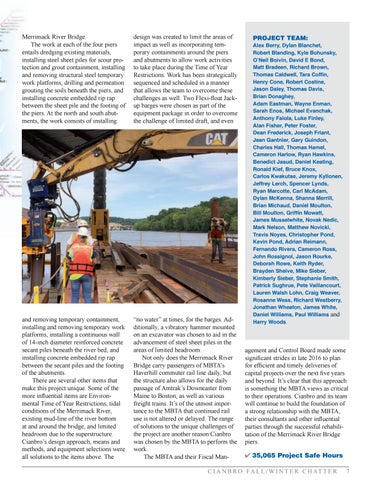
Merrimack River Bridge. The work at each of the four piers entails dredging existing materials, installing steel sheet piles for scour protection and grout containment, installing and removing structural steel temporary work platforms, drilling and permeation grouting the soils beneath the piers, and installing concrete embedded rip rap between the sheet pile and the footing of the piers. At the north and south abutments, the work consists of installing
design was created to limit the areas of impact as well as incorporating temporary containments around the piers and abutments to allow work activities to take place during the Time of Year Restrictions. Work has been strategically sequenced and scheduled in a manner that allows the team to overcome these challenges as well. Two Flexi-float Jackup barges were chosen as part of the equipment package in order to overcome the challenge of limited draft, and even
and removing temporary containment, installing and removing temporary work platforms, installing a continuous wall of 14-inch diameter reinforced concrete secant piles beneath the river bed, and installing concrete embedded rip rap between the secant piles and the footing of the abutments. There are several other items that make this project unique. Some of the more influential items are Environmental Time of Year Restrictions, tidal conditions of the Merrimack River, existing mud-line of the river bottom at and around the bridge, and limited headroom due to the superstructure. Cianbro’s design approach, means and methods, and equipment selections were all solutions to the items above. The
“no water” at times, for the barges. Additionally, a vibratory hammer mounted on an excavator was chosen to aid in the advancement of steel sheet piles in the areas of limited headroom. Not only does the Merrimack River Bridge carry passengers of MBTA’s Haverhill commuter rail line daily, but the structure also allows for the daily passage of Amtrak’s Downeaster from Maine to Boston, as well as various freight trains. It’s of the utmost importance to the MBTA that continued rail use is not altered or delayed. The range of solutions to the unique challenges of the project are another reason Cianbro was chosen by the MBTA to perform the work. The MBTA and their Fiscal Man-
PROJECT TEAM:
Alex Berry, Dylan Blanchet, Robert Blanding, Kyle Bohunsky, O’Neil Boivin, David E Bond, Matt Bradeen, Richard Brown, Thomas Caldwell, Tara Coffin, Henry Cone, Robert Costine, Jason Daley, Thomas Davis, Brian Donaghey, Adam Eastman, Wayne Enman, Sarah Enos, Michael Evanchak, Anthony Faiola, Luke Finley, Alan Fisher, Peter Foster, Dean Frederick, Joseph Friant, Jean Gantnier, Gary Guindon, Charles Hall, Thomas Hamel, Cameron Harlow, Ryan Hawkins, Benedict Jasud, Daniel Keating, Ronald Kief, Bruce Knox, Carlos Kwakutse, Jeremy Kyllonen, Jeffrey Lerch, Spencer Lynds, Ryan Marcotte, Carl McAdam, Dylan McKenna, Shanna Merrill, Brian Michaud, Daniel Moulton, Bill Moulton, Griffin Mowatt, James Musselwhite, Novak Nedic, Mark Nelson, Matthew Novicki, Travis Noyes, Christopher Pond, Kevin Pond, Adrian Reimann, Fernando Rivera, Cameron Ross, John Rossignol, Jason Rourke, Deborah Rowe, Keith Ryder, Brayden Sheive, Mike Sieber, Kimberly Sieber, Stephanie Smith, Patrick Sughrue, Pete Vaillancourt, Lauren Walsh Lohn, Craig Weaver, Rosanne Wess, Richard Westberry, Jonathan Wheaton, James White, Daniel Williams, Paul Williams and Harry Woods.
agement and Control Board made some significant strides in late 2016 to plan for efficient and timely deliveries of capital projects over the next five years and beyond. It’s clear that this approach is something the MBTA views as critical to their operations. Cianbro and its team will continue to build the foundation of a strong relationship with the MBTA, their consultants and other influential parties through the successful rehabilitation of the Merrimack River Bridge piers. 4 35,065 Project Safe Hours
C I A N B R O F A L L / W I N T E R C H AT T E R
7