ronment along the outside of the pier. Performing the work and putting the work in place were not the only innovative aspects of this project. The team also aligned the project with the rest of Cianbro and the company’s environmental initiatives of the 2010 NNE Business Plan. All equipment was run exclusively on biodiesel, including cranes, reach trucks, welders, pile driving hammers, and all other miscellaneous equipment. The timber from the demolished pier was processed and delivered to a biomass boiler for energy. All metals from the existing pier, and waste metals from the construction of the new pier, were recycled. All waste concrete from the new pier and any existing concrete was recycled into new aggregate. There were approximately 1,200 cubic yards of hazardous material dredged and de-watered on-site. The client also had the opportunity to save approximately $100,000 when Cianbro team leaders obtained the permitting to classify the spoils as “beneficial use material.” The values of the Gulf of Maine Research Institute and of Cianbro aligned seamlessly to produce a modern pier that has changed the face of Portland’s working waterfront. The accomplishment could not have been possible without the passion, hard work, and commitment of all team members who were involved:
Jose Salazar, Gary Mason, and Chris Pond place concrete pile cap Cliff Albert, Richard Bachelder, Duane Boissoneault, O’Neil Boivin, Andrew Bowden, Tom Caldwell, Steve Colby, Jason Coombs, Robbie Ferguson, Todd Folsom, Jeff Gilbert, Owen Grimes, Ben Jasud, Bob Lane, Gary Mason, Mark Nelson, Kyle Orlando, Chris Pond, Darren Pulkkinen, Bill Ring, Jose Salazar, Darren Smith, Jeff Stackpole, Pete Vaillancourt, Ron Wedgewood, Rick Westberry, Darren Weymouth, Art White, Jamie White, and Mike Zemla Project Management, Engineering and Administration included: Tharryn Smith, Pat Sughrue, Bill Moulton Brayden Sheive, Dan Musselwhite, Anthony DeRice Vanessa Davis, Tara Coffin, Lisa Cunningham, and Allie McDonough
✔ 19,388 Project Safe Hours
Giving Wings to Great Ideas:
Cianbro’s New Televised Safety Training ■
By Becky Thibodaux
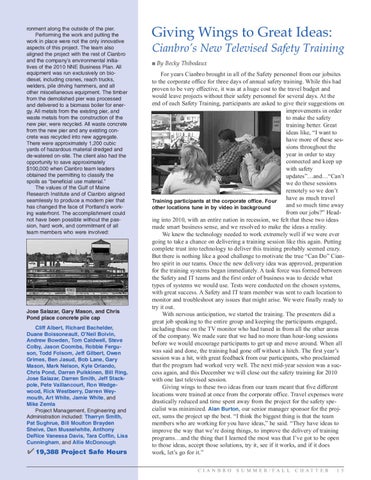
For years Cianbro brought in all of the Safety personnel from our jobsites to the corporate office for three days of annual safety training. While this had proven to be very effective, it was at a huge cost to the travel budget and would leave projects without their safety personnel for several days. At the end of each Safety Training, participants are asked to give their suggestions on improvements in order to make the safety training better. Great ideas like, “I want to have more of these sessions throughout the year in order to stay connected and keep up with safety updates”…and…“Can’t we do these sessions remotely so we don’t have as much travel Training participants at the corporate office. Four and so much time away other locations tune in by video in background from our jobs?” Heading into 2010, with an entire nation in recession, we felt that these two ideas made smart business sense, and we resolved to make the ideas a reality. We knew the technology needed to work extremely well if we were ever going to take a chance on delivering a training session like this again. Putting complete trust into technology to deliver this training probably seemed crazy. But there is nothing like a good challenge to motivate the true “Can Do” Cianbro spirit in our teams. Once the new delivery idea was approved, preparation for the training systems began immediately. A task force was formed between the Safety and IT teams and the first order of business was to decide what types of systems we would use. Tests were conducted on the chosen systems, with great success. A Safety and IT team member was sent to each location to monitor and troubleshoot any issues that might arise. We were finally ready to try it out. With nervous anticipation, we started the training. The presenters did a great job speaking to the entire group and keeping the participants engaged, including those on the TV monitor who had tuned in from all the other areas of the company. We made sure that we had no more than hour-long sessions before we would encourage participants to get up and move around. When all was said and done, the training had gone off without a hitch. The first year’s session was a hit, with great feedback from our participants, who proclaimed that the program had worked very well. The next mid-year session was a success again, and this December we will close out the safety training for 2010 with one last televised session. Giving wings to these two ideas from our team meant that five different locations were trained at once from the corporate office. Travel expenses were drastically reduced and time spent away from the project for the safety specialist was minimized. Alan Burton, our senior manager sponsor for the project, sums the project up the best. “I think the biggest thing is that the team members who are working for you have ideas,” he said. “They have ideas to improve the way that we’re doing things, to improve the delivery of training programs…and the thing that I learned the most was that I’ve got to be open to those ideas, accept those solutions, try it, see if it works, and if it does work, let’s go for it.” CIANBRO
S UMME R/FAL L
C H AT T E R
15