Globe October 22, 2008
Lifestyle
15
The Big Read comes to CHS Cultural Festivals presents an event that encourages and celebrates reading within the city of Clayton
Taylor Stone
Editor
Molly Brandt
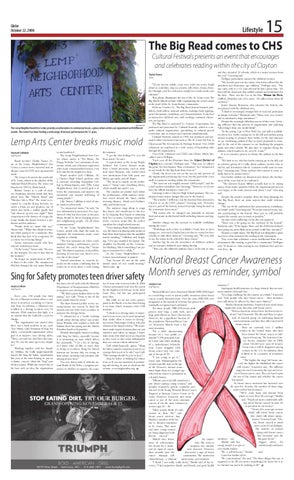
The Lemp Neighborhood Arts Center provides an alternative to commercial music, a place where artists can experiment with different sounds. The center has been hosting a wide range of musical performances for 12 years.
Lemp Arts Center breaks music mold Hannah Callahan Staff Reporter
Board member Charlie Turner, 21, sat at the Lemp Neighborhood Arts Center, a corner store converted into an all ages venue for DIY and experimental music. The Lemp is located in the south side of St. Louis, almost in the shadow of the Anheuser Busch Brewery. The venue was founded in 1996 by Mark Sarich. Behind Turner is a wall of stickers, displaying abstruse bands that have played here, like “Muscle Brain” and “Modern Life is War.” The room is occupied by couches facing forward, towards a drum set and speakers, one of which that holds a stuffed giraffe that “just showed up here one night.” Most conspicuous is the absence of a stage; the Lemp breaks the façade between a performer and his audience. “People don’t see music this way.” Turner said. “When they think of someone who’s going to be a musician, they think that they have to be a superstar. It’s a certain way of seeing things.” Turner represents people who have rejected mainstream music. “At the Lemp,” Turner said, “the music has integrity. It’s easy to lose that in the industry.” No longer do people look to MTV, or listen to the radio. The omnipresent iPod has changed the way music listened
to and marketed. The Lemp Neighborhood Arts Center, whose motto is “No Booze, No Drugs, No Jerks,” is a community of musicians, artists, and vehement supporters who escape commercialized society, even if it’s just for the length of a show. Board member Jack Callahan, 18, a Clayton High School graduate who is currently attending Hampshire College in Massachusetts, said, “[The Lemp Neighborhood Arts Center’s] goal is to better the community, and improve the emotional and mental well-being of young people.” Like Turner, Callahan is tired of music made to sell records. “In commercial music,” he said, “no new information is presented; it’s a repetition of what has been done in the past. Music should be about changing society and enlightening people—it’s all about communication.” At the Lemp Neighborhood Arts Center, people who share the same indignation for mainstream music come together as a family. “The best moments are when you’re surprised during a performance, and reminded why you’re doing this,” Turner said, “the shared experience is incredible, knowing it’s not just you; there’s everyone else in the room.” Turner’s attendance to concerts depends on the season, confessing that he comes six to seven times a week during
the summer. “I get the best feelings I’ve ever felt from music,” he said. A typical show at the Lemp Neighborhood Arts Center features music from a broad spectrum, such as noise rock band Neptune, who welded their own instruments from bike parts, saw blades, gas tanks, and oil drums. “The focus is entirely on the performance,” Turner said, describing shows, which usually last until 1 a.m. The couches are pushed back before the performance, while audience members crowd around the band, within sweating distance. Heads nod rhythmically, and bodies sway. The audience sings along to songs they know, and contributes to the music by clapping their hands or stomping their feet en masse. Looking around the room, everyone seems like the perfect candidate for a high school outcast. “Once during a Brain Transplant concert, the band was playing noise music so loud from their laptop that the amplifier started smoking,” Callahan said, laughing, “One guy smashed the laptop. The amplifier was literally on fire. I remember thinking, ‘this is something I am going to remember for a while.’” At the Lemp Neighborhood Arts Center, nonconformity is praised. “Just because it’s not on the radio doesn’t mean it’s not worth hearing,” Turner said.
has done a lot of work with the Missouri Department of Transportation (MoDot) to improve teen driving safety. “We held a prom fashion show in the spring,” says Gall. “Prom is one of the most unsafe times for teens.” The show featured public service announcements one screens be hind the models and seat belts worn as sashes to promote the driving theme. “I volunteered at a booth teaching people about driving safety,” says senior Jenna Wonish, who worked at both the fashion show last spring and the Modot Pointfest booth in September. Wonish thoroughly enjoyed working with Sing for Safety, especially because it is promoting an issue which affects her personally. “I do a lot of driving, so I know what it’s like to come close to being in accidents. [Sing for Safety] interests me because they are trying to help reduce accidents and promote safe driving to save lives.” One way this is done is with the annual Battle of the Belts, a program presented by MoDot to improve the num-
ber of teens who wear seat belts. In 2006 Clayton participated and won the award for the highest seat belt use in the Saint Louis Area, but has not participated since then. But while we are not active participants in the Battle, it is clear that driving is an issue which resonates with CHS students. “I think teen driving safety is important because teens can be more immature than adults when it comes to driving,” says senior Dominique Grahm, who also volunteers for Sing for Safety. “We sometimes make stupid decisions that can put ourselves and others in danger. I know some teens who don’t see it as a big deal, so they need to have some information that can convince them otherwise.” Gall whole-heartedly agrees. “[Sing for Safety exists] to empower teens to encourage their peers to be safe,” says Gall. “This message should be peer to peer.” Sing for Safety is looking for volunteers, so if you are interested in promoting safe driving, be sure to check out the website, www.singforsafety.org.
“If you devour, inhale, weep over, wish you wrote, laugh aloud at, underline, dog-ear, ponder, talk about, dream about, live through, can’t live without or simply love books, mark your calendar.” This phrase illuminates the top of the St. Louis event The Big Read’s official website, fully emphasizing the event’s status as the jewel of the St. Louis literary community. Held on October 11, The Big Read festival featured publishers, book-sellers, national authors, readings, book signings, panel discussions, workshops, and demonstrations. It also had an interactive children’s area with readings, costumed characters, and games. The Big Read is presented by Centene Corporation, but produced and presented by Cultural Festivals, which is a noprofit cultural organization, specializing in cultural special events that aim to educate and entertain simultaneously. Cultural Festivals, started in 1994, has produced and presented other esteemedevents such as The St. Louis Art Fair in Clayton and The St.Louis Jazz & Heritage Festival. Over 2,000 volunteers are employed in a wide variety of leadership roles through the organization. One of the volunteers was CHS’s own Library Media Specialist Lauren DeRigne. “Each year, all the librarians from the School District of Clayton have a booth,” DeRigne said. “This year, we offered the game ‘Are You Smarter Than a Librarian?’ So I volunteered in our booth for the Big Read from 8-noon.” Clearly, the focus was not on the success and prowess of the organization producing the event, but the goal of the event itself--to promote reading within the community. “The turn out was roughly around 5,000 people”, said the event’s author consultant Lisa Greening, “However, we do not have the official attendance count yet.” Greening is also a Clayton High School graduate. She emphasized some major changes this year to the festival. “The number 1 difference was the location from downtown Clayton to on the CHS campus,” Greening said. “Everyone stayed a part of the festival, instead of people being focused on the restaurants down town.” “The reason why we changed was primarily to increase food and music in the festival itself, including dancers and jugglers.” Another change was the increase in available workshops during the event. “Workshops such as how to publish a book, how to draw manga, etc. were such a big hit last year that we wanted to have a facility to take those classes in,” Greening said, “We were able to use the rooms in the school for these classes.” Another big hit was the attendance of children’s authors and an extensive children’s area during the fair. “This year, the children’s authors came a week early to visit,
and they attended 32 schools, which is a major increase from last year.” Greening said. DeRigne particularly enjoyed the children’s section. “My favorite part was the variety of activities offered for the preschool and elementary age children,” DeRigne said. “My son came, who is 2 1/2 years old and he had a great time. He loved all the characters that walked around and performed for the kids. There was the Cat in the Hat, Winnie the Pooh, Clifford, Madeline and a few more. He talked about them all weekend.” Junior Simone Bernstein, who attended the festival, also was pleased with the children’s area. “I think it encouraged younger kids to read and participate in unique activities,” Bernstein said, “Many were very creative and accumulated a large attendance.” Despite the seemingly effortless success of the event, Greening reflected that the process of organization and planning “takes longer than you would think”. “In the spring, I go to New York City and talk to publishers about new books coming out in the fall and authors going around touring to promote their books. In the mid summer, we are confirming authors if they accepted proposals to come, and by the end of the summer we are finalizing the program guide and other details. We also have to organize flying the authors, which totaled to 42, in to St. Louis.” It is an extensive process to choose the authors in the first place. “We look to see who has books coming up in the fall, and an advisory group of 12 talks about authors, decides who to bid for, and determines who St. Louisans would want to come hear,” Greening said. “Some authors who wanted to come actually had to be turned down.” Even before authors are discussed and chosen, the development of the event had to be confirmed. “The director (Laura Miller) actually had to be raising money from major sponsors before the organizational process even began, so the entire process took about 1 year.” Greening said. Despite the positive response from the long planning for The Big Read, there are some aspects that could welcome change. “The use of the auditorium (for presentations, workshops, etc) didn’t work,” Greening said. “Everyone wanted to stay outside participating in the festival. Next year we will probably expand the outside area as much as possible.” An issue with conflicting events also was apparent. “There was a lot going on the weekend of the festival,” Bernstein said, “If the Jaguar Show and the Fall Festival hadn’t been going on, most likely more people could have attended.” Despite a couple issues, The Big Read was altogether a great success as a fun awareness for reading in the community. “Any event that celebrates a more intellectual form of entertainment, like reading, is good for a community,” DeRigne said, “It shows we value reading in our children’s lives and our own lives.
National Breast Cancer Awareness Sing for Safety promotes teen driver safety Month serves as reminder, symbol Jessica Lefton
Staff Reporter
Every year, 250 people lose their lives in a Missouri accident where a teen driver is involved, according to Operation Stop. In addition, a Missouri teen is killed in a driving accident every 43 minutes. With numbers this high, it is no wonder that the Galls felt a need for change. “The organization was started after there was a fatal accident in my yard, “says Mindy Gall, President of Sing For Safety, a non-profit organization whose goal is to improve teen driving safety. “Then, a second boy died later that summer. He was the same age as my daughter.” Working together with her daughter, Melissa, the Galls single-handedly started the Sing for Safety organization last year, at the time hoping to put on a charity concert, (thus the “sing” part of their name). While the concert has so far been only an idea, the organization
Jocelyn Lee
Staff Reporter
National Breast Cancer Awareness Month (NBCAM) began as a week-long event to spread public awareness about breast cancer, a rarely discussed topic. Over the years, NBCAM, now designated as the month of October, has grown to be nationally recognized and celebrated. For many people, NBCAM means pink grocery store bags, a pink Arch, and a large pink ribbon on their Cheerios box. However, for a significant fraction of the population National Breast Cancer Awareness Month bears a lot more meaning. “It’s a little disconcerting because it’s a very public reminder,” CHS principal, Louise Losos, said when speaking of a pink-themed Schnucks store. Losos struggled with breast cancer only two years ago at the age of 38. “I was young to get it,” Losos said. Mammograms for women typically start at the age of 40. However, doctors sometimes begin them at a younger age when breast cancer is prominent in a family’s history. “[Breast cancer is] still considered a rare disease among young women,” said Jennifer Ivanovich, genetic counselor and director of the Young Women’s Breast Cancer Program at Siteman Cancer Center in St. Louis. However, Ivanovich said breast cancer is one of the most common cancers, if not the most common in women ages 20 – 40. “Most people think it’s only women in their 50s,” said breast cancer survivor Ann Shields, a member of the Susan G. Komen committee in St. Louis. “But more and more young women are being diagnosed with [breast cancer].” Shields’ story shows the importance of self-examination. She went to her doctor for a mammogram one month, and no signs of cancer were detected. However, three months later she discovered a sign of breast cancer through selfexamination. She underwent chemotherapy, a bilateral mastectomy, and radiation. “I think I was really, really lucky,” Shields said of her recovery. “I had supportive family and friends, and good health
insurance.” Inadequate health insurance is a huge obstacle that an enormous number of people face. “It’s a huge challenge for the country as a whole,” Ivanovich said. “And people who have breast cancer – their insurance rates will always be affected by their cancer history.” Besides financial problems, Ivanovich said racial issues might also come into play with breast cancer. “African American women have the lowest survival rate,” said Ivanovich. She also said there is a great deal of research going on addressing financial and racial issues and how they affect survival of breast cancer. There are currently over 2 million women in the United States who have been treated for breast cancer, according to nbcam.org. The American Cancer Society estimated that in 2008, about 182,460 new cases of invasive breast cancer will be diagnosed among women in the U.S. In addition, there is likely to be a number of recurrence cases. “The higher the stage [of breast cancer], the higher the likelihood the cancer will return,” Ivanovich said. The different stages are used to measure the type and severity of breast cancer cases. They are based upon the size of the tumor and whether the cancer has spread. As breast cancer awareness has increased over the past few decades, the number of those diagnosed with it has decreased. “We’ve come leaps and bounds from where we were 30 or 40 years ago,” Shields said. “People are more comfortable talking about [breast cancer] because it’s so prevalent in our society.” “Twenty-five years ago, women didn’t talk about breast cancer, they didn’t talk about mastectomies,” Ivanovich said. “[Today breast cancer] is much more a part of our dialogue. The number of women dying with breast cancer has decreased and the incidence rate has gone down.” Shields said her biggest advice for young people is to get examined early and know your family history. “Be a self-advocate,” Shields said. Losos has similar advice. “Be conscientious,” she said. “Do those things that one is supposed to do. [If you notice something,] it’s better for it to be checked out and it be nothing at all.”