38 E U R O P E A N LOV E R S I N A C H A R I OT India (Udaipur), circa 1720 Height: 27.5 cm Width: 17.5 cm
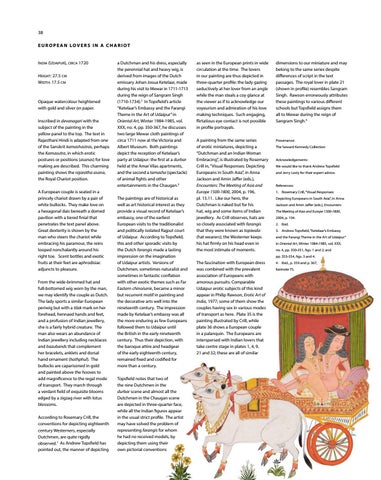
Opaque watercolour heightened with gold and silver on paper. Inscribed in devanagari with the subject of the painting in the yellow panel to the top. The text in Rajasthani Hindi is adapted from one of the Sanskrit kamashastras, perhaps the Kamasutra, in which erotic postures or positions (asanas) for love making are described. This charming painting shows the rajaratha asana, the Royal Chariot position. A European couple is seated in a princely chariot drawn by a pair of white bullocks. They make love on a hexagonal dais beneath a domed pavilion with a tiered finial that penetrates the text panel above. Great dexterity is shown by the man who steers the chariot while embracing his paramour, the reins looped nonchalantly around his right toe. Scent bottles and exotic fruits at their feet are aphrodisiac adjuncts to pleasure. From the wide-brimmed hat and full-bottomed wig worn by the man, we may identify the couple as Dutch. The lady sports a similar European periwig but with a tilak mark on her forehead, hennaed hands and feet, and a profusion of Indian jewellery, she is a fairly hybrid creature. The man also wears an abundance of Indian jewellery including necklaces and bazubands that complement her bracelets, anklets and dorsal hand ornament (hathphul). The bullocks are caparisoned in gold and painted above the hooves to add magnificence to the regal mode of transport. They march through a verdant field of exquisite blooms edged by a zigzag river with lotus blossoms. According to Rosemary Crill, the conventions for depicting eighteenth century Westerners, especially Dutchmen, are quite rigidly observed.1 As Andrew Topsfield has pointed out, the manner of depicting
a Dutchman and his dress, especially the perennial hat and heavy wig, is derived from images of the Dutch emissary Johan Josua Ketelaar, made during his visit to Mewar in 1711-1713 during the reign of Sangram Singh (1710-1734).2 In Topsfield’s article “Ketelaar’s Embassy and the Farangi Theme in the Art of Udaipur” in Oriental Art, Winter 1984-1985, vol. XXX, no. 4, pp. 350-367, he discusses two large Mewar cloth paintings of circa 1711 now at the Victoria and Albert Museum. Both paintings depict the reception of Ketelaar’s party at Udaipur: the first at a durbar held at the Amar Vilas apartments, and the second a tamasha (spectacle) of animal fights and other entertainments in the Chaugan.3 The paintings are of historical as well as art historical interest as they provide a visual record of Ketelaar’s embassy, one of the earliest European visits to the traditionalist and politically isolated Rajput court of Udaipur. According to Topsfield, this and other sporadic visits by the Dutch farangis made a lasting impression on the imagination of Udaipur artists. Versions of Dutchmen, sometimes naturalist and sometimes in fantastic conflation with other exotic themes such as Far Eastern chinoiserie, became a minor but recurrent motif in painting and the decorative arts well into the nineteenth century. The impression made by Ketelaar’s embassy was all the more enduring as few Europeans followed them to Udaipur until the British in the early nineteenth century. Thus their depiction, with the baroque attire and headgear of the early eighteenth century, remained fixed and codified for more than a century. Topsfield notes that two of the nine Dutchmen in the durbar scene and almost all the Dutchmen in the Chaugan scene are depicted in three-quarter face, while all the Indian figures appear in the usual strict profile. The artist may have solved the problem of representing farangis for whom he had no received models, by depicting them using their own pictorial conventions
as seen in the European prints in wide circulation at the time. The lovers in our painting are thus depicted in three-quarter profile: the lady gazing seductively at her lover from an angle while the man steals a coy glance at the viewer as if to acknowledge our voyeurism and admiration of his love making techniques. Such engaging, flirtatious eye contact is not possible in profile portrayals.
dimensions to our miniature and may belong to the same series despite differences of script in the text passages. The royal lover in plate 21 (shown in profile) resembles Sangram Singh. Rawson erroneously attributes these paintings to various different schools but Topsfield assigns them all to Mewar during the reign of Sangram Singh.4
A painting from the same series of erotic miniatures, depicting a “Dutchman and an Indian Woman Embracing”, is illustrated by Rosemary Crill in, “Visual Responses: Depicting Europeans in South Asia”, in Anna Jackson and Amin Jaffer (eds.), Encounters: The Meeting of Asia and Europe 1500-1800, 2004, p. 196, pl. 15.11. Like our hero, the Dutchman is naked but for his hat, wig and some items of Indian jewellery. As Crill observes, hats are so closely associated with farangis that they were known as topiwala (hat wearers); the Westerner keeps his hat firmly on his head even in the most intimate of moments.
Provenance: The Seward Kennedy Collection Acknowledgements: We would like to thank Andrew Topsfield and Jerry Losty for their expert advice. References: 1. Rosemary Crill, “Visual Responses: Depicting Europeans in South Asia”, in Anna Jackson and Amin Jaffer (eds.), Encounters: The Meeting of Asia and Europe 1500-1800, 2004, p. 194. 2. Ibid. 3. Andrew Topsfield, “Ketelaar’s Embassy and the Farangi Theme in the Art of Udaipur” in Oriental Art, Winter 1984-1985, vol. XXX, no. 4, pp. 350-351, figs. 1 and 2; and pp. 353-354, figs. 3 and 4.
The fascination with European dress was combined with the prevalent association of Europeans with amorous pursuits. Comparable Udaipur erotic subjects of this kind appear in Philip Rawson, Erotic Art of India, 1977; some of them show the couples having sex in various modes of transport as here. Plate 35 is the painting illustrated by Crill, while plate 36 shows a European couple in a palanquin. The Europeans are interspersed with Indian lovers that take centre stage in plates 1, 4, 9, 21 and 32; these are all of similar
4. Ibid., p. 359 and p. 367, footnote 75.