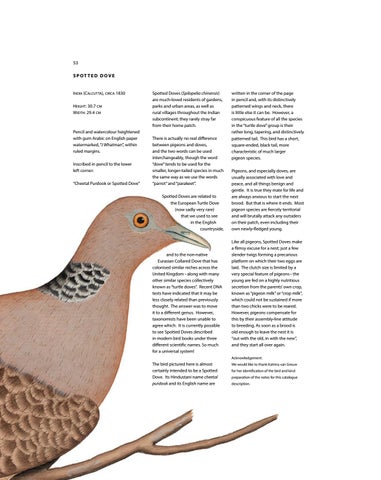
53 SPOT TED DOVE India (Calcutta), circa 1830 Height: 30.7 cm Width: 29.4 cm
Pencil and watercolour heightened with gum Arabic on English paper watermarked, “J Whatman”, within ruled margins. Inscribed in pencil to the lower left corner: “Cheetal Purdook or Spotted Dove”
Spotted Doves (Spilopelia chinensis) are much-loved residents of gardens, parks and urban areas, as well as rural villages throughout the Indian subcontinent; they rarely stray far from their home patch. There is actually no real difference between pigeons and doves, and the two words can be used interchangeably, though the word “dove” tends to be used for the smaller, longer-tailed species in much the same way as we use the words “parrot” and “parakeet”. Spotted Doves are related to the European Turtle Dove (now sadly very rare) that we used to see in the English countryside,
and to the non-native Eurasian Collared Dove that has colonised similar niches across the United Kingdom - along with many other similar species collectively known as “turtle doves”. Recent DNA tests have indicated that it may be less closely related than previously thought. The answer was to move it to a different genus. However, taxonomists have been unable to agree which. It is currently possible to see Spotted Doves described in modern bird books under three different scientific names. So much for a universal system!
written in the corner of the page in pencil and, with its distinctively patterned wings and neck, there is little else it can be. However, a conspicuous feature of all the species in the “turtle dove” group is their rather long, tapering, and distinctively patterned tail. This bird has a short, square-ended, black tail, more characteristic of much larger pigeon species. Pigeons, and especially doves, are usually associated with love and peace, and all things benign and gentle. It is true they mate for life and are always anxious to start the next brood. But that is where it ends. Most pigeon species are fiercely territorial and will brutally attack any outsiders on their patch, even including their own newly-fledged young. Like all pigeons, Spotted Doves make a flimsy excuse for a nest; just a few slender twigs forming a precarious platform on which their two eggs are laid. The clutch size is limited by a very special feature of pigeons - the young are fed on a highly nutritious secretion from the parents’ own crop, known as “pigeon milk” or “crop milk”, which could not be sustained if more than two chicks were to be reared. However, pigeons compensate for this by their assembly-line attitude to breeding. As soon as a brood is old enough to leave the nest it is “out with the old, in with the new”, and they start all over again. Acknowledgement:
The bird pictured here is almost certainly intended to be a Spotted Dove. Its Hindustani name cheetal purdook and its English name are
We would like to thank Katrina van Grouw for her identification of the bird and kind preparation of the notes for this catalogue description.