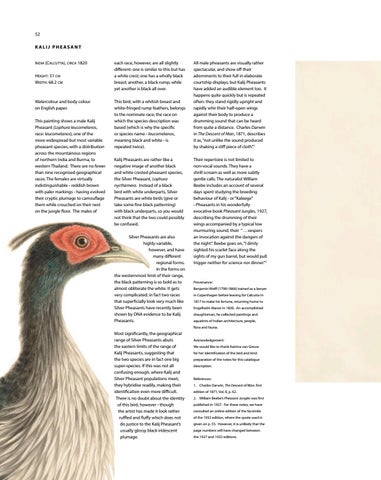
52 KALIJ PHEASANT India (Calcutta), circa 1820 Height: 51 cm Width: 68.2 cm
Watercolour and body colour on English paper. This painting shows a male Kalij Pheasant (Lophura leucomelanos, race: leucomelanos), one of the more widespread but most variable pheasant species, with a distribution across the mountainous regions of northern India and Burma, to western Thailand. There are no fewer than nine recognised geographical races. The females are virtually indistinguishable - reddish brown with paler markings - having evolved their cryptic plumage to camouflage them while crouched on their nest on the jungle floor. The males of
each race, however, are all slightly different: one is similar to this but has a white crest; one has a wholly black breast; another, a black rump; while yet another is black all over. This bird, with a whitish breast and white-fringed rump feathers, belongs to the nominate race; the race on which the species description was based (which is why the specific or species name - leucomelanos, meaning black and white - is repeated twice). Kalij Pheasants are rather like a negative image of another black and white crested pheasant species, the Silver Pheasant, Lophura nycthemera. Instead of a black bird with white underparts, Silver Pheasants are white birds (give or take some fine black patterning) with black underparts, so you would not think that the two could possibly be confused. Silver Pheasants are also highly variable, however, and have many different regional forms. In the forms on the westernmost limit of their range, the black patterning is so bold as to almost obliterate the white. It gets very complicated; in fact two races that superficially look very much like Silver Pheasants have recently been shown by DNA evidence to be Kalij Pheasants.
All male pheasants are visually rather spectacular, and show off their adornments to their full in elaborate courtship displays, but Kalij Pheasants have added an audible element too. It happens quite quickly but is repeated often: they stand rigidly upright and rapidly whir their half-open wings against their body to produce a drumming sound that can be heard from quite a distance. Charles Darwin in The Descent of Man, 1871, describes it as, “not unlike the sound produced by shaking a stiff piece of cloth”.1 Their repertoire is not limited to non-vocal sounds. They have a shrill scream as well as more subtly gentle calls. The naturalist William Beebe includes an account of several days spent studying the breeding behaviour of Kalij - or “Kaleege” - Pheasants in his wonderfully evocative book Pheasant Jungles, 1927, describing the drumming of their wings accompanied by a typical low murmuring sound; their “ …vespers an invocation against the dangers of the night”. Beebe goes on, “I dimly sighted his scarlet face along the sights of my gun barrel, but would pull trigger neither for science nor dinner.”2
Provenance: Benjamin Wolff (1790-1866) trained as a lawyer in Copenhagen before leaving for Calcutta in 1817 to make his fortune, returning home to Engelholm Manor in 1830. An accomplished draughtsman, he collected paintings and aquatints of Indian architecture, people, flora and fauna.
Most significantly, the geographical range of Silver Pheasants abuts the eastern limits of the range of Kalij Pheasants, suggesting that the two species are in fact one big super-species. If this was not all confusing enough, where Kalij and Silver Pheasant populations meet, they hybridise readily, making their identification even more difficult. There is no doubt about the identity of this bird, however - though the artist has made it look rather ruffled and fluffy which does not do justice to the Kalij Pheasant’s usually glossy black iridescent plumage.
Acknowledgement: We would like to thank Katrina van Grouw for her identification of the bird and kind preparation of the notes for this catalogue description. References: 1. Charles Darwin, The Descent of Man, first edition of 1871, Vol. II, p. 62. 2. William Beebe’s Pheasant Jungles was first published in 1927. For these notes, we have consulted an online edition of the facsimile of the 1932 edition, where the quote used is given on p. 55. However, it is unlikely that the page numbers will have changed between the 1927 and 1932 editions.